No, Telling Men To Get Vasectomies Is Not The Answer Right Now

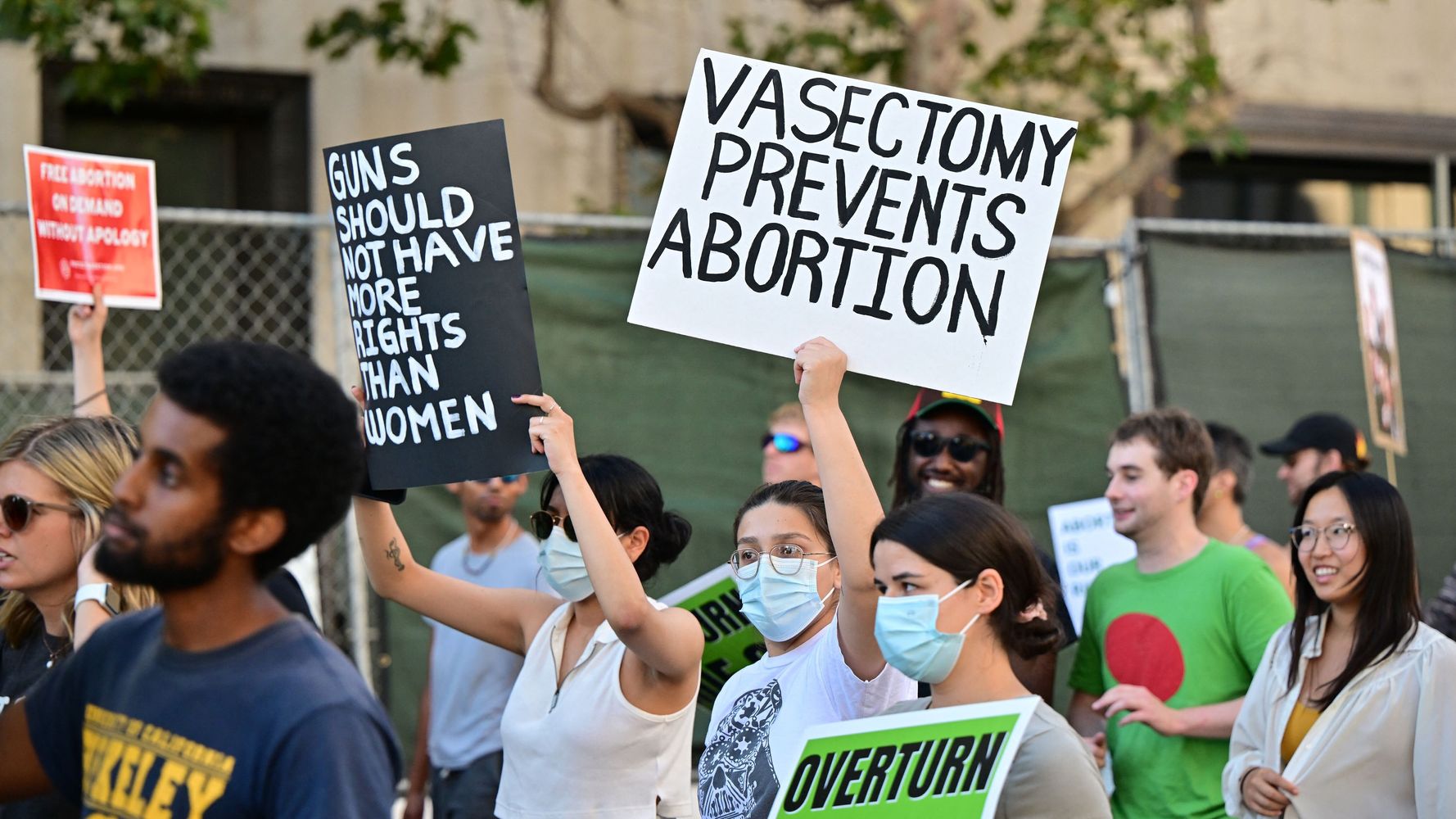
Since news of the overturning of Roe V Wade broke on Friday, ending the constitutional right to abortion in the US after almost half a century, abortion rights activists have galvanised, and social media efforts have amplified.

You may have seen posts alluding to the fact that a woman can only foster one full pregnancy a year, while a man can impregnate multiple people in a day, should he have the opportunity. And the solution often suggested: vasectomy, the surgical procedure that cuts or seals the tubes that carry a man’s sperm.

Amid so much anger around the policing of women’s bodies, the impulse to suggest that men’s bodies should also be policed is understandable.

In a world of reduced abortion access, where women are left either to manage birth control or carry their babies to full term, people are once again suggesting we shift the onus to men in the form of mandatory vasectomies.

In fact, this view has been circulating on social media for a while now. And while many people are probably not being literal in their calls for vasectomies, it speaks to the widespread rage over moves to control bodily autonomy.

However, many people are pointing out the flaws in the argument.

Vasectomies aren’t an ‘alternative’ to abortion

This suggestion has basic logistical failings, as PHD researcher Georgia Grainger, from the Centre for the Social History of Health and Healthcare in Glasgow, has pointed out in a Twitter thread.

As a historian of vasectomies, Grainger, aka @sniphist on Twitter, stresses that the procedure is not an alternative to abortion.

This is because women will still need terminations, she says, both of wanted and unwanted pregnancies, regardless of vasectomies and other forms of birth control.

Nor are vasectomies a failsafe form of birth control – and when in rare cases they do fail, it’s not usually obvious until the pregnancy is identified, she says.

In her thread, Grainger also highlights that even if someone had insisted they’d had the surgery, could you trust that they really had?

Especially, in the case of abusive relationships or sexual assault, why would someone who doesn’t respect consent take up an invasive surgery for the benefit of someone else?

Forced sterilisations are deeply problematic

Grainger stresses this important historical point. Forced sterilisations have been trialled as several points during history and they enforce eugenics, she says. The policy has predominantly been targeted at minority groups to stop them from procreating.

In US history, indigenous Americans, Black and Latinx people, incarcerated peoples, and poor communities endured forced sterilisations.

These groups were targeted throughout the 20th century, with nearly 70,000 people forcibly sterilised (and not just men, an overwhelming amount were working-class women of colour).

Germany also has a history of coercive sterilisation, having sterilised disabled people, institutionalised people, and even alcoholics. In Nazi Germany, the Hereditary Health Court also known as the Genetic Health Court, was a court that decided whether people should be forcibly sterilised.

Grainger is not the only one to point out these troubling historical precedents.

Bodily autonomy for all, not some

People have also pointed out that if we want better rights and autonomy for women and people who can get pregnant, this has to mean protecting these rights for everybody

Do we really want men to face the same bodily scrutiny applied to women – and for men who chose not to go through the procedure to be vilified?

Nor does the vasectomy vs abortion binary do much for trans and nonbinary people who also need access to abortions, and are often excluded from discussions of these human rights.

As the debate continues, Grainger’s insights have gone viral on Twitter, amassing more than 75,000 likes.

But, as she pointed out in her own thread, she is still pro-vasectomy, as long as they’re for the right reasons and for people who genuinely want them.

Ultimately, we shouldn’t pit vasectomies against abortions, she says. Abortions will always be needed, whether because the pregnancy is failing, the pregnant person is at risk, because there wasn’t consent to the sex in the first place, or simply because the pregnant person doesn’t want children.

So next time you see calls for mandatory vasectomies or are temped to make one yourself, remember that it’s not as straightforward as it seems.
Share Button

Covid-booster response hope for most vulnerable

A break in taking a common immune-suppressing drug could improve how well vaccines work, a trial suggests.

Share Button

Humans in the loop help robots find their way

Just like us, robots can’t see through walls. Sometimes they need a little help to get where they’re going.

Engineers at Rice University have developed a method that allows humans to help robots “see” their environments and carry out tasks.

The strategy called Bayesian Learning IN the Dark — BLIND, for short — is a novel solution to the long-standing problem of motion planning for robots that work in environments where not everything is clearly visible all the time.

The peer-reviewed study led by computer scientists Lydia Kavraki and Vaibhav Unhelkar and co-lead authors Carlos Quintero-Peña and Constantinos Chamzas of Rice’s George R. Brown School of Engineering was presented at the Institute of Electrical and Electronics Engineers’ International Conference on Robotics and Automation in late May.

The algorithm developed primarily by Quintero-Peña and Chamzas, both graduate students working with Kavraki, keeps a human in the loop to “augment robot perception and, importantly, prevent the execution of unsafe motion,” according to the study.

To do so, they combined Bayesian inverse reinforcement learning (by which a system learns from continually updated information and experience) with established motion planning techniques to assist robots that have “high degrees of freedom” — that is, a lot of moving parts.

To test BLIND, the Rice lab directed a Fetch robot, an articulated arm with seven joints, to grab a small cylinder from a table and move it to another, but in doing so it had to move past a barrier.

“If you have more joints, instructions to the robot are complicated,” Quintero-Peña said. “If you’re directing a human, you can just say, ‘Lift up your hand.'”

But a robot’s programmers have to be specific about the movement of each joint at each point in its trajectory, especially when obstacles block the machine’s “view” of its target.

Rather than programming a trajectory up front, BLIND inserts a human mid-process to refine the choreographed options — or best guesses — suggested by the robot’s algorithm. “BLIND allows us to take information in the human’s head and compute our trajectories in this high-degree-of-freedom space,” Quintero-Peña said.

“We use a specific way of feedback called critique, basically a binary form of feedback where the human is given labels on pieces of the trajectory,” he said.

These labels appear as connected green dots that represent possible paths. As BLIND steps from dot to dot, the human approves or rejects each movement to refine the path, avoiding obstacles as efficiently as possible.

“It’s an easy interface for people to use, because we can say, ‘I like this’ or ‘I don’t like that,’ and the robot uses this information to plan,” Chamzas said. Once rewarded with an approved set of movements, the robot can carry out its task, he said.

“One of the most important things here is that human preferences are hard to describe with a mathematical formula,” Quintero-Peña said. “Our work simplifies human-robot relationships by incorporating human preferences. That’s how I think applications will get the most benefit from this work.”

“This work wonderfully exemplifies how a little, but targeted, human intervention can significantly enhance the capabilities of robots to execute complex tasks in environments where some parts are completely unknown to the robot but known to the human,” said Kavraki, a robotics pioneer whose resume includes advanced programming for NASA’s humanoid Robonaut aboard the International Space Station.

“It shows how methods for human-robot interaction, the topic of research of my colleague Professor Unhelkar, and automated planning pioneered for years at my laboratory can blend to deliver reliable solutions that also respect human preferences.”

Rice undergraduate alumna Zhanyi Sun and Unhelkar, an assistant professor of computer science, are co-authors of the paper. Kavraki is the Noah Harding Professor of Computer Science and a professor of bioengineering, electrical and computer engineering and mechanical engineering, and director of the Ken Kennedy Institute.

The National Science Foundation (2008720, 1718487) and an NSF Graduate Research Fellowship Program grant (1842494) supported the research.

Video: https://youtu.be/RbDDiApQhNo

Share Button

Microbe protects honey bees from poor nutrition, a significant cause of colony loss

Indiana University researchers have identified a specific bacterial microbe that, when fed to honey bee larvae, can reduce the effects of nutritional stress on developing bees — one of the leading causes of honey bee decline.

Their findings were recently published in the International Society for Microbial Ecology Journal.

Humans rely on honey bees for food security. Because they will pollinate almost anything, honey bees are extremely useful for agriculture. But over the past few decades, the honey bee population has experienced dramatic declines caused by the effects of multiple stressors, the most pervasive of which is limited nutrition. Beekeepers in the United States reported losing 40.5 percent of their managed colonies between 2015 and 2016 alone, according to a national survey.

“The effects of poor nutrition are most damaging in the developing larvae of honey bees, who mature into workers unable to meet the needs of their colony,” said Irene Newton, a professor in the IU Bloomington College of Arts and Sciences’ Department of Biology, who led the study. “It is therefore essential that we better understand the nutritional landscape experienced by honey bee larvae.”

Newton said honey bees need to collect pollen and nectar from a variety of plants and flowers to help their colonies stay healthy throughout the year. But many bees in the U.S. lack this floral diversity.

“We’ve changed the way we use our land in the U.S.,” Newton said. “Now we have tons of monoculture crops like corn, which are wind pollinated and therefore no use to bees, covering acres and acres of land. Other crops that bees do pollinate are grown in monoculture as well, limiting the options for bees.

“If you limit yourself to only eating one thing, that’s not healthy for you. You have to have a broad diet that will help fulfill all of your nutritional needs. Bees are the same way.”

Honey bee larvae are fed by their sister bees. Their diet consists of foraged ingredients such as nectar and pollen, as well as royal jelly — a bee glandular secretion that is complex and nutrient rich. If larvae are destined to be queens, they will eat royal jelly their whole lives. If they are workers, their diets will shift to nectar and pollen after a few days.

In addition to being more nutritious than nectar and pollen, royal jelly has long been known to possess potent antimicrobial properties due to its acidity, viscosity and the presence of antimicrobial peptides. This means that most microbes exposed to royal jelly die, Newton said.

Except one.

According to their new study, Newton and her research team found that a specific microbe — Bombella apis — is the only larva-associated bacterium that’s actually able to thrive in royal jelly. They also found that B. apis makes royal jelly more nutritious by significantly increasing its amino acid content, which helps developing bees build resilience against nutritional stress.

“We have identified a nutritional symbiont of honey bees — a microbe that can help bolster the bees against nutrient scarcity and stress,” Newton said. “When we limited bee nutrition during development, we saw a drop in mass for the bees; bees were much smaller than their control counterparts.

“When B. apis was added to these same bees, although they had poor nutrition, they reached the same mass as control bees given full nutrition. The microbe was able to make up for the poor diet. This suggests that B. apis could be added to colonies as a probiotic to protect from nutritional stress.”

The results suggest that B. apis may have potential as a key supplement in future beekeepers’ efforts to counteract the negative influence of poor nutrition on honey bee health. B. apis can survive for over 24 hours in sugar water, so beekeepers who are already supplementing their colonies could potentially integrate a B. apis probiotic into their bees’ diets.

This research expands on over six years of previous studies by Newton and her colleagues, including findings that B. apis protects bees against fungal infections and is a significant part of the queen gut microbiome.

“We are excited to explore the other interactions that B. apis has in a colony, to better understand what it’s doing in different environments and the role it plays in association with honey bee queens,” Newton said.

Share Button

New way in which T cells learn to tell friend from foe

The human immune system is a nearly perfect defense mechanism. It protects the body from disease-causing bacteria, viruses, and other pathogens. It detects nascent tumors and eradicates them. It cleans up cellular debris at the site of injury or infection.

To perform its myriad functions, the immune system must, above all, differentiate between self and non-self — a remarkable selective ability that allows it to detect and disable harmful agents while sparing the body’s own tissues.

If the immune system fails to make this distinction, it can mistakenly launch an assault against the body, causing autoimmune disorders.

Researchers have known the general principle underlying this selective ability for some time, but exactly how immune cells learn to distinguish friend from foe has remained less well understood.

Now, a new study led by researchers at Harvard Medical School identifies a new mechanism that explains how the body’s most powerful immune troops — T cells — learn to tell self and non-self apart.

The work, conducted mainly in mice, was published online June 16 in Cell and is scheduled to appear in the July 7 print issue.

The research shows that the thymus gland — the organ where T cells are born and trained — educates nascent immune cells by exposing them to proteins made by thymus cells that mimic various tissues throughout the body. Specifically, the research demonstrates that by assuming different identities, these specialized thymus cells preview for the maturing T cells self-proteins they would encounter once they leave their native thymus gland.

“Think of it as having your body recreated in the thymus,” said study senior author Diane Mathis, professor of immunology at Harvard Medical School. “For me, it was a revelation to be able to see with my own eyes muscle-like cells in the thymus or several very different types of intestinal cells.”

The findings, Mathis said, shed light on how the adaptive immune system acquires its ability to discern friend from foe. Glitches in this critical recognition system can have grave consequences.

“Our immune system is super powerful. It can kill any cell in our body, it can control any pathogen we encounter, but with that power comes great responsibility,” said study first author Daniel Michelson, an MD/PhD student at Harvard Medical School and a researcher in the Mathis/Benoist lab. “If that power is left unchecked, it can be lethal. In some autoimmune diseases, it is lethal.”

School for T cells

T cells, so named because they mature and learn to do their job in the thymus before they are released into the body, are the immune system’s elite forces charged with multiple functions. They recognize and eliminate pathogens and cancer cells; they form long-term memory of viruses and bacteria encountered in the past; they regulate inflammation and tamp down hyperactive immunity.

But how does a newborn T cell that’s never left the thymus know which proteins are the body’s own and which herald enemy presence?

“T cells get educated in the thymus, but the thymus is not a gut, it’s not a pancreas,” Michelson said. “There’s no reason why these T cells should be able to recognize these organs before they leave the thymus.”

Researchers knew that this early training does take place in the thymus, but the precise teaching tools the gland uses have eluded them.

A molecular explanation for a centuries-old observation

Until the mid-1900s, the thymus provoked little scientific interest because it was deemed vestigial, Michelson said. But as far back as the mid-1800s — well before scientists knew what the thymus does or that an adaptive immune system existed — biologists had already noticed cells in the thymus that looked out of place. Peering into their microscopes throughout the decades, they saw cells that looked like they came from muscle, intestine, and skin. Yet, the thymus was none of the above. The observations made no sense.

The newly published research hearkens back to a very old finding and puts it into a whole new molecular context, Michelson said.

The study showed that these teacher cells, dubbed mimetic cells for their ability to mimic different tissues, work by co-opting various transcription factors — proteins that drive the expression of genes unique to specific tissues. When they do so, the mimetic cells effectively adopt the identities of tissues such as skin, lung, liver, or intestine. They then present themselves to immature T cells to teach them self-tolerance, the team’s experiments showed.

The work shows that T cells-in-training that mistakenly react against self-proteins either receive a command to self-destruct or get repurposed into other types of T cells that don’t kill but instead restrain other immune cells from attacking.

“The thymus says: This cell is autoreactive, we don’t want it in our repertoire, let’s get rid of it,” Michelson said.

Plot twist

Until now, the elimination of self-reactive T cells was thought to be regulated largely by a single protein called AIRE. The Mathis/Benoist lab was critical in elucidating the function of AIRE. Defects in this protein can lead to a serious immune syndrome characterized by the development of multiple types of autoimmune disorders.

Mathis and Michelson went into their current research seeking to map the molecular pathways involved in AIRE function. Instead, they found many cells in the thymus that did not express the AIRE protein but were still capable of adopting the identities of different tissue types. AIRE, the researchers realized, was only part of the story.

The researchers say the newly identified mimetic cells are likely to play a role in various autoimmune diseases associated with the tissue types they mimic, a hypothesis they plan to pursue.

“We think it’s an exciting discovery that may open up a whole new vision of how certain types of autoimmune diseases arise and, more broadly, of the origins of autoimmunity,” Mathis said.

The researchers said their next steps are to acquire an even deeper understanding of the molecular mechanisms that underlie T cell education, to study the association between individual mimetic cell types and T cell function and dysfunction, and to determine how the mechanism plays out in the human thymus.

Study co-authors included Koji Hase of Keio University, Tsuneyasu Kaisho of Wakayama Medical University, and Christophe Benoist of HMS.

The work was funded by National Institutes of Health grants R01AIo88204, Ro1DKo60027, and T32GM007753.

Share Button

Doctors warn of industrial action amid pay squeeze

Medics say pay has fallen by up to 30% since 2008 once inflation is taken into account.

Share Button

Sir John Major calls contaminated blood scandal ‘incredibly bad luck’

The ex-prime minister’s description of the disaster drew gasps from families watching the public inquiry.

Share Button

Why You Might Be Asked To Travel Across The Country For Surgery

People who remain on the waiting list for health treatments are being asked whether they are prepared to travel to receive treatment.

NHS England is set to “virtually eliminate” the list of those who have waited more than two years for treatment, the chief executive has said, as patients are given the option to be treated more quickly at hospitals in different parts of the country.

Of course, this plan will do little to help those without access to transport, those who need to juggle healthcare alongside care responsibilities, and those on zero hours contracts or self-employed, who need to take limited time off work to avoid pay losses.

The number who have waited for two years or more to receive treatment has fallen from a peak of 22,500 in January to 6,700, after the Covid-19 pandemic caused waiting lists to mount.

People who remain on the waiting list are being asked whether they are prepared to travel to receive treatment. More than 400 have agreed, with 140 booked in for surgery at a different hospital.

NHS chief executive Amanda Pritchard said: “As part of the biggest and most ambitious catch-up programme in NHS history, staff are now on track to virtually eliminate two-year waiters by the end of July.

“But the NHS will not stop here, from delivering one million tests and checks through our newly rolled-out community diagnostic centres to new state-of-the-art same-day hip replacements, staff are constantly looking for new and innovative ways to treat patients quicker, especially those who have been waiting a long time.”

The NHS has said it will cover travel and accommodation costs to patients “where appropriate”.

Three patients who had been waiting to receive treatment at University Hospitals of Derby and Burton NHS Foundation Trust went on to receive treatment at Northumbria Healthcare Foundation Trust more than 100 miles away, with a further two booked in.

Meanwhile, South West London Elective Orthopaedic Centre has treated 17 patients from the South West of England, and a further 11 are expected to receive treatment in the coming weeks.

Patients who opt to wait longer, or patients in highly-specialised areas that may require a tailored plan, however, will not necessarily have been treated by the end of July, the NHS warns.

The fall in waiting list numbers comes after the busiest ever May for emergency care, with 2.2 million A&E visits and almost 78,000 of the most urgent ambulance call-outs.

Pritchard added: “One of the benefits of the NHS is that hospitals can work together to bring Covid backlogs down together and so if people can and want to be treated quicker elsewhere in the country, NHS staff are ensuring that it can happen.

“Once again, NHS staff are demonstrating the agility, resilience and compassion that shows when they are given the tools and resources they need, they deliver for our patients.”

Health Secretary Sajid Javid said: “Innovations like this are helping to tackle waiting lists and speed up access to treatment, backed by record investment, and there are over 90 community diagnostic centres delivering over one million checks and scans in the last year.”

Saffron Cordery, interim chief executive of the NHS Providers organisation, said the health service is “nearing the target” of clearing the backlog of all people who have been waiting for more than two years for hospital care.

She told BBC Breakfast: “The NHS is doing incredibly well and we are seeing those figures coming down significantly week by week. I never like to say ‘Yes, it will definitely happen’, but I think it’s testament to the hard work of trust leaders up and down the country that that we are nearing that point.”

Asked abut the call for more nurses, she said: “We’ve known for a very long time that workforce is a significant challenge.

“I think one of the things we have to remember is that the challenges we are facing now, post-pandemic, were there before the pandemic and the pandemic has simply exacerbated them.

“So we’ve got funding challenges that have come from a decade’s worth of a funding squeeze; demand was already going up before the pandemic; we had challenges in terms of social care which we’ve got now and they are increasing significantly.

“But we’ve also got this workforce shortage, which is incredibly serious.

“We’ve called on the Government to establish a fully funded and costed long-term workforce plan so we can sort this out once and for all but we know there are big challenges there across the nursing workforce, across the doctor workforce and other parts of the NHS staffing structure.”

Share Button

6 Things People Leave Behind At Festivals (And Really, Really Shouldn’t)

Glastonbury is over, but the big cleanup has just begun. Collecting waste abandoned by festival-goers has taken between four and six weeks in previous years.

Now, a new survey has revealed the items people are most likely to leave behind, lose or break at festivals, despite 81% of people saying they think festivals generate too much waste, and 89% claiming they want to be more responsible.

Over half (58%) of those surveyed by gifgaf said they have left, lost or broken something at a festival before. The most common items are:

The findings also show that waste isn’t confined to what’s left behind on the site, with 79% of festival-goers buying new items ahead of the festival season. New outfits and wellies come top of the ‘must have’ list, with 49% and 41% respectively making the purchases. Around one in three (30%) buy a new tent and 15% also pick up a spare phone.

But festival organisers say they’re doing their bit to encourage environmentally-friendly habits. Glastonbury has launched the Love Worthy Farm, Leave No Trace campaign, for example, urging ticket holders not to pack anything they won’t be taking home with them again.

“There are now 15,000 very well signposted and beautifully painted bins (colour-coded for recycled and other rubbish) virtually everywhere on site for your rubbish,” the festival organisers say on their website.

“As you enter the site, stewards will hand you a green bag for recyclables and a clear bag for general waste – please help us look after the land by correctly filling them up as you go!”

In 2019 – the last pre-pandemic festival – organiser Emily Eavis said on Instagram that “93.3% of all tents were taken home”, calling it a “massive improvement” on previous years.

Waste left by festival goers waiting to be cleared at Worthy Farm on the Monday after Glastonbury Festival.

Ben Birchall via PA Wire/PA Images

Waste left by festival goers waiting to be cleared at Worthy Farm on the Monday after Glastonbury Festival.

The Association of Independent Festivals (AIF), a membership body for 60 independent festivals including Boardmasters, Boomtown and Kendal Calling, previously called on people to take their tents home with them.

The AIF said it wants to reduce the estimated 250,000 tents that are left at music festivals across the UK every year – most of which aren’t collected by charities and can’t be recycled, meaning they end up in landfill.

The average tent weighs 3.5kg and is mostly made of plastic – the equivalent of 8,750 straws or 250 pint cups, the AIF said.

In 2021, photos showed the mass waste left behind by revellers at Reading Festival. After seeing the images, Clean Up Britain founder John Read said: “Leaving behind tents seems like self-indulgent, first world and lazy behaviour.”

Abandoned tents at the Reading Festival campsite after the event in August 2021.

Matthew Childs via Reuters

Abandoned tents at the Reading Festival campsite after the event in August 2021.

He continued: “All of us must become more aware of the need to protect and cherish the environment. Dumping perfectly good tents runs contrary to this. Festival organisers need to get more socially responsible too, and insist on festival goers taking tents home with them.

“Some sort of deposit return scheme is required, but they have been very slow to act on this.”

Charities such as New Beginnings in Reading collect some of the abandoned tents and donate them to the homeless community, according to Berkshire Live.

Lily Robbins, the Reading festival’s sustainability manager, said: “We have loads of different teams working together this year to actually get the site back to what it was looking like before we arrived.

She added the clear up “always takes time, because we want to do it properly”.

Share Button

Adele Roberts Celebrates Being Told She’s Cancer-Free: ‘The Most Beautiful Sound I’ve Ever Heard’

Radio 1 DJ Adele Roberts has shared an emotional celebratory statement after being told she is now free of stomach cancer.

Last year, the presenter revealed she was undergoing cancer treatment, and later had surgery to remove a tumour from her stomach.

On Monday morning, a jubilant Adele posted a photo of herself leaping in the air outside a hospital, revealing “the day I’ve been waiting for” had finally arrived.

“Hearing the words ‘you’re free of cancer’ absolutely took my breath away,” she told her followers. “I keep replaying it in my mind. It was the most beautiful sound I think I’ve ever heard.

“Even though I was praying Dr Khan would say that to me I don’t think my head let me believe it until I heard it. Everything we’ve been through seems to be swirling around in my body and life feels a bit surreal at the moment… BUT I AM SO GRATEFUL! I am counting my blessings.”

Adele continued: “I am also in awe of anyone dealing with cancer. The courage, the strength, the determination… and at times, the humour you have shown has been nothing short of super human.

“You’ve inspired me and given me the fire to never give up. You’re warriors and it’s thanks to seeing you being so strong that’s kept me going. Feel the fear and do it anyway. Sometimes it took me all my strength just to get out of bed and face the day but I still did it. Every day I made sure I did something to do a huge f*ck you to cancer. It’s taken too many of us. I didn’t know what fate had in store for me but I knew I’d never stop trying.”

She went on to shout out her family, friends and anyone who has “taken time to message me, send love or positive thoughts” since her diagnosis.

“You’ve kept me going and helped me slay this beast,” Adele wrote. “That’s one thing Dr Khan said to me. Your mind can go to dark places when dealing with cancer but that’s the one thing I knew I had control over. My body might have been dying – it’s still so sore now – but there was no way I was letting it destroy my spirit.

“If anything it’s made me happier than I’ve ever been.”

Referring to her stoma bag, which she playfully named Audrey, Adele added: “Going through the darkness has given me the light. It’s transformed me, given me my little stoma Audrey, brought amazing people into my life and it’s time now for me to start really living.

“Thank you to Dr Khan, his team and the whole of the NHS. You are angels amongst us. Thank you for saving my life.

“Thank you to my Kate. The reason I had the strength to get out of bed every morning. I will never leave you and I will always find you. In this life and the next.”

Adele with her partner Kate Holderness

Shutterstock

Earlier this year, Adele received praise for a photo-shoot she took part in for Women’s Health magazine, in which her stoma bag was on display.

“Being diagnosed with cancer has meant I’ve learned to appreciate my body; be grateful that it works; be grateful they found the tumour in time to remove it and be grateful [that modern medicine means I can] have a stoma,” she told the publication.

“I feel like I love my body more than ever.”

Share Button