Shock Poll Shows Reform UK On Course To Win Next General Election

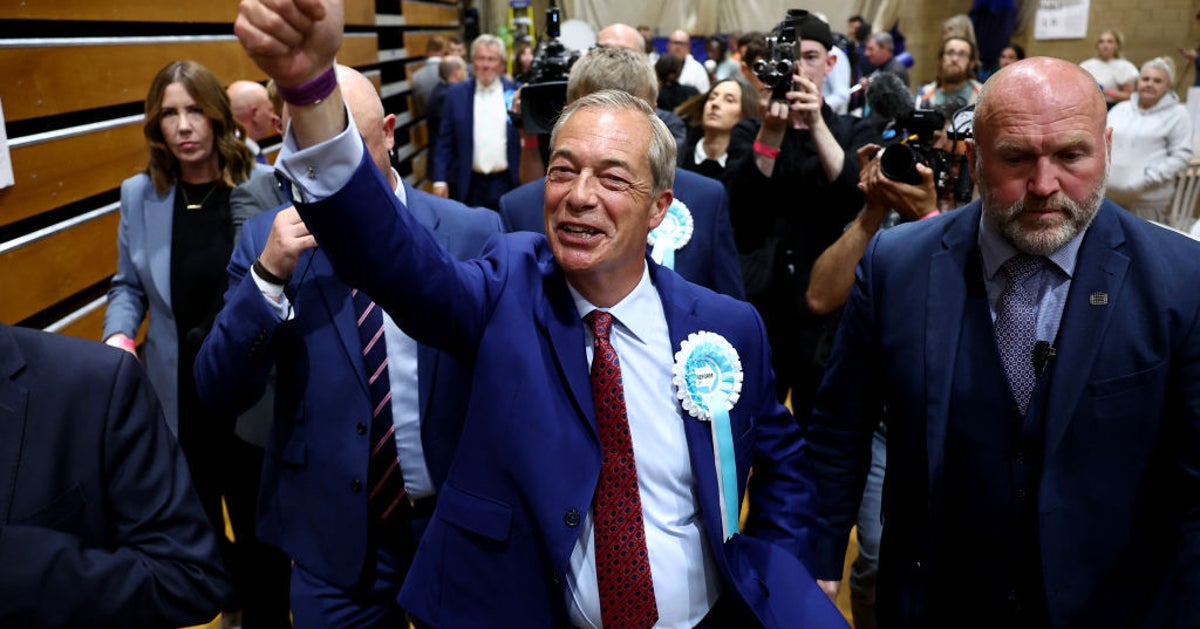
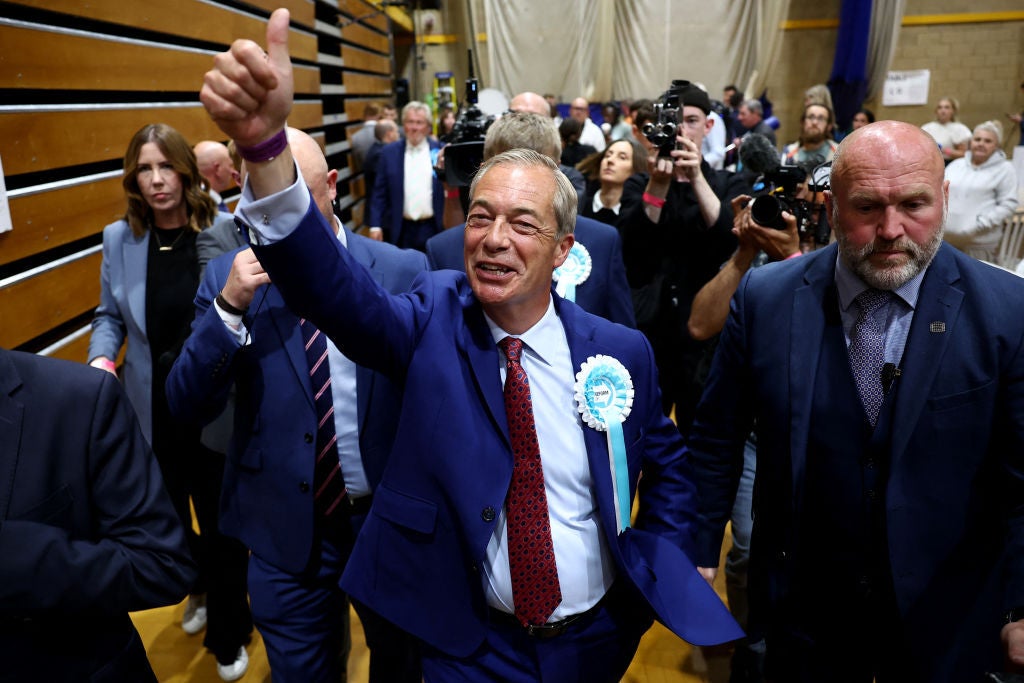
Reform UK are on course to win the next general election, according to a shock mega-poll.

Nigel Farage’s party would emerge with the most MPs in what would be a major political earthquake.

The More in Common think-tank asked more than 16,000 people who they would vote for if the election – expected in 2029 – was taking place tomorrow.

It showed that Reform, Labour and the Conservatives all have around 24% support among the electorate.

Using the so-called “MRP” method to give a seat-by-sea breakdown of that result, it showed Reform would have 180 MPs, a staggering 175 more than they got elected last July.

Labour would lose 246 seats leave them on just 165, the same number as the Tories.

Keir Starmer’s party would suffer “historic losses” in traditional heartlands in Wales, Greater Manchester and Yorkshire, with 10 cabinet ministers losing their seats.

Among the big names who are at risk are deputy prime minister Angela Rayner, health secretary Wes Streeting, chancellor of the Duchy of Lancaster Pat McFadden and home secretary Yvette Cooper.

The Lib Dems would lose five seats to leave them on 67, while the SNP would once again re-emerge as the biggest party in Scotland, surging by 26 to leave them with 35 MPs.

A total of 10 independent MPs would be elected, according to the poll, with Plaid Cymru up one on five seats, with the Greens unchanged on four.

The result throws up the possibility of Farage becoming prime minister at the head of Reform-Tory coalition.

However, Labour could also try to piece together a rainbow coalition with the Lib Dems, SNP and Greens.

Luke Tryl, More in Common’s UK director, said: “We are a long way from a General Election and trying to predict the result is a fool’s errand, but what we can say for certain is that as of today British politics has fragmented to an unprecedented level. The coalition for change that elected Keir Starmer’s government has splintered right and left.

“Nigel Farage’s Reform UK emerges as the biggest winners of this parliament so far, with our model suggesting that they could well become the largest party in parliament, something almost unthinkable a year ago.

“Though the party remains a long way from being able to secure a majority, it is clear Reform’s momentum is real and the question is whether their new level of support represents the start of a path to government or a ceiling that Farage’s polarising brand finds hard to overcome.”

Tryl said Labour “find themselves on the wrong side of a disillusioned electorate frustrated at the slow pace of change and some of the government’s early missteps”.

He added: “The Conservatives meanwhile may breathe a sigh of relief they haven’t been entirely wiped out, but despite Labour’s unpopularity their seat total would only return to 1997 levels and they would suffer further losses to Reform UK, while winning back few of their Liberal Democrat losses in the home counties.

“But the truth is the nature of a splintered electorate more than anything means elections for the next few years will be highly unpredictable with candidates winning on small shares of the vote and knife-edge results.

“The test for all three main parties will be which one can prove to the electorate that they can really deliver the change the public so desperately wants to see.”
Share Button

Vladimir Putin’s ‘Easter Truce’ Is A Sham, Says Volodymyr Zelenskyy As Bombing Goes On

The Russian president announced a temporary pause in hostilities in a surprise statement on Saturday.

He told Valery Gerasimov, the head of the Russian army, that the bombing would not resume until 10pm UK time on Sunday.

“Based on humanitarian considerations… the Russian side announces an Easter truce. I order a stop to all military activities for this period.

“We assume that Ukraine will follow our example. At the same time, our troops should be prepared to repel possible violations of the truce and provocations by the enemy, any aggressive actions.”

But in a statement posted on X on Sunday morning, Zelenskyy said there had already been 387 instances of shelling and 19 assaults by Russian forces since the ceasefire was suppose to have begun.

Drones were also used by Russia 290 times during the so-called truce, the Ukrainian president said.

He added: “Overall, as of Easter morning, we can state that the Russian army is attempting to create the general impression of a ceasefire, while in some areas still continuing isolated attempts to advance and inflict losses on Ukraine.

“Russia must fully comply with the conditions of the ceasefire. Ukraine’s proposal to implement and extend the ceasefire for 30 days after midnight tonight remains on the table. We will act in accordance with the actual situation on the ground.”

Share Button

‘Why I want an IVF baby to screen out gene that made me go blind’

Blind influencer Lucy Edwards on choosing IVF which will screen out the gene that made her who she is.

Share Button

3 Easter Lamb Recipes That Aren’t Just Your Usual Sunday Roast

Lamb is traditionally served at Easter, but there are loads of ways to cook it other than your usual Sunday roast.

We asked chefs their favourite ways to prep lamb for a delicious feast. Be warned: you’ll want to try them all.

Lavender and rosemary leg of lamb

Chef Richard Corrigan, from Bentleys, says this recipe is one of his all-time Easter favourites. “The lavender adds a beautiful floral flavour to the dish and complements the honey nicely,” he says.

Ingredients:

2kg/4½lb leg of lamb, on the bone

1 small bunch of English lavender

5 sprigs of rosemary

2 cloves garlic

1 small jar of honey

Method:

1. Preheat the oven to 200C/400F/Gas 6. Remove the lavender buds from the stalks and add to the honey Pull the rosemary leaves from the stalks and place in a blender. Add the salt and blitz.

2. Rub the lamb all over with the salt and place in a roasting tray.

3. Cover with foil and place in the oven for 20 minutes. After which remove the foil and leave to roast for a further 40 minutes (for medium).

4. Pour over the lavender and honey, return to the oven for a further 10 minutes.

5. Remove the lamb and leave it to rest for 10-15 minutes, with some foil on top to keep it warm. Serve with the pan juices and spring vegetables.

Richard Corrigan

Lamb raan

Chef Will Bowlby, who works at modern Indian restaurant, Kricket, recommends changing up your Easter feast. “Why not spice up your Easter this year with a centrepiece alternative to your usual roast lamb,” he suggests.

Ingredients:

A leg of lamb on the bone

4 tablespoons ginger and garlic paste

2 tablespoons Kashmiri red chilli powder

Pinch of sea salt

2 fresh Indian bay leaves

3 star anise

1 teaspoon black peppercorns

1 teaspoon cloves

1 cinnamon stick

400 ml (14 fl oz/generous 11⁄2 cups) white distilled vinegar

About 1.6 litres (56 fl oz/62⁄3 cups) cold water

500 ml (17 fl oz/2 cups) double (heavy) cream

A generous pinch of saffron strands, soaked in a little warm water

3 tablespoons garam masala

Method:

1. Rub the meat with the ginger and garlic paste, chilli powder and a pinch of salt and leave overnight to marinate. Preheat the oven to 200C (400F/Gas 6).

2. Transfer the leg to a deep ovenproof pan, add the remaining spices and vinegar, then pour in the water (it should just cover the meat). Cover the pan and cook in the oven for 30 minutes.

3. Lower the oven temperature to 160C (320F/Gas 3) and cook for a further 4–5 hours until the meat is falling off the bone.

4. Remove from the oven, take the meat out of the braising liquid and allow to cool. The meat is cooked when you can easily pick it from the bone. Transfer the braising liquid to a heavy-based saucepan and boil over a high heat until it has thickened and the flavours have intensified. Strain the liquid into a separate pan, reduce the heat and add the cream, saffron and garam masala. Reduce for a further 5 minutes, adjust the seasoning to taste and set aside to cool.

5. When you are ready to serve, heat a large frying pan (skillet) over a high heat and sear off the meat to get a nice crispy exterior. Add the braising liquid to the pan and spoon the liquid over the meat until it coats it nicely. Serve the meat whole, in its braising liquid.

Hugh Johnson

Lamb shoulder fricasee

Asimakis Chaniotis, chef at Pied à Terre, says: “Although it sounds French, lamb fricassée is a Greek Easter dish which I have grown up with. It’s so good, I could eat it all year round so it’s a shame it’s traditionally only eaten at midnight on the Saturday of the Easter weekend.”

Ingredients:

1kg of boneless shoulder of lamb with the fat and chopped in cubes

Good drizzle of vegetable oil

2 medium leeks, sliced

10 shallots, chopped

6 stalks of celery, with their leaves, chopped

5 cups chicken stock

2 tsp salt

1 tsp pepper

6 heads of lettuce cut in half and then sliced 2cm thick

A bunch of fresh dill, finely chopped

A bunch of fresh parsley finely chopped

A bunch of chervil finely chopped

For the sauce:

3 medium eggs, separated

Juice of 2 medium lemons

1 tbsp cold water

1 tsp corn flour

Method:

1. Cut the meat into 1 inch chunks. Pat down the lamb to remove any excess moisture then brown it on all sides over medium-high heat in the vegetable oil in a large saucepan

2. Add the leeks, onions, and celery to the pot and sauté gently until the vegetables soften. Add the chicken stock to cover the mixture and season it generously with salt and pepper. Cover and cook on medium heat for about 90 minutes, removing the lid for last 30 minutes

3. Chop all the herbs, reserving some for garnish. Chop the lettuce and add it to the pot, along with the herbs. Reduce the heat, cover, and simmer for 5 minutes, or, until the lamb is fork-tender and a small amount of liquid (about a cup or so) remains in the pot. Turn off the heat

4. Prepare the egg-lemon (avgolemono) sauce:

  • In a small bowl, whisk the egg whites with the teaspoon of cold water and cornflour until very frothy. Whisk in the egg yolks and lemon juice. Temper the avgolemono sauce by slowly adding one ladleful of the hot liquid from the pot to the small bowl with the eggs, while whisking the whole time. Continue with a second ladleful of the hot liquid and whisk again. Now add the avgolemono to the pot and stir gently to incorporate.

  • Shake the pot a few times to make sure everything is thoroughly mixed together.

  • If you need to reheat the lamb fricassée before serving, do so very gently, making sure the stew does NOT come to a boil (the egg will scramble).

5. Place on a serving platter, topped with the reserved chopped herbs. Good, crusty bread is a must and a Greek salad on the side is always a good idea.

Share Button

I’m Making It My Mission To Help Black Travellers See the World

I still remember the first time I held my passport in my hands. It wasn’t just a small blue book with my name inside – it was a key, a promise, a declaration of possibility. I was in my 20s and wasn’t immediately sure what travel would do for me, but I had what I needed to find out. As a Black Muslim woman, travel has been a way of expanding my world, learning my history beyond what textbooks tell us, and reclaiming my freedom in ways my ancestors fought for.

And yet, too many Black people in the United States don’t have access to this freedom. According to a survey from 2023, only 34% of Black Americans hold a valid passport.

I can promise that this statistic is not about not wanting to travel internationally; it is more of a reflection of systemic barriers that have long restricted our mobility. From the $165 passport application fee to the deep-rooted fears of traveling abroad, many Black Americans feel locked out of the world.

Furthermore, the lack of representation in travel media or stories of anti-Black racism abroad can create well-warranted anxiety. If we don’t see ourselves safely represented in the narrative of international travel, why bother?

And then there’s the unspoken reality: For generations, Black Americans were actively discouraged – or outright prevented — from moving freely, both within and beyond U.S. borders.

At 38 years old, I’ve lived in five countries and traveled to countless others, digging my heels into the literal paths traversed by Audre Lorde, Maya Angelou, James Baldwin, and so many other Black creatives who not only dared to dream but lived those dreams out loud and in the world. In every place I’ve called home, I’ve felt the weight of their footsteps and the power of their choices. Their journeys weren’t just about escape, they were about expansion—about finding spaces where they could breathe, create and exist beyond the confines of racism and oppression.

These choices were deeply political. They reflected a refusal to accept the criminalisation of Black folks, the silencing of Black voices, and the daily toll of surviving in a country built on anti-Blackness. Much like today, Black people then were searching for places where their full humanity could be recognised.

And so, the desire to explore the world isn’t just rooted in wanderlust. It’s an act of resistance, a declaration that we deserve rest, joy and safety. Leaving the United States, for many, has always been about more than just seeing new sights – it’s about finding freedom in places that won’t criminalise our very existence.

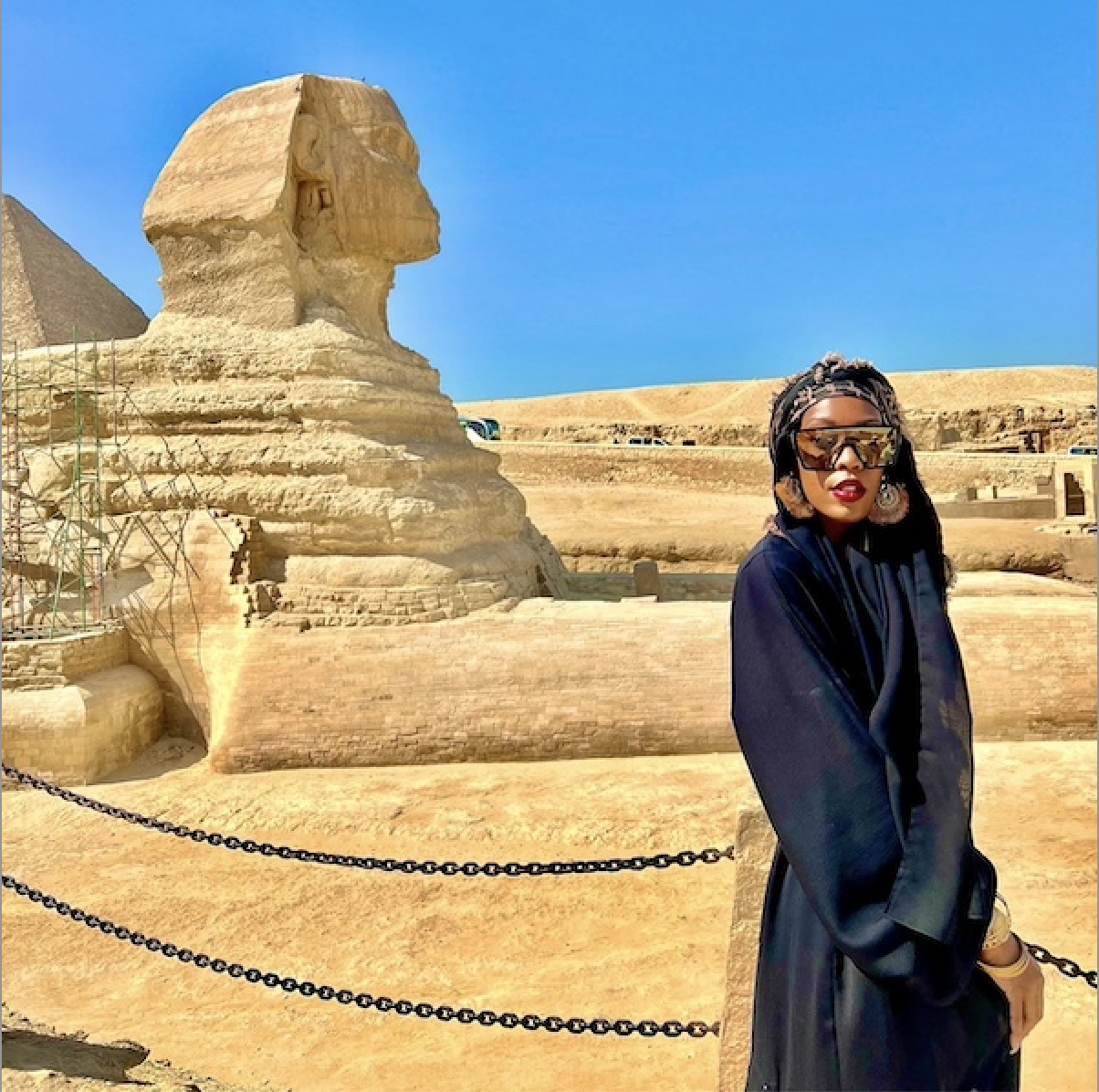
"I just wanted to do something to impact people the way travel has impacted me," writes author Imani Bashir, pictured here during a trip to Egypt.

Photo Courtesy of Imani Bashir

“I just wanted to do something to impact people the way travel has impacted me,” writes author Imani Bashir, pictured here during a trip to Egypt.

But I also know that for too many Black people who want to visit other countries, the barriers to entry are too high. That’s why I started my Paid Passport Initiative: to remove one of the biggest obstacles standing between Black people and the freedom to move.

The concept is simple but powerful. I would cover the cost of a passport book and the processing fee for Black adults who are ready to take that first step toward global mobility. Using my creator funds from TikTok, along with community support through a campaign I created on GiveSendGo, I’ve been able to fund 18 passports since Jan. 1, 2025 – each one representing a life opened to new possibilities. When I first launched the initiative, I expected interest, but I wasn’t prepared for the overwhelming response, especially since it’s just me. I just wanted to do something to impact people the way travel has impacted me.

Within the first 24 hours, I received 1,500 submissions, and to date, over 9,428 people have applied. They shared stories of wanting to reconnect with their ancestry, pursue job opportunities abroad, or simply experience a world they’ve only seen in books and on screens. It was a reminder that the desire to move and go has always been strong – and my goal is to eliminate the first financial hurdle.

Beyond travel, a passport is one of the strongest proofs of citizenship – a document that can mean the difference between security and uncertainty, especially at a time when citizenship, rights and even personhood are under attack. With voter suppression laws, mass incarceration and policies that disproportionately strip Black people of their rights, having a passport isn’t just about seeing the world – it’s also a safety precaution.

A valid passport ensures that if ever the need arises, we have the ability to leave, to seek refuge, to claim space elsewhere. It’s a safeguard against a system that has historically tried to limit our mobility and erase our belonging. In a world where political tides shift rapidly, possessing a passport isn’t just about freedom. It’s about protection.

Having a passport is a small act of resistance against a system that has long tried to keep us in place. And it’s a reminder that mutual aid, collective care and community support can create real change.

I know firsthand how transformative travel can be. It has shaped my identity, deepened my understanding of myself, and connected me to a global diaspora that exists far beyond the margins of the United States. I want others to experience that – to know that they are not confined and that their existence is not defined by limitations but by possibility.

My goal is to fund 100 passports by the end of 2025, but this is bigger than me. It’s about shifting the way Black people see themselves in the world. It’s about planting the idea that movement is our birthright. Because when we have access, when we have options, we are free. And Black freedom – no matter where it exists – is always worth investing in.

I don’t plan on stopping at 100 passports. Because when we move, we learn. And when we expand, we become unstoppable.

Share Button

Here’s What Actors Are Actually Smoking On Screen – And We’re In Disbelief

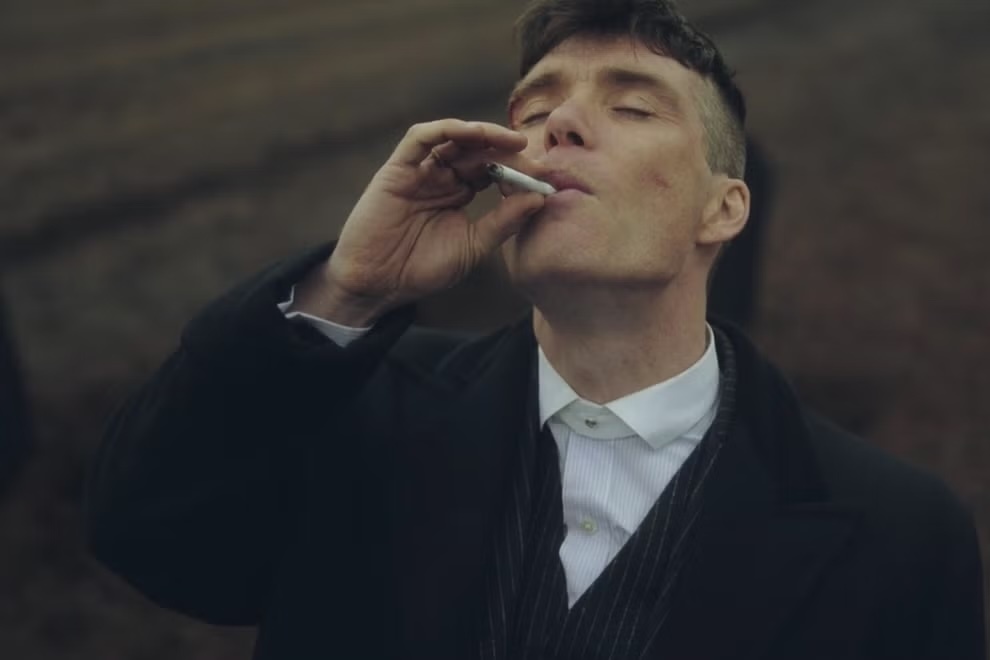
If you’ve ever sat through an episode of Peaky Blinders, you might find yourself wondering how the heck Cillian Murphy didn’t destroy his lungs playing the infamous Thomas Shelby.

Yup, there’s rarely a scene where the titular character isn’t puffing on a cigarette – so, what’s actually going on? Are they just destroying packets of cigarettes a la Dot Cotton actress June Brown?

Well, one TikToker has shared what our fave celebs are actually smoking – and it turns out things are far more herbal.

No, not that type of herb, before you get excited.

Director David Ma (@davidwma) often shares the truth behind Hollywood trickery and in a video which has amassed a whopping 2.2 million likes, the film expert has revealed what stars are smoking.

David explained: “Most of the time, when you see actors smoking on screen we use something called prop cigarettes. They’re herbal cigarettes that are tobacco and nicotine and additive-free.”

Well, that explains why we’ve not got hundreds of actors out there with hacking coughs.

“They also look quite real in an actor’s fingers,” David added, sharing that Jon Hamm went through packs of these while filming Mad Men.

“When you cut one open you’ll notice there isn’t tobacco inside, it looks more like herb – not that ’erb – but you know, rose petal, clover and tea leaves.”

But about smoke? According to David this tends to be added in post-production, usually with CGI.

And as for Cillian? Turns out he went through a whopping 3000 of the fake herbal cigarettes while portraying Tommy Shelby.

Share Button

Turning down starlight to spot new exoplanets

Researchers have developed a new coronagraph — an optical device that blocks out light from a bright source — that could make it possible to see distant exoplanets obscured by light from their parent stars. The new device could reveal exoplanets beyond our solar system that today’s telescopes cannot resolve, providing insights into the possibility of life beyond Earth.

“Earth-like planets in the habitable zone — the region around a star where temperatures could allow liquid water to exist — can easily be up to a billion times dimmer than their host star,” said research team leader Nico Deshler from the University of Arizona. “This makes them difficult to detect because their faint light is overwhelmed by the star’s brightness. Our new coronagraph design siphons away starlight that might obscure exoplanet light before capturing an image.”

In Optica, the researchers show that the new coronagraph can theoretically achieve the fundamental limits of exoplanet detection and localization set by quantum optics. They also used it to capture images that allowed them to estimate the position of artificial exoplanets with distances from their host star up to 50 times smaller than what the telescope’s resolution limit would normally allow.

“Compared to other coronagraph designs, ours promises to supply more information about so-called sub-diffraction exoplanets — those which lie below the resolution limits of the telescope,” said Deshler. “This could allow us to potentially detect biosignatures and discover the presence of life among the stars.”

Blinded by the light

Optically analyzing exoplanets poses a formidable challenge because, at astronomical scales, they are often too close to their parent star for current telescopes to resolve. Exoplanets can also be orders of magnitude dimmer than their host star. Although astronomers have developed various ways to indirectly infer the presence of a planet around a prospective star, directly observing exoplanets in images would be ideal.

With NASA’s next-generation space telescope, the Habitable Worlds Observatory (HWO), being dedicated to exoplanet science, many coronagraph designs have emerged, each with different practical and theoretical performance trade-offs. At the same time, recent work has shown that traditional notions of resolution for telescopes do not reflect fundamental limits and can be circumvented with careful optical pre-processing.

Inspired by these developments, the researchers decided to use a spatial mode sorter available in their lab to develop an improved coronagraph that theoretically rejects all the light from an on-axis star while achieving maximal throughput of an off-axis exoplanet.

Much like piano notes emit different acoustic frequencies, light sources in space excite different spatial modes — unique shapes and patterns of oscillation — depending on their position. The researchers separated these different modes using a mode sorter to isolate and eliminate light from a star and an inverse mode sorter to recompose the optical field after the starlight is rejected. This made it possible to capture an image of the exoplanet without the star.

“Our coronagraph directly captures an image of the exoplanet, as opposed to measuring only the quantity of light from the exoplanet without any spatial orientation,” said Deshler. “Images can provide context and composition information that can be used to determine exoplanet orbits and identify other objects that scatter light from a star such as exozodiacal dust clouds.”

Imaging faint exoplanets

After configuring their coronagraph in the lab, the researchers constructed an artificial star-exoplanet scene in which the exoplanet was positioned close enough to the star to be unresolvable with a traditional telescope. The contrast ratio between the star and the planet was set to 1000:1.

The researchers scanned the position of the exoplanet to simulate an orbit where the planet traverses in front of the star and then tried to determine its position in each frame. The images captured with their experimental setup incorporating the new coronagraph allowed them to estimate the position of the exoplanet at sub-diffraction planet-star separations.

The researchers are working to improve the mode sorter to reduce crosstalk, a type of interference in which light leaks across different optical modes. For scenes with moderate contrast levels, crosstalk is not very problematic. However, the extreme contrasts found in exoplanet science would require a very high-fidelity spatial mode sorter to sufficiently isolate light from the star.

The researchers say that this proof-of-principle experiment could inspire further exploration of optical pre-processing with spatial mode sorters in future astronomical instrumentation. For example, the spatial mode filtering methods they used could address more complex scenarios, such as treating stars as extended objects, and may also lead to new imaging methods for quantum sensing, medical imaging and communications.

Share Button

Throwing a ‘spanner in the works’ of our cells’ machinery could help fight cancer, fatty liver disease… and hair loss

Fifty years since its discovery, scientists have finally worked out how a molecular machine found in mitochondria, the ‘powerhouses’ of our cells, allows us to make the fuel we need from sugars, a process vital to all life on Earth.

Scientists at the Medical Research Council (MRC) Mitochondrial Biology Unit, University of Cambridge, have worked out the structure of this machine and shown how it operates like the lock on a canal to transport pyruvate — a molecule generated in the body from the breakdown of sugars — into our mitochondria.

Known as the mitochondrial pyruvate carrier, this molecular machine was first proposed to exist in 1971, but it has taken until now for scientists to visualise its structure at the atomic scale using cryo-electron microscopy, a technique used to magnify an image of an object to around 165,000 times its real size. Details are published today in Science Advances.

Dr Sotiria Tavoulari, a Senior Research Associate from the University of Cambridge, who first determined the composition of this molecular machine, said: “Sugars in our diet provide energy for our bodies to function. When they are broken down inside our cells they produce pyruvate, but to get the most out of this molecule it needs to be transferred inside the cell’s powerhouses, the mitochondria. There, it helps increase 15-fold the energy produced in the form of the cellular fuel ATP.”

Maximilian Sichrovsky, a PhD student at Hughes Hall and joint first author of the study, said: “Getting pyruvate into our mitochondria sounds straightforward, but until now we haven’t been able to understand the mechanism of how this process occurs. Using state-of-the-art cryo-electron microscopy, we’ve been able to show not only what this transporter looks like, but exactly how it works. It’s an extremely important process, and understanding it could lead to new treatments for a range of different conditions.”

Mitochondria are surrounded by two membranes. The outer one is porous, and pyruvate can easily pass through, but the inner membrane is impermeable to pyruvate. To transport pyruvate into the mitochondrion, first an outer ‘gate’ of the carrier opens, allowing pyruvate to enter the carrier. This gate then closes, and the inner gate opens, allowing the molecule to pass through into the mitochondrion.

“It works like the locks on a canal but on the molecular scale,” said Professor Edmund Kunji from the MRC Mitochondrial Biology Unit, and a Fellow at Trinity Hall, Cambridge. “There, a gate opens at one end, allowing the boat to enter. It then closes and the gate at the opposite end opens to allow the boat smooth transit through.”

Because of its central role in controlling the way mitochondria operate to produce energy, this carrier is now recognised as a promising drug target for a range of conditions, including diabetes, fatty liver disease, Parkinson’s disease, specific cancers, and even hair loss.

Pyruvate is not the only energy source available to us. Our cells can also take their energy from fats stored in the body or from amino acids in proteins. Blocking the pyruvate carrier would force the body to look elsewhere for its fuel — creating opportunities to treat a number of diseases. In fatty liver disease, for example, blocking access to pyruvate entry into mitochondria could encourage the body to use potentially dangerous fat that has been stored in liver cells.

Likewise, there are certain tumour cells that rely on pyruvate metabolism, such as in some types of prostate cancer. These cancers tend to be very ‘hungry’, producing excess pyruvate transport carriers to ensure they can feed more. Blocking the carrier could then starve these cancer cells of the energy they need to survive, killing them.

Previous studies have also suggested that inhibiting the mitochondrial pyruvate carrier may reverse hair loss. Activation of human follicle cells, which are responsible for hair growth, relies on metabolism and, in particular, the generation of lactate. When the mitochondrial pyruvate carrier is blocked from entering the mitochondria in these cells, it is instead converted to lactate.

Professor Kunji said: “Drugs inhibiting the function of the carrier can remodel how mitochondria work, which can be beneficial in certain conditions. Electron microscopy allows us to visualise exactly how these drugs bind inside the carrier to jam it — a spanner in the works, you could say. This creates new opportunities for structure-based drug design in order to develop better, more targeted drugs. This will be a real game changer.”

The research was supported by the Medical Research Council and was a collaboration with the groups of Professors Vanessa Leone at the Medical College of Wisconsin, Lucy Forrest at the National Institutes of Health, and Jan Steyaert at the Free University of Brussels.

Share Button

How thoughts influence what the eyes see

When you see a bag of carrots at the grocery store, does your mind go to potatoes and parsnips or buffalo wings and celery?

It depends, of course, on whether you’re making a hearty winter stew or getting ready to watch the Super Bowl.

Most scientists agree that categorizing an object — like thinking of a carrot as either a root vegetable or a party snack — is the job of the prefrontal cortex, the brain region responsible for reasoning and other high-level functions that make us smart and social. In that account, the eyes and visual regions of the brain are kind of like a security camera collecting data and processing it in a standardized way before passing it off for analysis.

However, a new study led by biomedical engineer and neuroscientist Nuttida Rungratsameetaweemana, an assistant professor at Columbia Engineering, shows that the brain’s visual regions play an active role in making sense of information. Crucially, the way it interprets the information depends on what the rest of the brain is working on.

If it’s Super Bowl Sunday, the visual system sees those carrots on a veggie tray before the prefrontal cortex knows they exist.

Published April 11 in Nature Communications, the study provides some of the clearest evidence yet that early sensory systems play a role in decision-making — and that they adapt in real-time. It also points to new approaches for designing AI systems that can adapt to new or unexpected situations.

Share Button

Unlocking the genetic basis of adaptive evolution: study reveals complex chromosomal rearrangements in a stick insect

Understanding the material basis of adaptive evolution has been a central goal in biology dating back to at least the time of Darwin. One focus of current debates is whether adaptive evolution relies on many mutations with small and roughly equal effects, or is it driven by one or a few mutations that cause major changes in traits.

Chromosomal rearrangements where large chunks of chromosomes are inverted, moved, deleted or duplicated, provide a possible source for such large-scale “macromutations.” However, characterizing chromosomal rearrangements with commonly tried DNA sequencing methods has been difficult.

Many organisms, including humans, are diploid, meaning they have two sets of chromosomes — one from each parent. The same is true for stick insects. This makes identifying chromosomal rearrangements with species challenging when assembling genomes.

“In the past, we’ve averaged data from each chromosome set, but the limited accuracy of this method doesn’t tell the whole story,” says Utah State University evolutionary biologist Zachariah Gompert. “Using newer, molecular and computational approaches that generate phased genome assemblies, where the two copies of each chromosome are assembled separately, has enabled us to directly show how complex chromosomal rearrangements have allowed stick insects to adapt by being cryptic on different host plants and thereby avoid predation.”

In the April 18, 2025 online issue of the American Association for the Advancement of Science journal Science, Gompert and colleagues report adaptive divergence in cryptic color pattern is underlain by two distinct, complex chromosomal rearrangements, where millions of bases of DNA were flipped backwards and moved from one part of a chromosome to another, independently in populations of stick insects on different mountains. Contributing authors on the paper include Gompert’s long-time collaborator Patrik Nosil and other researchers from the French National Center for Scientific Research (CNRS), along with scientists from the University of Notre Dame, the University of Nevada, Reno, and The Institute of Cancer Research in the United Kingdom. The research is supported by the National Science Foundation and the European Research Council.

The scientists studied Timema cristinae insects with varied color patterns, collected from two mountains near Santa Barbara, California. The wingless, plant-feeding insects are divergently adapted to two different plant species in the coastal chaparral habitats. One stick insect pattern is green, allowing it to blend in with the California lilac, while the other sports a thin, white stripe on its back making it nearly undetectable among the needle-like leaves of the chamise shrub.

Gompert and colleagues showed this adaptive difference in color pattern is almost completely explained by the presence versus absence of these individual complex, chromosomal rearrangements.

“The new phased genomic assembly technology used in this study was a critical piece in helping us examine how color pattern evolved in these insects,” says Gompert, professor in USU’s Department of Biology and the USU Ecology Center. “Our findings suggest chromosomal rearrangements might be more widespread and more complex than we previously thought.”

He says these mutations, despite being large, are easy to miss using traditional DNA sequencing approaches.

“Chromosomal rearrangements can be difficult to detect and characterize using standard approaches,” Gompert says. “We’re essentially exploring the ‘dark matter’ of the genome.”

Structural variation, he says, rather than being rare, may be regularly available to prompt evolution.

“We’re just scratching the surface,” Gompert says. “We’ve lacked the tools to detect structural variation, but with improved technology we hypothesize it plays a more important role in evolution than previously recognized.”

Share Button