Just as you take care of your physical health, therapy is an important aspect of taking care of your mental health. Making a therapy appointment can be a tricky task, especially if your therapist’s schedule overlaps with your workday.
It’s normal to experience a range of intense emotions following your therapy session. Understand that it may seem tough to transition back to work if you’re feeling emotionally and mentally drained. There are also a few ways to make going about your to-do list a little easier post-session.
Advertisement
If you plan to schedule your appointment during work hours, aim for a day when your workload may be lighter and you can work from home, if possible. Moreover, try to block some additional “transition time” in your schedule for after the visit, says Katie Duke, a nurse practitioner on the health care advisory board of the Figs clothing company in Santa Monica, California.
If you have the appointment on a busier workday, it is also helpful to inform your therapist if there are any important meetings that are happening after the session so that the therapist can also be mindful about tailoring what is talked about in the visit, says Alyssa Mancao, a therapist and founder of Alyssa Marie Wellness in Los Angeles.
Mancao also recommends being aware of time so you can spend the last 10 minutes of the visit on coping techniques to transition back to “work mode.”
And if you need a little extra help beyond that, here are a few expert-approved tips on how to pull yourself together after therapy if your appointment is during work:
Advertisement
Go for a walk
Mancao recommends going for a 15-minute walk after your therapy session to help calm your nervous system and transition your mind from being in “therapy mode.”
Take some time to get some fresh air and go for a walk outside or make a few rounds in your office building, if possible.
Try a quick breathing exercise
Deep breathing is a practice that helps cultivate mindfulness, aka. the ability to be present. Mindfulness can help calm your busy mind, improve your mood and reduce any stress you may be experiencing.
“Taking slow, controlled breaths that engage the diaphragm sends signals to our brain to evoke calmness and relaxation,” says Andrea Elkon, a psychologist with Best Within You Therapy & Wellness, based in Atlanta.
She recommends trying the following diaphragmatic breathing practice:
Aim to count to at least four as you inhale, imagining your diaphragm as a balloon filling with air
Exhale for at least another four counts, releasing all of the air
Westend61 via Getty Images
Taking a moment to unwind after your workday therapy session will help you better jump back into your tasks.
Give yourself a little pep talk
If you’re feeling especially overwhelmed or drained after your therapy session, understand that it is completely OK to feel this way. Don’t be too hard on yourself. Don’t let your inner voice criticise you.
“Instead, remind yourself that seeing a therapist is one of the best investments you can make for your mental health and well-being. Shift your focus on how seeking therapy has made a positive difference in your life,” Duke says.
Engage your senses with a distraction
When you focus on your senses in the present, it will shift your attention away from the painful memories and emotions that therapy might trigger, Elkon says.
To engage your senses, try activities like colouring, rubbing lotion on your hands, playing with a fidget toy or drinking a cup of hot tea or a very cold drink.
Advertisement
Nourish yourself with a snack
If you scheduled a therapy appointment during your workday, make sure to have a snack and water on hand after the session.
“Your body will likely have a stress response to the therapy session, leaving you feeling depleted, and having a healthy snack with some water is a way to nourish yourself,” says Kristin Meekhof, a therapist and author of A Widow’s Guide to Healing.
Jump into your to-do list or plan an event
It may be comforting to feel in control by tackling some items you’ve been putting off.
“Engaging in some sort of task that involves your thinking or planning brain will quiet the emotion centres and help you feel centred in the moment,” says Neha Chaudhary, a psychiatrist and chief medical officer of BeMe Health, a mobile mental health platform.
Chaudhary recommends drafting an email to someone at work (but not sending it!), writing down a grocery list or meal plan for the week, or thinking about the next place you want to travel and what activities you would do there.
Take it slow when going back to work
It’s normal to feel like you need to occupy your mind with work-related things immediately after your therapy appointment. However, be sure to not ignore any emotions you may be feeling.
Advertisement
Take slow steps as you start completing your work duties, and keep a journal handy to write down any of your thoughts and feelings as they come, says Regine Muradian, a psychologist based in California.
“Give yourself some grace, and remind yourself that you don’t need to finish everything today,” she says.
With our quirks and personal traditions, no two Christmases are the same. And – at the risk of sounding like a cheesy Christmas ad – that’s what makes the holidays so special.
Ahead of this year’s festivities, we asked readers across the country to share what they’ll be doing come Christmas day.
Advertisement
Some of you are heading to church, others to the pool. Some are looking forward to family time, others will kick back with friends – or cats. And the food? If you’re uninspired by traditional turkey fare, how does cottage pie, chicken Kyiv, or a Zimbabwean feast sound?
However you’re spending the day, have a happy one.
‘I’m a working Santa, Christmas is my day off’
Michael Facherty, who’s 71 and based in Caversham, and has played the role of Father Christmas for nearly 40 years. On December 25th he’ll be having a well-deserved break.
Michael Facherty
“In the run up to Christmas a working Santa has many jobs. Among them is recording videos for clients, this year including a charity pop single, various corporate jobs including parties, and grottos. My favourite this year was being Santa on Hobbs of Henley Santa Cruises. Work with individual families includes Zoom calls and home visits.
Advertisement
“I often have a charity visit on Christmas Day but not this year, so I’ll have a lie in. The day starts with some presents and then I have my special Christmas lunch. My wife and son are vegans, but Matt makes me cottage pie with steak mince as a special treat. I’ll watch the Richard Attenborough version of Miracle on 34th Street at some point during the day. Boxing Day is my favourite day, because our grandchildren visit us.”
‘My British friends are now family.’
Nishtha Goel, the founder of sustainable brand Unnaaty, is 32 and based in London. She’ll be spending her fourth Christmas in the UK with friends, who she calls her “chosen family”.
Nishtha Goel
“I am from India and have been living in the UK since 2018. I don’t have any family here, but have found a friend who is my chosen family and since 2019 it is has become a tradition that I spend Christmas at her place, with a few other friends. What could have been a lonely day is not, because my British friends are now family.
“I am a vegetarian so, while my friends enjoy turkey, they are thoughtful enough to cook a separate vegetarian meal for me, which includes vegetarian stuffing, peas, carrots, Brussel sprouts, to name a few things. I enjoy every bit of the traditional Christmas dinner, it is such a beautiful way of bringing families together.
Advertisement
“My favourite part of the day is late evening, when we play silly board/card games and just have a relaxed time with each other, full of smiles and laughter.”
‘It is my favourite park run of the year.’
Robin Barwick, aged 50, is the event director Royal Tunbridge Wells parkrun. On Christmas day he’ll be helping 200-300 runners start the day in high spirits.
Robin Barwick
“I will be run director at RTW parkrun this Christmas morning, for what has become one of our best attended fixtures. It is my favourite parkrun of the year. Between 200 and 300 runners and walkers are likely to show up for our 9am start, along with around 35 volunteers.
“Christmas morning parkruns have a special atmosphere. Many come in festive fancy dress, with anything from reindeer headbands, elf costumes, the full Father Christmas outfit or maybe a Christmas tree disguise.
Advertisement
“Runners can take the 5k run competitively if they want to but on Christmas Day most people treat it as an opportunity to get some fresh air and exercise with friends and family without worrying about their finish time. It is a very social occasion and as our cafe in Dunorlan Park will be closed many will bring their own refreshments to enjoy after their run. They are not always alcohol-free.”
‘I’ll sleep the whole way through Christmas day’
Marlene Bayuga, 59, lives in Morden, Surrey and works as a Marie Curie healthcare assistant in the community covering Southwest London and sometimes Kent.
Marie Curie
Healthcare assistant Marlene Bayuga.
“This Christmas I will be working throughout the night from 10pm until 7am. On Christmas day I will sleep during the daytime, and I will go for Christmas supper at my brother’s house, where we have roast turkey with all the trimmings. Then I will leave at 9pm to go to work and I will bring a mince pie and some Christmas pudding with me!
“When I arrive to my patients’ house I greet them with Christmas greetings and reassure their family that their loved one will be cared for, monitored, and supported during the night so that they can have a restful sleep. It can reassure them to know that someone is there with their loved one, so they won’t be alone overnight.
Advertisement
“I work during Christmas because someone in the community will always need my care at the end of their life, and because everyone deserves to have a good end of life experiences, both patients and their families. My family completely support and understand this. I know I’m there to give light during what can be a really difficult time for them.”
‘We go to church to celebrate Jesus’ birthday’
Nicole Bateman, 34 from Bournemouth, is a mum of two, author and owner of A Box Full of Joy. She’ll be celebrating Christmas by attending church and spending time with her family.
Nicole Bateman
“We start the day with the kids coming into our bed to open their stockings, then we have gammon and eggs with orange juice for breakfast and then open our presents under the Christmas tree.
“We then go to our church to celebrate Jesus’ birthday and then head over to grandparents for Christmas lunch, then a walk after that.
Advertisement
“I have a daughter who is three and a son who is six, and my son has epilepsy. He was diagnosed in July 2020 and has yet to find a medication to control his seizures. Last Christmas, he had five seizures over the four-day period, so by keeping to familiar things (like waking up at our house and going to our church like we do on a normal Sunday) it keeps some routine and stability to the day, which hopefully limits seizures.
“Christmas time can sometimes cause sensory overload and seizures for our boy, so we have to get the balance between too exciting (excitement is one of his seizure triggers) but then still making it a fun day.”
‘I’m solo cat-sitting – and I can’t wait’
Charlotte Lingard, who’s 34 and based in Kent, is looking forward to spending Christmas with some feline friends.
Charlotte Lingard
Charlotte Lingard and two of the cats she’s looked after this year.
“I will be cat-sitting a cat called Lola in Blackheath over Christmas for a couple who are abroad for the Christmas holidays.
Advertisement
“I plan to spend my day eating all the festive party foods I enjoy, cuddling Lola and making sure she is spoiled; also exploring Blackheath and Greenwich, as it is not an area of London I am familiar with, but I have heard a lot of nice things about it.
“I have been doing cat-sitting on and off for nearly a year now. It started when my flat did not allow pets, and I was missing feline company whilst working remotely. I use two websites to find and apply for cat sits, I have had five star reviews so far.
“I am completely happy in my own company, so I am looking forward to it!”
‘I swim then cook the kids’ favourite: Chicken Kyiv’
Sue Bordley, who’s 51 and from the Wirral, writes swimming-related books and will be heading the pool for her daily dip on Christmas morning.
Sue Bordley
“On Christmas Day, I’ll get up at about 7.15 am and have a quick coffee before heading to the pool, which opens at 8am that day. It’s always nice to have a chat to Julie, Paula and Harry, my fellow die-hard swimmers who are there every morning.
Advertisement
“I’ll swim for an hour. Swimming got me over a breakdown six years ago. It’s my release, my lifeline – why on earth would I not want to have that on the day that’s supposed to be the best of the year?
“After my hour’s swim and a lovely relaxation boost in the hot tubs, I go home to spend the day with my husband Mark (48) and sons, Jack and Olly (15 and 12).
“While the boys play their new computer games, I prepare a (reasonably) traditional Christmas meal: I make the usual roast potatoes and vegetables, but we don’t have turkey, choosing roast pork instead and the boys are allowed to have their favourite Chicken Kyiv. At Christmas, everyone should have what they like – and it’s only one more dish to wash.”
‘I’m setting my own solo Christmas traditions’
Patience M. Chigodora, a 30-year-old spiritual life coach from Nottingham, is using Christmas to have some me-time.
Advertisement
“This year I’m doing things differently. My Christmas isn’t about being with family and friends; it’s about me. I actually want to rest, recover and feel replenished in the New Year which honestly last year I didn’t after spending a lot of my time travelling around the UK to be with family and friends.
“I am planning a few days filled with candle-lit baths, PJs, feasting on all my favourite Zimbabwean and English infused dishes paired with my fave red wine of course. Binging on my favourite Christmas movies and series (like How to Ruin Christmas series on Netflix), I might pop to the cinema to watch the new Avatar movie, go on walks and I’m allowing freedom for spontaneity and going with the flow.
“It’s really important to me this year that I celebrate Christmas how I want to – not how I am expected to. I will be seeing family and friends here and there, focusing on quality time rather than quantity, but 80% of the period, including New Year, will be spent basking within my inner-verse.”
‘We Zoom our families and celebrate online’
Viva O’Flynn, who’s 40 and based in Gloucester, enjoys spending a cosy Christmas at home with her husband, John. They’ll spend the afternoon on Zoom, celebrating with family abroad.
Viva O’Flynn
Viva O’Flynn and her husband, John.
Advertisement
“Christmas Day starts with me waking up next to my husband, John. He cooks brunch for us, eggs florentine or eggs Benedict with salmon. Then, we head to our Christmas tree to open presents. I open each gift with a kiss, a ‘thank you’ and ‘I love you’. He does the same.
“It’s just the two of us celebrating Christmas in person, because his family are in Ireland, mine are in the Philippines. We log into Zoom and say our Christmas greetings to them, and we play some games with them online. Some of my cousins even sing Christmas tunes.
“There is nothing like being with family to celebrate in person: hugging them, kissing them on the cheek, holding their hands, eating meals with them. But it is the pandemic and flu season, and flights back home are doubly expensive. We’ll wait until after the holidays to reunite with them in person. The next best thing is seeing them, hearing their voices, and celebrating Christmas with them virtually.”
With both Christmas and New Year’s Day falling on a Sunday this year, the following Monday and Tuesday become bank holidays – which means the day you get paid will be moving.
The majority of companies opt to move their December pay date forward in this situation, which can feel like a real festive treat for employees at the time.
Advertisement
But come January, when you’ve potentially had 40 days or more between pay cheques, the disruption to your usual budget can really hit hard.
6 days until Christmas pay day, 100 days until January pay day 😂😭
Now they have rushed to pay you December Salary very early it’s sweeting you…remember that money is what you will use to work till pay day on the 66th day of January next year…Don’t spend like a theif then start disturbing others in January…Let’s all respect ourselves.
All this means that preparing for the inevitable Christmas pay gap is even more essential than usual.
If you’ve already been paid this month, try to avoid using those early funds to pay for last-minute Christmas gifts and extras that aren’t essential.
To help with budgeting, Mat Megens, CEO of money-saving app HyperJar, recommends dividing your December salary into five as soon as it hits your account.
“If you’re used to a monthly salary lasting four weeks you can come unstuck when you’re paid earlier than usual in December,” he tells HuffPost UK.
Advertisement
“So make sure you divide what you have by five (depending when you’re paid) – not four – to get you through to that next pay cheque at the end of January.”
Don’t forget to spend your December pay wisely, January payday isn’t for another 56 nights so be smart
If you receive Universal Credit alongside your salary, a shift in pay date can also change the benefits you receive – something to factor into any budgeting.
Advertisement
Anna Stevenson, senior benefits specialist at the charity Turn2us, explains: “Unfortunately, if you’re on Universal Credit, this can cause problems, because it might look to Universal Credit that you got twice as much pay in the month as you actually did.
“Your employer is supposed to report pay on the usual pay date, even when they pay early but it might be a good idea to remind them of this and point them to the HMRC guidance.”
If you think your Universal Credit payment has been cut in January, Stevenson advises contacting the Department for Work and Pensions (DWP) to explain what has happened.
“If it has been cut, be sure to ask for an RTI (real time information) dispute,” she says.
“This means that the DWP can investigate and re-assign your missing payment to your next month’s payment. It is worth noting this can take over a month to rectify, so it is best to talk to your employer before you are paid to prevent this happening.”
Others have shared their own tips on social media, such as setting some money aside and ‘paying yourself’ on your usual pay date.
Advertisement
I stick mine in my easy access saver and then transfer it back to my current account at the end of December in line with normal pay day. Stops the temptation to use some of it to “help” with Christmas costs! https://t.co/VkZrhoVMH7
Megens provides us with these further tips for staying on top of your budget when your pay date has moved:
Swap brands for supermarket own-label Food is one of our biggest monthly expenses. You can save around £40 in January by swapping big brands for supermarket own-label equivalents.
Forget regifting… resell instead If you don’t have gift receipts, head to auction sites like eBay, or try Depop and Vinted for clothes and accessories, to get some cash back in your pocket in January.
Have a strategy for the sales Set yourself a limit if you’re spending in the Boxing Day and New Year sales and don’t get carried away. Only buy what you’ve planned for, and double check the price now so you’re sure you’re getting a genuine bargain.
Take control: plan for pressure points Use any downtime between Christmas and New Year to take your first budgeting steps into 2023. Plan for the year’s financial pinch points – those big expenses that come up every year, like house insurance, holidays and Christmas. Note when they’re due and how much you need to start putting aside to pay for them and avoid getting into debt.
And if you’re doing all that and you’re still worried about money, Stevenson says it’s worth checking whether you’re eligible for state support.
Advertisement
“Millions of people miss out on thousands of pounds each year because they’re not sure what they’re entitled to,” she says – urging people use the free Turn2us Benefits Calculator to find out what extra help may be available to you and your family at this time.
If you have ever felt like a full day of back-to-back meetings was draining your life force, you’re not alone.
Many of us dread a packed work calendar. Wasting too much time in meetings is a distraction preventing 67% of professionals from making more of an impact, according to a 2019 survey of nearly 2,000 people by organisational consultancy Korn Ferry.
Advertisement
But it’s not just that a high number of meetings can give us feelings of anxiety. There’s actually research that shows how attending too many — and seldom taking breaks — can cause our brains to work differently.
Study Finds Stress Levels Spiked Amid Back-To-Back Meetings
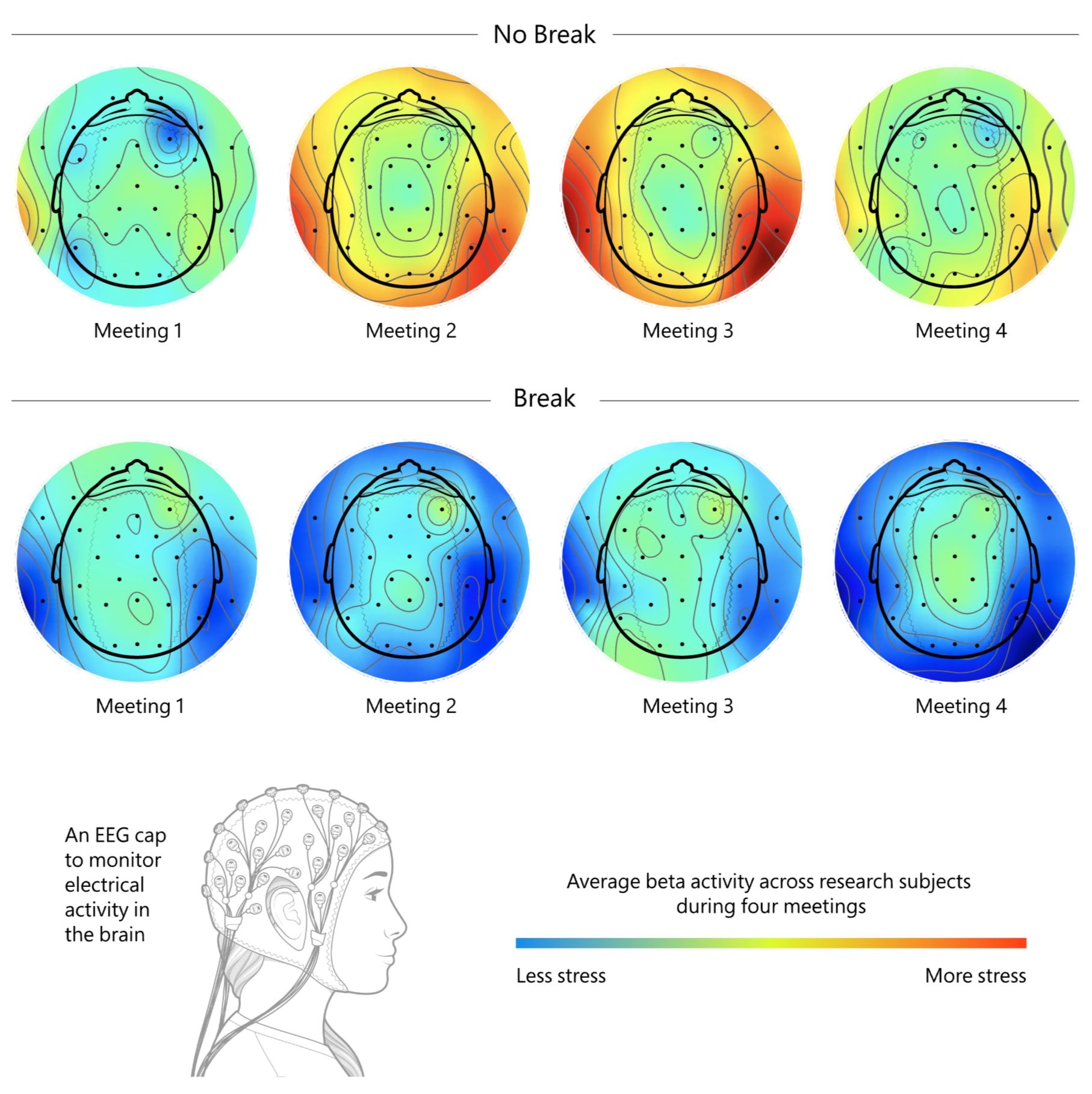
In 2021, researchers at Microsoft’s Human Factors Lab asked 14 people to take part in video calls while wearing electroencephalogram equipment that monitored electrical activity in their brains. On one Monday, some participants were given four half-hour meetings without breaks, while others had four half-hour meetings with a 10-minute break between each for meditation; then, on the following Monday, the two groups switched.
Among those who got no breaks, beta wave activity increased in the brain with each successive meeting, indicating heightened stress levels. In fact, just the anticipation of the next call caused a spike in beta activity during the transition period between meetings, researchers found.
Brown Bird Design
In a Microsoft study last year, beta wave activity increased in the brains of people who had successive meetings with no breaks, indicating a rise in stress. Beta activity remained stable in those who took 10-minute breaks.
Advertisement
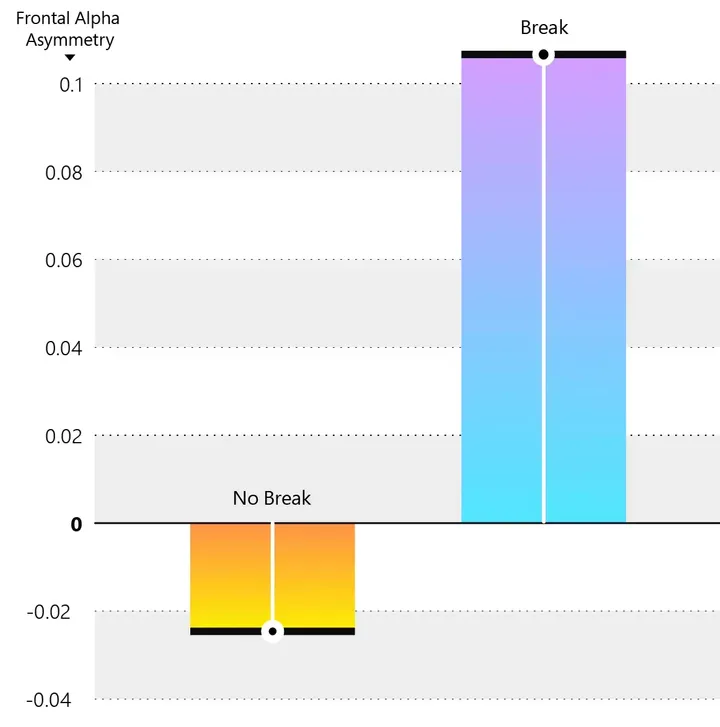
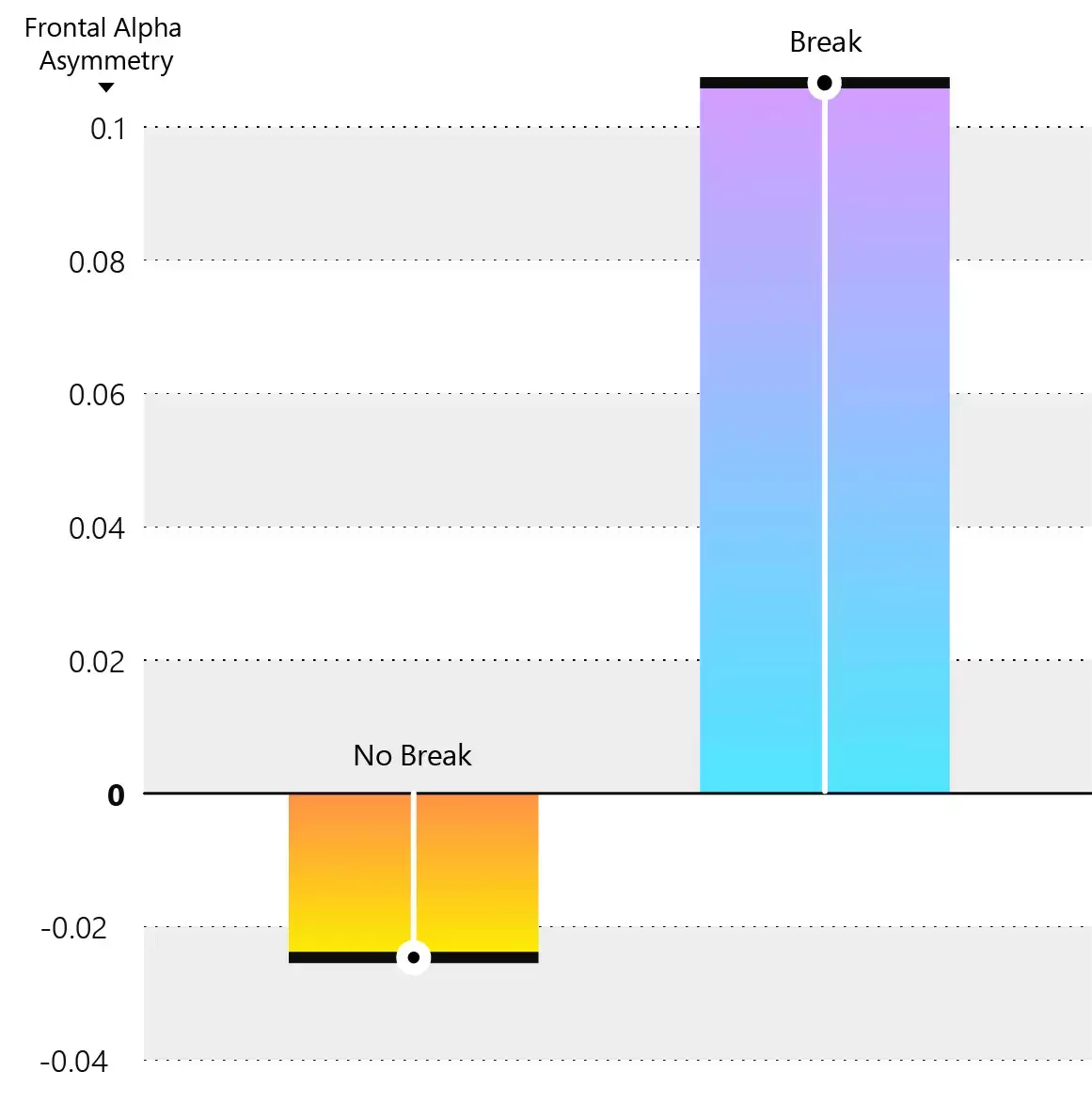
Meanwhile, the researchers also measured the difference in right and left alpha wave activity over frontal regions of the brain — known as frontal alpha asymmetry — which can indicate levels of mental engagement.
Participants who took breaks showed positive frontal alpha asymmetry, suggesting higher engagement during the meetings, while those without breaks had negative asymmetry, indicating that they were more mentally withdrawn.
Valerio Pellegrini
When study participants had breaks between meetings, their brains showed signs of higher engagement.
“I’m not surprised that people who took breaks between meetings felt better. People who take breaks in general feel better,” said Laura Vanderkam, a time management expert and the author of “Tranquility by Tuesday: 9 Ways To Calm the Chaos and Make Time for What Matters.”
“We all take breaks one way or another; it’s just [that] many times they’re unconscious. By choosing when and how to take a break, you notice the break happening and reap the rejuvenation,” Vanderkam said.
Advertisement
One big caveat to Microsoft’s findings, of course, is that the sample size of participants was small. But the study aligns with a large body of other research suggesting that meeting overload causes unproductive, unhappy employees who feel like their schedule is ruling their life.
In a recent survey of 76 companies, for example, management researchers found that employee productivity more than doubled when meetings were reduced by 40%.
“This is largely because employees felt more empowered and autonomous,” the researchers wrote in March for Harvard Business Review. “Rather than a schedule being the boss, they owned their to-do lists and held themselves accountable, which consequently increased their satisfaction by 52%.”
Making The Most Of Breaks In Meeting Marathons
If you’re looking for ways to make your own breaks more impactful, try to resist scrolling on social media or reading your email, experts said.
“Many people check email between meetings as a form of a break, and I get that,” Vanderkam said. “But [it is] even better to batch email at some point in the day, or only do it between every other meeting, and use those little bits of time for something else that will add joy and meaning to your life, like a 10-minute walk outside.”
Advertisement
Holistic health coach and mindfulness teacher Rosie Acosta recommended a relaxation technique in which you breathe in for three seconds and out for six, repeating as necessary.
“You only need to do three to five cycles before your body starts to respond and release tension,” she said. “Most of us sit at computers a lot. So if you do sit, perhaps use this time to stand and stretch. The biggest way to reset is to shut down the distractions.”
And if you’re a manager, try setting your teams up for success by avoiding marathon meeting days and building in more breaks.
“To make 10-minute breaks work, it’s helpful for organisations to set a culture that meetings start at, say, the hour and end 10-15 minutes early,” Vanderkam said. “That allows for a break or a ‘passing period’ like in a high school for people who need to travel.”
The big takeaway? It’s better to take a short breather than to power through a slew of meetings, as even a few minutes can make a big difference in our stress levels and ability to focus.
Advertisement
“When we are laser-focused on a task, we tend to create tension in our body, we stop breathing, and we stay in that tension throughout the day,” Acosta said. “If we are able to take short breaks to either do some breathing or even just relaxing of your shoulders, it gives your body the space it needs to feel relaxed.”
New government legislation allows employees the right to request flexible working from the time they start a new job. The move is being received well by unions, who advised minsters to do more in relation to making flexible working a norm.
Millions of Brits all over the UK are currently working flexibly, this includes people working from home, compressed hours, job sharing, flexitime and part-time and term-time only working.
Advertisement
The government announced on Monday that it would introduce legislation which will give employees the right to ask for flexible working arrangements as soon as they start a job. Previously, you could only make a request after 26 weeks.
Now, you can do it straight away. A request can be made every year and employers have up to three months to respond.
As well as helping those who want to work from home, the government said around 1.5 million low paid workers such as students, carers and gig economy employees would benefit from this legislation, because it would let those workers take on a second job if they desired.
Tray Durrant, executive director of PA recruiter, Bain and Gray, believes the new move will be a good thing for employees. “It will prompt discussion and iron out the working arrangements from day one, which can only be a good thing for both sides and ensure hybrid working arrangements are clear cut. It is already part of the dialogue for our candidates when looking for new roles,” Durrant says.
Advertisement
Though the move will be important for employees, some people shared that they’d feel uncomfortable asking for flexible working options in a job interview as they fear the response, according to a TUC survey.
However, Durrant thinks it’s important that this is covered during the interview process. “This should set the stage for the future working arrangements,” Durrant adds. “It’s crucial during any interview process that all elements are considered by both parties, and establishing the ground around flexible working arrangements would be anticipated by the employer.”
Equally, there are some who might feel anxious about approaching their current employer about the topic of flexible working. But Durrant says “whether or not someone is intimidated, communication is paramount”.
More than a quarter (26%) of businesses have reported an increase in questions regarding flexible working at interview stage. UK workers increasingly expect flexibility as a given, with some going so far as to say they’d be more likely to continue working for their employer if they were able to work overseas as part of their current job.
So, what’s the best way to make a WFH request?
“Employees need to think through the benefits of presenting their case for home working, which might be easier for some roles than others,” says Durrant. “Highlight clear tasks where the focus is individual and where undertaking these duties makes more makes more sense in an uninterrupted environment.”
Advertisement
Alison Blackler who is a mind coach understands that bringing up the topic of flexible working can be difficult if your manager isn’t keek on the idea. Blackler share’s three tips to when making a working from home request:
Prepare what you want to say, get as much factual information to present, for example, the length of time saved travelling and have the key pointers written down. This helps you get all your points over, keeps you on track and therefore reduces overwhelm and fluster.
Make sure that time has been planned into the managers diary and state what you want to talk about ‘flexible working’. Be brave and clear – being up front helps everyone with expectations. It is also tempting to try to ask casually, which can catch the manager off guard and therefore get an unwanted response. This also helps you prepare yourself for the conversation
Remember, these conversations usually go better than we imagine in our minds. We often dread them and make them into much bigger deals. Rehearsal also helps the mind so that it is not new and it is much easier.
This also goes for employees who feel pressured to work in the office, despite being offered hybrid working options. “If this becomes a problem for the employee, the individual should bring it up with their manager and ask for clear guidelines on the company policy and on their role,” Durrant shares.
“Again, communication is paramount to set parameters and ensure there is clarity around the role and the number of days in the office.”
Advertisement
Employees certainly want hybrid to stay – 15% of businesses are already receiving increased requests to work from anywhere, Totaljobs reported. Meanwhile 15% are getting questions about four-day working weeks.
Around 16% of companies have improved flexible working options in order to retain staff aged over 50, according to Totaljobs. And only 12% of companies citied “managing flexible working patterns” as one of the major challenges facing businesses in Q3 2022, suggesting most are getting used to the idea). Instead, cost of living (55%) and retaining staff (26%) were the principal concerns.
The Ministry of Justice (MoJ) has had one of its adverts banned, for being likely to cause “serious offence” by “reinforcing negative stereotypes about Black men”.
The ad for the MoJ’s Prison Jobs scheme, which ran this summer, featured an image of a white prison officer talking to a Black inmate, with superimposed text stating: “Become a prison officer. One career, many roles.”
Advertisement
A caption accompanying the image read: “We’re key workers, problem solvers, life changers. Join us to perform a vital role at HMP Wormwood Scrubs.”
A reader complained that the ad perpetuated negative ethnic stereotypes and was likely to cause serious offence.
The MoJ said the photographs used in the ad campaign featured real officers and prisoners, arguing that it did not therefore “portray” a Black man as a criminal but rather depicted a real person who had been convicted of an offence.
It said it was not therefore an inaccurate or unfair representation of the type of engagement that might have been seen between officers and prisoners.
Advertisement
The now-banned MoJ advert.
The MoJ said the image formed “one small part” of the overall campaign – accounting for less than 5% of its spending on the ads – “which used a wide variety of images and showed officers of different ethnicities, interacting with each other”.
It added that none of the other images used in the Facebook part of the campaign showed white officers alongside ethnic minority prisoners.
The Advertising Standards Authority (ASA) noted all this, but pointed out that viewers would be likely to see the advert in isolation on Facebook.
The ASA said: “The ad made reference to prison officers being ‘problem solvers’ and ‘life changers’, and we considered it drew a link between the officer depicted and those attributes. On the other hand, the Black prisoner was depicted as a criminal, without those positive attributes.
Advertisement
“We considered the ad did not suggest that all Black men were criminals or were more likely to be so than any other ethnic group.
“However, it showed an imbalanced power dynamic, with a smiling white prison officer, described as a ‘life changer’, and a Black, institutionalised prisoner.
“We considered the ad’s focus on the positive qualities of the white prison officer and negative casting of the Black prisoner was likely to be seen as perpetuating a negative racial stereotype.
“We concluded that the ad was likely to cause serious offence on the grounds of race by reinforcing negative stereotypes about Black men.”
The ASA ruled that the ad must not appear again, adding: “We told the Ministry of Justice to ensure they avoided causing serious offence on the grounds of race.”
Just like that, the last bank holiday of the season (until Christmas) has passed. Love Island has finished, we experienced two heatwaves, danced at Notting Hill Carnival and caught a tan at the beach. It looks like it’s time to slowly start putting your summer clothes away and get out your jumpers.
I know you don’t want to to think about winter just yet, so why don’t you use this time to start planning your holidays for next year?
Advertisement
It might feel too early, but if you start plotting your time now, you can get bag the best days and get 47 days off work by using only 19 days of annual leave. Imagine how you’d spend that time living your best life!
Want to find out how you can maximise your holidays next year? Keep reading.
Easter weekend 🐣
Easter Sunday falls on Sunday 9 April in 2023. If your employer closes on the weekends and bank holidays you can get a 10-day break using four days of annual leave.
Book off: April 3, 4, 5, 6
Get off: March 31 to April 10
May bank holiday 🌸
Ah, May how we love you for your multiple bank holidays. If you didn’t manage to get those days off in April then you’re in luck, because the May bank holiday is shortly after the Easter break. The first bank holiday is on May 1.
Book off: May 2, 3, 4, 5
Get off: April 31st to May 8th
The fun doesn’t stop there in May as we also have the late May bank holiday which falls on May 29.
Book off: May 30, 31, June 1, 2
Get off: May 29 to Sunday June 4
August bank holiday 🏖️
The August bank holiday is everyone’s favourite. It signifies the end of summer so we all want to make the most out of that weekend. And it’s the perfect time to book a little trip away. The 2023 August bank holiday falls on Monday 28.
Advertisement
Book off: August 29, 30, 31, September 1
Get off: August 26 to September 3
Christmas 🎄
Tis’ the season to be jolly by taking timing off to eat a dozen mince pies. Even those who don’t enjoy Christmas don’t want to work during that time. We’d all rather drink hot chocolate and snuggle up in bed. Christmas day falls on Monday 25 in 2023. You’ll also get a bank holiday on Boxing day (December 26) and New Year’s Day (January 1 2024)
Babies can come at the most surprising moments in life. And for many people, they arrive at a point where your personal finances aren’t at their strongest.
In fact, some women entering maternity leave are doing so without any savings at all.
Advertisement
Reduced pay during this time coupled with the costs of a newborn means many mums have to borrow money to get by. And some are being left in debt.
A study of parents by finance company Credit Karma found that a quarter of parents get into maternity leave without any money saved, while 26% of women get into debt while on their maternity leave.
Advertisement
The amount in borrowing has increased by £560 since 2018, the company says, taking the average borrowed per parent up to £2,800.
Those with student loans face the harshest outcomes as the interest rate on those loans remains seriously high while they are on leave and unable to pay it off.
Advertisement
Credit Karma said women with interest loans accrue an average of £1,770 loan interest in just six months of leave.
Given the cost of living crisis, which is seeing bills go up as never before, this paints a dire picture for new parents.
Akansha Nath, head of partnerships at Credit Karma UK said: “Women are often disadvantaged financially throughout their life, and the responsibility to give birth plays a huge role in this gender disparity.
“At a time when the cost of living is affecting most people, and every penny counts, it’s more important than ever that women take advantage of any support available to them.”

Advertisement
These debts, even if eventually paid off, can then follow women into life, affecting their credit score and therefore their ability to buy homes and other goods.
Credit Karma said maternity-affected credit scores can set women back an average £17,000 in interest over the course of their lifetimes.
If you are struggling with maternity debt, there are resources that can help.
Step Change has a benefit checker, as well as list of grants available to expectant parents. The website also offers free money management tools designed to help people with their finances, without judgement.
We’ve all been there: upon walking into the office, an acquaintance cheerfully greets you by name and you pause, frantically searching your brain for theirs.
You don’t want to disrespect them by saying the wrong name, but just saying “hey” seems so generic. Do you come clean about your memory lapse?
Advertisement
Here’s how experts say you can address the conundrum strategically and still keep your relationships intact.
You may consider a subtle approach first
Advertisement
If you are at an event and you see someone you know but you can’t remember their name, introduce yourself first, because it often prompts that person to say their name too. That’s what Mary Abbajay, president of the leadership development consultancy Careerstone Group, recommends.
“That is a signal for you to say your name back,” Abbajay says. But don’t think you are being sly about your strategy. Many people will recognise that it means you don’t know their name, she says.
Advertisement
One other indirect approach is to discreetly ask someone else to tell you the other person’s name, Abbajay adds.
If you are in a conversation that will continue later, consider asking the person to put their contact information in your phone. Or if the conversation needs to move to email, try asking, “Can you tell me how to spell your name to get the email right?” suggests Perpetua Neo, a psychologist and executive coach.
Better yet, ask them directly and apologise.
Avoiding saying someone’s name every time you see them will only get you so far.
Advertisement
“I think people fake it too long, and then they meet that person three or four times, and then they are too embarrassed to ask their name,” Abbajay says. “The best thing is to nip that in the bud right away. The second time you meet them, say, ‘Remind me of your name again. Thank you so much.’”
Don’t minimise your actions and say, “Oh I do this all the time.” If this is your third or fourth time asking their name, that deserves a bigger mea culpa, Abbajay says.People’s names are important to them, and you want your apology to come across as sincere.
Don’t make it too big a deal, though, either.
“We feel an internal pressure to remember people’s names after they tell us once, but that’s not fair, and truly, most people understand that,” says Lawrese Brown, the founder of C-Track Training, a workplace education company. “Even if it’s a close colleague, some of us are better with names than others and some of us forget things easily in general.”

“The biggest mistake is to be overly apologetic like there is something wrong with you,” Neo says. “Being gracious and pleasant about it can be useful.”
Don’t get discouraged if it happens more than once. Learning names takes time, Brown says, but what pushes her to ask for name reminders is to remember there are worse alternatives: You can make the wrong guess and call that person by an incorrect name, or you can be impersonal and never say their name.
“In the short term, asking may feel embarrassing, but that’s a temporary feeling,” Brown says. “The feeling of letting someone know that you care enough to call them by their name is what they’ll remember.”
Write down names whenever possible and try saying a person’s name when you first meet them.
Brown says that writing down someone’s name is what works best for her as far as remembering them.
Research has shown that writing things down helps our brains really retain what is being said. A 2014 study in Psychological Science, for example, found that students who wrote notes down on paper had better comprehension and retention of what was being taught than students typing on their laptops.
Advertisement
If you don’t have access to a pen or paper, try using your voice. Here’s a pro tip: Use someone’s name within the first minutes of meeting someone.
Abbajay says that in meetings she facilitates, she will ask people to introduce themselves even if some people already know each other as a way to help her remember names. When people introduce themselves, she diagrams where they are sitting and what their names are.
That way, “When I’m in the meeting, I can start using people’s names. If you use somebody’s name quickly when you meet them, chances are you are going to remember their name,” she says.
You’re reading Life-Work Balance, a series aiming to redirect our total devotion to work into prioritising our personal lives.
“How would you fit a giraffe into a fridge?” An asinine question in most settings, but especially peculiar during a job interview.
Advertisement
And yet, these kinds of ‘quirky’ and arbitrary lines of questioning seem to be commonplace during the interview process.
In an attempt to make people think ‘outside the box’ or on their feet, hiring managers are coming up with increasingly difficult (and frustrating) tasks and questions for interviewees.
Advertisement
And to make matters worse, many are leaving the applicants hanging once it comes to feedback or finding out the results of the conversation.
So, what does it say about their work culture when recruiting staff act like this when imbued with such powers?
Advertisement
For starters, if you’re being put in a difficult and tricky situation at the earliest stage of the job, then it might not be the best indication of the company’s treatment of employees. And it also means they have no regard to the preparation that applicants may have completed in anticipation of a more traditional interview.
After all, how does anyone answer how they’d put a giraffe in the fridge, or what words they’d have on their tombstone, or how they’d fare if locked in a room and asked to complete a challenge (all real requests)?
Here are some of the most ridiculous requests people have received:
I was locked in a room and told I had 45 mins to write a 2k-word essay (this was a social media job at a charity)
This was after an hour long interview where they asked questions like “what do you hate most about your current job” + “do you drink”
Mate I’d driven 2.5 hours from Wales to Manchester for this interview as well, and they never got back to me 🤣 was a shit job but I was desperate at the time
Was asked what 3 companies I’d love to work for and then was told I wasn’t suitable for the role because I could name two others. #ego 😂
— Francesca Stainer (she/her) (@FranStainer_PR) April 27, 2022
I once got asked for why my parents divorced, why I didn’t have a relationship with my Dad at the time and whether I’d be able up for the job as my family “had only ever worked in the public sector”… ☠️
It’s understandable that companies would try get creative with their asks, and indeed some are known for tough brainteasers that showcase the best of people, but most of us can agree that some questions are just a bit bizarre and show nothing about the person.
Advertisement
That’s what Hannah Langford, 31, from the North West, felt when she went for a job in law in Manchester.
She tells HuffPost: “I had a training contract interview at a law firm about 10 years ago and was asked two bizarre questions: ‘Why don’t polar bears eat penguins?’ and ‘How much water does it take to fill St Paul’s Cathedral?’.
“These questions made me doubt myself and I felt confused as to what answer was expected (i.e., was I expected to give an actual answer to the water question or was my thought process what they were interested in?).”
Langford ended up pivoting to a different sector altogether, deciding to work in charity.
Ramla*, 26, from London, can relate to navigating random questions that don’t relate to the job. “A charity that had many interview stages (and didn’t even give feedback after despite saying it would) had some interesting questions,” she recalls.
“One was about who’s your most problematic friend and why you are still friends with them. Another was about the last time you lost your temper.
“I’m not sure how far these questions really test someone’s values. No matter what you say, they’d have to take it with a pinch of salt because it’s an interview, not a chat with your best friend.
“These questions felt a bit like an interrogation. Surely what I’ve achieved and the places in which I’ve created transformative change should speak for itself – or at the very least, they could ask me directly about that?”
Unfortunately, eccentric questioning seems to be commonplace in the job interview space, when that time could be far better utilised talking about the things that bring us joy, what we’re passionate about, what we look forward to.
Because, truly, no one knows how to fit a giraffe into a fridge. And nor should they.
Advertisement
Life-Work Balance questions the status quo of work culture, its mental and physical impacts, and radically reimagines how we can change it to work for us.