Hidden 5-mile wide asteroid crater beneath the Atlantic revealed in stunning 3D

Researchers from Heriot-Watt University have released striking images of an asteroid impact crater hidden deep beneath the floor of the Atlantic Ocean.

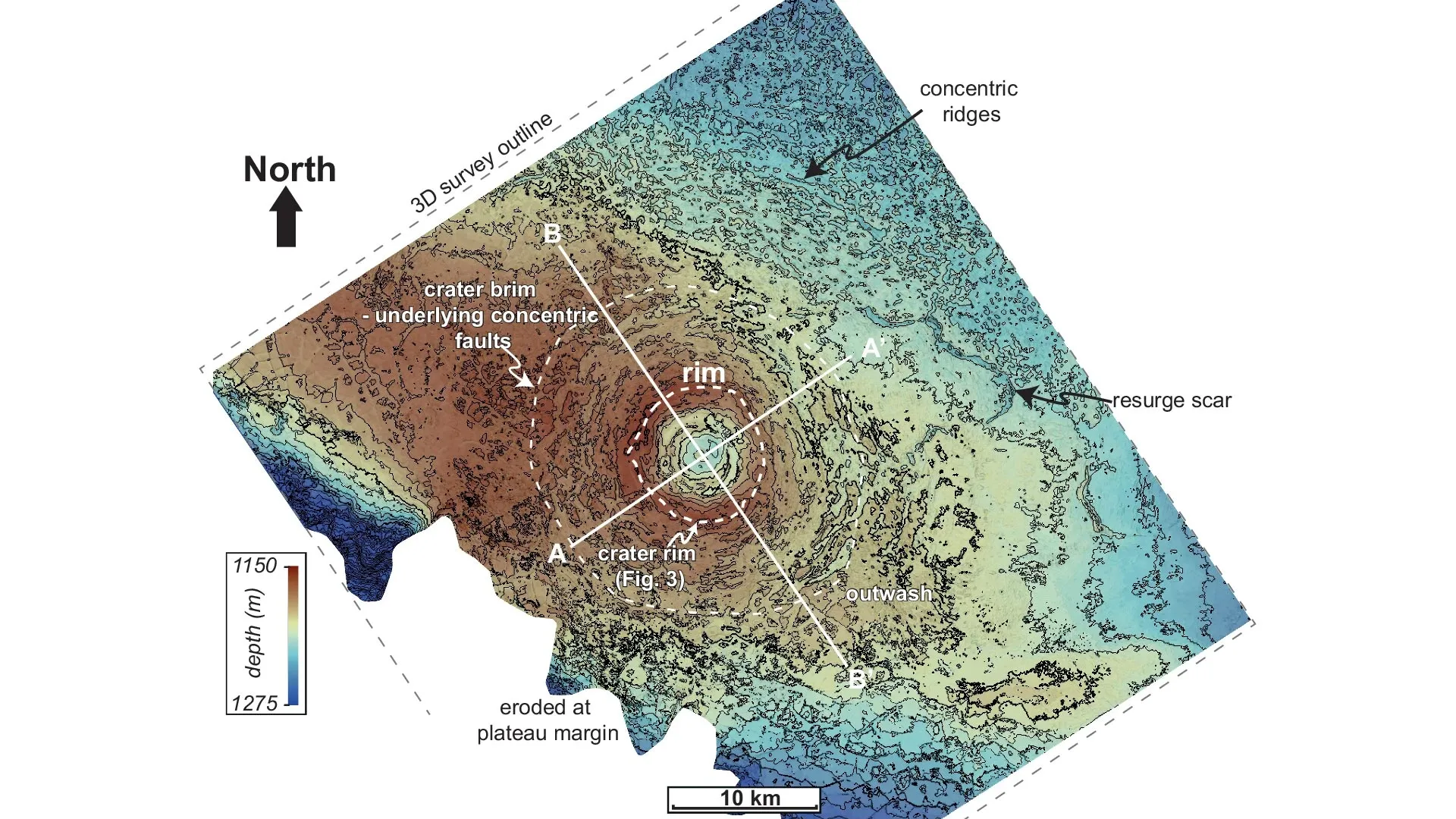
These images confirm that the 9 km (~5.6 mile) wide Nadir Crater, lying about 300 meters (~1000 feet) below the ocean floor, was created when an asteroid slammed into Earth roughly 66 million years ago at the end of the Cretaceous period.

The timing matches that of the Chicxulub impact in Mexico, the colossal 200 km (~125 mile) wide crater linked to the extinction of the dinosaurs.

Using the new data, scientists have pieced together what unfolded immediately after the Nadir impact: the crater initially formed as a deep bowl, molten rock surged upward from below, a vast zone of fractured rock spread outward for thousands of square kilometers, and an enormous tsunami more than 800 meters (~2600 feet) high swept across the Atlantic.

The research was published in Nature Communications Earth & Environment.

66 million-year-old underwater imprint

Dr. Uisdean Nicholson of Heriot-Watt University first identified the Nadir Crater in 2022 while examining seismic reflection data from the Atlantic seabed off the coast of Guinea in West Africa.

The data revealed a circular depression measuring more than 8.5 km across, leading Dr. Nicholson to suspect it was the site of an ancient asteroid strike.

He then collaborated with experts in planetary science and geology from the UK and the USA to analyze the evidence. Early results suggested the crater was formed by an asteroid several hundred meters wide about 66 million years ago, but proof remained uncertain.

That confirmation has now arrived.

From a grainy ultrasound to a 3D image

High-resolution, three-dimensional seismic data collected by the global geophysical company TGS and shared with Dr. Nicholson provides clear evidence that an asteroid created the Nadir Crater.

Dr. Nicholson said: “There are around 20 confirmed marine craters worldwide, and none of them has been captured in anything close to this level of detail. It’s exquisite.

“Craters on the surface are usually heavily eroded and we can only see what is exposed, whereas craters on other planetary bodies usually only show the surface expression.

“These data allow us to image this fully in three dimensions and peel back the layers of sedimentary rock to look at the crater at all levels.

“One way to understand it is to think about a pregnancy ultrasound. A few generations ago, the ultrasound would show a grainy blob. Now you can see the baby’s features in 3D, in incredible detail — including all the internal organs.

“We’ve gone from 2D, fuzzy imaging to amazing high-resolution imaging of the Nadir Crater.”

Data reveals minute-by-minute chaos after collision

Dr. Nicholson said: “The new images paint a picture of the catastrophic event.

“We originally thought the asteroid would have been around 400m wide. We now think it was 450-500m wide, because of the larger crater size as shown by the 3D data.

“We can tell it came from about 20-40 degrees to the northeast, because of spiralling thrust-generated ridges surrounding the crater’s central peak — those are only formed following a low-angle oblique impact.

“And we think it would have hit Earth at about 20 km per second, or 72,000 km per hour, although we still need to confirm this with a new set of impact models.”

Using the data, the scientists created a timeline of what happened in the seconds and minutes after impact.

Dr. Nicholson said: “After the impact and the central uplift forming, the soft sediments surrounding the crater flowed inwards towards the evacuated crater floor, creating a visible ‘brim’.

“The earthquake shaking caused by the impact appears to have liquefied the sediments below the seabed across the entire plateau, causing faults to form below the seabed.

“The impact was also associated with large landslides as the plateau margin collapsed below the ocean.

“As well as this, we see evidence for a train of tsunami waves going away from, then back towards the crater, with large resurge scars preserving evidence of this catastrophic event.”

A natural laboratory for asteroid impact research

Dr. Nicholson points out that humans have never witnessed an asteroid of this size crashing into Earth.

“The closest humans have come to seeing something like this is the 1908 Tunguska event, when a 50-meter asteroid entered Earth’s atmosphere and exploded in the skies above Siberia.”

“The new 3D seismic data across the whole Nadir Crater is an unprecedented opportunity to test impact crater hypotheses, develop new models of crater formation in the marine environment and understand the consequences of such an event.

“We’ve applied to IODP3, which is a new international drilling program, to drill into the seabed and recover cores from the crater. These will give us more information about the shock pressures experienced during impact, and the precise age and sequence of events that occurred after this event.”

Unlike the moon, Earth’s craters erode

Collaborator Dr. Sean Gulick of the University of Texas at Austin, USA, a geophysicist and expert on impact processes, noted: “3D seismic images of a fully-preserved impact crater are a fantastic research opportunity that can allow us to consider how impact processes and craters scale with the size of the impactor both for understand the evolution of the Earth, and other worlds.”

Collaborator Dr. Veronica Bray of the University of Arizona, an expert in impact cratering across the solar system, commented: “We see pristine impact craters on airless bodies like the Moon, but don’t have subsurface structural information.

“On the Earth, that is reversed: we have structural data from seismics, field mapping and drill cores, but the craters are usually very eroded at the surface.

“The new 3D seismic imaging of Nadir gives us both. It’s a startlingly good look at an impact crater!”

Could an asteroid this size hit Earth soon?

The rubble pile asteroid Bennu is around 400m in diameter. It is considered the most hazardous object in near-Earth orbit. According to NASA scientists, its total impact probability through the year 2300 is about 1 in 1,750 (or 0.057%). The researchers were also able to identify September 24, 2182, as the most significant single date in terms of a potential impact, with an impact probability of 1 in 2,700 (or about 0.037%)


Share Button

Melting ice is hiding a massive climate secret beneath Antarctica

Climate models have long predicted that global warming would weaken the Southern Ocean’s ability to absorb carbon dioxide (CO2). Yet decades of measurements show little sign of this decline. Scientists from the Alfred Wegener Institute (AWI) have now uncovered a likely reason for the surprising stability. Their findings suggest that fresh, low-salinity water near the surface has helped trap carbon in the deep ocean, slowing its return to the atmosphere. But climate change is steadily altering these delicate ocean layers and could soon disrupt this natural carbon storage system. The study appears in Nature Climate Change.

Why the Southern Ocean Matters So Much

The world’s oceans capture roughly one quarter of all human-produced CO2 emissions. The Southern Ocean alone accounts for about 40 percent of that total, making it one of the planet’s most powerful natural defenses against global warming. This immense carbon sink functions through a complex circulation system: deep water rises to the surface, exchanges gases with the atmosphere, and then sinks again, carrying absorbed CO2 back into the depths.

The balance depends on how much natural CO2 from ancient deep waters resurfaces. When more carbon-rich water from below reaches the surface, it limits how much new, human-made CO2 the ocean can take in. This interplay is governed by the layering, or stratification, of different water masses and by the strength of ocean currents.

Ancient Waters and Strengthening Winds

The deep water that resurfaces in the Southern Ocean has been isolated for centuries or even millennia, accumulating large amounts of CO2. Climate models predict that stronger westerly winds, a result of human-driven climate change, will bring more of this carbon-rich water to the surface, reducing the ocean’s capacity to absorb CO2 in the long term.

However, despite these stronger winds, data collected over recent decades show that the Southern Ocean remains a strong carbon sink. The new AWI research helps explain why: ocean layering has changed in a way that keeps much of the deep carbon locked away.

The Invisible Barrier Holding Carbon Below

“Deep water in the Southern Ocean is normally found below 200 meters,” says Dr. Léa Olivier, AWI oceanographer and lead author of the study. “It is salty, nutrient-rich and relatively warm compared to water nearer the surface.”

This deep water contains large stores of dissolved CO2 that entered the ocean long ago. In contrast, near-surface water is cooler, less salty, and holds less CO2.

As long as this density layering remains strong, the CO2-rich deep water stays sealed off. But if the boundary between layers weakens, that trapped carbon could more easily reach the surface and escape into the atmosphere.

Stronger Winds, Rising Risks

“Previous studies suggested that global climate change would strengthen the westerly winds over the Southern Ocean, and with that, the overturning circulation too,” says Léa Olivier. “However, that would transport more carbon-rich water from the deep ocean to the surface, which would consequently reduce the Southern Ocean’s ability to store CO2.”

Although such wind intensification has been observed and linked to human activity, measurements still show no major decline in the ocean’s carbon uptake — at least not yet.

Freshwater Inputs Strengthen Ocean Layers

Long-term monitoring by AWI and other research institutions shows that climate change is already altering the characteristics of both surface and deep waters. “In our study, we used a dataset comprising biogeochemical data from a large number of marine expeditions in the Southern Ocean between 1972 and 2021. We looked for long-term anomalies, as well as changes in both circulation patterns and the properties of water masses. In doing so, we only considered processes related to the exchange between the two water masses, namely circulation and mixing, and not biological processes, for example,” explains Léa Olivier. “We were able to determine that, since the 1990s, the two water masses have become more distinct from one another.” The Southern Ocean’s surface water salinity has reduced as a result of increased input of freshwater caused by precipitation and melting glaciers and sea ice. This “freshening” reinforces the density stratification between the two water masses, which in turn keeps the CO2-rich deep water trapped in the lower layer and prevents it from breaking through the barrier between the two layers.

A Temporary Shield Against Climate Change

“Our study shows that this fresher surface water has temporarily offset the weakening of the carbon sink in the Southern Ocean, as model simulations predicted. However, this situation could reverse if the stratification were to weaken,” summarizes Léa Olivier. Strengthening westerly winds are already pushing the deep water closer to the surface. Since the 1990s, the upper boundary of the deep water layer has risen by about 40 meters.

As CO2-rich water replaces more of the surface layer, the boundary between them becomes more vulnerable to mixing, likely caused by those same winds. Once mixing increases, stored CO2 could begin to leak upward and escape into the atmosphere.

Warning Signs Beneath the Waves

Recent research suggests that this process may already be starting. If more carbon from the deep ocean reaches the surface, the Southern Ocean’s role as a global carbon sink could weaken, accelerating climate change.

“What surprised me most was that we actually found the answer to our question beneath the surface. “We need to look beyond just the ocean’s surface, otherwise we run the risk of missing a key part of the story,” says Léa Olivier.

“To confirm whether more CO2 has been released from the deep ocean in recent years, we need additional data, particularly from the winter months, when the water masses tend to mix,” explains Prof. Alexander Haumann, co-author of the study. “In the coming years, the AWI is planning to carefully examine these exact processes as part of the international Antarctica InSync program, and gain a better understanding of the effects of climate change on the Southern Ocean and potential interactions.”

Share Button

NHS needs £3bn to cover strikes, redundancies and drug costs, say health leaders

Health leaders say progress on reducing waiting lists will be affected if there is no help in making up the financial shortfall.

Share Button

We will not ‘be held to ransom’ by striking doctors, says minister

The health secretary is refusing to make concessions on pay after the BMA announced a further walkout.

Share Button

The Most Popular Dog Names Of 2025

Just like baby names, dog names ebb and flow in popularity each year depending on pop culture, traditions and more.

One year, you may run into dozens of dogs named Ollie at the dog park, just for lots of pups named Luna to appear a few years later.

This year, though, many dog owners stuck to certain trending names, according to a report from online pet supply retailer and pharmacy Chewy, which uses data from the profiles users make for their pets to determine pet name trends and name popularity throughout the country.

When signing up for an account, users input the name of their dog, their pet’s birthdate and the type of dog they have, Ciara Lavelle, pet expert at Chewy, told HuffPost via email.

“By looking at this aggregated information, we can see which dog names are trending and celebrate the most popular picks of the year,” Lavelle said.

According to this year’s data, the top 10 dog names for both male and female dogs are:

  1. Bella

  2. Luna

  3. Daisy

  4. Lucy

  5. Max

  6. Charlie

  7. Bailey

  8. Cooper

  9. Buddy

  10. Sadie

Charlie and Luna are among the most popular dog names of the year.

Getty Images

Charlie and Luna are among the most popular dog names of the year.

Beyond the top 10, names like Cheeto, Brisket and Elphaba are also becoming more popular.

Even if your pup’s name doesn’t fall within the top 10 most popular, there’s a chance their moniker is still part of a larger movement.

According to Lavelle there are some “really fun dog name trends” going on this year; for example, food-inspired names are growing in popularity. “Cheeto and Pickles both rose about 25% in popularity since 2024, and Brisket is up 68%,” Lavelle said.

The popularity of the film “Wicked,” the first part of which was released in November 2024, also inspired some pup names, she noted. The name Elphaba, which is the name of the Wicked Witch of the West (played by Cynthia Erivo), has grown in popularity by 200% since last year, along with its nickname Elphie. The name Glinda, which is the name of the Good Witch (played by Ariana Grande), has grown by 175% this year.

A few other pop-culture names were favored this year, too. “Plenty of pups were named in homage to Ozzy Osbourne, who passed away earlier this year. We’re seeing a 15% bump in dogs named Ozzy,” Lavelle said.

The popularity of this past season of “The White Lotus” also inspired 2025 dog names. “Remember the ‘Piper, no!’ meme from the last season of ‘The White Lotus’? We can’t prove there’s a connection, but Piper as a pet name is up 33% since last year,” added Lavelle.

What to keep in mind when naming your pet, according to an expert.

Naming your dog can feel like a tall task. Will it match their personality? Do they look like their name? Or does it sound too much like your nephew’s name?

“You can take inspiration from just about anything as you’re naming your dog — their color, their personality, or your favorite movies or musicians,” Lavelle said.

If you need some inspiration beyond the name’s Chewy has identified this year, American Kennel Club has a helpful list of ideas, including unique names, trending names and classic ones. (Storm, JoJo, Scout, Zeke, Kona and Jax are just several of the names on this list.)

It is important to remember that your dog’s name isn’t something that only your pup will hear. “You’re going to be yelling it at the dog park and responding to it at the vet’s office, so if you decide on something silly, be prepared to own it,” Lavelle said.

As long as you pick a respectful, not-offensive name, you really can’t go wrong.

“No matter what you choose, your dog will love it,” said Lavelle — “because it’s how they’ll be called by their favourite person.”

Share Button

12 Things Millennials Do That Stress Out Gen Zers

Every generation has its quirks. Millennials and Gen Zers may only be a small number of years apart, but culturally, they often feel worlds away.

From the way they communicate to the way they approach work, life and even pop fandoms, their styles can clash ― sometimes in ways that really irritate each other.

We asked Gen Zers to share the millennial behaviours that frustrate and stress them out. Of course, many of these habits vary across individuals within the same generation, but certain tendencies and patterns still emerge. Here’s what they had to say:

1. Ominous Punctuation

“For me, a main millennial ‘ick’ is the dot-dot-dot or period of doom. Getting a ‘Sure…’ or ‘Thanks.’ makes it feel like I’m in trouble.” ― Ethan Hillis, TikTok creator

2. Over-Emphasis On Appearances

“They have a need to make everything aesthetic. Gen Z is very guilty of this as well, however, I think that millennials grew up with the rise of social media. Rather than listening to their favourite artist at a music festival or sharing a drink with friends at brunch, I think they’re more prone to focus on getting a good Instagram or Snapchat story. This just fuels what it means to live vicariously through social media, rather than in the moment.” ― Madeline Kerestman, TikTok creator

3. Passive-Aggressive Lingo

“The passive-aggressive work lingo. ‘Per my last email,’ ‘gentle nudge,’ ‘circling back’ … all of it stresses me out instantly.” ― Hillis

4. Getting Competitive Around Generations

“Making conversations about economic problems millennial vs. Gen Z instead of realising we’re all struggling, and different times had their own unique problems.” ― Ayana Williams, digital marketer

“Why is this a competition? Why are we battling between generations? I feel like millennials are constantly comparing their generation and saying things like, ‘Oh you guys have it so easy. Back in my day …’ I think millennials went through a really difficult period, so they might have a lot of resentment toward our generation. But in reality, I feel like Gen Zers are going through a lot of different challenges that the previous generation didn’t go through too.” ― Lavinia Gabriele, high growth startup manager and member of The Z Suite

5. Lack Of Boundaries

“I’ve noticed that a lot of millennials don’t have a lot of boundaries at work ― whether it’s that your work hours are not well defined and you’re supposed to be on at all times, or it’s asking personal questions. Millennials are a lot more open with their thoughts, and I think it’s a little bit stressful when they ask really personal questions about your life when maybe I don’t want you to know about it.” ― Gabriele

"Millennials are a lot more open with their thoughts, and I think it’s a little bit stressful when they ask really personal questions about your life when maybe I don’t want you to know about it," said Lavinia Gabriele, a gen Z high-growth startup manager.

We Are via Getty Images

“Millennials are a lot more open with their thoughts, and I think it’s a little bit stressful when they ask really personal questions about your life when maybe I don’t want you to know about it,” said Lavinia Gabriele, a gen Z high-growth startup manager.

6. Inability To Relax Until Things Are Fully Completed

“I feel that sometimes there is a very strong hustle culture where millennials feel they are always ‘in the trenches’ and life is about surviving rather than experiencing. Of course, Gen Zers are ambitious as well. But when there’s a big challenge or new project at work, I do observe that the millennials on my team are like, ‘Oh, my god. How do we survive through this?’ ― while the Gen Zs are a bit more relaxed and moving through it. It doesn’t mean we don’t care. We’re still going to power through. And I have friends and cousins who are millennials that tend to get really stressed out about planning certain things. Until the plan has reached a certain stage of being completed, they’re super stressed out.” ― Angel Aileen, member of The Z Suite who works in a tech forward beauty company

7. Withholding Validation And Information

“I think because Gen Zs grew up in a world of social media, we’re conditioned to get dopamine rewards constantly. So at a workplace, how that shows up is if we do work, we really want to feel recognised. Everyone has their different ways of feeling recognised or rewarded. But if they don’t get that, they feel very down. They want to feel seen, so getting a sense of reward or recognition makes a huge difference in the workplace. And millennials don’t necessarily realise that. But I really notice millennials who recognise and appreciate their Gen Z employees have better team dynamics. It’s similar with sharing information because Gen Zers like to see the whole picture of their job. If millennials share the big picture of what we’re all working on, then it’ll feel more like we’re all working toward the same goal and contributing to the puzzle. Gen Zers are happier when they feel a bigger sense of purpose in their work.” ― Aileen

8. Overwhelming Communication

“Slack novels. A whole LinkedIn-style essay in a quick chat app? I can’t.” ― Hillis

“With their communication style over text, they send like a lot of emojis, like a million emojis. And they’ll screenshot a meme and text it to you, instead of sending it to you directly in the app. And then the meme isn’t that funny…” ― Gabriele

9. Assuming Gen Zers Don’t Get References

“Not recognising some of us are Gen Zennials and very much remember late 90s/early 2000s references and going outside to play.” ― Williams

10. The Millennial Pause

“The millennial pause at the start of videos. They can just cut that part out.” ― Williams

11. Work-Life Balance Overload

“They lean a little too far into the ‘work-life balance’ mindset. As a med student myself, I am all about maintaining a ‘work hard, play hard’ mentality. I value hard work and believe that while it’s incredibly important to maintain a healthy balance, it should never be used as a way to do the bare minimum. I think the millennial generation introduced this mentality and took it to another level, which has normalised using ‘boundaries’ as an excuse to cut corners.” ― Kerestman

12. Taylor Swift Obsession

“This is 100% a personal preference, and I know I might get some backlash for this! For some reason, I feel like I associate the millennial generation with the ‘Swiftie’ fanbase. Taylor Swift is iconic and such a talented artist. However, I think her fans take it to an unnecessarily intense level, and I just don’t understand the hype.” ― Kerestman

Answers have been edited and condensed for clarity.

Share Button

Ancient DNA reveals the deadly diseases behind Napoleon’s defeat

Scientists from the Institut Pasteur have conducted a genetic analysis of the remains of soldiers who retreated from Russia in 1812. Their work uncovered traces of two disease-causing pathogens — those behind paratyphoid fever and relapsing fever — which match the symptoms described in eyewitness records from that time. The findings were first shared as a preprint on bioRxiv on July 16, 2025, and later published in the journal Current Biology on October 24.

Investigating the Mystery of the 1812 Retreat

Napoleon’s invasion of Russia in 1812, known as the “Patriotic War of 1812,” ended in one of history’s most disastrous retreats. To better understand what role disease may have played in this collapse, researchers from the Institut Pasteur’s Microbial Paleogenomics Unit partnered with the Laboratory of Biocultural Anthropology at Aix Marseille University. The team analyzed the DNA of 13 French soldiers exhumed in 2002 from a burial site in Vilnius, Lithuania, uncovered during archaeological excavations led by the Aix-Marseille University group. Using next-generation sequencing technology on ancient DNA, they searched for genetic traces of infectious organisms.

The researchers detected two distinct disease agents: Salmonella enterica subsp. enterica (serovar Paratyphi C), which causes paratyphoid fever, and Borrelia recurrentis, the bacterium responsible for relapsing fever. The latter is transmitted by lice and produces alternating periods of fever and recovery. Although different, both infections can cause severe fever, exhaustion, and digestive distress. Their combined impact could have intensified the soldiers’ suffering at a time when cold, hunger, and poor sanitation were already taking a heavy toll.

Genetic Evidence From Napoleonic Soldiers

Out of the 13 soldiers examined, DNA from S. enterica Paratyphi C was found in four individuals, and B. recurrentis was detected in two. This marks the first direct genetic confirmation that these pathogens were present in Napoleon’s army. Their exact contribution to the enormous death toll remains uncertain, but the findings complement earlier research that identified Rickettsia prowazekii (the cause of typhus) and Bartonella quintana (responsible for trench fever), both long suspected of spreading through the ranks during the retreat.

Because only a small number of samples could be analyzed compared to the thousands of remains in Vilnius, researchers cannot yet determine how widespread these infections were. The tested soldiers represent a tiny fraction — 13 out of more than 3,000 bodies at the site and roughly 500,000 to 600,000 troops who took part in the campaign, of whom about 300,000 died during the retreat.

Understanding the Past to Protect the Future

“Accessing the genomic data of the pathogens that circulated in historical populations helps us to understand how infectious diseases evolved, spread and disappeared over time, and to identify the social or environmental contexts that played a part in these developments. This information provides us with valuable insights to better understand and tackle infectious diseases today,” explains Nicolás Rascovan, Head of the Microbial Paleogenomics Unit at the Institut Pasteur and last author of the study.

To achieve these results, the team worked in collaboration with scientists from the University of Tartu in Estonia to develop an innovative authentication workflow involving several steps, including a phylogeny-driven interpretive approach for the highly degraded genome fragments recovered. This method enables scientists to accurately identify pathogens even if their DNA only yields low coverage, in some cases even indicating a specific lineage.

“In most ancient human remains, pathogen DNA is extremely fragmented and only present in very low quantities, which makes it very difficult to obtain whole genomes. So we need methods capable of unambiguously identifying infectious agents from these weak signals, and sometimes even pinpointing lineages, to explore the pathogenic diversity of the past,” he adds.

Linking History and Disease

The team’s results closely match the historical descriptions of the fevers that swept through Napoleon’s forces. This connection strengthens the theory that infectious diseases contributed to the disastrous outcome of the 1812 campaign, along with other factors such as exhaustion, starvation, and the brutal Russian winter.

Napoleon’s 1812 campaign ultimately ended in defeat, forcing a massive withdrawal that devastated his army. The Russian forces reclaimed Moscow, marking a turning point that dealt a fatal blow to Napoleon’s military ambitions.

Share Button

‘My Mum Expects Me To Care For Her In Old Age. How Do I Tell Her I Can’t?’

Over-50s own 78% of the UK’s property wealth, and the Financial Times reports that one in five “Boomers” are millionaires (largely due to soaring property prices).

But, like all modern wealth, this is a story of deep inequality. The Centre For Ageing Better says that roughly 18% of older people live in relative poverty; one in six over-55s have zero retirement savings, and 9-12% of rough sleepers are believed to be over 55.

Which means that renting long past retirement age, never mind costly nursing home care, is out of the question for many.

That might lead some, like the mother of Redditor u/Swimsmoke, to assume their children will help with their housing, care, and costs in their old age.

But, like the 6.6 million UK adults who say they wouldn’t know where to start with the commitment, the site user said they’re not sure they’re able to do it.

We asked Dr Barbara Sparacino, an adult and geriatric psychiatrist also known as The Ageing Parent Coach, how to handle the situation.

The original poster (OP) feels guilty

Writing to the forum r/AmItheAsshole (AITA), the OP said that her 63-year-old mother retired from her career 15 years ago but has been making money through a soap business since.

“She lives in a small studio and has a car but not much else to her name,” the woman added, stating that her mother is quite frivolous with her spending and likes to travel a lot.

Ahead of a hip surgery, her mum has started to think about what her future will look like and expects her 30-year-old daughter to “help”.

OP has a few reservations. Firstly, their relationship is a little fraught, and the poster says their mother delivered “bare minimum” care in their teens.

Then, guilt, money, and time come into it.

“I also feel some amount of responsibility for the woman who birthed me, a woman who had a hard and traumatising life as well – but I don’t have the resources to help in any real capacity,” they wrote.

“I don’t have money to throw at the problem, I don’t want to use all my time off for the year taking care of her, and I wouldn’t get paid if I take leave, which I won’t even qualify to take until another six months from now.”

She ended, “AITA for putting myself first here?”

Honesty is the kindest policy

Speaking to HuffPost UK, Dr Sparacino said that, “Often, these expectations are unspoken. A parent might have spent years believing you’d ‘step in one day,’ even if that was never discussed.

“When you finally say you can’t, guilt and fear can flood in, but honesty is an act of love, too.”

There is no point offering something you cannot emotionally or financially afford, she added. So, try to stay clear-sighted and precise about what you’re really able to offer – even if that doesn’t feel like much.

“Maybe you can help plan for future care, find resources, or support them emotionally, but you can’t take on full-time or financial responsibility. That’s not neglect; that’s setting a boundary rooted in realism and care,” the psychiatrist said.

She recommends saying something like, “Mum, I love you and want you to be well supported as you get older. But I can’t be your full-time caregiver. I’d like to help you make a plan so you’ll have what you need.”

Dr Sparacino added that your parent might respond with fear, anger, or sadness.

“Try to respond with calm empathy: ‘I know this is hard to hear, but I want us to plan ahead so neither of us faces this alone,’” she stated.

“You’re not rejecting your parent; you’re protecting both of you from burnout, resentment, and crisis later on. Love without boundaries leads to depletion, not devotion.

“If you’re struggling with this kind of conversation, you don’t have to figure it out alone, reach out to a professional experienced in ageing and family dynamics for guidance and support.”

Help and support:

  • Mind, open Monday to Friday, 9am-6pm on 0300 123 3393.
  • Samaritans offers a listening service which is open 24 hours a day, on 116 123 (UK and ROI – this number is FREE to call and will not appear on your phone bill).
  • CALM (the Campaign Against Living Miserably) offer a helpline open 5pm-midnight, 365 days a year, on 0800 58 58 58, and a webchat service.
  • The Mix is a free support service for people under 25. Call 0808 808 4994 or email help@themix.org.uk
  • Rethink Mental Illness offers practical help through its advice line which can be reached on 0808 801 0525 (Monday to Friday 10am-4pm). More info can be found on rethink.org.
Share Button

Willpower doesn’t exist. Why so much of your health isn’t your fault

Dr Xand and Dr Chris van Tulleken share four small but powerful tips they’ve learnt over the course of 30 episodes.

Share Button

Scientists launch $14.2 million project to map the body’s “hidden sixth sense”

How does your brain know when to take a breath, stabilize your blood pressure, or fight off an infection? The answer lies in interoception, a lesser-known process through which the nervous system constantly monitors the body’s internal signals to keep essential functions running.

Now, a collaborative team from Scripps Research and the Allen Institute has received the National Institutes of Health (NIH) Director’s Transformative Research Award to develop the first comprehensive atlas of this internal sensory system.

A Major Investment in Brain-Body Research

Leading the project is Nobel Prize-winning neuroscientist Ardem Patapoutian, joined by Li Ye, the N. Paul Whittier Chair in Chemistry and Chemical Biology at Scripps Research, and Bosiljka Tasic, Director of Molecular Genetics at the Allen Institute. Xin Jin, Associate Professor at Scripps Research, will serve as co-investigator, directing the genomic and cell-type identification work.

The NIH has awarded the team $14.2 million over five years to carry out this ambitious project.

“My team is honored that the NIH is supporting the kind of collaborative science needed to study such a complex system,” says Patapoutian, the Presidential Endowed Chair in Neurobiology at Scripps Research.

Patapoutian, who shared the 2021 Nobel Prize in Physiology or Medicine for his discovery of cellular sensors that detect touch, will now apply his expertise to understanding interoception.

“We hope our results will help other scientists ask new questions about how internal organs and the nervous system stay in sync,” adds Ye. Like Patapoutian, he’s also a Howard Hughes Medical Institute Investigator.

Established in 2009, the Transformative Research Award funds groundbreaking interdisciplinary projects that push beyond traditional scientific boundaries. It is part of the NIH Common Fund’s High-Risk, High-Reward Research Program, designed to support innovative ideas that could reshape our understanding of human health but might otherwise struggle to receive funding through conventional mechanisms.

What Makes Interoception Unique

Unlike the classic senses — such as smell, sight, and hearing — which rely on specialized sensory organs that detect stimuli from the outside world, interoception involves a vast network of neurons that sense what’s happening inside the body. These neural circuits track critical processes including circulation, digestion, and immune activity.

Because interoceptive signals originate deep within the body and are often processed unconsciously, scientists often describe this system as our “hidden sixth sense.”

Despite its fundamental role, interoception has received little scientific attention. The signals it produces are complex, overlapping, and difficult to measure. The sensory neurons that carry them are distributed throughout organs such as the heart, lungs, stomach, and kidneys, making them hard to isolate and map precisely.

Mapping the Brain-Body Connection

With the NIH’s support, the Scripps and Allen Institute researchers plan to map how sensory neurons connect with a wide variety of internal organs, including the heart and gastrointestinal tract. Their goal is to create a detailed anatomical and molecular atlas that reveals how these neural pathways are organized.

To achieve this, one part of the project will label sensory neurons and use whole-body imaging to trace their routes from the spinal cord to different organs, producing a high-resolution 3D map. The second part will use genetic profiling to distinguish between different cell types, such as neurons that send signals from the gut, bladder, or fat tissue.

Together, these datasets will form the first standardized reference for understanding the body’s internal sensory wiring.

Why Interoception Matters for Health

By decoding how interoception works, scientists hope to uncover key principles of brain-body communication that could lead to new treatments for disease. Disruptions in these internal sensory pathways have been linked to a range of conditions, including autoimmune disorders, chronic pain, neurodegenerative diseases, and high blood pressure.

“Interoception is fundamental to nearly every aspect of health, but it remains a largely unexplored frontier of neuroscience,” says Jin, who’s a Howard Hughes Medical Institute Freeman Hrabowski Scholar. “By creating the first atlas of this system, we aim to lay the foundation for better understanding how the brain keeps the body in balance, how that balance can be disrupted in disease and how we might restore it.”

Share Button