Speaking to The Times recently, actor Richard E. Grant – who lost his wife of 35 years, voice coach Joan Washington, in 2021 – said the experience led him to cut certain friends out of his life for good.
“There are people that have been edited out of my life, and I will never see them again,” he shared, speaking about friends who became distant after his wife’s death. “If I had done that to them, I wouldn’t be able to look them in the face.”
Advertisement
I’ve heard a similar sentiment from many bereaved loved ones (I’ve been blindsided by it, too). Something tragic happens, and just when you need support the most, people you’d have thought were closest to you appear to fade away.
Or maybe you feel you can never “connect” the same with your old pals after such a life-changing event (another common issue friends have shared).
What’s happening here? HuffPost UK spoke to BACP-registered therapist Laurie Hole about why friendships so often fall apart after a death.
Advertisement
Why do so many friendships break apart after a death?
Hole said that while death is universal, the topic of grief remains incredibly taboo for many.
“We are generally very under-equipped to understand grief or know how to support somebody through it,” she explained.
“Until you experience a significant loss, it can be almost impossible to comprehend the enormity of it – and even the grieving person themselves may struggle to make sense of what they are experiencing.”
That might mean those suffering a terrible loss feel the responsibility to explain their feelings or the nature of their pain when they might be least equipped to do so.
Advertisement
Therefore, the griever might isolate themselves first: “Sometimes withdrawing from friendships becomes a way of protecting already very limited emotional reserves”.
Other times, the therapist added, “Another person’s loss can bring up [friends’] own unacknowledged or unresolved grief, or confront them with feelings about death and mortality that they would rather avoid. They may have their own life challenges that mean they simply don’t have the capacity they ordinarily would.”
She said this isn’t always intentional, though it still stings.
“And sometimes people genuinely believe they are saying or doing something helpful, but it lands painfully. Good intentions don’t necessarily prevent hurt, particularly when we have so few conversations about what grief actually looks and feels like.”
Advertisement
How can I be a better friend to a grieving person?
Given how little grief and death are talked about, Hole shared some guidelines that can help you if your friend is going through it.
These are:
Ban the phrase “at least”. The therapist said we should avoid sentences like “’At least they lived a long life’, ‘at least they’re no longer suffering’, ‘at least you had the time you did’ – however well-intentioned, trying to find a positive in somebody’s loss can feel incredibly devastating to the person hearing it”.
Forget about timelines. When someone loses a loved one, Hole said, don’t try to give them a schedule for getting over the pain or “accepting” their loss. “Instead of asking whether they have accepted or moved on from the death yet, you could ask, ‘How is grief showing up for you right now?’ Be curious about their experience rather than assuming what it should look like,” she advised.
Read up. You might not be able to imagine your friend’s pain, but it can help to “read memoirs and accounts of grief rather than expecting your friend to teach you everything – while remembering that nobody else’s grief will be exactly like theirs”.
Don’t forget big dates. Check in on “the dates that matter: the anniversary of the death, birthdays and other significant occasions. And if you knew the person who died, share your memories,” the expert advised.
Say their loved one’s name. “People sometimes worry that mentioning somebody who has died will remind the grieving person of their loss, but they haven’t forgotten,” stated Hole. “Hearing their loved one’s name can instead be a reminder that this person mattered to other people too.”
When should I give up on a friendship that’s suffering after a death?
Sadly, Hole said, “Friendships don’t necessarily have to last a lifetime, and losing friendships following bereavement can itself become another loss that has to be processed. The death of someone you love is already a profound loss; discovering that some of your friendships cannot survive your grief can become another loss that has to be grieved”.
There’s no right or wrong answer when it comes to breaking a friend off, she continued. “Repair might involve acknowledging what happened, listening without becoming defensive, and taking responsibility for the impact – even when causing hurt was never the intention.
Advertisement
“But if somebody who is grieving has explicitly communicated what they need or set boundaries and a friend continually ignores or dismisses those needs, it is reasonable to consider whether that friendship can support them at this point in their life. Sometimes that means temporarily stepping back; sometimes it means allowing the relationship to end.”
Sometimes, the therapist shared, grief can expose existing problems that were easier to hide before a death. And bereavement can make someone who used to put up with a lot more bad behaviour less forbearing, too.
“If maintaining a friendship is repeatedly causing more hurt, it may be worth asking whether that person can still have a place in your life in the same way they did before.”
I hadn’t seen my dad in five years when my sister texted me that he had fallen at home. After I had my first child, the childhood abuse I had previously overlooked to keep the peace suddenly became incomprehensible, and I chose to become estranged from him.
But when I found out he was dying, I knew time was running out to reconcile. I didn’t want to regret missing it.
Advertisement
On my first visit to see him, I brought flowers and kneeled by his bedside. He was thin, jaundiced and bedridden. His fine hair was snowy and delicate over his scalp, his movie star cheekbones more prominent than ever. His brown eyes still looked like mine.
But he didn’t recognise me. He stared at me and looked away repeatedly, his expression bewildered and hurt.
“Who are you?” he asked.
I was stunned and told him who I was.
“Is it OK that I’m here, or would you prefer I go?” I asked.
“You can stay. I’m just surprised. It’s been a long time.” There was grief and accusation in his voice.
Advertisement
“I know,” I said.
I wouldn’t apologise for the estrangement. He wouldn’t apologise for the abuse. We wouldn’t talk about the past when death was so close.
When I left, I kissed his forehead and promised I’d be back.
A few weeks later, I signed up to be an early literacy volunteer, teaching young children to read. Once a week, I spent an hour with the students during their lunch break, reviewing the alphabet and helping them sound out words while they ate orange slices and whole wheat pizza.
Then I would spend an hour with my dad at the healthcare facility where he lived for his last five months. We would share a few minutes of small talk, I would feed him small bites of baked fish or tater tots, and we’d watch TV.
Advertisement
The two things were connected. My father’s side of the family is full of educators. My dad was a professor for more than 50 years. He’s the reason I have post-traumatic stress disorder, but he’s also the reason I love literature, travel, art, food and languages. His mother – my namesake – was once a missionary-teacher who rode on horseback four miles every day to reach her students.
“Teaching is a spiritual thing,” my dad said.
I thought volunteering to help children read would connect me to my dad and our family as he was dying. The kids were at the beginning of their lives and education, while my father, the professor, was coming to the end of his.
I volunteered on Mondays. Usually, I visited my father at the end of the week. My weeks were measured in the bookends of life.
Advertisement
There were six schools where I could volunteer – all underfunded and with low reading test scores. I chose the one closest to my childhood home, my dad’s house. I was a kindergartener in that neighbourhood the first time my dad squeezed my wrists so hard that bruises encircled them for weeks.
The school was a rectangular building made with dark bricks. I had passed by it countless times as a child. From the outside, it looked institutional in the late September sun. But inside, I was surprised by how light it was. The hallways were painted white and worn in places with scuffs and pencil squiggles – imprints from students growing up.
Three large trees grew in the foyer outside the library. Their shiny green leaves wove a canopy over the grey and blue tiles where kids walked from recess, lunch and library time. That’s where I met the kids with whom I’d be working, affectionately called Book Buddies.
Advertisement
The volunteer program coordinator handed me two folders, each bearing the name of a little boy. We had two assignments for the day. The first was to complete “getting to know me” sheets. The second was to assess how many letter names and sounds they knew.
I asked them their birthdays, their favorite colour and to draw their favourite food. My first buddy knew the letters in his name but no others. My second buddy surprised me by knowing all the letters and their sounds, but he said them quietly with his eyes downcast.
Photo Courtesy Of Virgie Townsend
The author volunteering for the Book Buddies program
Advertisement
At the school, there was the squeak of sneakers as kids ran in the hall and the voices of teachers announcing it was time to line up. There were boxes of small books, word games with dice, pencils, plastic utensils and thin straws for chocolate milk cartons.
Over time, I learned my first buddy loved to take a big sip of chocolate milk and burp and then we’d laugh together. He introduced me to his kindergarten friends. In the winter, his boot shoelaces were always undone, so I tied them before he returned to class.
My second buddy rarely made eye contact but read everything I put in front of him perfectly. He was reserved, but told me he lived with his dad and loved reading books the program gave him.
Advertisement
I praised both kids for their reading, hard work and the progress they made.
Sometimes after volunteering, I’d drive by my childhood home. With my father gone, the house stood empty.
At the healthcare facility, there was a crane to lift my dad, who used to hike by the Sequoias near his own childhood home. There were nurses who joked as they spooned medication into his mouth and the blare of televisions playing at full volume. There were cartons of Ensure and automatic hand sanitiser dispensers.
Sometimes my dad seemed stronger. On a good day, we watched Star Trek, and he laughed out loud for the first time in a while. When I left, he called after me in a strong voice, “Love you, honey.”
Advertisement
But organ failure is a rollercoaster with many ups and downs, all heading toward the inescapable end. Mostly, I worried about the emergence of new symptoms like the jaundice and itchiness that came and went. The bones I hadn’t seen before, jutting clavicle and breastbone. Lost fat on his fingers, every knuckle visible beneath the thin skin.
On a cold January day, I was with my dad when he began seizing. The seizures were quick, full-body and terrifying. He didn’t remember them – he just thought he’d fallen asleep for a minute. The doctor said there was nothing else they could do.
Four days later, he was unconscious. His breaths were long, slow and gasping. His TV was off. He had stopped responding to us. I asked my sisters for a minute alone with him. Everything we had left was in that small room.
Advertisement
“I hope that in whatever comes next, you receive the love you didn’t get as a child and you’re able to give that love to yourself and others in return,” I told him. “If there’s regret or anything else you’re carrying, you can put it by the wayside. You don’t have to carry it for me.”
He died the next morning. After he took his last breath, I watched the pulse in his neck grow fainter until I couldn’t see it beating under his skin anymore.
“Dad, I’m just going to check your pulse, OK?” I said. I placed two fingers on his neck – a place I had never touched before – and felt no movement.
Advertisement
Before the funeral home director placed him on the gurney, I kissed his forehead one final time and then wept.
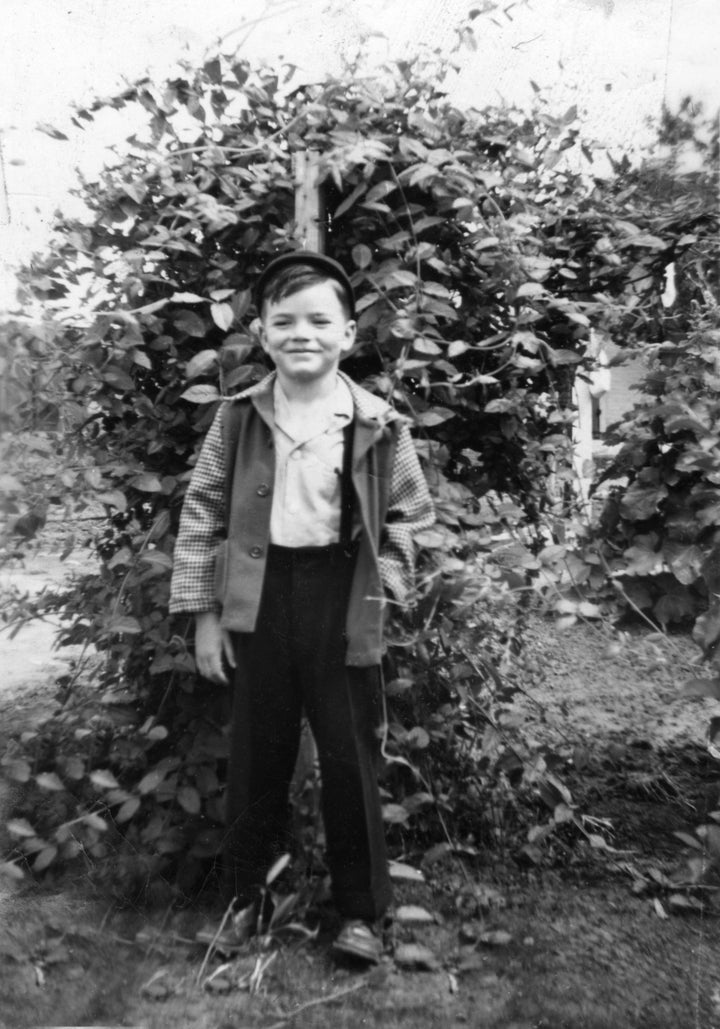
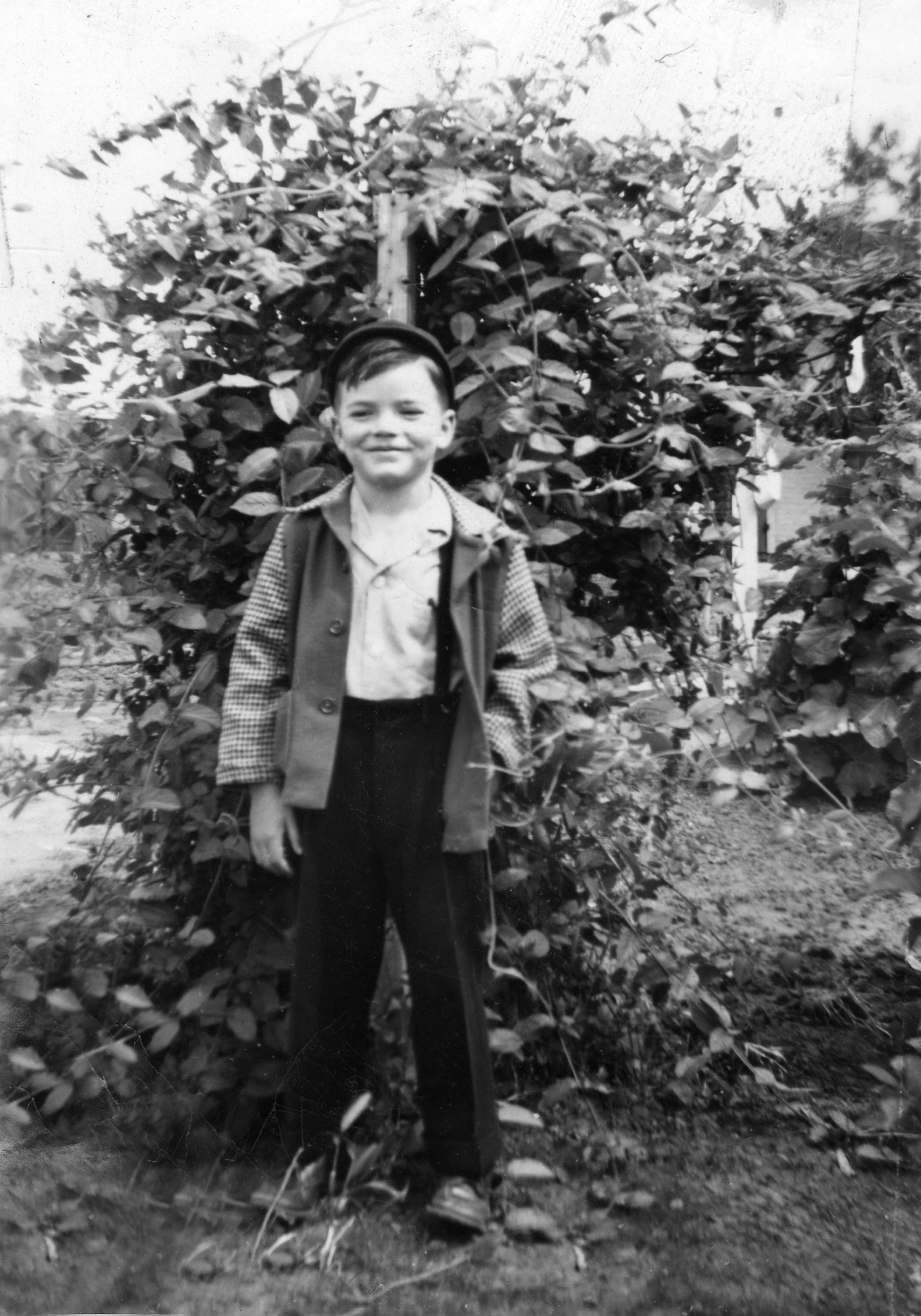
Depleted by grief and the paperwork that accompanies a parent’s death, I didn’t return to volunteering for a month. Sometimes I’d look at a photo of my dad from when he was 5 years old – the same age as my own son and my volunteering buddies.
In the picture, my dad wore a black cap over his dark hair, and his left hand was in the pocket of his checkered coat. Although I knew he had an unsafe, loveless childhood, he beamed a proud smile. I wished I could go back in time to protect that little boy.
Advertisement
Photo Courtesy Of Virgie Townsend
The author’s father, John Townsend, at 5 years old
When I went back to the school, my first buddy walked up to me with his lunch tray and a mildly scolding expression on his face.
“Where have you been?” he asked, as if I were a child who missed curfew.
“One of my family members was sick,” I said, smiling. “I’m back now.”
I was glad to be in the school, reading with the kids under the trees in the foyer. One day, as I arrived, my buddy was standing in the lunch line. He saw me, exclaimed to a friend, “That’s my Book Buddy!” and ran to hug me.
Advertisement
Later, when my second buddy caught a cold, I gave him tissues to take back to class because I knew he’d be too shy to ask the teacher. I helped another student carefully cut out a booklet for herself to take home to read. I made sure one of their classmates didn’t leave behind her lunchbox.
Little acts of care I wish had been given to the children that my father and I once were.
On the last day of volunteering, we held a party in the school library. I helped my buddies don plastic gold medals and paper graduation hats. We gave them backpacks with books, a toy keychain, bubbles and a red bracelet that said, “I love to read.”
“Do you love to read?” I asked my buddy, who was now reading several levels ahead of where he began.
He looked down bashfully and nodded with a smile, his two front teeth missing. We listened to a story about joyriding farm animals and played sight word bingo with candy. Then I tied his shoelace one last time, wished him a great summer, and watched him walk back to class.
Advertisement
I realised that while a child cannot heal their own parent, I could give that care to my kids and to other children who needed it. It was too late for my dad, but it might be right on time for them.
There are many perspectives the general public holds about death that mediums personally feel are untrue.
A medium’s main job is to help people connect with loved ones who have died; they see themselves as middlemen who communicate messages and bridge the gap between the physical and non-physical world, according to medium Alexis Williams. What’s more, some serve as a guiding light to navigate death, which is something so many people struggle to understand.
Advertisement
“The medium essentially becomes the antenna between worlds. What mediums train themselves to do to effectively receive messages is move or shift their own thoughts and awareness to the side and be completely open and receptive to the impressions that come to them from the consciousness they are connecting with,” Williams told HuffPost.
Mediums believe they have a unique and personal connection to death that many people do not – from what happens to our souls after we die to what the transition to the afterlife looks like. They navigate various religions, beliefs and fears people have about dying.
Here’s what they want you to know about their experiences with death.
1. Death is not a “door closing,” but a chance for a continued relationship
While we may no longer be able to talk to those who have died the way we did when they were alive, Williams said the biggest misconception she feels people have about death is that it’s a complete ending.
Advertisement
“Most people think of death as a door closing, when what I experience over and over is that it’s a frequency shift,” she said.
The communication may look different, but you don’t need a medium to tell your loved ones what you want to say. “They are always around and hear you,” medium Emilee Koch told HuffPost. This continues your relationship in a new way, one that allows you to remain connected with them until you’re reunited again.
“I wish people understood that dying does not mean you are no longer existing,” medium Naomi Attar said. “There are pieces of you that continue, just not in physical form. Our loved ones visit us frequently and try to speak to us. Everyone can listen to their loved ones in spirit; the issue is that most don’t listen.”
Advertisement
“Our consciousness lives on, our memories live on, the love we have for others lives on, and we’re not finished learning even on the other side,” Attar added.
Also, mediums believe our loved ones send us signs when they die. “We just have to pay attention. They would never abandon you, and they send signs so you know how much you still mean to them,” Attar said.
This could look like them appearing in dreams, songs that come on in the right moment, conversations with other people and other physical signs. It’s a new, unique way to stay connected with you.
Advertisement
2. A fear of death is normal, but limiting
Death can be scary for so many people, and that fear may impact how you view what happens after someone dies. It may also affect your belief in what happens to us after dying.
“When the body is in fear, it narrows what we’re able to take in, physically and energetically, and the possibilities we believe are available,” Williams said.
The perception of death can vary from person to person. Some believe in heaven and hell, others believe there is no afterlife, and so many of us simply aren’t sure what happens after you die. But no matter what you believe in, dying can be a scary thing to think about, and it’s normal to fear it.
Advertisement
“We fear what we don’t understand. It can be difficult to understand something we have not experienced. Some need to be proven differently but will still find ways to excuse it,” Attar said.
“I also find people can be fearful of the opposite – what if there is no afterlife? They want to believe it so badly that the thought of it not being true is fearful itself. But what is fascinating to me is that no matter the cause or reason for fear, they are hyper-focused on the dying itself rather than living their life to the fullest knowing the dying is inevitable.”
3. Death is an opportunity to let go of pain
The dying process differs for everyone, but mediums believe that death presents an opportunity to let go of pain. “Once our soul finally lets go, we are no longer filled with pain, whether emotion or physical,” Koch says.
Advertisement
Others believe that experiences from past lives carry into the next.
“I don’t believe there is one set of rules for [dying or an afterlife], and it is something that no one truly knows with full certainty. Maybe that’s part of the mystery and something we aren’t meant to know until the time comes for each of us,” Attar said.
“What I do know, though, is that we have many lifetimes and carry experiences from other lives into our current one. Some repeat relationships and people across multiple lifetimes. It’s this never-ending journey, and I think that’s beautiful.”
She continues: “Everyone has their own views of what death is like, but what I will say is that when spirit is speaking about their process, they often speak of who was there with them, how they felt, and how much love they had around them. They have told me many times that they are going ‘home,’ but no one really knows what ‘home’ means.”
Advertisement
4. The dead aren’t alone and haven’t left you
Losing a loved one and worrying about them in the afterlife – or wherever – is completely normal. But mediums want you to know that they aren’t alone when their souls let go and cross over. And you aren’t alone either.
“We are greeted with more love than you can imagine while here on earth. A lot of times, people are worried that the person who passed is by themselves, sad or disappointed about something that happened here. They never, ever are,” Koch said.
When someone dies, whether it be a parent, grandparent, friend or spouse, your daily life may completely shift. You aren’t doing the things you used to do with them because they are no longer in this world with us in the way they once were. But our relationship with the deceased still exists – just in a new form.
Advertisement
“I wish more people understood that death isn’t the end of the road for us, or the end of our relationship with our loved ones,” Koch said. “It never makes the grieving process easier, but it does give us hope and comfort knowing our loved ones are still with us.”
I was 14 the first time I really thought about the death penalty. Every day in freshman English, our teacher wrote a new question on the whiteboard. Before class began, we had to write a short essay on the topic. One day, the prompt read: “What is your opinion on capital punishment?”
Until that moment, I hadn’t given it much thought. Whenever I heard that someone had been sentenced to death, I just assumed they probably deserved it. But I’d never been asked to consider whether it was morally right.
Advertisement
I wrote my first sentence with a No. 2 pencil: “I believe the death penalty is appropriate when a serious crime has been committed.”
Then I stopped. I picked up the eraser and erased it. I realised I couldn’t, in good faith, justify capital punishment.
Unlike my answer to the question on the board, death wasn’t a decision that could be undone just by picking up an eraser. Death was final. So, from that moment forward, I knew where I stood: I was against the death penalty.
Advertisement
As I grew older, my opposition to the death penalty never faded. It became a core part of my identity, a topic I often returned to in conversations with friends, or sometimes even strangers.
The more I read about the topic, the more disturbed I became by how unevenly capital punishment is applied. Two people can commit the same crime and receive completely different sentences, depending on where the crime occurred, or on their access to money and legal resources.
I learned about the many people who were executed and later found to be innocent. I began donating to The Innocence Project, an organisation that works to free the wrongfully convicted. At times, my donations were small. But it was my way of staying connected to a belief I had carried since I was 14.
Advertisement
I never expected that 20 years later, I would again be confronted with the same question written on that whiteboard. But this time, it wasn’t hypothetical.
In April 2025, I received a jury summons. I didn’t have time for jury duty, but the court’s website said most proceedings last only two to three days. I assumed I would not be selected, and if I was, I expected it to be brief.
Ultimately, I was selected to be a juror, and I quickly realised this wouldn’t be the case. It was a trial of an accused serial killer who was alleged to have murdered eight people: Andrew Remillard; Parker Smith; Salim Richards; Latorrie Beckford; Kristopher Cameron; Maria Villanueva; his mother, Rene Cooksey; and her partner, Edward Nunn.
Advertisement
As the scope of the case became clear, I knew that a death sentence was a real possibility, and I felt conflicted about moving forward as a juror. But as I listened to other potential jurors answer the attorneys’ questions during selection, I began to think maybe I belonged there. I hoped I could keep an open mind and bring nuance to deliberative conversations.
One of the most difficult days as a juror was when the youngest daughter of Maria Villanueva testified. Maria had been abducted and sexually assaulted. Her lifeless body was found in an unpaved alley – nearly naked, surrounded by trash cans and cigarette butts.
After listening to her talk about her mother, I had a 6pm dinner reservation for pasta and drinks with my neighbours. The juxtaposition felt shameful, but I was desperate to think about anything other than what had happened in court.
Advertisement
After months of testimony, the jury deliberated on whether or not the defendant was guilty. We found the defendant guilty on all charges, but the jury still had to determine if the defendant would receive life in prison with no release or the death penalty.
Before the sentencing phase of the trial began, the victims’ families read their impact statements.
When Kristopher Cameron’s partner spoke, I knew her words would hurt.
“Our son was only 10 months old when his father was taken. My daughter never got to meet him. My kids will never experience dances or donuts with their dad. He had dreams. Now all we are left with is the void his absence will carry.”
Kristopher’s children will never hear his voice or watch him walk through the front door after work and kiss their mother. Instead, they’re left with ashes on a mantle. They won’t know his smell, his laugh, or how it felt to hug him. They will never unwrap a gift with a tag that says, “From Dad.” Kristopher’s murder ended one life, but it also fractured every life he was connected to.
Advertisement
After several more months of listening to the prosecution and the defense arguing over mitigating circumstances, it was time for the jury to deliberate again. We immediately took a preemptive vote.
I was the only one who didn’t instantly vote for death.
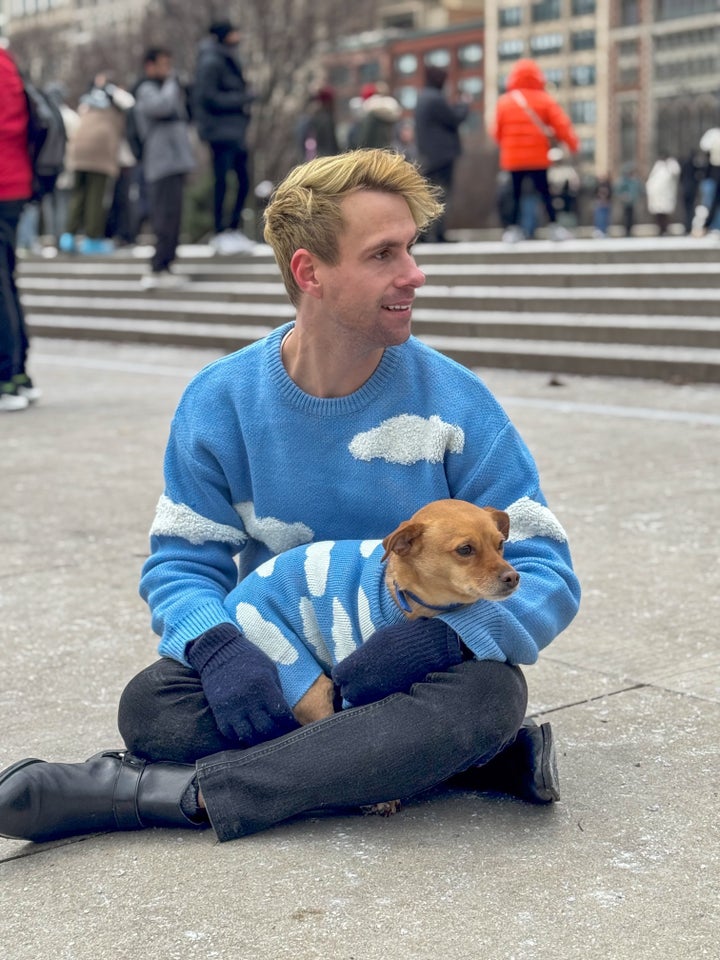
Photo Courtesy Of William Ehlers
The author with his dog.
Attempting to keep an open mind, for six out of the eight counts, I voted as “undecided”. For the murder of the defendant’s mother and her partner, I voted in favour of life without parole.
Advertisement
I braced for the judgement from the other jurors. I explained that I had tried to consider all the mitigating circumstances related to the defendant. He had been abused. I know his childhood was difficult, and I know that he had a problem with drugs. Legally, these factors all allowed us to grant leniency. But any attempt to have these conversations fell on deaf ears.
Many jurors refused to acknowledge the defendant’s history of drug abuse and mental illness, despite expert testimony from both the defense and the prosecution. All the mitigating circumstances were irrelevant to them. The only thing that mattered was making sure the defendant was executed.
It didn’t feel like justice for the victims – it was vengeance toward the defendant.
After just a few days of deliberation, I knew if I didn’t change my vote to execute, I’d be the cause of a hung jury, which meant the sentencing phase would have to be retried, a process that would take months. A new group of jurors would be tasked with deciding a sentence for a verdict they hadn’t delivered. And there was no way to know how long it would be before the new trial began.
Advertisement
I sat on the floor of the jury room hallway, creating a list.
If I choose death, that’s it. He’s dead.
But if I choose life, the jury will hang. His sentence will be retried, some new set of jurors will go through it all again, and the victims’ loved ones will be denied closure.
There was no option that did not harm someone, if not many people. There was no option that minimised the damage. I’d gone into this trial initially believing I would not vote to execute the defendant under any circumstance. I romanticised the idea of refusing to crack under pressure, and the mercy I would be extending to someone. But after a week of sleepless nights and several bottles of wine, I knew what I had to do.
“All in favour of life for count one, regarding Parker Smith, raise your hand.”
“Now, all in favour of death, raise your hand.” Twelve votes.
I was forced to put my hand up for each individual charge until I had voted for death six times. I couldn’t bring myself to vote for death regarding the murder of the defendant’s mother, Rene Cooksey, and her partner, Edward Nunn, because I did not believe the defendant was in a coherent state of mind when he committed these murders.
Advertisement
Once the vote was done, I managed to lift my head off the table, only to drop my face into my palms and weep. I couldn’t hold back any longer. I could hear backpacks zipping as the other jurors packed up their belongings to head out for lunch, while I just cried.
The defendant had been arrested on Dec. 17, 2017. Exactly eight years later, we turned in our verdicts. They were read out loud the next day.
Being a juror on a capital murder trial unearthed frustrations with our system that I never knew existed. I always knew that I didn’t support capital punishment, but I supported it even less after this experience.
Advertisement
I know I will always partially regret my decision. My life will forever exist in two sections: before trial and after trial. If I was able to give in on my most strongly held belief, what do I really believe in, and what do those beliefs even mean? Being responsible for an execution is a burden I will carry with me. While the death of each victim brings me sorrow, so does the inevitable death of the defendant.
I wish the trial hadn’t ended this way. But I wish there didn’t have to be a trial at all, because I wish that all eight victims were still here. I think about Andrew, Parker, Salim, Latorrie, Kristopher, Maria, Rene and Ed constantly. I will always do my best to make sure they live on.
I chose death, not because I wanted the defendant to die, but to bring closure to the families and to allow the victims to finally rest in peace. Although I know I am going to carry the burden of that choice with me forever, I hope it lifted at least a little of that burden off them.
Not long after my husband, Keith, died suddenly in April 2000, I overheard one of his family members tell someone that she didn’t feel sorry for me and my young children. “This will make them stronger,” she asserted.
Seventeen years later, her words taunted me as I shuffled across the sizzling parking lot of a suburban shopping center on my way to a therapist’s office. Stronger. What a joke; I could barely walk.
Once inside, I slumped into an oversized chair and wearily told my new therapist, Elizabeth, my problem was that I sucked at life and the visit would be a waste of time for both of us.
Advertisement
The only reason I was there was because one of my adult daughters had threatened to call 911 if I didn’t get help for myself. She’d become alarmed after she couldn’t reach me and had stopped by my house, where she discovered me flat on my back on my sofa. I hadn’t bathed or changed my clothes in weeks.
Assuming Elizabeth would show me the door so she could move on to a more worthwhile patient, I was surprised when she instead asked me to elaborate. After listening for nearly an hour, she said, “What you’re suffering from has nothing to do with being bad at life. It’s called resilience fatigue.”
I’d never heard of it, but I knew all about resilience. Its necessity had been drummed into my head since I was a kid. “Pull yourself up by your bootstraps ….” “When the going gets tough ….” “If at first you don’t succeed ….” As I saw it, resilience was the crux of my problem. If I wasn’t so weak and lazy, I could allow adversity to transform me into a deeper, tougher individual.
Advertisement
“We have a lot of work to do,” Elizabeth told me.
The American Psychological Association defines resilience as “the process and outcome of successfully adapting to difficult or challenging life experiences.”
“Adapting” is the key word. If stressful events never let up, there’s no time to adapt. Resilience fatigue or toxic stress is about prolonged, excessive and unmanaged intense stress that leads to a sense of being constantly overwhelmed. Without sufficient coping mechanisms, the body’s stress response becomes overworked. This, in turn, can lead to an imbalance in our physiological systems and affect everything from mood to the immune system.
That sounded like me.
I’d been living in a near-constant state of anxiety mixed with dread since April 2000. I’d grown so accustomed to the feeling of impending doom — the racing heart, the perpetual tightness across my shoulders — that I thought it was normal.
Advertisement
Apparently it’s not.
Keith’s death would have been challenging enough on its own, but overnight I also became a single mother of three. Worse still, I was pregnant with our fourth child.
And that was just the beginning.
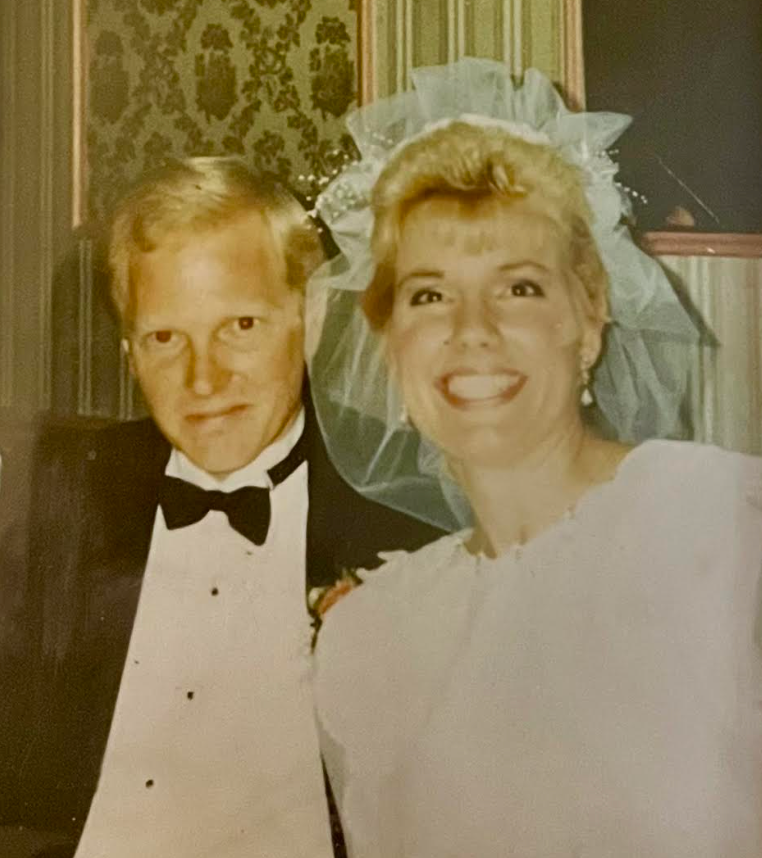
Courtesy Margaret Feike
The author and Keith on their wedding day, March 4, 1989.
Keith had minimal life insurance. I’d been a stay-at-home mother for almost a decade while we continually moved for his job as he climbed the corporate ladder. Even before I buried him, the realisation that I’d have to find both work and child care ASAP filled me with terror. A family of five had to have health insurance. We’d been insured through Keith’s employer, and I couldn’t afford to pay for it outright.
Advertisement
Finding work took precedence over everything, including grieving my husband and bonding with the baby born three weeks after he died.
I’d always assumed the capacity for resilience was limitless and also hardwired into human beings like the fight-or-flight response, but during my counselling sessions, I learned otherwise. It’s not innate; rather, it’s learned and comes not just from individual effort but also from available support and resources.
The times I attempted to discuss my fears or concerns with others, they dismissed them: “You’re young, you’ll bounce back ….” “God never gives you more than you can handle ….” “In a few years you’ll remarry and hopefully the next guy will be rich ….” This was what passed for support in my world.
Advertisement
Still, I believed grit and determination would not only save me but someday I’d look back on those terrible days and be thankful for what I’d gone through while reflecting on how far I’d come.
For a hot minute, that seemed to be the case. After an obsessive job search, I found a position in an auto insurance call center with top-notch benefits. My parents, who’d recently retired and had moved nearby, agreed to watch my kids and not charge me. I began humming the song “I Will Survive.”
Unfortunately, the job turned into a trap. Callers were frequently angry; they swore and shouted at me all day. There was little room for advancement unless I could put in overtime or travel, which was impossible given my situation. I’d leave work depressed and drained and come home to a messy house full of bickering kids and memories of the life I used to love.
Advertisement
I also began flashing back to the morning I found Keith dead in our bed. As time passed, I thought about him more instead of less, and I couldn’t understand why the last day of his life played on a constant loop in my head, as if I could change the outcome if I relived it enough times.
When I mentioned this to a relative, she chastised me. “You need to focus on all the good things you still have, not on the bad.”
Of course I was grateful for what I had, despite the fact that my finances were eroding at a frighteningly rapid pace. Despite the fact that I’d gone from enjoying a vibrant, hope-filled life with a man I loved to living like a cloistered nun. Despite the fact that one day my future had beckoned like the yellow brick road and the next there was a ROAD PERMANENTLY CLOSED sign blocking the entrance.
Advertisement
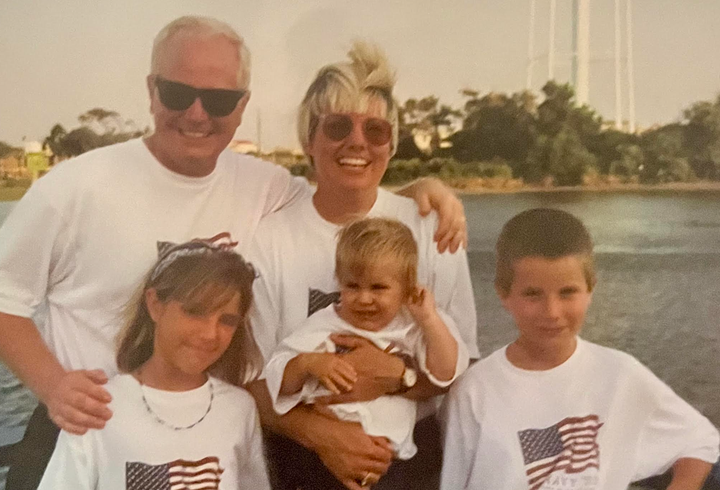
Courtesy Margaret Feike
The author’s family on their last family vacation in 1999. “Keith had less than a year to live,” the author writes.
Most of all I was grateful for my parents.
In their mid-60s, they were now practically raising a toddler and an infant. I was tired all the time and so were they. Our relationship deteriorated even as I suffered crushing guilt over what they were doing for me.
Yet I was certain I could turn everything around. So I prayed daily for acceptance of my situation. The Secret became my Bible, and I spewed positive affirmations morning, noon and night. I tried to banish negative thoughts from my head and focus on future abundance, not what I’d lost.
Advertisement
Nothing changed. Eventually I went through bankruptcy followed by foreclosure. I was fired from my job for not being able to keep up with the ever-changing metrics. When I discovered my oldest daughter was using heroin, I thought life could not get any worse.
I was wrong.
My father developed Alzheimer’s disease, and I moved in with my parents to help care for him. Two years after he died, my mother was diagnosed with terminal cancer, and I took care of her until the end.
By then my daughter was no longer using heroin, which was an unexpected miracle.
But at that point my younger daughter was in trouble for school truancy and drug use. Eventually she was removed from my home by Franklin County Children Services after her high school filed a criminal complaint with the local juvenile court and a judge ruled that she be placed in foster care at a local psychiatric residential treatment facility. It was a good thing I was unemployed, as my days became a merry-go-round of mandatory meetings with social workers, psychiatrists, counsellours and a court-appointed guardian. They picked apart my life and told me everything I was doing wrong as a parent but offered nothing in terms of concrete solutions or support.
Advertisement
My daughter was gone for over two years. Upon her return, she told me she’d been sexually assaulted while she was at the treatment facility. Guilt for what she’d been through vied with an impotent sense of rage deep inside me. The feelings were so inflammatory that sometimes I was sure I’d self-combust.
In the midst of my ongoing crises, I met a man in a writers’ group I’d joined in an attempt to get away from my life. Jim became a bright beacon in my otherwise dreary existence, so much so that I dared to envision a future with him. But three months after my mother passed, he died by suicide in my car. My younger son, who’d adored Jim, was so traumatised he had to be hospitalised after he became suicidal. My older son ghosted me for several years, deeming me a toxic mother.
I could no longer deny that my life had become a not-so-funny running joke, with me as the punchline. Sometimes I imagined my husband disgustedly shaking his head as he watched his family fall apart.
Advertisement
Just thinking about it exhausted me. One day I lay down on my living room sofa and couldn’t find the strength to rise again. I prayed for death as I thought about how I’d failed everyone, including myself.
Elizabeth helped me to reframe my viewpoint.
“Your husband died, then you had a baby. You had to hit the ground running with no time to grieve him or help your children. Your life became a runaway train that took 17 years to crash,” she said.
She put me in touch with a psychiatric nurse who prescribed a combination of antidepressants and anti-anxiety medications. She also utilised cognitive therapy, including EMDR (eye movement desensitisation and reprocessing). Slowly I began to feel better.
Advertisement
Courtesy Margaret Feike
The author and her youngest daughter, Dianna. “She was born three weeks after her father died,” the author writes.
Of course you can’t always control what life throws at you, but Elizabeth pointed out that my path might have taken a different turn if I hadn’t been forced into a race against time to secure health insurance and child care, those fickle twins that dictate life for so many Americans.
Still, I had trouble letting go of the conviction that I’d traded in resilience for lethargy. All my life I’d heard that adversity builds character and that what doesn’t kill us makes us stronger. Elizabeth shook her head. “Those are dangerous generalisations and they’re mostly false. Beliefs like that allow us to minimise other peoples’ suffering without feeling guilt.”
Advertisement
A growing body of research shows that despite the widespread belief that negative life events result in “post-traumatic growth” or positive personality change, “the only type of growth that seems to arise consistently is deepened relationships,” according to the Society for Personality and Social Psychology. Our relationships with loved ones often become more meaningful during times of struggle.
“But that requires having supportive relationships in the first place,” Elizabeth said. “Other than your parents, who were tossed out of the frying pan into the fire with you, you’ve been going it alone all this time. What would you say to that relative who told you Keith’s death would make you stronger if you saw her today?”
I didn’t hesitate. “I’d say, ‘You have no idea how badly I wish you’d been right.’”
Seven years on, my own mental health is in a much better place, and my children are thriving. We’re closer than we’ve ever been, and all four are involved in healthy relationships and working at jobs they enjoy. My older daughter became a psychiatric nurse and the younger one is pursuing a nursing degree in the same field.
Advertisement
After my oldest child went through a divorce a few years ago, I began watching my two young grandchildren while she worked, paying it forward the way my parents did for me.
I understand the urge to offer platitudes to someone who’s experienced a loss or tragedy. The right words can be difficult to find. But it’s better to say nothing than to imply they’ll somehow benefit or be improved as a result of their misfortune.
Suffering hasn’t made me stronger, but it certainly has taught me about the kind of person I want to be. Now I’m able to offer more than platitudes to others going through difficult times because I can share my experience along with empathy. Pain does not build resilience; lending support does, even if it’s only a sympathetic ear.
Advertisement
I’m grateful that today I can be that support for my family.
This piece was originally published in December 2024 and we are sharing it again now as part of HuffPost Personal’s “Best Of” series.
Margaret Jan Feike’s personal essays concerning subjects such as addiction, mental health, and grief have been published by Salon, McSweeney’s, Modern Loss, and other venues. She resides in central Ohio with her younger two children and a herd of cats and recently completed her first novel.
Losing a loved one is something we all will experience at some point – and unfortunately, no prior loss can prepare us for the ones that lie ahead and the world-shattering emotions that come with them.
For those of us who have to face the financial admin that’s left behind when somebody dies, there is a compounded grief as we try to navigate the institutions and paperwork that are an essential part of death admin.
Advertisement
In fact, in Octopus Legacy’s Human Cost of Dying report, families rank financial institutions among the least helpful when dealing with a loved one’s death.
These findings reflect the stories of people like Rosie and Lucy, who have faced overwhelming hurdles in the wake of their loved ones’ passing.
HuffPost UK spoke with Rosie and Lucie about the traumatic obstacles they faced following their losses – and what needs to change.
Advertisement
Rosie’s mother dying left her with an unmanageable amount of admin
Rosie lives in Edinburgh with her husband and three children.
Back in 2003, Rosie’s mother came to live with the family. But sadly in 2009 she suffered from a ruptured aortic aneurysm, was rushed to hospital and placed in the high-dependency unit.
Speaking with HuffPost UK, Rosie explains how her mother’s health deteriorated over time: “She was non-responsive for a couple of weeks – and as she woke up, it became evident that something wasn’t right.
“She had suffered a stroke during the operation and was eventually transferred to a hospital which supported stroke rehabilitation. From there, she was eventually well enough to come home.”
Advertisement
Unfortunately, their family’s peace didn’t last long.
“A few months later, as I was coming home from a run, I saw my mum waving at me from a bedroom window. I then watched her fall,” says Rosie.
“I ran home and found that she had suffered another stroke – we returned her to the local stroke unit, and then back to the rehabilitation hospital. This time, she wasn’t in for stroke rehabilitation but in a geriatric ward. She never left.”
The family experienced a prolonged period of grief prior to her passing
Rosie admits: “For me the grieving process was initiated in 2009 when she first went into emergency surgery. This was a long, tortured process of gradually watching my mother losing herself.
Advertisement
“My mother had been a force of nature, immensely practical and sensible. If there was a problem, my mother would find a way to resolve it.
“There were moments, during her rehabilitation when her very strong sense of humour would peep through. She would have a twinkle in her eyes watching the banter between staff on the ward. She would beam at me or my children when we came to visit – and pat our hands.”
But mostly, as she watched her mum deteriorate, she grieved.
“When my mum died it was a release. For her – and for all of us. We could actually say goodbye,” says Rosie.
Advertisement
Thankfully, the funeral went smoothly. Rosie and her family shared stories of her mother and bonded with others over their stories.
But the financial admin following the funeral was when the problems started
Rosie is self-employed and offered to work on the financial side of her mother’s estate on behalf of her siblings for an agreed fee. However, it wasn’t as simple as she had expected it to be.
“My mother had 13 ISAs with different institutions,” Rosie says.
“When my father died, my mother had become really interested in money management. She had invested in the stock market and had also taken advantage of great rates each year for her TESSA (tax exempt special savings scheme) and ISA allowance.
Advertisement
“I discovered that each bank had different requirements in order to close the accounts. Some required a death certificate certified in a branch. Some required a death certificate certified by a lawyer. Some required correspondence just from me. Some required correspondence from all three siblings. No two of the financial institutions I approached required the same process.
“The details are woolly now – but I remember sending endless letters / forms to my siblings for them to sign and return.”
The admin put a strain on Rosie’s relationship with her siblings
For Rosie, it seemed bizarre that there wasn’t a standard process that institutions used.
“Had I known at the outset, I would not have proposed to complete this work, particularly given the fact that my mother had died in Scotland, but her will was drawn up in England,” she says.
Advertisement
The siblings ended up needing to engage a legal firm to complete the work anyway.
“The whole process was time consuming, resulting in me spending far longer on the process than I had anticipated. Rather than supporting each other in a period of loss, we were really discussing who wanted a footstool, a salad bowl – or who had signed what form,” she says.
“The length of the process created friction between me and my siblings to the point that we had periods of not speaking following this time.”
One silver lining during this dark time was that Rosie’s mother had already been through the process of settling an estate when her husband died in 1993.
Advertisement
“As a very practical person, she had written a list every year, of all her assets and where they were. That was invaluable,” says Rosie.
“My mother had also taken the precaution to open joint accounts with each of us, so that we would be able to access funds in the event of her death.”
Advertisement
The admin following the loss of her husband put Lucie’s life on hold for years
After losing her husband during the pandemic, Lucie encountered administrative hurdles that sent her back to when she lost her husband.
Advertisement
Between receiving questions from pension providers like “could you have saved your husband?” and having bailiffs sent to her property, Lucie spent the next two years battling against a range of institutions.
Her life was on pause, and she was forced to relive the trauma of finding her husband dead every single time.
Speaking with HuffPost UK, Lucie says that young widowers face a wealth of obstacles that leave them unable to process their grief: “There are very few widows, particularly young widows, who can leave the financials to sort themselves out.
Advertisement
“Mostly, we really need that cash to keep going and enable at least a sense of stability at a time which is so destabilising. Having to relive your trauma, deal with what seems so trivial (yet unfortunately vital) takes strength and clarity which is so challenging to achieve at this time.
“Instead of focusing on self or family, one has to really focus on getting through a challenging process which means setting aside the grieving process – which, in my view, prolongs the process.”
Financial institutions left Lucie feeling overwhelmed and frustrated
If Lucie could suggest anything to organisations that frequently speak with grieving families, it’s better training. She urges: “Have specifically trained teams with appropriate scripts and understanding of the challenges.
Advertisement
“Additionally, ensure that customers are regularly reminded to provide statements of wishes, emergency contacts, nominated representatives who can deal with financials in the event of death or critical illness.”
She also believes that empathy can go a long way
Following a loss, particularly the loss of somebody very close to you, the world can feel like such a strange place – like you are the walking wounded and nobody quite understands the particular pain that you are feeling.
This is compounded by a lack of empathy in institutions that aren’t suitably prepared to work with people going through something so life-altering.
Advertisement
Lucie admits: “I was made to feel like a nuisance. So many inappropriate questions about the nature and circumstances of my husband’s death, none of which were relevant.
“Because I was pushing hard for resolution, I was made to feel like I was in the wrong and almost not grieving enough. It was a genuinely awful process.”
Lucie shares a warning to couples and families
Some of this is still unavoidable for families in the wake of a death, but Lucie believes preparation is essential.
Advertisement
She advises: “Agree on where you will store passwords. Communicate well about what financial products you have and where the information is.
“Draft a will. Complete your expression of wishes and update them regularly. Get comfortable talking about money and death.
“My biggest reflection is that these were not conversations we had; I had no idea where my husband’s paperwork was and most of it was on his laptop, the password of which I did not know… Share this stuff!”
When I exit the elevator into the hotel lobby, the urgency of my own voice startles me. “Are there any bodies of water nearby that I can access on foot?” The front desk receptionist gestures to the door and says I’ll meet Indian Creek within a few blocks.
I see sadness wash across my 73-year-old mother’s face. She’s holding the plastic bag containing her younger sister Carol’s cremains, and we’ve just learned we need permission from the U.S. Consulate to fly them back to my mother’s home in Spain for a proper memorial. Our flight leaves in a few hours, and a quick online search reveals that scattering ashes within 3 nautical miles of Florida’s shore is illegal. We have to be discreet.
“Carol loved Miami,” my mother whispers to soften the reality of what we are about to do: Leave Carol behind.
Advertisement
My aunt’s death at 69 had taken us by surprise. My mother’s weekly voice message, left on a Thursday, went unreturned. By Sunday, my aunt’s neighbour, who lives on the other side of the adjoining patio wall, smelled something off. He heard Chelsea, my aunt’s rescue dog, barking for days before he called 911.
The autopsy report attributes acute peritonitis caused by untreated (treatable) rectal carcinoma as the cause of my aunt’s death. The medical examiner surmised that she sat down in her rocking chair while preparing Chelsea’s food and never got back up to serve it.
The dog sat vigil by my aunt’s side for four days before they were discovered.
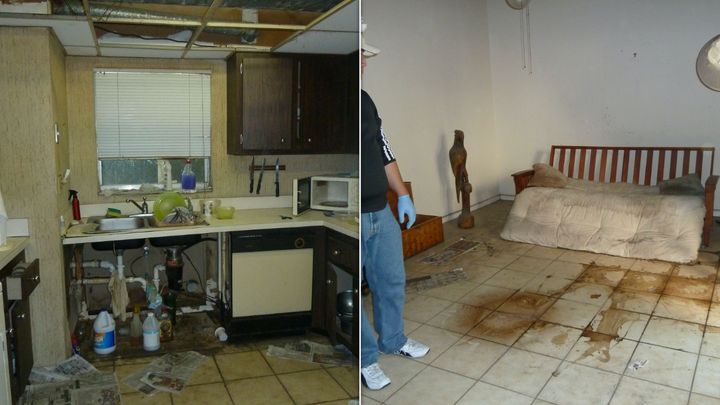
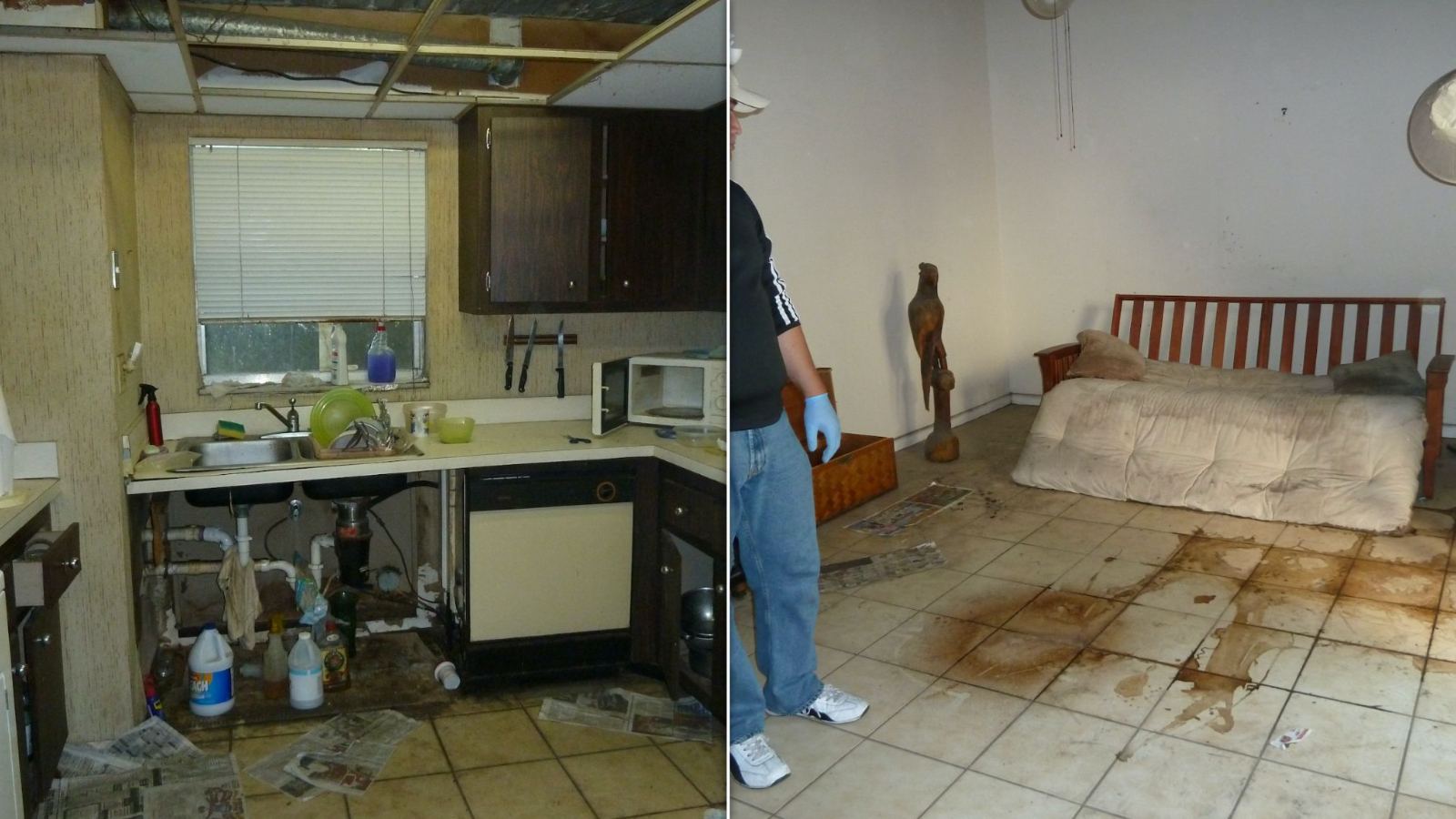
The Miami-Dade homicide detective explained that, because my aunt died alone in her home, the law required a forensic account of the scene. After they removed her body, I requested the property remain untouched. I wanted to piece together her final days to better understand her life, but I was not prepared for the chaotic state of her final months.
Perhaps my journalistic approach to her death is a way of coping with guilt and loss, but my investigation has revealed a heartbreaking reality.
Advertisement
My aunt, an educated, politically passionate, older gay woman, died isolated, financially destitute and alone. What could I have done to prevent it?
I had never asked Carol questions about her health or well-being. I was always caught up in my career and relationships, assuming deaths like this didn’t happen in a family like mine. I also believed my aunt was part of a system that took care of its aging population, and that I didn’t have to worry about her. I was terribly wrong, and I wanted to understand why.
Courtesy of Michelle Tamara Cutler
Aunt Carol’s home in Miami after her death (2012); Left: Aunt Carol’s kitchen Right: The room in Aunt Carol’s condo where she died.
My aunt knew she was gay at 13, in 1955, but coming out wasn’t the custom in 1950s America. Instead, Carol excelled in sports, was known as a class comedian and had a boyfriend, despite being in love with her best friend, according to my mother.
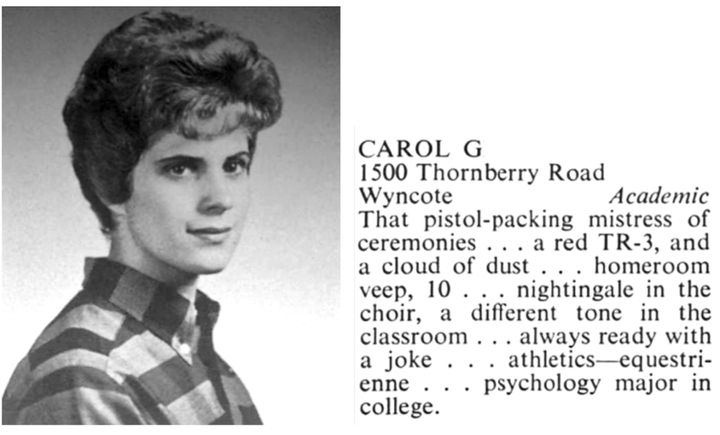
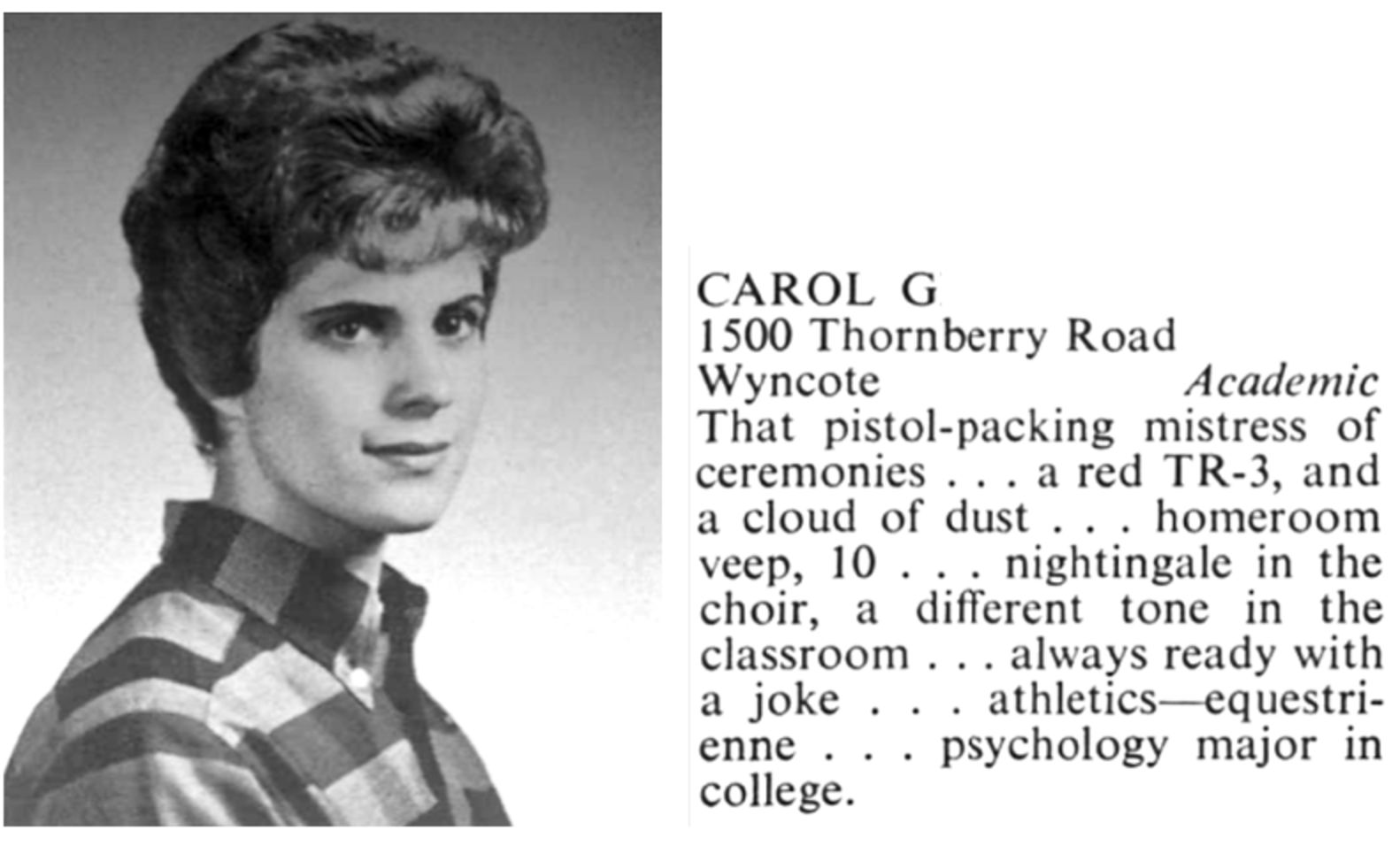
The comments under her yearbook photo describe her as a “pistol-packing mistress of ceremonies… always ready with a joke… athletic… psychology major in college.” Compared to the other femalestudents on the same page, with descriptions like “knee-length sweaters” and “future Miss Private Secretary,” it’s clear Carol was already defining herself by her choices.
Advertisement
Courtesy of Michelle Tamara Cutler
Aunt Carol’s high school yearbook photo (Philadelphia, 1958)
A man who introduced himself as Carol’s high school boyfriend contacted me after reading my aunt’s obituary. He said they were going steady until she suddenly cut off contact right before his senior prom. When he drove by her house to speak with her about what had happened, she ran inside. He was heartbroken and confused by her behaviour.
Years later, he bumped into my aunt when they were studying for their master’s degrees at Temple University. She pointed to his Eldridge Cleaver “If you’re not part of the solution, you are part of the problem” pin and let him know that she was now open about her sexuality and that he should accept it or else remain part of the problem.
Surprisingly, between the dreaded 1959 high school prom and the empowered run-in with her high school ex at Temple in 1970, my aunt married a young man from the neighbourhood. He was a friend, my mother told me, who agreed to a “sham” marriage to ward off scrutiny from her parents.
I can imagine how difficult it may have been for Carol to come out to them. My grandparents were first-generation Americans who owned a successful beauty salon known for styling young Grace Kelly’s hair before she left for Hollywood. They raised their family with the understanding that public appearance was social currency, and heteronormative relationships were the gold standard.
Advertisement
Still, Carol was 25 when she got married in 1967. Couldn’t she have escaped her parents’ middle-class aspirations without the charade of a marriage? And what happened during the three years between her wedding and 1970, when she was fully out of the closet? What had changed? Was there some specific catalyst for her coming out and accepting who she truly was, or had she simply grown tired of hiding? I wish I’d asked her.
Later, when I was growing up in the ’70s, I had two aunts: Aunt Carol and Aunt Patty. There was never talk of lesbians or girlfriends or homosexuality; there was simply Carol and Patty as a couple until something changed in their relationship in the ’80s.
According to my mother, Carol didn’t want Patty, who was younger, to see Carol’s body aging. Vanity is another byproduct of growing up in the beauty business, but I think their breakup had more to do with my aunt’s codependent relationship with my grandmother.
Courtesy of Michelle Tamara Cutler
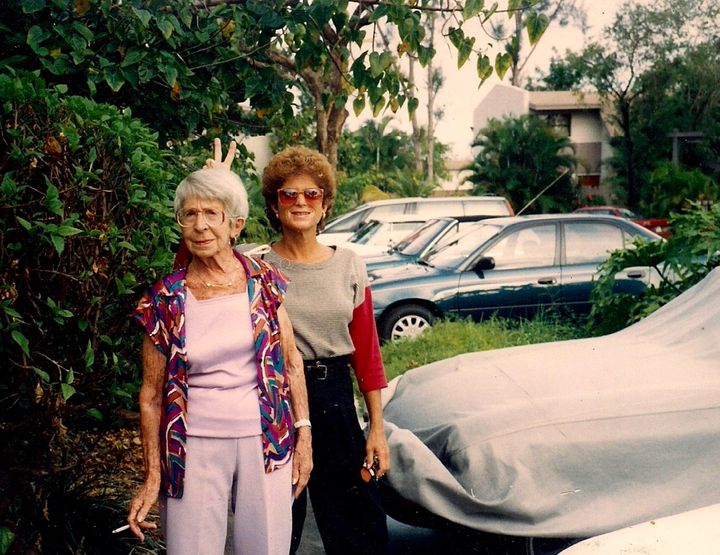
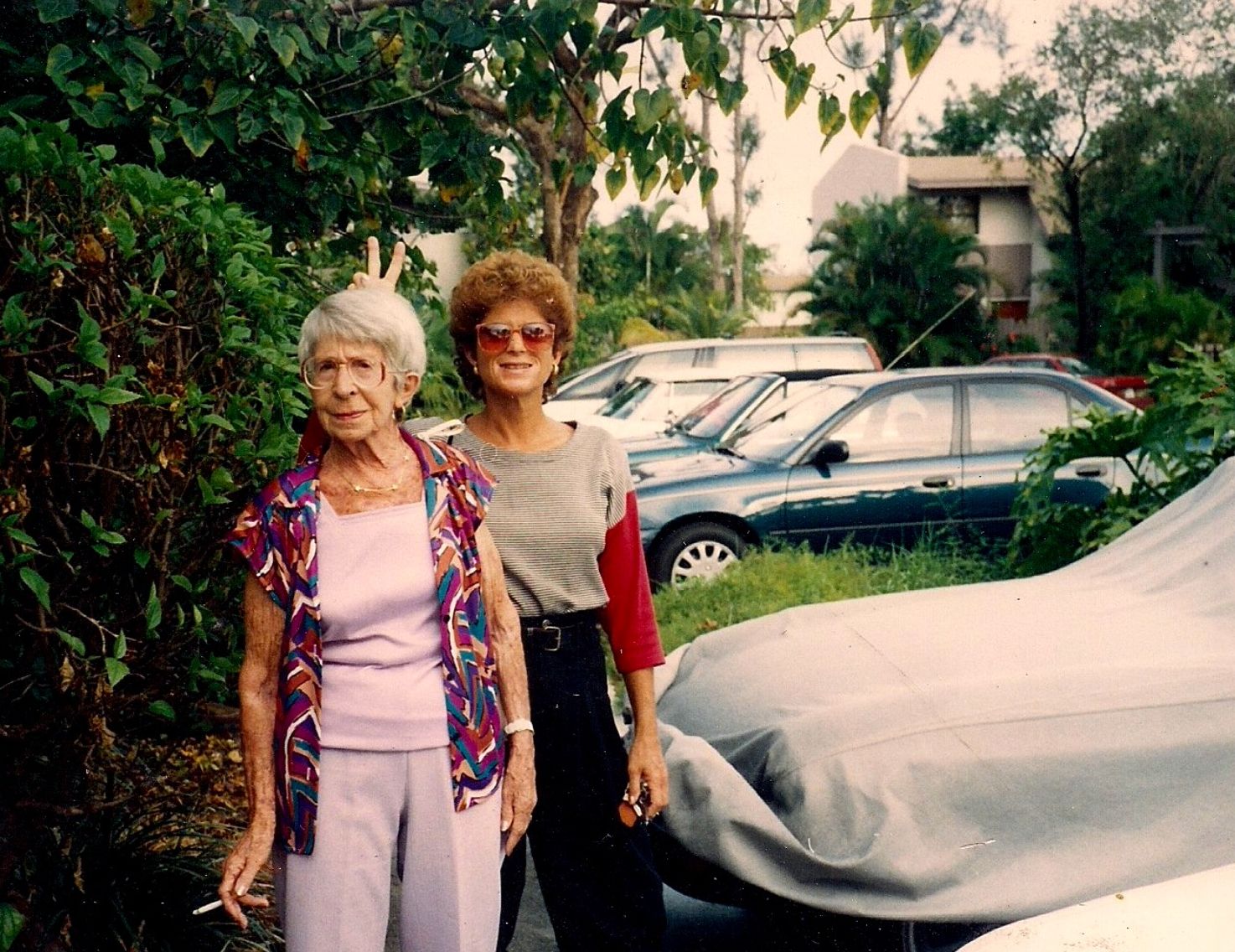
The author’s grandmother, left, with Aunt Carol in Miami sometime in the 1980s.
When my grandparents retired to Miami, my aunt followed and was single for another 40 years. She did have one longtime friend, also named Pat, but Pat swore in a conversation with me that she and my aunt were never romantically together. She said they went to the same “women’s parties” in Coral Gables in the ’80s and lived with or close to each other for decades.
Advertisement
Pat said she felt she had met a “veteran lesbian” in my aunt, someone who knew who she was and wasn’t struggling with her truth. Carol was liberating to young Pat. Pat was also the last person to see my aunt alive.
Pat agrees that Carol didn’t invite anyone into her life after the relationship with Patty ended. She had no long-term romantic relationships, just her rescue dogs and exotic birds, public television, and football.
She was a frequent caller on sports talk radio shows and taught English composition to the football players at the University of Miami to make sure they kept up their grades to play. I remember her saying The Rock was one of her favourite students.
My aunt was also known for her sharp humour and open critique of politics, according to reviews on RateMyProfessor.com. One of her Florida International University colleagues told me Carol was “always upbeat and eager to discuss books, teaching, and travel.”
The challenges of being an underpaid adjunct lecturer without benefits gradually wore her down, he explained, though her dedication to students remained clear. It was around this time that her contract at FIU wasn’t renewed, and she left her house less and less.
Advertisement
Courtesy of Michelle Tamara Cutler
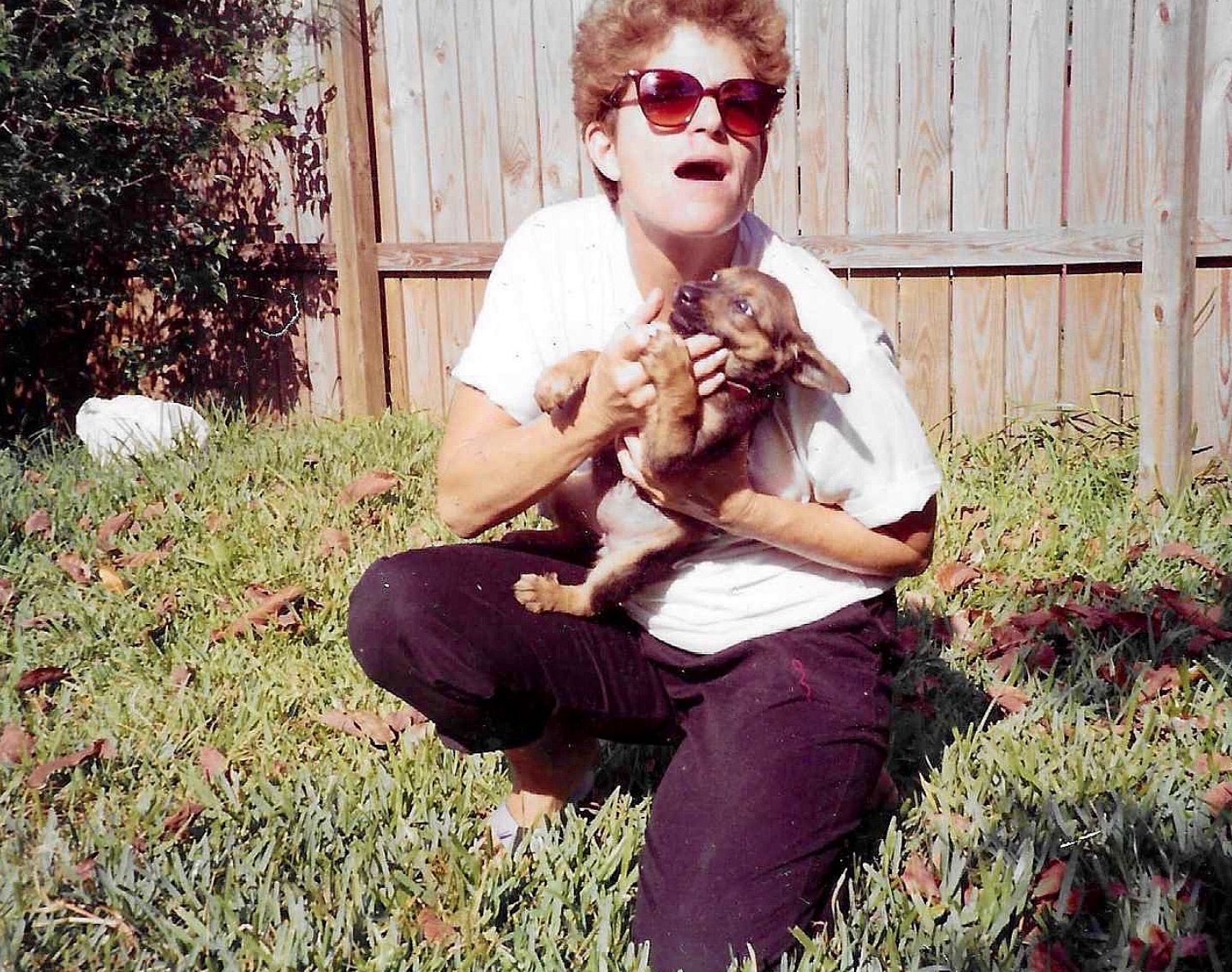
Aunt Carol with Chelsea as a puppy in Miami (date unknown).
The whole experience of going through Carol’s few remaining belongings in her foreclosed, gated-community condo shook me. I sobbed in the parking lot after seeing my mother break down for not successfully convincing Carol to move to Spain with her. It reminded me that I’d made no real effort to check in beyond email. Carol never extended an invitation to visit, and I never thought to just show up.
Suddenly flooded with memories, I quickly jotted them down before they disappeared — like one Christmas holiday in Miami Beach when Carol, dressed in black, made me laugh uncontrollably with an inspired version of Placido Domingo & John Denver’s 1981 song “Perhaps Love.”
Perhaps Love…
Is like a sweater
That fits into a box.
It shouldn’t smell like herring.
It shouldn’t taste like lox.
Carol had a way of poking fun at tradition even though she never felt at home with family gatherings or holidays, as she shared with me in an email the year before her death.
Courtesy of Michelle Tamara Cutler
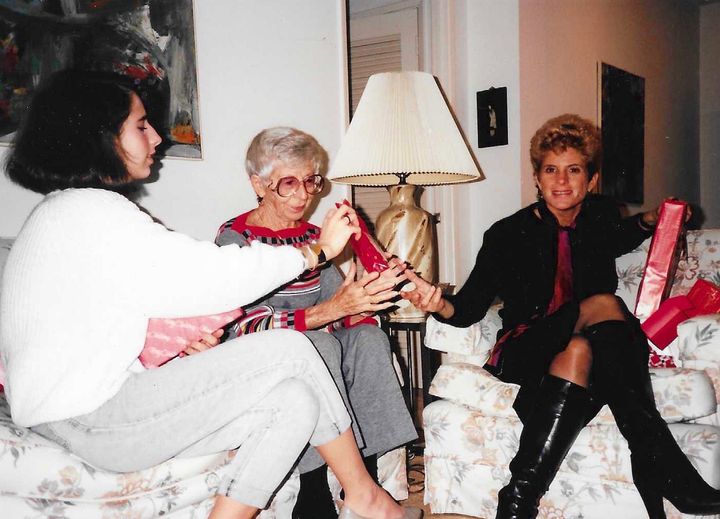
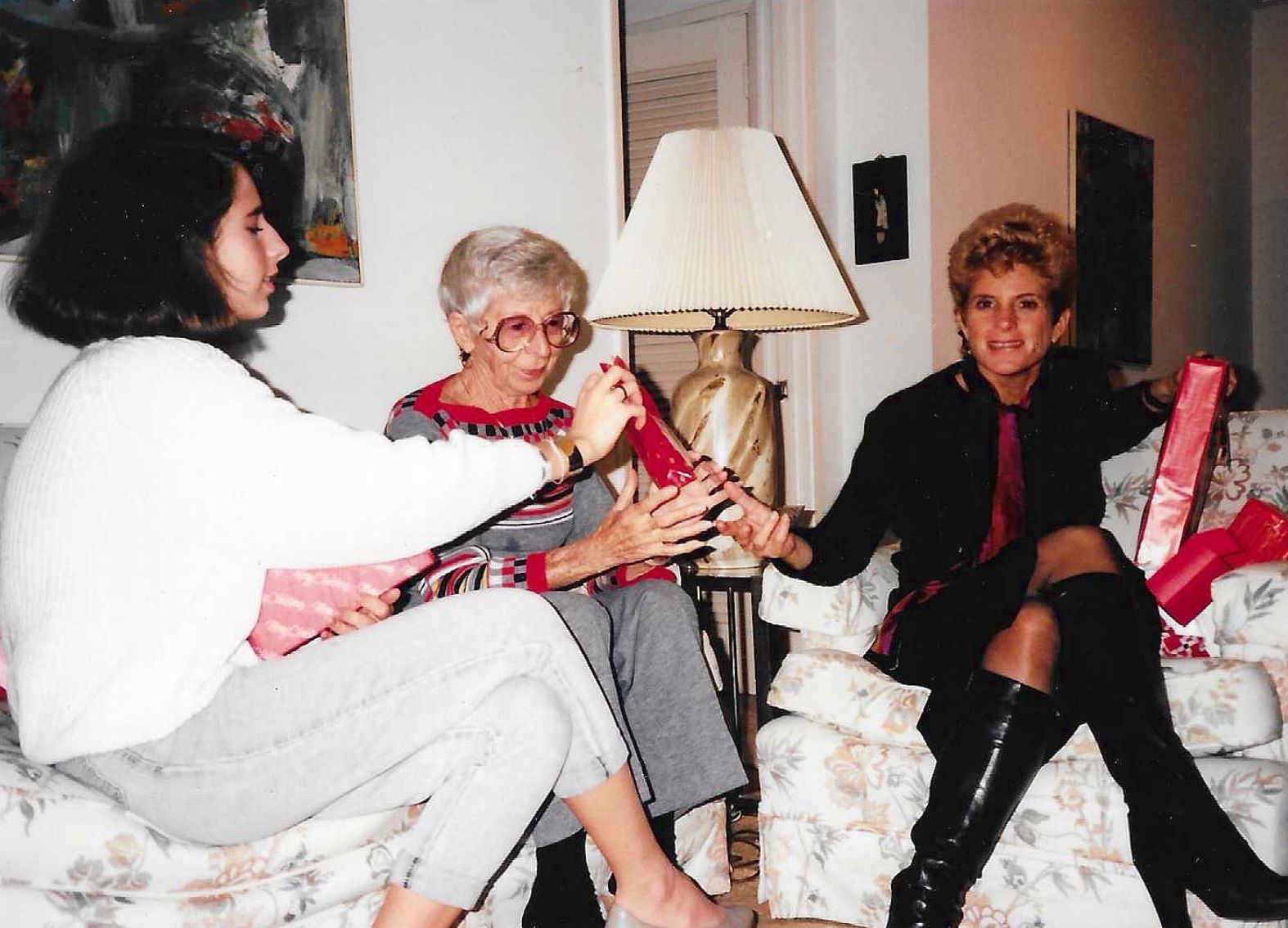
The author, left, with her grandmother, center, and Aunt Carol in Miami Beach (Christmas, 1981).
Advertisement
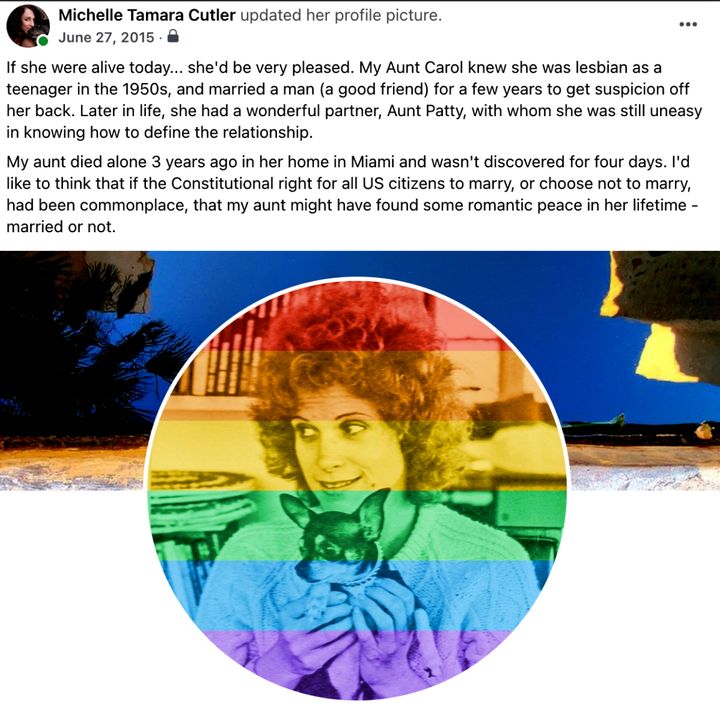
On June 26, 2015, 19 years after President Clinton signed the Defense of Marriage Actinto law, marriage equality became a right for millions of Americans. On that historic day, friends coloured my newsfeed with celebratory rainbow filters and messages.
Some had no intention of marrying, some were already traditionally or symbolically married, but they were all in agreement that discrimination has no place in our society.
I wondered if my aunt’s distrust of institutions, doctors and the public in general was an underlying contributor to her heightened level of self-preservation and loneliness.
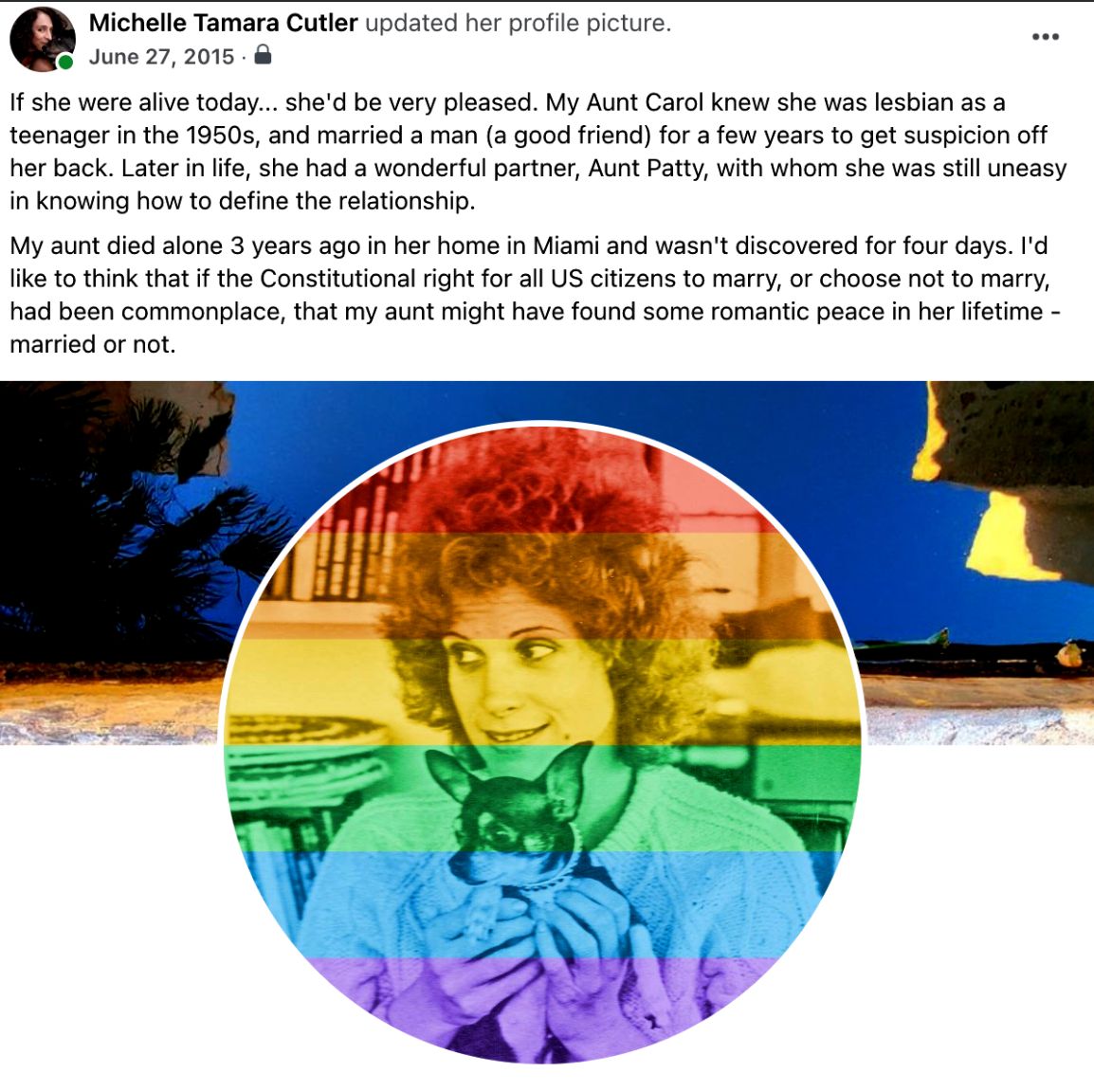
I dug out a black and white photograph of Aunt Carol in her late 30s.After studying her for a few moments, contemplating her life as an intelligent animal lover and activist with a wicked sense of humour — a real political firecracker — I decided to put a rainbow filter on the photo and share it on Facebook.
Advertisement
Courtesy of Michelle Tamara Cutler
The author’s 2015 Facebook post with a photo of Aunt Carol, circa 1980
If Carol were a 13-year-old today, however, there’s no guarantee she would feel any safer than she did in 1955. Basic civil rights, like marriage, family and financial planning, and hate crime prevention, have been argued and advanced in courtrooms, capitol buildings and the media, but these freedoms are perennially under attack.
I do believe Carol would still be fighting this fight if she were alive. I found her listed as a signatory in a 1993 pro-choice ad in the Miami Herald published in protest of the murder of Dr. David Gunn at a women’s medical clinic in Pensacola.
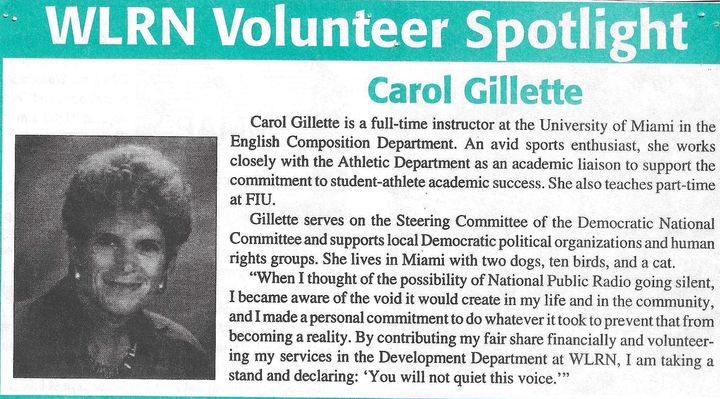
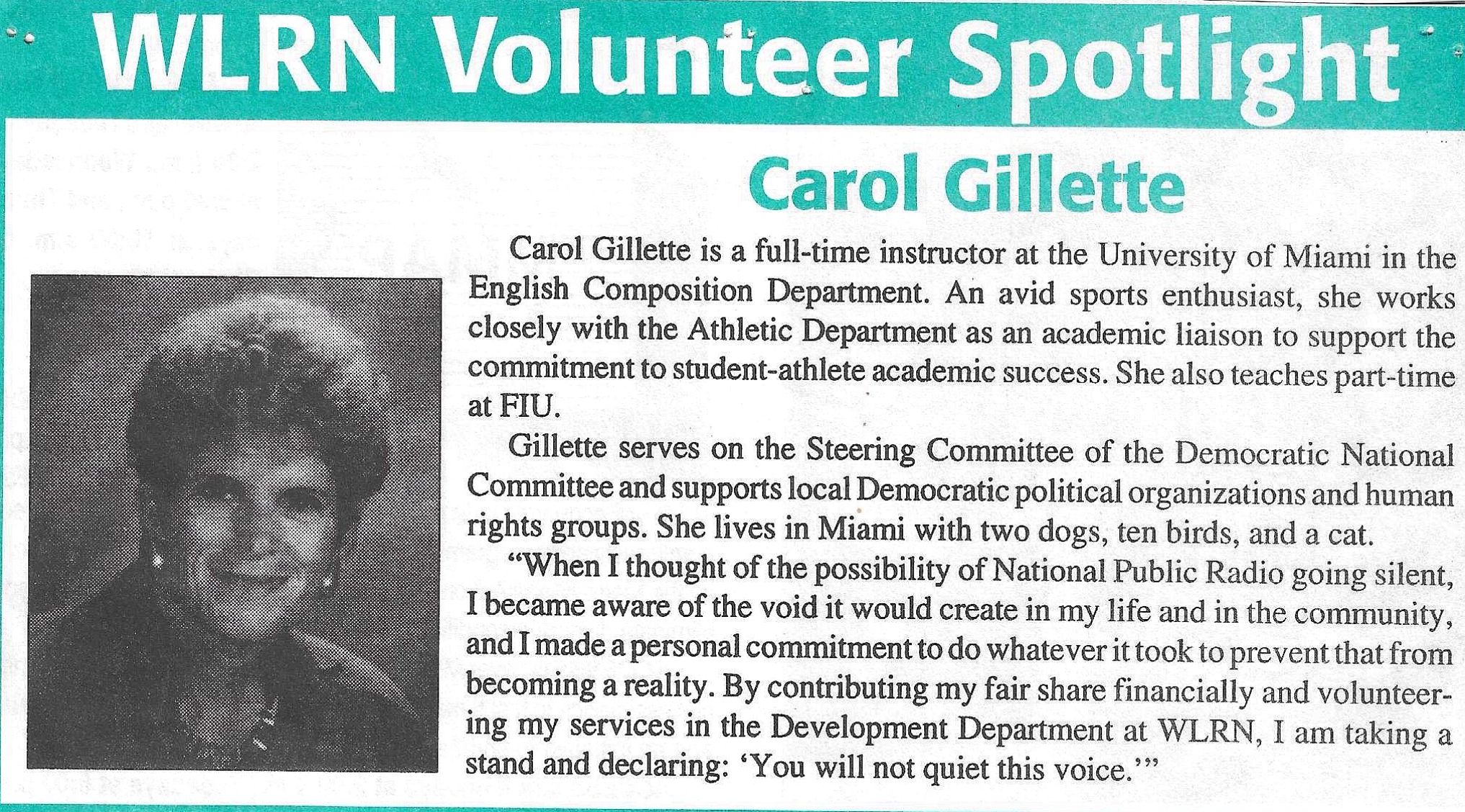
In another folder she kept of her achievements, I found letters from the head of her public television chapter, and in a 1997 volunteer profile, Carol is quoted as saying, “By contributing what I can… I am taking a stand and declaring, ‘You will not quiet this voice.’”
Advertisement
Still, her voice was ultimately quieted — and I know she’s not the only one.
Courtesy of Michelle Tamara Cutler
WLRN Volunteer Spotlight featuring Aunt Carol (1990s)
I wonder how many other Aunt Carols will die alone. There are an estimated 1.1 million LGBTQ+ identifying adults aged 65 and older.One study found 7 in 10 LGBTQ+ older adultslive by themselves compared to 3 in 10 non-queer adults, and many queer elders don’t have children to help them.
LGBTQ+ retirement communities and care facilities are on the rise, but not everyone — including Aunt Carol — wants to live their day-to-day life with other people or has the funds to support that level of care. Organisations like SAGE, founded in 1978 by queer activists, further advocacy, services and support to older members of the LGBTQ+ community, but these groups do not exist in many areas and, where they do, there is still much work to be done to prevent queer elders from facing an end like my aunt.
I cannot change what happened in my family, but I will continue to tell Aunt Carol’s story whenever and however I can. I miss her voice, her humor, and her chutzpah. She was navigating an era of deep adversity and left a lasting impact on the people and organisations she touched.
At the same time, I’m beginning to understand the tragic truth of her last days and why she closed herself off from a world in which she felt unvalued, invisible, and at risk.
Advertisement
I often think of the day Aunt Carol talked me into water skiing for the first time when she was working with the Miccosukee tribe in the Everglades. I was 12 and terrified to go out of my comfort zone, but as the engine revved, Aunt Carol sang out Elton John’s biggest hit at the time from the back of the boat: “I’m still standing better than I ever did… Looking like a true survivor, feeling like a little kid!”
And as the boat pulled away, my arms extended at the end of the rope. Thanks to her inspiring confidence in me, I found my footing, stood up tall, and overcame my fear.
Michelle Tamara Cutler is an award-winning screenwriter and storytelling coach who specialises in true story adaptations. Her reported and personal essays have appeared in HuffPost, Business Insider, Trail Runner Magazine, Under the Gum Tree, Longridge Review, Brevity Blog and elsewhere. She is writing a memoir that examines the circumstances of her Aunt Carol’s death to illuminate LGBTQ+ elder isolation, the rewards of family caregiving, and the influence of the beauty business on identity and mental health. Learn more at michellecutler.com and connect on Instagram.
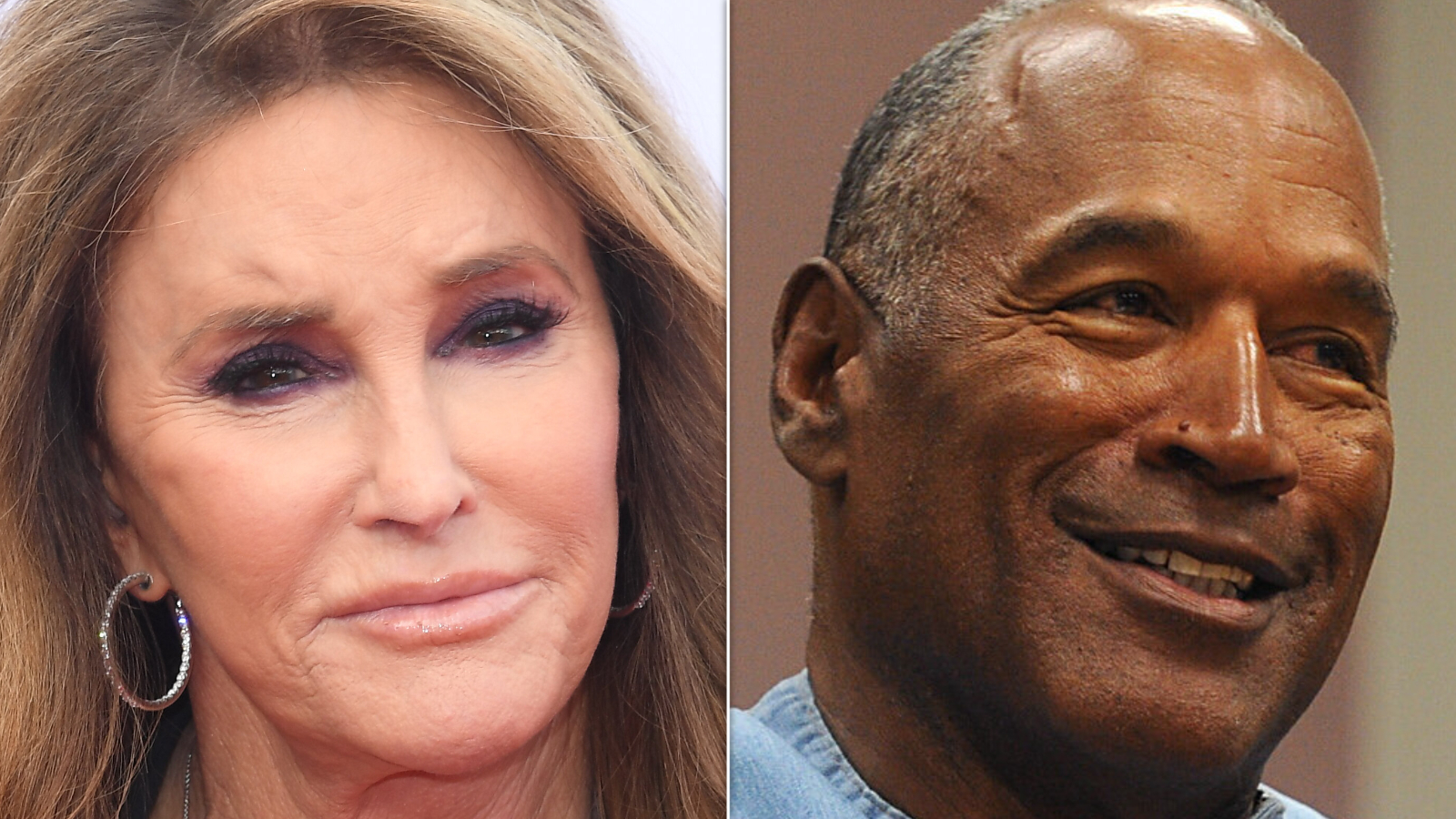
In her 2017 memoir The Secrets of My Life, she described her fellow athlete as “the most narcissistic, egocentric, neediest asshole in the world of sports I had ever seen”.
Advertisement
Over the years, Jenner also repeatedly claimed without merit that she believed the late NFL running back was responsible for the 1994 murders of his ex-wife, Nicole Brown Simpson, and her friend Ronald Goldman.
Caitlyn Jenner posted “Good Riddance” to O.J. Simpson after news of his death.
“I knew he did it,” Jenner told Andy Cohen in 2017. “There was three people at the crime scene: DNA evidence, three people at the crime scene. Pick a murderer. How hard is that?”
Her then-wife Kris Jenner was a close friend of Brown Simpson and was previously married to Robert Kardashian Sr, Simpson’s defence attorney.
Advertisement
Simpson was acquitted of murder charges in October 1995 but was found liable for Goldman and Brown Simpson’s deaths in a civil suit almost two years later.
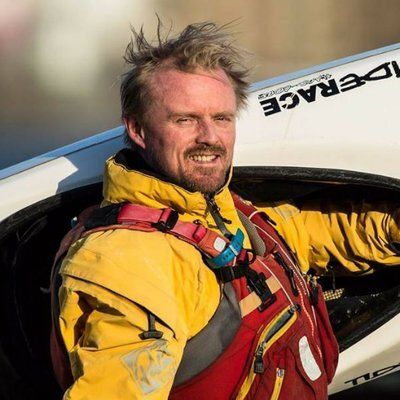
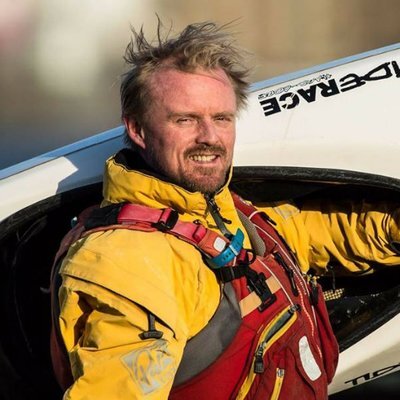
It was 5 days after my brother Toby’s death and, standing on a windswept Cornish headland in mid-January 2022, with some of his best friends, I decided to write the book “Moderate Becoming Good Later”.
It wasn’t my book to write but, as I reeled from the grief of losing my second brother and the last member of my close family, I realised that finishing it was the best thing I could still give him.
Advertisement
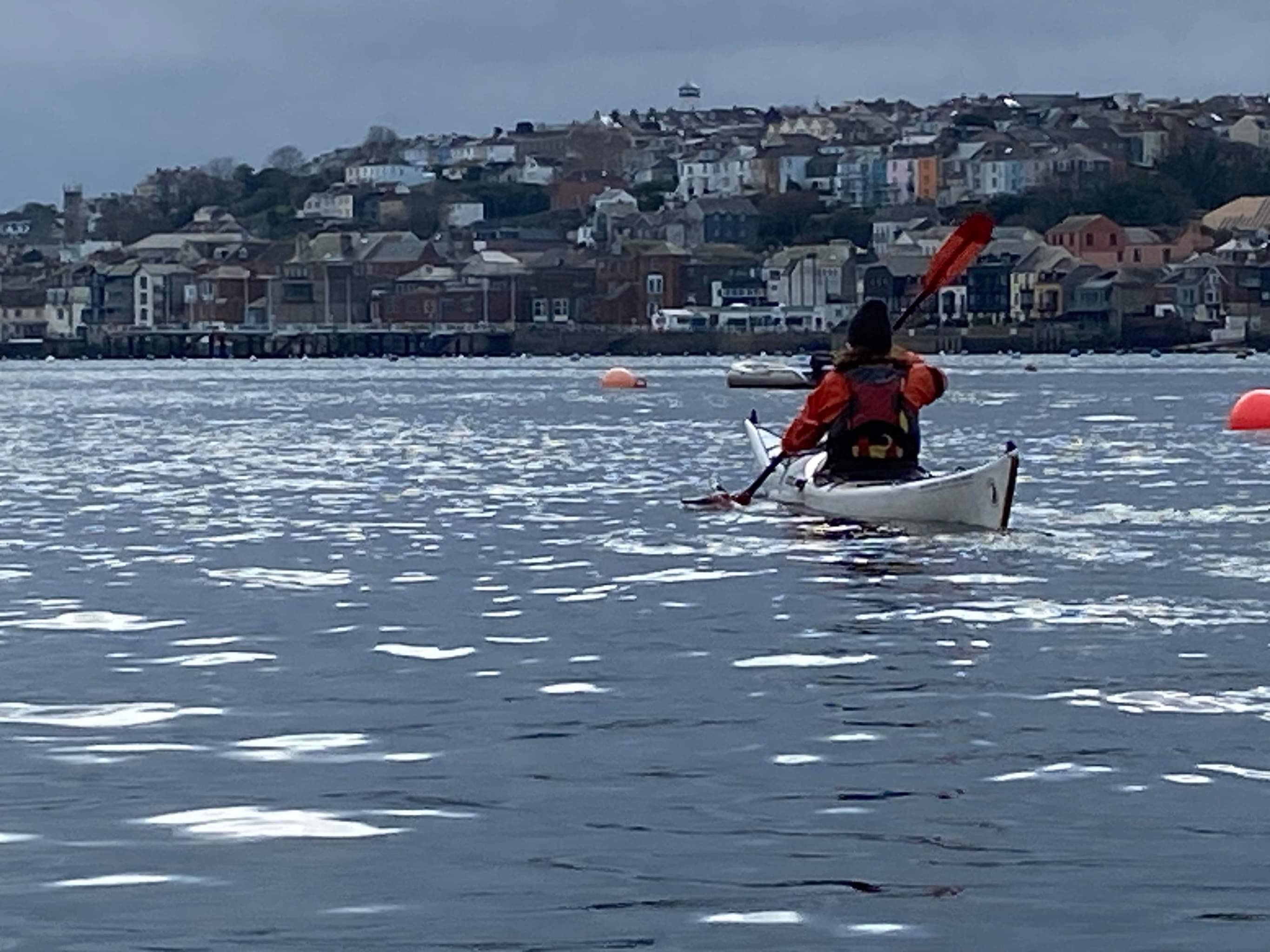
Like many of his friends and family, I knew all about the project. How he’d set off three and a half years earlier on a self-imposed challenge to sea kayak in all 31 sea areas of the Shipping Forecast (the marine weather forecast for the waters around the UK – reaching from Iceland in the north to Portugal in the south) and how in November 2021, he’d signed a publishing contact with Summersdale Publishers to tell his story.
I knew he hadn’t completed it (the agreement with the publishers was based on a proposal with 3 sample chapters). Before he died, he had taken to being somewhat elusive about how much he had drafted. Fair enough, I thought, because at this stage he was in the midst of terminal cancer. But admittedly, I was disappointed when I opened his external disk drive and clicked on the hopefully entitled “MBGL” folder, to find it empty.
A few days later, I came across the handwritten notebooks he had filled during his travels.
The detail in his observations lead me to one conclusion: he wanted his story to be told.
“Sitting in a chringhito beach bar overlooking the Ria Vigo,” he wrote in August 2019, “sailing boats low in water. Mist gradually lifting mountains re-emerging. Fading sunlight shining through the leaves of plants. A few people enjoying the loss of the sun on the beach. Low light picks up shadows on the bumpy sand making it look like waves.”
Now this I could work with.
For Toby, being in nature was one of the ways he dealt with Marcus’s death. It became a way for him to choose a full adventurous life, while no doubt, thinking in the back of his mind, “I’m next.”
Advertisement
So, I sat down for months with Toby’s notes, his blogs, his phone, his photos, his voice recordings and his videos and pieced together the book. When I look back, I feel like I was staring down a lion. Having lost my other brother Marcus in 2017, from cancer caused by Fanconi Anaemia (a rare illness they both shared), my dad from a heart attack in 2010, and my mum to mental illness in 1988, I knew that there is no running away from grief. Why not then turn to face it?
Cue a lot of crying at my desk and thinking to myself “who the hell does this?”. And yet, little by little, I got through it.
I spent an extra year with Toby at the best time in his life thanks to the book. On an adventure myself, I eventually turned something as ugly as cancer and death into something beautiful, despite acknowledging how hard they can be to deal with.
And something else happened, the more time I spent on the book, the more I wanted to get outside. For Toby, being in nature was one of the ways he dealt with Marcus’s death. It became a way for him to choose a full adventurous life, while no doubt, thinking in the back of his mind, “I’m next.”
On the 4 of January 2022, 6 days before he died, he wrote a note about the book and his journey on his laptop:
Advertisement
“It’s been a special experience that has shown me what can happen when you open the door to new adventures, perhaps asking what if? rather than why? …I hope that the journey can help others to find ways to connect with nature and imagine different realities.”
This comment stuck with me as I put the finishing touches to the manuscript in January this year. Who was I as the co-author to be encouraging others to get outside, when I struggle to get my kids dressed, fed and around the corner to the bus each school day?
Yes, I’d had some adventures, but since I became a mum they had been severely curtailed. Then I realised: Toby didn’t just leave me a book to write, he also left me an adventure to finish.
Katie Carr
The adventure is on.
Toby kayaked in 17 of the 31 sea areas of the Shipping Forecast, as part of the project. 4 of the ones left have no land, so are challenging to get to in a sea kayak, which leaves 10 areas for me. Rudimentary maths done; it was time to think feasibility.
Advertisement
When Toby started his journey, he’d been sea kayaking for over seven years, had the highest coaching and leading qualification that British Canoeing awards, was 10 years younger than me, had no kids and lived in the UK. I, on the other hand had never been in a sea kayak, was a mum of two and lived in Spain.
But this did not deter me. Toby’s challenge was to sea kayak in all areas of the Shipping Forecast. He was interested in the history of the places, the sense of connection across the seas and the solace you can find in the wild. I could see myself doing that bit.
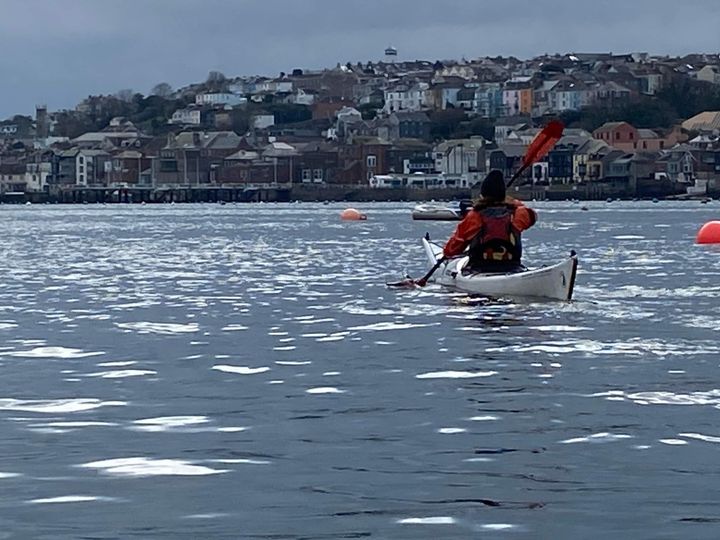
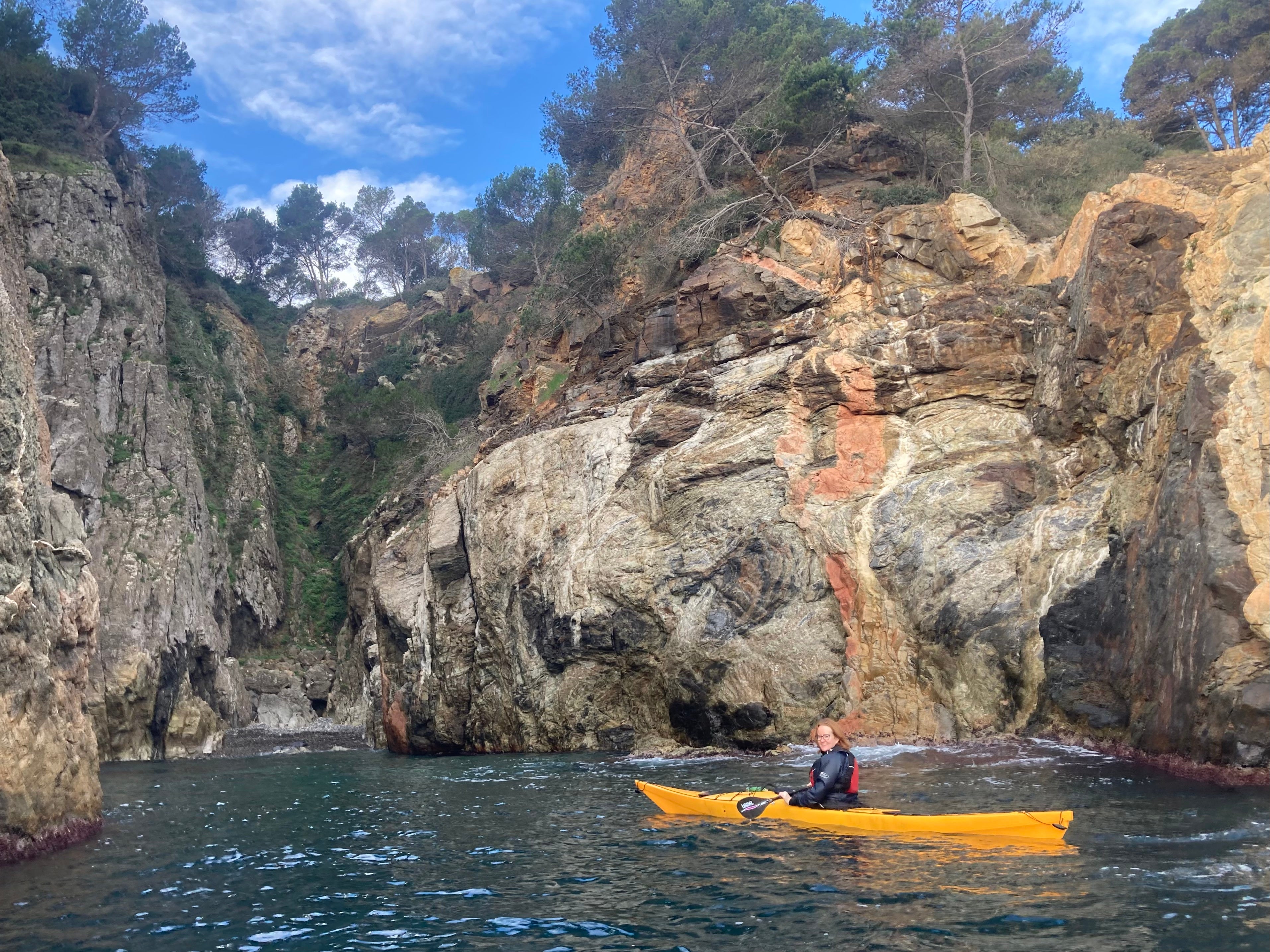
I’d already made up my mind to finish Toby’s Shipping Forecast challenge when my aunt Nicky got me in a sea kayak for the first time in the clear turquoise waters of the Costa Brava (just up the coast from Barcelona). I was relieved to find out that kayaking is a rather lovely thing to do, just as well really! All I needed to do now was get better at it.
With Nicky’s help a plan came together: start in Bristol in early March, continue in May in Pembrokeshire and Anglesey, take the kayak to Ireland and tick of the Irish sea areas during a 3-week family holiday with my partner and 2 young boys in late June, then Hebrides in August – all of these with experienced sea kayakers. I’ll then complete the last 4 areas next year, ended up in the Shetland Islands.
So, the adventure is on. I know I wouldn’t have found the time to complete it if it was “just for me” but since it’s for Toby, I will.
Advertisement
And perhaps that’s the best thing that Toby could have given me.
When you think of funeral music what songs come to mind? Hymns and classical music used to be people’s go to – but all that’s changing.
Gerry and the Pacemaker’s ‘You’ll Never Walk Alone’ has taken the top spot in Co-op Funeralcare’s annual music chart – and not just for Liverpool football fans.
Advertisement
The emotional melody has actually knocked Frank Sinatra’s ‘My Way’ off number one – playey at an estimated 9,500 funerals over the past year.
The undertakers’ annual music chart was launched in 2002 and is based on data and insights from Co-op Funeralcare’s directors and arrangers, who conduct approximately 100,000 funerals a year.
Advertisement
Ed Sheeran (who regularly tops wedding songs charts, too) is in there, with his song, Supermarket Flowers. And some oldies but goodies still feature in the top 10, including Monty Python’s ‘Always Look on The Bright Side Of Life’ and ‘We’ll Meet Again’ by the late Dame Vera Lynn, who dies last summer.
But each year, more pop and contemporary tracks are being played at people’s sendoffs – some with a surprisingly catchy tone.
Advertisement
Getty Images / HuffPost UK
Cardi B and Ed Sheeran, both funeral favourites.
The Greatest Showman’s big number ‘This Is Me’ entered the chart for the first time this year at number ten. Other songs in the top 10 includes Tina Turner’s anthem ‘Simply the Best’ at number four – which has taken on new meaning for must fans of the TV show Schitt’s Creek – and Fleetwood Mac’s ‘The Chain’ at number seven on the list
“Music plays such a big part in all of our lives, it’s no surprise that our favourite songs play a role in the way we say goodbye too,” said Sam Tyrer, managing director of Co-op Funeralcare.
“The songs we choose for a funeral all hold unique and personal meaning for ourselves and loved ones but naturally some songs remain more popular than others and we’re delighted to unveil this year’s music chart.
Among the more controversial songs to have been requested at recent funerals include ‘W.A.P’ by Cardi B ft. Megan Thee Stallion and ‘Girl on Fire’ by Alicia Keys. ‘F*** Forever’ by Babyshambles and ‘Ha Ha You’re Dead’ by Green Day satisfy the alternative crowd, and we quite want to know the story behind the people choosing ‘Ding Dong! The Witch is Dead’ from The Wizard of Oz.
Advertisement
It’s worth noting, however, that offensive songs can be refused to be played by a third party, such as the venue or person ordaining the funeral, says Tyler.
The Top 10 funeral songs for 2021
You’ll Never Walk Alone – Gerry and the Pacemakers
My Way – Frank Sinatra
Always Look on The Bright Side Of Life – Eric Idle
Simply The Best – Tina Turner
Supermarket Flowers – Ed Sheeran
Time to Say Goodbye – Andrea Bocelli and Sarah Brightman