
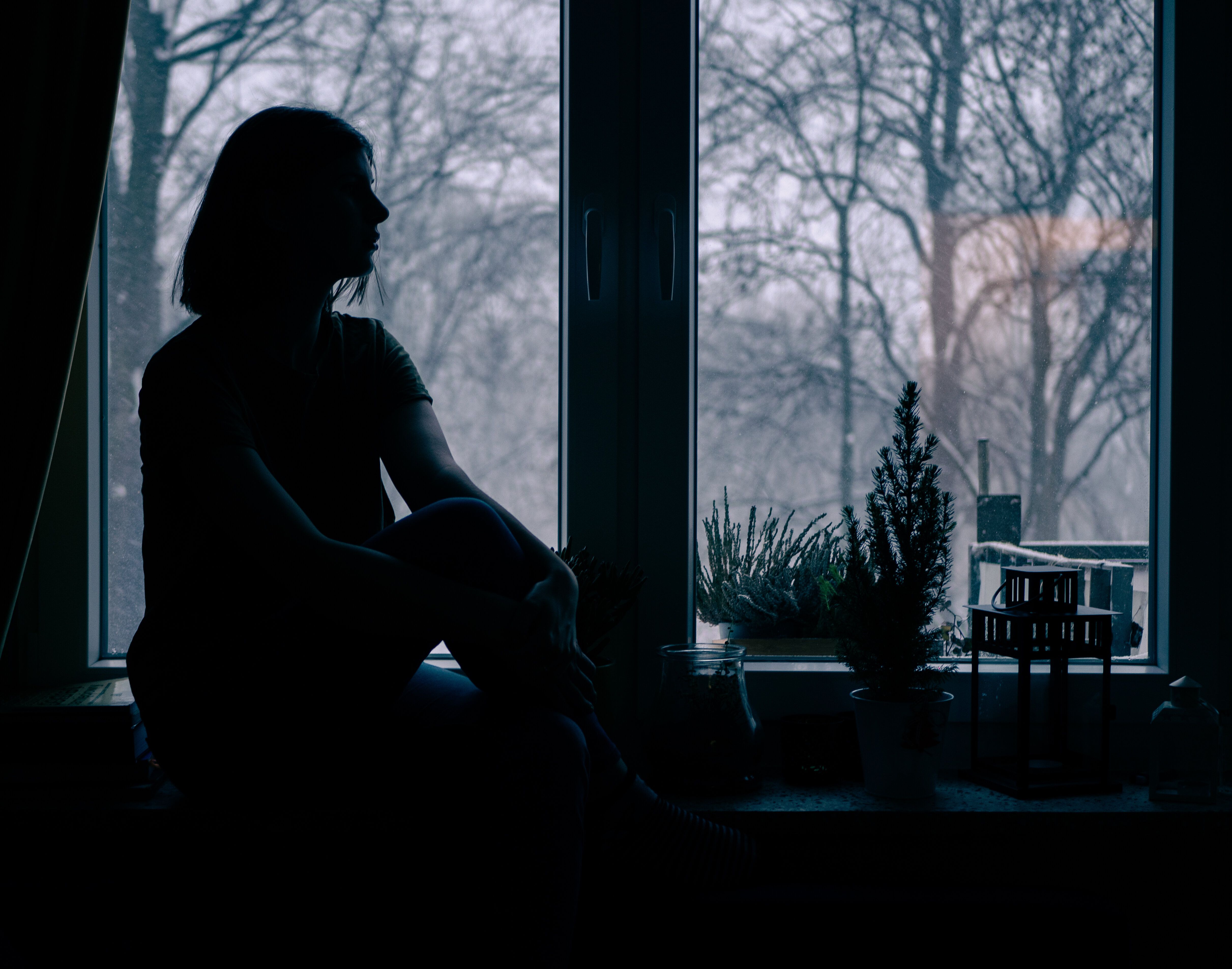
Personally, I find the holidays hard. I love Christmas as a concept but with three of my closest family members dying during this season, it just feels a little too tender for me.
One of my favourite Christmas songs is called “It’s Christmas So We’ll Stop” in which the singer describes Christmas as a chance to breathe during difficult times, a moment to forget the heavy weight of our lives. Then he goes on to say “next day life went back to its’ bad self”.
Advertisement
This is how it feels to me, and many of us. Life hits harder after moments of reprieve and celebration.
According to a medically reviewed article by Health Central, 64% of us struggle with post-holidays depression.
How to cope after Christmas
Writing for The Conversation, Jolanta Burke, Associate Professor, Centre for Positive Health Sciences, RCSI University of Medicine and Health Sciences has given her advice for muddling through.
Advertisement
First, she explains, this slump makes perfect sense: “During the festive period, dopamine levels tend to rise. Anticipation of celebration, time spent with others, indulgent food and festive rituals all stimulate this feel-good system.
“Compared with everyday life, the brain experiences a powerful boost. Even thinking about Christmas before it arrives can activate these pathways, creating a surge of sensory excitement.”
I can relate to this. The build-up to Christmas is almost always more fun than the day itself.
Burke adds: “Once Christmas is over, dopamine levels naturally fall back to their usual baseline. This sharp contrast between heightened stimulation and everyday routine can leave people feeling flat, unmotivated or low. This is the familiar post-Christmas slump.”
Advertisement
As for helping yourself…
Re-establish your routine ASAP
Burke says: “Re-establishing your usual routine as soon as possible can also help. Returning to regular bedtimes and wake times supports your circadian rhythm and helps your body regain a sense of normality.
“Exposure to daylight soon after waking is especially useful, as natural light signals to the brain that the day has begun. A short walk around midday, when light levels peak, can further support energy and mood.”
Make plans for the month ahead
Burke urges: “Scheduling small activities, social connections, or goals gives you something to look forward to and softens the emotional contrast between the festive season and everyday life. Practising presence and finding small moments of enjoyment each day can also help restore balance.”
Advertisement
We’re going to be okay.
Help and support:
Mind, open Monday to Friday, 9am-6pm on 0300 123 3393.
Samaritans offers a listening service which is open 24 hours a day, on 116 123 (UK and ROI – this number is FREE to call and will not appear on your phone bill).
CALM (the Campaign Against Living Miserably) offer a helpline open 5pm-midnight, 365 days a year, on 0800 58 58 58, and a webchat service.
The Mix is a free support service for people under 25. Call 0808 808 4994 or email help@themix.org.uk
Rethink Mental Illness offers practical help through its advice line which can be reached on 0808 801 0525 (Monday to Friday 10am-4pm). More info can be found on rethink.org.
It’s well-known that depression takes a toll on physical and mental health as feelings of isolation, loneliness, despair and low energy prevail.
One area that doesn’t get as much attention? Depression’s impact on your physical space, like your home or bedroom – but a conversation about this is starting on social media.
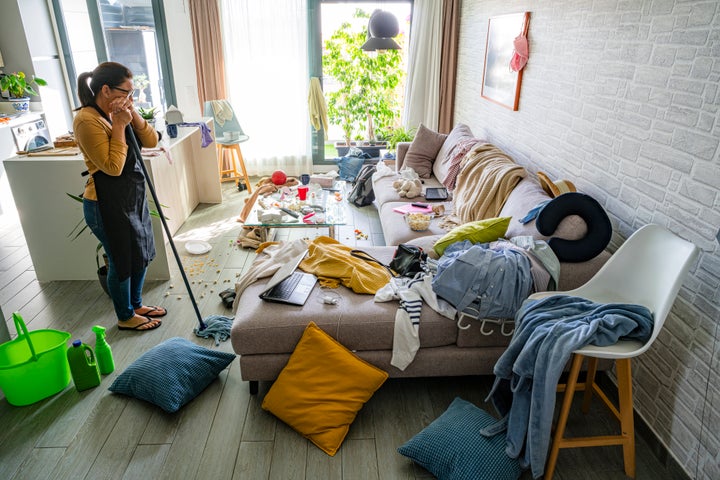
Folks on platforms like Instagram and TikTok are posting videos of their “depression rooms” – spaces filled with old laundry, trash, dirty dishes, takeout boxes and more that weren’t attended to when someone was feeling low. The videos show people cleaning their (or their loved ones’) “depression homes” or “depression rooms.”
Advertisement
“‘Depression room’ is this term that has entered into the pop psychology lexicon lately, and it refers to the living space of a person in the grips of a depressive episode,” said Dayton Olsen, a licensed professional counsellor with Thriveworks in Roanoke, Virginia.
“A ‘depression room’ describes a living space that has become noticeably cluttered or chaotic because the person living in it is experiencing depression,” said Kobe Campbell, a licensed clinical mental health counsellor in North Carolina.
“It’s not about laziness or lack of care, it’s a sign that the inner world has become so heavy or disorganised that maintaining the outer world feels impossible,” Campbell added.
Advertisement
There’s a clear reason “depression rooms” happen.
“The state of the room becomes a mirror of what is happening internally,” Campbell noted.
“It’s amazing what even just a brief glance into someone’s living space can say about how that person’s doing,” Olsen said. A picture – or video, in this case – speaks 1,000 words, he added.
“These awful depressive episodes, they do to a person’s living space what they do to a person. They rob them of the ability to just care for themselves, to tend to themselves and their space,” Olsen noted.
“Depression impairs executive function, which is the area of the brain that helps us plan, prioritise and follow through on tasks,” said Campbell.
Advertisement
When you’re depressed, everyday tasks and chores feel overwhelming, Campbell added.
Illustration: HuffPost; Photos: Getty
“Depression rooms” — the messy bedrooms and homes that reflect the lack of motivation that happens when someone is depressed — are trending on social media.
People who’ve dealt with depression describe it as a period of timelessness “where they can’t remember back, necessarily, to a time where they didn’t feel depressed, and they can’t imagine a future where they feel differently,” Olsen said.
“They’re just frozen in this awful emotional pain, and what that translates to so often is this difficulty to do what so many of us typically do when we’re well, which is to make small investments in our future – brushing our teeth, vacuuming, folding laundry, bathing, eating regularly, all of these things that don’t necessarily require a ton of energy or mental bandwidth but they do require looking ahead to the future and investing in that. And depression robs us of that,” Olsen explained.
Advertisement
Depression also robs folks of their energy and motivation, which can make things like doing the dishes or hanging up your clothes feel impossible.
“Depression room” cleaning is a way to break the depression feedback loop.
“When you think about psychology and mental health, there’s this feedback loop between your thoughts, your feelings and your behaviours,” explained Taisha Caldwell-Harvey, a psychologist and the founder and CEO of The Black Girl Doctor, an online therapy and wellness platform.
When your behaviour changes, and you’re no longer cleaning your bedroom or letting dishes pile up, it also influences how you think, talk to yourself and how you feel, she said.
Advertisement
“It’s all a circle, it’s all a loop, and so you might look around and say, ‘Oh, I’m gross, I’m lazy,’ and then if you say that, now you’re going to have [thoughts like] ‘I shouldn’t be doing this,’ ‘I’m a bad person,’ and that’s going to trigger emotions that are connected to that – now I’m sad, I feel guilty, I feel bad,” Caldwell-Harvey said.
If you feel bad, why would you do anything around your house? If you tell yourself you’re lazy, why would you pick up after yourself?
“It’s all a circle, it’s all a loop, and so you might look around and say, ‘Oh, I’m gross, I’m lazy,’ and then if you say that … that’s going to trigger emotions that are connected to that — now I’m sad, I feel guilty, I feel bad.”
– Taisha Caldwell-Harvey, psychologist and founder and CEO of The Black Girl Doctor
Advertisement
The clean-up depression room videos on social media are a way to break this feedback loop and make people feel better, Caldwell-Harvey said.
“Most of the times, we can’t just tell ourselves ‘feel better,’ right? The feeling [aspect] is the hardest one to try to interrupt… we usually let that one be for a minute and start with something that is an easier place, and so behaviour activation is a big one that is usually easier for people to do,” Caldwell-Harvey said.
“So, while you feel like crap, while you’re still telling yourself these negative things, you can force yourself to do a behaviour. We call it behaviour activation. And so it could be something like clean up your room, [or] it can be something as small as clean up this corner of your room,” she added.
Advertisement
If you don’t have it in you to clean your whole kitchen, set a timer for five minutes and clean for just that amount of time.
“So, you clean for five minutes, and now you think, ‘Oh, I did one small thing,’” she said. Being able to say to yourself, “I did one small thing” can lead to a tiny bit of hope and even a commitment to do five more minutes of cleanup the next day, she added.
This breaks the cycle and interrupts the pattern, she explained.
fcafotodigital via Getty Images
Depression robs folks of their motivation, which makes tasks like cleaning feel impossible.
Advertisement
You can also always use your home as a visual mental health check.
“Our environment influences our emotional health. A 2010 study published in Personality and Social Psychology Bulletin found that women who described their homes as cluttered or unfinished had higher levels of cortisol and more feelings of fatigue and depression compared to those who described their spaces as restful and restorative,” said Campbell.
“So, even small acts of tidying can help signal safety to the nervous system,” Campbell noted.
Beyond signalling safety, your home can give you a peek into your emotional and mental health, which is important as it’s hard to keep tabs on the small mental health changes that lead to big declines.
Usually, people wake up one day and feel totally depressed, but it doesn’t happen overnight, Caldwell-Harvey said. “You actually have a decline,” she said.
Advertisement
One way to keep tabs on your mental health and be aware of the decline is by using your bedroom or home as a mental health check, Caldwell-Harvey added.
“A lot of times, your environment really is telling you how you’re doing, and so it’s a good question to ask – ‘What is my environment telling me about what’s happening right now?’” she said.
If you do have a depression room, don’t be ashamed.
Depression is heavy, isolating and scary. If you have a depression room during times of low mood, that’s OK. “If you have a ‘depression room,’ you are not alone,” said Campbell.
Advertisement
“Feeling shame about it is understandable, but misplaced. Clutter isn’t a character flaw, it’s a flag signalling that you need more support than you can offer yourself,” she added.
It’s also a sign that you’re struggling and need additional care, Campbell noted.
Beyond taking a few minutes to clean your depression room, make social plans and create structure for yourself within your home, added Olsen, whether that’s waking up at the same time, logging on to work at a certain time or simply having a glass of water before bed.
And know when you need extra support.
“I always want to be really careful when we talk about stuff like this,” said Caldwell-Harvey.
While content about “depression rooms” can help people feel less alone and increase conversations about depression, “I also am really cautious that we’re not glamorising suffering, and that we’re not further stigmatising people that are in a clinical depression that needs treatment,” she said.
Advertisement
You can have symptoms of depression and not have clinical depression, Caldwell-Harvey explained. But for those with clinical depression, things like room cleaning, behaviour changes or daily mantras aren’t going to be enough to boost your mood.
If two weeks go by and you still aren’t feeling good, you may need more support, she noted.
“If you’re struggling and you are trying this stuff, and you’re just like, ‘Yeah, this ain’t doing it,’ that’s when we want you to reach out for help,” she said. “That is what therapists are for. Medication is really effective for depression – medication and talk therapy are both extremely effective for depression,” Caldwell-Harvey added.
For some people, a depression room – and depression – may be a short-lived occurrence, but for others, it’ll be a longer challenge.
Advertisement
“Cleaning your room is not going to take away grief. It might make you feel better for a minute, and that’s great if it does, but again, you probably need to talk to somebody and process it and do all the things that are going to give you the long-term relief from what you’re going through,” she said.
“Not all messy rooms are depression rooms. Not all depression shows up that way,” she added. Some depressed people have spotless homes, and some non-depressed folks have cluttered, messy spaces, Caldwell-Harvey added.
But if you know your depression room is just that, be sure to take care of yourself and be kind to yourself.
Advertisement
“The goal isn’t to flip a switch that changes you immediately. Healing requires tiny, consistent acts of kindness toward yourself, because caring for your space is caring for yourself, said Campbell.
Depression is an extremely common mental illness, affecting 1 in 6 adults in the UK and usually in combination with other mental health conditions like anxiety, stress, and loneliness. It’s still a massively undertreated condition with only 15% of women getting treatment for it and 9% of men. Women are also twice as likely to experience depression than men.
The differences don’t end there, though.
It turns out that the way the two sexes react to and experience the symptoms of depression are different, too.
Advertisement
Depression Between The Sexes
Depression can hit as early in life as adolescence and for girls, this means struggling with body image, guilt, feelings of failure, difficulty concentrating and general sadness. For boys, this manifests as losing interest in their usual activities and to be more downcast and tired in the morning.
As they get older, women are more likely to see their depression manifesting with stress, sadness, and sleep problems while men will experience irritability and anger outbursts.
Why Do The Sexes Experience Depression Differently?
A new study of over 270,000 participants found that prediction methods that take into account gender are more precise in determining an individual’s genetic predisposition to depression than those that do not consider gender.
Advertisement
Until now, depression has been treated without gender being considered but this research has highlighted the importance of gender-based treatments due to both the body’s development of the illness and the widely different ways that it can manifest.
The researchers found 11 sections of DNA associated with depression in women and only a single section in men.
This study also found that depression was linked to metabolic diseases like diabetes and also linked to obesity in women.
Researchers hope that this first-of-its-kind study will help to guide future gender-specific treatment.
Get Help With Depression
If you’re struggling with depression or think you could be, speak to your GP to get the support that you need. Treatments for depression can include talking therapies and medication. Your GP will work with you to identify the best treatment for you. The mental health charity Mind has advice on resources for mental health self-help too.
You’re reading Love Stuck, where trained therapists answer your dating, sex, and relationship dilemmas. You can submit a question here.
Watching someone you love struggle with their mental health isn’t easy. You want to support and care for that person but they might be shutting you out or worse, it could be affecting your relationship.
This week’s reader Holly has found herself stuck between a rock and a hard place. “My boyfriend is depressed and it’s affecting our relationship,” Holly says.
Advertisement
“My boyfriend has suffered from depression for the majority of our relationship. I feel bad for saying this but it’s starting to affect me too. We live together and in the last few months the depression has really put a strain on our relationship,” Holly adds.
She continues: “His moods are always up and down, he rarely wants to go out and it’s making me question the relationship. Part of me feels like I want to leave but is that fair? What can I do?”
What should Holly do? Should she fight for her relationship and support her partner?
Co-Founder of So Synced and Relationship Expert Jessica Alderson wants Holly to practice compassion.
“While it’s important for the reader to empathise with her partner’s struggles, she should acknowledge that it isn’t easy for her, either, and she shouldn’t feel guilty about that,” Alderson says.
What would you say to this reader?
“Depression can be an all-consuming mental illness, and it’s understandable that it’s starting to affect the reader as well,” says Alderson.
Advertisement
It can be emotionally taxing to support a loved one with depression so anyone in this position should have someone to talk to.
“In addition, the reader should remember to practice self-care. This might include regular exercise, taking time to pursue hobbies, and spending time with friends and family,” Alderson adds.
She explains that if your partner is suffering from a mental illness, it’s important not to fall into the trap of trying to “fix” them.
“Providing support and understanding is very different from trying to cure someone’s depression. It can be a dangerous road to go down and may cause the “saviour” to end up with serious issues of their own,” Alderson says.
Trying to save someone in a relationship usually doesn’t work as recovery from mental illnesses such as depression or addiction often requires professional help and serious commitment.
Advertisement
Alderson tells Holly that “while supporting a partner is a natural and essential part of any relationship, it’s important that we recognise our own limitations and be aware of our own needs. There’s a fine line between compassion and self-neglect, and staying on the right side of it is key for your overall well-being.”
How can one person having depression affect a relationship?
Alderson explains that “When one person in a relationship is experiencing depression, it can have a significant impact on the dynamics and well-being of both individuals involved. Here are some ways in which depression can affect a relationship:”
Emotional strain: Depression often leads to persistent feelings of sadness, hopelessness, and fatigue. The non-depressed partner may also experience feelings of helplessness, frustration, or guilt for not being able to alleviate their partner’s suffering. If it persists, both people can end up feeling disconnected from each other.
Communication challenges: Depression can impact people’s ability to communicate effectively. The person with depression may withdraw, have difficulty expressing their emotions, or struggle to engage in open and honest conversations. This can hinder effective communication and make it challenging for the couple to understand each other.
Reduced intimacy and sexual desire: Depression often causes a lack of interest in activities that people once enjoyed, including physical intimacy. One side effect of depression is a decreased libido, which can lead to less frequent sexual activity. In turn, this can cause feelings of rejection or inadequacy which can further strain the relationship.
Role imbalance: When one partner is dealing with depression, the other partner may need to take on additional responsibilities and support them, such as cooking, cleaning, or managing finances. This can result in an imbalance within the relationship, and the non-depressed partner might feel overwhelmed or neglected as they focus their energy on supporting their partner.
Social isolation: Depression can lead to social withdrawal and a reduced desire to engage in social activities. As such, the couple may end up going to fewer events together, which can leave both people feeling disconnected from their social network. The non-depressed partner may feel guilty about attending events without their significant other and may become socially isolated.
What practical advice would you give this reader?
This is clearly not an easy situation for Holly. “Deciding whether to stay with a partner who has depression is a deeply personal choice that depends on several factors,” Alderson says.
Advertisement
Holly should consider the impact that the depression is having on her own mental health. “There’s a clear distinction between finding a situation slightly challenging and feeling completely overwhelmed or unable to cope,” Alderson explains.
“One of the most important factors to consider is whether her partner is currently taking action to address his depression or is at least open to the idea,” she adds.
If her boyfriend is committed to making changes this massively impacts how likely it is that the situation will improve in the future. Holly should also consider how compatible they are as a couple on a fundamental basis.
“While depression can strain a relationship, it’s important that she evaluates whether there are other issues that go beyond the effects of depression. This includes factors such as mutual attraction, shared values, and aligned goals,” Alderson adds.
There is no one-size-fits-all answer to whether you should stay in a relationship with a partner who has depression, as each situation is unique.
Advertisement
“Ending a relationship with someone who is in need of support can be a difficult choice to make. It’s ultimately up to the individual to weigh up all the various factors and decide what feels right for them,” Alderson says.
It may feel wrong to leave a relationship when someone is suffering from mental health issues, b01ut if it’s causing significant distress for you it isn’t selfish if it’s done for the right reasons and in the right way.
Love Stuck is for those who’ve hit a romantic wall, whether you’re single or have been coupled up for decades. With the help of trained sex and relationship therapists, HuffPost UK will help answer your dilemmas. Submit a question here.
This mental health condition, also known as seasonal depression, lasts around four to five months on average. “The appropriately named SAD, or seasonal affective disorder, is considered a type of depression characterised by its seasonal nature,” Jeff Temple, a professor at University of Texas Medical Branch and a licensed psychologist, tells HuffPost.
A common misconception is that SAD is less serious than major depressive disorder because it doesn’t last all year round. However, people with this mental health condition explained to HuffPost that the symptoms of SAD are very real, and can even be debilitating.
Here’s what they want you to know:
People with seasonal depression may struggle to do daily activities
Like those with major depressive disorder, people with SAD may experience a lack of motivation and a loss of interest in day-to-day activities.
“I have had SAD for about 12 years, but I didn’t recognize the pattern or be diagnosed until about five years ago,” Claire, an optometrist, tells HuffPost. (Claire, along with some others in this story, asked to keep her last name private so she could freely talk about her mental health condition.) “I am typically an early riser and consider myself a productive person. However, when SAD hits, I struggle to do even the smallest daily chores like doing the dishes or making dinner.”
Advertisement
Similarly, Rebecca, a grad student, says that she has a “difficult time keeping up with [her] self-care and workout routine during the winter months,” and finds it nearly impossible to “function at full capacity.”
People with SAD may also feel more isolated during the darker months
Moreover, staying socially and emotionally connected to loved ones can require much more effort when coping with seasonal depression.
“The most prominent SAD symptoms I experience are loneliness and apathy. I tend to become quite numb in the winter months, and feel emotionally separated from the people around me,” says Vera, a freelance illustrator. “During regular depressive episodes, I may be able to ‘mask’ for most basic social interactions, whereas in winter seasons it’s not even an option. I’m too wiped out to even show up or pretend.”
Seasonal depression can interrupt normal sleep cycles and lead to extreme fatigue
SAD and sleep disturbances go hand in hand. Chloé Perrin, a bartender, has found that her symptoms of seasonal depression often manifest as constant exhaustion, leading to hypersomnia. Simply put, hypersomnia is characterised by recurring episodes of sleepiness during the day, difficulty waking up in the morning, and feeling tired despite oversleeping.
“My family used to joke that every winter I’d hibernate, whereas my sleep is otherwise normal-to-low the rest of the year and during other episodes,” she says.
Advertisement
Bella Sutter, a dancer with seasonal depression, explains that “getting out of bed feels impossible and my mornings normally start late.”
“I feel as if I would be better off hibernating through the winter because seasonal depression makes me feel like I’m half asleep anyway,” she adds.
Krzysztof Krysiak / EyeEm via Getty Images
SAD can cause mood changes, sleep disruptions and more.
People with seasonal depression may experience changes related to appetite and eating habits
Not only does seasonal depression impact sleep, but this mental health condition can have a negative impact on a person’s eating habits. Researchers have found a marked correlation between SAD and higher rates of disordered eating, including behaviours such as binging, purging and restricting food intake.
For Anna Samanamú, a high school paraprofessional and graphic designer, symptoms of SAD began when she was a teenager. “My appetite becomes affected [with SAD], and I would prefer to sleep rather than eat,” she says. “Unfortunately, that led me to have issues such as anaemia and Vitamin D deficiency.”
Advertisement
Seasonal depression may worsen symptoms of other mental health conditions
According to Temple, “seasonal affective disorder has a bi-directional relationship with other mood disorders like depression and bipolar disorder — meaning that people with one form are much more likely to develop or worsen the other.” Notably, SAD affects up to 20% of people with major depressive disorder, and 25% of people with bipolar disorder.
Rhiannon Bellia, who works in social services, has found that seasonal depression tends to exacerbate symptoms of other mental health conditions.
“My OCD gets a lot worse in the winter, it’s harder for me to focus and gauge time with my ADHD. With having autism, it’s also a bit harder for me to regulate sensory overwhelm,” Bellia says.
There are treatments for SAD
Temple explains that if symptoms such as losing interest in activities or feeling sad last “longer than a couple of weeks or [start] to interfere with your work, family, or relationships, then that’s a good sign that you may need some extra help.”
SAD is not simply feeling a little gloomy when the sun goes down; it is a serious mental health condition that can greatly impact every aspect of someone’s life.
“Please be kind to everyone who struggles with seasonal depression,” Samanamú says. “We are not lazy — sometimes there is just a disconnect from our minds and bodies. Many of us just need to take a little bit of time to become whole once again.”
Help and support:
Mind, open Monday to Friday, 9am-6pm on 0300 123 3393.
Samaritans offers a listening service which is open 24 hours a day, on 116 123 (UK and ROI – this number is FREE to call and will not appear on your phone bill).
CALM (the Campaign Against Living Miserably) offer a helpline open 5pm-midnight, 365 days a year, on 0800 58 58 58, and a webchat service.
The Mix is a free support service for people under 25. Call 0808 808 4994 or email help@themix.org.uk
Rethink Mental Illness offers practical help through its advice line which can be reached on 0808 801 0525 (Monday to Friday 10am-4pm). More info can be found on rethink.org.
HuffPost is part of Verizon Media. We and our partners will store and/or access information on your device through the use of cookies and similar technologies, to display personalised ads and content, for ad and content measurement, audience insights and product development.
Your personal data that may be used
Information about your device and internet connection, including your IP address
Browsing and search activity while using Verizon Media websites and apps
To enable Verizon Media and our partners to process your personal data select ‘I agree‘, or select ‘Manage settings‘ for more information and to manage your choices. You can change your choices at any time by visiting Your Privacy Controls.
HuffPost is part of Verizon Media. Click ‘I agree‘ to allow Verizon Media and our partners to use cookies and similar technologies to access your device and use your data (including location) to understand your interests, and provide and measure personalised ads. We will also provide you with personalised ads on partner products. Learn more about how we use your data in our Privacy Centre. Once you confirm your privacy choices here, you can make changes at any time by visiting your Privacy dashboard.
Click ‘Learn more‘ to learn and customise how Verizon Media and our partners collect and use data.
Mixing a specific type of meditation with a well-known hallucinogen may make for a new form of therapy that could aid those with depression, according to a new study.
New research suggests that combining meditation and psilocybin may improve symptoms of depression.
People often still regard psychedelic psychotherapy as a controversial treatment. However, recent evidence suggests that hallucinogens may have benefits for depression and anxiety disorders when individuals use them with certain other therapies.
The reasoning behind this is still unclear, but one theory states that psychedelics can help quicken the realization and thought processes a person needs for their therapy to work.
Psilocybin, a psychedelic that people find in magic mushrooms, has been the subject of several studies. Its effects can range from assisting with social interactions to limiting a person’s focus on themselves.
One such study, appearing in the Journal of Psychopharmacology in 2016, found that psilocybin, together with psychotherapy, produced antidepressant effects in patients with life-threatening cancer.
Researchers at Imperial College London found similar benefits in people with depression who had not responded to other treatments. Neuroimaging revealed the drug could turn off a part of the brain that is always on when a person is awake. Neuroscientists call this brain element the default mode network.
Earlier this year, the U.K. university opened the world’s first center for psychedelics research. A trial currently underway at the center is comparing the effects of psilocybin with those of a well-known antidepressant.
In the meantime, according to new findings that now appear in the journal Scientific Reports, combining psilocybin with a form of meditation may produce even more positive benefits.
Stay in the know. Get our free daily newsletter
You’ve got questions. We’ve got answers. Expert, evidence-based advice delivered straight to your inbox to help you take control of your health
Mindfulness meditation is already known to have a similar psychedelic effect to psilocybin, including reducing self-focus and boosting feelings of self-transcendence.
In the latest study, a team from the University Hospital of Psychiatry Zurich in Switzerland has combined the two to look at the joint impact for the first time.
Some 39 Buddhist meditation practitioners took part in a 5-day mindfulness retreat. Guided by a Zen teacher, they stuck to strict schedules that lasted from 6 a.m. until 9 p.m.
The practice — known as sesshin — involves sitting meditation sessions, indoor and outdoor walking meditation, and mindful physical activities. Participants were silent throughout.
On the fourth day of the retreat, the researchers gave some participants psilocybin while administering a placebo to the remainder.
Blocking negative impacts
Using questionnaires and mindfulness scales, among other neurocognitive measurements, the team found that, after 4 months, psilocybin takers had more positive changes.
These changes related to aspects such as empathy, self-acceptance, and psychosocial functioning.
Notably, even before the 4-month follow-up, “psilocybin markedly increased the incidence and intensity of self-transcendence virtually without inducing any anxiety compared to participants who received the placebo,” says Lukasz Smigielski, first author of the study.
In fact, researchers believe the skills gained during the meditation retreat helped guard against any negative impact from taking the psilocybin.
Predictors of a positive outcome included the depth of meditation and participants’ optimism and openness.
Another treatment for depression?
The intensity of the retreat and expertise of the participants may have limited the application of the findings, however. It may take the average person longer to experience the full benefits of mindfulness meditation, and many individuals will not have access to a structured, retreat-type experience.
But, says study director Prof. Franz Vollenweider, the findings could pave the way for “new therapeutic avenues.”
One example, he notes, could be “for the treatment of depression, which is often accompanied by increased self-focus and social deficits.”
With millions of adults in the United States currently living with depression, according to the Anxiety and Depression Association of America, this novel method could provide many more research opportunities.
As with all such research avenues, however, it is likely to take time before psychedelic psychotherapy or psychedelic enhanced meditation wholly enter the mental health conversation.
To proceed, simply complete the form below, and a link to the article will be sent by email on your behalf. Note: Please don’t include any URLs in your comments, as they will be removed upon submission.
We do not store details you enter into this form. Please see our privacy policy for more information.
Message sent successfully
The details of this article have been emailed on your behalf.
Click here to return to the Medical News Today home page.
HuffPost is part of Oath. Oath and our partners need your consent to access your device and use your data (including location) to understand your interests, and provide and measure personalised ads. Oath will also provide you with personalised ads on partner products. Learn more.
How Oath and our partners bring you better ad experiences
To give you a better overall experience, we want to provide relevant ads that are more useful to you. For example, when you search for a film, we use your search information and location to show the most relevant cinemas near you. We also use this information to show you ads for similar films you may like in the future. Like Oath, our partners may also show you ads that they think match your interests.