Immediately after the Big Bang, which occurred around 13.8 billion years ago, the universe was dominated by unimaginably high temperatures and densities. However, after just a few seconds, it had cooled down enough for the first elements to form, primarily hydrogen and helium. These were still completely ionized at this point, as it took almost 380,000 years for the temperature in the universe to drop enough for neutral atoms to form through recombination with free electrons. This paved the way for the first chemical reactions.
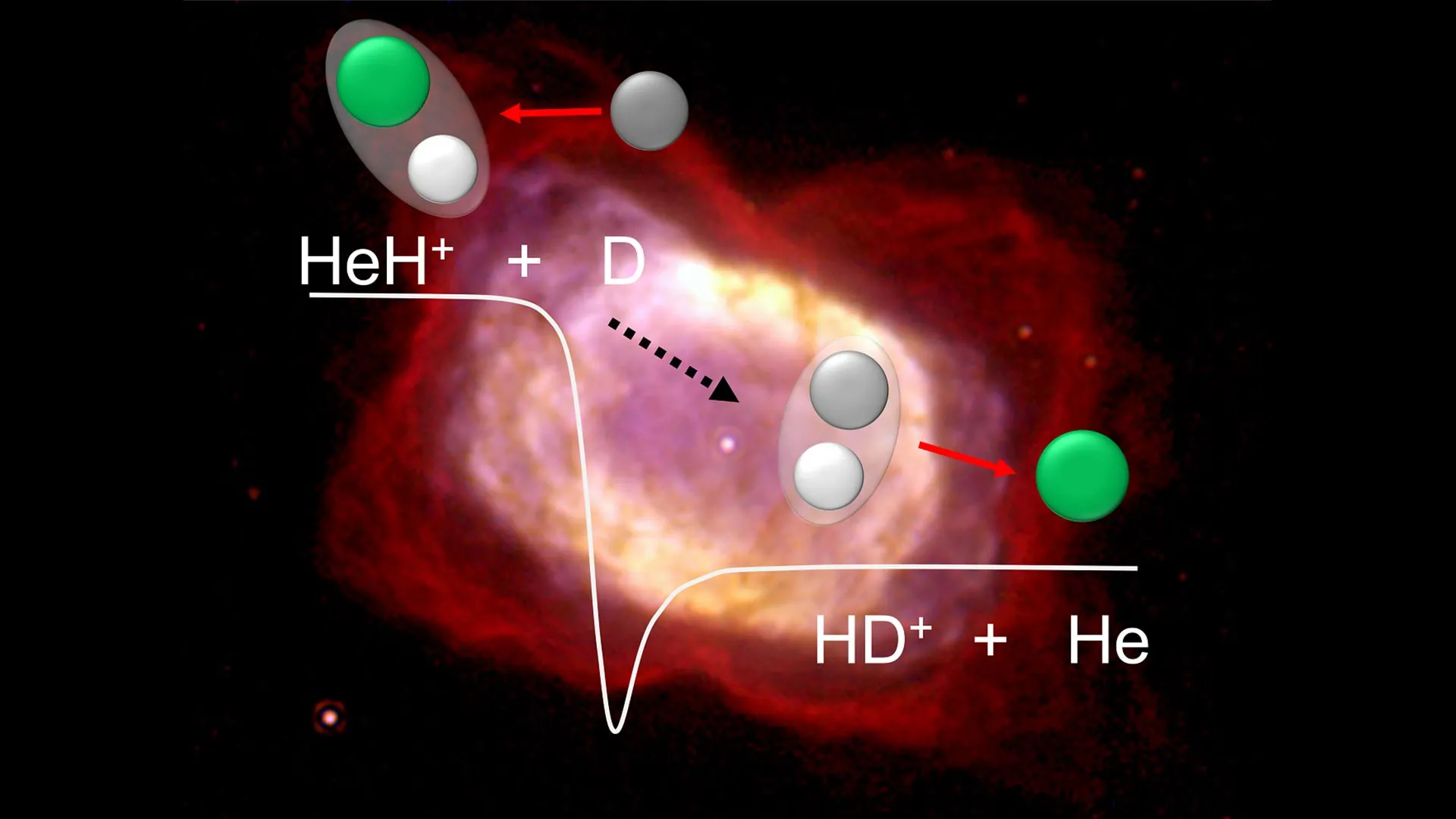
The oldest molecule in existence is the helium hydride ion (HeH+), formed from a neutral helium atom and an ionized hydrogen nucleus. This marks the beginning of a chain reaction that leads to the formation of molecular hydrogen (H2), which is by far the most common molecule in the universe.
Recombination was followed by the ‘dark age’ of cosmology: although the universe was now transparent due to the binding of free electrons, there were still no light-emitting objects, such as stars. Several hundred million years passed before the first stars formed.
During this early phase of the universe, however, simple molecules such as HeH⁺ and H2 were essential to the formation of the first stars. In order for the contracting gas cloud of a protostar to collapse to the point where nuclear fusion can begin, heat must be dissipated. This occurs through collisions that excite atoms and molecules, which then emit this energy in the form of photons. Below approximately 10,000 degrees Celsius, however, this process becomes ineffective for the dominant hydrogen atoms. Further cooling can only take place via molecules that can emit additional energy through rotation and vibration. Due to its pronounced dipole moment, the HeH⁺ ion is particularly effective at these low temperatures and has long been considered a potentially important candidate for cooling in the formation of the first stars. Consequently, the concentration of helium hydride ions in the universe may significantly impact the effectiveness of early star formation.
During this period, collisions with free hydrogen atoms were a major degradation pathway for HeH⁺, forming a neutral helium atom and an H2⁺ ion. These subsequently reacted with another H atom to form a neutral H2 molecule and a proton, leading to the formation of molecular hydrogen.
Researchers at the Max-Planck-Institut für Kernphysik (MPIK) in Heidelberg have now successfully recreated this reaction under conditions similar to those in the early universe for the first time. They investigated the reaction of HeH⁺ with deuterium, an isotope of hydrogen containing an additional neutron in the atomic nucleus alongside a proton. When HeH⁺ reacts with deuterium, an HD⁺ ion is formed instead of H2⁺, alongside the neutral helium atom.
The experiment was carried out at the Cryogenic Storage Ring (CSR) at the MPIK in Heidelberg — a globally unique instrument for investigating molecular and atomic reactions under space-like conditions. For this purpose, HeH⁺ ions were stored in the 35-metre-diameter ion storage ring for up to 60 seconds at a few kelvins (-267 °C), and were superimposed with a beam of neutral deuterium atoms. By adjusting the relative speeds of the two particle beams, the scientists were able to study how the collision rate varies with collision energy, which is directly related to temperature.
They found that, contrary to earlier predictions, the rate at which this reaction proceeds does not slow down with decreasing temperature, but remains almost constant. “Previous theories predicted a significant decrease in the reaction probability at low temperatures, but we were unable to verify this in either the experiment or new theoretical calculations by our colleagues,” explains Dr Holger Kreckel from the MPIK. ‘The reactions of HeH⁺ with neutral hydrogen and deuterium therefore appear to have been far more important for chemistry in the early universe than previously assumed,’ he continues. This observation is consistent with the findings of a group of theoretical physicists led by Yohann Scribano, who identified an error in the calculation of the potential surface used in all previous calculations for this reaction. The new calculations using the improved potential surface now align closely with the CSR experiment.
Since the concentrations of molecules such as HeH⁺ and molecular hydrogen (H2 or HD) played an important role in the formation of the first stars, this result brings us closer to solving the mystery of their formation.
Macquarie University astronomers have tracked an extreme planet’s orbital decay, confirming it is spiralling towards its star in a cosmic death dance that could end in three possible ways.
The ultra-hot Jupiter exoplanet TOI-2109b, located 870 light-years from Earth, completes an orbit around its star in just 16 hours – making it the closest hot Jupiter ever discovered.
With a mass nearly five times that of Jupiter and almost twice Jupiter’s size, TOI-2109b orbits even closer to its star than Mercury does to our Sun.
“Just to put it into context – Mercury’s mass is almost 6,000 times smaller than Jupiter, but it still takes 88 days to orbit our Sun. For a huge gas giant such as TOI-2109b to fully orbit in 16 hours – it tells us that this is a planet located super-close to its star,” says Dr Jaime A. Alvarado-Montes, a Macquarie Research Fellow who led the international study published on July 15 in The Astrophysical Journal.
By analysing transit timing data from multiple ground-based telescopes, NASA’s TESS mission and the European Space Agency’s CHEOPS satellite spanning 2010 to 2024, the team detected subtle changes in the planet’s orbit.
Both theoretical models and observations independently calculated that the planet’s orbital period would decrease by at least 10 seconds over the next three years – confirming the planet may be spiralling towards its star.
The researchers identified three possible fates for TOI-2109b: it could be torn apart by tidal forces, plunge directly into its star, or have its gaseous envelope stripped away by intense radiation, leaving only a rocky core.
“This planet and its interesting situation could help us figure out some mysterious astronomical phenomena that so far we really don’t have much evidence to explain,” Dr Alvarado-Montes says. “It could tell us the story of many other solar systems.”
The findings suggest some rocky planets in other solar systems might be the stripped cores of former gas giants – a possibility that could reshape our understanding of planetary evolution.
With continued monitoring over the next three to five years, astronomers will detect the predicted orbital changes, providing real-time observation of a planetary system in its death throes.
A new study from NYU Abu Dhabi has found that high-energy particles from space, known as cosmic rays, could create the energy needed to support life underground on planets and moons in our solar system.
The research shows that cosmic rays may not only be harmless in certain environments but could actually help microscopic life survive. These findings challenge the traditional view that life can only exist near sunlight or volcanic heat. Published in the International Journal of Astrobiology, the study is led by the Principal Investigator of the Space Exploration Laboratory at NYUAD’s Center for Astrophysics and Space Science (CASS), Dimitra Atri.
The team focused on what happens when cosmic rays hit water or ice underground. The impact breaks water molecules apart and releases tiny particles called electrons. Some bacteria on Earth can use these electrons for energy, similar to how plants use sunlight. This process is called radiolysis, and it can power life even in dark, cold environments with no sunlight.
Using computer simulations, the researchers studied how much energy this process could produce on Mars and on the icy moons of Jupiter and Saturn. These moons, which are covered in thick layers of ice, are believed to have water hidden below their surfaces. The study found that Saturn’s icy moon Enceladus had the most potential to support life in this way, followed by Mars, and then Jupiter’s moon Europa.
“This discovery changes the way we think about where life might exist,” said Atri. “Instead of looking only for warm planets with sunlight, we can now consider places that are cold and dark, as long as they have some water beneath the surface and are exposed to cosmic rays. Life might be able to survive in more places than we ever imagined.”
The study introduces a new idea called the Radiolytic Habitable Zone. Unlike the traditional “Goldilocks Zone” — the area around a star where a planet could have liquid water on its surface — this new zone focuses on places where water exists underground and can be energized by cosmic radiation. Since cosmic rays are found throughout space, this could mean there are many more places in the universe where life could exist.
The findings provide new guidance for future space missions. Instead of only looking for signs of life on the surface, scientists might also explore underground environments on Mars and the icy moons, using tools that can detect chemical energy created by cosmic radiation.
This research opens up exciting new possibilities in the search for life beyond Earth and suggests that even the darkest, coldest places in the solar system could have the right conditions for life to survive.
The summer holidays are now in full-swing and for some parents across the UK, that can only mean one thing: a camping holiday to enjoy a hearty dose of nature and, let’s be honest, tire the kids out in time for bedtime.
You have the equipment ready, the car is packed and the kids are suitably excited for the opportunity to go absolutely feral on a campsite. There’s only one issue: what do you eat every day?!
Advertisement
Of course, going out for dinner is an option but heading out for every single meal kind of defeats the point of camping and can make this relatively affordable holiday quite pricey after a few days.
Thankfully, there are plenty of options to choose from.
The best foods to eat when camping
Sandwiches
I know, I know, what an obvious suggestion. However, these handy snacks are ideal for throughout the day, are very easy to store and if they’re wrapped in tinfoil, can last a little longer than usual. They’re popular for a reason!
Pasta
Whether it’s tuna pasta, tomato and cheese pasta or even just pesto pasta, this delicious dinner is great hot or cold. You can make it ahead of time to reheat once you’re camping or you can simply tuck into it cold.
Advertisement
Pasta salads are also a delicious go-to, just keep the components separate until you’re eating to save anything going soggy.
Breakfast burritos
The camping experts at The Adventure Bite say: “Camping Breakfast burritos are easy to put together and full of delicious sausage, eggs, crispy fried potatoes, and melted shredded cheese. It’s the ultimate lazy camping breakfast if you put them together at home and toss them on the fire in foil.”
YUM. Perfect for filling tummies ahead of a day of adventures.
Cereals
Keep milk in your cooler bag and take with you a box of cereal or muesli. Quick, simple and cheap. Plus, kids never tire of cereal.
Advertisement
Tinned fruits
BBC Good Food recommends: “When it comes to camping desserts, it’s often a case of assembling rather than cooking. Tinned fruit can be mixed into an instant salad, but if you want to add a special touch, melt some chocolate to drizzle over tinned pears, then sprinkle with hazelnuts.
“Sweet, shiny canned peaches with cream are a retro winner, too.”
Pre-seasoned meats
In the /r/camping community on Reddit, user RedJessa says: “I like to pre-season steak, chicken breasts or pork chops and seal them in vacuum sealer bags. Just throw them on whatever grill type you please. I also will pre-chop potatoes and veggies, seasoned and sealed.
“Ready to sautee or cook in foil packs over the grill. The vacuum sealer thing is great for prepping camp food and I re-use the bags until I can’t anymore to reduce waste. I pre-cooked bacon last time so we only had to throw it on to heat and crisp, so much easier and less mess.”
Who said camping couldn’t be bougie?
Finger foods
Eat Sleep Wild suggests: “Another favourite option is a sort of lunch mezze of breads, olives, cured meat, cheeses, and hummus. All of these options travel well, are high in calories and good fats, and are super tasty!”
Salt–N–Pepa might have famously sung the words ‘Let’s Talk About Sex, Baby’, but let’s face it, talking about our bedroom antics isn’t always comfortable, especially when it comes to sharing the nitty gritty details of what you like, how much you’re having and – scariest of all – your feelings about it.
Fortunately in 2025 conversations around sex have become so much more commonplace thanks to an ever-changing cultural shift that champions emotional openness, but according to new data, men are being left behind.
Advertisement
A survey on over 2,000 UK adults from Lovehoney, the UK’s leading sexual wellness brand, has uncovered the deep emotional disconnects around sex, intimacy and identity that the men of the UK are struggling with.
According to the stats, 40% of men worry about their sexual performance (compared to just 21% of women) and many still avoid honest conversations with their partner.
In fact, 10% of men want to talk more openly about sex with their partner, but don’t – that’s equivalent to over 2.25 million male adults.
Advertisement
And worries about sex is an intergenerational issue when it comes to men – the survey found that 79% of men have worries about sex, increasing to 86% of Gen Z men and 87% of Millennial men.
“It’s a finding that speaks volumes about modern masculinity,” GP and men’s health expert, Dr Anand Patel, who has teamed up with Lovehoney, tells us.
“We’re living through a time when men are under pressure to be everything at once; emotionally open, sexually confident, but still somehow ‘in control’. The result? Performance anxiety, miscommunication, and in some cases, total disconnect.”
Advertisement
So what do the men of the UK actually think about sex in 2025? And as the data has found generational differences when it comes to worries about sex, what are Boomers feeling versus fresh-faced Gen Zers?
Enter Gideon, Kian, Gill and Keith – a Gen Z, a Millenial, a Gen X and a Boomer who’ve shared their lived experiences of sex, dating, and identity in a bid to shatter stereotypes and give voice to real, often-overlooked male perspectives.
Here are their stories.
“It’s magic, not a miracle”: Gideon, 27, Gen Z
Gideon, Gen Z
Advertisement
From a young age, Gideon Allen knew he was different.
“I just felt this spark within me,” he remembers. “I grew up obsessed with crystals and mermaids. It spoke to something in me.”
Now 27, Gideon is a gay actor and part-time witch living in Liverpool – a man who blends mysticism, kink and a no-BS approach to dating in equal measure.
“People ask me why I don’t magic up a boyfriend,” he laughs. “But it’s magic, not a miracle. You can only do so much.”
Advertisement
Despite his openness around kink and communication, Gideon is single and, frankly, unimpressed.
“People tend to over-promise and under-deliver in bed,” he says. “A lot of men brag about their sexual achievements – if you want to call it that – but when it actually comes down to getting dirty, they’re lacklustre. All bark and no bite.”
As a gay man, Gideon is also tired of being used as someone else’s experiment.
“One of my biggest gripes is straight-identifying men who flirt or make suggestive moves, then brush it off as a joke. It’s not flattering. It’s exhausting,” he says. “I become their secret, a way to explore without being seen. That secrecy isn’t just isolating, it’s emotionally draining.”
Gideon typically waits three days before sleeping with someone. Not because of prudishness, but because he believes intimacy should be intentional.
Advertisement
“In the gay community, there’s often pressure for immediate gratification. But I think a little waiting creates trust. It helps me feel emotionally and physically safe.”
While Gideon doesn’t claim to practice black magic, he admits some spells aren’t exactly squeaky clean.
“I have voodoo dolls in my lair, but I don’t stick pins in them,” he says, mischievously. “Let’s just say…people who cross me tend to have things go wrong. They fall down the stairs, lose a job, hairlines recede. Was it me? Who knows. But I like to think it was.”
Advertisement
Right now, though, the love life is on pause.
“Honestly, it feels like most men don’t know what they’re doing – emotionally, sexually or communicatively. Maybe it’s the ginger in me. We do have a higher pain threshold, after all.”
“People assume I’m a player – but I’m just honest about sex and what I want”: Kian, 29, Millennial
Kian, Millennial
Kian’s not the type to play games. Despite being regularly labelled a player by women who make snap judgements based on his looks and style, he’s upfront about what he wants, both emotionally and sexually.
Advertisement
“I dress well and I get attention,” he says. “But I’m very introverted. I like to keep to myself. I’m not the guy who walks up to women in bars with cheesy lines. I just like a real conversation – if it flows, it flows.”
Right now, Kian’s happily single. He hasn’t been in a relationship for four years, his longest was at 18 and lasted four years and he’s not in any rush to settle down.
Instead, he’s enjoying the freedom of a no-commitment relationship.
“We’re friends first. Sometimes we’re intimate, sometimes we just watch a movie. There’s no pressure,” he explains.
Advertisement
“In regards to body counts I don’t tell anyone by number.
“Men will tell their friends the real number, but not women – because girls do judge. If the number’s too low, they think you’re inexperienced. If it’s too high, they think you’ve been around. Either way, you can’t win.”
When it comes to sex, Kian wants to make every woman feel attractive, no matter what.
“I’ve met women who are confident about their bodies, and others who are body shy and want to keep their top on during sex. I don’t judge. I’ll always tell them they’re attractive – inside and out. I want them to feel good. You are your own person. That’s what matters.”
Kian’s mum is one of his closest confidantes. “She gives the best advice – always honest, never judges me. I tell her everything. She just wants me to be happy and settled. That makes a huge difference.”
Advertisement
His dad passed away five years ago, and among his six siblings, some are in long-term relationships, while others are doing their own thing and in no hurry.
Whether it’s sex, commitment, or trust, Kian believes open communication is the key to everything.
“If a woman’s been hurt in the past, it can take a while for her to trust. But I’d rather we talked about it. That’s how relationships grow, rather than pretending everything’s fine.”
“We’re not monkeys in a zoo”: Gil, 46, Gen X
Gil, Gen X
Advertisement
46-year-old Gil is sexually active, happily single, and refreshingly open about everything from erectile dysfunction to his experiences with sex work. However, the modern LGBTQ+ landscape looks very different from the one he grew up in.
And not all of the changes are positive.
For Gil, one of the biggest issues is how formerly gay-only spaces are now being “monopolised and misappropriated.”
“You get women who act completely normal in a straight bar,” he explains, “but they come to a queer bar, get their boobs out, dance up against you, and tell you: ‘I love gay men because they leave me alone.’
Advertisement
“I came here to be with other gay men, not to take selfies with straight women grinding against me. We’re not monkeys in a zoo.”
The same goes for Pride. Gil is blunt: “If you think Pride is just a party, I’m sorry –you’re not really welcome.
“London Pride is now super overcrowded. Half the people there are straight. I get it – be an ally. But understand why we have Pride. It started as a protest. People fought for our rights. That meaning has been lost.”
Advertisement
Gil is refreshingly candid about getting older and how that affects his sex life.
“I’m less active than I used to be – and that’s okay,” he shrugs. “Sometimes I rely on the little blue pill. Brewer’s droop is real, especially after a few drinks. That’s part of ageing. It doesn’t bother me.”
One topic Gil’s particularly passionate about is HIV education.
“I want people to understand that ‘undetectable’ means untransmittable. If someone is HIV positive but undetectable, they can’t pass it on. I’ve had safe sex with men who are undetectable and been absolutely fine.”
He credits organisations like 56 Dean Street and the Terrence Higgins Trust for their life-changing work: “There’s no excuse for outdated prejudice in 2025.”
Advertisement
Above all, Gil believes openness in relationships is key.
“I’ve always been an open book. And I think when you’re honest about sex, ageing, and insecurities, it helps others feel they can be too.
“There used to be so many taboos, but people are more open now and that’s a good thing. We’ve got to keep the conversations going.”
“You don’t stop having sex at 70 – but you do have to talk about it more”: Keith, 70, Boomer
Keith, Boomer
Advertisement
Boomers aren’t exactly known for their sexual openness – they’re the generation where what happens behind closed doors, stays behind closed doors. But Keith is done with that stereotype.
The 70-year-old part-time actor and retired teacher from Hastings has been married to Heather, 61, for 25 years. He credits their lasting relationship to one thing – open communication, even when it’s uncomfortable.
From erectile dysfunction and dwindling libidos to keeping things spicy in their autumn years, Keith and Heather talk about it all.
Advertisement
“Men don’t talk about sex,” says Keith. “At least not properly. If they do, it’s all pub banter. We’re afraid of appearing vulnerable. You don’t want people to think you’re less than.”
It’s an attitude Keith has tried to challenge in his own marriage. When he noticed their sex life drying up, he didn’t brush it under the carpet – he brought it up.
“At first, the lack of sex caused tension. It became: ‘Not another headache.’ I started to feel rejected. I thought, ‘Just say you don’t fancy me anymore.’”
Advertisement
He soon realised it wasn’t personal. It was biological. Their once-great sex life had been sideswiped by the triple whammy of menopause, hormonal changes, and erectile dysfunction.
“I didn’t go to the doctor, I used to teach biology, so I knew it was the blood pressure meds. And I figured I’d rather be alive than take something that messed with that.
“Sexual intimacy doesn’t have to mean going all the way. There’s still a sense of grief, sure. But there are still things you can do for each other that feel good. You adapt.”
Advertisement
Keith also wants more couples to understand the biology of desire – and how changes in sex drive don’t have to spell disaster.
“So many relationships end because one partner thinks the other’s not interested anymore. But hormones change, especially for women. It’s not rejection – it’s just biology.
“You’ve got to talk. Talk when it’s not right. Talk when it is. If sex stops, it doesn’t mean the love has.”
Advertisement
His final piece of advice to younger generations?
“Talk to each other. Don’t be afraid to talk when things aren’t working – or when they are. Enjoy sex. Communicate. And never feel ashamed of it.”
No one likes being ghosted. But what if you’re not actually being ghosted? What if the other person is genuinely just…busy? But someone being busy and feeling ghosted can often feel like the same thing when dating in a culture that expects instant responses.
As Monica Berg, relationship expert and author of “Rethink Love,” explains: “For many of us, especially those with anxious attachment patterns that were formed in early childhood, a pause in connection can feel like abandonment — not because it’s the reality of the situation, but because it reminds us of old feelings and stories.”
When we’re in the early stages of love, we’re flooded with cortisol, dopamine and all the chemical chaos that makes infatuation feel urgent and obsessive (the feeling of “butterflies,” for example). Layer in those unresolved attachment stories from childhood, and suddenly we’re reliving them in real time.
Advertisement
Vuk Saric via Getty Images
Waiting by the phone never gets any easier. But you can reframe these moments to make them less anxiety inducing.
“If we believe we’re ‘not enough’ or that ‘everyone abandons me,’ then even a delayed text can feel like confirmation of those beliefs,” Berg said.
How Instant Text Gratification Messes With Your Head
While dating apps can often feel like “The Hunger Games,” and no one wants to waste time or emotional investment on a swipe, this obsession with immediate responses from someone who is essentially a stranger can create unrealistic expectations for many single people. It dismisses the reality that the other person may have their own schedule, priorities or boundaries, none of which are necessarily a reflection of how they feel about you.
Advertisement
Still, the absence of a ping on your phone can trigger a defensive response: “He can’t be that busy. He must not be into me,” or “I don’t want someone too busy to text me.”
“The constant accessibility of modern communication — texts, DMs, voice notes, read receipts — creates the illusion that we should always be available,” Berg said. “Especially in new relationships, this immediacy can feel intoxicating at first: They messaged again! They’re thinking of me! But very quickly, it can become anxiety-inducing and even addictive,” she explains.
But that reaction, Berg adds, often reinforces a cycle of emotional dependence on the ping itself. The dopamine hit we get when someone we like — or think we like — texts us back becomes the metric for our self-worth.
Advertisement
Receiving texts and notifications triggers a dopamine hit — the neurotransmitter responsible for pleasure and infatuation. Pairing the constant contact with the consistent dopamine can make “us feel a false sense of intimacy, when real trust and intimacy evolves over time,” Berg said.
Halfpoint Images via Getty Images
The false intimacy of text-based relationships can make pauses or gaps in talking so much more upsetting.
“Instead, we can find ourselves diving headfirst into emotional enmeshment,” Berg adds. “Boundaries — both energetic and emotional — become blurred, and we’re starting off in codependency, fantasy and expectation.”
Advertisement
Psychologically, she said, this sets us up for attachment dysregulation. “Our nervous systems become hijacked by anticipation, constantly scanning for connection or perceived rejection, and we are caught in an infatuation loop that will inevitably end — whether we end up together or not.”
Building on this, psychotherapist Israa Nasir explains how the dopamine feedback loop in texting and dating apps specifically keeps us focused on external rewards ― likes, replies, matches ― rather than turning inward to consider if we truly like the person.
“When we rely on external validation (like someone texting back, matching with us, or complimenting us) we’re outsourcing our sense of self-worth to others,” she explains. “These moments of approval trigger dopamine spikes, reinforcing the idea that we are only ‘OK’ when someone else chooses us.”
Advertisement
The more we rely on others for reassurance, Nasir adds, the less we develop and trust our own internal coping mechanisms. Which means when someone doesn’t text back, “the brain interprets it as a threat, triggering anxiety, self-doubt and shame. This keeps us in a reactive loop, instead of a grounded state.”
Nasir also points out that dating apps are deliberately “gamified,” designed like slot machines to maximise user engagement, not necessarily emotional well-being. “This behavioural design wires us for compulsive checking and distorted thinking patterns, making it harder to form secure, healthy connections.”
Making Peace With The Lack Of ‘Ping’
So what should you do if you feel panicked or dysregulated when you don’t hear back from a romantic interest within a certain timeframe?
Advertisement
Berg recommends seeing the trigger as an invitation to grow. “When that familiar panic sets in, the first thing to do is pause. Breathe. Call it out. You might even say out loud, ‘Here is my old story. I feel it, but I know it’s not real.’ From here, you can now challenge the story instead of letting it run the show. I often say that we don’t have control over our first thought, but we do have control over our second.”
Berg admits that challenging these habitual, negative thought patterns is a skill that is required in any phase of a relationship but especially in these early moments. “It can also help us to remember that love, real love, isn’t built in instant replies — it’s built in trust, in patience, in spiritual growth.”
And remember that a pause in communication isn’t always a rejection. “Often, it’s just life,” Berg said. “Our lives are so fast-paced and busy. What’s more important is the work of learning to regulate and soothe our own nervous systems, not outsource our peace of mind or our sense of worth to someone else’s response times. This is the shift from what I call ‘reactive interest’ to ‘conscious interest.’ And it’s where real connection begins.”
Advertisement
Nasir offers practical guidance on navigating the ambiguity of digital communication, including differentiating between whether someone is actually ghosting you or simply someone needing space or living their life offline.
“Track patterns, not moments: Look at their overall communication habits. Were they consistently responsive before, or had replies already started slowing down? Consider time and context: If it’s been a few hours or even a day, they may just be living life offline,” she explains. “Ghosting typically involves a sudden, complete drop-off with no explanation over an extended period (usually a week or more).”
“Reduce time doom-scrolling or waiting for a ping. Instead, engage in meaningful, self-affirming activities: friendships, hobbies, creativity, solo travel or dining, rest. These fill your emotional reserves and make dating feel like a part of life, not the whole thing.”
– Israa Nasir, psychotherapist
Advertisement
If you suspect you’re really being ghosted, Nasir suggests asking directly, once. “If you’re unsure, it’s OK to check in with a grounded message. If there’s no response after that, it’s information, not necessarily personal failure.”
When nothing is guaranteed in love or life and when dating feels like it’s doing more harm than good now more than ever, Nasir further emphasises the importance of building emotional resilience.
“The most important thing is to make sure your entire life is not centred on romance or dating,” she said. “Reduce time doom-scrolling or waiting for a ping. Instead, engage in meaningful, self-affirming activities: friendships, hobbies, creativity, solo travel or dining, rest. These fill your emotional reserves and make dating feel like a part of life, not the whole thing.”
Advertisement
She also recommends building in regular check-ins with yourself after interactions: “How did I feel? Did I show up as myself? This centres your experience, rather than obsessing over theirs. Practice sitting with discomfort—like the unknown of a delayed reply — without reacting impulsively. Use grounding tools like breath work, movement, or journaling to stay present. This rewires your nervous system to see uncertainty as tolerable, not dangerous.”
As Berg puts it: “The goal of a relationship is not constant contact or infinite good feelings — it’s real connection, which can only occur slowly over time.”
Terrestrial plants drove an increase in global photosynthesis between 2003 and 2021, a trend partially offset by a weak decline in photosynthesis — the process of using sunlight to make food — among marine algae, according to a new study published in Nature Climate Change on August 1. The findings could inform planetary health assessments, enhance ecosystem management, and guide climate change projections and mitigation strategies.
Photosynthetic organisms — also known as primary producers — form the base of the food chain, making most life on Earth possible. Using energy from the sun, primary producers fix, or convert, carbon from the air into organic, or carbon-based, matter. But primary producers also release carbon through a process called autotrophic respiration, which is somewhat akin to breathing. The rate of carbon gain after accounting for loss through respiration is called net primary production.
“Net primary production measures the amount of energy photosynthetic organisms capture and make available to support nearly all other life in an ecosystem,” said first author Yulong Zhang, a research scientist in the lab of Wenhong Li at Duke University’s Nicholas School of the Environment. “As the foundation of food webs, net primary production determines ecosystem health, provides food and fibers for humans, mitigates anthropogenic carbon emissions and helps to stabilize Earth’s climate.”
Previous research on net primary production has typically focused on either land or ocean ecosystems, leaving gaps in our understanding of net primary production across Earth and the potential implications for climate mitigation.
For this study, the team explored annual trends and variability in global net primary production, with a focus on the interplay between land and ocean ecosystems.
“If you’re looking at planetary health, you want to look at both terrestrial and marine domains for an integrated view of net primary production. The pioneering studies that first combined terrestrial and marine primary production have not been substantially updated in over two decades,” said co-author Nicolas Cassar, Lee Hill Snowdon Bass Chair at the Nicholas School who jointly oversaw the research with Zhang.
Satellite Insights
Observations from satellites offer continuous perspective on photosynthesis by plants and marine algae called phytoplankton. Specifically, specialized satellite instruments measure surface greenness, which represents the abundance of a green pigment called chlorophyll produced by photosynthetic life. Computer models then estimate net primary production by combining greenness data with other environmental data, such as temperature, light and nutrient variability.
The authors of the new study used six different satellite-based datasets on net primary production — three for land and three for oceans — for the years from 2003 to 2021. Using statistical methods, they analyzed annual changes in net primary production for land and, separately, for the ocean.
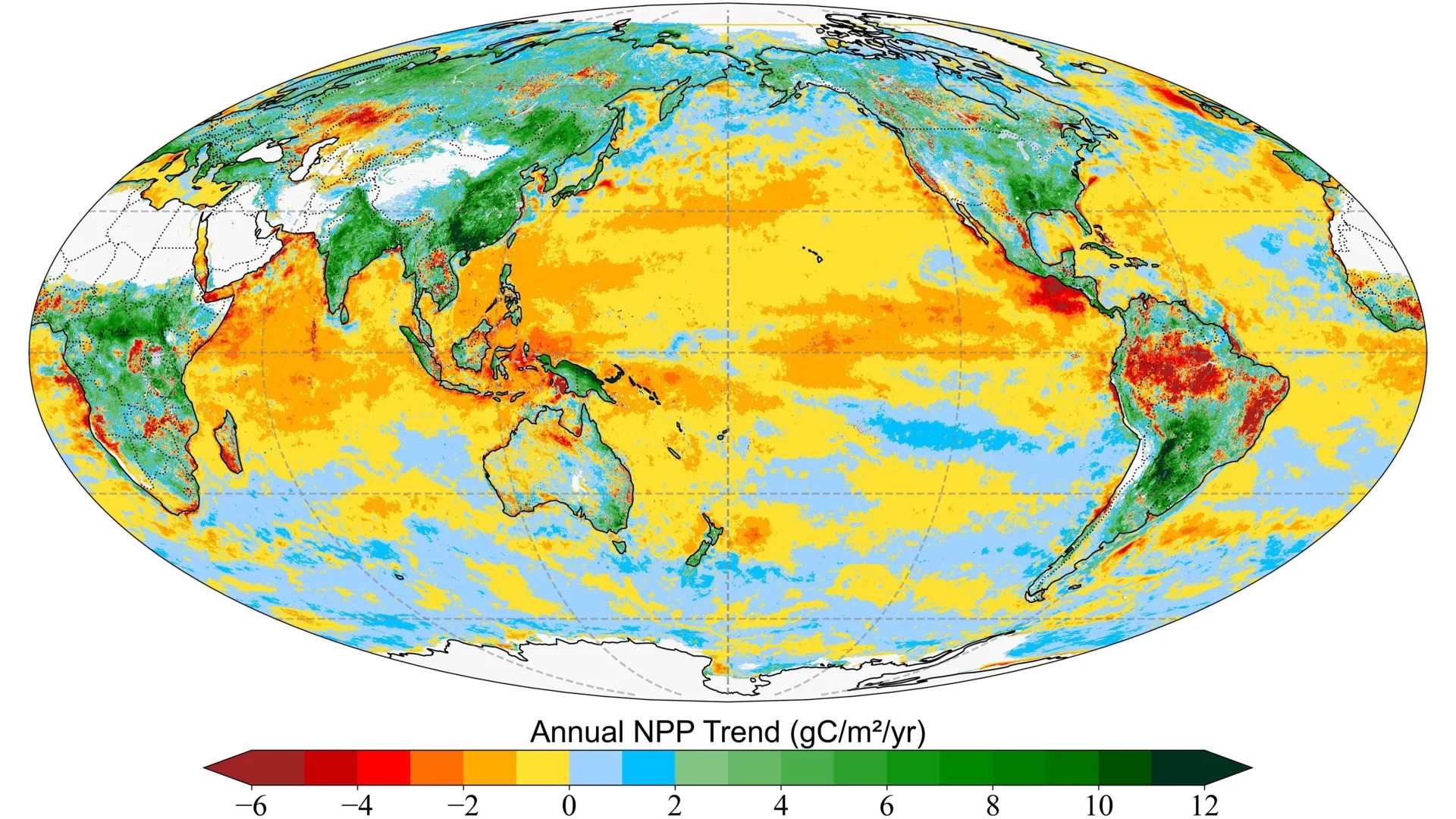
They found a significant increase in terrestrial net primary production, at a rate of 0.2 billion metric tons of carbon per year between 2003 and 2021. The trend was widespread from temperate to boreal, or high-latitude, areas, with a notable exception in the tropics of South America.
By contrast, the team identified an overall decline in marine net primary production, of about 0.1 billion metric tons of carbon per year for the same time period. Strong declines mainly occurred in tropical and subtropical oceans, particularly in the Pacific Ocean.
All told, trends on land dominated those of oceans: Global net primary production increased significantly between 2003 and 2021, at a rate of 0.1 billion metric tons of carbon per year.
Environmental Drivers
To understand the potential environmental factors at play, the team analyzed variables such as light availability, air and sea-surface temperature, precipitation and mixed layer depth — a measure that reflects the extent of mixing in the ocean’s top layer by wind, waves and surface currents.
“The shift toward greater primary production on land mainly stemmed from plants in higher latitudes, where warming has extended growing seasons and created more favorable temperatures, and in temperate regions that experienced local wetting in some areas, forest expansion and cropland intensification,” said Wenhong Li, a professor of earth and climate sciences at the Nicholas School and a co-author on the study.
Warming temperatures appeared to have an opposite effect in some ocean areas.
“Rising sea surface temperatures likely reduced primary production by phytoplankton in tropical and subtropical regions,” Cassar added. “Warmer waters can layer atop cooler waters and interfere with the mixing of nutrients essential to algal survival.”
Although land drove the overall increase in global primary production, the ocean primarily influenced year-to-year variability, especially during strong climate events such as El Niño and La Niña, the authors found.
“We observed that ocean primary production responds much more strongly to El Niño and La Niña than land primary production,” said co-author Shineng Hu, an assistant professor of climate dynamics at the Nicholas School. “A series of La Niña events was partly responsible for a trend reversal in ocean primary production that we identified after 2015. This finding highlights the ocean’s greater sensitivity to future climate variability.”
Broad Implications
The study points to the important role of terrestrial ecosystems in offsetting declines in net primary production among marine phytoplankton, according to the authors.
But they added that declines in net primary production in tropical and subtropical oceans, coupled with stagnation on land in the tropics, can weaken the foundation of tropical food webs, with cascading effects on biodiversity, fisheries and local economies. Over time, these disruptions could also compromise the ability of tropical regions to function as effective carbon sinks, potentially intensifying the impacts of climate warming.
“Whether the decline in ocean primary production will continue — and how long and to what extent increases on land can make up for those losses — remains a key unanswered question with major implications for gauging the health of all living things, and for guiding climate change mitigation,” Zhang said. “Long-term, coordinated monitoring of both land and ocean ecosystems as integrated components of Earth is essential.”
Funding: Y.Z., W.L., and G.S. were partially supported by the Duke University-USDA Forest Service collaboration (23-JV-11330180-119). N.C. was supported by the National Science Foundation (OCE-2123198). J.M. was supported by the Oak Ridge National Laboratory. J.X. is supported by the National Science Foundation (Macrosystem Biology) and NEON-Enabled Science Program (DEB-2017870).
As early humans spread from lush African forests into grasslands, their need for ready sources of energy led them to develop a taste for grassy plants, especially grains and the starchy plant tissue hidden underground.
But a new Dartmouth-led study shows that hominins began feasting on these carbohydrate-rich foods before they had the ideal teeth to do so. The study provides the first evidence from the human fossil record of behavioral drive, wherein behaviors beneficial for survival emerge before the physical adaptations that make it easier, the researchers report in Science.
The study authors analyzed fossilized hominin teeth for carbon and oxygen isotopes left behind from eating plants known as graminoids, which includes grasses and sedges. They found that ancient humans gravitated toward consuming these plants far earlier than their teeth evolved to chew them efficiently. It was not until 700,000 years later that evolution finally caught up in the form of longer molars like those that let modern humans easily chew tough plant fibers.
The findings suggest that the success of early humans stemmed from their ability to adapt to new environments despite their physical limitations, says Luke Fannin, a postdoctoral researcher at Dartmouth and lead author of the study.
“We can definitively say that hominins were quite flexible when it came to behavior and this was their advantage,” Fannin says. “As anthropologists, we talk about behavioral and morphological change as evolving in lockstep. But we found that behavior could be a force of evolution in its own right, with major repercussions for the morphological and dietary trajectory of hominins.”
Nathaniel Dominy, the Charles Hansen Professor of Anthropology at Dartmouth and senior author of the study, says isotope analysis overcomes the enduring challenge of identifying the factors that caused the emergence of new behaviors — behavior doesn’t fossilize.
“Anthropologists often assume behaviors on the basis of morphological traits, but these traits can take a long time — a half-million years or more–to appear in the fossil record,” Dominy says.
“But these chemical signatures are an unmistakable remnant of grass-eating that is independent of morphology,” he says. “They show a significant lag between this novel feeding behavior and the need for longer molar teeth to meet the physical challenge of chewing and digesting tough plant tissues.”
The team analyzed the teeth of various hominin species, beginning with the distant human relative Australopithecus afarensis, to track how the consumption of different parts of graminoids progressed over millennia. For comparison, they also analyzed the fossilized teeth of two extinct primate species that lived around the same time — giant terrestrial baboon-like monkeys called theropiths and small leaf-eating monkeys called colobines.
All three species veered away from fruits, flowers, and insects toward grasses and sedges between 3.4 million to 4.8 million years ago, the researchers report. This was despite lacking the teeth and digestive systems optimal for eating these tougher plants.
Hominins and the two primates exhibited similar plant diets until 2.3 million years ago when carbon and oxygen isotopes in hominin teeth changed abruptly, the study found. This plummet in both isotope ratios suggests that the human ancestor at the time, Homo rudolfensis, cut back on grasses and consumed more oxygen-depleted water.
The researchers lay out three possible explanations for this spike, including that these hominins drank far more water than other primates and savanna animals, or that they suddenly adopted a hippopotamus-like lifestyle of being submerged in water all day and eating at night.
The explanation most consistent with what’s known about early-human behavior, they report, is that later hominins gained regular access to underground plant organs known as tubers, bulbs, and corms. Oxygen-depleted water also is found in these bulging appendages that many graminoids use for storing large amounts of carbohydrates safely away from plant-eating animals.
The transition from grasses to these high-energy plant tissues would make sense for a species growing in population and physical size, Fannin says. These underground caches were plentiful, less risky than hunting, and provided more nutrients for early humans’ expanding brains. Having already adopted stone tools, ancient humans could dig up tubers, bulbs, and corms while facing little competition from other animals.
“We propose that this shift to underground foods was a signal moment in our evolution,” Fannin says. “It created a glut of carbs that were perennial — our ancestors could access them at any time of year to feed themselves and other people.”
Measurements of hominin teeth showed that while they became consistently smaller — shrinking about 5% every 1,000 years — molars grew longer, the researchers report. Hominins’ dietary shift toward graminoids outpaced that physical change for most of their history.
But the study found that the ratio flipped about 2 million years ago with Homo habilis and Homo ergaster, whose teeth exhibited a spurt of change in shape and size more suited to eating cooked tissues, such as roasted tubers.
Graminoids are ubiquitous across many ecosystems. Wherever they were, hominins would have been able to maximize the nutrients derived from these plants as their teeth became more efficient at breaking them down, Dominy says.
“One of the burning questions in anthropology is what did hominins do differently that other primates didn’t do? This work shows that the ability to exploit grass tissues may be our secret sauce,” Dominy says.
“Even now, our global economy turns on a few species of grass–rice, wheat, corn, and barley,” he says. “Our ancestors did something completely unexpected that changed the game for the history of species on Earth.”
A research team from Kumamoto University has made a groundbreaking discovery that reveals how the human T-cell leukemia virus type 1 (HTLV-1) silently persists in the body, potentially laying the foundation for new therapeutic approaches. Their findings, published on May 13, 2025, in Nature Microbiology, identify a previously unknown genetic “silencer” element that keeps the virus in a dormant, undetectable state.
HTLV-1 is a cancer-causing retrovirus known to lead to adult T-cell leukemia/lymphoma (ATL), an aggressive and often fatal disease. Although most infected individuals remain asymptomatic for life, a fraction eventually develops leukemia or other inflammatory conditions. The virus achieves long-term persistence by entering a “latent” state, during which its genetic material hides inside the host’s genome with minimal activity — evading immune detection.
In this study, the research team, led by Professor Yorifumi Satou from the Joint Research Center for Human Retrovirus, Kumamoto University, identified a specific region within the HTLV-1 genome that functions as a viral silencer. This sequence recruits host transcription factors, particularly the RUNX1 complex, which suppresses the virus’s gene expression. When this silencer region was removed or mutated, the virus became more active, leading to greater immune recognition and clearance in lab models.
Remarkably, when the HTLV-1 silencer was artificially inserted into HIV-1 — the virus that causes AIDS — the HIV virus adopted a more latent-like state, with reduced replication and cell killing. This suggests that the silencer mechanism could potentially be harnessed to design better therapies for HIV as well.
“This is the first time we’ve uncovered a built-in mechanism that allows a human leukemia virus to regulate its own invisibility,” said Professor Satou. “It’s a clever evolutionary tactic, and now that we understand it, we might be able to turn the tables in treatment.”
The findings offer hope not only for understanding and treating HTLV-1, especially in endemic regions like southwestern Japan, but also for broader retroviral infections.