Engage 11: 5 Powerful Decisions to Make Today!

Lesson 11 of the free Engage course reveals 5 uncommonly powerful decisions for you to make today to get yourself onto a much stronger path of lifelong self-development.

You’ll find the rest of the Engage course videos in the Video section.

Join the Engage Email List

Join the Engage notification list to get an email whenever a new Engage lesson is published. I also encourage you to subscribe to my YouTube channel to follow the course there.

Enjoy!

Share Button

How our noisy world is seriously damaging our health

The BBC’s James Gallagher investigates the invisible killer all around us.

Share Button

I Stopped Working Out My Abs And Got The Strongest Core Of My Life

I recently found myself faced with quite the riddle: what’s the difference between an ab workout and a core workout?

If I’d been asked that by a bridge-dwelling troll a few months ago, I’d have resigned myself to a watery end. After all, I only recently learned that while abs are part of your core, your core is so much more than just abs.

I mostly go to the gym for health, rather than aesthetic, reasons. I’m way more worried about my bone density and brain health than I am about my muscle definition. So, I wouldn’t have minded if the difference was mostly cosmetic.

But it turns out that not only are core muscles key to a healthy back (and crucial for preventing falls in ageing), but a lot of the ab-led workouts I’d been doing previously actually did little to strengthen the crucial muscle group.

As a result, I changed my routine ― and I’ve noticed less back pain, better form in other moves (like squats), and even improved posture since.

Wait ― what’s the difference between abs vs core?

Your core is a set of muscles that includes the transverse abdominis and rectus abdominis, oblique, erector spinae, multifidus, diaphragm, quadratus lumborum, hip flexors, and pelvic floor muscles.

It involves groups of muscles we don’t usually think much about when flicking through workout videos, including those that support your spine and hips.

Only one of those muscle groups ― the rectus abdominis ― forms the “six-pack” people might try to achieve through sit-ups and crunches.

But The Mayo Clinic said that while lots of us try to achieve visible abs, broader core exercises (which “train the muscles in your core to work in harmony”) are all too often neglected.

That’s a shame, they said, because true core workouts are key to every other exercise you want to try ― and the stability a strong core gives you makes day-to-day life easier, too.

So, how do I achieve a stronger core?

Good news. The Mayo Clinic said any exercise that involves “the use of your stomach muscles and back muscles in a coordinated way” counts as a core exercise.

That’s why your class instructor is constantly asking you to “engage your core” when squatting, lifting, and even running.

Personally, I started doing what are known as compound exercises ― those which work multiple muscles at once, rather than isolating a couple ― to target both as many core muscles as I can in one go.

Hollow holds, planks, L-sits, pull- and push-ups, and bird dog exercises are all well-known core workouts that include far more muscles than we realise. I still love these.

But lifting weights with your core engaged, as is needed for overhead marches, renegade rows, and kettlebell swings (my personal favourite, and the move that I feel has strengthened me most) works too, and was a revelation to me.

Since incorporating more full-body core movements into my routine, I’ve not only spent more time on the area (a kettlebell swing can be part of a leg day routine, while sit-ups are usually core-specific moves), but added more weight, and therefore resistance, to the action too.

After all, it’s not like your stomach has a way of lifting a dumbbell; you have to recruit other parts of your body for that.

What other exercises work your core rather than just your abs?

Speaking to Harvard’s site, physical therapist Carina O’Neill recommended planks and bridges for the best day-to-day core stability.

But it doesn’t need to be that intense. NHS Fife recommends moves like cat-cow yoga patterns and kneeling planks to keep your trunk steady.

Of course, ab-focused sit-ups and crunches have their place too ― but if you’re hoping to get the best benefits from a strong core, it might be time to expand your understanding of the area to more parts of your body.

Share Button

I Tried Mary Berry’s Secret To The Best Spaghetti Bolognese, And I’m Never Going Back

I try a lot of celebrity chef recipes for my job (hard-hitting journalism, you know?).

And while I love Nigella Lawson’s iconic lasagne of love, swear by Hugh Fearnley-Whittingstall’s brown butter brownies, and have even allowed Gordon Ramsay’s tips to alter my treasured rocky road recipe, my heart still lies with Mary Berry.

Her Thai-inspired tomato soup was an instant hit in my home. I tried making her 15-minute lemon curd last weekend too ― it was so good, I skipped making the rest of the pie I’d planned and made six jars instead.

So, who else would I turn to for my next spag bol? Though the dish is described as “controversial” on the BBC’s site for its, er, un-Italian star ingredient, hey ― in Mary we trust.

The chef adds cream to her bolognese

The start of Mary’s bolognese is pretty simple. She finely chops onions, celery, and carrot, and fries them over a medium-high heat until soft.

I took Nigella’s lasagne advice here; it’s just faster to whizz them up in a blender rather than chopping them to tiny, even bits.

Once those have softened, she chucks in pork and beef mince (I’ll be honest; I only had beef, and it was fine) and garlic, cooking them until the mince is browned and its liquid has evaporated.

Mary adds tomato purée to the mix and follows it up with passata, chopped tomatoes, stock, wine, and thyme.

If you take nothing else from her advice, I’d recommend the half-passata, half-chopped tomato mix for almost all tomato-based dishes now I’ve tried it. Tinned tommies can be too watery, while the paste can be too thick – this is perfect.

After seasoning it, you bake the bolognese for an hour. I placed tinfoil over my frying pan and whacked it in the oven, though I’m sure a proper Dutch oven is a better option.

Then, you stir in some cream (the controversial ingredient), put the bolognese back in for an hour, and serve it with whatever pasta you like.

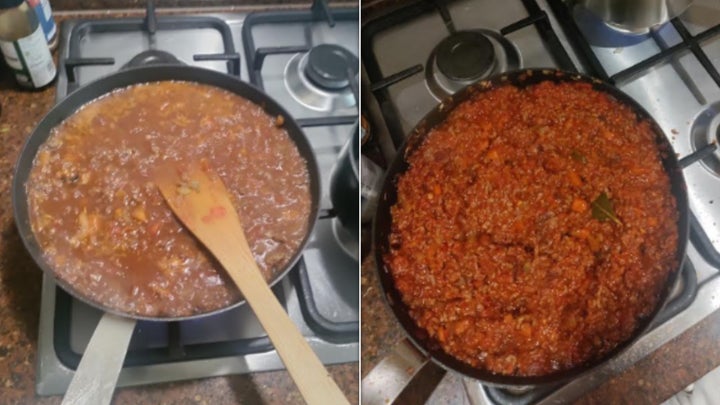
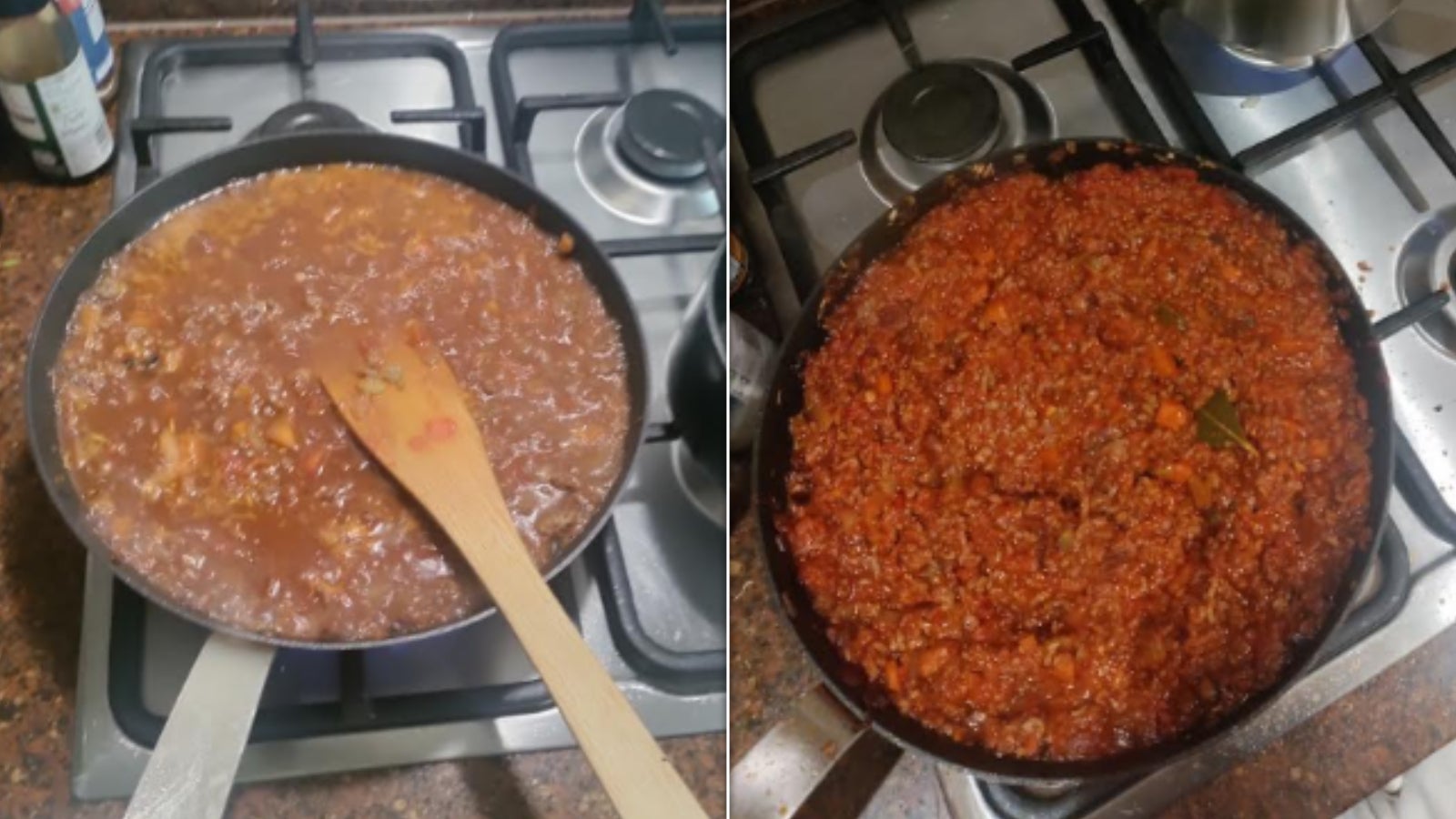
Bolognese before baking (left) and after (right).

Amy Glover / HuffPost UK

Bolognese before baking (left) and after (right).

So… what’s the verdict?

I regret to inform you it’s delicious. I don’t know whether it’s the cream or the extended stay in the oven that did it, but this was the deepest, richest, most satisfying bolognese I’ve tried.

It kind of makes sense ― Nigella adds milk to her lasagne’s ragu for a subtly creamy finish, so this is sort of the same idea (only more decadent).

The two-hour bake time is annoying, but it didn’t require much actual active cooking. I work from home, so made the sauce on my lunch break and cooked it in the oven while I was working. As Mary points out, the sauce “can be made up to a day ahead and reheated.”

I ate mine with Parmesan, linguini, and a huge smile on my face ― OK, her star ingredient is “controversial”, but there’s no denying the results are delicious.

Share Button

Congrats! You’ve Officially Entered The ‘Why’ Era Of Parenting. Now What?

There comes a time in every parent’s life when their child starts to question everything.

You mention something and their reaction is: why? Then you explain why that is, and they ask again. They dig deeper and deeper, until you realise you actually have no idea why soil is brown, and you simply respond, a little exasperated: “I don’t know.”

If you’re stuck in the depths of the why?! phase then, first of all, solidarity.

Secondly, therapists have revealed a handy phrase you can respond with when you’re deep in the “why?!” cycle – and parents on social media are loving the tip.

Why do kids say ‘why?’ a lot

Before we talk about how to respond, it might help to think about the reasons behind why (sorry) children ask their parents for more information.

In short: they’re trying to discover more about the world we live in.

Clinical psychologist Linda Blair told the BBC that around the age of two or three, connections are being formed in their brains about how certain things are categorised or how one thing can lead to another thing happening.

Once this clicks into place, they want to know more and they obviously realise that the best way to find out more is to ask you – their parent – about this.

Blair said this incessant questioning usually happens around the ages of three and four – and the reasons behind it are actually quite sweet.

“Firstly, they want you to clarify and explain things to them so that they can make predictions about the world and what will happen within it. Just like adults, children are most afraid when they’re not sure what is going to happen,” Blair said.

And secondly, they get excited to share things they’re interested in with you and “by sharing an interest with you, they feel valued, and that also grows their self-esteem”.

How to respond when a child keeps asking ‘why?’

Deena Margolin, a family therapist who shares helpful parenting tips on the popular Instagram account Big Little Feelings, urged caregivers to respond to kids with the question: “Why do you think?”

“You’re empowering them to pause, build self-awareness by looking inside, and notice their own thoughts and opinions,” said Margolin in a reel.

“And you’re still staying connected in the relationship with them because you’re not totally shutting them down or ignoring them.”

The therapist added that parents would “be surprised how well this works” and caveated that this obviously isn’t the way to respond every time your child asks “why?” but it can help to give you a break from the cycle every now and then.

Linda Blair also suggested this phrase as a good way to get a better idea of what your child really wants to know. She offered the example of if it’s raining and they ask why it rains.

“Maybe what they really want to know isn’t the literal reason why it’s raining. Maybe it’s what they should wear when it’s raining? Or if they are allowed to run around in the rain?” she added.

While some parents swear by this technique (“yessss we do this and it’s so beautiful watching her process and come to whatever conclusion,” said one person in response to Margolin’s Instagram post), it’s worth noting that sometimes it doesn’t quite have the desired effect.

As one poor parent found out: “Mine replies ‘you tell me’ and we bat it back and forth until I give up.”

Share Button

Will scrapping NHS England help improve patient safety?

The decision to scrap the organisation could offer a new chance to examine how patients are dealt with.

Share Button

New clue on what is leading to neurodegenerative diseases like Alzheimer’s and ALS

In Nature Neuroscience, UConn School of Medicine researchers have revealed a new scientific clue that could unlock the key cellular pathway leading to devastating neurodegenerative diseases like Alzheimer’s disease, and the progressive damage to the brain’s frontal and temporal lobes in frontotemporal degeneration (FTD) and the associated disease amyotrophic lateral sclerosis (ALS).

The study, “Endothelial TDP-43 Depletion Disrupts Core Blood-Brain Barrier Pathways in Neurodegeneration,” was published on March 14, 2025. The lead author, Omar Moustafa Fathy, an MD/Ph.D. candidate at the Center for Vascular Biology at UConn School of Medicine, conducted the research in the laboratory of senior author Dr. Patrick A. Murphy, associate professor and newly appointed interim director of the Center for Vascular Biology. The study was carried out in collaboration with Dr. Riqiang Yan, a leading expert in Alzheimer’s disease and neurodegeneration research.

This work provides a novel and significant exploration of how vascular dysfunction contributes to neurodegenerative diseases, exemplifying the powerful collaboration between the Center for Vascular Biology and the Department of Neuroscience. While clinical evidence has long suggested that blood-brain barrier (BBB) dysfunction plays a role in neurodegeneration, the specific contribution of endothelial cells remained unclear. The BBB serves as a critical protective barrier, shielding the brain from circulating factors that could cause inflammation and dysfunction. Though multiple cell types contribute to its function, endothelial cells — the inner lining of blood vessels — are its principal component.

“It is often said in the field that ‘we are only as old as our arteries’. Across diseases we are learning the importance of the endothelium. I had no doubt the same would be true in neurodegeneration, but seeing what these cells were doing was a critical first step,” says Murphy.

Omar, Murphy, and their team tackled a key challenge: endothelial cells are rare and difficult to isolate from tissues, making it even harder to analyze the molecular pathways involved in neurodegeneration.

To overcome this, they developed an innovative approach to enrich these cells from frozen tissues stored in a large NIH-sponsored biobank. They then applied inCITE-seq, a cutting-edge method that enables direct measurement of protein-level signaling responses in single cells — marking its first-ever use in human tissues.

This breakthrough led to a striking discovery: endothelial cells from three different neurodegenerative diseases — Alzheimer’s disease (AD), amyotrophic lateral sclerosis (ALS), and frontotemporal dementia (FTD) — shared fundamental similarities that set them apart from the endothelium in healthy aging. A key finding was the depletion of TDP-43, an RNA-binding protein genetically linked to ALS-FTD and commonly disrupted in AD. Until now, research has focused primarily on neurons, but this study highlights a previously unrecognized dysfunction in endothelial cells.

“It’s easy to think of blood vessels as passive pipelines, but our findings challenge that view,” says Omar. “Across multiple neurodegenerative diseases, we see strikingly similar vascular changes, suggesting that the vasculature isn’t just collateral damage — it’s actively shaping disease progression. Recognizing these commonalities opens the door to new therapeutic possibilities that target the vasculature itself.”

The research team believes this newly identified subset of endothelial cells could provide a roadmap to targeting this endothelial disfunction to stave off disease, and also to develop new biomarkers from the blood of patients with disease.

Funding was provided by startup funds from the UConn School of Medicine and Department of Cell Biology, Center for Vascular Biology and Calhoun Cardiology Center, American Heart Association Innovative Project Award 19IPLOI34770151 (to P.A.M.); NIH National Heart, Lung, and Blood Institute Grants K99/R00-HL125727 and RF1-NS117449 (to P.A.M); American Heart Association Predoctoral award 23PRE1027078 (to O.M.F.O.) R01-AG046929 and R01-NS074256 (to R.Y.) and NIH GM135592 (to B.H.).

Share Button

Immunotherapy may boost KRAS-targeted therapy in pancreatic cancer

Adding immunotherapy to a new type of inhibitor that targets multiple forms of the cancer-causing gene mutation KRAS kept pancreatic cancer at bay in preclinical models for significantly longer than the same targeted therapy by itself, according to researchers from the Perelman School of Medicine at the University of Pennsylvania and Penn Medicine’s Abramson Cancer Center. The results, published in Cancer Discovery, prime the combination strategy for future clinical trials.

Combatting the “undruggable” RAS genes

Patients with pancreatic cancer have an overall poor prognosis: in most patients, the disease has already spread at the time of diagnosis, resulting in limited treatment options. Nearly 90 percent of pancreatic cancers are driven by KRAS mutations, the most common cancer-causing gene mutation across cancer types, which researchers long considered “undruggable.” In 2021, the first KRAS inhibitor was approved to treat non-small cell lung cancer with KRAS G12C mutations, but with longer follow-up, it has become clear that KRAS-mutant cancers can quickly evolve to resist therapies targeted at one specific form of the gene mutation.

“We’ve been excited by the prospect of RAS inhibition for pancreatic cancer, which remains one of the deadliest and most difficult forms of cancer to treat,” said co-corresponding senior author Ben Stanger, MD, PhD, the Hanna Wise Professor in Cancer Research and director of the Penn Pancreatic Cancer Research Center. “While the first wave of KRAS inhibitors have had limited impact in cancer care, this research shows that newer RAS inhibition tools may have an immune stimulatory effect, making them ideal to pair with immunotherapy for longer and better treatment response.”

Previous research led by Stanger and Robert Vonderheide, MD, DPhil, director of the Abramson Cancer Center, who is also co-corresponding author on this study, showed that a small molecule inhibitor specifically targeting KRAS G12D, the form of the mutation more commonly found in pancreatic cancer, stimulated the immune system while shrinking tumors or stopping cancer growth in preclinical mouse models of pancreatic cancer.

A new type of RAS inhibitor

In this study, the researchers used RAS(ON) multi-selective inhibitors, the investigational agent daraxonrasib (RMC-6236) and the preclinical tool compound RMC-7977 (both discovered by Revolution Medicines, whose scientists contributed to the study). These inhibitors use a different mechanism of action than most other KRAS inhibitors (including that in the previous study) to target the active or ON-state of multiple forms of RAS mutations.

“The benefit of this ‘multi-selective’ approach is that the inhibitors are designed to inhibit multiple RAS mutations, so if the cancer mutates, and another type of RAS mutation emerges, the treatment may not necessarily stop working,” Vonderheide explained.

The research team found that not only was RAS(ON) multi-selective inhibition effective in preclinical pancreatic cancer models, but it was even more effective when combined with immunotherapy. Using the combination approach, all mouse models had tumor shrinkage and half had a complete response, meaning the tumor was eliminated.

The research team used a Penn-developed immunocompetent model considered the gold standard worldwide for assessing potential therapies for pancreatic ductal adenocarcinoma. This model allows the tumor to spontaneously evolve after implantation, making it possible to discern the drug’s impact on the surrounding tumor microenvironment. The research team found that RAS(ON) multi-selective inhibition reshaped the tumor microenvironment by bringing in more T cells and other immune cells, making the tumor particularly receptive to immunotherapy.

Next steps and clinical trial information

Daraxonrasib (RMC-6236) is already being tested in clinical trials across the United States. A clinical trial testing RAS(ON) inhibitors with other anticancer agents in certain patients with gastrointestinal solid tumors is now open at several sites across the country, including at Penn Medicine. Click here for more information about the study.

“We’re hopeful that we’re starting to crack the code on immunotherapy and RAS therapy for pancreatic cancer,” Vonderheide said. “After decades of limited progress, it’s encouraging to see new treatment approaches making their way into the clinic for patients.”

The study was supported by Revolution Medicines, the National Institutes of Health (R01CA252225, R01CA276512, P30DK050306, P30CA016520) the Department of Defense (W81XWH2210730), the Molecular Pathology and Imaging Core, A Love for Life, the Basser Center for BRCA, and the Penn Pancreatic Cancer Research Center.

Information for patients interested in joining a clinical trial: visit Penn Medicine’s Abramson Cancer Center Clinical Trial Information Service online or call 1-855-216-0098 to speak to a clinical trial navigator.

Editor’s note: Vonderheide is an inventor on patents relating to cancer cellular immunotherapy and KRAS immune epitopes.

Share Button

Scientists discover how to reactivate cancer’s molecular ‘kill switch’

Alternative RNA splicing is like a movie editor cutting and rearranging scenes from the same footage to create different versions of a film. By selecting which scenes to keep and which to leave out, the editor can produce a drama, a comedy, or even a thriller — all from the same raw material. Similarly, cells splice RNA in different ways to produce a variety of proteins from a single gene, fine-tuning their function based on need. However, when cancer rewrites the script, this process goes awry, fueling tumor growth and survival.

In a recent study reported in the Feb. 15 issue of Nature Communications, scientists from The Jackson Laboratory (JAX) and UConn Health not only show how cancer hijacks this tightly regulated splicing and rearranging of RNA but also introduce a potential therapeutic strategy that could slow or even shrink aggressive and hard-to-treat tumors. This discovery could transform how we treat aggressive cancers, such as triple-negative breast cancer and certain brain tumors, where current treatment options are limited.

At the heart of this work, led by Olga Anczuków, an associate professor at JAX and co-program leader at the NCI-designated JAX Cancer Center, are tiny genetic elements called poison exons, nature’s own “off switch” for protein production. When these exons are included in an RNA message, they trigger its destruction before a protein can be made — preventing harmful cellular activity. In healthy cells, poison exons regulate the levels of key proteins, keeping the genetic machinery in check. But in cancer, this safety mechanism often fails.

Anczuków and her team, including Nathan Leclair, an MD/PhD graduate student at UConn Health and The Jackson Laboratory who spearheaded the research, and Mattia Brugiolo, a staff researcher who contributed his expertise, discovered that cancer cells suppress poison exon activity in a critical gene called TRA2β. As such, levels of TRA2β protein increase inside cancer cells, causing tumor proliferation.

Furthermore, the team found a correlation between levels of poison exons and patient outcomes. “We’ve shown for the first time that low levels of poison exon inclusion in the TRA2β gene are associated with poor outcomes in many different cancer types, and especially in aggressive and difficult-to-treat cancers,” said Anczuków. These include breast cancer, brain tumors, ovarian cancers, skin cancers, leukemias, and colorectal cancers, Anczuków explained.

Anczuków, Leclair, and Brugiolo then went on to see if they could increase the inclusion of the poison exon in the TRA2β gene and reactivate the kill switch. They found their answer in antisense oligonucleotides (ASOs) — synthetic RNA fragments that can be designed to increase poison exon inclusion in specific ways. When introduced into cancer cells, ASOs effectively flipped the genetic switch, restoring the body’s natural ability to degrade excess TRA2β RNA and inhibit tumor progression.

“We found that ASOs can rapidly boost poison exon inclusion, essentially tricking the cancer cell into turning off its own growth signals,” said Leclair. “These poison exons work like a rheostat, quickly adjusting protein levels — and that could make ASOs a highly precise and effective therapy for aggressive cancers.”

Interestingly, when researchers completely removed TRA2β proteins using CRISPR gene editing, tumors continued to grow — suggesting that targeting the RNA rather than the protein could be a more effective approach. “This tells us that poison-exon-containing RNA doesn’t just silence TRA2β,” explained Anczuków. “It likely sequesters other RNA-binding proteins, creating an even more toxic environment for cancer cells.”

Further studies will refine ASO-based therapies and explore their delivery to tumors. However, preliminary data suggest that ASOs are highly specific and do not interfere with normal cellular function, making them promising candidates for future cancer treatments. This research was supported by the National Institutes of Health and the NCI-designated JAX Cancer Center.

Share Button

Scientists use light to unlock secret of atoms

A team of researchers from the University of Ottawa has made significant strides in understanding the ionization of atoms and molecules, a fundamental process in physics that has implications for various fields including x-ray generation and plasma physics.

Think about atoms — the building blocks of everything around us. Sometimes, they lose their electrons and become charged particles (that’s ionization). It happens in lightning, in plasma TVs, and even in the northern lights. Until now, scientists thought they could only control this process in limited ways.

Led by Ravi Bhardwaj, Full Professor at uOttawa’s Department of Physics, and PhD student Jean-Luc Begin, in collaboration with Professors Ebrahim Karimi, Paul Corkum and Thomas Brabec, the research introduces innovative methods to control ionization using specially structured light beams.

Ionization is crucial in strong field physics and attosecond science, where it describes how electrons escape from their atomic bonds. Traditionally, it was understood that this process could not be manipulated beyond certain limits. However, this new study challenges that notion.

“We have demonstrated that by using optical vortex beams — light beams that carry angular momentum — we can precisely control how an electron is ejected from an atom,” explains Professor Bhardwaj. “This discovery opens up new possibilities for enhancing technology in areas such as imaging and particle acceleration.”

The research took place over two years at uOttawa’s Advanced Research Complex. The team found that the handedness and properties of the optical vortex beams significantly affect ionization rates. By adjusting the position of a “null intensity region” within the beam, they achieved selective ionization, introducing a novel concept called optical dichroism.

Key findings from the research include:

  1. The first demonstration of ionization that depends on the properties of light beams carrying angular momentum.
  2. Enhanced control over ionization processes that could lead to advancements in imaging techniques beyond current limitations.
  3. A new understanding of how light can be engineered to influence the behavior of electrons in unprecedented ways.

This work builds upon foundational theories in the field and has the potential to revolutionize how scientists approach ionization. This isn’t just for physics textbooks — it could lead to better medical imaging, faster computers, and more efficient ways to study materials. It’s especially promising for quantum computing, where controlling individual particles is crucial.

Professor Bhardwaj emphasizes the importance of this breakthrough: “Changing the way we think about how electrons are ejected has been challenging, but our research proves that using advanced laser technologies can lead to new discoveries that impact both science and technology.”

Share Button