WellnessMaster

Get The Latest News on Holistic Wellness

WellnessMaster

Tom Hanks, Famed ‘Nepo Dad’, Gets Defensive About Son Being In His New Movie

Tom Hanks appeared to get pretty heated over the “nepo baby” controversy during an interview with Reuters published earlier this week.

A “nepo baby,” short for “nepotism baby,” is a buzzy, albeit condescending term that refers to children of celebrities who are now famous due partly to their parents’ fame.

The topic hit its boiling point in late December when New York Magazine declared 2022 was The Year of The Nepo Baby.

Tom was speaking to Reuters (as seen in The Sun’s video below) about his new film A Man Called Otto, which employed a few of his family members.

He co-produced the film with his wife Rita Wilson, who also co-wrote the script and performed an original song in the movie, per The Hollywood Reporter.

<div class="js-react-hydrator" data-component-name="YouTube" data-component-id="4713" data-component-props="{"itemType":"video","index":7,"contentListType":"embed","code":"

","type":"video","meta":{"author":"The Sun Showbiz","author_url":"https://www.youtube.com/channel/UCy4Kmbjk_M-eK2q44pGEAmw","cache_age":86400,"description":"Hollywood’s nice guy Tom Hanks is breaking type by playing a grumpy old man in ‘A Man Called Otto’.\n\nHowever, Hanks didn’t have to audition as he and his wife Rita Wilson bought the rights to adapt the Swedish novel and Oscar-nominated film ‘A Man Called Ove’ for American audiences.\n\nSpeaking to Reuters, Hanks said “Look, I’m selfish. I’m a selfish actor and I’m very competitive and I know a good role when I see one and I don’t think that anybody else was considered for the role of Otto in ‘A Man Called Otto’ because I selfishly said ‘I know exactly what I want to do here, I know exactly how to be not just cranky but also always correct’. If there’s anybody in this movie that is right one hundred percent of the time in the movie, it’s Otto and I like playing the guy who’s always right.”\n\nWhen you meet Otto, he is walking around his neighborhood chastising all the residents for various reasons, from dogs peeing on his front lawn to postal vans parking in the street.\n\nAfter playing so many nice guy roles, was it freeing for Hanks to be rude?\n\n“Well it’s freeing to mumble it under your breath while nobody can really hear it,” said Hanks, adding “What is freeing is being able to use the body language that says the same thing, you know. Like ugh, you know, that. A good frustrated sigh is almost as good as one of those yoga breaths, you know where you’re supposed to just clear everything out.”\n\nThe film not only stars Hanks and features a song by his wife, but his son Truman plays the younger version of Otto in flashbacks during the film.\n\nHanks said “Look. This is a family business. This is what we’ve been doing forever. It’s what all of our kids grew up in. We have four kids, they are all very creative, they are all involved in some brand of storytelling and if we were a plumbing supply business or if we ran the florists shop down the street, the whole family would be putting in time at some point even if it was just inventory at the end of the year.”\n\nIn the film, Otto’s behavior to his neighbors is finally brought into check when a Latino family moves in across the street and begins to show kindness to the old man.\n\nTo ensure that there were distinct differences between ‘A Man Called Otto’ and ‘A Man Called Ove’, Hanks and his wife brought in the producer of the original film, Fredrik Wikstrom.\n\n“There are huge differences between the social structure of Sweden and the social structure of the United States of America and actually that gave us more things in order to examine,” said Hanks.\n\nHe added “In the United States of America, for a Mexican family to move across the street, it has very specific connotations to it, different than it would even in Sweden.”\n\n‘A Man Called Otto’ goes on full theatrical release in the United States on January 4.","options":{"_cc_load_policy":{"label":"Closed captions","value":false},"_end":{"label":"End on","placeholder":"ex.: 11, 1m10s","value":""},"_start":{"label":"Start from","placeholder":"ex.: 11, 1m10s","value":"134"},"click_to_play":{"label":"Hold load & play until clicked","value":false}},"provider_name":"YouTube","thumbnail_height":720,"thumbnail_url":"https://i.ytimg.com/vi/kpzwdl7lvYs/maxresdefault.jpg","thumbnail_width":1280,"title":"\"Look, this is a family business\": Tom Hanks defends son’s casting in ‘A Man Called Otto’","type":"video","url":"https://www.youtube.com/watch?v=kpzwdl7lvYs","version":"1.0"},"flags":[],"enhancements":{},"fullBleed":false,"options":{"theme":"news","device":"desktop","editionInfo":{"id":"uk","name":"U.K.","link":"https://www.huffingtonpost.co.uk","locale":"en_GB"},"slideshowAd":{"scriptTags":[],"otherHtml":""},"slideshowEndCard":{"scriptTags":[],"otherHtml":""},"isMapi":false,"isAmp":false,"isVideoEntry":false,"isMt":false,"entryId":"63b9193ae4b0d6f0b9fb1e15","entryTagsList":"ukfilm,tom-hanks,chet-hanks,colin-hanks,nepotism,@widget-imported","sectionSlug":"entertainment","deptSlug":null,"sectionRedirectUrl":null,"subcategories":"","isWide":false,"headerOverride":null,"noVideoAds":false,"disableFloat":false,"isNative":false,"commercialVideo":{"provider":"custom","site_and_category":"uk.entertainment","package":null},"isHighline":false,"vidibleConfigValues":{"cid":"60afc140cf94592c45d7390c","disabledWithMapiEntries":false,"overrides":{"all":"60b8e525cdd90620331baaf4"},"whitelisted":["56c5f12ee4b03a39c93c9439","56c6056ee4b01f2b7e1b5f35","59bfee7f9e451049f87f550b","5acccbaac269d609ef44c529","570278d2e4b070ff77b98217","57027b4be4b070ff77b98d5c","56fe95c4e4b0041c4242016b","570279cfe4b06d08e3629954","5ba9e8821c2e65639162ccf1","5bcd9904821576674bc55ced","5d076ca127f25f504327c72e","5b35266b158f855373e28256","5ebac2e8abddfb04f877dff2","60b8e525cdd90620331baaf4","60b64354b171b7444beaff4d","60d0d8e09340d7032ad0fb1a","60d0d90f9340d7032ad0fbeb","60d0d9949340d7032ad0fed3","60d0d9f99340d7032ad10113","60d0daa69340d7032ad104cf","60d0de02b627221e9d819408"],"playlists":{"default":"57bc306888d2ff1a7f6b5579","news":"56c6dbcee4b04edee8beb49c","politics":"56c6dbcee4b04edee8beb49c","entertainment":"56c6e7f2e4b0983aa64c60fc","tech":"56c6f70ae4b043c5bdcaebf9","parents":"56cc65c2e4b0239099455b42","lifestyle":"56cc66a9e4b01f81ef94e98c"},"playerUpdates":{"56c6056ee4b01f2b7e1b5f35":"60b8e525cdd90620331baaf4","56c5f12ee4b03a39c93c9439":"60d0d8e09340d7032ad0fb1a","59bfee7f9e451049f87f550b":"60d0d90f9340d7032ad0fbeb","5acccbaac269d609ef44c529":"60d0d9949340d7032ad0fed3","5bcd9904821576674bc55ced":"60d0d9f99340d7032ad10113","5d076ca127f25f504327c72e":"60d0daa69340d7032ad104cf","5ebac2e8abddfb04f877dff2":"60d0de02b627221e9d819408"}},"connatixConfigValues":{"defaultPlayer":"8b034f64-513c-4987-b16f-42d6008f7feb","clickToPlayPlayer":"5a777b9b-81fe-41a6-8302-59e9953ee8a2","videoPagePlayer":"19654b65-409c-4b38-90db-80cbdea02cf4"},"customAmpComponents":[],"ampAssetsUrl":"https://amp.assets.huffpost.com","videoTraits":null,"positionInUnitCounts":{"buzz_head":{"count":0},"buzz_body":{"count":0},"buzz_bottom":{"count":0}},"positionInSubUnitCounts":{"article_body":{"count":10},"before_you_go_slideshow":{"count":0}},"connatixCountsHelper":{"count":1},"buzzfeedTracking":{"context_page_id":"63b9193ae4b0d6f0b9fb1e15","context_page_type":"buzz","destination":"huffpost","mode":"desktop","page_edition":"en-uk"},"tags":[{"name":"ukfilm","slug":"ukfilm","links":{"relativeLink":"news/ukfilm","permalink":"https://www.huffingtonpost.co.uk/news/ukfilm","mobileWebLink":"https://www.huffingtonpost.co.uk/news/ukfilm"},"section":{"title":"Entertainment","slug":"entertainment"},"topic":{"title":"Film","slug":"ukfilm","overridesSectionLabel":false},"url":"https://www.huffingtonpost.co.uk/news/ukfilm/"},{"name":"tom hanks","slug":"tom-hanks","links":{"relativeLink":"news/tom-hanks","permalink":"https://www.huffingtonpost.co.uk/news/tom-hanks","mobileWebLink":"https://www.huffingtonpost.co.uk/news/tom-hanks"},"relegenceId":2846821,"url":"https://www.huffingtonpost.co.uk/news/tom-hanks/"},{"name":"chet hanks","slug":"chet-hanks","links":{"relativeLink":"news/chet-hanks","permalink":"https://www.huffingtonpost.co.uk/news/chet-hanks","mobileWebLink":"https://www.huffingtonpost.co.uk/news/chet-hanks"},"url":"https://www.huffingtonpost.co.uk/news/chet-hanks/"},{"name":"colin hanks","slug":"colin-hanks","links":{"relativeLink":"news/colin-hanks","permalink":"https://www.huffingtonpost.co.uk/news/colin-hanks","mobileWebLink":"https://www.huffingtonpost.co.uk/news/colin-hanks"},"url":"https://www.huffingtonpost.co.uk/news/colin-hanks/"},{"name":"nepotism","slug":"nepotism","links":{"relativeLink":"news/nepotism","permalink":"https://www.huffingtonpost.co.uk/news/nepotism","mobileWebLink":"https://www.huffingtonpost.co.uk/news/nepotism"},"url":"https://www.huffingtonpost.co.uk/news/nepotism/"}],"cetUnit":"buzz_body","bodyAds":["

\r\n\r\n HPGam.cmd.push(function(){\r\n\t\treturn HPGam.render(\"inline-1\", \"entry_paragraph_1\", false);\r\n });\r\n\r\n","

\r\n\r\n HPGam.cmd.push(function(){\r\n\t\treturn HPGam.render(\"inline\", \"entry_paragraph_2\", false);\r\n });\r\n\r\n","

\r\n\r\n HPGam.cmd.push(function(){\r\n\t\treturn HPGam.render(\"inline-2\", \"entry_paragraph_3\", false);\r\n });\r\n\r\n","

\r\n\r\n HPGam.cmd.push(function(){\r\n\t\treturn HPGam.render(\"inline-infinite\", \"repeating_dynamic_display\", false);\r\n });\r\n\r\n"],"adCount":0}}”>


Tom stars as the titular Otto in the movie, and his son, Truman Hanks, plays a younger version of the character in flashback sequences.

“Look, this is a family business,” the two-time Oscar winner says in the video, seemingly in response to his son being in his film. “This is what we’ve been doing forever. It’s what all of our kids grew up in.”

He added: “If we were a plumbing supply business or if we ran the florists shop down the street, the whole family would be putting in time at some point, even if it was just inventory at the end of the year.”

Although employing family members in your plumbing or florist company would still be a form of nepotism, the actor’s tirade wasn’t done.

Tom then claimed that his children did not get a leg up in their Hollywood careers thanks to his famous last name.

Tom Hanks and his son, actor Colin Hanks, in 2009.

Dimitrios Kambouris via Getty Images

His son Colin Hanks starred in Fargo and has also appeared in dozens of movies, including King Kong, Jumanji: The Next Level and The House Bunny.

Meanwhile, Tom’s son, Chet Hanks’ work includes roles in the TV shows Shameless and Empire.

“The thing that doesn’t change no matter what happens, no matter what your last name is, is whether it works or not,” Tom said.

“That’s the issue anytime any of us go off and try to tell a fresh story or create something that has a beginning and a middle and an end. Doesn’t matter what our last names are. We have to do the work in order to make that a true and authentic experience for the audience.”

He added: “That’s a much bigger task than worrying about whether anybody’s going to try to scathe us or not.”

Tom Hanks at a screening of Elvis last year

Pascal Le Segretain via Getty Images

Although the cultural discourse around “nepo babies” is relatively new, actors deploying the family business excuse is getting pretty old.

Zoe Kravitz — the daughter of musician Lenny Kravtiz and actor Lisa Bonet — used the same tactic.

“It’s completely normal for people to be in the family business,” she told GQ in November.

Kate Hudson, the daughter of actor Golden Hawn and step-daughter of actor Kurt Russell, took a similar approach while speaking to The Independent last month.

“I look at my kids, and we’re a storytelling family. It’s definitely in our blood,” Kate said.

Maybe these celebrities could take a page out of “nepo baby” Allison Williams’ playbook and take a tad of accountability.

The Girls star, the daughter of former NBC journalist Brian Williams, called nepotism “just unfair” in an interview with Vulture published earlier this week.

“Period, end of the story, and no one’s really working that hard to make it fair,” she told Vulture.

“To not acknowledge that me getting started as an actress versus someone with zero connections isn’t the same — it’s ludicrous. It doesn’t take anything away from the work that I’ve done. It just means that it’s not as fun to root for me.”

Share Button

The Most Common Symptoms Of XBB Covid Variant, According To Doctors

If you’ve been following Covid news, then you’re likely well aware there’s a new variant in town that’s concerning the scientific community.

Known as XBB, the variant is believed to be the most immune-evasive to date and currently accounts for over 40% of infections in the United States, according to data from the US Centers for Disease Control and Prevention.

It’s been called the “kraken variant” by some, and according to the World Health Organisation, it has now been identified in at least 28 other countries.

As the BBC reported, some cases of XBB.1.5 variant, which evolved from XBB, have already been recorded in the UK – the mutation helped it beat the body’s immune defences, but has also reduced its ability to infect human cells, the report said.

Because XBB is relatively new, scientists are still working to figure out if and how the variant behaves differently from other recent variants. Though XBB’s symptoms are expected to be on par with past omicron infections, doctors say they are seeing some issues becoming more prevalent than others.

“Viruses typically mutate to become more contagious and less severe; it appears that this is happening with this strain of the coronavirus,” Dr. Henry Redel, the chief of infectious disease at Saint Peter’s University Hospital in New Brunswick, New Jersey, tells HuffPost US.

We asked infectious disease experts what they’re seeing in US hospitals right now. Here’s what they said.

The most common XBB Covid symptoms appear to be congestion and body aches.

There’s limited data on XBB, but experts suspect the symptoms associated with XBB infections will be similar to the symptoms people experienced with Covid throughout 2022.

That said, evidence has shown that the symptom profile has shifted a bit with each variant. Omicron caused more cold-like symptoms (like fatigue, runny nose, sneezing and muscle aches), for example, whereas delta and alpha more commonly triggered anosmia (loss of smell) and ageusia (loss of taste).

So, what is on the docket for XBB? “In general, I think people are more achy and still have congestion and headache,” Dr Julie Parsonnet, an infectious diseases specialist with Stanford Health Care, tells HuffPost. You may also expect to see the other usual symptoms: fever, chills, cough and sore throat.

Less common symptoms include loss of taste and smell and shortness of breath.

Anosmia and ageusia appear, anecdotally, to be less common with XBB. Experts don’t expect ageusia and anosmia to make a comeback just yet.

“Since XBB is part of the Omicron group, I expect that loss of taste and smell will not be common, but I have not seen data yet,” says Dr. Thomas Campbell, a professor in the department of infectious disease at the University of Colorado Anschutz Medical Campus.

One thing doctors on the front lines are seeing less of: severe shortness of breath, Redel says. Rarely have recent patients needed supplemental oxygen, he added. Redel notes he’s seeing many more Covid patients come in with classic upper respiratory symptoms – like runny nose, congestion and sore throats – along with fever and muscle aches.

Common symptoms have changed since the original iteration of the coronavirus.

Malcolm P Chapman via Getty Images

Common symptoms have changed since the original iteration of the coronavirus.

What causes symptoms to change between subvariants?

Because so many people have been infected – in some cases, multiple times — it’s tough to pin down exactly how the symptomatology is influenced by the host versus specific traits of the virus. Parsonnet suspects that immunity plays a pretty big role.

“There is likely a strong element of underlying immunity, but there may also be differences in the virus’s ability to cause symptoms,” Parsonnet tells HuffPost.

According to Dr. Martin Krsak, an infectious disease expert at the University of Colorado Anschutz Medical Campus, people’s genetics and underlying health – i.e. whether they have a chronic disease or prior injury – also influence the type of symptoms they develop.

Like Parsonnet, Krsak says that each variant and the way it infects our cells likely impacts symptoms as well. “Variants have a different capacity to evade prior immunity and also a different capacity to bind to the main target on human cells,” he says.

Does the current Covid booster prevent you from getting infected with XBB?

A pre-print study from Japan determined that XBB came to be during the summer of 2022 when two sub-variants of the BA.2 omicron lineage combined. Scientists believe that, in this process, XBB picked up mutations that help it better evade immunity conferred by both vaccination and previous infections.

XBB’s mutations also let it attach to our cells more easily, enabling it to spread more efficiently than other versions of omicron.

“It binds tighter, appears more transmissible, and is also immune-evasive,” says Dr. Eric M. Poeschla, the head of the Division of Infectious Diseases at the University of Colorado Anschutz Medical Campus. It’s unknown whether those mutations alter the virus’ clinical profile and the symptoms it causes, Parsonnet says.

The updated Covid booster, which was tweaked in 2022 to target newer variants of Omicron, doesn’t work super well at preventing infections of XBB, considering there are so many new infections in the community, Parsonnet says.

But the fact that there hasn’t been a rapid increase in deaths shows that the shots, combined with the immense amount of immunity gained from past infections, continue to protect many people from severe outcomes. Together, that immunity will help blunt the XBB wave, according to Poeschla.

Of course, there’s always the very real risk of long Covid, which is a debilitating condition that can follow even a mild case of the coronavirus. Long Covid can cause lasting fatigue, brain fog, respiratory issues and more. There’s still a lot for us to learn about XBB and the symptoms or potential complications it may cause.

But there’s one thing we know for sure: There’s a benefit to being vaccinated rather than not. “The bivalent booster offers some protection against all omicron-based variants and is highly recommended, especially for those over 65 or with serious other risks,” Poeschla says.

Experts are still learning about Covid-19. The information in this story is what was known or available at the time of publication, but guidance could change as scientists discover more about the virus. To keep up to date with health advice and cases in your area, visit gov.uk/coronavirus and nhs.uk.

Share Button

Does traveling make you sick?

If you get motion sickness, try these suggestions: Focus on the horizon or a distant, stationary object. Keep your head still while resting against a seat back. Steer clear of alcohol and smoke. Don’t overeat. Avoid spicy and greasy foods. If you become ill, eat dry crackers or drink a carbonated beverage to settle your stomach. To prevent motion sickness, try taking an antihistamine that you can buy without a prescription. Or ask your health care provider about a prescription adhesive patch that can help prevent motion sickness.

Jan. 07, 2023

.

Share Button

Exclusive: Downing Street Accused Of ‘Quietly Editing’ One Of The PM’s Five Promises To Voters

Downing Street has been accused of “quietly editing” one of Rishi Sunak’s five new promises to voters.

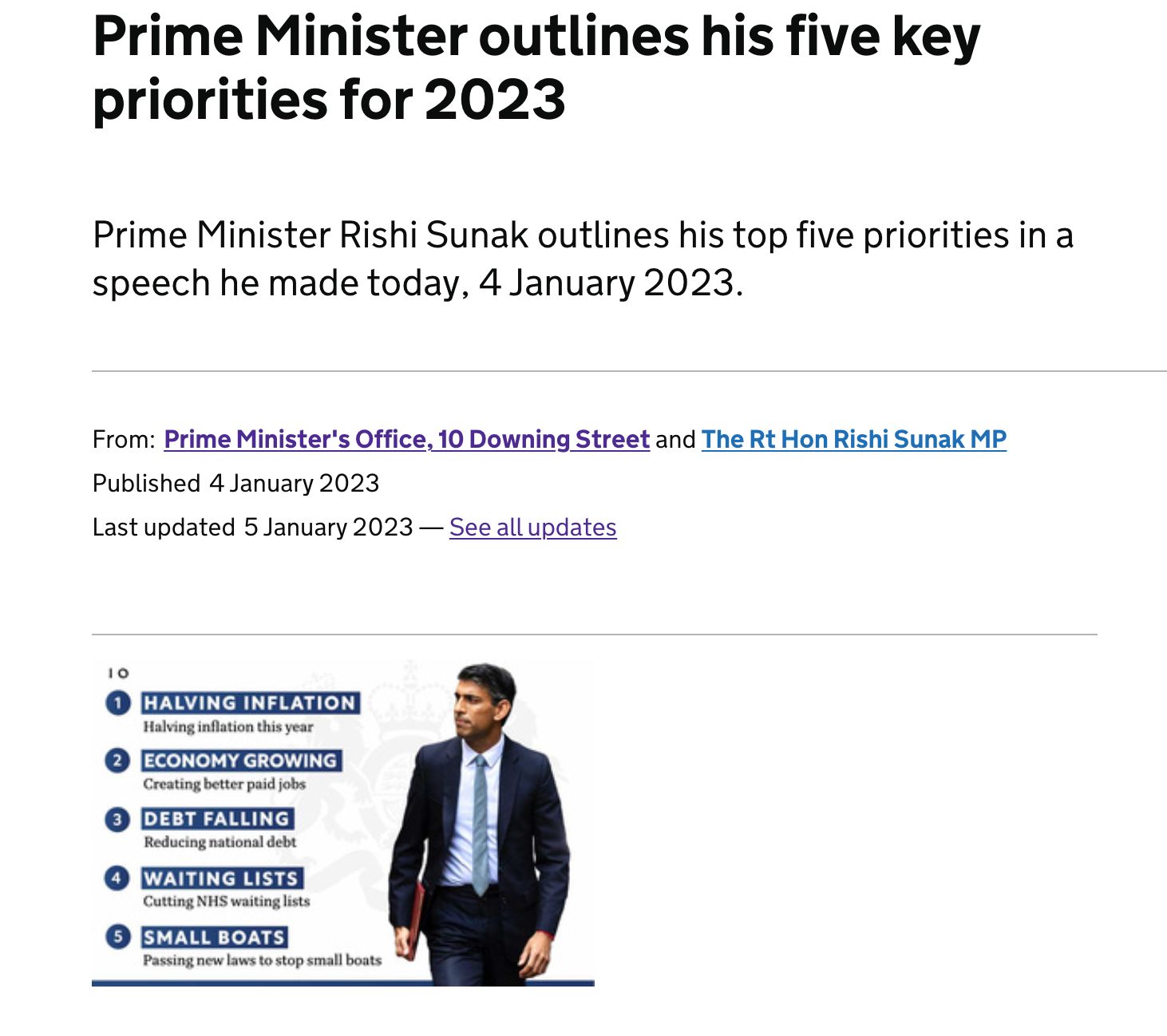
The prime minister unveiled the pledges in a major speech setting out his plans for 2023.

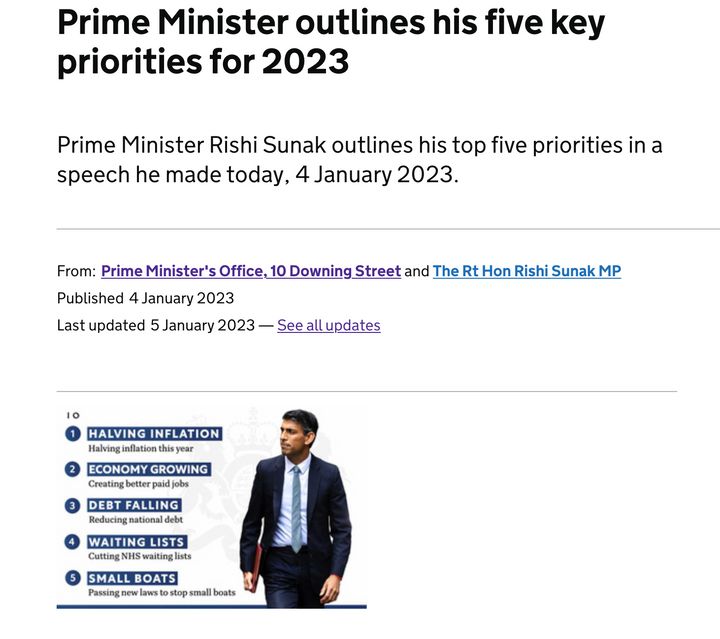
They included a vow to halve inflation this year, grow the economy and cut hospital waiting lists.

Sunak said: “No tricks, no ambiguity – we’re either delivering for you or we’re not.”

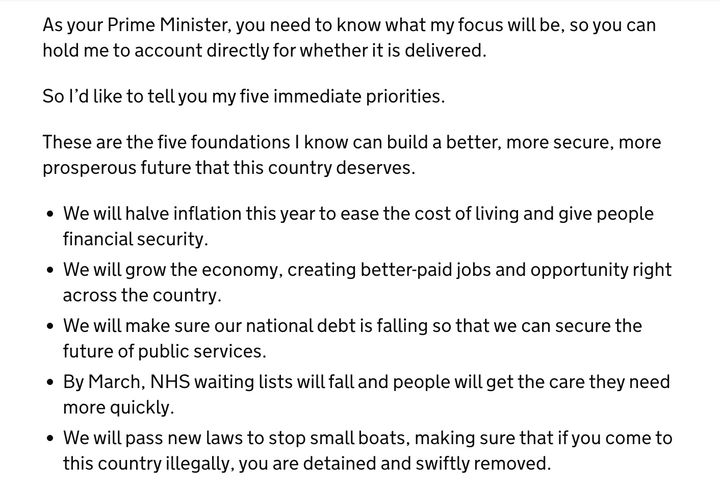
The original version of the announcement published on the government website after Sunak made his speech on Wednesday says: “By March, NHS waiting lists will fall and people will get the care they need more quickly.”

The fourth bullet point claims waiting lists will fall "by March".
The fourth bullet point claims waiting lists will fall “by March”.

UK government

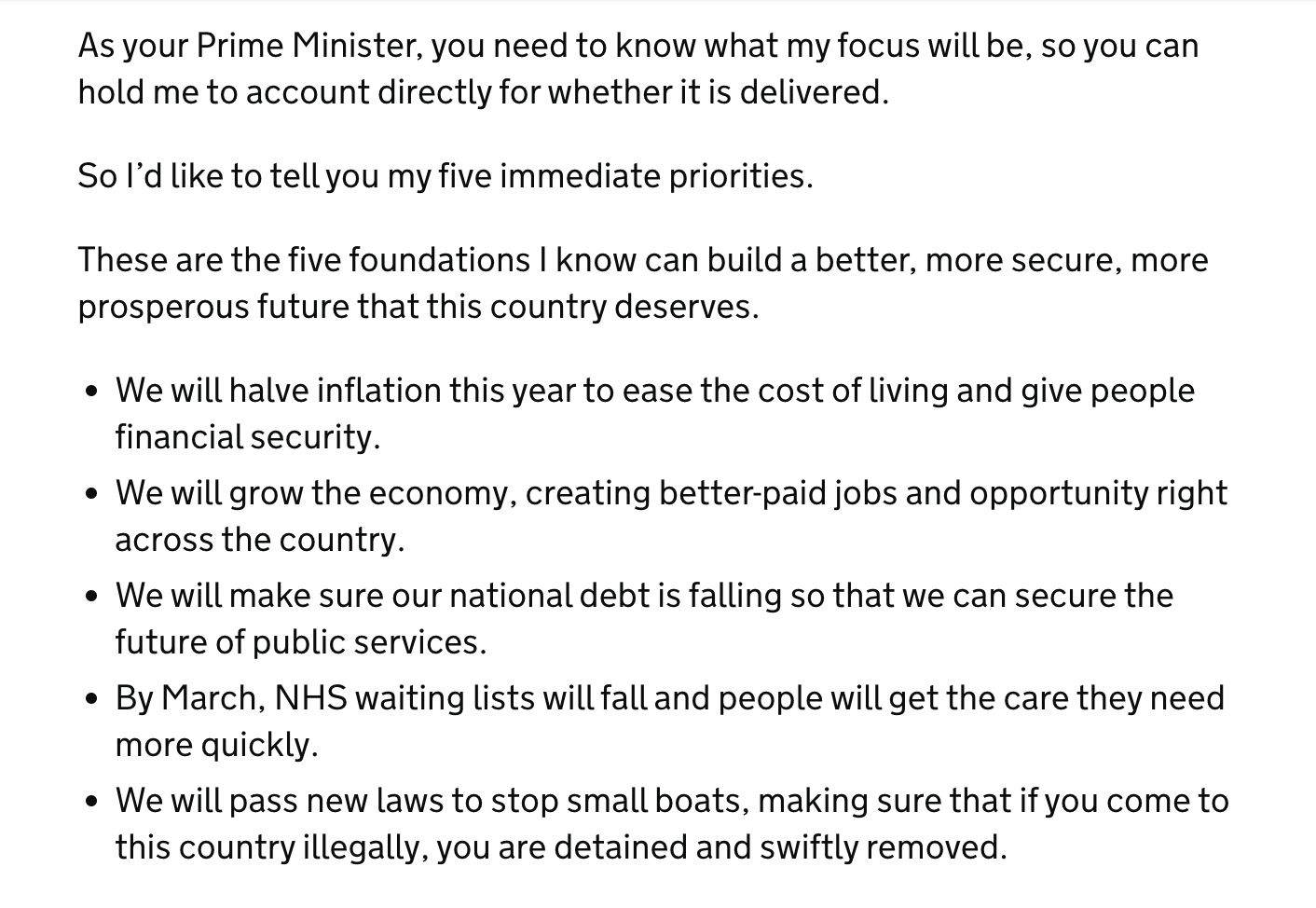
However, visitors to the same page are now told that it was “updated” on Thursday and the March reference has been removed.

That pledge now says: “NHS waiting lists will fall and people will get the care they need more quickly.”

The page has since been edited and the March reference removed.

UK government

Shadow health secretary Wes Streeting told HuffPost UK: “Just 48 hours after promising the British people a series of cast-iron promises, Sunak is already quietly editing the small print.

“The longer we give the Conservatives in power, the longer patients will wait.”

Answering questions from journalists after his speech, the PM said: “By spring of next year, we will have practically eliminated those waiting over a year, with the overall waiting list falling.”

A Downing Street source said the target for bringing waiting lists down is March 2024, and the government website had been edited to avoid any confusion.

HuffPost UK can also reveal that former health secretary Sajid Javid first made the March 2024 vow almost a year ago.

Speaking last February, he said: “Assuming half of the missing demand from the pandemic returns over the next three years, the NHS expect waiting lists to be reducing by March 2024.

“Addressing long waits is critical to the recovery of elective care and we will be actively offering longer waiting patients greater choice about their care to help bring these numbers down.”

Share Button

5 Signs Your ‘Dry January’ Should Maybe Be A Permanent Thing

So you’re trying Dry January – aka a month of no alcoholic beverages. Perhaps you’re doing it to save money, because you’re worried you drink a little too much or because your friend doesn’t want to do it alone.

Regardless, there’s probably a part of you that’s “sober-curious,” meaning you’re thinking about how alcohol affects you and your life.

As you skip out on drinks throughout the month, you may notice signs that make you even more sober-curious. Maybe you realise how much you’ve been relying on alcohol or how much better your life is without it.

Below, experts share the signs your Dry January challenge should become a more permanent part of your lifestyle and list tips for sticking with it.

1. You realise all you’ve missed out on because of drinking

While alcohol is something many of us turn to when we feel upset, want to have fun or need to wind down, it can also limit our lives. For example, when you’re drunk, you can’t drive to a Zumba class or play with your baby niece.

“Dry January presents a host of opportunities to experience what we otherwise might have missed out on,” says Brook McKenzie, the chief operating officer at Renewal Lodge by Burning Tree, an addiction treatment center. With all that extra time you had during Dry January, he explained, you might have gotten to try something new and exciting.

Further, you might recognise all you missed out on — either in general or sober. “Often, due to the prevalence of alcohol in our culture, people can go years — even decades — without having experienced things like a first kiss, an intimate conversation, a child’s first steps, a movie, meal, birthday, [or] Christmas without the use of alcohol,” says James Hartley, a U.K.-based counsellor who’s been sober for three and a half years.

2. Your interests change

According to Hartley, you may find your old interests boring or need to re-find the value of something without a drink.

“Enjoying yourself without alcohol takes some relearning, and you might find that some things you thought you enjoyed, you actually don’t, and you might find that you start developing new interests,” he says.

For example, you might find more value in small group gatherings than parties, or enjoy playing recreational soccer over drinking alone at home.

3. You feel better emotionally, mentally and physically

As you probably know, alcohol can make you feel groggy, moody and nauseous, to start. So, abstaining from it has many benefits.

“You might experience an increase in energy, alertness, positive thinking, less depressed symptoms, more restful sleep and overall an improvement in your well-being,” says Cathrin Moeller, a licensed marriage and family therapist with Thriveworks in Colorado Springs, Colorado, who specialises in addiction, depression, coping skills, stress and relationships.

Elena Touroni, a consultant psychologist and co-founder of The Chelsea Psychology Clinic, explained how this works: “As we all know, alcohol is a depressant and it impacts our brain’s ‘happy’ hormones, like serotonin and dopamine,” she says. “One of the benefits of cutting out alcohol is that you’re likely to feel more balanced in mood, less anxious, etc.” Those changes may help you at your job, too, as work feels more doable and less stressful.

4. Your relationships have improved

Since alcohol can take us away from friends, family, special events and more, you may have noticed the deepening of your relationships in Dry January.

“People are coming around [you] more, they are [giving] positive feedback that drinking less has been good for them, and [your] interactions with people are more genuine and less superficial,” says Kendall Phillips, a licensed professional counselor.

Connecting with others in a meaningful way is vital to our well-being. It can lengthen your life, strengthen your immune system and lower levels of anxiety and depression.

5. Staying away from alcohol was difficult for you

If you notice distressing emotions come up more than they have in other months – and wish you could quiet them with a drink – that could be because you used alcohol to numb them in the past, according to Moeller.

“If that is the case, it is important to seek support in working through this with a licensed mental health professional,” she adds.

Ultimately, it comes down to dependence. “The main difference between social drinking and being a ‘problem drinker’ is reliance,” Touroni says. Some signs of reliance she shared are struggling without having alcohol to turn to, thinking about alcohol a lot and feeling like you need it in social situations.

“If during this period a person is having physical, emotional or psychological cravings and withdrawals, this does signify a more serious problem,” adds Dee Johnson, an addiction therapist based at Priory Hospital Chelmsford in the UK. As a result, staying away from alcohol may be especially difficult – and something you need professional help with, she says, as Dry January can be dangerous for people whose bodies are addicted to alcohol.

Dry January is a good way to examine your relationship with alcohol and decide whether you should make more concrete changes to your drinking habits.

Nenov via Getty Images

Dry January is a good way to examine your relationship with alcohol and decide whether you should make more concrete changes to your drinking habits.

Do those signs necessarily mean you’re dealing with addiction?

The short answer: No. However, continuing to pay attention to your relationship with alcohol is crucial.

“Alcohol misuse is usually a slow burner that increases subtly over time, to the point that as physical tolerance levels slowly increase, it is quite common for the realisation to hit that there really is an issue only at crisis or near to [the] crisis point,” Johnson says.

(FYI, the signs of alcoholism include feeling powerless to alcohol, drinking in high-risk situations, developing a tolerance, noticing withdrawal symptoms without it, facing problems in your personal and professional life because of your need for alcohol, and more.) Also, Johnson adds, you don’t have to drink “every day” or “just the hard stuff” to have an addiction.

Truth be told, we all have something we turn to when we need to cope: sex, food, alcohol, yoga, friends. To some degree, that’s normal and OK. The problem is when it interferes with your life and well-being.

“What’s important is the relationship you have to that thing and whether, in the long term, that is preventing you from living a fuller and more contented life,” Hartley adds. “Whether you term yourself as ‘an addict’ is irrelevant: The truth is, you have a problem with the way things currently are, and it may be worthwhile having a go at changing that a little.”

Tips For Exploring A Sober Lifestyle

Regardless of how you define your relationship with alcohol, what can help you avoid it (especially when it’s basically everywhere)? Here are some options, straight from these experts:

  • Working with a therapist
  • Asking your family and friends to support you
  • Practicing new coping skills
  • Leaning in to your religion or spirituality
  • Finding new hobbies and interests
  • Asking someone to be your accountability partner
  • Attending meetings focused on quitting alcohol
  • Not going to bars
  • Taking it one day at a time
  • Thinking about how much better you feel
  • Brainstorming your goals (those related to staying sober and other ones).

If you slip up, be gentle with yourself. This happens, and your hard work isn’t lost. “It is part of the journey to experience setbacks, as with any goal,” Moeller said. “Think of it as part of the journey versus a failure.”

Remember, you’re not alone in what you’re going through, and help is out there.

Help and support:

Share Button

Just What Is Really Going On With Rishi Sunak’s Speaking Style?

Rishi Sunak’s speaking style has attacted some attention since he became the UK’s third (and final) prime minister of 2022.

While he hasn’t received quite the level of criticism aimed at his predecessor Liz Truss and her famously stilted manner, there have been some comparisons to the cringey Will MacKenzie from The Inbetweeners.

As the actor behind the character, Simon Bird, joked to The Times: “I’m absolutely baffled why anyone would see any similarities at all between this privately educated, socially awkward, out-of-touch caricature and … ah. Scrap that.”

Sunak’s first speech of 2023, where he made five promises to rejuvenate the nation, was also subject to some ridicule over its delivery.

Here’s a sneak peek…

The Guardian’s John Crace said Sunak spoke “breathlessly and earnestly. And vacuously”, while The Times’ Quentin Letts dubbed it a “wonderfully terrible” talk where Sunak spoke acted as “wide-eyed as a Girl Guide talking about badges”.

The Telegraph’s Madeleine Grant even said it was like “painting by numbers but with words” or “Count von Count from Sesame Street was moonlight as PM”.

Twitter has also frequently pointed out that Sunak would be the ideal children’s presenter.

But is there a reason why Sunak has such a particular delivery?

Speaking to HuffPost UK, Ges Ray, who teaches people how to speak in public for a living, suggests that Sunak might have deliberately chosen to have more of a “low profile” compared to his predecessors.

Ray notes that Truss adopted the voice of Margaret Thatcher, with her voice dropping in tone and timbre when she took up her place in No.10.

He adds: “Those who watched Boris Johnson noted his ability to adopt the bumbling orator style as a chosen persona, part of his high profile.”

By comparison, he says that Sunak uses an “encourage tone” with “relatively simple and straightforward language”, which allows his critics to categorise him as “primary school teacher, reaching above the noise of the classroom with warm encouragement”.

“Which is the audience that matters? His immediate critics, or the population at large, perhaps more open to the contrast with recent PMs?”

– Ges Ray, speech coach

If the PM wants to change his delivery, Ray suggests he needs to work on “voice tones, gravitas, his physical stature” to improve as a speaker.

But he also asks: “Which is the audience that matters? His immediate critics, or the population at large, perhaps more open to the contrast with recent PMs?

“Could it be – and this is simply personal conjecture! – that with the enormous demands of the greatest of Great Offices of State he has eschewed, and indeed distanced himself from the path of his two immediate predecessors, deliberately choosing not to develop a new speaking style?”

When analysing Truss’s speech during her time in the spotlight, journalist Viv Groskop of the How To Own A Room podcast, explained that there are advantages to being a less conventional speaker.

She told HuffPost UK: “In previous decades we have been used to speakers ― and politicians in particular ― who look and sound more confident than most of us. But often that approach now comes across as stuffy and old-fashioned.

“Now that we are surrounded by TikTok content, TED talks, YouTube and we constantly have people talking at us and trying to get our attention, our perception of what is authentic and worth our time is changing fast.”

But then, we should consider Sunak’s very privileged background, son-in-law to a billionaire and the richest PM ever to take up a seat in No.10.

Some sketch-writers did picked up on Sunak’s slight tone-switch when he started answering journalists’ questions during his speech this week.

Letts noted that a “sparkier, more commanding, combative Sunak” emerged when challenged by the media on his vision.

“He dropped that dreadful Timmy-the-Hamster voice and sounded more like a corporate high-flyer grasping supply-chain problems,” Letts commented.

Does this mean Sunak is still playing with his speaking style? Only time will tell if we’ll ever experience another gem to rival Truss’s “pork markets” again.

Share Button

‘I’m 26. I’ve Never Found Love And I Don’t Think I Ever Will’

You’re reading Love Stuck, where trained therapists answer your dating, sex and relationship dilemmas. You can submit a question here.

By the time we reach our mid-twenties, it can feel like most people have been in a few relationships – but what if this isn’t your reality? You want love but you’re ashamed to admit it hasn’t quite happened yet. You ask yourself if something is wrong with you, and more urgently, if you’ll ever find love.

This is the case for this week’s reader, Patricia. “I’m 26 years old, and I’ve never had a boyfriend,” she writes. “This wouldn’t be a problem in itself, but ever since I moved to a new country/became independent, I feel more pressured to find a significant other.”

This pressure, she says, comes not just from her family but from casual acquaintances, even strangers, who throw out comments such as “you’re such a nice girl, how come you’re single’? or “we weren’t made to be alone”.

“This paired with the fact that I only managed to have flings so far, which never developed into serious/meaningful relationships,” Patricia says. The story goes more or less like this: I meet someone, we spend time together getting to know each other, and after a couple of weeks they say they’re not ready for a serious relationship.”

These experiences have left Patricia questioning if there’s something wrong with her and if she’s worthy of a relationship. “I know that romantic love is an experience that many humans never have and that it is still possible to live a fulfilling life in spite of that, so I have been trying to accept that it might never happen to me,” she says. “However, I must admit that sometimes I feel like I’m missing out on something major that seems to be natural to most people.”

Counselling Directory member Laila Fish shares her advice for Patricia.

Why can there be so much pressure to get into a relationship and how can you release herself from this pressure?

There are a range of pressures on people to embark on relationships, says Fish, including family and societal expectations.

“Family members may have good intentions, they may have experienced this pressure themselves, and would like to see you in a relationship as maybe they are worried about you moving to a new country – despite how frustrating this sounds for you!” she says.

The next time a family member or friend asks Patricia about relationships, Fish wants her to pay attention to herself – “does it make you feel sad or frustrated – this can often tell us a lot” – and take a deep breath before responding. Meanwhile, to release herself from societal pressures, Fish says it’s helpful to avoid comparing herself to other people her age.

“Embrace your independence. It sounds like you are doing amazingly and enjoy all the opportunities ahead of you,” she advises Patricia. “Knowing what you want allows you to tune out society’s messages that don’t reflect your desires currently.

“It can be tough seeing everyone you know meeting someone romantically, but that doesn’t mean it is something that you necessarily want and that’s OK.”

How can you hold on to hope you’ll find someone special?

“Patricia sounds confident and independent and needs to believe in herself that when the time is right she will find the right person, and until then to enjoy meeting new people,” Fish says.

“Patricia says that the people she meets only last a short while. I would advise reframing this perspective into thinking how interesting and great an opportunity to meet new people is. Then, if one day a relationship happens, it does.”

Fish recommends she focuses on herself first and works on her self-esteem.

“Don’t be afraid of feeling like you are missing out on something – that something is ‘you’ and independence right now is your best friend. Also, be kind to yourself and challenge your negative beliefs that you may not be worthy.”

What practical tips would you give this reader to get into a relationship?

Expanding your interests and social activities can provide opportunities to meet different people, Fish says, but it’s important to start with what you want to do.

“Spending time thinking about your likes and dislikes as well as your goals can enable you to be clearer about who you are,” she explains. “Discovering other goals to focus on such as your professional life, your health, alongside meeting someone, can help you feel more confident and empowered if/when you do.”

She suggests Patricia ‘dates herself’ to get to know herself. “Go for a walk in the park, journal about your values and aims in life, go to that museum and see that film – this will all help towards you developing your self-esteem and consequently feeling worthy.”

In the end: “Focusing on finding happiness in your own life will pay dividends to avoid any relationship escalator your family or society is rushing you towards.”

Love Stuck is for those who’ve hit a romantic wall, whether you’re single or have been coupled up for decades. With the help of trained sex and relationship therapists, HuffPost UK will help answer your dilemmas. Submit a question here.

Share Button

I Know A Lot About Toddlers, Here Are 5 Potty Training Mistakes Parents Make

Plenty of parents dread potty training – and for good reason. There will be rogue poos that find their way onto your favourite rug, there will be wee everywhere, and there will be tears (mainly from you).

But once the penny drops and things click into place, nothing can quite prepare you for that feeling of accomplishment. You will burst with pride – not just for your genius of a child, but for yourself. After all, if you can teach them how not to soil themselves, you can literally achieve anything.

For those yet to embark on the journey, or if you’ve recently started but aren’t having much success, there are some key things to know.

Potty training and toddler specialist Amanda Jenner – who is glamorously known by kids as “the wee and poo fairy” – has worked with hundreds of parents over the years, helping their children master the art of going to the toilet.

When asked what the perfect age is to start, she says there isn’t one as every child is different. “You know your child best,” she says, suggesting you might want to start the process “any time from around 2-4 years old”. When they’re showing signs of readiness (more on that later) and can communicate when they need to go, “then it’s the right time to give it a go,” she adds.

Here, the toddler expert talks us through the potty training mistakes that parents commonly make (we’re only human after all) – and how to rectify them.

1. Starting when your child isn’t ready

If you’ve started potty training, given it a good couple of weeks and your toddler is showing absolutely no interest and having lots of accidents, then they are simply not ready, says Jenner.

Children are able to control their bladder and bowels when they’re physically ready and when they want to be dry and clean. Every child is different, so some might be ready to start this sooner than others.

We know that by two years of age, some children will be dry during the day, but the NHS acknowledges this is still quite early. By three, however, most children are dry most days – although some will have the odd accident if excited or upset.

What to do instead: have a break for one or two months and then start fresh. Look out for them showing signs of readiness. These include:

  • stopping in their tracks when they are doing a wee or a poo,
  • becoming aware of their bodily functions,
  • insisting on a nappy change when it has been soiled,
  • hiding behind the sofa when they are doing a wee,
  • going longer periods with drier nappies,
  • understanding simple instructions and commands,
  • being able to communicate that they’ve done a wee or poo.

2. Getting started when there’s a change in circumstances

It’s not a good idea to start potty training if you’re experiencing some disruption to your lives right now. This could be because your toddler is feeling unwell, there’s a new baby in the family, you’ve moved house, your child has started or changed nursery, or there are any problems in the household, such as a separation or a death in the family, says Jenner.

What to do instead: wait until there’s less disruption in your lives and start the process again. Jenner recommends spending the week before you start potty training educating yourselves on the process and reading a potty training story book to your little one to help them understand what they have to do.

StefaNikolic via Getty Images

3. Getting frustrated with your child

Potty training can be unbelievably frustrating for both you and your toddler. Believe us, we know. But little ones don’t like to disappoint their parents, so try not to become cross with your child for accidents or not wanting to sit on the potty or toilet, says Jenner.

What to do instead: turn your frustration into lots of encouragement using upbeat and happy language. You could say: “mummy and daddy are so proud of you for trying” or “what a big boy/girl you are using the potty/toilet and wearing big girl/boy pants”.

4. Trying to nighttime potty train at the same time as daytime potty training

Trying to get your child to use a potty in the day and then go through the night without going to the toilet – and not wearing any nappies – is probably not going to work out like you’d hoped.

It usually takes a little longer for children to learn to stay dry throughout the night and although most learn this between the ages of three and five, around 20% of children aged five sometimes wet the bed.

Nighttime dryness involves different bladder control than the day and some children sleep deeper than others, which means they aren’t aware when they have a full bladder, says Jenner, which can then lead to bed wetting.

What to do instead: wait until they are dry in the day for a couple of months and then begin nighttime training. In the meantime, keep them in nappies overnight.

5. Forcing them to sit on the potty if they are refusing

If they won’t sit on the potty, don’t make them do it as this will only result in them associating the potty with a negative or fearful experience, says Jenner, meaning they probably won’t want to continue with potty training.

What to do instead: try using distractions and making it a more fun and positive experience – use bubbles, books and sensory toys. If they still refuse, then stop after a few days of trying and revisit again in a month or so. Continue to educate them in this break by using books, flash cards, watching videos and talking about it. Good luck!

Share Button

Exclusive: Teachers’ Strike Ballot Result Will ‘Go Down To The Wire’

A strike ballot organised by the UK’s largest education union will go “down to the wire”, HuffPost UK understands.

The National Education Union (NEU), which represents around 450,000 teaching staff across England, Wales and Northern Ireland, is currently holding a formal ballot calling for a “fully-funded, above inflation pay rise” following a decade of eroded wages.

A preliminary indicative ballot by the NEU in October showed strong support among teachers and support staff for taking industrial action to achieve a pay rise — but there are fears that turnout for the formal postal ballot has been hampered by Royal Mail strikes and bad weather.

Under the Trade Union Act, NEU members are bound by higher turnout thresholds to push through strike action.

The union must achieve a turnout of 50% in both the teacher and support staff ballots. Some 40% of those eligible to vote must back strike action for it to go ahead.

A source close to the Trades Union Congress (TUC), which represents unions across England and Wales, told HuffPost UK: “The result is going to be very close in terms of turnout.

“The NEU could meet the threshold or it could not — it’ll be down to the wire.

“The fact that the NEU is on the verge of this historic result, despite the massive barriers of the Trade Union Act, shows how angry teachers are about the way they’ve been treated and the formidable NEU data-led operation.”

They added: “It’s true the situation at Royal Mail could delay some ballots and this could make it very close, so individual votes will matter.”

If teachers back strike action, it will create another headache for the government which is so far refusing to back down on union pay demands — increasing the likelihood that disruptive strikes could go on for months.

Already this week the government is battling a series of damaging walkouts by the RMT and Aslef rail unions which began on January 3 and will finish on Saturday.

Nurses will also go on strike on January 18 and 19 unless negotiations are opened, having already withdrawn their labour for two days in December.

And in Scotland, primary school teachers will walkout on January 10 and secondary school teachers on January 11, with more strikes planned for later in the month and into February.

The average primary classroom teacher in England currently earns £38,200, rising to £41,600 for a secondary classroom teacher.

Heads of primary schools typically take home £67,400, which rises to £94,900 for the average secondary school.

The government has offered most teachers a pay rise of 5% for this year, up from an original offer of 3%. Those who are newly qualified will receive a pay rise of 8.9% to meet the Department for Education’s (DfE) commitment to increase starting salaries to £30,000 by 2023.

However, the teaching unions argue that the pay offers amount to a real-terms pay cut given that the rate of inflation stands at 10.7%. Research by the NEU estimates that its members have lost a minimum of £64,350 in earnings since 2010.

Last year, the NEU’s indicative ballot found that 86% of teachers would be prepared to take strike action to demand a pay rise, on a 62% turnout.

A separate ballot of school support staff also strongly supported taking strike action over pay, with 92% of staff rejecting the government’s offer and 78% backing industrial action.

The NEU’s formal postal ballot will close on January 13 next year, with strikes potentially taking place towards the end of the month.

Fellow teaching unions the National Association of Schoolmasters Union of Women Teachers (NASUWT) and The National Association of Head Teachers (NAHT) are also holding strike ballots for members in England and Wales that will close on January 9 and 11, respectively.

Sources within the education sector expressed concern that strikes by the Communication Workers’ Union (CWU), whose members work for Royal Mail, have resulted in some members not receiving their ballots on time, potentially hampering turnout.

The CWU has not yet announced strike dates for 2023 but held walkouts over the Christmas period, including on Christmas Eve, in a bitter dispute with Royal Mail over pay.

If the turnout threshold is reached and strike action is approved, around 24,000 schools in England and Wales could be forced to close as children are sent home.

“The knock-on impact on parents and wider society will be huge,” the source said.

“The government can continue to pretend there’s not a problem or sort it out. Teachers are simply tired of what’s happened to education since 2010 and the strength of feeling is high.”

A spokesperson for the NEU said the union was confident that the thresholds for strike action would be met and that members would be able to re-order any mislaid postal ballots.

“The NEU supports the CWU and the postal workers’ strike,” they said.

“Despite the unfair threshold set by government for strike action to go ahead we are confident our members will vote in the margins required for action to take place. The NEU ballot for strike action for a fully-funded pay increase closes on the January 13 and the results will be known shortly afterwards, most likely on January 16.

“Until this date we will not have the final numbers. It is an indication of the anger felt by teachers and support staff that the union’s electronic indicative ballot had an overwhelming yes vote for action resulting in the union moving ahead with a formal ballot.”

They added: “Through successive below inflation pay rises teachers and support staff have suffered losses of over 20% in salary since 2010. Many are leaving the profession. Government recruitment targets are missed year on year and nearly a third of teachers leave within the first five years of entering the profession. Something has to change.

“Government needs to start negotiating in good faith with the education unions to ensure children get the education they deserve, and teachers and support staff are fairly paid for the vital role they play.

“We don’t want to have to take this action — and we are calling on government to negotiate. It is in the government’s gift to avert these strikes with a new offer on a fully funded pay rise.”

In response, sources at the DfE said plans were being put in place to minimise any disruption if strikes do take place.

They said the best way of making money go further in schools was for the government to tackle inflation and for schools to be made away of the “resource management” available to them.

They also pointed to the £5 billion in funding to help children recover from lost learning in the aftermath of the pandemic, including more than £1 billion for the national tutoring programme.

A DfE spokesperson said: “There are no great schools without great teachers which is why we are making the highest pay awards in a generation – 5% for experienced teachers and more for those early in their careers, including an 8.9% increase to starting salary.

“We are also investing an additional £2 billion in schools next year and £2 billion the year after, taking school funding to its highest-ever level.

“After two years of disrupted education for young people, strike action is simply not a responsible solution.”

The CWU has been contacted for comment.

Share Button

Rishi Sunak Must ‘Step Up To The Plate’ To End Strikes, Says Union Chief

Rishi Sunak has been urged to “step up to the plate” by personally sitting down with union bosses to end the strikes.

TUC boss Paul Nowak has written to the prime minister demanding talks on how to find a solution to the industrial action crippling public services.

Nurses, railway workers and ambulance drivers are among those taking part in strike action throughout January in the ongoing disputes over pay and conditions.

Nowak said Sunak must “allow his ministers to get around the table with our unions reach a fair settlement on pay.”

He said striking workers “can’t afford another year of a real terms pay cut”.

“The reality is their mortgages are going up, their food bills are going up, their rents are going up – the only thing that isn’t going up is their wages,” he told Sky News.

“I think the government has got to take some responsibility now, step up to the plate, facilitate those talks and lets get a fair pay settlement for our NHS workers and public sector workers right across the piece.”

The TUC boss said Sunak had “forgotten some of those basic lessons” from the pandemic, when the TUC worked with him to develop the furlough scheme during lockdown.

He said: “I think he’s forgotten the value of sitting down and reaching an agreement and taking ideas from people outside his own cabinet.

“And frankly, I think it would be really good for Rishi Sunak to talk to our unions, but also to talk to some of those frontline parandemics, those physiotherapists, teachers in the classrooms, civil servants – people who for the last decade have been placed under real pressures on workload who feel they’re at breaking point.

“Let the prime minister talk to those workers and understand their concerns and their issues. I think that’s what any decent employer would do, and as someone responsible for the employment of millions of public sector workers, that’s exactly what the prime minister should do as well.”

Sunak will today set out his plans for the year ahead in a major speech in London.

The PM will unveil plans to make all pupils study some maths until they are 18, as well as explain how he plans to tackle the NHS crisis, illegal immigration and boost the economy.

Share Button
✕
smartphone

FREE
VIEW