11 Early Signs Your Relationship Is Quietly Falling Apart

A 2011 meta-analysis of studies found that marriage doesn’t actually make couples happier ― if your relationship with your partner wasn’t great before the big day, their research says, it likely won’t become that way afterwards.

That’s why Evon Inyang, a licensed associate marriage and family therapist and the founder of ForwardUs Counselling previously told HuffPost UK that it’s important not to go along with a failing relationship for the sake of it.

There’s no need to settle for unhappiness “just because invitations have been sent out, the dress has been bought and deposits have been paid,” she wrote.

Still, many of us struggle to recognise when our relationship is “off.” So it’s a good thing u/one-droplet recently asked the netizens of r/AskReddit: “What are the early signs of a failing relationship that most people ignore?”

Here are some of the most-upvoted responses:

1) “Not wanting to talk to them about things you find interesting because you feel their reaction will ruin it.”

Credit: u/Oograsti

2) “In my experience, when you stop imagining a future together, that’s how you know it won’t last.”

3) “When you love the memories more than the person standing in front of you.”

Credit: u/dragonzander1

4) “Only one person doing all the work.”

Credit: u/Slick_Nick420

5) “I used to slow down at work just so I would have to work late even though I wasn’t getting paid for it.”

“Did this for years before I finally decided to leave my ex.”

6) “When you stop arguing with your spouse. Not because things are good but because it doesn’t matter anymore.”

7) “When conversations become minimal or surface-level, it can indicate a deeper disconnect.”

Credit: u/LaylaLoyal3

8) “If a partner is too busy for you then they’ve found something more important than you.”

“If you’re of importance to someone, they’ll make time for you.”

Credit: u/saqreye

9) “Indifference. When you really have no emotional response to each other.”

“This the death of a relationship.”

Credit: u/dma1965

10) “When you stop sharing the little things — random thoughts, funny memes, or how their day went.”

“When the small talk disappears, the connection starts fading.”

Credit: u/GreedyFig6373

11) “Feeling annoyed when you know you have to see them in the evening. Or when you hear them chewing.”

“Or when they start talking and you just wish they would stop soon. Feeling annoyed when they kiss or hug you or give you affection. You might not even know you are annoyed.

“You just get that heavy feeling in your chest when you have to be in their vicinity. You hear an ‘ugh’ go through your mind.”

Credit: u/Brynhild

Do you agree with these or have any thoughts to add?

Share Button

Here’s The Real Reason Your Cat Licks You, And It’s Pretty Heartwarming

Ever had your shoe stolen by a dog?

Well, according to experts, your furry friend is likely just reassured by your scent and wants to be near it.

Cute as that seems, dogs have so many other ways of showing affection (wagging their tail, running up to you, leaning against you) that you might be left wondering why they had to turn to your favourite slipper in the first place.

Surely that’s the sort of behaviour you’d expect from notoriously cryptic cats, whose rarer displays of affection include stretching at, kneading on, and licking their owner?

And does your cat licking you mean they like you at all?

It could be a form of “allogrooming”

According to PetMD, we can’t be 100% sure (typical felines) ― but one of the leading theories vets have is that your cat might lick you to get closer to you.

“Mothers groom their kittens and cats may groom one another, which is called allogrooming,” the publication shared.

This helps to strengthen social bonds and increases a sense of belonging (aww).

Blue Cross’ animal behaviourist, Claire Stallard, said that allogrooming is the most likely reason your cat is licking you.

Other causes may include your cat seeking attention from you, your cat liking the taste of your skin (yes, really ― be careful with this if you’re wearing lotions, fake tan, or perfume), and them identifying you as a part of their group.

Rarely, the habit could indicate stress or anxiety. This is especially likely if their ears are flat to their head and/or their tail is swishing

See your vet if your cat suddenly starts licking you a lot out of nowhere, though. Very occasionally, this can be caused by medical conditions that create nausea.

Why are cats’ tongues so scratchy?

A study published in Proceedings of the National Academy of Sciences found that cats’ tongues actually have little hooks, rather than cones, which allow them to hold saliva on their tongue.

When cats lick themselves (or you), this is designed to comb their fur and distribute the cleansing saliva evenly across the surface they go for ― sometimes at the cost of a scratching sensation on your skin.

Per BBC Science Focus, this is partly because cats (unlike dogs) are solitary hunters. When a cat is hunting, they need to disguise their scent ― their specially-designed tongue helps them to do this to themselves easily.

This is less important for dogs, whose pack-hunting technique requires less disguise from both their prey and potential predators.

Share Button

I’m A Sex Expert — 4 Steps For Women Who Struggle To Orgasm

Getting off, the big O, la petite mort, cumming… There is a plethora of ways to describe the female orgasm and yet, many of us still aren’t quite making it to that final moment.

In fact, according to sexperts at Lovehoney, data shows that just 15% of women can orgasm during penetrative sex alone.

Additionally, 2023 research by Durex found that only 5% of women would say that they always orgasm during sex.

So, why is this?

It partially comes down to The Orgasm Gap

Of course, we know that the journey can be just as fun and enjoyable as the destination but, if we’re very honest with ourselves, not being able to orgasm can be pretty frustrating, to say the least.

The disparity between men and women having orgasms is defined as ‘the orgasm gap’.

Psychology professor Laurie Mintz wrote about this phenomenon for The Conversation and said the main reason for it “is that women are not getting the clitoral stimulation they need”.

“And cultural messages about the supremacy of intercourse feed into this. Indeed, countless films, TV shows, books and plays portray women orgasming from intercourse alone,” said Mintz.

“Popular men’s magazines also give advice on intercourse positions to bring women to orgasm. And while some of the positions do include clitoral stimulation, the message is still that intercourse is the central and most important sexual act.”

It can also be down to a health concern

If you can’t orgasm from penetrative sex or clitoral stimulation, you may have a condition called ‘Anorgasmia’.

Medical experts at Mayo Clinic explain: “Multiple factors may lead to anorgasmia. These include relationship or intimacy issues, cultural factors, physical or medical conditions, and medicines.

“Treatments can include education about sexual stimulation, sexual enhancement devices, individual or couple therapy, and medicines.”

If you are having sexual difficulties, speak to your GP or reach out to relationship experts at Relate.

Four steps you can take to reach orgasm

Annabelle Knight, sex and relationship expert at Lovehoney, says: “Achieving better orgasms for women involves a combination of understanding your body, communication, and addressing both physical and emotional factors.”

Get to know your own body better with masturbation

“Ensure that you don’t overlook self-exploration and masturbation,” Knight urges.

“Spending time exploring what feels good to you, and trying different techniques such as using fingers, sex toys, lube and varying positions can help you understand your body better.”

Knight reveals that while the data at Lovehoney shows that just 15% of women can orgasm during penetrative sex alone, that number jumps to 46% when using a sex toy.

Communicate with your partner

If you have a partner, open up to them about the problems that you’re having.

Knight advises: “Openly discussing what you both like, providing guidance during sex, and engaging in mutual exploration can help with intimacy and satisfaction from orgasm.”

That sounds pretty fun, actually.

Try to relax

Trying to coax your body into an orgasm when you’re mentally at a heightened stress level probably won’t get you very far.

Instead, Knight suggests that you try relaxing with deep breathing, meditation, or yoga, being present in the moment, and building anticipation through prolonged foreplay to heighten arousal and intensify your orgasm.

Check in on your emotional wellbeing

“Emotional and relationship factors are equally important when it comes to having a satisfying sex life,” adds the sexpert.

“Building emotional intimacy with a partner, addressing unresolved conflicts, and having a positive body image through self-love and acceptance will help transform how you feel in the bedroom.”

We’re rooting for you.

Share Button

People Are Realising The Real Reason You Can’t Recline Your Seat During Takeoff, And I Had No Idea

You know those ominous black clumps you see in the branches of trees sometimes?

Well, it took a Reddit post for me to realise that those aren’t actually bird’s nests.

Nope ― they’re either mistletoe (which is technically a parasitic plant), or a “witch’s broom” growth irregularity spurred on by animal or bacterial invasions.

And now, a post shared to r/explainlikeimfive has inspired me to ask experts why we actually have to recline our chairs on takeoff and landing.

In a recent post shared by u/bishopZ, the site user asked: “Why do airline passengers have to put their seats into a full upright position for takeoff? Why does it matter?”

Takeoff and landing are the riskiest parts of the flight

A now-deleted Reddit account wrote under the original comment: “You’re most likely to have some sort of accident during takeoff and landing. This is also why your tray tables have to be up and you can’t have laptops during these times: ease of evacuation.”

Indeed aerospace safety expert and associate professor of aeronautical science Anthony Brickhouse told Business Insider that 49% of deaths happen during landing, while 14% occur at takeoff.

Speaking to HuffPost UK, a spokesperson for the Royal Aeronautical Society’s Flight Operations Specialist Group explained: “There are two primary safety-related reasons why aircraft seats must be in the upright position for take-off and landing.

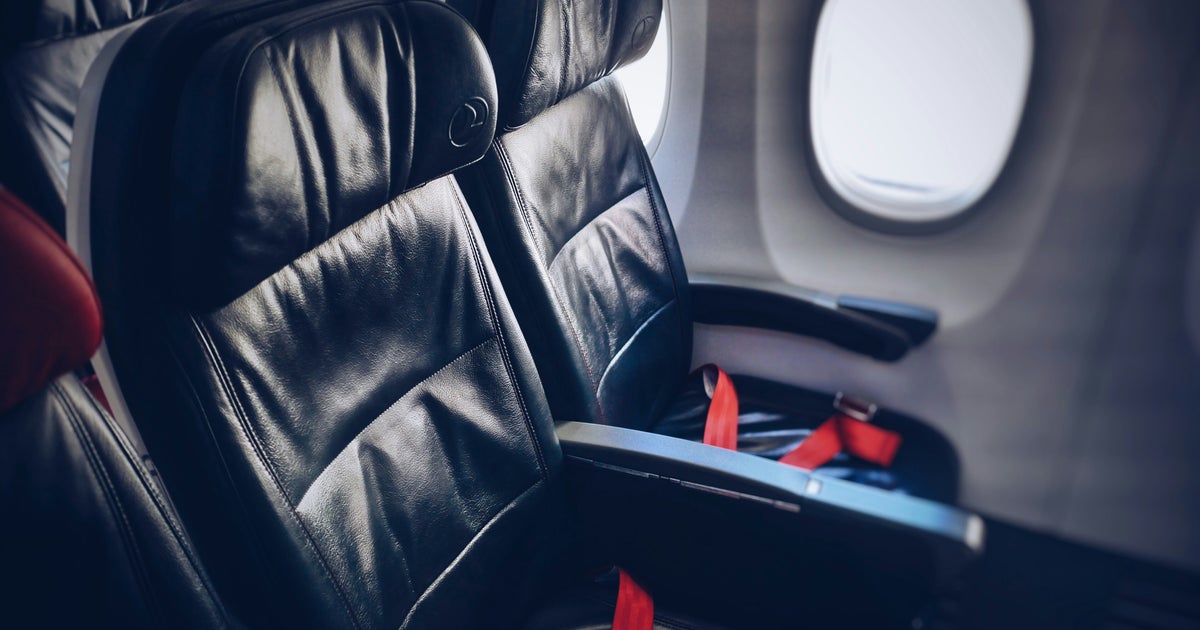
“The first is that the seat gives the occupant maximum impact protection when upright, and its structure locks into position accordingly. Being upright also reduces the possibility of the occupant ‘submarining’ under their lap belt in the event of a violent deceleration.”

“Submarining” happens when a person’s seatbelt is a little loose, allowing their body to slip underneath it at high speed. They slide under the belt, increasing the risk of injury.

“The second reason is that reclined seats reduce the space available in the row behind for occupants to escape quickly if an emergency evacuation is required,” the Royal Aeronautical Society’s Flight Operations Specialist Group added.

In fact, people who listen to “boring” plane protocol are more likely to survive disaster

The Guardian shared experts’ research into survivors of plane accidents. They found that people who had survived (rare) catastrophes had some things in common ― including being more likely to have read the plane’s safety briefing.

Knowing where the exits are, keeping your shoes on, and practising both the brace position and undoing your seatbelt can all help too.

And remember, Amanda Ripley, author of The Unthinkable: Who Survives When Disaster Strikes, says: “between 1983 and 2000, 56% of passengers involved in serious plane accidents survived.”

Share Button

I Tried Mary Berry’s 15-Minute Lemon Curd Recipe, And I’ve Made 6 Jars Since

Ex-Great British Bake-Off host Mary Berry doesn’t just do sweet treats ― we love her sausage casserole and “Mexican lasagne” recipes for our midweek meals.

With that said, there’s a reason one of her (many) cookbooks is called The Baking Bible. When I want to make dessert, I turn to the Cordon Bleu-trained chef first.

This weekend, I craved a lemon meringue pie. So, I thought I’d give her pared-down recipe a go (I’d tried more complex recipes recently, like a pomegranate curd, and had been left with a runny disaster).

People, the pie never got made. The curd was so good, I simply slathered it on slices of bread and ate spoonfuls from the jar ― I re-made double the recipe again to stay in stock for the rest of the month.

How does Mary Berry make her lemon curd?

Her instructions are simple: whisk one egg per whole lemon zest and juice to 75g caster sugar and 56g butter together. Twice this calculation makes roughly a jar.

Then, keep whisking the lot over a gentle heat for seven to 10 minutes. Mary warns: “Do not allow the mixture to boil or it may split.”

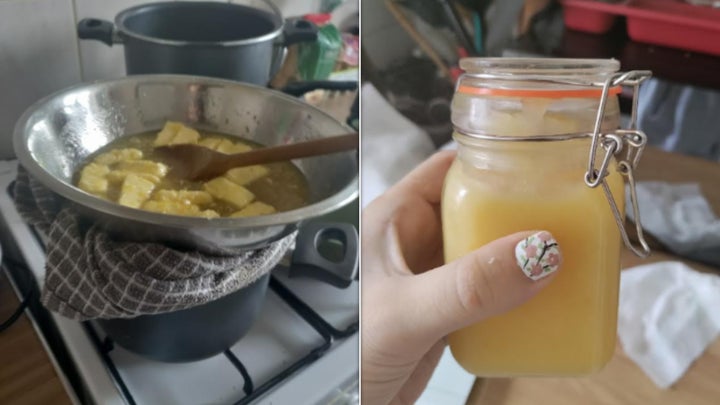
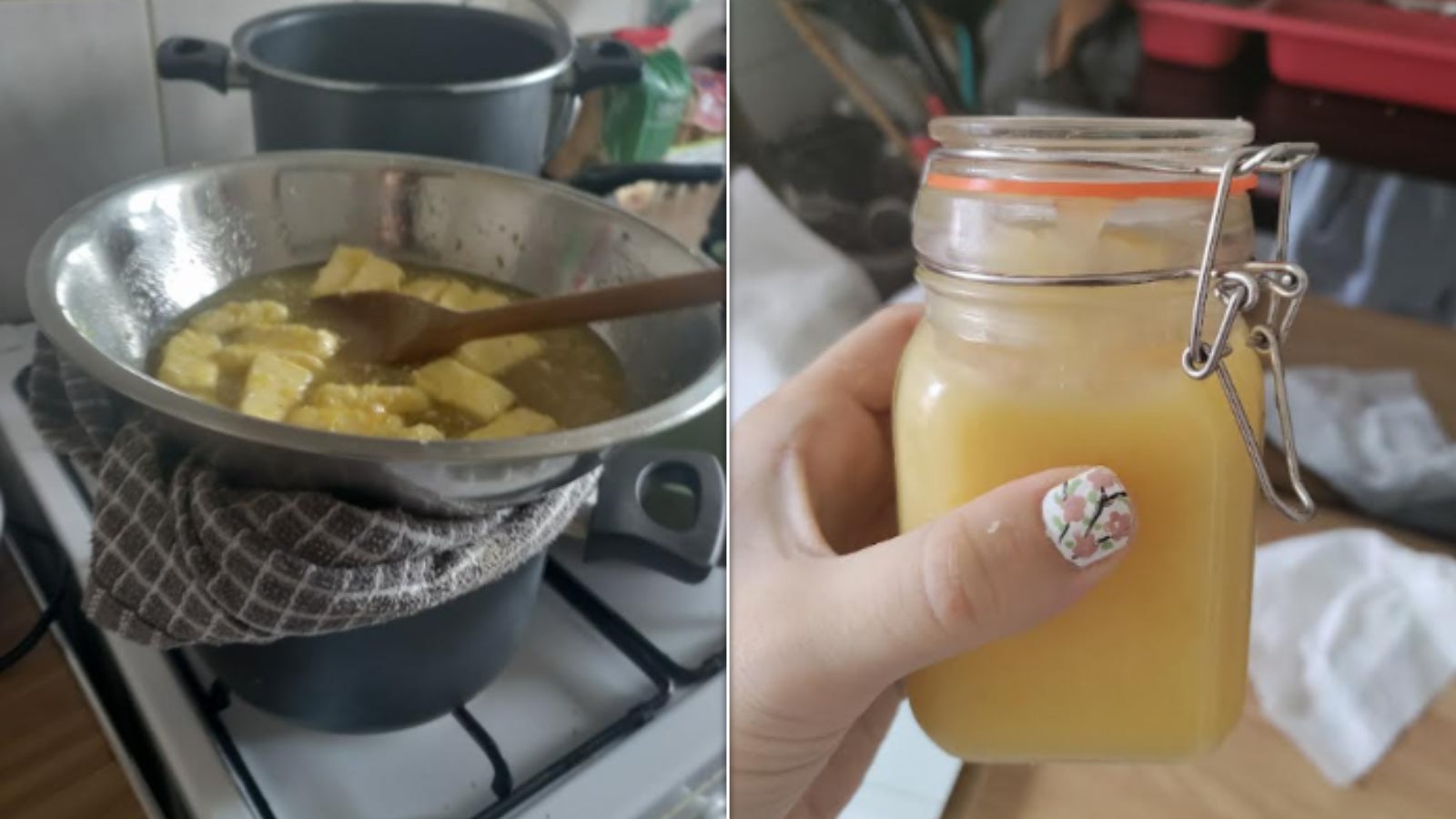
For that reason, I made my first batch in a heatproof bowl over a saucepan of boiling water (like the one you’d use for melting chocolate).

I recommend this if, like me, you’re using thin, cheap saucepans; if you have a heavy-bottomed saucepan and really good temperature control on your hob, though, a saucepan should be fine.

Once the mixture has thickened enough to coat the back of a wooden spoon, you’re ready to spoon the curd into a sterilised jar ― it should thicken in a couple of hours, and the curd will last for a month or so in the fridge.

I loved that Mary uses the full zest and curd of all lemons. It makes a brilliantly tangy curd, and also means your kitchen smells amazing for hours.

I also think it made the curd less creamy, which I personally prefer.

Lemon curd cooking on left: jarred on the right

Amy Glover / HuffPost UK

Lemon curd cooking on left: jarred on the right

Any other tips?

Yes! Mary’s advice for sterilising the jars accidentally ensures they’re capable of taking in the hot curd without breaking or cracking, too.

“To sterilise jars, wash the jars in very hot, soapy water or put through the hot cycle of a dishwasher,” she writes.

Then, “place the jars onto a baking tray and slide into an oven preheated to 160C/325F/Gas 3 for 10–15 minutes”.

I spooned my curd into the jars while they were still warm(ish) from the oven. That way, you run far less risk of a shattering disaster.

Share Button

I’m A Flight Attendant – This Is The Safest Place To Park Your Car In The Airport

Airport parking demand shifts hugely across the UK, Transport Network reports.

Fewer than 1% of travellers through Heathrow look for a parking spot, but 10% of those passing through Bristol Airport look out for one.

That’s partly because of local transport links, they explain. But no matter where you’ve parked your car while on holiday, you’ll want to know it’s safe.

In a YouTube Short, flight attendant Cierra Mistt shared that the most secure place to park your car may be in the spot you like least.

Where’s safest to park in an airport car park?

“If you want to make sure your vehicle is safe at the airport ― especially on those long trips ― park in either the top floor of the [multi-storey car park], or the very back of economy parking,” Mistt said.

Though those areas are far away from the airport and can seem “unguarded”, Cierra said she recommends them for good reason.

“This is actually the parking where all the employees of the airport, along with crew members that are going to be on trips, park,” she explained.

“Security is constantly monitoring that area to make sure that no one breaks into those cars, and the shuttles are over there more than any other place because they need to make sure that their employees get to work on time.”

Some airports have separate parking arrangements for their staff ― but you can usually look this up ahead of time.

<div class="js-react-hydrator" data-component-name="YouTube" data-component-id="7359" data-component-props="{"itemType":"video","index":14,"contentIndexByType":1,"contentListType":"embed","code":"

","type":"video","meta":{"author":"Cierra Mistt","author_url":"https://www.youtube.com/channel/UCUSiprPHb__2r3tb4kjSscw","cache_age":86400,"description":"Follow for more Flight tips, tricks, secrets, and hacks\n\nFOR EARLY AND EXCLUSIVE ACCESS: Link in bio","options":{"_cc_load_policy":{"label":"Closed captions","value":false},"_end":{"label":"End on","placeholder":"ex.: 11, 1m10s","value":""},"_start":{"label":"Start from","placeholder":"ex.: 11, 1m10s","value":""},"click_to_play":{"label":"Add your own player cover","value":false}},"provider_name":"YouTube","thumbnail_height":360,"thumbnail_url":"https://i.ytimg.com/vi/FyHHL3946HQ/hq2.jpg","thumbnail_width":480,"title":"travel hacks you NEED to know for your next flight ✈️","type":"video","url":"https://www.youtube.com/watch?v=FyHHL3946HQ","version":"1.0"},"flags":[],"enhancements":{},"fullBleed":false,"options":{"theme":"life","device":"desktop","editionInfo":{"id":"uk","name":"U.K.","link":"https://www.huffingtonpost.co.uk","locale":"en_GB"},"originalEdition":"uk","isMapi":false,"isAmp":false,"isAdsFree":false,"isVideoEntry":false,"isEntry":true,"isMt":false,"entryId":"67c87573e4b04fc1efc84923","entryPermalink":"https://www.huffingtonpost.co.uk/entry/safest-parking-spot-airport_uk_67c87573e4b04fc1efc84923","entryTagsList":"holidays,youtube,flying","sectionSlug":"lifestyle","deptSlug":null,"sectionRedirectUrl":null,"subcategories":"","isWide":false,"headerOverride":null,"noVideoAds":false,"disableFloat":false,"isNative":false,"commercialVideo":{"provider":"custom","site_and_category":"uk.lifestyle","package":null},"isHighline":false,"vidibleConfigValues":{"cid":"60afc140cf94592c45d7390c","disabledWithMapiEntries":false,"overrides":{"all":"60b8e525cdd90620331baaf4"},"whitelisted":["56c5f12ee4b03a39c93c9439","56c6056ee4b01f2b7e1b5f35","59bfee7f9e451049f87f550b","5acccbaac269d609ef44c529","570278d2e4b070ff77b98217","57027b4be4b070ff77b98d5c","56fe95c4e4b0041c4242016b","570279cfe4b06d08e3629954","5ba9e8821c2e65639162ccf1","5bcd9904821576674bc55ced","5d076ca127f25f504327c72e","5b35266b158f855373e28256","5ebac2e8abddfb04f877dff2","60b8e525cdd90620331baaf4","60b64354b171b7444beaff4d","60d0d8e09340d7032ad0fb1a","60d0d90f9340d7032ad0fbeb","60d0d9949340d7032ad0fed3","60d0d9f99340d7032ad10113","60d0daa69340d7032ad104cf","60d0de02b627221e9d819408"],"playlists":{"default":"57bc306888d2ff1a7f6b5579","news":"56c6dbcee4b04edee8beb49c","politics":"56c6dbcee4b04edee8beb49c","entertainment":"56c6e7f2e4b0983aa64c60fc","tech":"56c6f70ae4b043c5bdcaebf9","parents":"56cc65c2e4b0239099455b42","lifestyle":"56cc66a9e4b01f81ef94e98c"},"playerUpdates":{"56c6056ee4b01f2b7e1b5f35":"60b8e525cdd90620331baaf4","56c5f12ee4b03a39c93c9439":"60d0d8e09340d7032ad0fb1a","59bfee7f9e451049f87f550b":"60d0d90f9340d7032ad0fbeb","5acccbaac269d609ef44c529":"60d0d9949340d7032ad0fed3","5bcd9904821576674bc55ced":"60d0d9f99340d7032ad10113","5d076ca127f25f504327c72e":"60d0daa69340d7032ad104cf","5ebac2e8abddfb04f877dff2":"60d0de02b627221e9d819408"}},"connatixConfigValues":{"defaultPlayer":"8b034f64-513c-4987-b16f-42d6008f7feb","clickToPlayPlayer":"5a777b9b-81fe-41a6-8302-59e9953ee8a2","videoPagePlayer":"19654b65-409c-4b38-90db-80cbdea02cf4"},"topConnatixThumnbailSrc":"data:image/png;base64,iVBORw0KGgoAAAANSUhEUgAAAAEAAAABCAQAAAC1HAwCAAAAC0lEQVR42mNkYAAAAAYAAjCB0C8AAAAASUVORK5CYII=","customAmpComponents":[],"ampAssetsUrl":"https://amp.assets.huffpost.com","videoTraits":null,"positionInUnitCounts":{"buzz_head":{"count":0},"buzz_body":{"count":0},"buzz_bottom":{"count":0}},"positionInSubUnitCounts":{"article_body":{"count":8},"blog_summary":{"count":0},"before_you_go_content":{"count":0}},"connatixCountsHelper":{"count":0},"buzzfeedTracking":{"context_page_id":"67c87573e4b04fc1efc84923","context_page_type":"buzz","destination":"huffpost","mode":"desktop","page_edition":"en-uk"},"tags":[{"name":"Holidays","slug":"holidays","links":{"relativeLink":"news/holidays","permalink":"https://www.huffingtonpost.co.uk/news/holidays","mobileWebLink":"https://www.huffingtonpost.co.uk/news/holidays"},"url":"https://www.huffingtonpost.co.uk/news/holidays/"},{"name":"YouTube","slug":"youtube","links":{"relativeLink":"news/youtube","permalink":"https://www.huffingtonpost.co.uk/news/youtube","mobileWebLink":"https://www.huffingtonpost.co.uk/news/youtube"},"url":"https://www.huffingtonpost.co.uk/news/youtube/"},{"name":"flying","slug":"flying","links":{"relativeLink":"news/flying","permalink":"https://www.huffingtonpost.co.uk/news/flying","mobileWebLink":"https://www.huffingtonpost.co.uk/news/flying"},"url":"https://www.huffingtonpost.co.uk/news/flying/"}],"isLiveblogLive":null,"isLiveblog":false,"cetUnit":"buzz_body","bodyAds":["

\r\n\r\n HPGam.cmd.push(function(){\r\n\t\treturn HPGam.render(\"inline-1\", \"entry_paragraph_1\", false, false);\r\n });\r\n\r\n","

\r\n\r\n HPGam.cmd.push(function(){\r\n\t\treturn HPGam.render(\"inline\", \"entry_paragraph_2\", false, false);\r\n });\r\n\r\n","

\r\n\r\n HPGam.cmd.push(function(){\r\n\t\treturn HPGam.render(\"inline-2\", \"entry_paragraph_3\", false, false);\r\n });\r\n\r\n","

\r\n\r\n HPGam.cmd.push(function(){\r\n\t\treturn HPGam.render(\"inline-infinite\", \"repeating_dynamic_display\", false, false);\r\n });\r\n\r\n"],"adCount":0},"isCollectionEmbed":false}”>

What if I don’t want to go that far?

Airports claim your car will still have lots of protection, like CCTV, number plate recognition, and patrols.

Otherwise, the Met Police suggest following some basic steps will prevent break-ins, at the airport and elsewhere.

These include locking your car, shutting your windows and sunroof, securing your number plates with tamper-resistant screws, and taking out or hiding valuable items inside the vehicle.

And don’t even leave hints of pricey electronic goods, like sat nav mounts, on show, they add.

Share Button