My Children Are Autistic, Here’s How We Make Christmas Wonderfully Unique

The festive period can be overwhelming for lots of people, but for autistic children it can be a particularly fraught time of year.

The disruption to their routine, sensory overload, and overwhelming influx of new information can be stressful and sometimes even distressing, says Michelle Myers, who works for Great Minds Together, a charity supporting young people with special educational needs and disabilities (SEND).

Myers – who is an autistic woman and mum to autistic children – suggests all of this can add up to trigger episodes of increased levels of anxiety, fluctuation of needs and different behaviours as children process these changes.

“It can be a really difficult time,” she tells HuffPost UK, “but there are steps that parents can take to better support them and reduce the overall stress of the festive period.”

Here are her tips for navigating the festive period if your child is autistic or has additional needs.

Don’t be afraid to create new traditions

“Be unapologetically you and do what brings your family peace and joy this Christmas,” says Myers.

Whether it’s leaving presents unwrapped under the tree because your child has a sensory sensitivity to wrapping paper, or you let them eat their favourite pizza instead of Christmas dinner, her main piece of advice is to “do what works for you”.

“Create new traditions,” she suggests. “Neurodiverse families are wonderfully unique so it makes sense that our Christmas should be just as wonderfully unique as we are.”

Do plan ahead

Sticking to daily routines can be so important for autistic children (and adults!), so Myers advises keeping as many routines in place as possible over the festive period – and that includes Christmas Day.

“Some routines for autistic people are as essential to us as breathing,” she says, “so to have too many changes can really impact us.”

When things do have to change, it’s important to plan as far in advance so you can give your child as much warning as possible – “and don’t change too many things at once,” she adds.

Don’t say ‘yes’ to events you know will be stressful

It’s so important to advocate for the needs of your child – and that means saying no to events that you know will be stressful.

“Tell Aunty Irene that hugs are a no-go. Ask school for a timetable of events. You owe no explanations to anyone,” says Myers.

She says autistic people deserve to have their “often-hidden needs accepted and respected”, otherwise they can fall into the trap of feeling the pressure to conform, which can lead to masking, she adds, “which is never a good thing for anyone”.

Masking is where a person hides or disguises parts of their selves in order to fit in. According to the National Autistic Society, it might involve suppressing certain behaviours autistic people find soothing, or mimicking the behaviour of other people in order to get by in social situations.

Do use visual supports

Visual supports such as lists, calendars, text messages or even photos can help autistic people prepare for new experiences, suggests Myers. So don’t be afraid to roadmap what Christmas – and the following days – will entail.

“It helps us to process time, sequence activities and even reduces our anxiety,” she says.

Any kind of visual support you can provide will act as a sat nav to their day. This helps them see the steps they need to take, prevents them from getting lost, and maps out the time it will take (so they can see it will end eventually).

All of this can contribute to preventing them from getting overwhelmed.

Do remember to schedule time for them to recharge

“Imagine we all have a battery inside us. Some things we do drain our battery, and some things we do charge our battery. December brings with it lots of things that can quickly deplete autistic children’s batteries,” says Myers.

Whether it’s the carols, the flashing lights, the social interaction with family members you haven’t seen since this time last year.

“We need to remember that their little batteries may need more opportunities to charge at this time,” says Myers. So do schedule time for your family to rest amid the mayhem of the festive period – even on Christmas Day.

“Take a sensory bag, ear defenders, a dark den, their favourite snack or blanket, whatever works for them,” she adds.

Don’t be too hard on yourself

One thing it’s important for parents to remember is that it’s ok if things don’t turn out perfectly at Christmas. You’re doing the best you can.

Myers recalls how one year her Christmas tree collapsed and thousands of pine needles fell off it. “I was devastated,” she recalls. “I cried so much I convinced myself that Christmas was over.

“But then my son came bounding down the stairs and proceeded to swish through the dry dead pine needles like fallen autumn leaves – my tears turned to hysterical laughter streaming down my face.

“All was not lost, right there in that moment we found joy and laughter. We shared such a moment together in the chaos of my fallen tree that I realised that for us, Christmas was always going to look a bit different to everyone else’s – and that was OK.

“In fact, it was more than ok, it was amazing.”

For more information on supporting children with SEND including informative blogs and podcasts visit www.greatmindstogether.co.uk.

Share Button

Time Flies By As We Get Older. This Is Why It Feels That Way

For many people, 2022 went by in a blink – doesn’t it feel like it was just January? But for others, especially children, last year’s holidays may seem like eons ago.

There’s a reason why you may feel like the years moved slowly when you were a kid, but zoom by now. Experts say our perception of time greatly changes as we age, which makes certain periods feel like they go by quickly.

“Our perception of days, weeks, years and that kind of time seems to be especially influenced by our perspective: Are we in the moment experiencing it, or are we looking backward on time?” says Cindy Lustig, a professor of psychology at the University of Michigan.

She added that the perception of time is also influenced by memory and how much you’ve experienced. For an eigh-year-old, a week is a big portion of their life. For an 80-year-old, a week is a much smaller portion of their life, which contributes to the feeling that it went by quickly.

Looking back on time plays into this feeling of acceleration

A day in the life of a retired 80-year-old may feel like it’s going by more slowly than that of an eight-year-old who is busy at school. However, when both people look back on a month or a year, that period of time will seem like it went by faster to the older person.

This is for a number of reasons. For the 80-year-old, their life probably doesn’t look too different than it did when they were 78 or 79, “so, in that case, they’re looking back on fewer events,” Lustig says. “When you’re looking back, the less rich your representation is, the more it’s going to seem like the time went by quickly.”

In other words, our brains lump time together when the days or weeks are similar. So for an 80-year-old who largely does the same thing every day, the year is going to blend together in their mind and feel like it went by quickly.

The new and exciting things in a day are what make the days and months feel different, and thus set them apart in our minds.

As you age, your perception of time changes, which is why years may feel like they fly by.

Halfpoint Images via Getty Images

As you age, your perception of time changes, which is why years may feel like they fly by.

Changes to your routine can also affect how fast the years seem to go by

“Our brains are designed to record change,” says Adrian Bejan, a professor of mechanical engineering at Duke University and the author of the recent book Time And Beauty: Why Time Flies And Beauty Never Dies.

The many experiences young children have in a day (such as learning new things at school, going to ballet class or visiting a new friend’s house) contribute to the notion that time is more plentiful and more activities can fit into that time. Therefore, when looking back, time may feel slower.

This can apply to adults, too. When we look back on a time period that was filled with lots of new experiences, “we see [a] large expense of events and memories, and that makes it seem like time stretches out … and it feels very long,” Lustig says. If you’re not introducing new patterns into your life, time can feel like it’s going by much quicker overall.

Some experts think that how our brain absorbs images impacts our perception of time

How we process what we see can also influence how we view time, Bejan says. Our brains are trained to receive many images when we are infants. Because we’re absorbing so many new images as kids, it may feel like months and years are longer.

As adults, “the brain receives fewer images than it was trained to receive when young,” Bejan says. Therefore, we feel like time went by more quickly. In other words, there are physiological factors at play that influence our perception of time ― namely, the older we get, the faster it feels.

Trying out new things can help it feel like time went by more slowly.

Maskot via Getty Images

Trying out new things can help it feel like time went by more slowly.

While you can’t slow time, you can do things to feel like it’s moving a little slower.

Bejan says many older people ask him how they can slow down time, “because everybody wants to live longer [and has] the urge to do more and better things with the time that is available.”

He said one way to do this is to experience things that are new and out of your usual regimen.

This could mean picking up a childhood hobby (like dancing or violin), taking an overnight trip to a city you’ve never visited or signing up for a cooking class. Learning new things is another good way to make your time feel longer when you look back on your life, he said.

Bejan stresses the adage “variety is the spice of life”: you should get out of your routine and take advantage of the time you have, which will only help make you feel like your year had more time to fill, he says.

Living a routine-only life makes the year fly really fast, he adds.

Lustig notes that being fully engaged and “in the moment” can make those moments seem to last longer. In fact, laboratory studies show that mindfulness exercises can stretch our perception of time, she says. So don’t try to focus on multiple tasks at once. Instead, just focus on the experience at hand.

“None of us know how much time we have, but, interestingly, we do actually have a lot of control over how we experience that time,” Lustig says. “So I encourage everybody to make the most of the time that you’ve got.”

Share Button

How To Keep Perishable Food Fresh For As Long As Possible

With food prices skyrocketing and the very food-centric festive season upon us, it makes sense for budget-minded home cooks and shoppers to find ways to get the most mileage out of their weekly grocery hauls.

While shelf-stable groceries (like canned goods) are designed for longevity, fresh items like fruits, vegetables, meats and dairy products have an annoying tendency to spoil before they’re used, which can make it difficult to justify spending money on these ingredients (in spite of their health benefits and superior taste).

But with a basic understanding of how produce, dairy products and meat spoil, and a few simple storage safeguards, you can prolong the life of your perishable groceries and keep these nutritious, hearty and flavourful ingredients in your kitchen rotation.

Whenever possible, buy locally grown fruits and veg

This isn’t just for clout. While farmer’s markets and small food shops with direct connections to local farms often charge higher prices for produce than supermarkets, locally grown fruits and veggies stay fresh longer than imported versions, which can help to defend their prices.

“Shopping as locally as possible will help prolong freshness,” food scientist, recipe developer and cookbook author Tiffany Swan explains. “When your produce was harvested the day prior and you are buying it at a farmer’s market or food co-op, you know that it will last longer than food that has been in ships, trucks and distribution centres, since a good portion of the viable shelf life has been spent in getting the produce to you.”

Make sure your fridge is set to the proper temperature

When it comes to keeping perishable groceries fresh, the fridge is your most important tool. Make sure your fridge is set to a level that meets food safety standards, chef, educator and recipe developer Sally Cameron explained.

Food safety rules say that’s between 1.5 and 4.5°C, Cameron says. “If your refrigerator does not have a built-in digital readout, buy an inexpensive refrigerator [thermometer] to test it.”

And keep in mind that refrigerator door shelves often keep foods warmer than the rest of the fridge, since they tend not to be as well insulated.

Some produce is better stored at room temperature

While refrigerating fruits and vegetables will extend their freshness, certain produce items prefer to be stored at room temperature. (You should know by now that you should never refrigerate a tomato.)

A slightly warmer storage temperature keeps some fruits and veggies more flavourful and better-textured. Also, because refrigeration slows the process of decay, it helps to consider which fruits and vegetables start to break down on a cellular level faster than others.

Savannah Bradenfood, a scientist with Apeel, gives a shout-out to citrus fruits like oranges, limes and lemons as examples of those that take longer to rot.

“Fresh lemons, for example, can be stored on your counter for many weeks before [the decomposition] process starts to happen,” Braden explains.

In the case of starchy vegetables like potatoes, a cool (but not cold!) storage space keeps them fresh without compromising their texture.

“In terms of where to store, potatoes prefer to be cool versus cold, and refrigerators are cold,” Cameron says. “A cool pantry prolongs their life, as the starches convert to sugar more slowly, extending their life” for weeks or months. Refrigeration can make potatoes “last for a month or longer,” she adds, but the flavour and mouthfeel might not be worth that extended lifespan.

Give leafy greens the chance to dry before storing them in the fridge

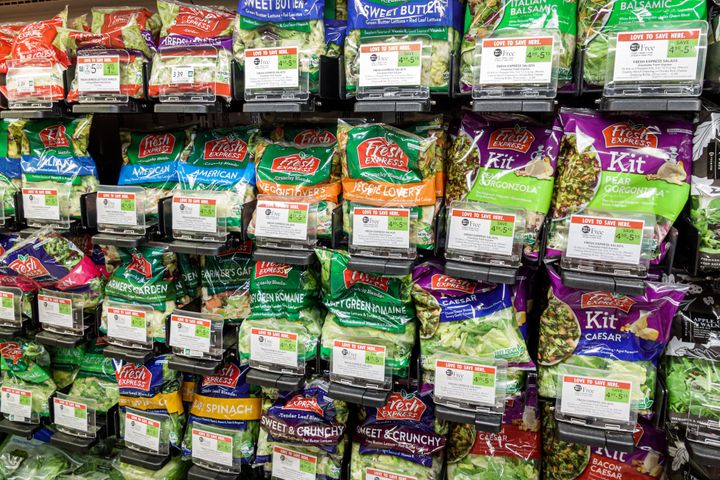
Lettuce, kale and other salad greens are notorious for spoiling quickly, and a lot of that has to do with their somewhat contradictory reactions to moisture. “Grocery stores are notorious for ‘misting’ their produce with automatic water sprayers. The idea is to make the food look fresh and appetising; however, it actually has the opposite effect and causes produce to degrade much faster,” explains Lisa Lotts, the recipe developer behind Garlic & Zest.

In order to remove the excess water from your greens, Lotts recommends “laying leafy greens like kale and lettuce out to dry for about 15 minutes and then wrapping them lightly in a paper towel before putting them back in the plastic bag. The paper towel will absorb excess moisture so the produce doesn’t go bad prematurely.”

Bagged salad may be convenient, but it won't last as long as a fresh head of lettuce that you wash and chop yourself.

Jeff Greenberg via Getty Images

Bagged salad may be convenient, but it won’t last as long as a fresh head of lettuce that you wash and chop yourself.

Droplets of water on leafy greens can cause premature spoiling (which is why it’s also advisable to wait to rinse your greens until right before you plan to use them).

But here’s the contradictory part: leafy greens actually shouldn’t be stored in a low-humidity refrigerator drawer, as a lack of moisture in the air will speed the wilting process. Instead, “the ideal setting for leafy greens is a higher-humidity environment,” Lotts says. Use the controls on your fridge to set a crisper drawer to higher humidity, and that will serve as an excellent storage spot for lettuce, kale, arugula, and fresh herbs to retain their crispness and flavour.

Bagged salads spoil more quickly than full heads of greens

Speaking of salad greens, it’s often appealing to save time by picking up a bag of pre-rinsed and chopped greens. But if you want produce with longer-term freshness, bagged salads aren’t the way to go.

“It’s more work to buy a head of lettuce, wash it and dry it yourself,” Cameron notes. But this method will give you lettuce that often lasts longer and stays fresher.

Store fresh herbs the same way you’d store freshly cut flowers

Fresh herbs offer home cooks an easy way to brighten up a dish, but opening up a crisper drawer only to find shriveled, wilted, browned leaves of basil, rosemary or thyme is a sadly common disappointment.

Lotts has an easy solution to the rotten herb problem. “For fresh herbs, snip the ends of the herbs with kitchen scissors and put them in a glass jar filled halfway with fresh water,” she says. “Then cover the herbs with a plastic vegetable bag from the grocery store and keep the fresh herbs on a shelf in the refrigerator. They will last for a week or more when you use this method… it’s like keeping a bouquet of flowers alive.”

Bananas produce ethylene, which can make other product ripen faster.

Elena Popova via Getty Images

Bananas produce ethylene, which can make other product ripen faster.

Keep ethylene-producing items separate from ethylene-sensitive produce

There’s a great reason most refrigerators include more than one crisper drawer: Different types of produce have different storage needs, and certain fruits and vegetables can actively derail the freshness of their crisper-drawer neighbors. Specifically, you want to be wary of fruits and veggies that produce ethylene, an organic chemical that accelerates the ripening process.

Common ethylene-producing foods include apples, apricots, avocados, bananas (ripe), blueberries, cantaloupe, cranberries, figs, green onions, grapes, kiwi, mangos, nectarines, papayas, peaches, pears, plums, potatoes and tomatoes, Cameron said.

When you store ethylene producers alongside non-ethylene-producing fruits and veggies that are particularly sensitive to ethylene (like leafy greens, berries, asparagus and carrots), the ethylene will cause the sensitive produce to spoil more quickly. It’s best to keep ethylene producers and non-ethylene producers in separate crisper drawers.

Store dairy and meat products in the coldest part of your fridge

Because meat and dairy products count among the priciest items on any grocery list, there’s a lot of incentive to prevent these foods from spoiling before their time. When it comes to keeping dairy products and meat fresh in the fridge, it’s all a matter of location, location, location.

“Meat and dairy are pretty perishable. The best way to prolong the storage of these items is to store them in the coldest part of your fridge. Don’t put that milk in the door!” says Tiffany Swan, a professional chef and the food scientist behind Salt & Sage.

Swan also urges you to keep these foods in their original packaging. Introducing air and potential airborne microbes when transferring to another container is likely to shorten the shelf life. Also, she says, retail packaging is usually tested to make sure it maintains freshness.

Share Button

Ambulance strike causing deep worry, say NHS bosses

Major disruption is likely as paramedics, call handlers and emergency care assistants walk out.

Share Button

Nurses’ strike: ‘If we have to, we’ll continue to strike’

The PM insists he won’t back down against striking workers, as nurses demand a 19% pay rise.

Share Button

Using deep learning to monitor India’s disappearing forest cover

Using satellite monitoring data, researchers have developed a deep learning algorithm that could provide real-time monthly land use and land cover maps for parts of India.

One of the 10 most forest-rich countries in the world, about 80.9 million hectares of trees cover India — about 25% of the nation — but this is a significant decline from years past. Between the 1890s and the 1990s, a combination of rapid economic development and overexploitation of local resources led to India losing nearly 80% of its native forest area. Now, as India’s forests still continue to disappear, researchers are focused on helping preserve what remains.

“Our work was done in an effort to help India’s government and industries improve the country’s attempts at forest sustainability,” said Ying Zuo, lead author of the project and a graduate student in earth sciences at The Ohio State University.

The land use monitoring system was trained using data provided by Norway’s International Climate and Forests Initiative (NICFI), an enterprise of the Norwegian government that aims to reduce the destruction of tropical forests, in part by providing high-resolution images of the world’s tropics. The product is generated using images from PlanetScope, a constellation of satellites that takes daily images of the entire globe.

By combining the NICFI products’ data with a global land cover map produced by Tsinghua University, their deep learning model was able to acquire a more detailed type of base map of the area.

“In an effort to combine two datasets into the same system, we resampled them into the same spatial resolution and aligned each pixel to create an image-labeled paired training dataset,” said Zuo. “The process helps us to assimilate the two datasets so they can be used to train our deep learning model.” This essentially merges thousands of small pictures into one larger base map.

After training their deep learning model on these new satellite images, the team was able to process 10 base maps of the area, ranging from January to October 2022.

The research poster was presented last week at the annual meeting of the American Geophysical Union. During her presentation, Zuo said that using these maps, the team was able to detect seasonal shifts across India, such as changes to barren land, how crop land was affected by monsoons during the rainy season, and the distribution of forests in mountainous regions.

One conclusion from the study was that it is vital for ecologists to more closely study the seasonal impact of monsoons on India’s forest cover. Understanding these seasonal changes can help scientists understand the effects of climate change on forests.

“As the average temperature of our Earth increases, natural hazards will become a lot more frequent, so having these maps at our disposal benefits everyone’s understanding of how this problem affects life on Earth,” she said.

Additionally, if the team can expand the timespan of these base maps over several years instead of several months, Zuo said better results could help scientists study other annual changes around the globe, such as floods.

“The characteristics of local forests and their surrounding habitats might likely be different in other regions,” said Zuo. “But with the help of more detailed datasets, our work could easily be used in areas of the world where detecting and alerting the public to forest degradation and its side effects need to become a priority.”

Co-authors of the poster include C.K Shum, Rongjun Qin, Yuanyuan Jia, Guixiang Zhang and Shengxi Gui, all researchers at Ohio State. This work was supported by the USAID Forest Sustainability Project.

Story Source:

Materials provided by Ohio State University. Original written by Tatyana Woodall. Note: Content may be edited for style and length.

Share Button

Biodegradable medical gowns produce harmful emissions

Biodegradable medical gowns, designed to be greener than conventional counterparts, actually produce harmful greenhouse gases, according to new research published Dec. 20 in the Journal of Cleaner Production.

The use of disposable plasticized medical gowns — both conventional and biodegradable — has surged since the onset of the COVID-19 pandemic. Landfills now brim with them.

Because the biodegradable version decomposes faster than conventional gowns, popular wisdom held that it offers a greener option by less space use and chronic emissions in landfills.

That wisdom may be wrong.

“There’s no magic bullet to this problem,” said Fengqi You, professor in energy systems engineering at Cornell University.

“Plasticized conventional medical gowns take many years to break down and the biodegradable gowns degrade much faster, but they produce gas emissions faster like added methane and carbon dioxide than regular ones in a landfill,” said You, who is a senior faculty fellow in the Cornell Atkinson Center for Sustainability. “Maybe the conventional gowns is not so bad.”

According to this research led by Cornell doctoral student Xiang Zhao, biodegradable gown production poses an additional 11% higher ecotoxicity rate than conventional alternatives.

Adopting landfill gas capture and utilization processes in biodegradable gown sanitary landfills can reduce 9.79% of greenhouse emissions, life-cycle landfill use by nearly 49%, and save at least 10% fossil resources by employing onsite power co-generation, the researchers found.

Conventional gowns are environmentally and socially sustainable because they can pose 14% less toxicity to humans, cause 10% fewer greenhouse gas emissions, and are nearly 10% less toxic to freshwater when compared to biodegradable gowns in landfills with extra gas emissions.

Improving the gas capture efficiency above 85% can make biodegradable gowns more environmentally sustainable than conventional gowns.

“It’s nice to break down the plastic into smaller things,” Zhao said. “But those small things eventually decompose into gas and if we don’t capture them, they become greenhouse gases that go into the air.”

Funding for this research was provided by the Cornell Center for Materials Research (CCMR) with funding from the NSF and New York State Empire State Development’s Division of Science, Technology, and Innovation.

Story Source:

Materials provided by Cornell University. Original written by Blaine Friedlander, courtesy of the Cornell Chronicle. Note: Content may be edited for style and length.

Share Button

See no evil: People find good in villains

Whether it’s on television or in a movie, we love the villain.

No matter how egotistical, power hungry or greedy the person is, many of us are still attracted to their dark side — in part because we suspect some may have a redeeming quality. In fact, according to a new University of Michigan study, both adults and children more often reported that villains were inwardly good than that heroes were inwardly bad.

“In other words, people believe there is a mismatch between a villain’s outward behaviors and their inner, true self, and this is a bigger gap for villains than for heroes,” said Valerie Umscheid, U-M psychology doctoral student and the study’s lead author.

Inside, villains are a little less evil than they outwardly seem while heroes are fully good guys inside and out.

Umscheid and colleagues conducted three studies with 434 children (ages 4-12) and 277 adults to determine how individuals make sense of antisocial acts committed by evil-doers. They focused on participants’ judgments of both familiar and novel fictional villains and heroes, such as Disney’s Ursula from “The Little Mermaid” and Pixar’s Woody from “Toy Story.”

Study 1 established that children viewed villains’ actions and emotions as overwhelmingly negative. This suggests that children’s well-documented tendency to judge people as good does not prevent their appreciation of extreme forms of villainy.

Studies 2 and 3 assessed children’s and adults’ beliefs regarding heroes’ and villains’ moral character and true selves, using an array of converging evidence, including how a character felt inside, whether a character’s actions reflected their true self and whether a character’s true self could change over time.

Across these measures, the research indicated that both children and adults consistently evaluated villains’ true selves to be overwhelmingly evil and much more negative than heroes’. At the same time, researchers also detected an asymmetry in the judgments, wherein villains were more likely than heroes to have a true self that differed from their outward behavior.

Both children and adults believed characters like Ursula had some inner goodness, despite the bad/immoral actions they regularly engage in, Umscheid said.

The study, published in Cognition, was co-authored by Craig Smith, senior associate librarian, University Library; Felix Warneken and Susan Gelman, both U-M professors of psychology; and Henry Wellman, U-M professor emeritus of psychology.

Story Source:

Materials provided by University of Michigan. Note: Content may be edited for style and length.

Share Button

Strike: What will ambulances respond to on Wednesday?

What you need to know about emergency care during the ambulance strike.

Share Button

Watch: On the picket line with nurses across the UK

Nurses in Northern Ireland, Wales and England stage industrial action, calling for fair pay.

Share Button