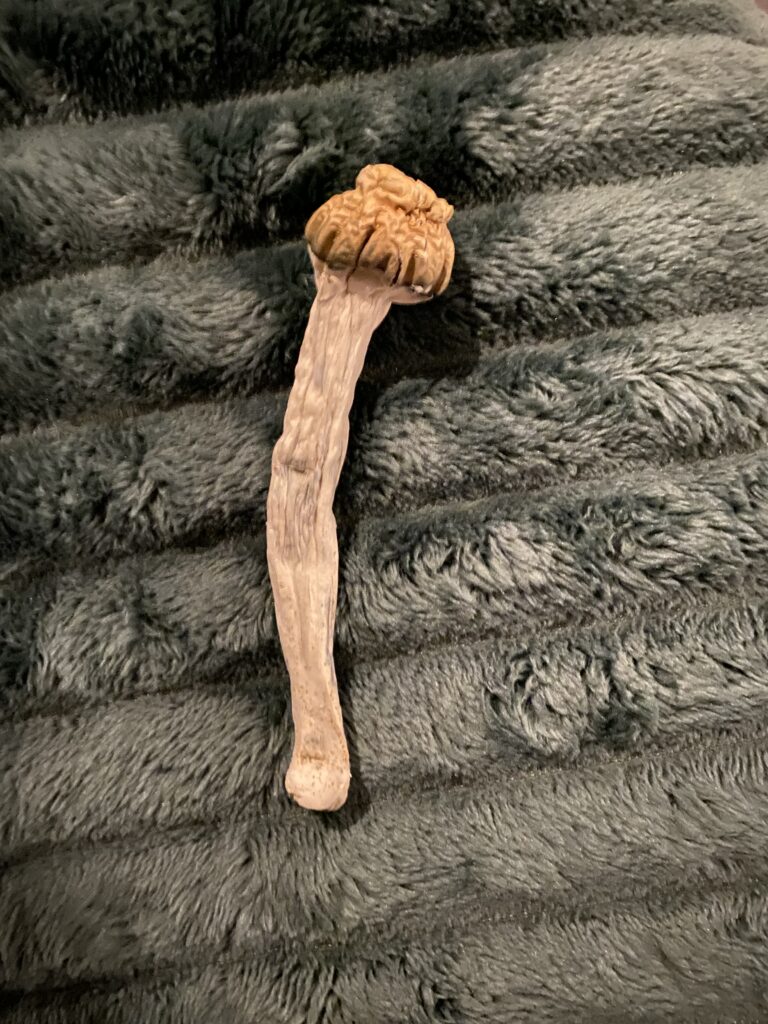
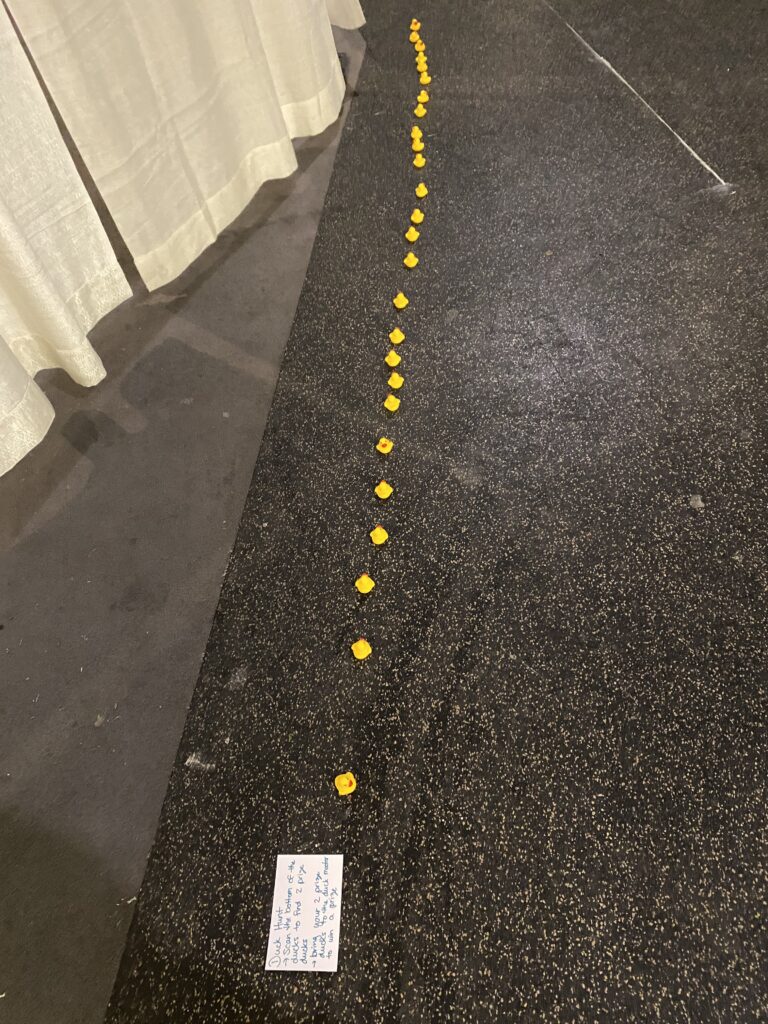
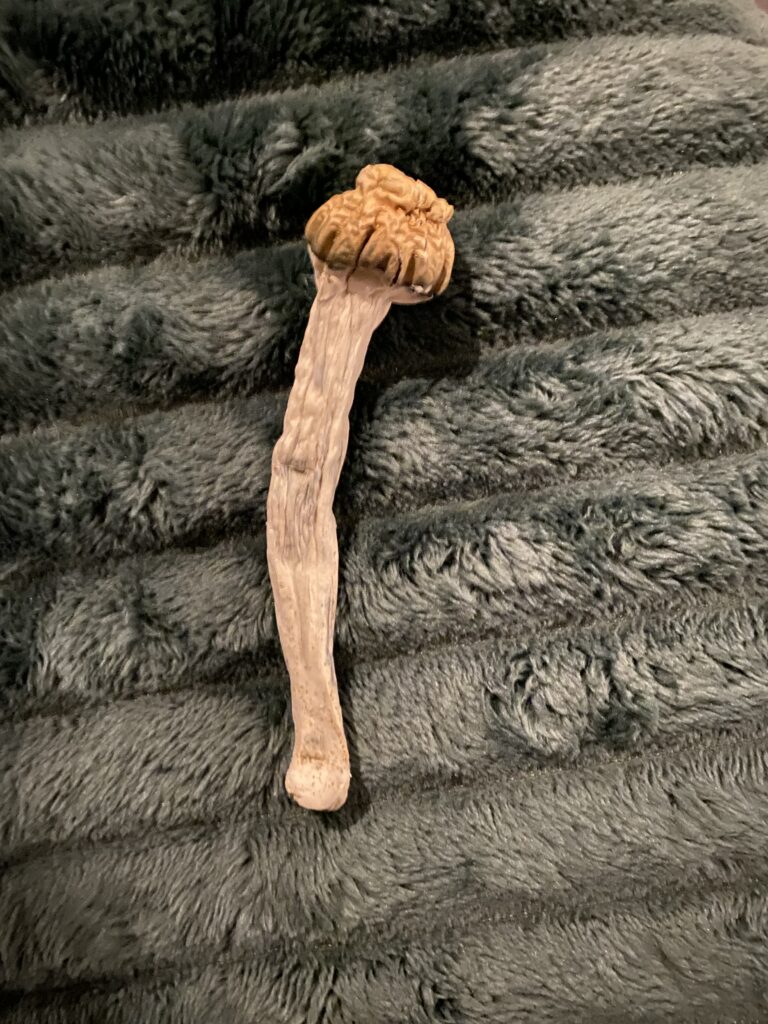
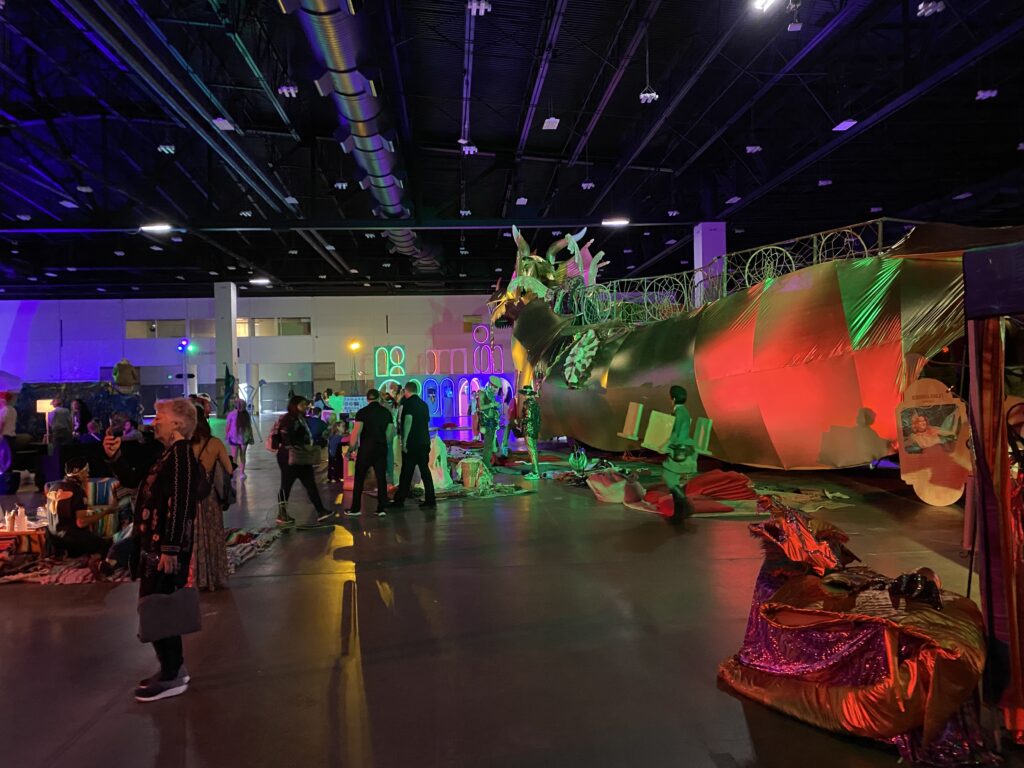
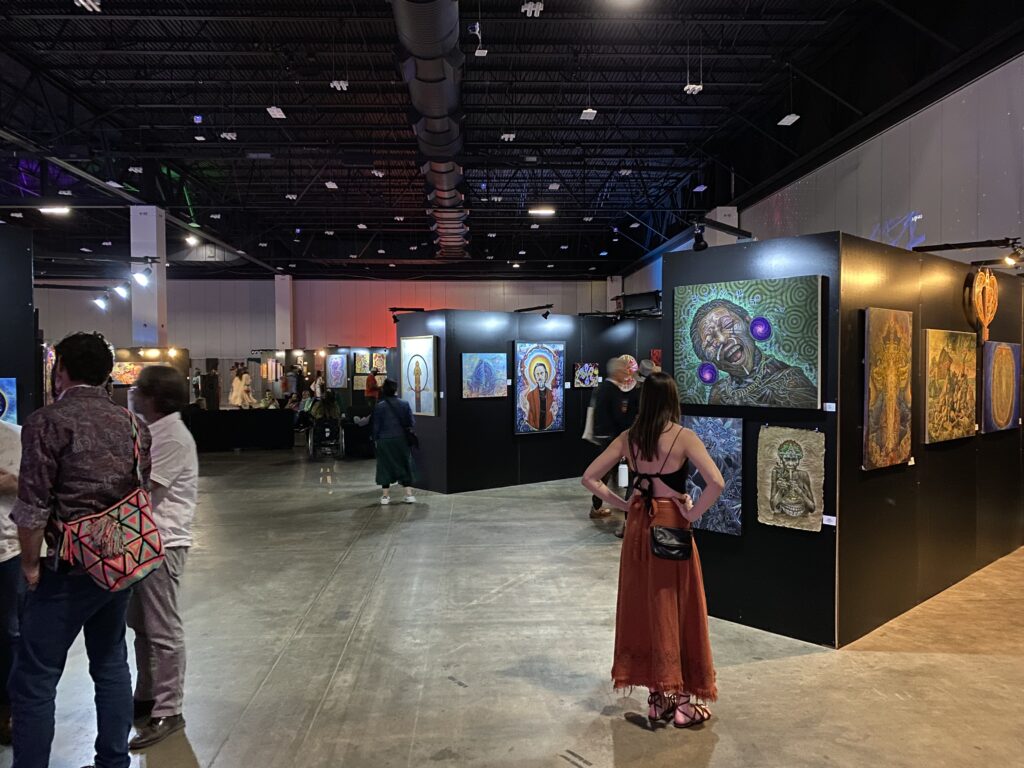
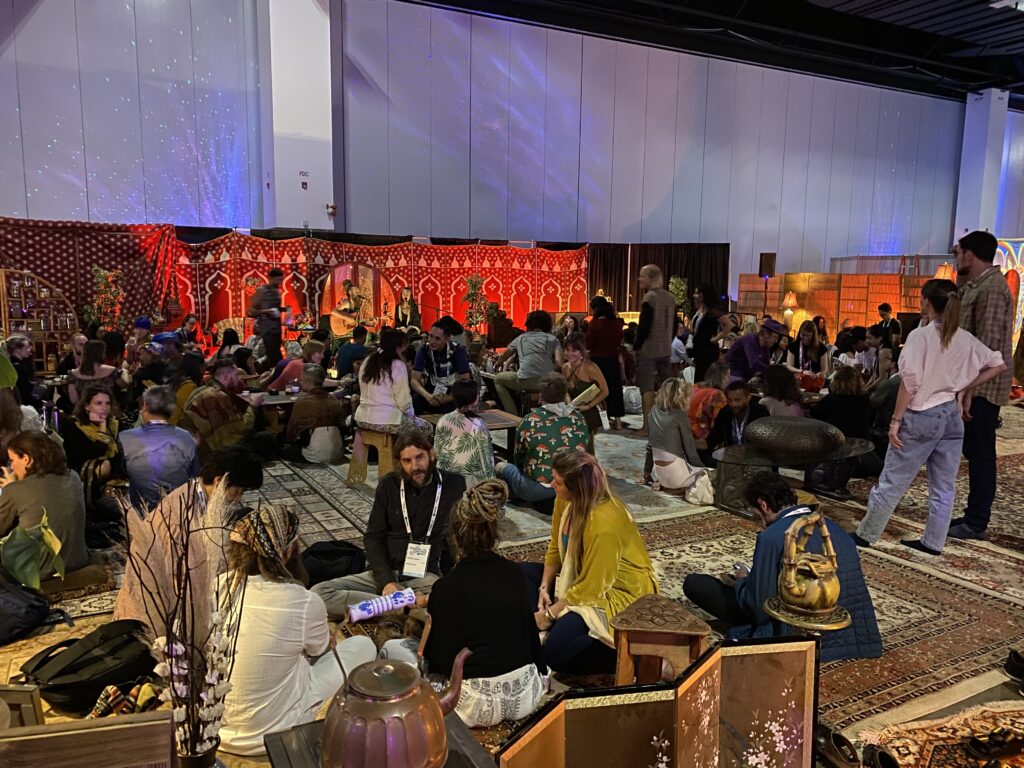
At the end of our Denver trip for the Psychedelic Science 2023 conference (see my earlier full conference review if that interests you), I played a game at one of the afterparties and won a magic mushroom (shown below). It weighed about 3 grams. Magic mushrooms were decriminalized in Colorado last year, including for personal use and gifting but not for selling.
Saturday Night
The afterparty only went till 1am, and it wasn’t the right setting for a deep mushroom journey. I thought about my intention for this little guy and decided that for my first experience, I just wanted to energetically shake hands with the mushroom space and not do anything too deep.
I’ve had psilocybin before during a journey last November with a group of friends, but it was in the form of chocolates mixed with ayahuasca, and we took a couple other substances as well for a layered effect, run by an experienced facilitator. So up to this point I hadn’t consumed magic mushrooms separately. I know I’ll have more opportunities to explore mushrooms, so I wanted to lean into it gently – not like my first psychedelic experience of doing ayahuasca ceremonies for four back-to-back nights in Costa Rica in 2019.
We only had two more nights in Denver before returning to Vegas, so I wanted to eat about half of the dried shroom one night and half the second night, as a way of leaning into it. I wanted to have a positive experience even if it would be fairly mild given the low dosage. I had done my homework first, so I had a relatively good sense of what range of effects to expect, or so I thought.
I decided to eat about a quarter of it first, roughly 0.75g, see if I noticed anything after an hour, and then have more if all seemed good, while still at the afterparty. I was surprised that it tasted good, almost like popcorn but with the texture of a dry cracker. I’d heard that some people didn’t like the taste of magic mushrooms, but that may depend on the variety. This one was pleasant enough that my taste buds would have had no complaints about eating more of them.
During that first hour I only noticed some mild giddiness, nothing special. So I ate another 0.75g. These weights are mainly guesses, but after eating the first piece, we found a scale at the afterparty, and I was able to weigh the remainder, which helped me estimate that the whole shroom must have been about 3g total.
In case you’re wondering, I did invite Rachelle to share it with me, but she passed. It wouldn’t have been a problem to procure plenty more shrooms at this party since there was a jar on a table filled with dried shrooms as well as magic mushroom chocolates (including some labeled vegan), which seemed to be free for the taking. Playing the game with the mushroom prize wasn’t really necessary – I just did it for fun. If I wanted a more intense experience by eating more shrooms, that would have been easily attained. However, I felt that splitting those 3g across two nights would be just perfect for the kind of intro to mushroom space that I was looking for, especially while traveling.
Shortly after I ate the second mushroom piece, we walked back to our hotel, which took about 30 minutes. I still didn’t notice a very strong effect other than feeling a bit happier. Rachelle said she could see a difference when she looked into my eyes though. I found it amusing when she kept staring at me to check. I had no trouble with balance or coordination while walking back.
We arrived at the hotel without incident, and now it was close to two hours since I ate the first piece. I could feel there was the potential to have a deeper experience but that I’d have to meet it halfway. So I lied down on the couch, put on some music with my headphones, closed my eyes, and went into a meditative space to see what I could experience internally.
That was delightful all throughout. I enjoyed some lovely psychedelic visuals and sensations, not super intense but still beautiful. They were similar to the ayahuasca visuals but gentler, more electric looking, and more peaceful. I felt this gentle feminine energy communicating with me in waves, with rising intensity followed by periods of lower intensity, each cycle lasting a few minutes.
I felt like the mushroom energy was mapping out how to communicate and connect with me inside my mind. There was a consciousness to it, which grew a bit stronger as we synched up. I found it very easy to relax and surrender to the flow of the experience.
It peaked around 1:30 AM, about three hours after I ate the first piece, and I eventually went to bed at 3:15. I slept really well and had some nice visuals extending into my dreams too.
I got what I wanted from this first experience – a gentle greeting and a mild but interesting inner journey. I would have appreciated a bit more intensity, but this was a really nice, low-risk beginner experience.
Sunday Night
The next night we didn’t have any parties to attend, so I opted to have the second experience in the hotel room all the way through. We had a suite, so Rachelle could go to bed if she wanted without my keeping her up. I also started earlier this time (around 9pm).
I decided to do something different this time and opted to make mushroom tea, using the remaining 1.5g of dried mushroom. I know that consuming it this way is supposed to have a faster onset and be a bit more intense. I didn’t know how much more intense though, and 1.5g is still a relatively modest amount.
I used my fingers to crumble the mushroom into small pieces in a cup. Then I used the hotel coffee maker to make some hot water. For extra flavor, I added a chamomile teabag (no caffeine). I didn’t have any lemon, so I couldn’t use the Lemon Tek method. The high acidity of lemon (or lime) juice breaks psilocybin into the psychoactive psilocin faster than stomach acid, which makes for a more intense journey.
I let the shroom tea steep for 15 minutes while journaling about my intentions for the experience. This time I wanted to go deeper and focus on some questions. After clarifying my intentions, I drank the tea, including swallowing all of the little mushroom bits. I figured that with only 1.5g, I might as well squeeze as much out of it as possible. Our flight home wasn’t till the afternoon the next day, so I had plenty of time.
I lied down on the couch with my headphones, listening to some relaxing music. I started with native flutes, and I soon realized I didn’t like the ones that had certain nature sounds like crickets or birds. For some reasons those sounds felt too creepy to me. I flipped over to a relaxing spa music playlist, which felt like a good vibe to begin with.
After the first 15 minutes, I noticed some mild tingling in my arms, and they felt a bit lighter, but the sensation was pretty mild. During the next 15 minutes, however, the intensity ramped up fast. I sat up, and it looked the floor was rolling in waves. I wasn’t feeling good in my body at all. It felt like being deeply dizzy but without the spinning sensation, like my energy matrix was destabilizing and being pulled in chaotic directions. Is there such as thing as spirit-level dizziness? That’s sort of how it felt.
The intensity of those sensations continued to climb during the next few minutes, from mildly nauseating to that “Oh I’m definitely going to throw up” feeling. Even while I’m typing this now, I feel like my body is relieving those sensations at lower intensity.
I got off the couch opened the bedroom door, saying to Rachelle something like, “I’m probably going to be throwing up in the bathroom now, but don’t worry. I’ll be okay.” – partly to reassure myself as well. Internally I was also wondering how long these unpleasant sensations would last. I wasn’t looking forward to hours more of this.
As I flung myself to the bathroom floor in front of the toilet, I felt super nauseous but also confused. I sensed something wanted to come out, but it also felt omnidirectional, like I needed to throw up in all spherical directions at once, while my body was trying to translate that to mean up, down, or both. At the conference I had just recently learned the term “double platinum” and was hoping I wasn’t about to have that experience.
Then in a really quick shift, I suddenly sensed that this confused swirling of energy had made a decision and that it was definitely going down, not up. I shifted onto the toilet seat and purged quickly, wondering if I’d soon have to flip back around. But no. That feeling of disorientation and nausea abated even faster than the onset. Within a few minutes, I no longer felt nauseous and was actually feeling pretty good, almost euphoric. I almost couldn’t believe how quickly the nausea left me.
The speed of these shifts surprised me, but I was glad to be feeling better physically. This was still well within the first hour, so I knew there was plenty more to experience.
I asked Rachelle to sit with me on the couch for a while. I still felt a bit disoriented and wanted her energy there with me, figuring she’d be a comforting presence. I sensed that if I tried to lie down and listen to music again, I’d feel too nauseous, so I wanted to stay upright for a while.
She was happy to sit with me, which led to a very interesting experience. We sat closely on the couch next to each other, arm in arm. When I had my eyes open, the carpet still looked a bit wavy, and I began noticing a facial pattern. It wasn’t really a face – the carpet was very splotchy looking – but I noted that my mind was pattern-matching different elements to eyes, a nose, a mouth, etc. Fortunately that wasn’t too disorienting. I had the thought that my brain’s pattern-matching circuitry was becoming more flexible.
When I closed my eyes, I saw beautiful, electric, colorful, animated visuals – about 3x brighter and more intense than the night before. I preferred keeping my eyes closed since it was more captivating to observe the visuals than to look at the slightly wobbling hotel room.
The most fascinating part of this experience was what I felt internally while in contact with Rachelle. I had figured she might help to keep me feeling physically grounded, but it was almost the opposite of that. While we were touching, the sensation of touching and the sense of having a body faded away. I could still access the connection to my body but only while focusing on it directly and only with enough intensity to remind me that my body was still present on the couch. It’s similar to sensations I’ve had during deep meditation, where my body is so relaxed that I lose the physical sensations of having a body. but I can still reach back and wiggle a finger if I want to reconnect with it.
As with the deep meditation experience, I felt very safe. My focus shifted to a sensation of being a purer form of energy. Instead of sensing Rachelle as a separate presence there, there was no distinction between her energy and mine. We were melded together in a single energy form.
It wasn’t like being connected to some kind of source energy per se. It was more personal than that. I had the recognition that my energy and Rachelle’s energy were the same energy and that we were always sharing it. We were really the same being at an energetic level.
What’s also interesting is that Rachelle was focused on sending me love energy while sitting with me. Afterwards that made me wonder what might have been different if she had held different intentions – that’s something I want to explore more in the months ahead.
I kept my eyes closed most of the time and also talked with Rachelle about what I was experiencing. Even during the physically disorienting onset period, I didn’t feel anxious or fearful. I checked my pulse on my Apple Watch numerous times along the way since I was curious about that. It normally hovered around 75 BPM while sitting on the couch. The highest I saw the whole night was 81. The lowest was 49 at one point while I was feeling very nauseous in that first hour. So my heart definitely wasn’t racing. Emotionally I was calm, but that 49 reading was very low for me, and it was only for a brief time while I was feeling sick.
Rachelle continued to sit with me for around two hours. I noticed that whenever I was in physical contact with her, I immediately went into that beautiful space of energetic oneness with her, not actively sensing our bodies but just feeling like a singular energy cloud, her energy and mine being the same. In fact, there was no sense of this energy having any parts or components, like our bodies have limbs. It was a feeling of wholeness without any internal divisions.
Within that wholeness, however, I could read certain things about this energy. I could ask questions about myself or Rachelle and get an immediate sense of knowing. The energy had a very shamanic vibe about it, totally centered and present, like it was patiently holding space for our human selves and bodies. I got the sense that Rachelle was some kind of shaman herself yet pretending not to be so she could blend in with the humans. That made me wonder if that’s what we’re all doing here on some level, like there’s a part of us that’s energetically pure and whole, and we pretend to disconnect from it so we can have human adventures for a while, much like playing The Legend of Zelda: Tears of the Kingdom for long enough to feel immersed in its world.
I think this experience also confirmed the incredibly special relationship that I’ve enjoyed with Rachelle since 2010, which has often felt like it had a timeless quality to it. We vibe so well with each other and seem ridiculously compatible. The experience of feeling like our energies were the same energy was like a more intense version of what I normally experience while hugging or cuddling with her. I feel more aware of how holding her changes the perception of my energy, making it feel very peaceful, loving, and cozy. It feels like a very natural home base to experience with another person, energetically speaking. It’s not the sensation that we’re two parts of the same whole; it’s the absence of any partitioning. When we cuddle it feels like we create a cuddle-field in which our human bodies mostly dissolve into energy, and it’s all the same energy.
During those two hours on the couch together, whenever I broke contact with Rachelle and we stopped touching for a while, that’s when I felt more grounded and present in my body and the physical environment, like now I’m back in the hotel room.
During that time I also experienced rolling waves of intensity, which grew milder over time. Sometimes there were mild waves of nausea too but not nearly as strong as during that first hour. Other times I felt of a different frequency, where I noticed the closed-eye visuals becoming more intense or changing their patterns. Sometimes I felt surges of positive energy, like the pressure one experiences before laughing. In fact, I did laugh several times during the night as way to release some of energy, which felt good.
Anyway… after those lovely two hours on the couch together, Rachelle finally went to bed, and I was in a good place to continue on my own. I turned off the lights, put on my headphones, and lied down on the couch to do more inner journeying for a couple more hours. That was a more mental experience for the rest of the night, whereby I asked and got interesting answers to many different questions – so many that I felt like I’d run out of questions by the end. Or I felt like I just didn’t have any meaningful ones left to ask on this particular night.
I also experimented with different kinds of music during this time. Slow-paced music felt a bit boring, and I found that my favorite for these final hours was trance music. I loved high-energy tracks that amped me up emotionally. I also listened to some of my favorite songs just to see what that would be like, but that aspect didn’t seem unusual, perhaps because the songs were too familiar. I still liked it though.
I finally went to bed at 2 AM, not even feeling that tired, so overall the experience was about 5 hours. I could still feel a bit of background communication going on as I drifted off to sleep, but at this point I didn’t find it necessary to consciously engage with it because I felt complete and then some.
I woke up the next day feeling very well-rested and completely normal. I like that these journeys didn’t leave me feeling depleted. I couldn’t discern any negative after-effects whatsoever.
Integration
When I returned to Vegas, I went to an integration circle the following Tuesday and shared about my recent experiences there. The feedback and questions were helpful since they invited me to do some extra reflection. I also continued to discuss the experiences with Rachelle and did some journaling as well. I find that the more I reflect upon and talk about these experiences, the more my understanding of them shifts a bit.
Overall this was a great introduction to magic mushrooms, both very positive experiences despite the disorienting and rapid onset with the mushroom tea – that really packed a punch relative to eating the shroom straight. I got what I wanted, which was to lean into building a positive, growth-oriented relationship with mushroom space. Whenever I get into something new, I like to set conscious intentions for the kind of relationship I want to develop and explore.
I like that psychedelic journeying can yield interesting insights about myself, life, and reality. Getting to connect with Rachelle in a deeper way was such a beautiful gift as well.
After a mushroom trip, the brain remains more neuro-flexible than usual for roughly two more weeks. That’s a great time for making changes because the brain is less resistant to receiving fresh input and more receptive to learning. I experienced a feeling of greater openness and flexibility during that time period. I felt more willing to say yes to divergent invitations and to entertain new ideas that I might have otherwise declined. It felt like my inner suppression circuitry had loosened up a bit, so it was easier to stretch myself more.
After weekly medical check-ins at the end of pregnancy, most people won’t see a health care provider until six weeks postpartum. At that point, if it looks like healing is proceeding well, they are officially “cleared” to have sex and exercise again.
Following delivery, the focus tends to shift to the baby’s health (how much are they eating, sleeping or crying?) and away from the person who gave birth.
Advertisement
Common postpartum physical complaints such as incontinence or pain in the back, pelvis or genitals are often written off as par for the course, as though pregnancy and birth are expected to do some damage to the body.
While postpartum healing is a process, and most people need some time before they feel “back to normal,” there are things that you can do to support healing and lessen pain and discomfort.
One proactive step you can take is to make an appointment with a physical therapist, who can evaluate you for common postpartum issues and recommend exercises to prevent incontinence and pain.
Postpartum physical therapy isn’t the norm in the U.S., but in other countries, such as France, it’s standard care.
Advertisement
Pregnancy’s impact on the body
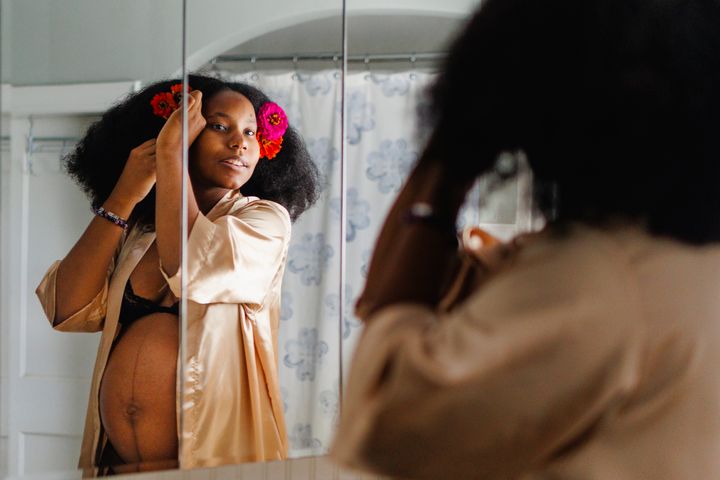
Cavan Images / Rebecca Tien via Getty Images
After weekly medical check-ins at the end of pregnancy, most people won’t see a health care provider until six weeks postpartum.
There are multiple ways that pregnancy can put a strain on your musculoskeletal system. The hormonal shifts of pregnancy don’t only affect your reproductive organs.
“What happens is the joints can become a little more loose and lax,” Jenni Limoges, a physical therapist in Nevada specialising in pelvic floor issues, told HuffPost. This loosening helps your pelvis expand to make room for the baby, but it can also trigger pain from a previous back or hip injury or result in new discomfort.
In addition, as your belly grows, your body has to adjust to a new centre of gravity. “It tends to pull people forward. It creates instability,” said Limoges.
Your pelvis tips forward, and the muscles in your back, pelvis and hips all shift, either lengthening or shortening. Your abdominal muscles separate to make space for the baby. Even your feet change, flattening out to support your pregnant body (many people find they go up a shoe size following pregnancy).
Advertisement
Your pelvic floor muscles provide a sort of shelf inside your hip bones that supports all of the internal organs, including the uterus. There are three layers and nine different muscles that work in concert, Limoges explained.
“These muscles help us stay dry,” she said, and play a key role in sexual functioning. The way these muscles have to stretch to accommodate pregnancy and allow for delivery can cause them to become too stiff or too loose, causing pain or incontinence (urinary and/or faecal).
“I often times hear of people saying that they want to opt for a C-section because they think this protects their pelvic floor,” said Ruba Raza, a North Carolina-based physical therapist who also specialises in pelvic floor, pregnancy and postpartum issues. However, Raza told HuffPost that you can still have pelvic floor issues following a C-section.
“Regardless of the mode of delivery, it is important to see a pelvic floor physical therapist if you are having symptoms during or after pregnancy,” Raza said.
“A lot of people do not seek out our services during pregnancy because they assume that their symptoms will improve postpartum, but with most concerns, these can continue and even worsen if they are not addressed.”
Advertisement
Common postpartum issues
In addition to urinary and faecal incontinence, other common postpartum complaints that can be addressed with physical therapy, Raza said, include: “Sacroiliac joint pain [the sacroiliac joints link the pelvis to the bottom of the spine], constipation, low back pain, pelvic floor pain, C-section scar sensitivity, pain with intercourse and rectal pain.”
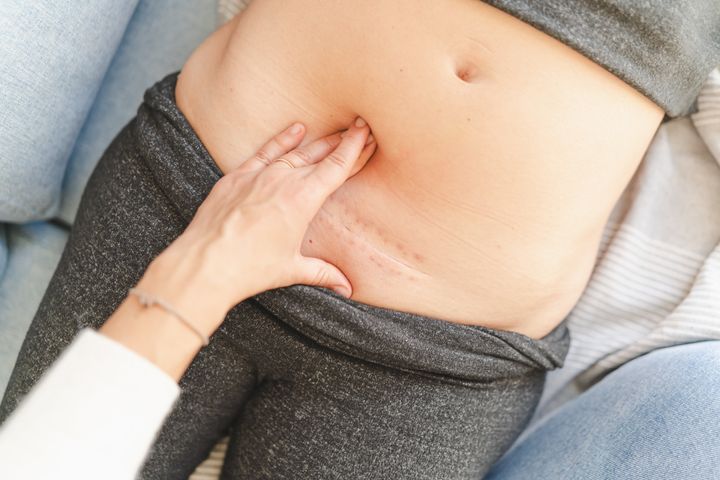
Rawlstock via Getty Images
Many of the common postpartum complaints such as pelvic floor pain, C-section scar sensitivity and back pain can be addressed with physical therapy,
Another issue you may have heard about is diastasis recti. A line of connective tissue called the linea alba runs down the middle of your stomach and fastens together on both sides of your abdominal muscles.
During pregnancy, this tissue stretches out and often separates to accommodate your growing uterus. After delivery, it generally closes back up again over the course of eight weeks or so. If it doesn’t close back up, you may notice that you continue to have a belly pouch, as though you were still pregnant. You may also have pain or incontinence.
Because movements like traditional abdominal crunches can worsen diastasis recti, it’s important to work with a knowledgeable provider who can prescribe exercises to help your diastasis recti heal.
Advertisement
What treatment looks like
Physical therapy for postpartum issues generally involves weekly visits.
“The typical model for the pelvic floor is one-on-one for an hour,” said Limoges, adding that you should feel the results as soon as a couple of weeks in.
“I definitely expect within four to six weeks you’re seeing some improvements,” she continued.
Raza said she typically sees patients once a week for six to eight weeks, but of course, this varies based on the nature and severity of the issue they’re dealing with.
“The plan is very individualised to the patient’s concerns or symptoms,” she said. There are a multitude of exercises your physical therapist may teach you and have you practice at home.
Limoges explained that the treatment for pelvic floor issues such as incontinence depends on whether the problem is that the muscles are too stiff or overstretched and lacking in tone.
With incontinence, it’s common to hear the blanket advice to do Kegel exercises (contracting the pelvic floor muscles — the ones you use to stop urination mid-stream), but these can be counterproductive if the issue is stiffness. For this reason, it’s a good idea to have an evaluation with a physical therapist before starting any exercise program to address your problem.
Advertisement
While a good portion of the evaluation involves the physical therapist learning what your symptoms are, and sometimes this can even be done via a remote telehealth visit, if you’re having a pelvic floor issue, an internal pelvic exam is usually necessary at some point.
“I like to tell people, ‘I’m not the gynaecologist’s office, so I don’t use stirrups,’” said Limoges.
“I typically do a scan of tissue first, just to make sure everything looks OK. And then for the internal assessment, I insert my finger vaginally, and I’m checking each layer of muscles.” This internal exam allows the physical therapist to assess the muscle’s flexibility and to see if there is organ prolapse.
Your therapist will likely want to see how long you can hold a contraction of your pelvic muscles (a Kegel). The standard goal is ten seconds. They will also want to see how quickly you can contract the muscles and whether you have any pain.
While a physical therapist may recommend Kegel exercises if they find a lack of tone in your pelvic floor muscles, there are many other types of exercises they may prescribe.
Advertisement
Twenty47studio via Getty Images
Each physical therapist stressed the importance of finding a way for a new parent to work these exercises into their day in a way that is feasible.
Raza and Limoges discussed using breathing exercises with postpartum pelvic floor patients. Other possibilities include stretches, squats, and what Limoges called “self-tissue mobilization,” in which you apply gentle, internal pressure to the layers of muscle.
Each physical therapist stressed the importance of finding a way for a new parent to work these exercises into their day in a way that is feasible.
“I love incorporating exercises into activities that the patient is already doing, such as adding in a pelvic floor and core contraction every time the patient completes a transitional movement or working on diaphragmatic breathing and pelvic floor relaxation while they are breastfeeding their baby,” said Raza.
Limoges also mentioned feeding/pumping as an opportunity to do Kegels or breathing exercises, as your life during those first few months tends to revolve around these moments. She recalled working with one mom caring for her newborn while homeschooling her older children. She needed exercises that she could do while standing and wearing the baby, so Limoges prescribed some wall sets and lunges she could do.
Advertisement
Postpartum or not, Limoges said she limits treatment to a few daily exercises that a person can work into their routine without too much trouble and works with the patients to address their most urgent concerns within the context of their lives.
A mother of twins, Limoges recalled, was having issues with urgency to urinate. “But she was running into a problem because she couldn’t get the twins in a place that she could watch them and go to the bathroom at the same time.” She padded her bathtub so she could set them safely in it to pee without leaking or holding it too long.
While your body will never return exactly to what it was before pregnancy, Limoges believes that improvement is always possible with any of these physical issues.
“My goal is to get people to 90% at least,” Limoges said. “Can you get yourself to where you’re not hunting for the bathroom or worrying about wearing a pad everywhere you go or [not] leaving your house and those kinds of things? Absolutely.”
There was abundant evidence of the transformational effectiveness of psychedelics, which shows great promise in treating issues like depression, anxiety, PTSD, and addiction, especially at relatively high doses (like 30-40mg of psilocybin).
Psychedelics can also create powerful effects that people describe as spiritual. Given a high enough dosage, most people report a profound mystical experience that they claim to be one of the peak experiences of their lives.
The connection between psychedelics and creativity seems to be more anecdotal at this point, especially when microdosing. That could be at least partly due to the challenge of figuring out how to measure creativity improvements.
Investment
Lots of investment is currently flowing into the psychedelic space, including money, new businesses, and people (researches, doctors, therapists, coaches, etc.). There are even churches popping up that use psychedelic substances as their sacraments.
Feelings on this investment flow are mixed. On the one hand, greater mainstream interest helps to overcome the negative aspects of the 1960s counter-culture association with psychedelics, which led to the War on Drugs in the 1980s, thereby giving this wave of psychedelic resurgence more mainstream legitimacy with the backing of doctors, scientists, and investors. On the other hand, I saw much concern regarding the influence of corporate greed upon this space and the massive potential harm it could do, much as it did with cigarettes and the opioid crisis.
This creates an interesting dynamic where the field seems to be courting and welcoming mainstream legitimacy and advocacy while at the same time wanting to keep the influence of money and corporations at arm’s length, so as not to ruin the human and social benefits (community, healing, connection, transformation, positive social ripples, etc).
Placebo Effect
With respect to microdosing, recent studies have been finding that the placebo effect accounts for most of the total effect (perhaps 90-95% of it). The effects of microdosing can be almost entirely negated when someone thinks they’re taking a placebo while actually taking a real psychedelic substance such as LSD. And the positive effects can be largely replicated by giving a placebo to someone who thinks they’re getting the real thing.
At higher doses, however, the placebo effect seems to play a lesser role, although it’s still measurably present. When people are taking real psychedelic substances, they tend to know they didn’t get the placebo due to the strong effects. Of course that difference makes it difficult to conduct double-blind testing because most people can easily tell which group they’re in. That isn’t the case with microdosing, where people can easily guess wrong.
Environment
Psychedelics can be very sensitive to environment (aka setting). Taking the same substance at a therapist’s office may lead to a very different experience than doing it in the Amazon jungle, in your own home, at a rave, at Burning Man, etc.
Stigma
We’ve come a long way in turning societal impressions of psychedelics to be more truth aligned. More people now recognize the positive benefits of psychedelics and acknowledge their non-addictive nature and the relatively low risks (the risks often having more to do with set and setting than with the substance taken). People are becoming more aware that mushrooms, LSD, MDMA, and ketamine aren’t remotely the same as heroin or cocaine. With some psychedelic substances, it’s nearly impossible to overdose since they aren’t toxic in higher amounts, although you might end up having a very intense trip.
Influence
Lots of players seem to want to influence the way the rapidly growing psychedelics community evolves, including doctors, therapists, scientists, individual psychonauts, local psychedelic communities, indigenous people, investors, business, government officials, etc. Many different interests are vying to secure, maintain, or expand their seats at the table to ensure their interests are considered and represented. Yet no one is really in charge.
Different interest groups favor different frames to support their positions. Therapists may use the patient care frame. Individual psychonauts often play the personal freedom card. Researchers may emphasize the supremacy of science. Indigenous people seem to favor the multi-generational stewardship and experienced elder frames. Government officials claim to want what’s best for the people they serve. Some local psychedelic communities lean on anti-corporate and empower-the-local-community framing.
It’s impressive to see that despite competing for influence, many people in this space are willing to float among different frames to broaden their perspectives, including considering frames that don’t support their positions. I think many people recognize that psychedelic space is complex and not easily understood from the perspective of any singular frame. Frames are not truths; they’re only windows peering into a greater reality from different angles.
Exploring a Direct Relationship with Psychedelics
One personal takeaway was the value of cultivating a direct relationship with psychedelics, such as by using them solo or with a sitter, instead of going through gatekeepers like a therapist or shaman. Whenever you bring anyone else into the psychedelic journey with you, their energy gets woven into the experience.
Be careful about the people with whom you explore. You may have a better experience exploring with trusted friends in a comfortable and familiar location than in some jungle, retreat center, or office with people you don’t know.
If you do work with a gatekeeper, it’s wise to research their background and talk to previous clients. Going to a psychedelic retreat center with a rotating rent-a-shaman may not be your best bet. And if you do find retreat centers appealing, shop around and ask around for more options since their prices can be all over the place.
Self-Development Potential
In terms of personal growth value, there’s a tremendous about of experimentation that can be done with exploring different intentions in your psychedelic journeys. Psychonauts have invited new truths about themselves and reality, upgraded old thought patterns and behaviors, overcome addictions, created new emotional realities for themselves, and so much more.
Psychedelics can provide new vectors into self-discovery that you may not have accessed before. The potential of using psychedelics for self-development is vast.
Synthetic vs. Natural Psychedelics
Some people have a preferences for natural psychedelics such as magic mushrooms or ayahuasca instead of synthetic forms like LSD or MDMA. In terms of the results people are getting, both in scientific studies and anecdotally, there seems to be little practical difference between natural and synthetic psychedelics. Both are capable of creating very similar experiences. Even across different types of psychedelics, the effects tend to be more similar than dissimilar, with factors like set, setting, dosage, and intentionality often playing a bigger role than the specific substance taken.
Curing vs. Drugging
Many people are moving away from pharmaceuticals that only treat their symptoms, cause unwanted side effects, mask underlying problems without actually curing them, and often create drug dependencies. They’re turning to psychedelics to unearth, explore, and finally cure their underlying conditions. Some achieve this through microdosing, others through intense high-dose experiences.
Psychedelics and Meditation
There’s great overlap between the long-term benefits of psychedelics and meditation practice. Psychedelics typically yield much faster results though, often creating profound transformations with just one or two doses, achieving transformations that consistent meditation practice might attain within years or decades, if ever. Moreover, even experienced meditators can have powerful revelations when taking psychedelics, often in ways that supplement their meditation practice. Meditation and psychedelics are highly compatible, and the best results may come from combining them.
Social Benefits
Psychedelics can create many positive social ripples, such as helping people to feel more connected to each other, be more compassionate and cooperative, and set more socially responsible and beneficial goals and priorities. Widespread psychedelic use could potentially lead to a reduction in violent crime, among many other positive ripples.
Decriminalization
The psychedelic decriminalization and legalization movement is building momentum, so we may see similar shifts like we’ve seen with marijuana in recent years. In the USA, Colorado has been leading the way. Other states are advancing in this direction too.
Do the Work
Psychedelics can be powerful tools of transformation, but you must still do the inner work to unleash their full potential. If you use psychedelics primarily for entertainment, you may not experience much transformational value. Moreover, no one can do the work for you, even if you work with a therapist or shaman.
A key pattern I saw among people who had powerful breakthroughs with psychedelics was that they assumed personal responsibility for their transformations. Psychedelic exploration often came into their lives after they decided it was time to step up and finally fix their issues, whatever it takes. For some this meant overcoming major trauma. For others it was finally time to get off anti-depressants. Still others wanted to do something purposeful and meaningful instead of feeling stuck. There were many different scenarios that led people to conclude that they needed to definitively fix their issues and finally move on with the rest of their lives. For some it appeared as if psychedelics came onto their radar as the manifestation of the transformational power they were now summoning, as if reality said to them, “Ah… I see you’re finally committed to solving this issue for good. Here’s what you need to complete that journey.”
Expansion
The psychedelic space is clearly going through a major expansion phase. Expect to see significantly more growth in this space in the years ahead. New career opportunities are springing up rapidly, such as psychedelic therapists, coaches, and trainers. You may soon see people you know switching careers to get involved.
Don’t be too surprised when you see more influencers sharing openly about their psychedelic journeys. You’ve probably been seeing some shifts towards greater openness and exploration already if you’ve been paying attention.
I hope you enjoyed these takeaways. I encourage you to ponder how some of them may apply to other areas of your life in more personally applicable ways. For instance, are there any situations where you’re still going through a gatekeeper, such as by seeking permission, when a more direct approach would serve you better? Where in life do you need a powerful commitment to “do the work” in order to progress? How do your set (mindset), setting (environment), and intentionality affect your results and experiences? Where are you getting stuck into mono-framing instead of taking in the big picture across multiple frames?
In June I attended the Psychedelic Science 2023 conference at the Colorado Convention Center in Denver. We were told this was the largest psychedelic-related gathering in the history of the planet, attracting about 12,000 attendees and 500 speakers. In this post I’ll share about my experiences and insights from the conference.
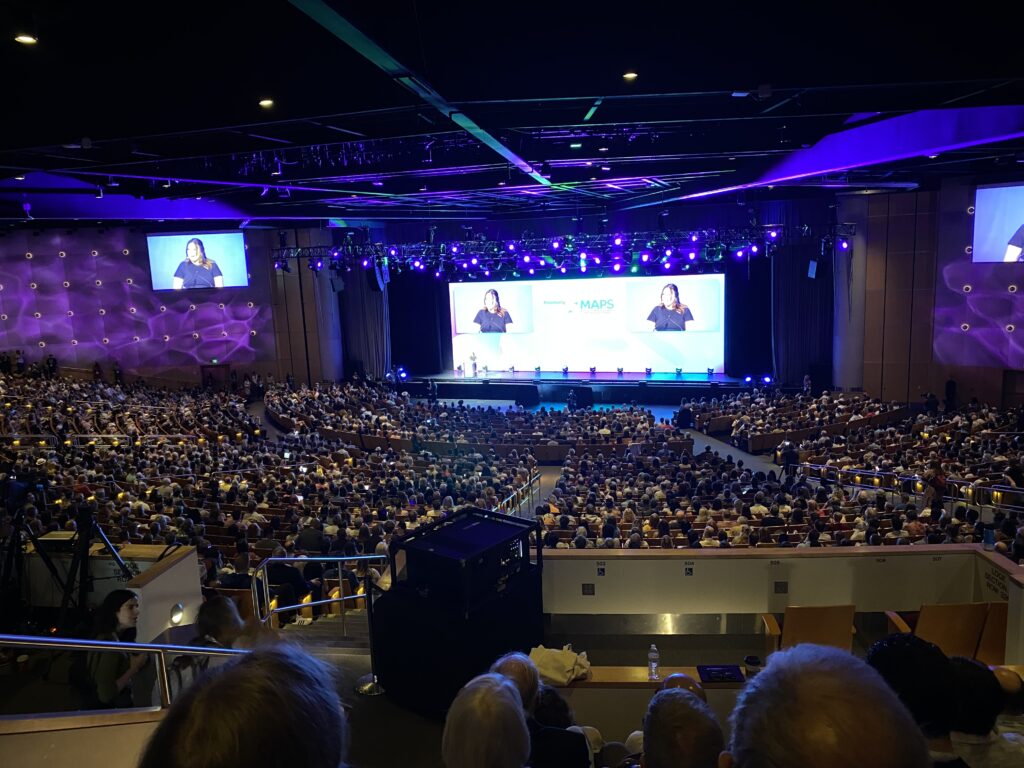
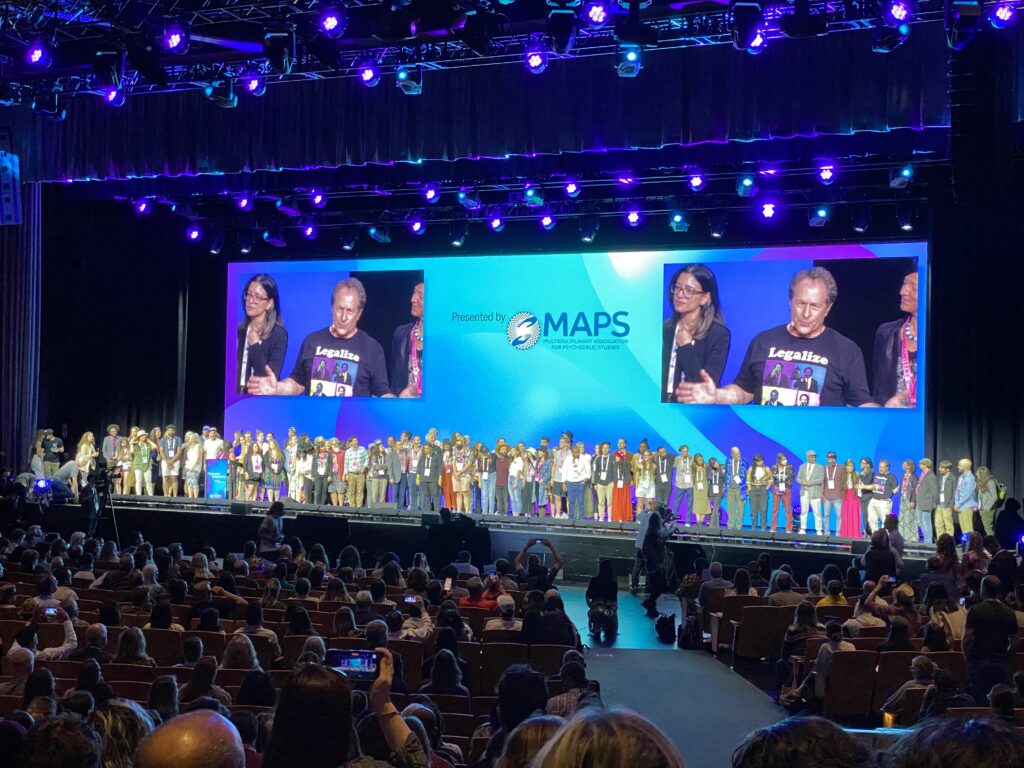
Here’s a pic from inside the Bellco Theater where the main keynotes were held.
The Colorado Convention Center is sizable, and sessions were spread across many different rooms. Even though I didn’t do extra exercise on this trip, I was typically hitting about 1000 calories a day from movement (according to my Apple Watch), mostly from walking between conference sessions but also to and from nearby restaurants for meals. My hotel was across the street from the Convention Center, and I’m glad I stayed close since there was so much to go-see-do.
PS2023 offered hundreds of sessions across several different tracks (science, business, studies, plant medicine, community, society, etc), running concurrently, so I had to be selective and couldn’t possibly see it all. I’m glad I took the time to thoughtfully prep my schedule in advance, using the conference app’s “My Planner” feature. That helped me stay in the flow of attending sessions for all three days instead of feeling overwhelmed by too many possibilities each hour. I prioritized what I wanted to see while allowing for some flexibility to make final choices as I went.
I opted for a balance of different types of sessions, and I came to appreciate how much variety this conference packed in. I especially liked how well it balanced the left- and right-brained aspects of psychedelics. I appreciated the science and studies sessions full of data-rich slides. I loved hearing the personal stories. I enjoyed the panel discussions, which provided diverse perspectives. I especially loved the range of speakers – experienced psychonauts, scientific researchers, therapists, journalists, entrepreneurs, indigenous people, athletes, and more.
The sessions were of varying lengths. Some were only 15 minutes while others were an hour or longer. This made planning trickier since sessions started at different times spread all throughout the day, as opposed to having every track starting their sessions in sync, such as at 9am, 10:30am, etc.
You may find this review very opinionated because I’m going to share my innermost thoughts and feelings about what I experienced, including why some sessions didn’t resonate. My intention is to be as honest as I can in sharing the interior perspective of what it was like for me to attend this unusual conference. I read some journalistic coverage of the conference and found it ridiculously shallow (no surprise there), so I want to give you a deeper understanding of what it was like to be there, including lots of pics.
Rachelle and I opted to stick together for all the sessions instead of making different individual choices – she trusted me to make the selections and manage the conference schedule. We went to the following sessions:
Wednesday, June 21
Welcome to Psychedelic Science 2023 – The event began with a series of short opening addresses within the first hour.
Opening Land Acknowledgement – I know that acknowledging prior indigenous land stewardship of the location, including how that land may have been stolen, has become a popular feature at some live events these days. Personally I find this practice mostly ridiculous, and I’m hoping that it will soon go out of fashion, like MySpace and Twitter. Taking up time to do this as part of the event provides no meaningful value to attendees, and I don’t see it as being very respectful towards indigenous people either. It would make more sense to put such a statement on the conference website, if at all, but don’t do this from the stage. Weaving this into the opening address felt out of place, inappropriate, and disrespectful of the audience. The intention behind it felt misaligned as well. It sounds like, “Okay, so this land we’re on right now was stolen, and in lieu of any actual remedy, let’s invite some collective guilt and shame into the room and reflect upon how much our ancestors were assholes. And we’re assholes too since we’re using this stolen land. Now let’s get on with the show!” Even though this backstory may be true, I don’t see how directly stating this during the event serves the purpose of the event; it only detracts from it. I’d rather see an extra five minutes of value subbed in, like an accounting of which psychedelics were used to create all six seasons of Rick & Morty. If you’re organizing an event and you’re tempted to include a land acknowledgement, I’d recommend surveying your audience first to see if they want it; then use your best judgment when no one fills out the survey.
Opening Address from Rick Doblin, Ph.D. – This was pretty standard opening stuff and a bit self-congratulatory regarding the growth of these conferences: 800 people in 2010, 1900 in 2013, 3000 in 2017, and now 12,000 in 2023. So yeah… interest in psychedelics research and practice is exploding, and we can likely expect huge growth in the years ahead. I think that’s probably no surprise to people who’ve been engaging in the space, although the resurgence of psychedelic interest may surprise some outsiders.
Opening Address from Governor Rick Perry – Rick Perry is a conservative former Texas Governor. I sensed he wouldn’t be too popular at a conference like this and wondered why he was on the agenda (in a WTF sort of way), but I was impressed by how well he addressed the elephant in the room, including using self-deprecating humor by referring to himself as a knuckle-dragger. He demonstrated that he knew how to find common ground with an audience that was likely full of people biased against his political party. Overall I liked the stories he shared. I’d say he was the most memorable part of the opening hour.
Opening Address from Governor Jared Polis – The current Governor of Colorado spoke next. His communication style was very different from Perry’s – more mental and less story-driven – but I also liked what he had to say. He spoke about the decriminalization process and how it’s not perfect and will surely require some adjustments in the years ahead. He also talked about looking into pardoning thousands of people who’d been convicted under past drug laws that have changed. Colorado is really leading the way with decriminalization. I like that they’re paving the way for other states to follow, including my home state of Nevada, which seems to be following a few years behind, first with marijuana and next with psychedelics. Nevada could have gone faster, but despite popular support for decriminalization, the legislature punted the decision by creating a working group to study psychedelics first. At least that allows time to see things go in Colorado first. Polis’ address concluded the opening hour of the conference.
Beyond Medicalization: The Renaissance of Relationship – Natalia Rebollo Corral talked about the importance of reciprocity with indigenous people, a theme I heard a few other times in the conference. I can see how that may apply in some situations like if psychedelic tourists are going to indigenous lands to use their plant medicines, especially when dealing with limited resources. But I don’t see how reciprocity applies when using LSD, MDMA, mushrooms (that can be grown anywhere), etc. It felt like she was suggesting that indigenous people deserve a kickback (such as a licensing fee) for plant medicines they began using first. I resonate with reciprocity in general, but I didn’t resonate with how it seemed to be overextended during this talk.
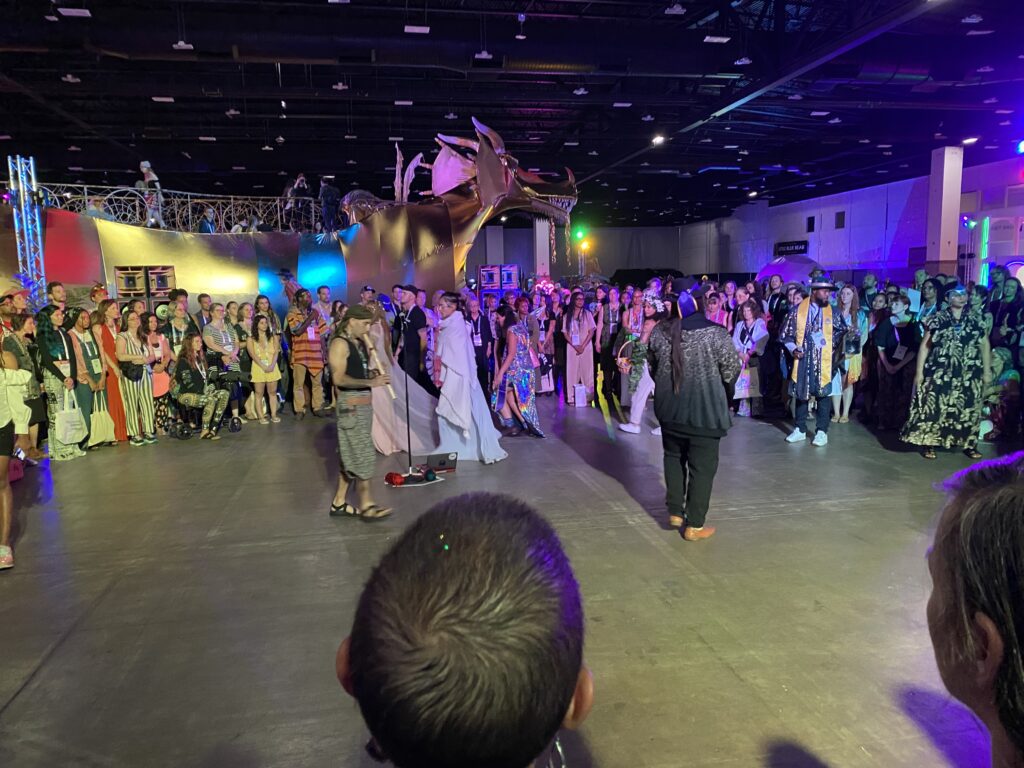
Socio-Celestial Mapping and Living Mandalas, an Opening Ritual Ceremony – This was our first session in the experiential Deep Space area of the conference. It was an hour-long ceremony that begin with everyone getting into groups arranged by astrological sign, so I got to hang out with the awesome Aries folks. Then collectively we all formed one big circle, and in the middle the presenters played out the symbolic roles of the planets, the Sun, the Moon, and Pluto. Each celestial body took turns sharing something for a few minutes, such as a song, performance poetry, a pep talk, drumming, etc. There wasn’t much left-brained content to speak of, but my right-brained side quite enjoyed the costumes, visuals, and experiential nature of it. Rachelle didn’t seem to find it that impressive, perhaps because she was relegated to the Aquarius group, but I found the experience touching and creative. It gave me the idea that I’d love to include some ceremonial or ritualistic aspects in future workshops to see if people like that. I think it can be a nice way to help people feel more connected and a nice balance to left-brained ideas. One aspect I found interesting was how each sign was given an associated statement. For Aries it was, “We are.” For Aquarius it was “We know.” I saw Rachelle’s face light up when she heard the statement for her sign. I felt playfully resonant with “we are” as well, maybe since I feel very comfortable in my own skin, and I regard criticism of who I am or what I’m currently exploring as relatively pointless – it just bounces off my I-am-ness, and I often feel a combo of bewilderment and compassion for those who attempt to knock me off center, much like watching someone run into a wall.
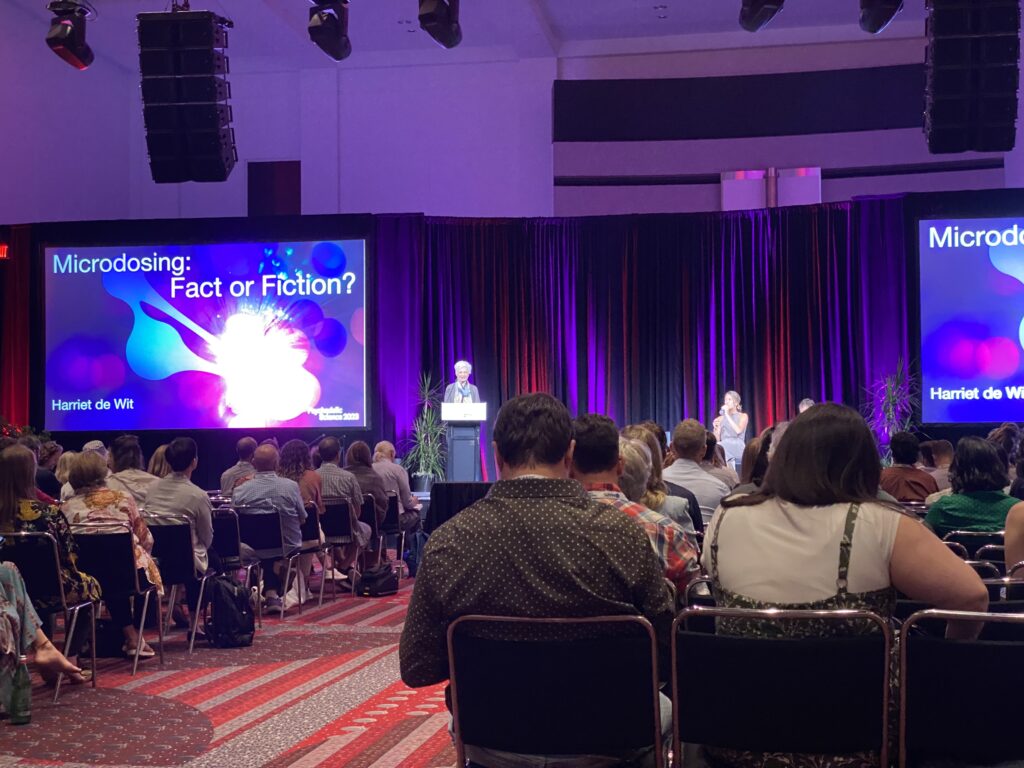
Assessing the Evidence for Microdosing – This presentation shared results from several recent studies on microdosing. It was interesting to see that microdosing does have a measurable positive impact, especially in terms of alleviating depression and anxiety, but that difference is mostly due to the placebo effect. What matters most is whether people believe they’re taking a psychedelic substance, not whether they’re actually taking one. In fact, the benefits can largely be negated when people are microdosing with a psychedelic substance, but they think they’re taking a placebo. That made me ponder if on a certain level, the main effect of psychedelics might be a higher-level placebo effect. We think it will do something powerful to us, so it does.
Lunch Break – We had 90 minutes for lunch each day (1:00 to 2:30pm), and it barely felt like enough time. We usually went to Modern Market, a counter-service restaurant a 5-minute walk from the Convention Center with a few decent vegan options (I liked the Buddha bowl). By the time we walked there, progressed through the food ordering line packed with other attendees, got our food, and ate, we had to get up and leave immediately to make it to the next session.
The Mazatec Sierra and the Sacred Mushrooms: Past and Present – This panel had a translator, and it was only 30 minutes, so it was fairly light on content, but was interesting to hear the indigenous perspective on how they use mushrooms and what they think about the proliferation of their usage throughout western society. This helped me see how plant medicines help to create social cohesive in some cultures. I respect that many indigenous people have a lot of psychedelic experience, but I also note that their intentions and frames don’t always resonate with me, and that makes me more interested in cultivating a direct relationship with psychedelics. I feel this perspective was strengthened by attending the conference. I was surprised that hearing directly from indigenous people at the conference actually served to deflate some of my “indigenous elder” framing on psychedelics.
Building Culture with Principles: A Conversation with Burning Man CEO Marian Goodall – I’ve never been to Burning Man (although I’d love to go at some point), and I enjoyed hearing Marian Goodall’s perspective on the events and how they’ve created ripples beyond Nevada’s Burning Man, including by introducing more people to psychedelics. A large portion of the audience raised their hands when asked if they’d attended Burning Man and did psychedelics there. This session made me more curious about connecting with people in this space as well as continuing to gain more psychedelic experience.
Psilocybin Mushrooms and their Tryptamines: Potential Medicines for Neurogeneration – I was looking forward to this session from Paul Stamets after seeing him in Fantastic Fungi. I found it interesting on a technical level as he talked about different mushroom species and their properties, and he was lively and entertaining throughout. However, this talk felt like more of a showcase of his knowledge and experience, and I felt a disconnect in terms of receiving any practical takeaway value. I can’t say I learned anything from it that I can actually apply to my life, and there was nothing here that challenged me or gave me fresh insights. I at least enjoyed seeing his passion for shrooms.
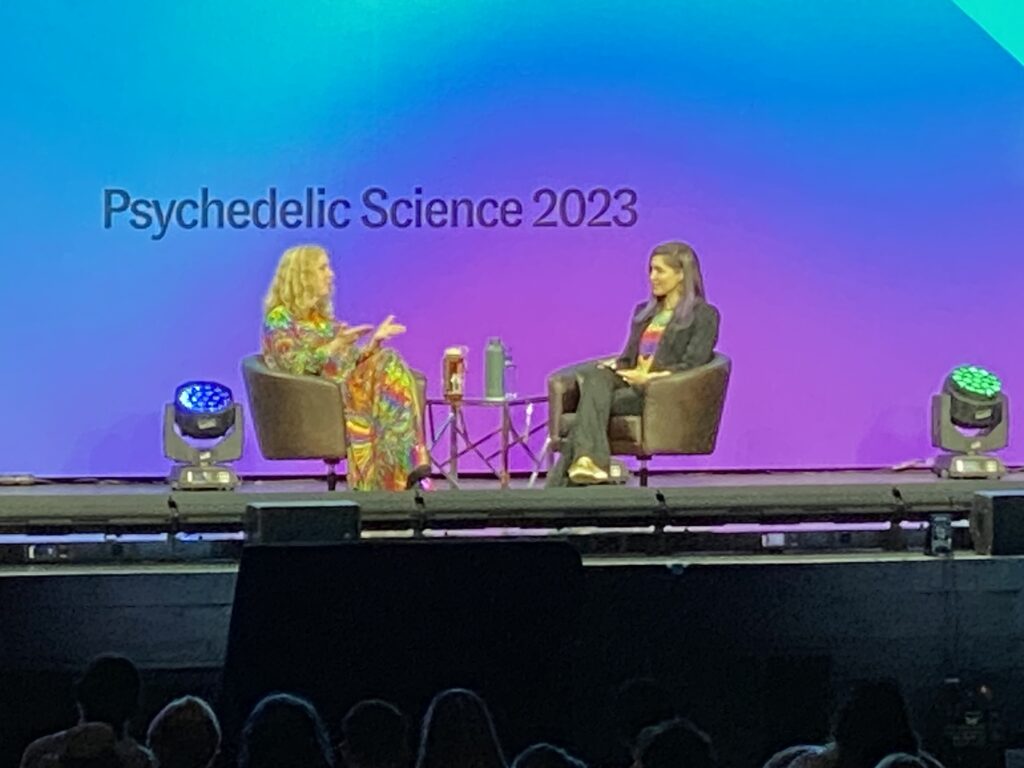
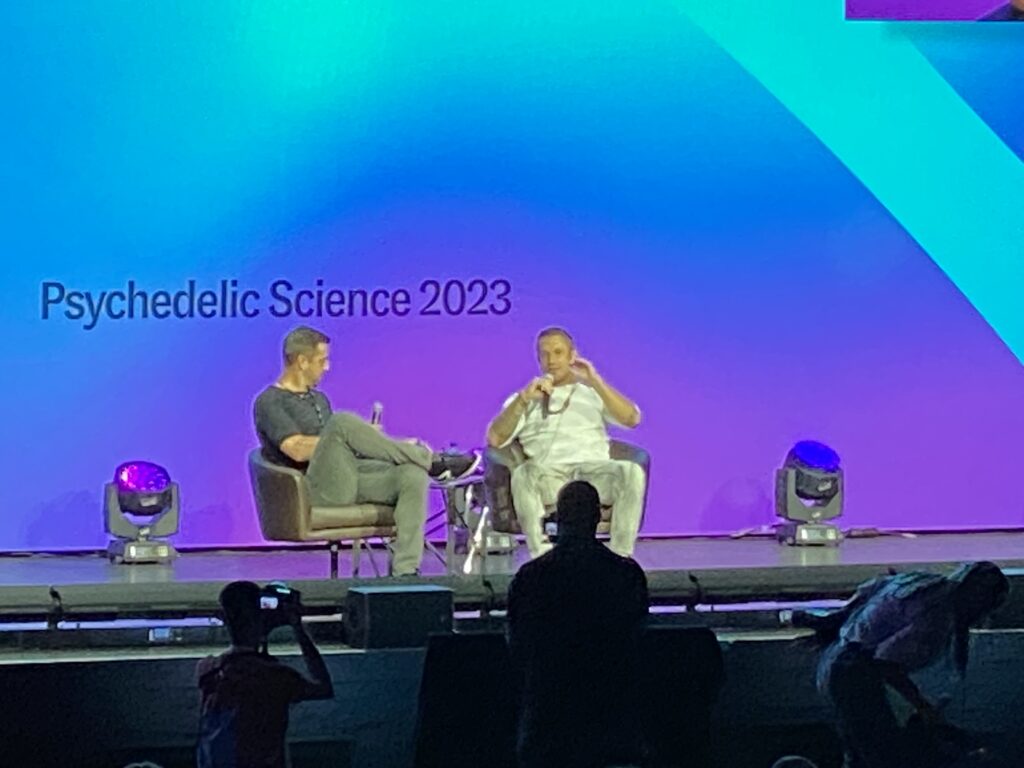
How Psychedelics Can Unlock Elite Performance – This was a popular session where Aubrey Marcus talked with SuperBowl Champion Aaron Rodgers about psychedelics and sports. It was lively and fun. It didn’t go too deep into the promoted topic of unlocking elite performance, and it focused more on the social aspects of doing psychedelics, such as how it’s perceived in a professional setting. The performance aspect mainly had to do with the emotional benefits like reducing depression and anxiety and increasing feelings of team connectedness, especially when multiple players are doing psychedelics. I’d say I got more entertainment value from their repartee than much practical value, but this late in the day I didn’t mind that so much.
A Ceremony of the Psychedelic Story – This was supposed to be a 2-hour evening session, 7:30-9:30pm, showcasing BIPOC psychedelic stories. It was a long day already, but I wanted to squeeze this one in after dinner, especially given my past work with the Diversity Committee in the Transformational Leadership Council. Overall I loved it. There were deep, emotional, and moving stories of transforming trauma with psychedelics, including from those framing it as multi-generational trauma. I was impressed by how far some people went into their journeys, including international travel to advance their transformations. The downside was that this session was disorganized. They started late and ran more than an hour overtime, almost every speaker went long, and they had trouble being consistent with microphone usage, so it was hard to hear some people at first. A lot of attendees left early (perhaps most of them). The room was packed in the beginning, but the final speakers had a much smaller – and more fatigued – audience. That’s too bad since there were powerful messages to be heard throughout. One of my key takeaways was an unspoken one – that if people want to transform their lives, it begins with taking 100% personal responsibility for doing the work. No one else can do the transformation for you, even someone you think may have caused or contributed to the harm you endured. That was a key theme I saw elsewhere in the conference too: We all have to do our own inner work, and if we don’t step up, no one is coming to rescue us. One reason people do psychedelics is that they really want to transform their lives, and they’ve often tried many other approaches before landing in psychedelic land.
I had originally planned to attend a morning session this day called “Microdosing: Remarkable Results, Surprising Implications” with James Fadiman, Ph.D. However, when I got to the room, it was packed with people and spilling out the doorways into the hallway, and I couldn’t get in. That was disappointing since I wanted to learn more about this topic. Seeing the room so overstuffed gave me the early impression that the conference might be oversold. So after this I made a point of getting to potentially overstuffed sessions early, which turned out to be a wise idea.
Thursday, June 22
Psychedelics: Spirituality, Mindfulness, and Mortality – Personal Reflections and Visions for the Future – This was a slide-rich presentation by Roland Griffiths, Ph.D. from Johns Hopkins School of Medicine. There was lots of eye-opening data here, and it showed me how researchers are measuring whether people have spiritual experiences on psychedelics and how that can be beneficial. The part about visions for the future was pretty minimal (for timing reasons I think). My main takeaway was that people are clearly finding spiritual benefits in psychedelics. Life becomes more conscious, expansive, and supportive when we take them. An unspoken aspect that I picked up was that studying psychedelics seems to be transformative for the researchers as well, even if they aren’t taking any substances. It’s clearly rewarding doing studies that create such powerful benefits for people. I can see how that would be very motivating and inspiring. Throughout the conference I got the sense that many of these researchers truly love their work and feel that they’re right where they want to be in terms of serving the greater good.
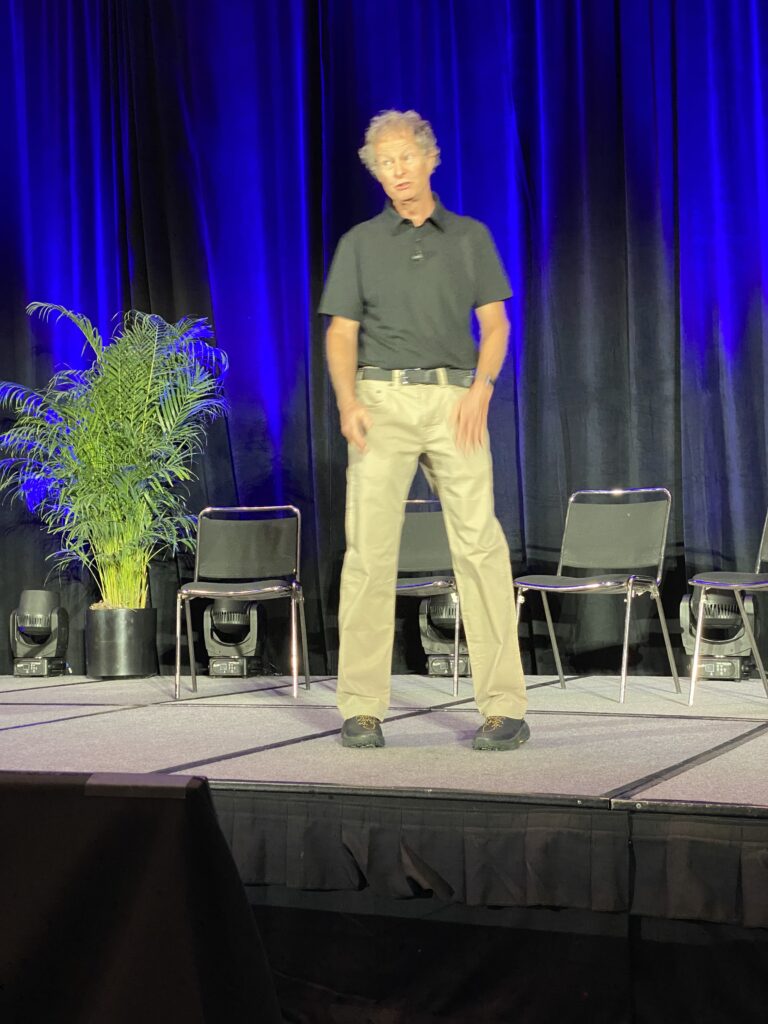
What 50 Years of Psychedelics Have Taught Me About Purpose, Love, and Life: Reflections from John Mackey, Co-Founder of Whole Foods Market – I raced to this session since I thought it might fill up, but it was actually relatively sparse, maybe because it was a Business track session or because of other sessions it was competing with. Rachelle and I grabbed seats in the front center, just several feet from the stage. Even though it was only 20 minutes, this was one of my favorite sessions from the conference. John shared the highlights of his psychedelics journey and how Whole Foods wouldn’t have existed if he hadn’t done LSD first. That LSD experience led him to start thinking about his purpose, which led him to join a vegetarian co-op. Soon he became the food buyer for the co-op, which eventually led to him starting a small grocery store, and that evolved into a small chain which later became Whole Foods. John was warm, personable, and funny – totally the kind of speaker I love watching. I could have listened to him for hours and wished he’d had a longer time slot. I also wish Whole Foods hadn’t been bought by Amazon since the vibe in the store hasn’t been the same since that happened. I still shop there occasionally, especially for items I can’t get elsewhere, but the energy inside feels conflicted, sometimes even gross, like it doesn’t really know what it’s trying to be anymore. Perhaps the new managers could benefit from a fresh round of psychedelics.
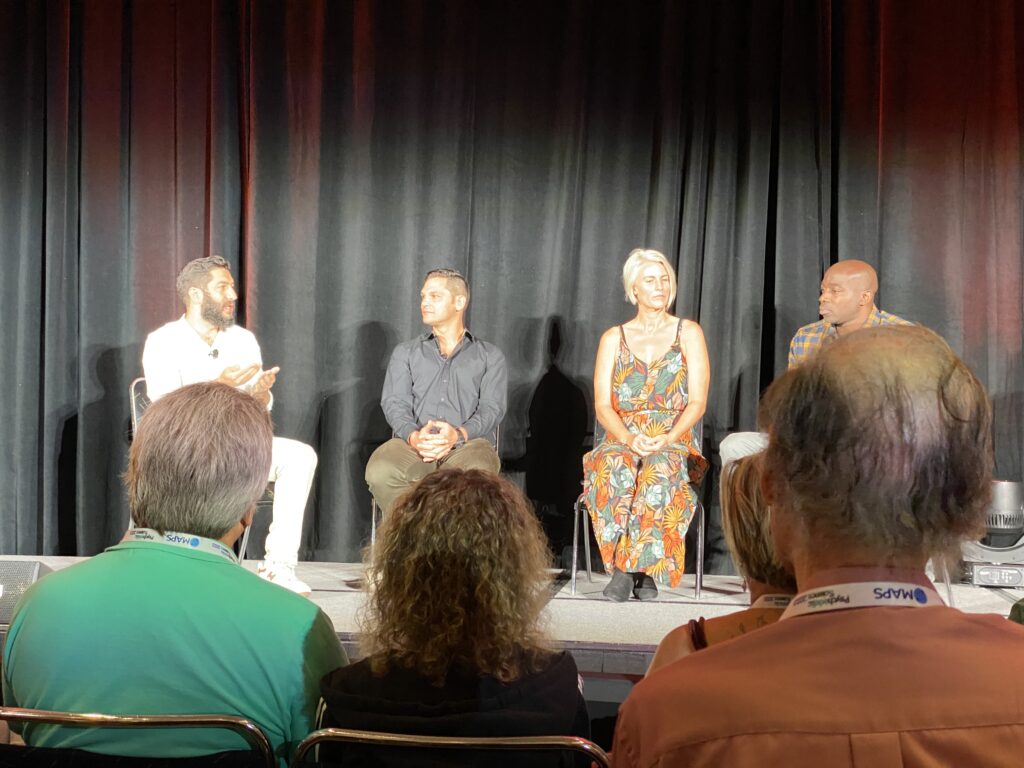
Sports, Psychedelics, and Mental Health: The Mind-Body Connection – This panel was hosted by Daniel Poneman, son of our good friend Debra Poneman, and featured panelists from the NFL, NHL, and NBA. I loved it! It was lively and insightful, and Daniel was an outstanding host. It was interesting to hear more stories about how psychedelics can benefit athletes mentally and emotionally, upping their game but not like physical performance enhancement drugs. I see this as another vector that’s helping to remove the stigma that psychedelics inherited from the old War on Drugs. It strikes me as ridiculous that Twinkies, cigarettes, and alcohol are legal but magic mushrooms aren’t (in most places).
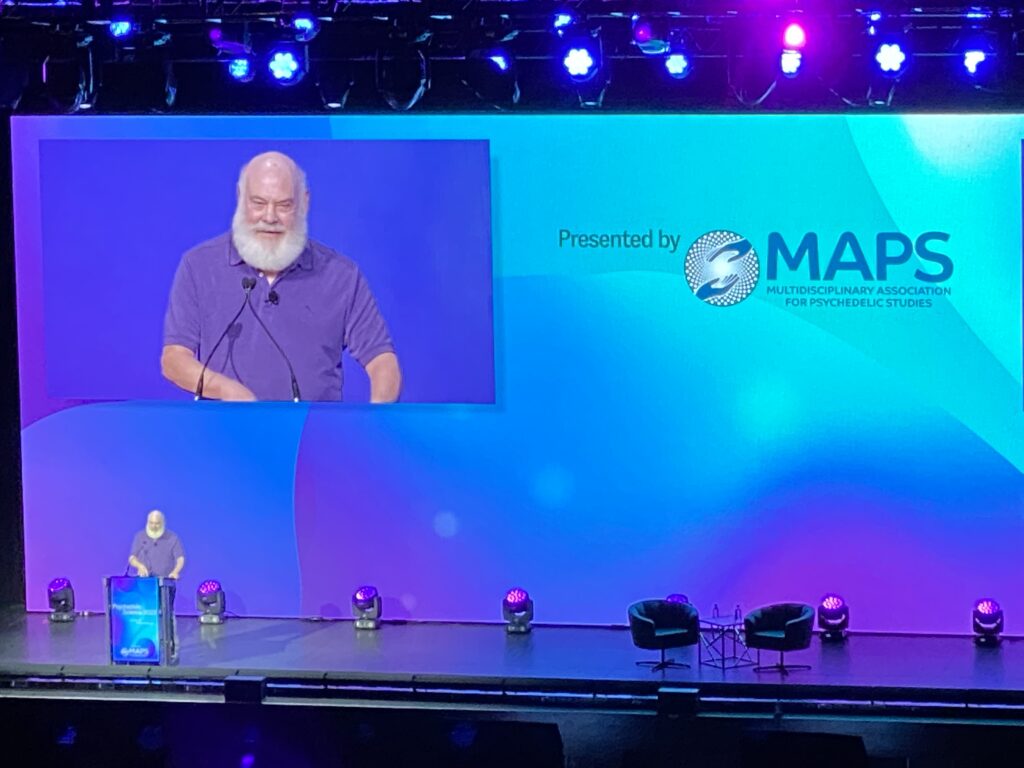
Reflections on a Lifetime with Psychedelics – This was a fun and lively session with Dr. Andrew Weil (who could easily pass for Santa Claus) recounting some of his psychedelic experiences, alone and with friends, including some humorous mishaps. It was a very positive session highlighting the many social benefits of psychedelics and expressing hope for the future if more people engage with psychedelics for transformative experiences, not just for themselves as individuals but for society and the world.
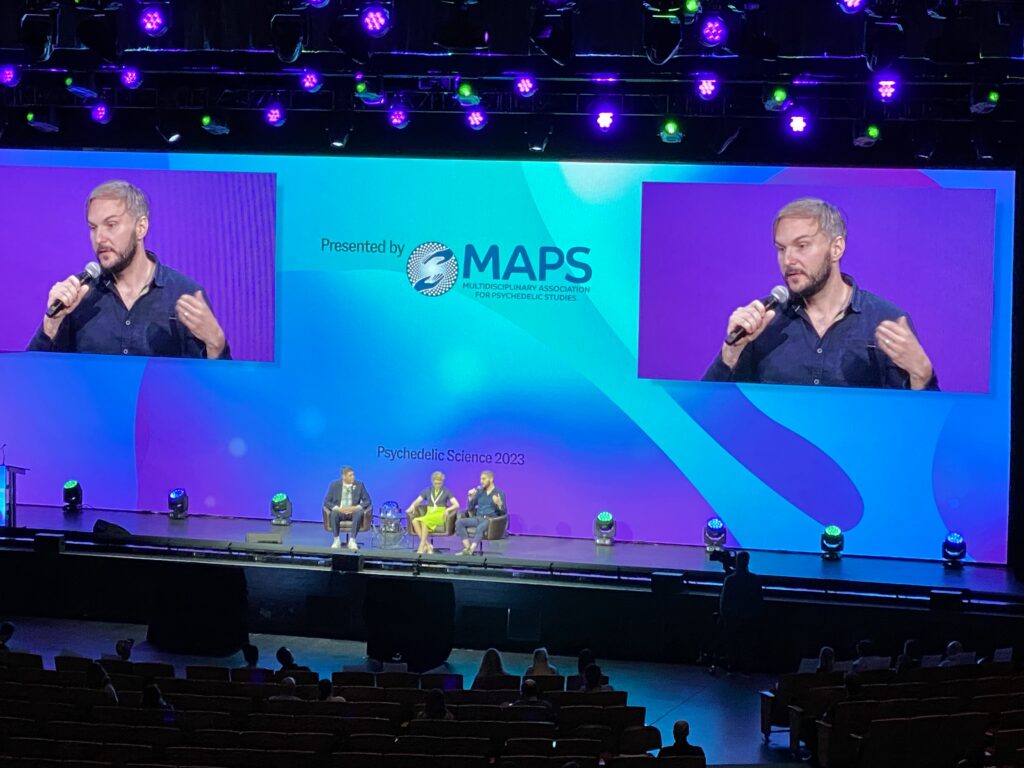
Tempering Psychedelics: A Conversation Between Michael Pollan and Bob Jesse – I went into this session with high hopes since I’d read Michael Pollan’s How to Change Your Mind book and liked the related Netflix series. I found this conversation a bit dull though, with Michael and Bob seeming a little too enamored of each other while not delivering much takeaway value for the audience. The “two people talking organically” format sometimes works and sometimes doesn’t, and IMO this one was a miss. I felt like I was watching an insider conversation between two people who were hornier to talk to each other than to provide value to the audience, and bearing witness to their on-stage bromance didn’t draw me in this time. I kept hoping for something interesting to emerge, but I ended up leaving with a hollow feeling. The main takeaway I got was “Don’t overdo it,” which was about as useful as it sounds.
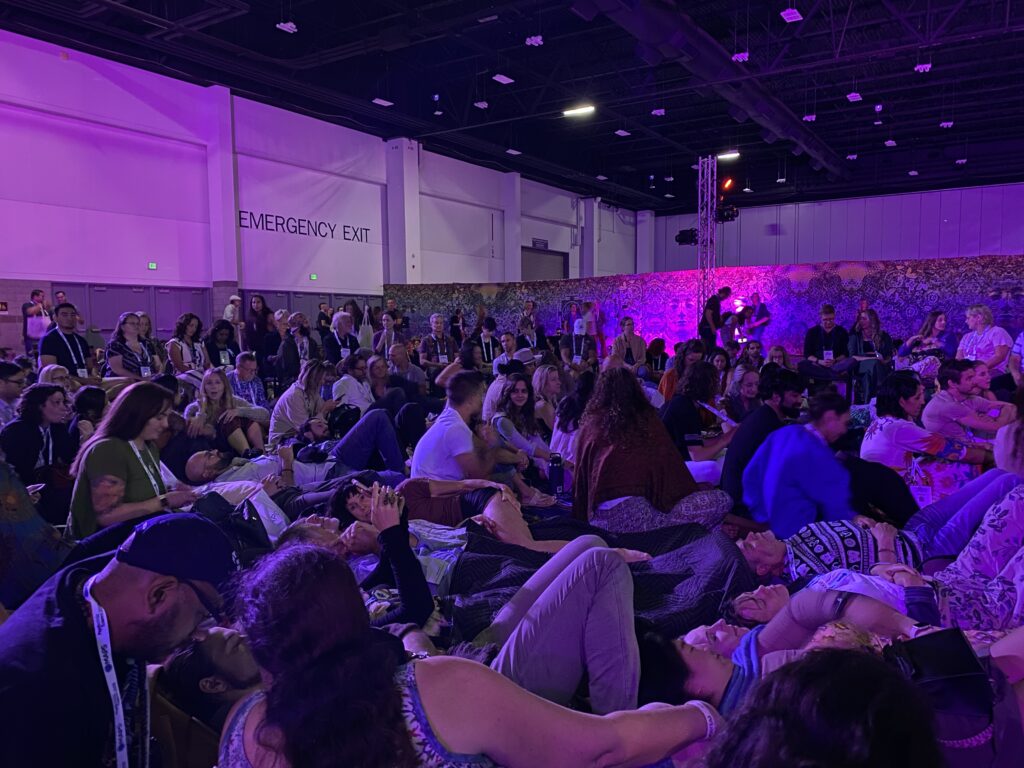
Ceremonia + Soundgasm Present: 432hz Sound Activation – This was an experiential sound bath meditation experience in the Deep Space area. We got there early and snagged seats, and it filled up quickly with people sitting and lying on the floor all around the area, almost like a giant cuddle puddle. This session got off to a rough start, being very late and having mic problems, but once they got going, it was flowed beautifully with gongs, chimes, crystal bowls, singing, flutes, and more. I found it nicely restorative, although I thought it would have been better if it was done in an separate enclosed space instead of in the large open Deep Space exhibit hall with other things happening all around. Think of it like meditating in the middle of a large indoor shopping mall with high ceilings – not the ideal setting but still nice when everyone meditates together.
Buddhism and Plant Medicine: An Acceleration of Healing and Insight – In this 30-minute talk, Spring Washam shared her personal experiences of blending ayahuasca and Buddhist practices. The main takeaway was that yes, they combine well. This relates to a theme I saw elsewhere the conference – that psychedelics and meditation are highly compatible and have overlapping benefits. Both can help you develop greater mindfulness, for instance. Psychedelics just gets you there faster.
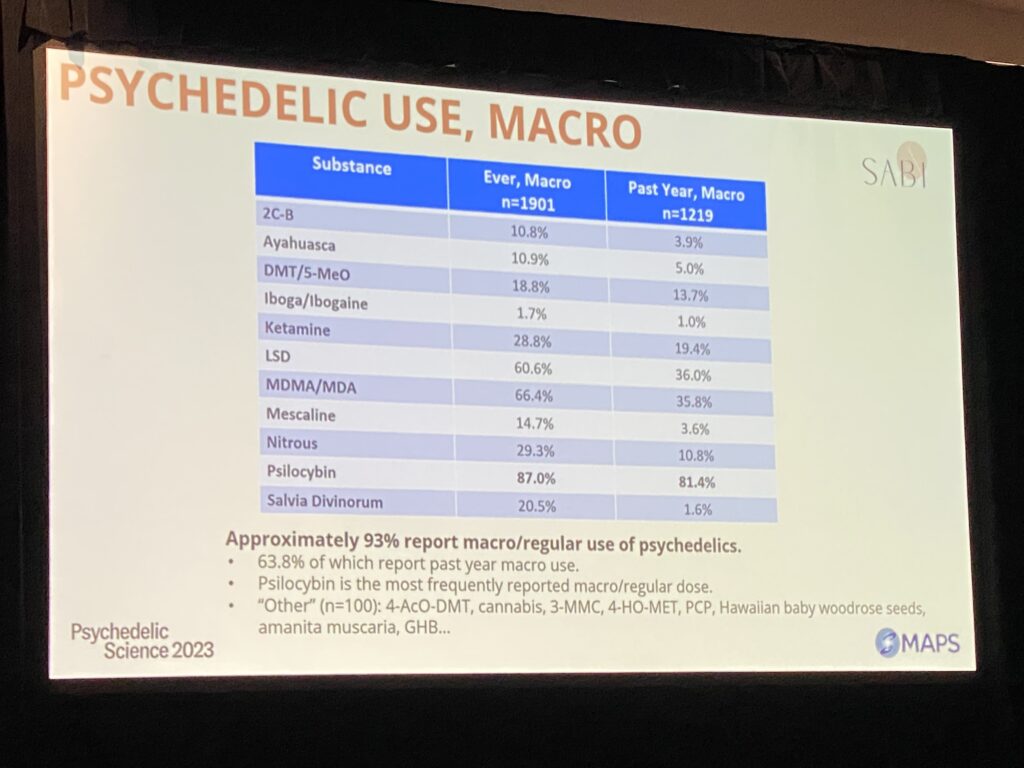
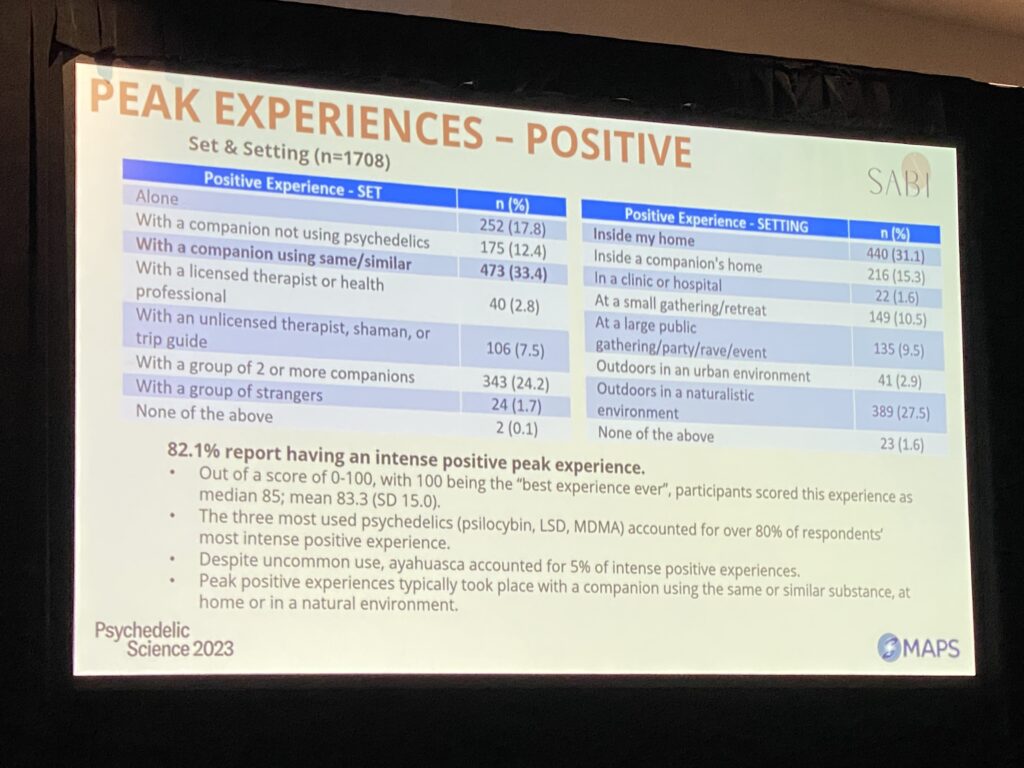
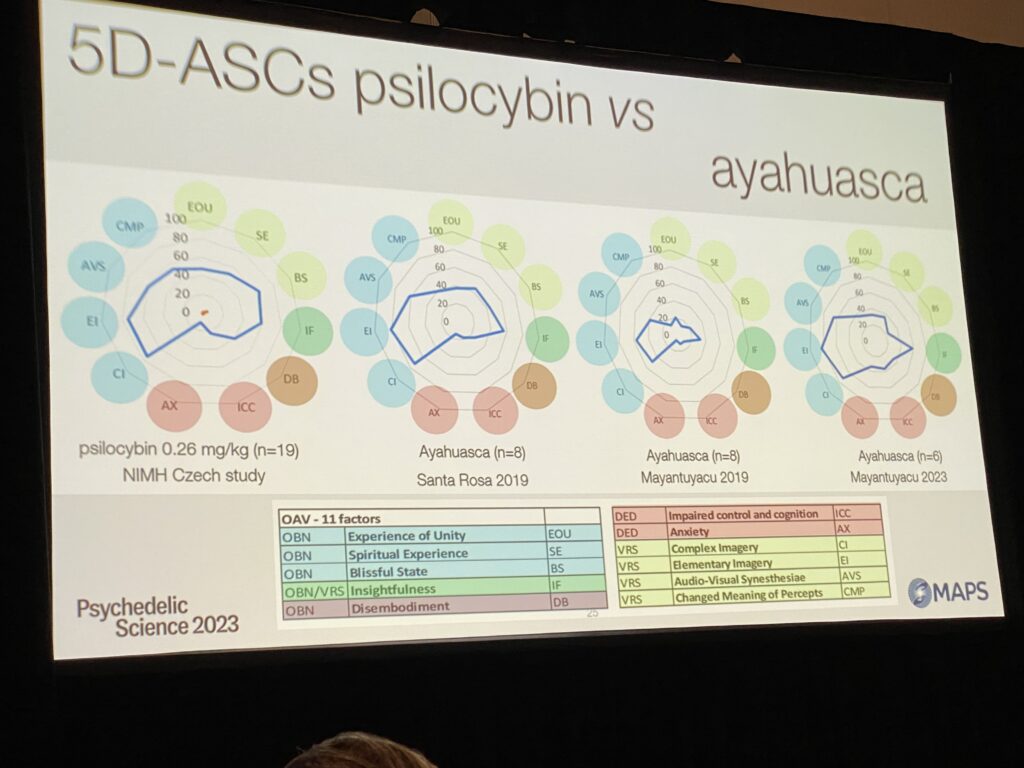
The Canadian Psychedelic Survey: Results of a Large Cross-Sectional Survey of Canadian Adults Who Use Psychedelics – I was late getting to this session since it began at the same time that the previous one ended, and it took time to switch rooms. But I caught most of it and loved what I saw being presented by Philippe Lucas, Ph.D. This was a data-rich presentation based on a massive 650-question survey answered by about 2400 Canadian psychedelics users. The sheer amount of data was very revealing, reminding me of Dr. Kinsey’s revelations about human sexuality practices. I went up and talked to the presenter afterwards, asking him a few more questions before heading off to dinner.
This slide showed psilocybin (magic mushrooms) to be the most popular psychedelic in Canada, followed by MDMA and LSD. Apparently in some Canadian cities, you can buy shrooms in certain marijuana dispensaries. That’s technically illegal in Canada, but some dispensaries aren’t very by-the-book about that, nor is local law enforcement.
This slide seems consistent with my own (very limited) experiences: “Peak positive experiences typically took place with a companion using the same or similar substance, at home or in a natural environment.”
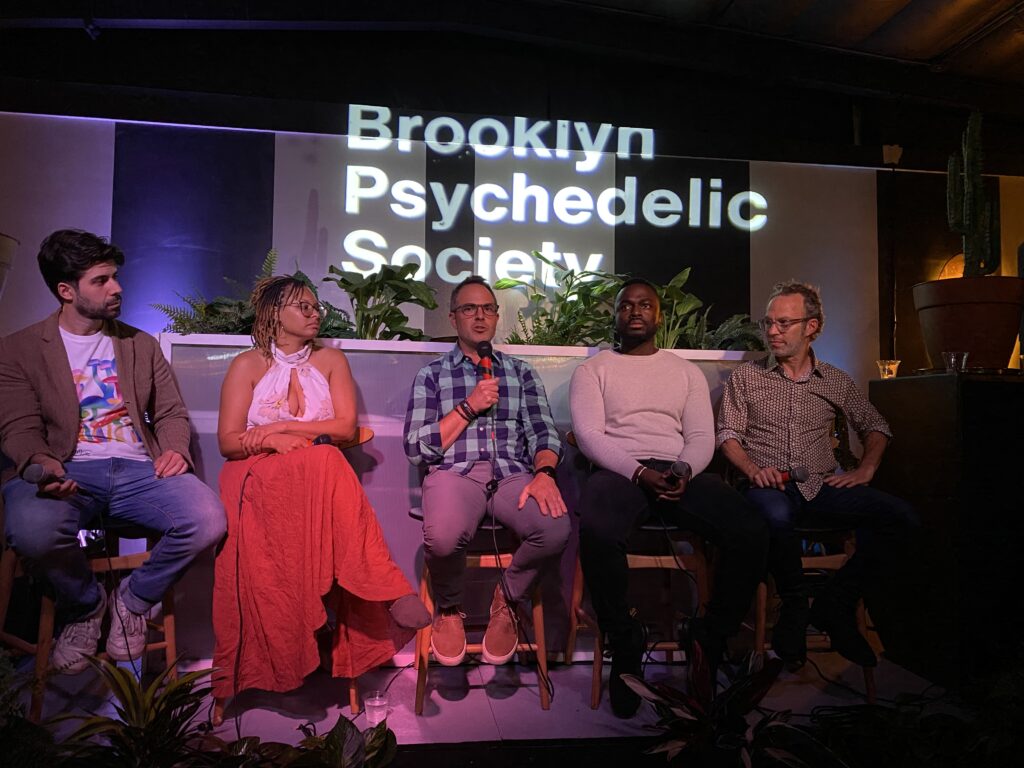
Between Two San Pedros: Building Transformational Psychedelic Organizations – This was a paid after-conference experience from the Brooklyn Psychedelic Society ($30 per person). It was a psychedelic talk show format (like Between Two Ferns) and hosted at a different venue. They got off to a rough start with some audio issues, including nearly blowing out the audience’s eardrums with screeching feedback noise from the large speakers – multiple times – as we howled in pain. They were also pretty late getting going, but once they took the stage and the panel got into a nice flow, I found it compelling and worthwhile. They discussed some interesting aspects of local psychedelic societies, including the legal and economic perspectives. The overall tone felt very aligned with a left-leaning New Yorker perspective. I liked that it broadened my understanding of psychedelic space, and I was glad I went. When they opened it up for Q&A, I asked a question and received some thoughtful answers. There were some concerns expressed about corporate money flowing into this field and doing a lot of damage. I wondered whether some consciousness behind psychedelics may actually be using the corporations to spread their own messages and energy, almost like a Trojan Horse.
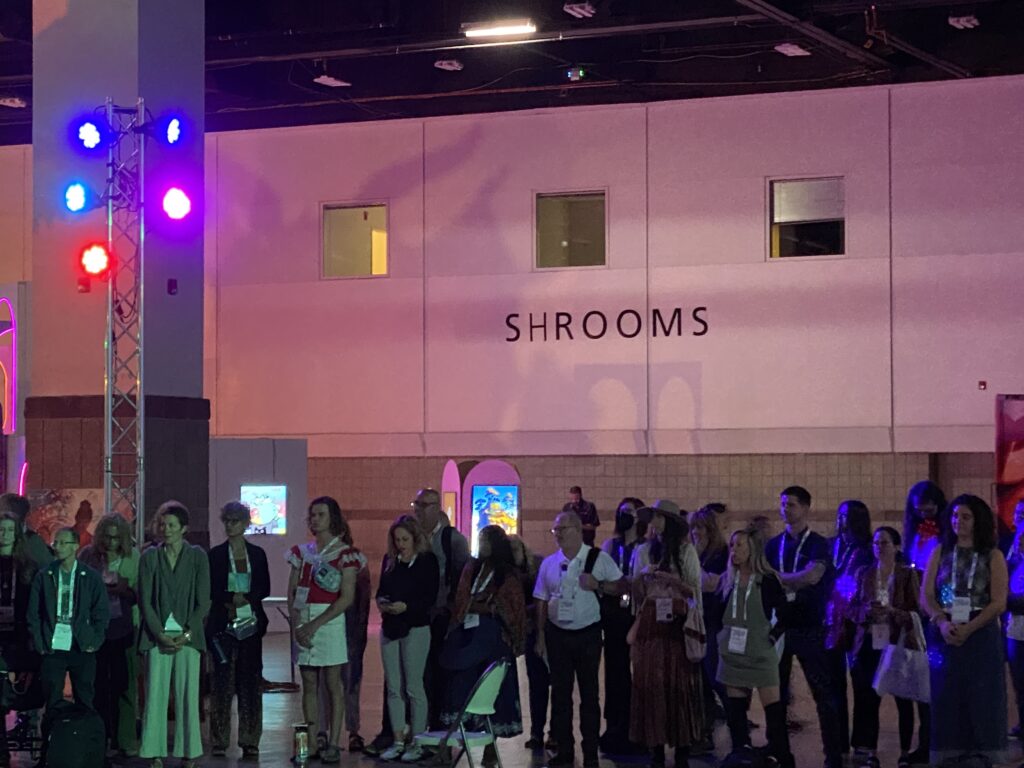
BPS Presents “Community is the Medicine” PS2023 Afterparty – Admission to this afterparty was included with the preceding psychedelic talk show, so we opted to stick around, hoping the party would be fun and interesting. It mostly wasn’t though. In one room there was some loud but weaksauce music with a few people dancing (or trying to) and way more people standing around as if they were waiting for some dance-worthy music to finally manifest. Rachelle and I danced a little, trying to make the best of it, but it was nowhere near as fun as what we’d experienced the previous Saturday at the Radiance Festival at Area15 in Vegas. If all they did was play 80s hits, I think everyone would have had more fun. I was offered some shroom gummies but declined because they weren’t vegan, and I’m not into eating liquified horse. The gummies were freely available to everyone there, provided by an event sponsor called Neudelic, which is also a candlemaker. I talked to people from the company about making vegan gummies at some point, but they seemed ignorant about it being possible and cited failed tests, even though other companies are already doing it. Rachelle and I mostly cuddled in a chair and later on a couch, watching some people consume various substances while others seemed to be waiting for something interesting to happen. At one point we watched a 5-minute movie from Neudelic, which was supposed to be some kind of sensory experience, but it really wasn’t worth the wait. Overall this party felt like a mishmash of odd components stuck together piecemeal but without much unity or cohesion. I had short conversations with a few people there, but the overall vibe felt off to me.
Friday, June 23
Opening Address (Plant Medicine Track) – This earned the distinction of being the worst session I attended since it was such an shameless bait and switch. Based on the description, it was supposed to be a session about “cultivating a personal, non-mediated relationship with plant medicines,” which sounded appealing. In actuality it was nothing but an advertisement for a psychedelic “church” called Chacruna, including inviting people to donate. Seriously there was zero content other than that. This kind of bullshit really did not belong at an otherwise awesome conference, so please don’t ever invite these presenters back. I wouldn’t be opposed to a public flogging either.
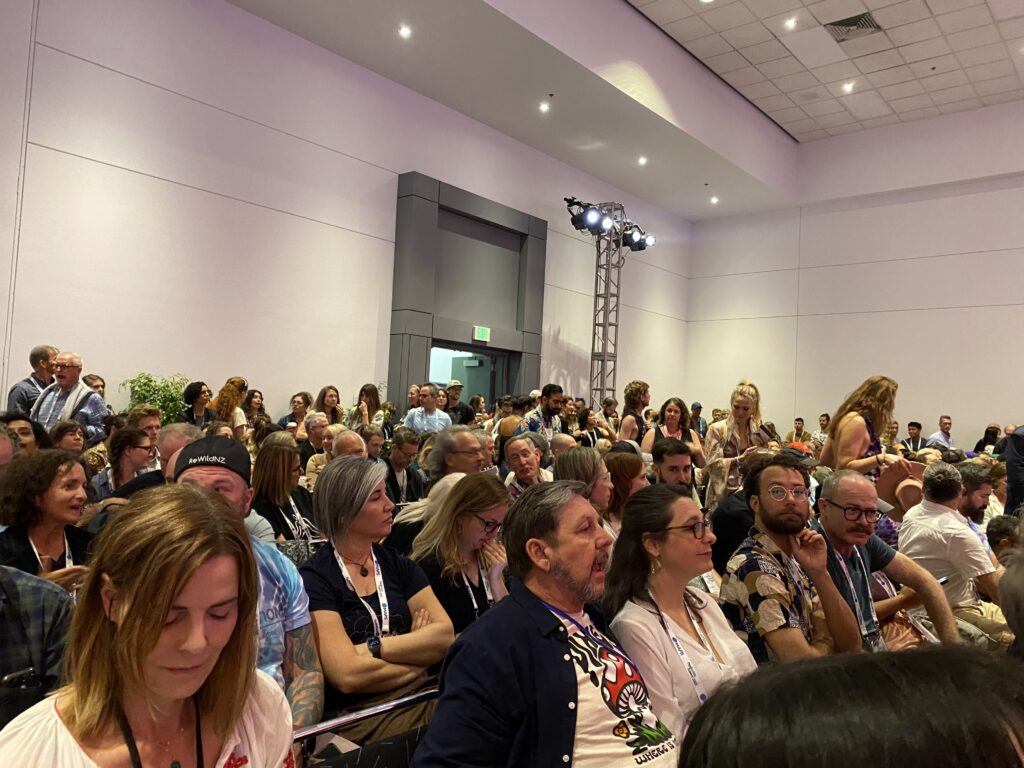
Sex and Psychedelics: Weaving Altered States for Healing and Pleasure – I had the feeling this would be a popular session, figuring that people in the psychedelic space are probably very sex positive, so we went to this one 20 minutes early just in case. We were lucky to snag seats because it was nearly full already, and by the start time, people were sitting in the aisles and packing the perimeter and doorways too. In fact they had to tell people not to sit in the aisles due to it being a fire hazard. This was a pretty awesome session with four lively women, including one who said she was a former sex worker, talking about two key aspects of this topic: 1) using psychedelics to improve your relationship with your sexuality, such as by healing sexual trauma; and 2) using psychedelics during sex to create different kinds of experiences, such as more oneness, intimacy, and heart connection. One interesting takeaway was that for the latter situation, it can work, but you’d better be open-minded about where it takes you. Taking psychedelics before or during sex can lead to unpredictable results. It might enhance the experience and make it very tantric. Or it might bring up some deep issues that you need to work through, perhaps with your partner, which may not lead in a very sexy direction physically, although it could still be beneficial long-term. That makes total sense to me. I’m not aware of any sexual trauma in need of healing within myself, at least not in this lifetime, and Rachelle is much the same, but I think the second option sounds worthwhile to explore at some point. I appreciated the reminder about not getting attached to outcomes when combining psychedelics with sex. If you’re in the mood for a specific kind of sexual experience, then psychedelics may not mix well. However, this also depends on which substances you take and how much. That said, I do feel like psychedelics could have benefitted me many years ago, in terms of helping to get past all the nonsense about sexuality that I learned growing up Catholic. It’s probably no surprise that the psychedelics community is rich in ex-Catholics like me.
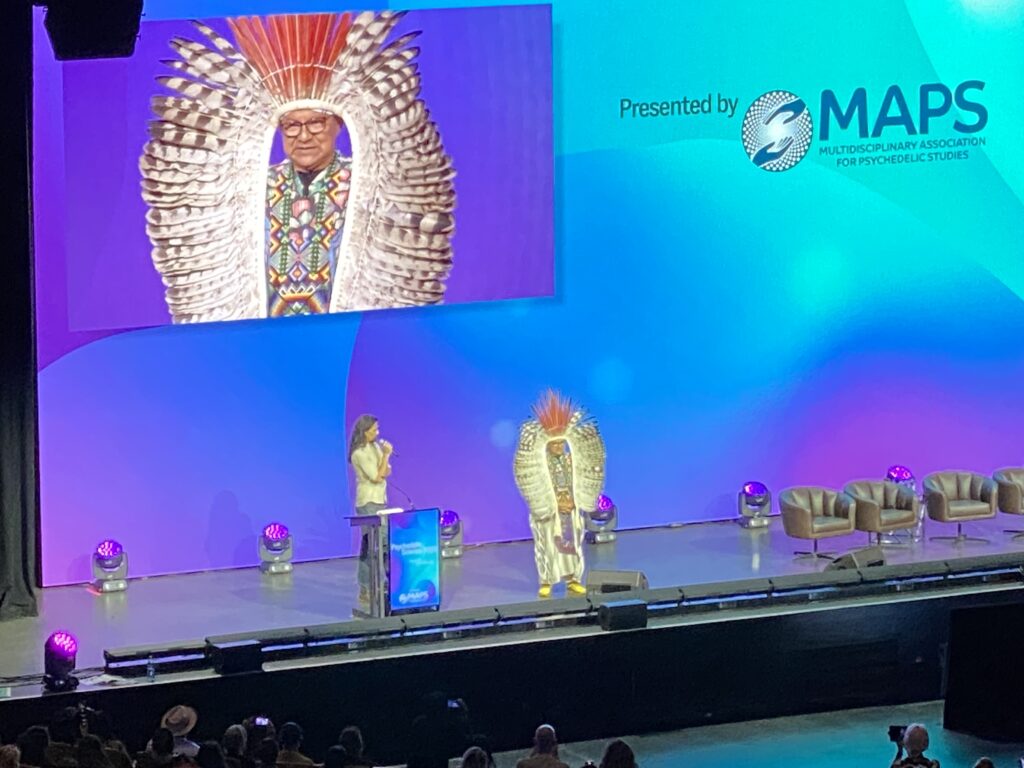
A Message From the Amazon – I went into this session thinking it would be packed with some interesting wisdom, and I left noting that there seems to be an interesting power struggle going on, which includes a number of players from venture capitalists to indigenous people to doctors and therapists to community-oriented psychonauts. Everyone wants to claim a seat at the table and influence how the field evolves. I don’t have a horse in this race personally, but it was hard for me not to see this talk through the lens of indigenous people trying to play the elder card, claiming a privileged position in the psychedelic theater due to their multi-generational history with plant medicines. I was actually rooting for them to make that case, but I don’t think they landed the plane. I left this session feeling even more aligned with cultivating an individual relationship with psychedelics, as opposed to wanting to work with a shamanic gatekeeper. Even with my limited personal experience thus far, I feel I’m better off learning from and journeying with friends, especially locally, and experimenting on my own with a strong focus on thoughtful intentionality, instead of putting someone else on a pedestal because they claim psychedelic elder status. I still want to be open-minded about this, but so far life seems to be steering me down a more individual and local community-oriented path. I prefer to have Rachelle or an experienced local friend as a sitter because I feel safer with them than with a shamanic elder I don’t know and who uses frames that I don’t necessarily resonate with. That said, there are many complex, interwoven issues at play here, and I’m still mapping out my preferred framing. Plus I like to stay nimble with the frames I use, strongly resisting wrapping any into my identity. So if you think I feel a need to defend these frames as “my stance on this,” don’t waste the keystrokes.
The Role of Previous Experience, Gender, and Set and Setting on Acute Psychedelic Experience and Its Persisting Effects – Due to timing I only caught the tail end of this session, where the presenter was sharing about his experiences with indigenous ayahuasca rituals, so I missed much of the data that may have been shared earlier. The small portion I saw reinforced the notion that psychedelic experiences are very sensitive to intention and environment. One way to invite more variety, if you want that, is to deliberately change the environmental factors, such as by doing psychedelics in a different country.
The War in Ukraine and Psychedelic-Assisted Therapy – This was a powerful and moving session about using psychedelic therapy to treat soldiers and civilians impacted by the War in Ukraine, shared from the perspective of two people who grew up in Ukraine and wanted to help. In addition to combat-related issues like PTSD, people are enduring so many other traumatic experiences due to this war. One panelist shared that Russians were injecting the genital areas of Ukrainian women with a foam that renders them sterile, so they can’t bear children. The main takeaway is that psychedelic therapy shows real promise for treating some of the worst psychological hardships that people endure. There was a different session at the conversion about Israelis and Palestinians using psychedelics to build bridges, although I didn’t end up attending that one. It’s impressive to see just how many ways psychedelics are being used globally, including in some of the most difficult situations imaginable. This session really gave me the impression that the psychedelic space is infused with deep compassion, caring, and courage. I can see why some people are very protective of those aspects as really don’t want corporate agendas fucking it up.
Psychedelics, Joy, and Celebration – This seemed like an upbeat topic, with two women talking about the happy side of psychedelics. I found it dreadfully boring though – slow, plodding, shallow, and without meaningful or interesting takeaways. If this was a video, I would have needed to play it at 4x speed. It was like watching two people talking about unicorns grazing on grass. I felt dragged down by a major nap field me from people around me getting sleepy, and I can’t blame them since I was in the thick of it too. Late afternoon sessions can be tough since people’s energy often starts to wane, so it’s important to keep the energy up when you have such a time slot, and these two women did the opposite, talking slowly and with long pauses. I searched for a reason to stay but couldn’t justify it, so after 25 minutes, I suggested an alternative to Rachelle, and she had no resistance to bolting with me. That tuned out to be a good choice since the closing session we flipped to (below) was way more lively and interesting. No nap field. My main takeaway from this session was to trust my instincts and not settle for partial matches.
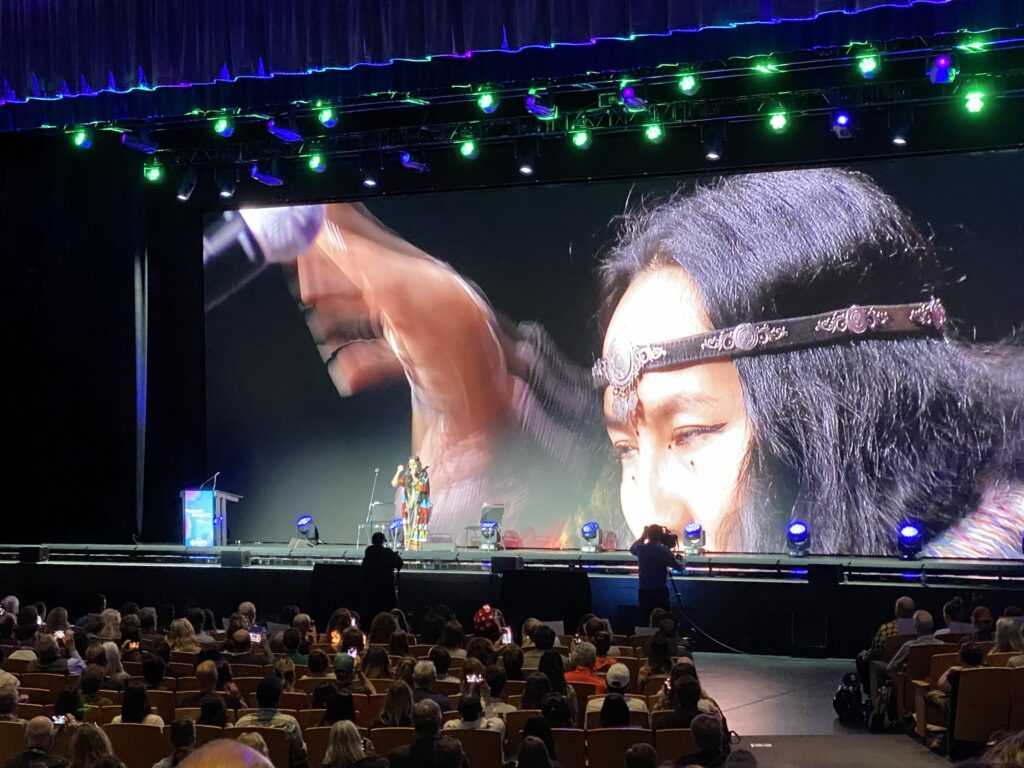
Reflections on Psychedelic Science 2023 (Closing) – This was a very different kind of closing than I expected – a collage with a surprise. First there were some nice final comments and musical performances, especially from Snow Raven, who performed an incredibly unique musical act showcasing her voice and some mouth instruments, including creating animal-like sounds. She was the star of the show and got a well-deserved standing ovation. Just wow.
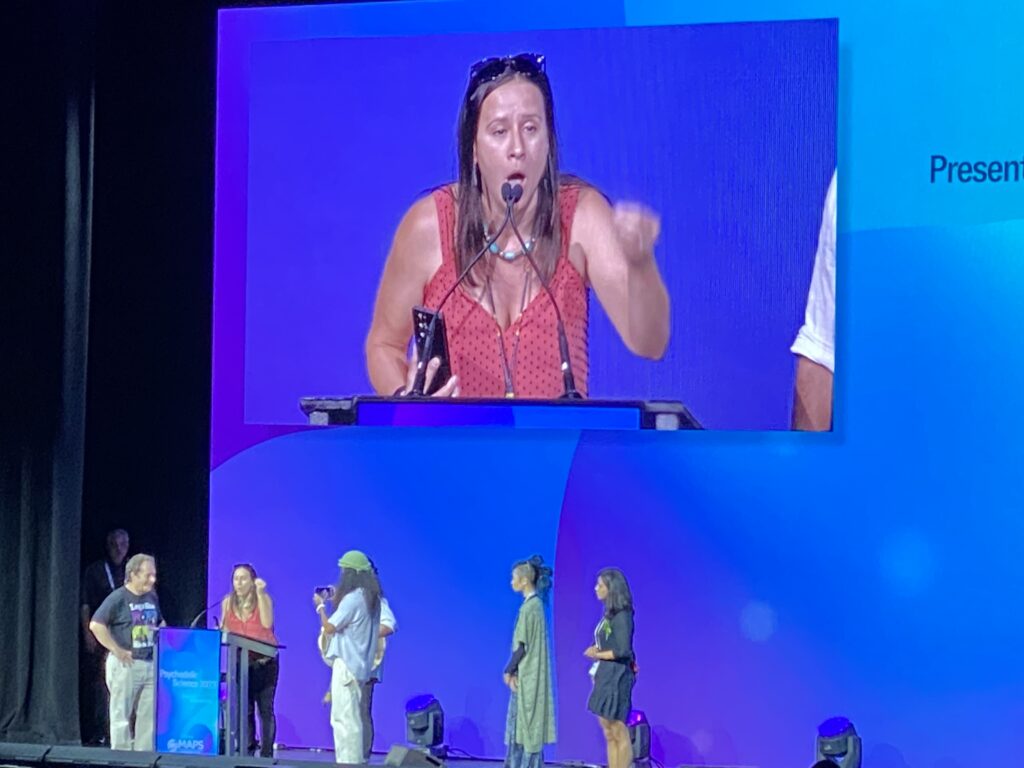
As Rick Doblin took the stage to share his final remarks, some drama ensued. A handful of protestors began shouting, with one of them banging on a large drum, proceeding through the audience and yelling something about our being lied to. Fortunately there was no violence, and I figured they’d be escorted out by security soon enough. Rick tried to verbally assuage them, telling them this wasn’t the right time and place for that, but as they persisted, he eventually flipped to the opposite approach and invited them on stage to say what they wanted to say. It really surprised me that he would do that, but I gathered that he knew at least some of them and that there was probably some history there. Several people took turns at the mic, each briefly voicing their objections, particularly about the commercialization of the psychedelic space and not sharing enough about the risks. One speaker noted how society had transformed what were originally plant medicines and ceremonial tools into addictive cigarettes (from tobacco), cocaine (from coca leaves), the opioid crisis, etc. He warned that we’re doing the same with psychedelics and that we aren’t learning from history. I must say that he did get me wondering about that. Are we heading towards the creation of the Big Psychedelics industrial complex?
Here’s a pic of the passionate protestors taking turns at the mic while Rick Doblin (on the left of the lectern) tries to make lemon Tek out of lemons, which oddly sort of worked. Psychedelic space is remarkably flexible.
Eventually Rick closed out the event, including inviting the staff on stage, but on a different note than he likely intended. I was impressed by how he handled it under the circumstances, but I’m not privy to the backstory that led up to this. And to their credit, the protestors shared their messages succinctly and without overdoing it. I was resistant to their take-over at first, but I do feel they added some value at the end, giving me even more to reflect upon.
I really appreciated the balance of diverse voices and viewpoints woven into the conference, at least from the parts I got to see. If anything the ending just further reinforced the myriad complexities of psychedelics’ potential impact on society. It’s a bit like generative AI in that regard – lots of benefits and plenty of risks, all woven together in an unpredictable package of emergent possibilities.
This conference further impressed upon me the importance of intentionality. With a different set, setting, and intentional framing, tobacco is a ceremonial tool. With corporate-style intentionality, it becomes a bunch of cancer sticks. It’s a potent reminder to keep reaching for the highest good with our intentions, and avoid succumbing to intentions rooted in neediness and greediness.
Saturday, June 24
On Saturday we attended some post-conferences events at the Denver Sports Castle, which was neither sporty or nor particularly castle-like.
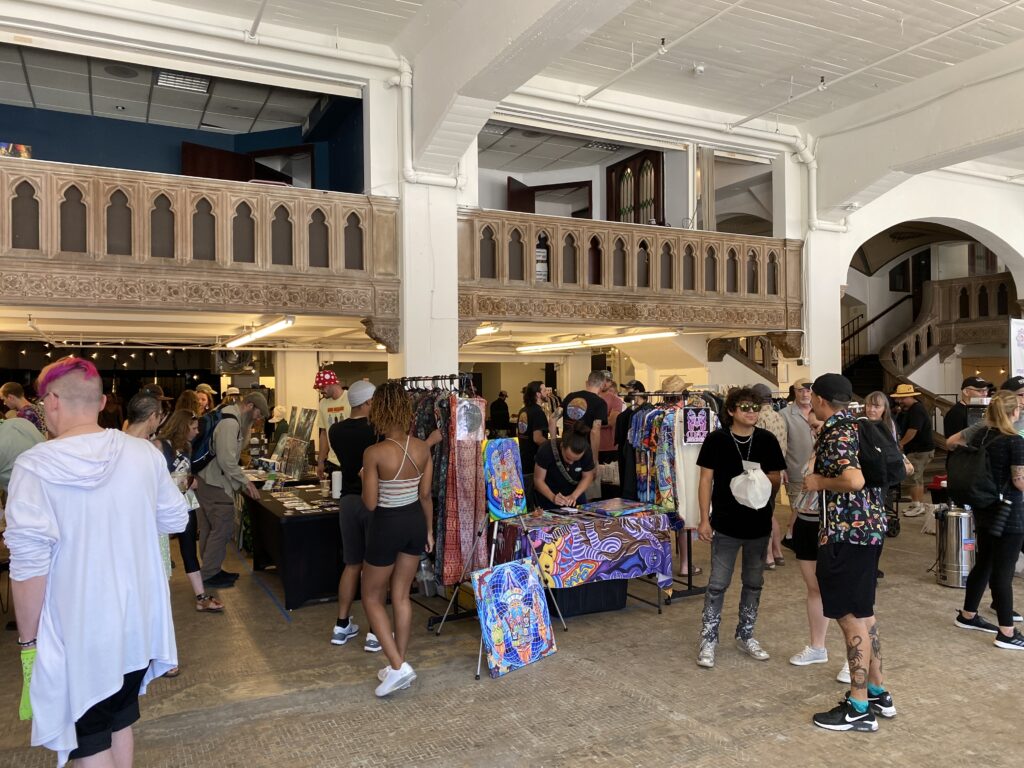
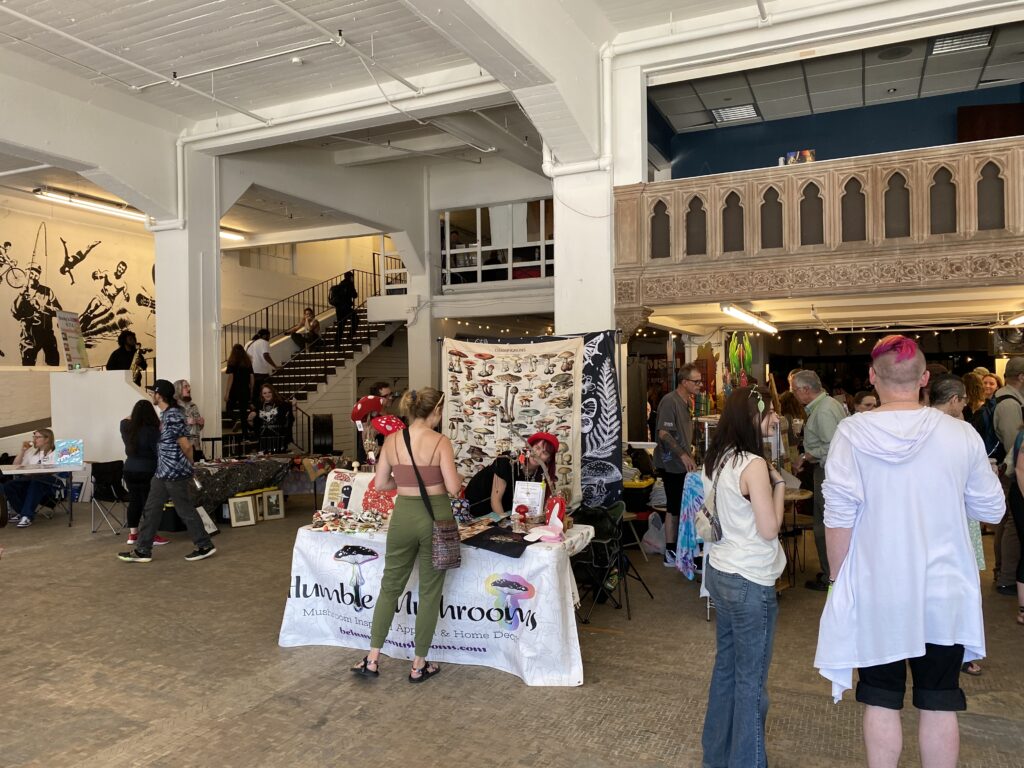
Mindful Marketplace – There was a small indoor marketplace running 10am to 5pm, with people selling psychedelic-related items such as clothing, artwork, jewelry, mushroom grow bags, and spore syringes. We browsed the market casually for a while, and Rachelle bought a nice little handbag. No one was selling psychedelics directly, since that would be illegal even in Denver, but as we experienced later that night at the after-party, it’s okay to grow magic mushrooms for personal use in Colorado, including giving them away.
Mycology Class (Denver Spore Company) – There were several extra classes offered throughout the day, tucked away in the back corner areas of the market. I opted to go to one mycology class, hosted by a guy with 17 years of experience. He did 30 minutes of instruction with slides, followed by 60 minutes of Q&A – a format that worked surprisingly well since there were lots of great questions, and he gave detailed, down-to-earth answers. He also passed around some grow bags in different stages of growth, so we could see the mycelium making progress in a substrate of brown rice and coco coir. I knew a decent amount about this already just from my own research (I’m a fast learner), and I was happy to gain some extra tips and details. It was well worth the $15 each and a nice opportunity to get answers to some questions from a very experienced guy. I also enjoyed some of his humorous customer service stories. This was another pattern I saw in some of the vendors – a nice heart-alignment with serving people and doing their best to help their customers have positive experiences. I noted again that a lot of people don’t want this pleasant vibe getting ruined by too much corporate greed flowing into the space.
Psychedelic Club of Denver Castle Bash (Afterparty) – For an extra $20 each, we attended this afterparty, which wasn’t bad overall. It still had weaksauce music like the Thursday night one, with the predictable impact on people’s willingness to dance, but it had some other redeeming qualities that made it more interesting. Early on there was a psychedelic speed-friending experience, where we did a few rounds of talking to people one-on-one for eight minutes each. I enjoyed that since I love meeting new growth-oriented people. They gave everyone some question cards to use as icebreakers, which was fine for getting started.
Out in front of the building, there was an arcade bus where Rachelle and I played some classic games: Teenage Mutant Ninja Turtles, Street Fighter II, and Super Mario Brothers. I used to be kickass at all three of those a few decades ago, including being able to pass the first level of SMB with my eyes closed, but boy was I rusty. Rachelle even kicked my ass at SF2. I’m never gonna tell my younger self about that if I encounter him during a psychedelic journey; that would only traumatize him. I could at least reveal to him that The Legend of Zelda series is still going strong… and that Octoroks are still assholes.
Later that evening they set up a game with a bunch of little rubber ducks, each of which had a QR code on the bottom. If we scanned each duck’s underside with a phone camera, some would lead to psychedelic-related articles, but two of the ducks would open prize confirmation pages. Whoever found both of those prize ducks could go track down a woman holding a bucket full of prizes and claim a prize from it. The prizes were crowd-sourced from people at the event and included various odds and ends. Some were as basic as a pen, a notepad, or a plastic mushroom.
I did the game and claimed the prize of an a dried shroom that someone had donated to the prize pool. This wasn’t too surprising since I saw people eating mushrooms at the event, and there was even a table with jars full of them as well as mushroom chocolates, seemingly free for the taking. In Denver it’s legal to grow and consume magic mushrooms (along with a few other psychedelics), but it isn’t legal to sell them. It’s legal to share them with others for personal use.
You can’t see it too well in the pic, but the stem had some bluish bruising, a telltale sign that it contains psilocybin. I wondered what variety it might be and figured it was probably Golden Teacher (very common). I showed it to a couple of people, including the guy in charge of substance identification. The people I talked to also agreed it was most likely Golden Teacher. This variety is known to be very beginner-friendly, both for growing and consuming. I had some interesting psychedelic experiences with this little guy, including later that night and the following night, but I’ll share that part of the story in a separate post a bit later. For now suffice it to say that I had a decent time at that party, and we left sometime after midnight. The party only ran till 1am, and it wasn’t the right setting for deep psychedelic journey.
Other Conference Activities
Exhibitors – There were dozens of exhibitors at the expo portion of the conference, mostly small booths with mushroom grow kits and spores, clothing, psychedelic societies and non-profits, chocolates, clothing, jewelry, etc. We didn’t have much time to walk through this space, but we briefly walked up and down the aisles just to see what was there. It was about as expected.
Deep Space – This was an experiential zone in one of the exhibit halls with a variety of experiences, vendors, and artwork. I liked the chill lighting in this space and wished I’d had more time to explore all the nooks and crannies of it. Rachelle and I especially enjoyed some of the artwork we saw.
Contemplative Sacred Space – I liked this little area and went there a couple of times to relax, chill, reflect, and briefly chat with other attendees. The area was divided into two sections, one area with a few cozy chairs and couches where people could socialize and another section with cushions for quietly meditating. I took advantage of this space to meditate for 10 minutes between sessions on Friday, which was very nice. I wish more conferences had spaces like this.
Therapy Dogs – There was a special room at the conference where people could take a break to interact with therapy dogs. That made me curious, so of course I had to check it out. Here’s a pic of therapy dog Louis enjoying Rachelle’s touch (I know the feeling). You might figure that interacting with lots of people might be a bit overwhelming for the dogs, but apparently they’re very social and extroverted dogs who enjoy connecting with humans, and the dogs are only “on duty” for a couple hours. We were told that left to his own devices, Louis would naturally go up and greet every human in the room, one by one. They also maintained a queue, so the dogs weren’t flooded with too many humans at once. Fortunately we popped in when it wasn’t busy.
Quiet Room – Across the hall from doggie land, there was a quiet room, which wasn’t an issue since the therapy dogs were very quiet and didn’t bark. We went in there just to check it out, and there were some people napping on the floor, plus a few tables and chairs, but otherwise it was just a small empty meeting room. I liked the contemplative space much better since it had nicer lighting, cushions, couches, and a bit of decor.
The Social Experience – I very much enjoyed the social aspect of the conference and the chance to engage, however briefly, with so many open-minded, growth-oriented people here and there. I felt totally at home at this conference all the way through. We even ran into a friend from our workshops and shared some meals together with him and had fun catching up – we didn’t know he was going to be there.
I also liked the conference’s style – reasonably well-organized given the scale, yet with a twist of counter-culture here and there. Note the modified restrooms sign in this pic, for instance.
Key Takeaways
This was a whirlwind of a trippy trip, and I’m so glad I went. I’d be delighted to go to this conference again, which could be even more massive next time.
I’m going to share a summary of my main takeaways from the conference in my next post, so I can separate the play-by-play of the experience from the more reflective insights.
In a different upcoming post, I’ll also share about the two magic mushroom journeys I did on the Saturday and Sunday nights after the conference. So stay tuned… 🍄
A mum has revealed how just six months after giving birth, she can’t remember the pain of labour. And it’s something many – but not all – can relate to.
“My husband thinks this is crazy. But I didn’t know if anyone else experienced this,” revealed the parent. “I gave birth almost six months ago and I don’t remember the pain.”
Advertisement
The phenomenon is not uncommon. Lots of women report not quite remembering the sensations of labour, even though they recall it was painful for them at the time.
“I vividly remember being in pain, and clutching the hospital bed rails with all my might, but the actual pain, [I] can’t recall it for anything,” said the mum, taking to Reddit.
“It blows my mind. Like I know I had contractions for hours, but I couldn’t even tell you what they felt like.”
Other parents were equally baffled and shared their own experiences of not remembering the sensations of birth. “I remember between (screaming through) contractions I said to my husband, ‘how do siblings exist?!’” said one.
Advertisement
“Two weeks later I’m picking out sibling names.”
But not everyone shared the reduced memory recall, as far as pain was concerned. “I can vividly recall every single pain and I’ve already decided to never do it again,” said one parent.
Another added: “Can’t relate. The pain haunts me daily.”
So, why is this?
Unsurprisingly it’s not a well-studied area, but one study of women’s memory of labour pain – from two months to five years after birth – found memory of labour pain did decline in a lot of women over a period of time.
But for those who had a negative overall experience of childbirth, the memory of labour pain didn’t decline. What’s more, women who had an epidural – suggesting they experienced extreme pain during birth – reported higher pain scores at all time points, suggesting that these women remember the ‘peak pain’ of labour.
In a piece for the Conversation, Monique Robinson, of the Telethon Institute for Child Health Research at The University of Western Australia, suggested lots of other factors can play a part in how a birth is remembered. So things like: satisfaction with care-providers, choice of pain relief, level of medical intervention, complications, outcomes for the baby, and other personal factors.
All of these would add up to either form a positive or negative birth experience. Positive experiences are less likely to be associated with pain, whereas negative ones are.
Advertisement
Discussing why some people might forget the pain of birth, Jennifer Conti, clinical professor of obstetrics and gynaecology at Stanford University, told Self her theory is that from an evolutionary perspective, the survival of our species could depend on women forgetting the pain of labour and birth.
“If you can’t remember how intense your [birth experience] was, maybe you’re more likely to do it again and reproduce,” she said.
“I often hear women say that they can remember that they were in pain during labour, but can’t actually recall the perception or intensity that well. On the other hand, there are women who swear they remember the event like it happened yesterday.”
Being pregnant and birthing a baby can be stressful enough, but getting pregnant and going into labour without even knowing about it? Well, that’s unlocked a new fear.
Some people are taking to TikTok to share their accounts of ‘cryptic’ or ‘invisible’ pregnancies.
Doctors swiftly realised she was crowning and she was rushed to the labour ward where, in 15 minutes, she’d given birth to a baby girl.
“Throughout my so-called pregnancy I had lost 30lbs, was the flattest I had ever been and had my period every month,” Simpson recalled.
What is a cryptic pregnancy?
In short, it’s where you don’t realise you’re pregnant because your body doesn’t really give you any of the tell-tale signs.
While for a very small amount of people they might not realise they’re pregnant until labour, a cryptic pregnancy can also apply to people who don’t realise they’re pregnant until at least 20 weeks.
Advertisement
Some people might not experience any symptoms, or very mild symptoms of pregnancy; others might blame their pregnancy symptoms on issues, like stress; and some might not grow a baby bump at all.
Why do some women not get a baby bump?
TikTok creator Nikki Salazer shared a video of her story. While she knew she was pregnant, it didn’t take away from the fact that not getting a bump felt a bit strange.
“As the months went by, I still had nothing,” she explained. “But I still had all the symptoms and felt kicking regularly. At eight months, I started to feel very heavy – but still, no bump.
“No-one could believe I was pregnant – even at the hospital. Thankfully, I had a healthy birth and delivery.”
Dr Karan Raj stitched Salazer’s video with some commentary of his own to explain just why these hidden bump pregnancies occur. “There are a number of factors that could contribute to this,” he said.
Advertisement
Apparently, it’s all to do with the shape of your uterus – and if you have a retroverted uterus, it’s easier for your baby to hide.
“Most women have an ‘anteverted’ uterus where it’s slightly tilted forwards,” said Dr Raj.
“But one in five have a backwards tilt towards the spine. For some women, it may remain tilted backwards for the duration of the pregnancy. This backwards growth could hide any bump.”
He explained that previous surgery, endometriosis and other gynaecological conditions could scar what’s known as the uterosacral ligaments, which “keep the uterus fixed to the spine and inside the pelvic cavities”.
“If these are stiff because of scarring, these ligaments can literally hold the uterus back and stop it from protruding too far out,” he said, which will result in a tiny little bump, or no bump at all.
Advertisement
And bad news if you’re tall… “If you’re taller, you’ll have a longer torso, so there’ll be more space for the uterus to develop upwards rather than just outwards,” added Dr Raj.
Gym bunnies should be wary, too, as a super strong stomach could have the same effect.“If you have well-developed rectus abdominal muscles, the uterus may develop closer to your core, rather than protruding out,” he said.
Other causes can include:
Having recently given birth,
PCOS,
Peri-menopause.
How common are cryptic pregnancies?
The good news is cryptic pregnancies are relatively rare. Studies suggest that around one in 475 pregnancies aren’t noticed until about 20 weeks gestation, which is halfway into the pregnancy.
And around one in 2,500 pregnancies go completely unnoticed until delivery.
On the upside, not having a huge bump getting in the way of tying your shoes, picking things up and generally moving around can be super beneficial.
But the emotional trauma of suddenly going into labour must be… well, a lot.
Although as Kayla Simpson said: “Within those 15 minutes my life changed forever – and now I can say for the better … Obviously I was in shock but I do think that things happen for a reason.”
Let’s be honest: the breakfast buffet is one of the best parts of going on holiday.
Those continental set-ups with the croissants, cheeses and delicious orange juice help set you up for the day in just the right way.
But if you’re watching your health then it might be good to know there are definitely more nutritious options to pick when you’re having breakfast.
Advertisement
Healthy-living advocate Michael Mosley can help you there, as he’s shared his list of foods to steer clear of when it comes to holiday breakfasts, as part of his Fast 800 programme.
His no-go list includes…
Fruit juices and dried fruit
Pastries
Cereals
Muffins and cake
Hash browns
Why? Well, recent research shows that processed foods such as muffins, cakes and pastries aren’t amazing for our long-term health.
And deep-fried foods like hash browns can contain a lot of saturated fat from the oil they’re cooked in, plus added salt.
So, what should you eat instead?
If you want to maintain energy levels and stay healthy while away, Mosley recommends these breakfast items instead:
Advertisement
Omelettes – some hotels have omelette stations where you can choose your own fillings, so don’t be shy with the vegetables. Eggs are particularly good for breakfast, at around 6g of protein per portion and packed with nutrients and minerals.
Greek yogurt – rich in protein, calcium and iodine, Greek yogurt with a side of fresh berries is a fab way to get your day started.
Veggies – you’ll often find veggies like spinach, tomatoes and mushrooms at the breakfast bar, which, luckily enough, pair really well with eggs (see above).
Cheese, nuts and avocadoes are great healthy fats to add to your plate as they’ll keep you fuller for longer.
With that all said, if you’re anything like me, holidays are the time to let loose and really enjoy yourself. So, I will be stacking my plate high with pasteis de nata when I visit Portugal later this year, thank you very much.
And maybe I’ll add some berries on the side… You know, for balance.
Of all the summer maladies, I reckon hayfever is among the worst.
The constantly-watering eyes, the itchy nose, the explosive sneezes – I’d happily trade a couple of days’ worth of sun for some sniffle-free time, ta very much.
If you’re anything like me, you will have tried every conventional hayfever-busting trick in the book. But for some reason, the pollen this summer seems to have some serious hands.
Advertisement
Thankfully, Dr. Karan Raj recently took to TikTok to explain three of the best lesser-known antidotes to hayfever – including everything from pro-level meds to sneaky hair-washing hacks.
Here’s what he had to say:
Make absolutely definite you’re doing the basics
OK, OK, I know I started this off by saying that you’ve probably tried all the better-known solutions.
But just in case, Dr. Raj listed all his favourite go-to hayfever hacks to check off before you try anything drastic.
These are:
Wearing Vaseline, or another petroleum jelly, around your nostrils
Wearing sunglasses when you’re out
Washing your hair before bed to clear out any stray pollen
Not drying laundry outside, where your clothes can catch pollen
Changing your clothes frequently
Once you’ve got those covered, he recommends trying what he calls “extras”.
1) Nab yourself some fexofenadine
When it comes to hayfever symptom-relieving tablets, it turns out that not all options are created equal.
Fexofenadine, Dr. Raj says, is the “strongest over-the-counter medication you can buy” for hayfever.
Sure, it might cost a little more than your usual faves – but its “much stronger” active ingredient, fexofenadine hydrochloride, could well be worth a shot.
Just make sure you actually *are* getting the active ingredient on there, Dr. Raj says.
2) Irrigate your nose
Yes, taking meds is easy and can be effective – but as Dr. Raj says, “It’s in your nose holes that pollen can get trapped and cause reactions.”
Flushing your nostrils with water or a nasal spray can loosen the trapped pollen, potentially relieving you of those cursed symptoms.
But the doctor stresses the importance of using the nozzles products like nasal sprays correctly.
“Don’t point up towards your brain,” he says. He recommends we point “sideways, towards (our) ears” instead.
While the arrival of summer brings the opportunity to spend more time lounging on your lawn or hiking woodsy trails, we’re not the only ones excited about the long, warm days ahead: Ticks are most active from April through September. And while no one wants a bug bite, ticks are significantly more threatening than most insects.
While treatable with antibiotics if caught early enough, if it’s left untreated, Lyme disease symptoms can spread to the joints, heart and nervous system, which is why it’s important to catch it early (or, ideally, to avoid getting it at all).
Below, infectious disease experts share the most common early symptoms of Lyme disease so you don’t end up with a chronic case of it ― and how to avoid getting it in the first place.
The Top Early Signs Of Lyme Disease
Dr. Tammy Lundstrom, an infectious disease specialist at Trinity Health in Michigan, and Dr. Sarah Park, an infectious disease clinician who works at the life sciences company Karius in Honolulu, suggested looking out for the following early signs of Lyme disease.
A ‘Bullseye’ Rash
Formally called “erythema migrans,” a rash that looks like a bullseye or target is the most common early Lyme disease symptom, according to Lundstrom.
Advertisement
“It can be very faint, however,” she said. “It also may be absent in 20-30% of cases and can be hard to see on darker skin tones.”
Park added that this rash typically appears within three to 30 days following a tick bite.
Flu-Like Symptoms
Between COVID, the flu and even the common cold, if you find yourself with achy joints, chills, a fever, a headache or other flu-like symptoms, Lyme disease may not be the first thing on your mind. But these symptoms could be signs of it.
“These symptoms can easily be mistaken for a common viral infection such as a cold or flu,” Lundstrom said. “However, the onset of these symptoms paired with potential tick exposure ― for example, hiking in the brush, woodsy areas or tall grass ― occurring three to seven days afterward can signal Lyme disease is a possible cause. Be sure to consult with a medical professional, especially if you identify the bullseye rash or develop other noted symptoms.”
Fatigue
Sudden fatigue could also be an early Lyme disease sign.
“Fatigue is an early sign that is frequently dismissed and assumed to occur from not enough sleep or regular everyday activities like working out,” Park said.
Non-Bullseye Rashes
Other rashes that don’t look like a target could be an early sign of Lyme disease, too.
“A bullseye rash may first appear as a small red bump or a solid red patch that gradually expands, but not everyone develops this type of rash,” Park said. “Other skin manifestations like hives or discomfort similar to a sunburn can also occur.”
Advertisement
FG Trade via Getty Images
Fatigue is one of the hallmark signs of Lyme disease.
How To Prevent Lyme Disease
While Lyme disease is treatable when caught early enough, the best case scenario is that you don’t get it at all — which is why it’s key to protect yourself from ticks, be aware of the early signs of Lyme disease, and know when and where you’re most likely to get it.
“The illness is caused by ticks in the nymph stage, not adults,” Lundstrom said. “They may be very small, around the size of a poppy seed, and hard to see, but it is important to do a thorough check for ticks after outdoor activities. This includes skin folds and your hair. Early recognition and treatment are key to preventing chronic symptoms such as arthritis, headaches, neck stiffness and facial drooping.”
In addition to checking for tinier ticks (remember: the size of a poppyseed!) Lundstrom recommends wearing long pants and long-sleeved shirts when hiking.
“Treat clothing with 0.5% permethrin or buy pretreated hiking gear, and use EPA-registered insect repellent containing DEET,” she added. “Walk in the centre of trails for less contact with brush and grass, and always examine skin and clothing carefully and shower to wash off unattached ticks upon returning from a hike.”
Advertisement
If you prefer a DEET-free alternative, Lundstrom said picaridin, IR3535, Oil of Lemon Eucalyptus (OLE), para-menthane-diol (PMD), or 2-undecanone are options to look for in an EPA-registered insect repellent.
It’s also important to do regular tick checks if you live in an area with more Lyme disease and to seek help right away if you’re noticing any signs that could be symptoms of the disease.
Finally, know that in most cases, a tick has to be attached to your body for 36 to 48 hours before Lyme disease can be transmitted, which is why checking for and removing ticks quickly can make all the difference when it comes to Lyme disease prevention.
While a Lyme disease vaccine may be a possibility at some point in the future, for now, it’s a reality we’re living with. So know the signs, wear protective clothing and bug spray, and do regular tick checks this summer. Trust us, you won’t regret it.
Sitting in my Brooklyn apartment early one Friday morning, sipping on a mug of strong coffee, my cell phone pinged. “The eagle has landed,” the text message read, and I quickly threw on a jacket, ran downstairs, and hopped on my bike to pedal about three miles south, to the historic neighbourhood known as Ditmas Park. Pulling up to the street I was looking for, I pumped the brakes to cruise into my friend Adam’s driveway, where an insulated lunch box was waiting for me on his doorstep. I carefully placed the precious cargo into my bike’s rear basket, and set off straight for home: Time was of the essence.
Back in my apartment, I breathed a sigh of relief that my roommates had already left for work, as I was about to attend to a task so embarrassing and so frankly disgusting that I would not want another soul to bear witness to it. Setting myself up in my bathroom, I unzipped the lunch box to reveal its contents: A zip-top plastic bag containing one perfectly formed human turd – yes, I’m talking about poop – still warm, naturally, from its brief stint inside the padded box.
Advertisement
Working quickly in order to avoid introducing air into the bag – and also, let’s be honest, because the task was gross – I tipped a small quantity of saline solution into the bag, zipping it back up and using my hands (from the outside of the bag, of course) to mash the saline into the poop to approximate the thickness of a chocolate milkshake (my apologies for ruining that craving for you).
Once achieving that texture, I snipped a corner off the plastic bag, squeezed the brown mixture into a disposable plastic enema bulb, and lay down on my side atop a clean towel I had placed on the bathroom floor. Pulling my knees up to my chest, I reached behind me, squeezed the bulb’s contents into my rear, and browsed social media on my phone for about 15 minutes, at which point I placed my legs up the wall and waited for another 15 before going about my day.
What kind of a person would do something so astonishingly nasty and incredibly taboo? A perfectly normal one, I assure you – but also a very sick and desperate one. The process I describe above is known as a DIY or at-home faecal transplant, and I performed my first such treatment back in the fall of 2018. A
bout a year prior, I – a formerly very active, healthy, and vibrant 31-year-old – had become very, very sick, more or less overnight. Whereas my days used to be packed with such varied activities as researching and writing freelance journalism articles, biking all over my borough, cooking elaborate meals to enjoy with friends, and attending yoga classes, in that time I had gradually become housebound with symptoms such as joint pain, digestive issues, the confused thinking known as “brain fog,” and chronic fatigue that had me sleeping up to 18 hours a day.
Advertisement
By this point, I was no longer living, but just surviving, day in and day out, as I attempted to piece together what, exactly, had gone wrong.
Prior to my descent into chronic illness, the only sickness I had ever known was a short-lived cold or headache. Therefore, I was truly out of my depths when it came to sleuthing out the cause of my symptoms, which had been kicked off by a course of common antibiotics I took for a urinary tract infection in 2017.
Shortly after finishing the meds, I started to experience all sorts of bizarre things: My scalp itched incessantly as if I had lice, my extremities were hot to the touch and visibly inflamed, and my former stomach of steel suddenly had trouble digesting foods I’d eaten my whole life. At the time, I was living abroad in Mexico, and was forced to travel back to New York to seek medical attention.
At my first appointment with a naturopath recommended by a friend, the doctor looked up from the notes she was scribbling furiously when I mentioned the recent course of antibiotics. “Are antibiotics something you take frequently?” she asked. “Actually, yes,” I replied. I explained that throughout my 20s, I had been plagued by frequent and painful UTIs, and that doctors always prescribed antibiotics for them. Together, the naturopath and I figured out that I had ingested about 15 rounds of antibiotics in adulthood alone, and who knows how many as a child.
Today, it’s fairly well known that this class of drugs, while lifesaving in certain cases, is vastly over-prescribed and can negatively affect the health of the complex ecosystem that resides in our guts, known as the microbiome or microbiota.
Advertisement
There, up to 1,000 species of bacteria (ideally) live in harmony, forming the basis of our immune system and helping the body not only to digest food, but also to stave off invaders such as harmful bacteria and viruses.
But at the time, I didn’t know that antibiotics kill off both beneficial and pathogenic bacteria indiscriminately, a mechanism the new naturopath explained to me. Especially when overused, the drugs can permanently eradicate species of good bacteria in the gut, she told me, leading to system-wide malfunction in the body, and, potentially, symptoms such as irritable bowel syndrome, chronic sinus infections, and chronic skin infections.
The naturopath suspected that my myriad of symptoms stemmed from a gut depleted of various species of beneficial bacteria, and she suggested a course of treatment that included absolute avoidance of antibiotics and a diet rich in fermented, probiotic foods such as sauerkraut. But back at home, where I continued to research the issue online, I learned that the healthy bacteria in fermented foods don’t readily survive in the gut, which is, after all, a completely different environment than a strand of cabbage. The only known way to repopulate the gut with native strains of bacteria is through the infusion, to put it nicely, of faeces from a healthy “donor”: aka, a faecal transplant.
Known to livestock farmers – who observed that giving an enema made of poop from a healthy animal to a sick one could, in many cases, save the latter animal’s life – for at least a century, a faecal transplant consists of administering from a healthy subject to to the rectum of one that is sick, typically with the type of chronic diarrhoea that often leads to death due to extreme dehydration.
There, the beneficial bacteria from the healthy subject immediately start to colonise, restoring the immune system and helping the sick animal recover.
Advertisement
Eventually, the medical world caught on to what farmers had been doing for ages, and in 1958, the first faecal transplant in humans was used to treat the often-mortal gut infection known as Clostridioides difficile. Since then, FMT, as the process is known (short for faecal microbiota transplant) has been used regularly – with great success – to save the lives of patients struggling with this dangerous infection.
Unfortunately for patients facing the repercussions of antibiotics overuse, C. diff is the only approved hospital use for faecal transplants. For those who hope to treat chronic conditions such as IBS, liver disease, and neurocognitive disorders, the only settings that provide the treatment are private centres such as England’s Taymount Clinic and Australia’s Centre for Digestive Diseases, where in-patient courses of several FMT procedures can run up to $6,000 out of pocket.
In my case, as in the case of many others suffering from chronic illness, the only affordable option is a DIY one. Known as DIY or at-home FMTs, rogue faecal transplants have been something of a trend over the past decade.
Many websites, such as The Power of Poo, as well as tons of firsthand YouTube accounts exist to walk brave at-home FMTers through the process. Those suffering from sickness are advised to locate a “donor” who has a spartan history of antibiotic use, a balanced organic diet, and, of course, excellent digestive health. Many desperate people will go ahead with FMT based on those criteria alone, but others – like myself – will collect a potential donor’s “specimen” and have it laboratory-screened for common pathogens such as E. coli bacteria and Epstein Barr virus.
I identified three possible donors – among my closest circle of friends, who I knew wouldn’t judge me for my interesting choice of treatment – and tested their poo. Sadly, the results were mixed –clear evidence of our modern, toxic way of living – but Adam’s results were the best by far. After ironing out the unsavoury details with him, we entered into the rather unusual agreement.
Advertisement
All in all, I completed about 12 at-home FMTs, the process becoming decidedly less unsavoury as I noticed some positive changes such as an easing of my extreme chronic fatigue and fewer allergic reactions to foods.
Unfortunately, however, I didn’t experience the dramatic healing reported by many of the online accounts I had found, and I continued to dig into other possible causes of my symptoms. Eventually, towards the tail end of my treatments, I received a positive diagnosis for Lyme disease – which made sense considering that my symptoms started around the time that I had not only taken that course of antibiotics, but also immediately after a hiking trip to the Catskill Mountains in New York State, an area infamous for its high incidence of tickborne illness.
Using a just as off-the-beaten-path – but far less gross – treatment known as bee venom therapy, which harnesses the antibiotic and anti-inflammatory effect of live bee stings, I was able to fully recover my health, and have been well for more than a year. But I’ll always maintain – from a distance, of course – a certain level of respect for the healing power of poop.