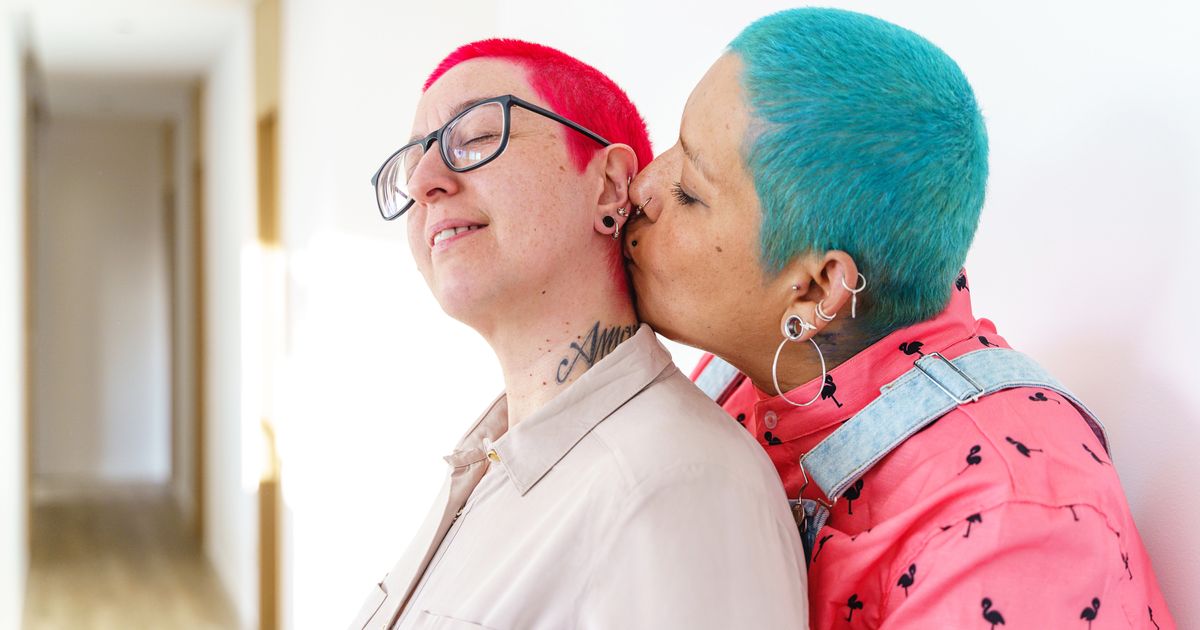
One of the eternal truths about sex is that we all do it a little differently, and have different relationships with bedroom antics.
However, this Pride month, the sexperts at Beducated have shared that they believe that heterosexual folks could learn a lot about sex and intimacy from their queer counterparts.
Advertisement
Given that heterosexual women orgasm less than LGBTQ+ women, we reckon that there are definitely some essential insights we could all learn from.
What straight people can learn from queer sex
There is no ‘right way’ to have sex
While a lot of us feel pressure to perform well in the bedroom and get it ‘right’ when it comes to sex, there’s actually no wrong way to have sex and orgasms can come (pun intended) without any penetration.
Beducated CEO Mariah Freya said: “There is this outdated misconception that sex is only complete when there is penetration involved. That can be a problem because it makes penetration the main event.
“However, we know that people with vulvas require more than just penis-in-vagina action to reach an orgasm.”
Advertisement
Your gender doesn’t define whether you’re submissive or dominant
While there is no gender behind these roles, society often imposes rigid gender roles in sexual dynamics, expecting straight men to be dominant and straight women to be submissive. Queer sex challenges these norms.
Freya said: “Why let gender define how we express ourselves in the bedroom? Instead, think about the role you find most pleasurable, expectations be damned.”
Toys and gadgets are your friends, not foes
Sex toys and accessories are not just for replacing body parts; they can enhance sexual experiences significantly and bring a whole lot of fun to the bedroom.
Freya said: “Lesbian folks are often asked, ‘Don’t you miss dick?’ Cringe aside, sex sans penis doesn’t mean you have to skip the penetration — there are dildos for that.
“Beyond replacing body parts, toys, lubes and accessories can elevate sex to a whole new level.”
Outdated prejudices limit your pleasure potential
Freya said: “People with penises are blessed with this small gland called a prostate, which has the potential to lead to next-level orgasms. For some ridiculous reason, we’ve decided as a society to completely ignore it because prostate stimulation involves getting close to – gasp – the anal region.
Advertisement
“Imagine having something that powerful, and not using it because of prejudice. The world is upside down.”
There is no magical secret to orgasms, just knowledge
Though the orgasm gap between straight and queer women is a real thing, it really doesn’t have to be, and Beducated believe the only difference is a knowledge gap.
Freya said: “You don’t need to have a vulva to know how to turn one on; all you need to do is educate yourself.
“Getting familiar with vulva anatomy means you can find the G-Spot and cervix, for example. Sure, clitoral stimulation is great, but that’s just the tip of the iceberg. The same goes for male body anatomy – you want to know where the perineum is, or how to approach hand jobs when your partner is (or isn’t) circumcised.”
In yet another blow to PM Rishi Sunak as his campaign continues to flounder, YouGov has revealed that that two thirds (67%) of Brits disapprove of the government’s record.
Advertisement
Three quarters (73%) think the UK is a worse place than it was 13 years ago, too – and that includes a majority (59%) of 2019 Tory voters.
In fact, even 61-68% of those planning to vote Tory in the next election agreed.
Of the 2,040 adults polled between 29 and 30 May, only 8% think the UK is better now, and 11% think life is pretty much the same.
YouGov also asked participants what they thought about how the government has handled 21 different topics, from social issues to healthcare.
The respondents were most united in their reaction to how the cost of living has changed over the last 14 years – 85% said the Tories had made it worse.
Advertisement
This was closely followed by the NHS, which 84% thought had worsened under the Conservatives.
The poll offered similarly bleak reactions over what has happened to immigration system and the economy in the last decade and a half with 78% saying both areas had worsened.
This will be an especially disappointing result for those in the Conservative headquarters considering the party has been pledging to reduce the number of migrants since David Cameron got into office.
The party has often portrayed itself as the one which is best at managing the economy, too – but it seems that reputation is now in tatters.
In fact, more than half of participants thought the Tories had made 15 of the 21 issues worse – including housing, crime and policing, Britain’s standing in the world and standards in public life.
A majority also had a poor opinion of what’s happened to the health of British democracy, the tax system, transport, schools, the state of the armed forces, the welfare system and local government services.
Advertisement
In most ways, most Britons think the UK is worse now than it was in 2010
% who say the following are now worse than in 2010 Cost of living: 85% NHS: 84% Immigration: 78% Economy: 78% Housing: 72% Crime/policing: 71% Britain’s standing in the world: 67% Standards in public life:… pic.twitter.com/U24Sb33tIn
More than half (57%) said they thought Rishi Sunak was a poor or terrible prime minister, and only 13% thought he was a great or a good one.
YouGov is not the only one predicting a pretty bleak turnout for Sunak at next month’s election, either.
On Tuesday, Survation’s mega poll predicted the Conservatives face electoral wipeout at the general election, with just 71 MPs in a potentially “extinction level event” ahead.
Still struggling? You could be unknowingly consuming something that’s to blame. According to sleep doctors, there are more foods and drinks that can mess with sleep than people realise. Rounded up here are seven foods and drinks that sleep doctors recommend steering clear of if you struggle with sleep. Plus, they offer guidance on which foods will work for you, not against you.
Advertisement
7 Foods And Drinks That Surprisingly Can Cause Sleep Problems
1. Spicy foods
Digging into some hot chicken wings or curry at dinner could cause sleep problems when you head to bed. Dr. Abhinav Singh, a board-certified sleep medicine and internal medicine doctor, is medical director of the Indiana Sleep Center and a medical reviewer for Sleep Foundation. He told HuffPost that eating food that’s spicer than you’re used to can increase acidity in the stomach, which can cause acid reflux that can make sleeping difficult. Singh explained that gastric acid is already naturally higher at night, and if it continues to rise, it can disrupt sleep.
Dr. Ruchir P. Patel, a sleep medicine doctor and medical director of The Insomnia and Sleep Institute of Arizona, agreed. “Eating spicy food close to going to bed can cause acid reflux, which can trigger the brain to wake up excessively.”
In addition to triggering acid reflux, Singh said, spicy food can make people feel hotter, which can also disrupt sleep.
2. Pizza (or anything with tomato sauce)
Patel said many people don’t realise that tomato sauce can be an acid reflux trigger, which can disrupt sleep similarly to the effect of spicy food. That means having pizza or spaghetti for dinner could keep you up.
Advertisement
In general, Patel said, it’s best to avoid eating food that’s high in sodium and saturated fat (like pizza, especially if it has pepperoni) three hours before bed because it takes longer to digest, which can then cause sleep problems.
3. Burgers
Like greasy pizza, burgers are another food that takes the body longer to digest. For this reason, Singh said, eating a big, juicy burger too close to bedtime could keep you up, especially if it has ketchup on it, which, again, can trigger sleep-disrupting acid reflux.
If you want a burger that will help with sleep rather than disrupt it, choose a plant-based burger made with lentils, which Singh said are easier to digest, or, if you are going to have beef, go for as lean a cut as possible.
Getty Images
4. Ice cream
You might want to resist having a bowl of ice cream for dessert if you’re dealing with sleep issues. Dr. Raj Dasgupta, the chief medical adviser for Sleep Advisor, told HuffPost that foods high in sugar, such as ice cream, can keep you up. “The high sugar content can cause fluctuations in your blood sugar, cause stomach issues and keep you alert at bedtime, preventing you from relaxing and falling asleep,” he said.
Advertisement
Singh also said that chocolate ice cream in particular can keep you up. “Many people don’t know that chocolate has caffeine,” Singh said, adding that dark chocolate has more caffeine than milk chocolate. Singh explained that the high fat, high sugar and high caffeine in chocolate ice cream is a triple whammy in terms of disrupting sleep.
5. Milk
In movies, TV shows and children’s books, kids are often given a glass of milk before bedtime. But in real life, Patel said, this can make falling asleep harder.
“Milk can trigger acid reflux,” he said, adding that this can happen to both children and adults. Patel explained that the lactose in milk can be problematic. If you are prone to acid reflux but want to have milk in the evening, his advice is to choose a plant-based milk, which is lactose-free and shouldn’t cause symptoms.
6. Vitaminwater
Though most people know that caffeine can disrupt sleep, Patel revealed that not everyone realises they’re consuming something with caffeine in it. “Some fancy water brands, like vitaminwater, can have up to 50 milligrams of caffeine,” he said. Singh added that some electrolyte drinks or powders can also contain caffeine.
7. Peppermint
Sucking on a peppermint after dinner or sipping peppermint tea seems pretty innocuous. But Singh said that this can cause sleep problems for some people. Why? Like many other foods on this list, he said that peppermint can trigger acid reflux, a link most people aren’t aware of.
Advertisement
Grace Cary via Getty Images
A handful of nuts is a smart option for bedtime snacking.
What To Eat Instead
Now that we know greasy foods, spicy foods and ice cream are off the menu, what can you eat that will work in your favour? All three sleep doctors recommend eating a dinner that includes complex carbs, fibre and lean protein. Examples of complex carbs high in fibre are most vegetables, brown rice, lentils, beans, whole wheat bread and quinoa. Examples of lean protein are poultry and fish.
Dasgupta explained that these types of food support healthy digestion, which in turn is good for sleep. Scientific research backs this up, showing that a diet high in fibre, complex carbs, protein and unsaturated fats is connected with good sleep.
Singh says that meal timing matters, too. If you are going to eat close to bedtime or want a nighttime snack, he recommends keeping the portion small, under 300 calories. “A handful of nuts is a good nighttime snack because it has fibre and unsaturated fats,” he said.
What we eat and drink has a powerful effect on the body, including how well (or not) we sleep. If you have trouble falling or staying asleep, avoid the seven foods and drinks on this list to see if it makes a difference. Soon you might not need that melatonin after all.
“Find a job you love and you’ll never have to work a day in your life.”
Ever since I entered the workforce about a decade ago, I’ve noticed versions of this expression on inspirational posters, mugs, online memes, laptop stickers and more. The phrase speaks to the idea that if you are passionate about your work, it won’t feel like a chore or a burden, but rather an enjoyable and fulfilling experience in which you want to take part.
This is all a nice idea, but even in a job you love, is it really possible to feel like you’re never working? I spoke to career coaches, psychologists and people who genuinely love their jobs to find out what they think about the expression and how it relates to the reality of work.
Advertisement
It makes sense why the phrase appeals to people.
“When so many people are stressed and burnt out by work, the idea that you could have a job that doesn’t ‘feel like work’ is incredibly appealing,” said Lauren Appio, a psychologist, executive coach and organisational consultant who specialises in mental health at work. “It’s aspirational and soothing for people who live in a culture like ours in the U.S., where there is little social safety net and people typically have to work very hard to make ends meet.”
Many people have very negative relationships with their work. Gallup’s latest State of the Global Workplace report showed job dissatisfaction to be at an all-time high, along with staggering rates of unhappiness and disengagement.
“You hear about the ‘Sunday Scaries’ or a ‘case of the Mondays,’” said career strategist Ana Goehner. “Some people also believe that everyone hates their job. This expression gives people hope that finding a job they love makes their negative feelings about work go away.”
While people commonly attribute the quote to Confucius, there’s very little information regarding the origin of “find a job you love and you’ll never have to work a day.” Some citations of the expression date back to the 1980s, but it seems to be even more prominent in the Etsy era of embroidered quote pillows and inspirational memes.
Advertisement
“I think this mantra is almost as millennial as ‘live, laugh, love,’” said Kate Kennedy, author of the upcoming book “One in a Millennial” and host of the “Be There in Five” podcast. “I’m not sure when it became widespread, but I remember hearing it a lot in the early 2010s, whether it was a product of being post-recession, the start-up boom, or being in peak ‘Shark Tank’ America.”
Having entered the workforce amid the economic downturn of the Great Recession, Kennedy believes many young people were made to feel lucky to have any job at all.
“There comes the point of burnout where a lot of the joy is sapped from the hobby when it becomes your meal ticket.”
– Kate Kennedy
“That built-in sense of indebtedness to our employers normalised having a job you tolerated that paid the bills, so having a job you loved seemed like the most glamorous dream of all,” she said.
Meanwhile, technological advancements expanded our career options, with full-time bloggers, Instagram influencers and entrepreneurs monetising their hobbies through e-commerce and other new sources of income. Social media compounded the shift, as we saw people “just like us” showing off their flexible schedules, financial success and other aspects of these new aspirational work lifestyles.
Advertisement
“It’s hard not to find other people’s lives and careers more desirable based on how they portray them online,” Kennedy said. “It’s almost like the volume of options and the frequency of seeing successful examples of exercising those options created a sense of ‘elsewhere’ for careers, where during the moments you are feeling job dissatisfaction, it’s hard not to idealise doing something else.”
But the reality is often detached from the ideal.
“It’s important to acknowledge that not everyone has the luxury of choosing a job they love,” said Elizabeth Pearson, a women’s career coach and author of “Career Confinement.” “For many people, their work is simply a means to an end, and they may not find much enjoyment or fulfilment in it. Additionally, even if you do love your job, there will still be times when it feels like work ― deadlines, difficult projects and long hours can all take a toll on your energy and motivation.”
We Are via Getty Images
Having a job you love is no guarantee that you won’t face challenges, difficult co-workers and other obstacles that make it feel like work, at least sometimes.
Stressful situations, terrible bosses, difficult co-workers, economic downshifts and other obstacles can arise no matter how passionate you feel about your work. Thus, “find a job you love and you’ll never have to work a day in your life” is, for most people, more of a feel-good statement than a feasible reality.
“I see this idea sold to service professionals: Work for yourself and do what you love,” Goehner said. “But few people discuss the challenges of building a business and performing tasks you dislike. Few people talk about the issues you face and all the learning involved. Doing what you enjoy should be the norm, but it’s still work. You are still trying to make a living.”
Advertisement
Even if you have the freedom to take a leap and monetise your hobby, it probably will still feel like work at times.
“There comes the point of burnout where a lot of the joy is sapped from the hobby when it becomes your meal ticket,” Kennedy said. “The biggest issue for me when I started a product-based business was not having access to capital to outsource or hire out many of the functions to get off the ground efficiently, so it all fell on me to figure out, which ended up with me working way more hours for a lot less money than I made in my corporate job.”
The job doesn’t magically feel like it’s not work once you’ve found a sustainable way to make a comfortable living, either.
“I absolutely love my job, and I’m still beat by the end of the day,” Appio said. “It requires deep, sustained focus and active emotional processing and regulation for hours at a time. Outside of my sessions, I also complete paperwork, manage all of my billing, marketing and communications with clients and colleagues, offer consults for prospective clients, develop and deliver trainings, and pursue continuing education.”
Any job comes with difficult days, including one that overall brings fulfilment and joy. And it’s normal to not always want to devote the required time and effort to the job.
Advertisement
“Even when you find work you love, jobs are temporary,” Goehner added. “In our current economy, you won’t likely spend your entire career with one company and do the same tasks. Even people who dedicate their lives to their careers may have tough days or perform tasks they dislike. You do what you enjoy, receive pay and hopefully get recognised for your efforts.”
What you ‘love’ doesn’t always translate to success or happiness.
“Telling others to ‘do what you love!’ is an oversimplification. Doing what you enjoy is not enough. Doing what you’re good at ― and being willing to stick with something, even when what was fun is no longer so fun ― can be just as important,” said Gorick Ng, a career adviser at Harvard University and author of “The Unspoken Rules: Secrets to Starting Your Career Off Right.”
Consider whether you can leverage certain skills or expertise to succeed in your field.
“Maintaining the belief that work you love isn’t actually ‘work’ can create shame for people who feel burnt out or overwhelmed by work that they do truly love. This is especially common in work like health care, mental health and education.”
– Lauren Appio
“The expression doesn’t help people see possibilities based on where they are in their careers now,” Goehner said. “You can use your skills, gain new ones and find a workplace where you use 60-70% of the skills you enjoy. Sometimes, feeling a sense of expertise and having the freedom to share that at work can help you feel a sense of purpose or connection with your job.”
If you’re feeling drawn to a completely different path, give it a lot of thought and do your research. Ng emphasised that the idea of something is often more interesting than the thing itself.
Advertisement
“Would I like to be a musician? Sure! Can I sing to save my life? No!” he said. “And does singing the same song over and over again in a different city each week still sound fun when I haven’t been home for six months? I’m not so sure.”
“Your number one passion may not be a realistic career,” Goehner added. “I’d love to take care of baby pandas, but the likelihood of this happening is minimal. Also, what you love may not provide a decent living for yourself or your loved ones. It could be a source of income, but you may need to supplement it with another job. Love doesn’t always pay the bills.”
Morsa Images via Getty Images
Even if you love a hobby like photography or baking, that doesn’t mean you’ll necessarily love the business of doing that hobby as a career.
Additionally, consider how you feel about the business of the thing you love, not just the activity or hobby itself.
“It’s great to have a dream job, but it’s also important to remember that you may not like the day-to-day tasks associated with monetising that dream,” Kennedy said. “I started a handmade business selling home decor where I hand-painted things, and I loved the category, I love working with my hands and being creative and I loved the idea of self-employment. But I didn’t spend most of my days doing an artist’s work ― I was mostly buried in things I was less passionate about, like shipping, fulfilment, customer service, and inventory management before I could afford help in those areas.”
Advertisement
Ng shared a time he met a talented photographer and asked if he wanted to pursue his art as a full-time career.
“His response surprised me,” Ng recalled. “He said, ‘I love taking photos, but I hate the business of taking photos. The minute I start relying on photography to pay the bills is the minute I’ll stop loving it.’ Be honest with yourself if you’re thinking of turning an interest into a career. Do you love the business of doing something as much as you love doing the thing itself? Not everyone will say yes to this question and that’s OK.”
The expression sets up workers for dissatisfaction and shame.
One problem with this idea about work? “It can keep people preoccupied with finding their ‘dream job’ and experiencing a chronic sense of dissatisfaction,” Appio said. “Because if your work feels like work ― as work does ― does that mean you’re doing something wrong?”
This fantasy of doing what you “love” and never feeling like you have to work can also lead to feelings of guilt or shame for those who don’t take a huge leap. This is especially true in the age of social media when we frequently see “creators” sharing all the highlights of their careers and few if any of the downsides.
“When I was in a corporate job, I wondered if I had ‘sold out’ or forwent meeting my potential by working in the corporate world,” Kennedy said. “Sometimes, it creates a fear that you actively chose to do something you don’t love when you could have followed your passion.”
Advertisement
There’s a sense of guilt for those who do make the choice to pursue a passion-based career.
“Maintaining the belief that work you love isn’t actually ‘work’ can create shame for people who feel burnt out or overwhelmed by work that they do truly love,” Appio said. “This is especially common in work like health care, mental health and education. Professionals in these areas may feel guilty or ‘ungrateful’ for experiencing compassion fatigue or needing a break.”
She also believes the “find a job you love and you’ll never work” expression can be used to further devalue creative or mission-driven work.
“If you love your job, people will often tell you that you ‘didn’t get into it for the money,’” Appio said. “But we all work to earn money, and even if we’d do our work for free in a different world, we all deserved to be paid well for the work we do.”
But it’s not completely off base.
“This is actually an expression that I believe in myself, and there have been moments where I lived it,” said career coach Jasmine Escalera. “The thing is, I do believe the expression needs to be tailored because it isn’t just about finding work you enjoy, but finding work that is connected to your purpose, to your passions and to your strengths.”
She believes a job that integrates the skills or tasks you’re particularly good at can make you feel inspired and as though you’re not working at all.
Advertisement
“The company culture is such an integral part of enjoying the work, as well,” Escalera said. “So I would say not just find a job you love, but find an environment that will let you be the most successful version of you, and you’ll never feel like you have to work a day in your life.”
Other experts offered their own rewrites of the expression.
“To make the expression accurate, I’d say, ‘Find a job you enjoy and that recognises your efforts, and build time for hobbies and activities that bring purpose outside of work,’” Goehner said. “You are more than your job.”
“I’d tell people if they haven’t found a job they love, to find a job comprised of tasks they like and do what they love on the side,” Kennedy added. “Jobs are often more about the day-to-day than the broader industry or buzzwordy job description, and paying attention to the type of work you find engaging can be a good way to find job satisfaction within the confines of being employed by someone else.”
Whether you’ve monetised a hobby or simply work to pay the bills and seek greater purpose elsewhere, Ng noted that there is no objective right or wrong in your approach to your career, just a difference in personal choices and values.
If you do want to find meaning in work, however, he shared this rewrite: “Find something that brings you joy and purpose every day, and you’ll always have something to look forward to.”
Advertisement
“Ultimately, the idea that you should ‘find a job you love’ is a good one, but it’s not always realistic or feasible,” Pearson echoed. “Instead, it’s important to strive for a job that aligns with your values and provides some level of fulfilment, while also being realistic about the fact that work is still work, even if you love it.”
This story was previously published on an earlier date.
Commentator Piers Morgan called out politicians for omitting Brexit from their election campaigns last night.
While critiquing the first leadership debate of the election so far, Morgan told BBC Newsnight: “The great unmentionable in all this is Brexit. Nobody is talking about Brexit.
Advertisement
“Eight years after that referendum, I was someone who voted Remain but was adamant that you can’t just have another referendum immediately.”
The former TalkTV host said while he thought the initial “re-moaning was ridiculous”, he thinks it is now time to consider voting on the topic again.
Morgan said: “After eight years, given the state of the supposed ‘control’ of our borders, which is terrible, and given the self-harming effect on our economy, surely it’s time that Labour had an honest conversation about where the polling is on Brexit, which is where most people in this country would like another referendum, to see if they would like what they’ve been given.”
Piers Morgan, “The great unmentionable is Brexit.. Nobody is talking about Brexit” #ITVDebate
“I was somebody who voted remain.. I was adamant that you can’t just have another referendum immediately.. But I’m sorry, after 8 years.. Given the state of our borders.. The self… pic.twitter.com/XdcDYZKdJf
Labour called for another referendum on the UK’s EU membership back in 2019, before the country had officially left the trading bloc.
At the time, Jeremy Corbyn was the leader of the opposition and parliament was deadlocked over the terms of the withdrawal agreement.
Corbyn said he wanted to stop “no deal” or a “damaging Tory Brexit”.
Since then, Corbyn has lost the Labour whip and the party’s leader Keir Starmer – who is widely expected to win the next election, according to the polls – said last September there is no case for returning to the EU.
Advertisement
He has stayed quiet on the topic ever since.
The Conservatives have not mentioned Brexit at all, despite spending the whole of the 2019 general election arguing that they were the ones who “got Brexit done”.
However, the topic is only more likely to rear its head now Chief Brexiter Nigel Farage has just returned to frontline politics.
To great fanfare, he announced this week that his eighth attempt to run for parliament in Clacton as the new Reform UK leader.
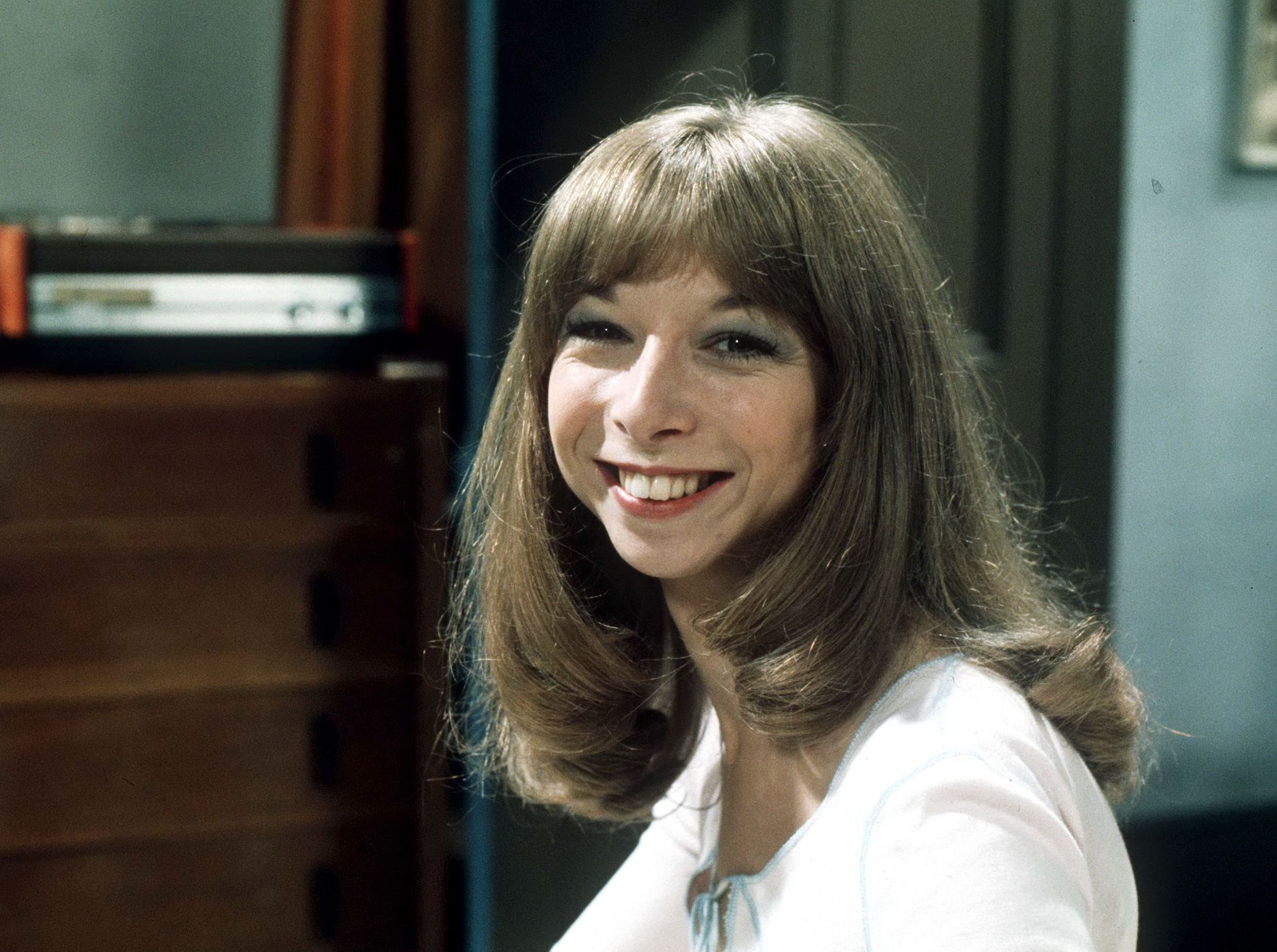
Helen is best known for her portrayal of Weatherfield resident Gail Platt in the long-running soap, a character she first began playing in 1974.
After five decades on the cobbles, the award-winning actor announced on Wednesday that she would be stepping away from the show later this year, and will be filming her final scenes as Gail next month in what’s being described as a “major storyline for the Platt family”.
“This year felt like the perfect time to leave the show after celebrating 50 years in the most wonderful job on the most wonderful street in the world,” she said.
“I made the decision at the start of the year and spoke to the producers who were very kind and understanding. I have been truly blessed to have been given the most incredible scripts week in week out, and to have worked with fantastic actors, directors and a brilliant crew.”
The 73-year-old admitted: “The past 50 years have flown by and I don’t think the fact that I am leaving has quite sunk in yet.”
Over the last 50 years, Corrie fans have seen Gail at the centre of numerous huge plotlines, most notably her daughter Sarah-Louise’s teenage pregnancy, an attempted murder attempt by her ex-husband Richard Platt and her Tudor-esque six marriages.
In 2014, to coincide with her 40th anniversary playing Gail, Helen was honoured with an Outstanding Contribution prize at the National Television Awards.
She was also recognised with an MBE last year for her services to drama.
Rishi Sunak has been accused of a “bare-faced lie” for wrongly claiming the number of migrants crossing the Channel in small boats is coming down.
Sunak said: “Over the last twelve months, the number of crossings [are] down a third because the plans we’ve put in place are starting to make a difference.”
But figures released by the Home Office today show that 10,745 have made the perilous journey so far this year – up 41% on the same point last year.
Jonathan Ashworth, Labour’s shadow paymaster general, said: “Another bare-faced lie from Rishi Sunak has been exposed.
“Last night, he told the British people that the number of small boat arrivals were coming down. But today, we have confirmation from the Home Office itself that small boat arrivals so far in 2024 are at a record high, running more than 40% higher than last year.
“Even worse, we now know that – when Rishi Sunak promised the British people that he would stop the boats – he was telling another lie.
“Exactly 18 months on from that day, 40,000 people have now made the crossing, while he has sat on his hands doing nothing to take on the smuggling gangs. Rishi Sunak has become a desperate liar.”
The row follows the controversy over Sunak’s claim that Labour will put up taxes by £2,000 per household if the party wins on July 4.
Diane Abbott has been formally confirmed as a Labour candidate for the general election, following a meeting of the party’s ruling National Executive Committee.
The veteran left-winger will be allowed to stand for re-election in Hackney North and Stoke Newington, the seat she has held since 1987.
Advertisement
Abbott, Britain’s first black female MP, was embroiled in a bitter row over whether she would be allowed to stand.
She was suspended by Labour last year for suggesting that Jewish, Irish and Traveller people were not subject to racism “all their lives”.
She apologised, withdrew the comments and was eventually given the Labour whip back last week.
But party sources briefed The Times that Labour intended to block Abbott from seeking election for the party.
This triggered a widespread and vocal backlash from her supporters, with Abbott accusing Keir Starmer of engineering a “cull of leftwingers”.
Advertisement
Starmer U-turned on Friday by saying Abbott was “free” to be a Labour general election candidate and she later confirmed that she planned to do so.
Labour’s ruling NEC met on Tuesday to confirm the candidates for the election, with Sky News reporting Abbott was on the list rubber-stamped.
In a further sign of the bad blood between Starmer and Abbott, on Sunday Abbott tweeted “more lies from Starmer” above an article in which he claimed to have “more respect” for her than she realises.
The row over whether Abbott would be allowed to stand overshadowed much of the start of Labour’s election campaign.
The festival of the summer is almost upon us once again, as music fans prepare to head to Glastonbury to watch headline performances from Dua Lipa, Coldplay, SZA and more.
This year’s festivities take place between 26 and 30 June at Worthy Farm, where there will also be performances from the likes of Avril Lavigne, Little Simz, Shania Twain, Burna Boy and many more.
Advertisement
Those who were lucky enough to secure the ever-so-coveted tickets to this year’s event can get their highlighter pens at the ready, as the full line-ups and stage times for this year have finally been revealed.
But with that announcement also comes the dreaded clashes, as festival-goers will now have to make tough choices and decide who they want to prioritise later this month.
Here are the set clashes that have left us completely torn…
Sugababes and The Vaccines (Friday)
Anthony Harvey/Brian J Ritchie/Hotsauce/Shutterstock
You might remember that the Sugababes quite literally shut down the Avalon stage two years ago, so you can guarantee their Friday performance on the West Holts Stage from 4:55pm to 5:55pm is going to be another to remember.
Advertisement
However, they’re also set to clash with indie rockers The Vaccines’ performance at Woodsies from 4:30pm to 5:30pm.
Jamie xx and Jungle (Friday)
RMV/Brian J Ritchie/Hotsauce/Shutterstock
Dance fans are going to have to decide where to take their boogie shoes on on Friday night, as Jamie xx will be performing on the Woodsies stage from 10:30pm to 11:45pm, while Jungle will be headlining the West Holts stage around the same time from 10:15pm to 11:45pm.
Both acts will no doubt bring the revelry and escapism attendees will be looking for, but it’s a matter of whether you’re leaning towards electronic or something a little more funky. Oh, and as if that wasn’t enough, Fontaines D.C. are also on at 11pm on The Park Stage, too.
Cyndi Lauper and Tems (Saturday)
Andrew H. Walker/Richard Isaac/Shutterstock
Advertisement
A tough one for girls who just want to have fun.
Both sets from US pop star Cyndi Lauper and Nigerian R&B star Tems on Saturday are set to be big weekend highlights. Cyndi will be on the Pyramid Stage from 2:30pm to 3:30pm (marking her Glasto debut more than 40 years into her music career), while Tems will be on The Other Stage from 2:15pm to 3:15pm.
Disclosure and Jessie Ware (Saturday)
Ash Knotek/Amy Harris/Shutterstock
This one is more of a triple clash, as Coldplay, Disclosure and Jessie Ware will be performing on the Pyramid stage, Other stage and West Holts stage, respectively, at the same time on Saturday.
While the start times are slightly staggered, each of the acts is due to finish up at 11:45pm. The euphoria of A Sky Full Of Stars, thumping basslines of Latch or the hip-shaking abandon of Free Yourself? Take your pick…
Of course, we know that the simultaneous evening headliners on the Pyramid and Other stage always make for a tough choice. But while they may be intended to suit different tastes, what about those of us who like to get deep in our feels to a range of genres?
SZA and The National’s headlining set will be a tough one for eclectic music fans to decide between, with the Kill Bill singer’s performance beginning at 9.30pm, before the Brooklyn alternative rock band take to the Other stage just 15 minutes later.
Avril Lavigne and Janelle Monáe (Sunday)
Chris Tuite/imageSPACE/Daniel DeSlover/Shutterstock
Sk8ter bois and and pleasure seekers will have to make a difficult decision on Sunday night, as Avril Lavigne and Janelle Monáe’s performances are set to very much overlap.
Janelle will be on the Pyramid Stage from 5:45pm to 6:45pm, while Avril will take to the Other stage from 6pm to 7pm. Maybe see how fast those legs can move if you want to try and catch the first 15 minutes of Janelle’s set before bolting over for some pop punk.
Advertisement
Romy and Nia Archives (Sunday)
Dave Hogan/Hogan Media Ltd/Shutterstock Dave Burke
Dance or jungle? The xx solo star Romy will be performing one of her joyful sets with songs like Enjoy Your Life and Strong over on the Woodsies stage from 8pm until 9pm on the Sunday, while Nia Archives (who was handpicked by Beyoncé to open one of her London Renaissance shows last year), will be tearing up the decks at, yes, exactly the same time, on the West Holts stage.
The good thing is, though, Romy will also be doing a DJ set at Levels on the Friday afternoon if you want to make it to that instead.
Burna Boy and Ghetts (Sunday)
ExclusiveAccess/Shutterstock/Ray Tang
Burna Boy and Ghetts are set to take to the stage as the penultimate Sunday night acts on the Pyramid Stage and The Park Stage, respectively, both taking place in the one hour slot of 7:30pm to 8:30pm.
Advertisement
Given the amount of collaborations that the two artists have racked up, their sets are both ripe for at least one surprise guest performer.
Which is all well and good ― but what about more fun ways to keep the condition at bay?
Well, in his book How To Prevent Dementia, neurologist Dr. Richard Restak shared that hobbies and “obsessive” interests can be really, really good for your brain health ― and that reading in particular can build up something called “cognitive reserve.”
Advertisement
What’s my “cognitive reserve,” and why does it matter?
Dr. Restak compares people with a high “cognitive reserve” and those without to two people who have lost their homes in a hurricane.
One is a millionaire who barely notices the change, and the other is “wiped out” by the loss as all his assets are tied up in his house.
“As with wealth, cognitive reserves are built up over time,” the neurologist says.
“Cognitive reserve theory refers to the representation stored within the brain of the knowledge, experience, and life events that accumulate during the course of a person’s lifetime,” he adds.
The bigger your “cognitive reserve” is, the more ballast you may have against dementia, the theory suggests ― just as a high muscle mass may help to give you more defences against the side effects of chemotherapy.
Advertisement
“A lifetime investment in building up cognitive reserve leads to healthy cognition and thinking later in life,” Dr. Restak wrote.
So, why reading in particular?
Thanks to the brain’s plasticity, “It is never too late to build your cognitive reserve” by learning something new, or more deeply, or experiencing different things, Dr. Restak says.
No matter what age you are, he says that the best way to build a decent cognitive reserve is to “Pick something that really interests you, grips you in a visceral sort of way, and then obsess (in a good way) about it.”
But that aside, “Reading for pleasure is perhaps the single most effective activity you can engage in for increasing cognitive reserve,” he says.
This is because reading “exerts its most powerful effect on memory,” both episodic and working.
He adds, “Fiction is more brain-challenging than non-fiction because it demands your full awareness of the narrative you are currently reading, while at the same time requiring you to hold in mind the situations and characters described earlier in the book.”
Advertisement
The author referenced a study which found that being immersed in a book was the “magic juice” which improved participants’ cognitive ability over those who did word puzzles.
So before you dismiss your romance novel habit as trashy, remember ― you’re simply strengthening your cognitive reserve.