Strictly’s Oti Mabuse Gets Candid About One ‘Beautiful Life Lesson’ Pregnancy Has Taught Her

Former Strictly Come Dancing professional Oti Mabuse has shared a candid Instagram post about the “huge adjustments” she’s made due to her pregnancy.

Over the weekend, Oti announced that she and her husband, fellow dancer Marius Lepure, are expecting their first child, and in a follow-up Instagram post, revealed she had to take an extended break from dancing early on in her pregnancy due to the nausea it triggered.

“I actually do enjoy working out lately again,” she explained. “In the beginning it was the one thing along with dancing that would cause my nausea so I stayed away for the longest of time.

“This obviously was a huge adjustment for my body, mental health and stamina and came with another huge but beautiful life lesson. I am creating a human being and whatever my body needs I should listen to it.

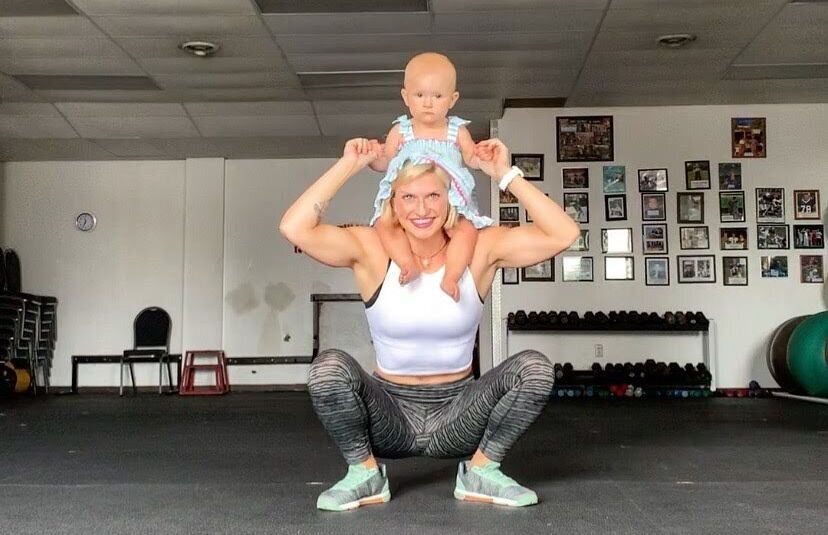
“But now that I can walk, run [and] lift weights again… I’m excited to get active again.”

Oti joked: “And this new ass… OH MY DAYS. I love it.”

In her original post announcing her pregnancy news, Oti wrote: “This is new for us, scarier than swimming with sharks, jumping off cliffs or even swinging from bridges, but the best news we could have ever asked for.

“We love our little bundle of joy so much already… and can’t wait to see what our future will now look like as family of three plus Leo [the couple’s dog].

“It’s been a beautiful journey so far with close friends and family and nearly over but we have learnt a lot a long the way…. Christmas is about to get even louder.”

The South African performer followed this with a beautiful video in which she was seen sharing her happy news with her husband, Marius, as well as different family members and friends.

Oti is most well-known for her seven-year stint as a professional on Strictly, during which she made TV history as the only dancer to have won the show in two consecutive series.

More recently, she joined the panel of ITV’s Dancing On Ice and served as a judge on The Masked Dancer.

Share Button

‘My Tween Is Ruining My Marriage’

You’re reading Between Us, a place for parents to offload and share their tricky parenting dilemmas. Share your parenting dilemma here and we’ll seek advice from experts.

Parents have a lot to juggle in their own lives, as well as their children’s lives. So it’s no surprise then that when tweens (and teens) start to act out, it can feel like you’re teetering on the edge.

Ripples are felt far and wide – on your own mental health, on your relationship – the whole situation can swiftly spiral.

Such is the case for one parent, who shared their parenting dilemma on Reddit this week:

“My child is ruining my marriage. My eldest is almost a teenager and this year has been tough on her. She’s lost a lot of friends in school, has had to deal with a new sibling taking our attention and she’s got a rare pain condition. We have tried so hard to be supportive. We’ve tried giving her advice, attention, space, support, solutions and bent over backwards to be kind to her. It’s been hard though because she’s responded with an attitude that stinks and acting like she doesn’t care.

“I’m honestly at a loss because I don’t know what to do and me and my husband have had so many rows about her and her behaviour. We’ve just had a huge blow up and I honestly don’t know if we can come back from this. He’s so angry that she’s gone to do nice things today after speaking to me like shit and I was cross too and things were said that blew up. I can’t stop crying. I feel awful. I’ve failed as a mother and a wife.”

So, what can they do?

1. Be kind to yourself

Counselling Directory member Jenny Warwick says that, first and foremost, parents in this position need to prioritise themselves. “You have not failed as a mother or wife,” she says. “This is the time when you need to be kind to yourself.

“Remember, you won’t be able to help others if you feel drained and exhausted. Taking breaks for self-care is not selfish; it’s necessary.”

Family Lives, a charity supporting families, recommends that parents take time to relax; treat themselves occasionally; talk about their concerns with friends, partners or online forums; and learn techniques for coping with low mood, sadness and depression or anxiety.

2. Know that the tween period is really hard for all involved

Research actually suggests the tween period – when children are eight to 13 years old – are the hardest years of parenting.

According to parenting expert Sarah Ockwell-Smith, this is because they are much more emotionally exhausting, not to mention less rewarding than, say, the toddler years when your child still relies on you for so much and is learning a lot, too.

Warwick agrees that this period can be “particularly tricky” to manage for parents. “Part of being a tween is finding independence and forging their own path, resulting in a strong push away from their parents,” she explains.

“As far as you are concerned, this has come out of nowhere and feels personal. However, recognising this as a typical part of preteen development can make the emotional burden easier to bear.”

On top of that, she acknowledges it sounds like the daughter is going through a lot – navigating shifts in friendships, coping with a pain condition and a new sibling.

But while this might contribute to her behaviour, “none of this gives her an excuse to be rude”, adds the counsellor.

If your child appears to be particularly struggling mentally, it might be worth speaking to your GP or a mental health charity – like The Mix, YoungMinds and Relate – for further advice.

3. Remember: your daughter still needs you

When your child is pushing you away, it might be tempting to just let them – especially when their attitude towards you leaves little to be desired – but Warwick suggests the daughter needs her parents now more than ever.

That said, the way to offer support to her is very different at this stage in her life than when she was younger, she suggests.

“Helping her find solutions is much more effective than jumping in to fix things for her. This can be a hard change in approach for parents to make, but it is the way forward,” says Warwick.

At the same time, you need to prioritise yourself and help your daughter recognise that your life doesn’t revolve around her, suggests the therapist.

4. Carve out time to be with your partner

When you welcome a new child, your relationship can instantly be put on the back-burner – add wider family discord into the mix, and things get trickier.

It will undoubtedly put pressure on a romantic relationship. And, to top that off, children can sense any tension, which might prompt further behavioural changes.

“You and your husband need to be on the same page regarding parenting,” says Warwick. “It sounds like you have a lot on your plate, too, with a new child.”

Verywell Family recommends parents try the following tips to help get back on the same page:

  • Determine what the consequences are for your children breaking rules in your home and stick to them.
  • Create parenting rules together and if you don’t agree on some of them, talk it out. Then share these rules with the wider household.
  • Back each other up in front of the kids and don’t disagree with each other in front of them.
  • Listen to each other, compromise where you can, and remember you’re on the same team.

Warwick’s advice to this parent is to give the relationship some care, “as it’s much easier if you are in this together”. This means taking time to be together as a couple to maintain a connection.

“Doing this lets you devise a plan of action together and establish agreed-upon boundaries for your family,” she adds.

Help and support:

  • Mind, open Monday to Friday, 9am-6pm on 0300 123 3393.
  • Samaritans offers a listening service which is open 24 hours a day, on 116 123 (UK and ROI – this number is FREE to call and will not appear on your phone bill).
  • CALM (the Campaign Against Living Miserably) offer a helpline open 5pm-midnight, 365 days a year, on 0800 58 58 58, and a webchat service.
  • The Mix is a free support service for people under 25. Call 0808 808 4994 or email help@themix.org.uk
  • Rethink Mental Illness offers practical help through its advice line which can be reached on 0808 801 0525 (Monday to Friday 10am-4pm). More info can be found on rethink.org.
Share Button

Gentle Parents Set Kids Up For ‘Lifetime Of Friendlessness’, Says Parent In Divisive Online Rant

Gentle parenting is a lot like Marmite – you either love it or you hate it.

Case in point: a parent has taken to Mumsnet’s ‘Am I Being Unreasonable?’ forum to reveal they think gentle parents are “setting their kids up for a lifetime of friendlessness and struggling to hold down a job”. Ooof.

“You get one chance to build the neural pathways that guide you for the rest of your life and if you don’t learn that you’re not the centre of anyone else’s universe as a young kid, you never will,” they wrote.

Well, you can imagine how that went down. “I think you’ve misunderstood gentle parenting. Wildly,” someone responded in the comments section.

“I think you mean passive or permissive parenting,” said another.

So, what is gentle parenting then? (And why do some people think it’s the devil?)

Gentle parenting is composed of four main elements, according to Verywell Family, these include: empathy, respect, understanding, and setting firm boundaries.

This parenting style focuses on being compassionate while also enforcing consistent boundaries. It’s about teaching, not punishing.

The parenting style is sometimes confused with permissive parenting. These parents are more lenient in their approach and take on more of a friend role than a parent role.

“My DF’s [dear friend’s] sons are being gentle parented, never told off, always calmly spoken too and explained everything and given the option to talk about their feelings,” said one parent on the Mumsnet thread.

“Both massive brats who are violent to other children, constantly demanding attention and breaking toys if they don’t get it. Constantly asking for treats, sweets, cake, etc., I guess never hearing a straight ‘no’ must encourage this. Can’t bear to organise playdates anymore.”

Another person said of the parenting approach: “Gentle parenting means when your child beats up another child or wrecks somebody’s house you say in a calm voice ‘no darling we don’t do that’.”

There were a lot of comments – we’re talking hundreds – on the forum, but the general consensus was that the above is absolutely not what gentle parenting is.

“I am so sick and tired of people slating what they think is gentle parenting (when they are actually just describing lazy, shit parenting),” a parent responded on the thread.

“I’ve never shouted at my six year old, never had to. He’s brilliantly behaved, yes he does things wrong and acts up but I don’t need to shout or make him cry and dish out punishments.”

An example of gentle parenting in action

Sarah Ockwell-Smith, who specialises in the psychology and science of parenting and is generally regarded as the founder of the gentle parenting movement, offers a handy example of gentle parenting in action.

A two-year-old has found some shampoo and, unbeknown to their parent, has started to pour it out onto the bathroom floor and in the bath. Then they’ve used someone’s toothbrush to swirl it around and make patterns.

“In this example, permissive parents would allow the toddler to carry on, reluctant to apprehend, knowing if they take the shampoo and toothpaste away the toddler will cry,” Ockwell-Smith explained on her website.

But she added this isn’t true gentle parenting.

“A truly gentle parent would take the shampoo and toothpaste from the toddler, explain why they cannot play with them, offer them an alternative for ‘messy play’ with limits, such as using pouring toys whilst the toddler is in the bath, and sit with them during the resulting tears and tantrum that will ensue,” she said.

Does gentle parenting work?

Studies suggest it has lots of benefits. According to Forbes, research suggests gentle parenting could decrease the risk of childhood depression and help kids self-regulate.

The parenting style also promotes a secure attachment, which could result in children being more curious, self-reliant and independent.

Of course, as with anything, there are drawbacks, too: it’s time-consuming, can be hard for parents to implement if they were parented differently, and requires a heck of a lot of patience.

But parents who have followed it agree that in the end, it can pay dividends.

“I followed some (not all) gentle parenting approaches and I think it paid off in spades. They are lovely, kind children who absolutely know the world doesn’t revolve around them,” said one parent on Mumsnet.

Another added: “Reading through examples of gentle parenting, we probably did lots of it although didn’t realise it had a term. It seems normal to me to listen and respect your children, not shout at them, teach them to think of others, explain reasoning instead of just being the ‘behave this way because I said so’ type.

“I think explaining things, listening to them, respecting their opinions, is much more time consuming but really pays off in the teen and adult years. Our kids know we are reasonable, and that they’re important, so they respect us because they like us.”

Share Button

Adele Gets Teary As She Helps Expectant Couple With Mid-Concert Gender Reveal

Adele made a New York couple’s visit to Las Vegas extra special by helping them with a very personal announcement.

Viral footage captured over the weekend shows the 16-time Grammy winner halting a performance of her blockbuster residency, Weekends With Adele, to reveal the sex of Chris Dare and Shantelle Lord’s baby.

The pair – who travelled from Newburgh, New York – attended Adele’s performance at the Colosseum at Caesars Palace on Saturday bearing a custom-made flag that read: “Adele will you do our gender reveal?”

Once the flag caught Adele’s eye, she tore into a sealed envelope that had been handed to her by the couple, after which she proclaimed: “Shantelle and Chris are having a baby boy!”

After the crowd erupted into applause, Adele became visibly teary before making a request of her own.

“That’s so emotional, oh, my God,” she said, adding: “If and when I get pregnant, will you do my gender reveal?”

Dare uploaded footage of the moment on his TikTok and Instagram accounts and thanked Adele for her assistance.

“POV: Adele did our gender reveal,” he wrote on Instagram. “Adele, you are amazing and we will remember this night for the rest of our lives.”

Adele kicked off the second leg of Weekends With Adele” last month, and has said she plans to commemorate the show with a live concert special.

The singer is the mother of a 10-year-old son, Angelo, whom she shares with ex-husband Simon Konecki. She’s currently in a relationship with sports agent Rich Paul, and has been open about her desire to have another child.

Share Button

Um, So Here Are 4 Things You Really Shouldn’t Say To Teens On Results Day

The next couple of weeks will be a mixture of anxiety and excitement for teens (and their parents) up and down the country.

On August 17, A-level, AS-level and T-level results will be revealed, while a week later, on August 24, GCSE results will be announced.

It’s a huge moment for a lot of teens who, based on their results, may then decide to continue studying, try and get a job, or even consider resits.

So, says Dr Nihara Krause, a consultant clinical psychologist specialising in teenage mental health, “how parents engage at this time can help shape motivation and confidence moving forwards”.

It’s understandable that lots of teens will be more than a little anxious about how their parents will respond to their grades – so responding positively is key, even if the outcome is not what you or they wanted, suggests the psychologist.

While we want what’s best for our children, sometimes we can easily let our own disappointment show – and when your teen is feeling pretty pants, this isn’t really going to help.

Here, Dr Krause – who is working with Talking Futures, a toolkit which helps parents instigate career conversations with their kids – shares some phrases you definitely want to avoid uttering when they receive their grades.

What not to say on results day

1. You should have revised more

In short: not a helpful comment. “This suggests disappointment in the effort put into revision and that your child has fallen short of parental expectations,” says Dr Krause.

It’s going to leave your teen feeling pretty lousy.

2. If only you had spent less time on your phone

Whilst spending time on the phone is a very common parental concern, it’s more helpful to identify what difficulties or blocks there might be in a young person applying themselves to their studies rather than focusing on time spent elsewhere, suggests the psychologist.

3. What are you going to do now with these results rather than the ones predicted?

“Avoid indicating that there are no alternatives and painting a bleak future,” says the expert.

Instead, parents might want to do a bit of research themselves, looking into further education and career options available to their child following their exam results.

This way, they can steer their teen’s focus towards their futures, no matter their results.

4. How did everyone else in your class do?

If your child is feeling rubbish about their results, this focus on how other people did probably isn’t going to help.

“Opting for a judgmental question may affect self-esteem in terms of feeling less than or, if they’ve done better, to feel ‘better than’,” says the psychologist.

5. Exams were a lot harder in my day

It’s best to avoid turning the conversation into a comparison on sitting exams when you were young, as this “minimises their success”, she adds.

What to say instead

1. I’m so proud of the effort you put into your exams

Regardless of results, it’s important to acknowledge your child’s efforts and encourage them to think about the steps they have taken to get to where they are today.

“Encourage gratitude, discourage bragging, and focus your conversations with them around next steps in their future whilst motivation is high,” she suggests.

2. Let’s focus on your strengths, rather than comparing yourself to others – how your friends did won’t impact you or your future

“There is a mistaken belief that comparison generates ‘healthy competition’,” says Dr Krause.

But she suggests focusing on what helps a young person to gain their own personal best is far more effective than comparing, as it helps them identify unique qualities and improve on these.

It also helps generate self-acceptance and positivity, while avoiding complacency, the expert suggests.

3. Let’s consider your next steps together

A problem shared is a problem halved, after all.

“Be positive about alternatives and help build confidence by showing that you are there to support them,” says Dr Krause, “by doing this you can also motivate your young person to look ahead.”

Research from Talking Futures found 65% of 13-to-18-year-olds are most likely to say their parent is the number one person in their life that they would want to support and guide them on their chosen career path.

However good timing and using the right phrases are essential to ensuring this is done constructively.

“Depending on how the young person feels about the results they have received, now might not be the best time for parents to bring up the topic of the future and next steps,” says Dr Krause.

“And even if it does feel like it’s an OK topic to discuss, parents should approach conversations with extra care – mixed emotions and feeling overwhelmed is common for both parents and young people alike at results time, so let them settle first before constructive conversation can begin.”

Here’s to a positivity-filled results day, no matter the outcome.

Share Button

These ‘Vintage’ Baby Names Are Set To Make A Comeback In 2023

A baby names expert has revealed the ‘vintage’ names she believes will see a resurgence in 2023 and beyond.

Mia Bardot, the editor-in-chief of Random Names, suggested monikers such as Julia, Betty and Vincent could see a revival in the popularity charts as parents look for “timeless classics which evoke nostalgia”.

Celebrities are also exploring the vintage name trend with their new arrivals, which could prompt others to follow suit.

Blake Lively and Ryan Reynolds, for example, have named three of their children James, Betty and Inez. They recently welcomed their fourth child, however it’s not clear what they have named them.

Bardot said: “It is so exciting to see these timeless classics resurfacing. Eleanor, Margaret, Julia, and Adelaide have royal and elegant rings, while Betty and Inez were immensely popular in the 20th century and present a charming simplicity.

“The sturdy and enduring appeal of names such as Henry, James, and Louis is hard to resist due mainly to their deeply rooted royal associations.“

According to experts at Nameberry, the best vintage names are inspired by literary, biblical and royal sources.

Bardot predicts the following names will continue to rise in popularity throughout 2023, thanks to their “elegant and historical feel”.

Are any of these on your list?

Vintage baby names set to make a comeback

1. Eleanor

4. Dorothy

5. Florence

8. Vincent

9. Abraham

11. Margaret

12. Adelaide

14. Evelyn

15. Estelle

20. Chester

Go To Homepage
Share Button

The Important Reason You Need To Copy Your Baby

A video of a baby interacting with their dad is melting hearts across the internet – and while it’s certainly got the cuteness factor, there’s also a very important lesson behind the video which an early years expert has shared.

Dan Wuori, senior director of early learning at The Hunt Institute, shared the adorable video on X, formerly Twitter, which shows a dad holding a very young baby and mimicking her expressions and sounds. (You can watch the video here.)

The expert suggested this interaction helps “light up” a baby’s brain. He calls it “serve and return” – yes, like in a tennis match.

“Serve and return entails back and forth interaction during which adult and child trade conversational (and other expressive) turns,” Wuori explained.

The video shows the baby sticking her tongue out – which the early years expert described as a “serve”. The dad then “returns” by copying the expression, but also “extending her cues and vocalisations”.

According to Harvard University’s Center on the Developing Child, these ‘serve and return’ interactions shape brain architecture, help build relationships, and their absence “is a serious threat to a child’s development and well-being”.

This is why Wuori’s message was ultimately for parents to do as much interacting, face-to-face, with their baby and child as possible, which means being mindful of screen time and other distractions.

And no, this doesn’t mean watching them like a hawk 24/7, but rather taking time out to really connect with them, with zero distractions, throughout the day.

With babies, some examples of “serve and return” interactions might include:

  • If your baby smiles and you smile back at them
  • If they make a sound and you mimic the sound
  • If they look at something and you explain what it is.
  • If your child points at something, or seems interested in something, pay attention to what they’re focused on. This will help you learn more about your child’s abilities, interests and needs.
  • Offer children comfort with a hug and gentle words, help them, play with them, or acknowledge them. So, for instance, you could make a sound or facial expression, or nod, to let a child know you’re noticing the same thing.
  • Help name what your child is seeing, doing or feeling to help them learn to talk and understand words.
  • Take turns with them while playing or drawing, as this helps them learn self-control and how to play with others.

So, next time you’re in the presence of a baby or young child, you know what to do.

Share Button

Overpraising Your Kid Could Be Doing More Harm Than Good

As parents, all we want is for our kids to be happy and confident – and part of how we show them how great they are is to dish out praise.

“Well done!” ~ “Good boy/girl!” ~ “Great job!”

You probably utter these a fair few times throughout the day if your little one does something well.

And while praise is mostly considered to be beneficial for motivation, studies have found it’s the type of praise that makes the difference here.

Which praise is best?

A review of studies found praising a child’s intelligence had more negative consequences for their achievement motivation than praise for effort.

Fifth graders (10-11 year-olds) praised for intelligence were found to care more about performance goals relative to learning goals than children praised for effort.

When these children failed, they displayed less task persistence, less task enjoyment, more low-ability attributions, and worse task performance than children praised for effort.

What’s more, children praised for intelligence described it as a fixed trait more than children praised for hard work, who considered it subject to improvement.

Recently, clinical psychologist Dr Martha Deiros Collado shared an Instagram post about how parents can offer praise without even thinking sometimes, and that can be a problem.

“Praise is most effective when it is specific and focused on what a child has done,” she wrote in the caption for the post. “‘Well done’ sometimes rolls off the tongue so fast you may miss the effort your child has put into something.”

Dr Deiros Collado notes that “praise is a form of pressure” so the more a parent says “well done” or “good girl/boy” the more their child is likely to rely on their parents’ evaluations and judgement of what’s good or not.

“This can increase anxiety and shrink self-confidence,” she adds.

This pressure can also make some children “pull away” from doing something they’re good at, she suggests.

So, what should parents be doing?

In short: praising effort, not talent, seems to be the best course of action.

A Stanford study of toddlers found doing this led to greater motivation and more positive attitudes towards challenges later in life.

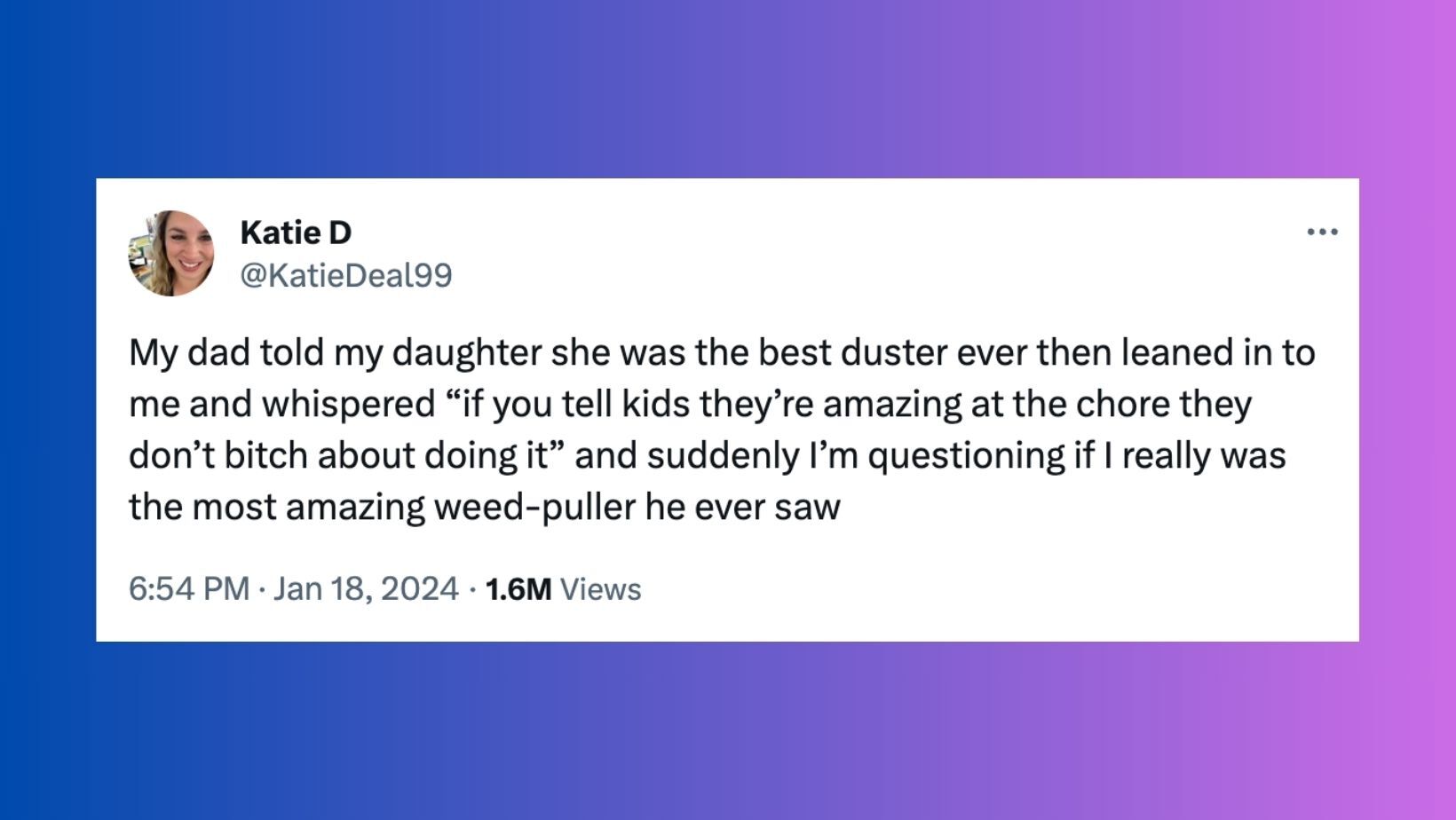
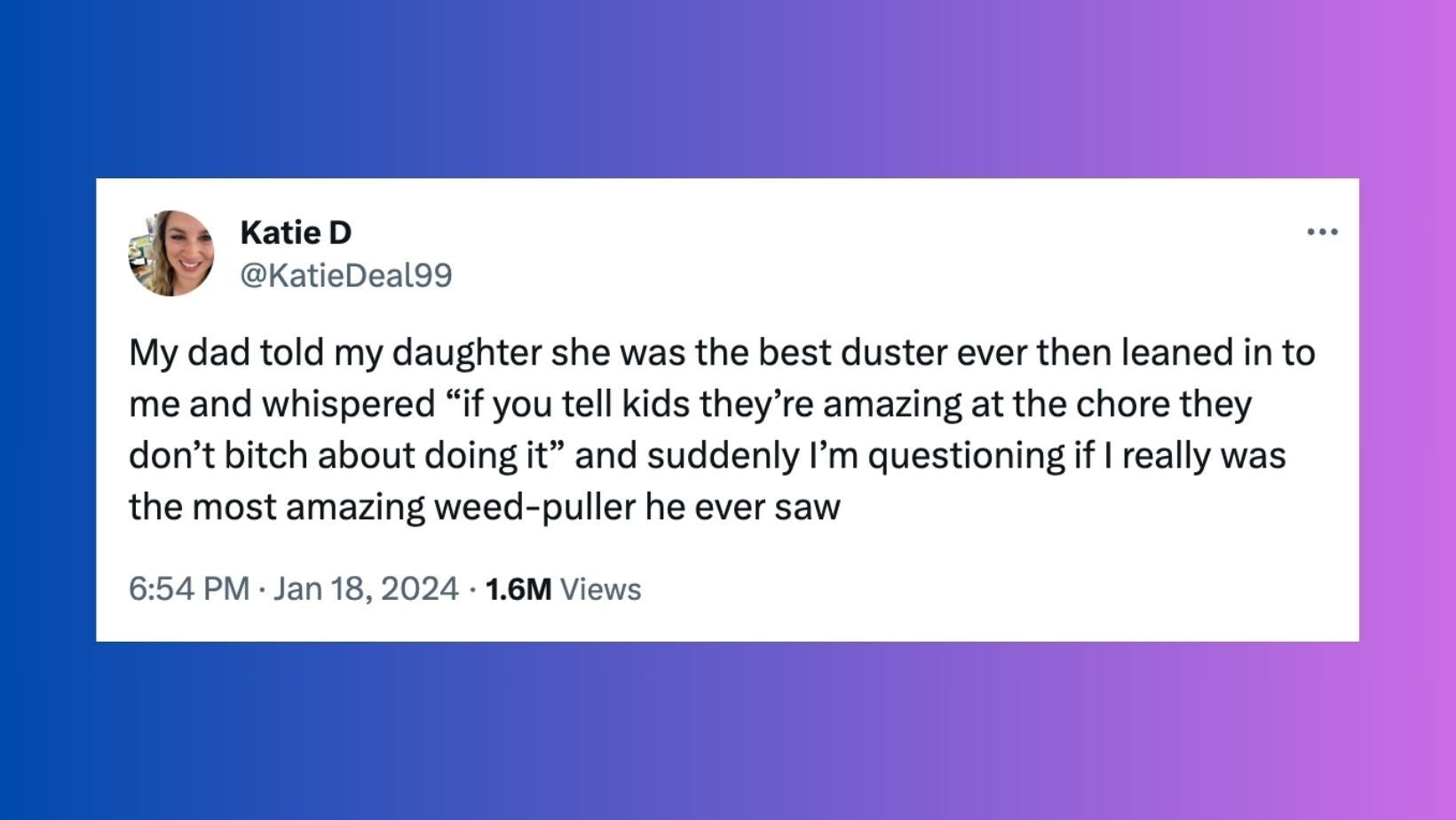
As study author Professor Carol Zweck, told Psychology Today, statements like ‘you’re great’ or ‘you’re amazing’ aren’t helpful because later in life, when they don’t get it right or don’t do it perfectly, “they’ll think they aren’t so great or amazing”.

Dr Deiros Collado recommends talking less and asking more. So if your child draws something, you could ask: “How did you choose those colours?” or “Tell me more about the picture!”

Sometimes, instead of offering praise, silence can be just the ticket. “Let your child share their experience and pride (if it exists) or just let it be. Children do not need praise to be good,” she adds.

And lastly, she suggests you could try an approach where you offer praise and ask questions – she offers the example of saying: “Well done! You put your top on all by yourself. How did you do that?”

Of course, saying “well done” and “good girl/boy” every now and then isn’t going to hurt – but if you can think of creative ways to acknowledge your child’s effort in the things they do, you’ll be helping them in the long-run.

Share Button

35 Raw And Powerful Birth Photos That Capture Strength Of Humanity

The photographers who document childbirth capture some of the most powerful and emotional moments in a parent’s life.

The organisation invited birth photographers to submit photos taken in 2022 and 2023 and received entries from almost 200 photographers around the world.

A panel of judges selected winners in categories like “between two worlds,” “birth team,” and “story in one image.”

“We put together this year’s showcase because we wanted to find a way to celebrate powerful birth imagery in a new way,” Nicole told HuffPost.

“By creating some more unique categories, we hoped to shine a light on images that often get overlooked in traditional photo contests.”

In addition to fostering a sense of community among birth photographers, Mason and Nicole work to change policies on social media platforms and offer courses for aspiring birth photographers.

Their biggest goal, however, is to make birth more visible, which they believe will help create a “safer and gentler” experience for all.

“We hope that people feel inspired by the images they see, and we hope they can recognise themselves or their birth story in some of these images,” Nicole said.

“We hope that this entire showcase illustrates just how diverse, powerful, and beautiful birth can be. ”

Keep scrolling for a selection of winning photos and other submissions and visit Birth Becomes You for the full collection. (Readers should note that the following uncensored photos show people in the act of childbirth.)

Share Button

19 Of The Most Ridiculous Requests Parents Sent To Teachers

On the first day of school, teachers often send a message to parents in the form of a letter or an email. They include things that students will need for the class, highlights of the year ahead, and how to contact them.

Email, mobile phones and a growing number of school communication apps means that it’s easier than ever before for parents to get in touch with teachers.

Questions, requests, complaints – veteran teachers have heard it all. But, sometimes, parents ask for things that are well outside of the realm of any teacher’s job description.

Jane Morris, a Maryland educator whose online presence is known as Teacher Misery, created a video a few years ago featuring fifth-grade teacher Deandre Rashard as he reacted to a series of actual requests from parents that are too wild and bizarre for anyone to have fabricated.

They included: “My son swallowed a watch battery at home. Please use this fork and clothes pin to inspect his poop until we find the battery.”

Others asked teachers to clean their child’s nose on picture day, track a student’s menstrual period and “mood changes,” and squeeze a student’s head during test-taking to relieve anxiety.

Perhaps most galling were requests in which the parents assumed they had greater pedagogical knowledge than the teacher, like the parent who requested that their son be given credit for an essay in spite of not turning one in because he “wrote it in his head.”

HuffPost asked teachers in our HuffPost Parents Facebook community to share their most memorable requests and complaints from parents. Here are some of their responses:

“One time I had a parent email me and ask if their student could take an upcoming math test on a different day because they had a golf tee time scheduled during the test. The student wasn’t on a golf team, nor were they a junior professional, they just wanted an afternoon of golf!”

S., middle school math teacher in California

“I had a note from a parent to ‘excuse her son from activities if the weather was over 63°’ because he didn’t like to sweat. I also had a note from a dad who said ‘M is on her period today. She said she cannot do any running or physical activity. I told her it would be good for her. She screamed at me. Good luck.’”

Alaina, middle school P.E. teacher in California

“Parent calls to inform me that their child swallowed a ring the night before and the doctor informed them that it was too far down to be of concern, however they needed to check the child’s bowel movements for the ring to make sure it passed through their system. I was asked to collect any poop and look at it to see if I could find the ring.

We were asked to wash, dry, and change socks of a student each time we came into the classroom because the ‘sand irritates’ her feet. They choose a school whose playground is 100% sand and we go outside four times a day.”

Christine, pre-K through third grade teacher in New York

“I had a parent some years back who wanted me to chart every day if their child pooped. They also wanted me to keep track of what the child ate at lunch. Child was having digestive issues. Instead, we suggested that they ask child when they got home and they send lunch every day with directions to return all uneaten food for parents to see.”

Mrs. K

“I once had a parent complain to admin that they liked last year’s teacher much better. I looped with them from 1st to 2nd ”

Melissa Gartside, Connecticut

“Mom wanted to put on the IEP that me (special ed teacher) and the occupational therapist would go to their house and teach their very capable autistic 4th grader how to shower more independently. ”

Jen Monahan, K-5 special education teacher

“I once had a parent accuse me of eating their kids lunch and claimed they had an audio recording of me doing it. ”

Jenna Marie

“I had a father request a meeting with me and the principal. The father wanted his son moved to a seat by another pencil sharpener. (I had two very expensive electric pencil sharpeners in two different places in my room — that I bought with my own money). The son claimed that sharpener closer to his seat ate up his pencils. Truth was he wanted to move closer to his buddy who was right by the other sharpener. I was told to move the student where he wanted.”

Sandi Parks

“Mom complained to my principal because she didn’t like my fun Friday bubblegum font. I had to change it ”

Heidi Ramos

“Since my child sees a speech pathologist for the half hour after lunch, I’d appreciate it if you didn’t ‘teach anything new’ until he returns to the classroom.”

Jennifer Kish Donoghue

“I teach kindergarten. I had a mom email me to tell me that she didn’t think her son was drinking enough water throughout the day. She asked me to check the toilet after he used the bathroom each time so I could monitor the color of his urine and report back to her.”

Maressa Brooks Rousslange

“Mom sent in a bar of soap. The student, who was a large male, said I was to wash his mouth with soap if he used bad language.”

Pamela Robison Duren, fourth-grade teacher in California

“When I taught middle school, parent wanted me to make a 60% a ‘B’ because maybe that’s the best the student could do. I had to break it to her that I didn’t create the grading scale.”

Diane Runner

“Can you stand over him every class and make sure he does his assignment?”

Maribeth Jones, high school French teacher

“I had a dad give his first grade son a laxative before school. He sent him with pull ups and wipes and asked if I could help clean him up after.”

Ginger Martin-Foster

“I had a mother ask me to keep an eye on how much her son played a game on his phone and report back to her regularly because he was racking up crazy charges on in-app purchases — north of $400. As long as his phone wasn’t out during my class, it’s not my place to monitor an 18 year old’s device usage.”

Jason D. Moore, high school graphic design teacher in New York

Responses have been lightly edited for length and clarity.

Share Button