So why do I have 14 unread texts at the moment, and how come the idea of dragging my weary bones to an after-work event has made me sob in the past?
I love my friends, but if I’m honest, I am too exhausted by life and its endless admin to make plans as much as I’d like to.
Advertisement
This is not fair of me, and I feel awful about it, but it seems to be a common concern: a 2024 study found that less than half of us spend as much time as we’d like with our mates, which makes sense since we hang out under half the amount we used to 10 years ago.
And, per Dating.com, Google searches for “don’t have time for friends” have jumped +163% this month.
If you’re in the same boat, what should you do? Here’s what Dr Uma Darji, a family doctor, and Lee Thompson, co-founder of Flash Pack (a travel company that brings solo adventurers together), told us.
Feeling too tired for friends is, sadly, all too common
Ironically, you are not alone in feeling too fatigued to hang out.
Dr Darji admitted, “When you’re juggling work, family, and the daily chaos of adult life, friendship can start to feel like another item on your to-do list. I see this all the time in my patients, and honestly, I’ve felt it too.
Advertisement
“The truth is that mental and emotional exhaustion don’t just make us tired, but they also make us withdraw. Although catching up with a friend should feel energising, it can feel overwhelming when your brain is in survival mode.”
Thompson, meanwhile, said that he spent much of his 30s neglecting his friendships for the sake of his business.
“By the time I hit my 40s, the impact hit me hard – I felt long stretches of loneliness because I hadn’t nurtured the friendships that really mattered,” he shared.
Advertisement
Interestingly, both told me that some degree of letting go is crucial if you want to rebuild your friendships.
Dr Darji said you should try as hard as you can to release any guilt you might feel. “You’re not a bad friend for being tired. Adult friendships don’t have to look like they did in college,” she said.
“What matters most is staying emotionally connected, not necessarily seeing each other constantly.”
Thompson stated, “I’ve learned that friendship doesn’t need to be complicated.” He began lowering the expectations he had for himself and his friends, and has been much happier since.
Advertisement
How can I maintain friendships when I’m exhausted?
Like Thompson, Dr Darji said remodelling your social expectations to fit your adult life is key.
“I suggest adjusting expectations. If you aren’t up for a long dinner, try to engage with a short voice note or quick meme exchange to keep the lines of communication and connection alive without draining you,” she stated.
“Try to combine social time with activities you already do, such as walking with a friend while kids play or catching up while shopping for groceries, calling a friend when driving.
“Be honest with your friends, you don’t have to pretend that you can do it all.”
Thompson makes an important point, though; once you have adjusted your expectations to fit what is possible for you, stick to your new rules.
Advertisement
The business co-founder says he puts “one dinner in the diary every month with my closest friends, and we never cancel.
“It’s the most important meeting I have all month because it energises me, helps me feel seen, inspires me and gives me space to breathe outside work and family life.”
While it might sound exhausting, the two experts told me, the payoff is definitely worth it.
“Connecting with others is essential to our emotional well-being,” Dr Darji explained.
“A short interaction can refill our cups in ways that only rest can’t… always remember that.”
Thompson, meanwhile, called it a “small investment that pays off massively for your mental health and happiness”.
You know what sends chills down my spine? The phrase “stay as long as you like” – I get the feeling the person saying it does not actually mean I can live rent-free for the next decade at their home, but I wonder if a one-night stay under those terms would seem offensively short.
(See also: “let me know if there’s anything I can do to help”. Anything? Really?)
“I have British friends in the UK who invited me to stay with them when I visit the UK. They said I can stay with them as long as I want but I don’t want to overstay my welcome,” the Singaporean poster asked.
Advertisement
“Do they really mean that?”
We asked the founder of Etiquette Expert, Jo Hayes, for her thoughts.
The term means different things in different cultures
Speaking to HuffPost UK, Hayes said that the phrase means so many different things across cultures and individuals that when someone extends such a “generous and hospitable” invitation, you should take it as “genuine”.
However, she says, there’s a caveat: this should only be assumed “as long as your presence doesn’t start smelling like a dead fish”.
Advertisement
In other words, it’s not so much about decoding what your host might theoretically mean with their kind offer as it is recognising when you’re overstaying your welcome.
“Having house guests can be great or terrible, depending on the host and the guest. We all have different levels of introversion/extroversion, different capacities for small talk, [and] different needs for alone time,” she told us.
“If the host and guest are drastically mismatched on any of the above, the house stay situation could get very old, very quickly.”
Advertisement
Well-matched guests and hosts may never notice this issue, Hayes continued. But if you notice tension in the household, communicate clearly with your hosts.
“Be aware of signs of weariness/exhaustion/‘I’m over this’ in the host, and if that happens, firstly communicate (‘I insist you tell me if you need me to move on, zero offence!’), and/or, if it’s clearly not working, simply make a decision to wrap it up,” she recommended.
“Keep things light and polite – [say] ‘Thank you so much for having me,’ [and give them] a kind gift to thank them for their hospitality, etc.”
Advertisement
How can I be a great house guest?
Though you can never tell in advance exactly how you and your host will get along, the etiquette pro has some rules for those seeking to maximise their odds of remaining in their friend’s good books.
“Guests, don’t loaf about,” she commented.
“Contribute to the household, help wherever you can, make it so the hosts are glad you’re there. Be quick to help with cooking, dishes, taking trash out, and unloading the dishwasher. Keep the place clean. Offer to vacuum, etc.”
For hosts, she ended, “give your guests breathing room. Don’t hover, encroach on their need for personal/ alone time.
Advertisement
“Kind, calm, clear communication is the MO for making the deal sweet for all concerned.”
There’s a simple lesson from psychologists that you can adopt right now to improve your relationships – no matter the age of the person who is confusing or upsetting you. It’s the difference between assuming the best or the worst in people, also known as the most or least generous interpretations.
That’s because we likely grew up with people who taught us “to associate bad behaviour with bad intentions or being a bad person,” Kennedy said.
Even trained psychologists like Kennedy deal with this impulse. “When my child snaps or ignores me, my brain automatically goes to: ‘They’re being defiant. They don’t respect me.’”
“I’ve had to train myself to pause and ask: ’What’s the most generous interpretation here? Maybe they’re tired. Maybe they’re overwhelmed. Maybe they don’t yet have the words for what they’re feeling, and so their out-of-control behaviour is the only way to let me know what’s going on.“
Advertisement
It can take some time, but once you learn to make this switch, you might be surprised by how differently you see every toddler tantrum – or miscommunication by a friend or partner.
“That tiny mindshift changes everything,” Kennedy explained. “It doesn’t mean I excuse behaviour. … Ironically, we have to understand a behaviour to help someone change their behaviour.”
Why ‘most generous interpretation’ works so well with adults and kids
VioletaStoimenova via Getty Images
Are you practicing an “MGI” or an “LGI”? It can make all the difference.
Advertisement
“MGI isn’t just a parenting trick – it’s a life skill,” Kennedy said, because it forces us to separate who someone is from what they are doing and put their behaviours in perspective. When you use it on kids, you get to be the curious, empathetic adult you want kids to grow up to be.
“Kids learn: People can get it wrong sometimes, and there’s often more going on for someone than meets the eye,” Kennedy said. “Because when you help your kid realise they can be curious about their behaviour instead of meeting it right away with judgment and blame, curiosity is what allows them to reflect and move forward in a productive way – whereas shame and blame keep us frozen and make it very difficult to change.”
And it applies to adults, too. With couples, using a more generous interpretation of someone’s behaviour can help bridge divides after doubts and betrayals.
Advertisement
“When I work with couples in therapy, I will ask clients directly: ‘Do you detect malice in what your partner is saying?’” said Brendan Yukins, a licensed clinical social worker and relational therapist at The Expansive Group. “Often when we directly ask ourselves if we think someone is doing something on purpose, we see that ‘LGI’ is an illusion that our brain is casting to protect us from being harmed again. Realising that someone else is trying their best to love us can lead to deep, meaningful healing.“
And it also makes us see “bad friend behaviour” with more understanding eyes. Kennedy gave the example of a friend being late to meet up with you. In this case, the least generous interpretation is to think, “She doesn’t value my time,” and feel judged and distant as a result.
But what if you took the “most generous interpretation” approach? If instead you think, “‘She might be juggling a lot today,’ you’re more likely to feel connected and understood,” Kennedy said.
Advertisement
Once you embody this mindset, you can help be the change you wish to see in others.
It’s OK to use the ‘least generous interpretation’ sometimes, too
Your least generous interpretation is a neurological connection that gets hardwired every time you think the worst of someone. Yukins said it’s “an expression of our anxiety in trusting others.” That’s why it’s good to challenge these negative beliefs.
“If you are able to disrupt the signal, even a little bit, it gives your brain a fraction of a second to catch itself before going into an anxiety spiral,” he said.
“In my own life, I use ‘abducted by aliens’ when someone’s late for a meeting,” Yukins said. “It takes me out of the drudgery of everyday and introduces a playful element that keeps my brain open to interpretation.”
Advertisement
Of course, sometimes it’s more than OK to stop giving adults the benefit of the doubt, especially when they continually disrespect or mistreat you.
“Cycles of abuse or neglect often feature a hurtful person who insists that others continue to give them MGI even when they deserve LGI,” Yukins said.
He noted that if you suspect someone is purposefully hurting you, this is when it’s all right to set boundaries and reclaim your time: “Maybe leave the last text you sent without a follow-up, or schedule a self-care night if they seem hesitant to put you on their schedule.”
Advertisement
MGI is a muscle you can build every day for your wellbeing
Many kids and adults have good intentions that our brains overlook. Using an MGI mindset helps you learn this for yourself.
“The key is not deceiving your brain into trusting everyone,” Yukins said. “Rather, it’s to use MGI over and over again until you find through your own research that most people have the best intentions.”
It won’t just help with how you view others. It will help you be more gentle and understanding with yourself as well.
Advertisement
“Our natural inclination if our trust has been broken is to assume the worst of others,” Yukins said. But when we keep jumping to the worst conclusion of people’s behaviours, “Eventually, we will begin to distrust our own intentions. This can make the world smaller.”
And the great part of this psychology lesson is how you can start using it right away.
Kennedy equates MGI to a muscle. “We have to work it out and build that muscle in calm moments to have a greater likelihood of being able to flex it in the heat of the moment,” she said.
Friendship breakups are the worst. They hurt just as much as a romantic breakup, and sometimes, even more.
As someone who’s been through a ton of friend breakups, I can tell you that the pain never really goes away. Certain platonic relationships have a special level of intimacy that usually can’t be matched by a romantic partner. I mean, I still mourn ex-friendships from 15 years ago. Ex-boyfriends? Hardly.
That’s weird, right? Not at all, according to relationship experts.
freemixer via Getty Images
A friend breakup can hurt just as much, if not more, than a romantic one.
Advertisement
“Some friendships can feel even deeper than your blood family — especially when you’re not close to blood family,” explained Angelika Koch, relationships and breakup expert at Taimi, an LGBTQ+ dating app. “This can add a layer of complexity when it comes to walking away from a friendship that no longer serves you.”
“Breaking up with a friend can feel more complicated than ending a romantic relationship because we don’t have the same cultural scripts or language for it,” said licensed marriage and family therapist Saba Harouni Lurie, the owner and founder of Take Root Therapy. “With romantic relationships, we understand that sometimes people aren’t compatible or that feelings change, but with friendships, there’s often an expectation that they should last forever or only end due to major betrayals.”
“‘Ghosting’ — as we understand it in 2025 — has increased in frequency over the past decades, likely due to the integration of social apps into everyday life and shifts in communication norms,” said Morgan Cope, assistant professor of psychology at Centre College and an expert on interpersonal relationships. “Around 13% of people report having ghosted someone in the past, and 23% report having been ghosted in the context of romantic relationships.”
“We started to see a shift [in ghosting] after the pandemic in friendships as well as relationships, where people have become more protective of their peace,” Koch said. “The pandemic caused everyone to face their mortality, which caused many people to become protective of their own energy.”
But it’s what Harouni Lurie told HuffPost that I believe encapsulates the root problem behind ghosting: “Unfortunately, most people are not well-versed in having difficult and honest conversations, and may elect to ghost a friend instead of trying to understand if the relationship can grow and change.”
Advertisement
I can relate to what these experts are saying, because even though I’ve been on the receiving end of a ghosted friendship multiple times, I found myself ghosting several friends over the past five years for exactly the reasons Koch highlighted.
I know the sorrow of being discarded by someone I thought was my ride-or-die, so why would I ever engage in the same insensitive behaviour I’ve rebuked for years? Wild as it sounds, I genuinely believed both parties would avoid further heartache if I just cut and ran (or rather, hit that block button). After all, isn’t it easier to hide behind a block button? Or to just leave those texts on read indefinitely?
Turns out I was wrong: While ghosting a friend may feel like a more “gentle” way to break up in the heat of the moment — you avoid a messy argument and potentially hurtful words — it’s not the healthiest approach in the long run.
Advertisement
Ghosting Isn’t A Gentle Way Out Of A Friendship
“Ghosting is cruel when the other person is still reaching out and uncertain about what’s happening,” Rose from New Orleans, who asked to use just her first name to protect her privacy, told HuffPost. “I don’t think it’s gentle — I think it’s callous and cowardly.”
Rose knows the agony of being ghosted all too well. She endured a devastating breakup where she was ghosted by not one but two friends. “I was absolutely gutted by the situation,” she said. “Not just the rejection and abandonment, but the way they closed ranks to keep me out. It was probably the most painful friend breakup I ever experienced.”
If you’re contemplating ghosting a friend you no longer vibe with, you may want to take Rose’s story into consideration first. “Many people have a deep fear of hurting others and move through life trying to cause as little harm as possible,” acknowledged Koch.
Advertisement
But abruptly tossing someone aside comes with significant consequences. “To many people, ghosting — which is a passive way to leave a relationship — feels like a gentle breakup,” Koch continued. “Unfortunately, this can cause confusion and a lack of closure on the end of the friend who is being ghosted.”
“We mustn’t confuse niceness (not having to tell someone you don’t want to see them anymore) for kindness (providing a clear rationale and explaining your feelings) when it comes to ending a relationship,” added Cope.
We Can Blame The Tech (At Least A Little Bit)
I’ll be the first to admit that social media has made me far more comfortable ghosting friends than it should. To be clear — and this is in no way an excuse — the people I’ve ghosted were mainly social media and/or online friends. Since we never saw each other in real life and were interacting primarily through Instagram DMs and texts, it was all too simple to hit that block button.
Advertisement
“I do think social media block buttons have made it easier for some people to cut ties on their end and move on,” agreed Rose, though that doesn’t mean she supports the practice. “With friends from offline, or online friends you’ve got a real built-up history with, I don’t think ‘block and move on’ is the best way to deal with conflict.”
“While we probably have a lot of work to do around learning to communicate,” Harouni Lurie said, “technology has likely exacerbated our problems.”
“With texting, it can be really easy to misunderstand someone and to lose nuance in a conversation,” she continued.
Advertisement
Guilty as charged: Even though I was raised on the art of chatting on the phone for hours on end, I’ve spent the past decade-plus ditching direct conversation with friends and relying almost entirely on texts.
Perhaps, given the potential for misunderstanding, we should reconsider the lost art of phone calls (scheduled only, please!).
Ending A Friendship Respectfully
Although ghosting isn’t a kind way to end a friendship, it’s OK to walk away from certain friends if you feel the relationship isn’t working anymore.
Advertisement
Honesty is the best policy, if that’s the case.
“If you’re the one ending the relationship, having a difficult conversation about the friendship and why it’s not working can afford you the opportunity to practice being honest and authentic, to advocate for yourself, and to have compassion for yourself and for your friend,” Harouni Lurie said.
She also reiterated that while it’s “challenging,” it’s “not impossible to end a friendship amicably.” Harouni Lurie advised approaching the discussion “with compassion, and respect for both your needs and theirs.” Start by acknowledging the good parts of your friendship and what you’ve appreciated about this person. Then, you can share your feelings about why you don’t think you’re compatible anymore.
“Being specific about what isn’t working can be helpful,” continued Harouni Lurie, but it’s important to “focus on your own experience rather than making it about their flaws.” Even though you may be frustrated with your estranged friend’s inability to understand anything about your life (it’s me, hi!), this is not the time to air those grievances.
Advertisement
Some examples Harouni Lurie offered are less critical of your friend and more of an emphasis on what you need:
“I’ve realised I need more space right now.”
“I think we’ve grown in different directions.”
After you’ve explained your reasons, Cope recommended giving your friend the courtesy to respond to your breakup decision.
“These conversations will not be easy,” she warned. “Our brains are motivated to establish and maintain social relationships to help us stay alive and thriving. But when we need to, we can end relationships and friendships in a way that prioritises everyone’s dignity and well-being.”
It’s a problem I’ve seen posted all over social media: people without kids are starting to resent their parent friends who bring their children along to events.
“I realise that even though I care about [my parent friends], our relationship has changed, and over time we’ve drifted apart, also because none of them have EVER found a way to go out alone with me, they always bring the kid,” an upset Redditor opined.
Advertisement
A Mumsnet user who is tired of hanging out with her pal’s teenagers, meanwhile, said she’d “tried making excuses” not to meet her anymore.
I don’t have kids, but I have to admit I found these scenarios a bit baffling. Surely, I thought, the polite thing is to state your preference before this discomfort builds?
But then, I’m not an expert. Jo Hayes, founder at Etiquette Expert, is though – and thankfully, she shared her rules for banning (and bringing) kids as guests.
Advertisement
Communication is key – but so is context
Speaking to HuffPost UK, Hayes shared that “the number one key in such situations is communication… Specifically, kind, calm, clear communication”.
And number two, she added, is “common sense, common wisdom and common intuition”.
For something like a wedding invite, the etiquette expert said that invites should “clearly” state who’s meant to come. Hosts might want to explicitly state their child-free rules in this scenario – especially if the children are relatives.
Adding something like “we absolutely adore our nieces and nephews, but, due to limited capacity, this will be an adults-only celebration” works, Hayes said.
Advertisement
But precedent matters. If your annual getaway with your mates never involved kids, it’s up to the parent/s to ask whether it’s alright to bring their child on this occasion.
“For guests, if in doubt about whether children are invited, do not assume. ASK,” she explained.
“In fact, unless it’s an absolutely obvious ‘children are included’ event (eg. there’s a big lawn outside for the children to run around in), I suggest guests ask, just to be on the safe side.”
What should I do if someone has brought kids to my child-free event?
Even the best-written invite, or what seems to you to be a clear-cut child-free event, can be confusing to some parents, Jo said.
Advertisement
If someone has brought a child to an event which is inappropriate for them, the expert said “it may be necessary for the host to have a discrete word to the parent, and have the child taken home, or picked up (say, by a grandparent)”.
Do this quietly and discreetly so as not to embarrass your guest, she added, saying something like “you may have missed this on the invite, but this is intentionally a child-free event”.
She ended: “A note to guests: Do not argue the point, or try to wrangle a spot for your children. This is the host’s event, not yours. If they say no children, it’s no children. It’s impolite not to respect this boundary.”
Heavy rainfall returned in parts of the UK this week, which has overwhelmed the country’s Victorian sewage system.
‘Why does this impact me?’ you may ask. Well, dear reader, we’re sorry to inform you that raw sewage is being released into the sea – and it may scupper your usual bank holiday plans.
Advertisement
Over 40 beaches and swimming spots in England and Wales – mainly on the southern coast – saw pollution warnings in place after downpours followed months of little-to-no rain.
Sewage water could be seen gushing into the ocean at Bexhill Beach in East Sussex on Wednesday. Southern Water said electrical issues at a wastewater pumping station had caused the discharge. So, it’s safe to say our plans to go to the beach during the bank holiday are a little less appealing now.
Not to worry though, there are plenty of other ways you can enjoy the last weekend of August that don’t involve stomaching the stench of poo at the seaside. If you’re out of plans, keep reading.
Notting Hill Carnival
After three years, the UK’s favourite Caribbean celebration is finally back. Carnival was put on pause in 2020, along with so much else, but this year it’s back with a bang and we know it won’t disappoint. There’s music, dancing, Black joy and lots of food. And the best part of it all? It’s free!
Advertisement
Picnic in the park
You can’t go wrong with a classic picnic. Get all your friends together and go to your local park. Bring some snacks, drinks and a speaker and appreciate the outdoors. It’s warm across most of the country this weekend too, so it could be the last chance to have a picnic in the sun.
All Points East
What’s a better way to say goodbye summer than a festival? If you’re a music lover then All Points East is where you want to be. It’s running all weekend and you’ll be able to hear music from acts like Tame Impala, Disclosure and James Blake. Get your tickets here.
Edinburgh Fringe
It’s not too late to make it to Edinburgh for the Edinburgh Festival Fringe. This is the place to be if you want to experience some arts and culture this weekend. There are many, many plays and comedy gigs to choose from. Buy tickets here.
Ken Jack via Getty Images
Two performers promote their show during the Edinburgh Festival Fringe.
Cornwall’s Seal Sanctuary
In the mood to see some animals? You should head down to the seal sanctuary in Cornwall. Here you’ll find seals (naturally) and also penguins and sea lions! You’ll be happy to know their mission is all about rescuing and helping injured or distressed animals. An ideal place to go for a family day out.
Advertisement
Get some free fish and chips
Yes, you read it right, you could get some free fish and chips this weekend courtesy of Sarson’s Vinegar. With the rising cost of living affecting some of Britain’s most-loved institutions, they want to give back. To be in with a chance of a free dinner, fish and chip fans need only snap a photo of their order (complete with Sarson’s vinegar, of course) and share it to Twitter or Instagram (post or story) tagging @SarsonsUK and #SarsonsFryday. The company will choose 400 people who’ll have their meal reimbursed this bank holiday weekend.
Go to a bottomless brunch
Who doesn’t like a boozy brunch on the weekend? If you haven’t tried a bottomless brunch yet, this is the time to do it (with an extra day to get over that hangover). There are several restaurants all over the country that offer a bottomless brunch on the weekends.
If you’re in London and want to continue with the theme of carnival, head over to the The Laslett in Notting Hill for their Carnival brunch. If you’re in Manchester, head to The Pen & Pencil for a free flowing brunch or go to the Lost Cat for their bottomless brunch, which they serve everyday. For those of you in Birmingham, check out the Bristol Pear or The Lost & Found.
The Big Feastival
Love food? Love music? The Big Feastival has both, with big-name chefs leading cooking demonstrations while bands play on into the evening. There’s also a lot of street food to try. The festival is happening Friday – Sunday in the Cotswolds and tickets are still available.
Visit a different city for a day
Bored of what’s on your doorstep? Get a train or a coach ticket to a different city for a day. Why not try going to Plymouth, Southampton or Newcastle for a day? You’ll be surprised at how much fun you have.
A new book
Book lovers! If you’re looking for a recommendation for a new read to help you relax this weekend, we have plenty of suggestions on our Shopping channel. From otherworldly books to reads that have a cathartic release, you’ll find something to suit you.
Cookery (and foraging) classes
Extend your cooking skills this bank holiday by attending this bread making or pasta class. Running on August 27, the class will teach attendees the key pillars of bread-making and pupils will leave with freshly baked focaccia, milk buns, tiger bread and soda bread. Or enjoy a pasta filled class run by pasta evangelists.
If you’re more of the outdoorsy type, the Foraging, Cookery and Lunch for Two course with Totally Wild is right up your street. They have 18 different locations across the UK and they’re all about teaching you how to make delicious meals with ingredients in the countryside.
Situated in Tenby, Wales, this wildlife park is the home to several exotic and endangered animals from all over the world. They also have a bouncy castle, indoor play and a cafe that serves homemade pizzas. Take a look here.
You’re reading Love Stuck, where trained therapists answer your dating, sex and relationship dilemmas. You can submit a question here.
There’s a reason why the friend to lover trope is so popular in film and TV. You’re friends with someone for years, you date other people and then you realise the person you’ve been looking for has been right in front of you.
Advertisement
Having a solid friendship with someone can be a great foundation for a relationship. But the movies we watch don’t tell us how awkward it can be to tell your friend you fancy them. What if they aren’t attracted to us? What if it ruins the friendship?
This is what this week’s reader, Carol, is worried about. “There’s a man that I like and we have been friends for about five years. We are in the same running and wild swimming group and get on well. How can I move out of the ‘friend zone’?” she asked.
Advertisement
Though the term “friend zone” has been debated, there’s nothing wrong with exploring the potential of a relationship with a friend – as long as you’re fully prepared to accept that they may not reciprocate your feelings.
Though it can be scary to shift the dynamic, Counselling Directory member Simona Bajenaru says we should be honest and authentic.
Advertisement
“Speaking your feelings might be as rewarding as perhaps the hesitation to do so. Whether reciprocated or not, once the initial fear and shame subside, your sense of confidence and pride might blossom,” Bajenaru says.
How can we get out of the friend zone?
Bajenaru first invites anyone in this situation to ask yourself five questions:
Why now?
What drives your desire to move out of the “friend zone”?
What are your expectations, moving out of it?
Would you say he completes or complements you where you are at now?
What feelings come up when you envisage your future together?
Advertisement
Bajenaru emphasis that “although answering these questions logically is important, digging deeper into your feelings will help clarify whether your desire to advance this relationship is genuine or acting on a temporary need to be fulfilled (company, intimacy) or fear to be satisfied (loneliness, low self-esteem).”
In a situation like Carol’s – where you usually see the other person in an activity group – asking them if they’d like to meet up one on one for a coffee or drink is probably a good first step.
Why do people struggle to move from friendship to romantic?
“Coming out of the ‘friend zone’ is terribly scary for most of us,” Bajenaru says. “Hesitation is a natural reaction to such prospects since a non-reciprocation of your feelings blurs your treasured friendship’s way forward.
“Best case scenario, his feelings are mutual and knowing each other well enough provides a beautiful and safe space to nurture the next stage of your relationship.
“The less fortunate scenario may be a slow distancing leading to potentially losing a valued friend, a perhaps abrupt end to his reliable, consistent presence in your life. Should this be the case, please know you have not done anything wrong.”
How can we continue a friendship with someone if they don’t reciprocate feelings for us?
There is an overall risk of awkwardness between yourselves for a while after feelings are shared.
“Sometimes the response is not even immediate: your friend may choose to process his own feelings first. A beautiful placeholder to receive might be ’I am flattered, I need to process it,” Bajenaru says.
“However, they may choose to never respond nor engage, avoiding difficult conversations with you and themselves.
Advertisement
Bajenaru adds that “continuing the friendship would require an honest conversation about the attempt to have more than a friendship and setting some boundaries and perhaps ‘ground rules’ until some new kind of ‘normality’ is established.”
Love Stuck is for those who’ve hit a romantic wall, whether you’re single or have been coupled up for decades. With the help of trained sex and relationship therapists, HuffPost UK will help answer your dilemmas. Submit a question here.
Last year, when my roommates and I were stuck with each other for the festive period, one of them made a startling accusation over dinner: According to her, I hold my fork wrong.
Like most of us, I think, I learned my table manners from my family rather than through any kind of formalised etiquette classes. So while I’m sure there are little customs and mannerisms of high society to which I’m not privy, it never occurred to me that I could be doing something as basic as holding my fork wrong. I wondered with horror – did work connections, friends, partners’ families, basically everyone I’d ever eaten in front of, think I was a rude slob?
Advertisement
Fortunately, Lizzie Post of the Emily Post Institute, a century-old authority on etiquette who is based in Vermont, assured me that I’m “probably not doing anything rude.” She did talk about the best way to hold cutlery, which we’ll get into, but it has more to do with keeping your food from slipping off your plate than appearing classy or not.
Table manners, to some, can be a class signifier, but most of the little rules and customs we’re taught to follow have some practical reasoning behind them. They’re not often just frivolous or aesthetic in nature. At least the ones worth following. I spoke to some etiquette experts to find out what the most common faux pas are when it comes to etiquette on eating and drinking – and why those customs are worth paying attention to in this modern age.
Advertisement
Don’t gross out everyone at the table.
The most important purpose of etiquette, Post emphasised, is really to make the people you’re with feel comfortable and at ease. And a great way to make a dinner uncomfortable is to gross out your fellow diners. For her, the most important “rule” to follow is an obvious one: Chew with your mouth closed, and be mindful of the sounds you’re making while eating and drinking.
Advertisement
“We want them to enjoy our company and our conversation, and when we’re seeing masticated food, that’s not going to happen,” Post said.
She did make one important caveat. Some people have medical conditions that make it difficult for them to breathe through their noses while eating. If you’re one of those people, she advises you to just do your best. Chances are you already have your own methods for chewing discreetly. In any case, don’t be a jerk if someone chews loudly or with their mouth open. Making someone else feel ashamed of the way they eat, especially when it’s out of their control, is a much bigger social misstep.
General messiness while eating is another way to gross out your company, so just be sure you’re not eating in a way that results in, say, literal egg on your face. If you’re unsure of the way you look while eating, Post says that eating in front of a mirror or filming yourself can be very revealing. You might notice little idiosyncrasies that you otherwise wouldn’t, and if you don’t like how you come across, you can adjust accordingly.
Don’t salt your food before you taste it
Advertisement
Etiquette consultant Monika Walczak raised a point that’s as practical as it is polite. Don’t season your food before you taste it.
“By seasoning food before trying, we send the message to the host, or the person that has cooked the meal, that we don’t really trust their cooking skills and we need to season this food, even before trying,” she said.
It’s fine to top off your food with a bit of salt and pepper, but try it first to make sure the food actually needs it. Besides, you can always add more salt, but you can’t take it away. If you accidentally make your meal taste like the ocean, you’ll be guzzling water all night. Yuck.
And if someone asks you to pass the salt or pepper, send both. Walczak says keeping the shakers together is just a good way to keep them from getting lost at a big table.
The way you hold your utensils can matter, but mostly for practicality
Ever sat down at a table to find way more forks than you know what to do with? Honestly, this is the kind of etiquette that you really don’t have to worry too much about. Do some research if you’d like, but don’t stress over which is the salad fork and which is the dinner fork.
“Emily Post was always the first to say it doesn’t matter which fork you use,” Lizzie Post told me. “It [only] matters that you’re using a fork.”
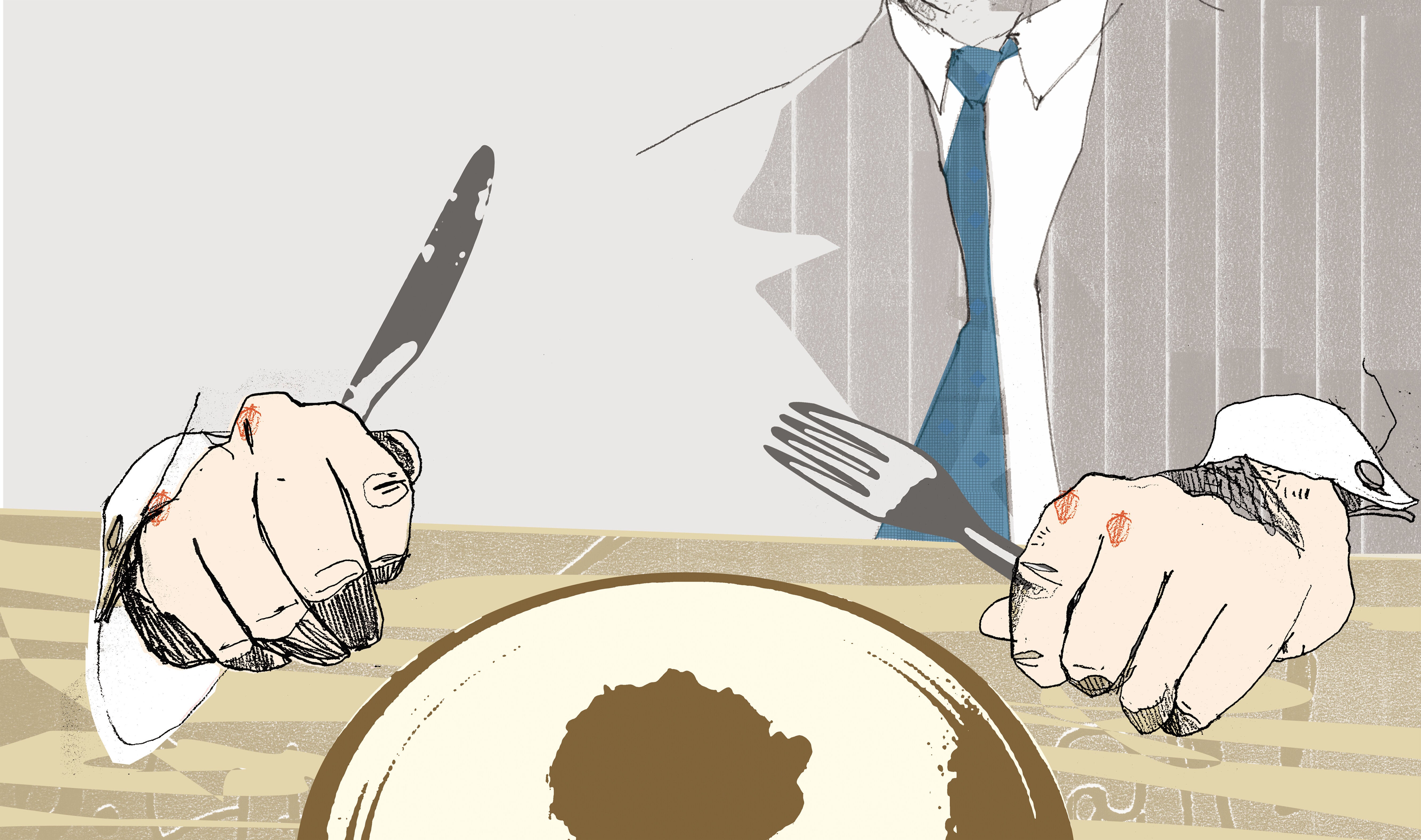
That said, there are a few cutlery customs that are just practical. Case in point, the weird way I grip my fork. No matter which cutlery style you use, American or Continental (look it up if you’re curious, but that’s another detail not to sweat), you want to hold your fork and knife similarly to how you’d hold a pencil as opposed to, for instance, gripping it with your whole fist. (For the record, I swear my fork-holding style isn’t that exaggerated. It’s more of a half-fist grip.)
Post said it’s most common to see people doing this when they’re stabbing something, like a piece of meat, and cutting it with their other hand. The “correct” way is actually just the more effective way. When you hold your fork at an angle, with your thumb and index finger, you actually have greater precision and control, which means you’re less likely to accidentally send your food flying off your plate. Saucy or buttery food can be especially prone to slippage.
Sometimes the placement of your utensils really does send a message.
Advertisement
There are proper ways to rest your cutlery on your plate when you’re not using it, chiefly for the sake of communicating with your host or waitstaff. Post says to envision your plate as a clock face and set your fork and knife at the 8 and 4 o’clock positions when you’re taking a break from eating or stepping away from the table for a moment. At a restaurant or catered event, servers recognise that position to mean, “I’m not done; don’t take my plate away yet.” When you are done, rest both at 4 o’clock.
Traditionally, servers are trained to serve you your plates from your left side and clear your plates from the right, particularly in fine dining settings. When your utensils are oriented toward the right, a server can easily pick them up with one hand without risking a knife sliding off.
Ana Silva / EyeEm via Getty Images
Clinking at the rim of the glass is a disaster waiting to happen.
What about drinking glasses and toasting etiquette?
First and foremost: glasses are set to the right of plates, Walczak reminds us. So if you’re overwhelmed by a densely set table, just keep that in mind. The glasses on the right side of the plate are yours.
No matter what’s in your glass, the general rule is to take sips, not gulps, and do it quietly, without slurping. Also, don’t do that thing where you turn the glass upside down to get the last drops, Post advises.
Like most of these etiquette guidelines, the reasoning is simply to avoid making a spectacle of your basic human functions. You probably don’t want people to miss what you have to say because they’re too distracted by your drinking mannerisms – or, like a girl on the subway once did to me, knock skulls with someone when you throw your head back to take a swig.
When it comes to wine and wine glasses, there are a couple of particulars worth knowing. Wine educator Ami Gangemella says that when people toast, she often sees them clinking glasses at the delicate rim. Clinking at the bowl, instead, reduces the risk of accidentally smashing and breaking the glasses. No one wants to deal with stains and shards mid-party.
Being the recipient of a toast can be an awkward moment of spotlight, especially if you don’t know what to do. Walczak says that in formal settings, the most gracious thing to do is basically nothing, Don’t raise your glass, don’t take a sip.
“The person being toasted should just sit quietly, smile and appreciate the toast that has been given in their honour,” she said. “Let others raise their glasses and drink.”
The other wine-drinking custom to know is that, although it’s common for people to hold their glasses by the bowl, the better way is to hold them by the stem with your thumb and forefingers, Gangemella says. (You can support the bottom with your pinkie if you want.) This keeps your body heat from warming up the wine ― room-temperature Champagne just doesn’t taste as good.
Advertisement
Don’t be a snob.
Again, the purpose of all of these guidelines is to make the people around you feel comfortable and to allow the focus to be on what you all have to say and how delicious the food is rather than on the way you eat it.
For that reason, try not to sweat it too much if there’s something you didn’t know or did differently than your company. If anyone gives you judgmental looks about something as minute as forks or glasses, ultimately they’re the one being rude.
As Lizzie Post put it, “Anyone who’s completely offended to dine with you because of how you’re holding your cutlery doesn’t deserve your company.”
HuffPost is part of Verizon Media. We and our partners will store and/or access information on your device through the use of cookies and similar technologies, to display personalised ads and content, for ad and content measurement, audience insights and product development.
Your personal data that may be used
Information about your device and internet connection, including your IP address
Browsing and search activity while using Verizon Media websites and apps
To enable Verizon Media and our partners to process your personal data select ‘I agree‘, or select ‘Manage settings‘ for more information and to manage your choices. You can change your choices at any time by visiting Your Privacy Controls.
HuffPost is part of Verizon Media. We and our partners will store and/or access information on your device through the use of cookies and similar technologies, to display personalised ads and content, for ad and content measurement, audience insights and product development.
Your personal data that may be used
Information about your device and internet connection, including your IP address
Browsing and search activity while using Verizon Media websites and apps
To enable Verizon Media and our partners to process your personal data select ‘I agree‘, or select ‘Manage settings‘ for more information and to manage your choices. You can change your choices at any time by visiting Your Privacy Controls.