There’s no doubt that the festive season can be a stressful time, amid all the travel plans, family visits and present shopping.
These activities often involve an array of demands that take a toll on your mental health, such as cleaning, cooking and spending. So it’s totally OK to experience stress or anxiety among the festivities; even mental health professionals – who may seem like they have it all together – aren’t immune to these feelings.
Advertisement
HuffPost asked therapists for insight on how they feel joy and cheer amid the stress of the season. Here are their personal tips for decompressing and relaxing:
They set aside time for themselves
The festive season can be a busy time, especially if you are surrounded by friends and family. It’s normal to feel stressed and anxious about meeting up with people or hanging with relatives.
“I always make sure I set aside some time for myself to relax during the holidays and focus on my wellness needs,” says Michael Klinkner, a licensed clinical social worker in Arizona.
They scribble a few thoughts in a journal
Minerva Guerrero, a therapist who founded Mind Matters Mental Health Counseling in New York, says she often takes a journaling break to intentionally ground herself.
Advertisement
“I like to journal to get clear on what I’m hoping the holidays bring me and how I feel during this time,” she says. “This self-care activity really helps me destress and relax during the holiday season.”
They listen to music
Music therapy can evoke feelings of calmness and relaxation.
“I often create soothing and hype-me-up playlists, which help me move through my feelings,” says Naiylah Warren, a therapist and clinical content manager with mental health platform Real.
They focus on holiday events that give them joy
During one of the busiest times of the year, it’s important to set boundaries to take care of your mental health and wellbeing.
“I generally check in with myself in regards to what traditions or gatherings feel stressful to me and which ones bring me joy,” says Kama Hurley, a clinical counsellor and life coach in Idaho. “I prioritise what I love to do and say no to the things that make me feel anxious.”
LordHenriVoton via Getty Images
Even therapists need some coping strategies to get through the holidays.
Advertisement
They make a self-care list
Hurley says she writes a self-care list when she’s anxious or stressed, as it gives her agency and lifts her mood.
“I write down activities that help me relax and make me feel good about myself that I can accomplish when feeling the intense emotions,” she says.
Having a go-to list that you can reference and change will help you identify which activities are sources of joy.
Madeline Lucas, another therapist and clinical content manager at Real, shared some self-care activities that help her feel less isolated in her holiday stress: taking long showers with music, applying sheet face masks, going on walks and stretching.
They sit in stillness for a few minutes
The art of meditation can be powerful in achieving a sense of calm and balance.
“I practise meditation exercises for a few minutes whenever I feel stressed,” says Regine Muradian, a clinical psychologist in California. When you feel that stress starting to creep up on you, take a moment to inhale deeply and focus on your breathing.
Advertisement
They plan ahead
Israa Nasir, a therapist who founded the mental wellness brand Well.Guide, said she plans ahead for the festive season, which helps her destress. “I make sure to take care of any client and associated work-related obligations fully when I take time off during the holidays,” she says.
Planning a schedule before you get too busy may feel comforting as it offers a sense of routine, with many decisions already made in advance.
They talk to their therapist
Many mental health professionals get help from therapists of their own to manage stress. If you feel that stress is inhibiting your ability to get through the day, consider connecting with a mental health professional now.
“If I anticipate a lot of stress prior to the holiday season, I’ll schedule a few extra sessions with my own therapist before they go on their holiday break to help process the feelings I’m having,” Nasir says.
For many people, 2022 went by in a blink – doesn’t it feel like it was just January? But for others, especially children, last year’s holidays may seem like eons ago.
There’s a reason why you may feel like the years moved slowly when you were a kid, but zoom by now. Experts say our perception of time greatly changes as we age, which makes certain periods feel like they go by quickly.
Advertisement
“Our perception of days, weeks, years and that kind of time seems to be especially influenced by our perspective: Are we in the moment experiencing it, or are we looking backward on time?” says Cindy Lustig, a professor of psychology at the University of Michigan.
She added that the perception of time is also influenced by memory and how much you’ve experienced. For an eigh-year-old, a week is a big portion of their life. For an 80-year-old, a week is a much smaller portion of their life, which contributes to the feeling that it went by quickly.
Looking back on time plays into this feeling of acceleration
A day in the life of a retired 80-year-old may feel like it’s going by more slowly than that of an eight-year-old who is busy at school. However, when both people look back on a month or a year, that period of time will seem like it went by faster to the older person.
This is for a number of reasons. For the 80-year-old, their life probably doesn’t look too different than it did when they were 78 or 79, “so, in that case, they’re looking back on fewer events,” Lustig says. “When you’re looking back, the less rich your representation is, the more it’s going to seem like the time went by quickly.”
Advertisement
In other words, our brains lump time together when the days or weeks are similar. So for an 80-year-old who largely does the same thing every day, the year is going to blend together in their mind and feel like it went by quickly.
The new and exciting things in a day are what make the days and months feel different, and thus set them apart in our minds.
Halfpoint Images via Getty Images
As you age, your perception of time changes, which is why years may feel like they fly by.
Changes to your routine can also affect how fast the years seem to go by
The many experiences young children have in a day (such as learning new things at school, going to ballet class or visiting a new friend’s house) contribute to the notion that time is more plentiful and more activities can fit into that time. Therefore, when looking back, time may feel slower.
Advertisement
This can apply to adults, too. When we look back on a time period that was filled with lots of new experiences, “we see [a] large expense of events and memories, and that makes it seem like time stretches out … and it feels very long,” Lustig says. If you’re not introducing new patterns into your life, time can feel like it’s going by much quicker overall.
Some experts think that how our brain absorbs images impacts our perception of time
How we process what we see can also influence how we view time, Bejan says. Our brains are trained to receive many images when we are infants. Because we’re absorbing so many new images as kids, it may feel like months and years are longer.
As adults, “the brain receives fewer images than it was trained to receive when young,” Bejan says. Therefore, we feel like time went by more quickly. In other words, there are physiological factors at play that influence our perception of time ― namely, the older we get, the faster it feels.
Maskot via Getty Images
Trying out new things can help it feel like time went by more slowly.
While you can’t slow time, you can do things to feel like it’s moving a little slower.
Bejan says many older people ask him how they can slow down time, “because everybody wants to live longer [and has] the urge to do more and better things with the time that is available.”
Advertisement
He said one way to do this is to experience things that are new and out of your usual regimen.
This could mean picking up a childhood hobby (like dancing or violin), taking an overnight trip to a city you’ve never visited or signing up for a cooking class. Learning new things is another good way to make your time feel longer when you look back on your life, he said.
Bejan stresses the adage “variety is the spice of life”: you should get out of your routine and take advantage of the time you have, which will only help make you feel like your year had more time to fill, he says.
Living a routine-only life makes the year fly really fast, he adds.
Lustig notes that being fully engaged and “in the moment” can make those moments seem to last longer. In fact, laboratory studies show that mindfulness exercises can stretch our perception of time, she says. So don’t try to focus on multiple tasks at once. Instead, just focus on the experience at hand.
“None of us know how much time we have, but, interestingly, we do actually have a lot of control over how we experience that time,” Lustig says. “So I encourage everybody to make the most of the time that you’ve got.”
In the past few years we’ve seen mental healthand therapy content explode online. As the stigma towards therapy decreases, people are using social media to share the beauty that can come out of sitting down with a professional and talking.
Among those sharing videos, are therapists and counsellors who want to reach a wider audience.
As someone who has been in therapy, being able to watch content linked to anxiety has helped and encouraged me to continue to do the internal work. And let’s face it, accessing therapy can be both arduous and expensive – especially if you’re early in your career or you’re facing long NHS waiting lists – so these videos are a way for people to start work on themselves today, without paying a hefty fee.
Advertisement
However, there’s been recent debate around how therapists are using social media. There’s a big difference between a therapist who shares five tips for coping with anxiety – and a therapist who retells their client’s life story for likes. (And no, I won’t be sharing examples of the latter).
slightly concerned about the amount of doctors, nurses, & therapists trying to go viral on tiktok & insta…can at least *one* segment of society be, like, healthy and grounded enough to maybe not need validation from strangers via 15-second clips with spongebob music
I had some students confide in me that their THERAPISTS were making fun of them on Tiktok. They were so completely traumatized, and I’m not sure they will even regain the ability to trust people in authority again. I would never make fun of a student.
Increasingly, it feels like it’s becoming normalised for therapists to speak about their clients in their social media, which has made people wonder how ethical this is.
“Therapists are not supposed to be using their clients to become influencers,” one therapist (@QueeringPsych) said on Twitter.
“Sharing helpful info (without generalising or diagnosing strangers) is great. Making your clients wonder if you’re gonna talk about them affects the relationship,” he added.
Therapists aren’t the only ones using social media to speak about their profession. American nurses recently came under fire after sharing their patient ‘icks’ on TikTok.
Advertisement
No job is perfect and being a nurse is a demanding job. But where is the line between raising awareness of the challenges of your profession and speaking about real-life patients? Does it matter if they’re unnamed? Or does it still cross a line?
Vuma Phiri, who is a 25-year-old paralegal from Western Australia, thinks the content therapists make is starting to go overboard.
“There are certain client-facing careers that need to avoid speaking about the people who come to see them because they visit you at their most vulnerable. It’s unethical to use their vulnerability to go viral,” Phiri says.
However, she shares that she’s benefitted from therapy content but mainly the therapists who give general advice without mentioning their clients’ experiences.
Advertisement
“You can definitely reach your audience well by giving out advice based on your knowledge rather than specifically speaking on those who come see you,” she says.
Phiri also says she’d be angry if her therapist used her story for a viral video. “The security I feel signing a confidentiality agreement would be breached by you speaking about me online on an app as far reaching as TikTok, even if I was anonymised.”
Crystal*, who has been going to therapy for some years, understands how these videos can help others, but “when its explicitly prefaced and explained as the story of a particular person, I think it’s invasive and an informal violation of trust,” she says.
She explains that she would feel violated if her therapist shared her story online. “How can I be baring my soul and telling a professional things that even my close family and friends don’t know and they’re using it as gist online for engagement?” asks the 24-year-old painter from London. “Even though only I would know it was about me, I would feel quite exposed.”
Westend61 via Getty Images
Advertisement
She adds that she’s never found hearing people’s personal stories in this context helpful. “It feels like entertainment and the focus is always on how juicy the story is rather than the healing/resolution/lesson to be learned,” Crystal adds.
Caroline Jesper, who’s head of professional standards at the British Association for Counselling and Psychotherapy’s (BACP), believes social media channels can be a great way to connect and communicate with people, and for therapists, it can be a good way to network with other professionals.
“However, it’s important therapists keep in mind their ethical values and principles while doing so,” she tells HuffPost UK.
“They shouldn’t breach confidentiality or publish anything on social media which could identify a client. They should also be aware that even when anonymising aspects of their client work, a client may see this and recognise themselves in being said. This would be a breach of trust in the therapeutic relationship.”
Are therapists allowed to speak about clients online?
Counselling Directory member Jennifer Warwick shares that there’s been some healthy debate amongst therapists about how, or if, they should use social media.
Advertisement
“Some stay well away, while others see it as a way of connecting and engaging with people,” Warwick says. “It’s a way of showing ourselves as being human and relatable.”
Therapists in the UK are bound by ethical guidelines set out by the governing boards, such as the BACP, so in theory this should prevent people crossing a line.
“Client confidentiality and privacy are key, so we need to make sure that no information that might identify the client is used,” Warwick explains.
“The BACP even have specific guidance for its members, which includes how social media relates to its ethical framework, maintaining clients’ privacy and confidentiality, as well as appropriate boundaries.”
But if you’re viewing this kind of content on TikTok – or you’re in therapy yourself – how can you judge when a therapist has shared too much?
Advertisement
“It’s vital for therapists to tread very carefully around this and not to share anyidentifiable information about clients, past or current.” Warwick adds.
“Imagine seeing a post from your therapist and thinking ‘they’re talking about me!’ even without them giving a name or location.”
She emphasis on the the importance of a health relationship between therapists and clients. “It makes no sense to have a client or potential client feel that we might not be safe to work with when they see us posting about a current client.
“It can however be helpful to talk about general themes or issues on social media that we work with, as this helps clients find the right therapist for them.”
Should therapists ask their clients if they can speak about them online?
“It’s definitely good to set boundaries with clients around social media use, for example, not responding to DMs or accepting friend requests,” Warwick says.
Advertisement
“Ideally, this would be stated as part of the therapist’s social media and also as part of the agreements made when starting with a client.”
“It might be good to discuss with a client how we use social media, to be there to answer any questions they might have and put their minds at ease so they know we are bound by ethical guidelines in our work, which protects our clients’ privacy and confidentiality.”
If you have concerns about your therapist, the BACP advises trying to speak to your therapist first to try to resolve the issue directly with them. But if you think confidentiality has been breached, you can make a formal complaint.
Help and support:
Mind, open Monday to Friday, 9am-6pm on 0300 123 3393.
Samaritans offers a listening service which is open 24 hours a day, on 116 123 (UK and ROI – this number is FREE to call and will not appear on your phone bill).
CALM (the Campaign Against Living Miserably) offer a helpline open 5pm-midnight, 365 days a year, on 0800 58 58 58, and a webchat service.
The Mix is a free support service for people under 25. Call 0808 808 4994 or email help@themix.org.uk
Rethink Mental Illness offers practical help through its advice line which can be reached on 0808 801 0525 (Monday to Friday 10am-4pm). More info can be found on rethink.org.
There are a few crucial items to figure out when starting therapy – like finding a therapist who you trust, picking the best treatment modality, and figuring out a way to fit a session into your schedule.
When it comes to the latter, the time you choose may be more influential than you think. Is it a bad idea to do it during your lunch break? Should you try to have your session at the start of the week? Is there even such a thing as an ideal therapy schedule?
Advertisement
“The best time of the day to have a therapy session depends on a variety of factors, and it varies based on the individual,” said Kristen Casey, a clinical psychologist and insomnia specialist. “Every person has a different schedule, lifestyle and ways of coping with the emotional hangover from a therapy session.”
In other words, there isn’t a “one-size-fits-all” answer, and it may take some trial and error to find the time that works for you. With that in mind, here are some factors that you’ll want to consider when it comes to determining the best time of day to schedule your next therapy session.
Think about what you’re going to talk about
It’s pretty difficult to say with certainty what topics are going to arise during a session, but if you have an idea of the subject matter that you plan on talking about, then that can be helpful in determining what time to schedule your next appointment.
“If you are working on intensive trauma that leaves you drained after each session, it might not be the best to do a session right in the middle of the work day,” said Kristen Gingrich,licensed clinical social worker and certified drug and alcohol counsellor. “However, if the only time you can find is in the middle of the day between different tasks, it’s important to make sure that you schedule time to help regulate yourself to make sure that it is not going to impact your day.”
Advertisement
Consider what processing looks like for you
If you’ve had a therapy session during lunch at work and then had to hop on a meeting in the next hour, then you might have realized that you need more time to process your appointment since your mind is still actively churning thoughts. In those scenarios, you’ll want to try to schedule your therapy session for a time where you’ll have some time afterward to recollect yourself.
“Try to schedule a bit of a buffer before and after to make the most of your session and give yourself space to process what you’ve just worked on,” said Dr. Nina Vasan, the chief medical officer at Real, a mental health platform. “Otherwise it can feel jarring to jump back into work or daily life.”
It can be helpful to develop a post-therapy ritual if your schedule allows it to come down from heightened emotions. This can be as simple as taking a nap, going on a quick walk, reading your favorite book, mindfully drinking a cup of tea, or anything that helps ground you back into your daily routine.
Anchiy via Getty Images
When scheduling your sessions, think about when you’ll have some downtime to process what you discussed with your therapist.
Think about when you’re most productive
After a long day at work, the last thing you might want to do is have another hour-long conversation. Even though it’s a voluntary activity, it can still be overwhelming for some people. If that sounds familiar, then the best time for a therapy session may not be at the end of the day.
Advertisement
However, if you’re a morning person, then a session before work may be more beneficial. “For example, maybe you’re distracted in the morning by the commitments you have for your day. In that case, an evening appointment could be better,” Vasan said. “For others, by the evening, energy is zapped which means meeting earlier in the day is more productive.”
Think about it: If you’re paying for a session, you want to make sure it’s at a time where it’s going to have your complete attention so you can focus entirely on your healing journey.
Discuss a good schedule with your therapist
Unfortunately, it isn’t always possible to schedule a therapy appointment at the time of the day that works “best for you.”
Since many therapists have full case loads, it can be a challenge to cater to everyone’s needs, said Kelly McKenna, a licensed clinical social worker and anxiety therapist. That’s not to say your therapist won’t work with you to find a time that is most beneficial, but due to the nature of the job and the schedule, sometimes it isn’t always possible.
In this instance, for example, you may want to find a therapist who works on a routine weekly schedule (ie. you see them at the same day and time every week). Not every therapist operates like this, so you may just have to succumb to one of the open slots they have left, but each case is different, so a conversation is definitely necessary to figure out a cadence that works for everyone.
During college, I grew a tumour that meant I hung out quite frequently in MRI machines. Though I’d never had a problem before, I found myself newly and severely claustrophobic – laying in a tiny tunnel for hours, arms raised overhead, will do that.
What I never saw coming was that phobia transferring to other small spaces, namely, airplanes. I’d developed severe anxiety around flying, stemming from that claustrophobia. Once the flight attendants closed the doors, and I was stuck there for a few hours, I was history. Since then, I’ve been on a mission to overcome flight anxiety because who wants to hang out in the Midwest their whole life?
Advertisement
It turns out I’m far from alone — up to 40% of Americans (and one in 10 Brits) have some sort of flying anxiety, from fearing a plane crash to worries about close contact with others. Or, like me, they don’t want to be stuck. Still, others dread navigating the airport, worrying their valuables might be lost or that they could encounter an issue with security doubting their intentions. Flying anxiety has become such an issue that some airlines like British Airways even offer courses, such as their Flying with Confidence one-day class, to get you back in the air.
There’s likely even more of a spike in flight anxiety thanks to the pandemic, according to Susan Zinn, a psychotherapist and author of “The Epiphanies Project.”
“That is why there’s been an uptick in airplane phobias, fear of flying, and feeling out of control, or road or flight rage — people all of a sudden get triggered that bring them back to a time in our recent past where they felt so out of control,” Zinn said.
Here’s what experts say we can do to reduce our anxieties about airplanes.
Expose yourself to the aspects of flying (preferably with a mental health professional)
For Johnny Jet, a worldwide traveler and expert who has been to over 70 countries, his traveling fears started with a doctor’s comment. He was headed on a 27-hour flight when his asthma doctor commented that he “might have a problem breathing on a plane because the cabin is pressurised.”
Advertisement
This led to a full-blown panic attack at a New York airport ahead of the flight, which he called “one of the worst days of his life,” and prompted an almost four-year-long fear of flying.
Exposure to planes and airports ended up being, ironically, part of the solution. “Speak to the flight crew, take a course, read books, go to the airport and do practice runs,” he suggested.
This type of activity ― known as exposure therapy ― can help your brain adapt to the situation over time and take some of the fear and uncertainty away from flying. It’s best to try this with a therapist who is trained in doing this.
Zinn added that medication might also be necessary for some people in tandem with preparation. She’s worked with clients who have spent several months practicing for a flight before the real trip.
Get strategic about your seat selection
Right after 9/11, Zinn had to jump on a plane out of New York for a business trip. She was terrified as their flight was escorted by air marshals openly carrying weapons. She was one of many who would develop a new fear of flying, which caused nausea and panic attacks.
Advertisement
One strategy that helped her was carefully picking a seat that made her feel comfortable. “I always still to this day will sit on the outside aisle [seat] to make sure I can always get up, versus kind of being stuck on the inside, which made me feel better,” she said.
Quick access to the bathroom, where you can splash cold water on your face to “shock your system” when you feel panic is another tool that helps, Zinn explained. If financially possible, upgrading to first class for more room or choosing an exit row for more legroom might also help, Jet added.
izusek via Getty Images
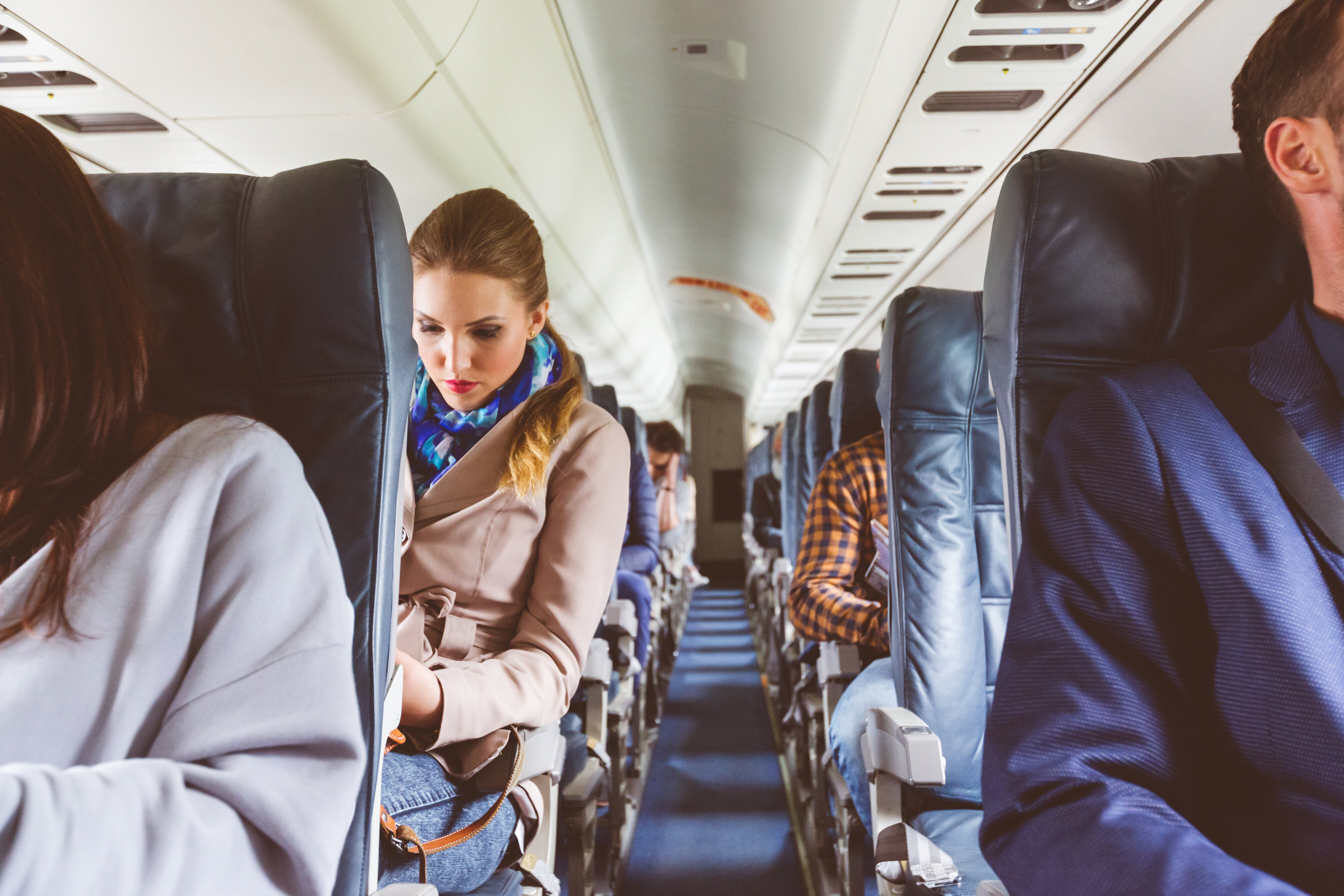
Experts recommend choosing a seat that brings you the most comfort if you’re worried about getting on a plane.
Find a deep breathing method that works for you
It may be an annoying suggestion to hear, but breathing exercises are often given as a recommendation for anxiety because they work. Zinn said she often suggests her patients practice intentional breathing exercises, like five-finger breathing, where you take deep inhales and exhales as you trace the outline of your hand.
Doing this can help calm the panic that arises before it turns into a full panic attack, Zinn said.
Pack some sour candy in your carry on
Zinn also suggested eating some sour candy, such as a WarHead, to force your brain back into reality. The candy’s tartness can help you better focus on the moment rather than the fear or “what if?” during flying. It’s another way to practice mindfulness.
Advertisement
Learn the “why” behind air bumps
Adam Banks, a retired pilot based in New York, said the turbulence is one of the most concerning parts of flying for anxious passengers. Understanding what it is might help you see it as more normal and less of a sign of impending doom.
“Turbulence is just shifting winds. If you fly into a puffy cloud, the airplane is going to get a bump,” he said. “Airplanes are designed to handle these bumps. If you’re sitting over the wing, you can see the wings flex as they absorb turbulence. Turbulence might feel like the airplane is moving around thousands of feet, the reality is the airplane is probably only being jostled a few feet.”
Ground yourself in facts
Zinn said that dealing with both physical anxiety and our mind’s perception of danger plays a role in calming down, so statistics might help. For example, the annual risk of dying in a plane crash is only one in 11 million. You are much more likely to die from sunstroke, a bee sting, consuming a hot substance or even being attacked by a dog.
For me, flying in a tiny space will probably always be a struggle. But armed with some tools and tricks, flying is doable again, and I’m no longer doomed to the Midwest for life.
This mental health condition, also known as seasonal depression, lasts around four to five months on average. “The appropriately named SAD, or seasonal affective disorder, is considered a type of depression characterised by its seasonal nature,” Jeff Temple, a professor at University of Texas Medical Branch and a licensed psychologist, tells HuffPost.
A common misconception is that SAD is less serious than major depressive disorder because it doesn’t last all year round. However, people with this mental health condition explained to HuffPost that the symptoms of SAD are very real, and can even be debilitating.
Here’s what they want you to know:
People with seasonal depression may struggle to do daily activities
Like those with major depressive disorder, people with SAD may experience a lack of motivation and a loss of interest in day-to-day activities.
“I have had SAD for about 12 years, but I didn’t recognize the pattern or be diagnosed until about five years ago,” Claire, an optometrist, tells HuffPost. (Claire, along with some others in this story, asked to keep her last name private so she could freely talk about her mental health condition.) “I am typically an early riser and consider myself a productive person. However, when SAD hits, I struggle to do even the smallest daily chores like doing the dishes or making dinner.”
Advertisement
Similarly, Rebecca, a grad student, says that she has a “difficult time keeping up with [her] self-care and workout routine during the winter months,” and finds it nearly impossible to “function at full capacity.”
People with SAD may also feel more isolated during the darker months
Moreover, staying socially and emotionally connected to loved ones can require much more effort when coping with seasonal depression.
“The most prominent SAD symptoms I experience are loneliness and apathy. I tend to become quite numb in the winter months, and feel emotionally separated from the people around me,” says Vera, a freelance illustrator. “During regular depressive episodes, I may be able to ‘mask’ for most basic social interactions, whereas in winter seasons it’s not even an option. I’m too wiped out to even show up or pretend.”
Seasonal depression can interrupt normal sleep cycles and lead to extreme fatigue
SAD and sleep disturbances go hand in hand. Chloé Perrin, a bartender, has found that her symptoms of seasonal depression often manifest as constant exhaustion, leading to hypersomnia. Simply put, hypersomnia is characterised by recurring episodes of sleepiness during the day, difficulty waking up in the morning, and feeling tired despite oversleeping.
“My family used to joke that every winter I’d hibernate, whereas my sleep is otherwise normal-to-low the rest of the year and during other episodes,” she says.
Advertisement
Bella Sutter, a dancer with seasonal depression, explains that “getting out of bed feels impossible and my mornings normally start late.”
“I feel as if I would be better off hibernating through the winter because seasonal depression makes me feel like I’m half asleep anyway,” she adds.
Krzysztof Krysiak / EyeEm via Getty Images
SAD can cause mood changes, sleep disruptions and more.
People with seasonal depression may experience changes related to appetite and eating habits
Not only does seasonal depression impact sleep, but this mental health condition can have a negative impact on a person’s eating habits. Researchers have found a marked correlation between SAD and higher rates of disordered eating, including behaviours such as binging, purging and restricting food intake.
For Anna Samanamú, a high school paraprofessional and graphic designer, symptoms of SAD began when she was a teenager. “My appetite becomes affected [with SAD], and I would prefer to sleep rather than eat,” she says. “Unfortunately, that led me to have issues such as anaemia and Vitamin D deficiency.”
Advertisement
Seasonal depression may worsen symptoms of other mental health conditions
According to Temple, “seasonal affective disorder has a bi-directional relationship with other mood disorders like depression and bipolar disorder — meaning that people with one form are much more likely to develop or worsen the other.” Notably, SAD affects up to 20% of people with major depressive disorder, and 25% of people with bipolar disorder.
Rhiannon Bellia, who works in social services, has found that seasonal depression tends to exacerbate symptoms of other mental health conditions.
“My OCD gets a lot worse in the winter, it’s harder for me to focus and gauge time with my ADHD. With having autism, it’s also a bit harder for me to regulate sensory overwhelm,” Bellia says.
There are treatments for SAD
Temple explains that if symptoms such as losing interest in activities or feeling sad last “longer than a couple of weeks or [start] to interfere with your work, family, or relationships, then that’s a good sign that you may need some extra help.”
SAD is not simply feeling a little gloomy when the sun goes down; it is a serious mental health condition that can greatly impact every aspect of someone’s life.
“Please be kind to everyone who struggles with seasonal depression,” Samanamú says. “We are not lazy — sometimes there is just a disconnect from our minds and bodies. Many of us just need to take a little bit of time to become whole once again.”
Help and support:
Mind, open Monday to Friday, 9am-6pm on 0300 123 3393.
Samaritans offers a listening service which is open 24 hours a day, on 116 123 (UK and ROI – this number is FREE to call and will not appear on your phone bill).
CALM (the Campaign Against Living Miserably) offer a helpline open 5pm-midnight, 365 days a year, on 0800 58 58 58, and a webchat service.
The Mix is a free support service for people under 25. Call 0808 808 4994 or email help@themix.org.uk
Rethink Mental Illness offers practical help through its advice line which can be reached on 0808 801 0525 (Monday to Friday 10am-4pm). More info can be found on rethink.org.
The word, defined as “an extended period of instability and insecurity”, is one of the several terms on the 2022 list which has seen increasing usage due to the ongoing crises in the UK and across the world.
Advertisement
The dictionary said it chose the word as it “sums up quite succinctly just how truly awful 2022 has been for so many people”.
Six words on Collins’ list of 10 words of the year are new to CollinsDictionary.com, including “permacrisis”, despite being first noted in academic contexts from the 1970s.
Another word on the list which has contributed to the feeling of “permacrisis” is “partygate”, referring to the scandal over social gatherings held in defiance of public health restrictions and which contributed to an extended period of political instability.
“Kyiv” has also been added after the city became a symbol of Ukraine’s stand against Russian aggression as well as “warm bank”, which describes a heated building such as a library or place of worship where people who cannot afford to heat their own homes may go.
Advertisement
The personal impact of the ongoing crises has also influenced the list with the addition of “quiet quitting” – the act of doing one’s basic duties at work and no more, either by way of protest or to improve work/life balance, as well as “vibe shift” which relates to a “significant change in the prevailing atmosphere or culture”.
The historic moment of the Queen’s death in September has also been marked as “Carolean” is added to the lexicon, signifying the end of the second Elizabethan era and the beginning of the reign of King Charles.
“Lawfare”, which is the strategic use of law to intimidate or hinder an opponent, is also included as well as the more unusual term “splooting” relating to animals stretching themselves out in order to cool down – a phenomenon seen frequently during this summer’s intense heat.
Rounding off the list is “sportswashing”, a word for how organisations or countries use sports promotion to enhance reputations or distract from controversial activities or policies, which has seen increased use in the year of the upcoming Fifa World Cup in Qatar.
Alex Beecroft, managing director of Collins Learning, said: “Language can be a mirror to what is going on in society and the wider world and this year has thrown up challenge after challenge.
Advertisement
“It is understandable that people may feel, after living through upheaval caused by Brexit, the pandemic, severe weather, the war in Ukraine, political instability, the energy squeeze and the cost-of-living crisis, that we are living in an ongoing state of uncertainty and worry; “permacrisis” sums up quite succinctly just how truly awful 2022 has been for many people.
“Our list this year reflects the state of the world right now – not much good news, although, with the determination of the Ukrainian people reflected by the inclusion of “Kyiv”, and the dawn of the new “Carolean” age in the UK, there are rays of hope.”
The lexicographers at Collins Dictionary monitor their 18-billion-word database and a range of media sources, including social media, to create the annual list of new and notable words that reflect our ever-evolving language and the preoccupations of those who use it.
Last year’s word of the year was “NFT” (short for non-fungible token) – which entered the mainstream after millions were spent on the most sought-after images and videos.
When you’re pregnant, levels of worry can ramp up to never-before-seen levels.
Much of those nine months can be spent worrying obsessively about miscarriage, whether you’re eating or doing the right things to keep your baby healthy, whether your baby is moving enough, and the impending birth.
It’s a lot. So it’s perhaps no surprise then that one in 10 women will struggle with pregnancy anxiety, which can begin to rule their lives.
Advertisement
It’s the subject of Break Free From Maternal Anxiety, a new book penned by three NHS clinical psychologists: Dr Fiona Challacombe, Dr Catherine Green and Dr Victoria Bream.
The trio use cognitive behaviour therapy (CBT) techniques to explore how women can cope with persistent and distressing worries about pregnancy and becoming a mother. Here are some of the things we learned from it.
1. Pretty much every mum-to-be will feel anxious at some point during their pregnancy
If you’re pregnant and feeling anxious, know you’re not alone.
From worries about whether your baby is moving enough to how you’ll cope with the birth (and all of the uncertainty that surrounds that), pretty much every mum-to-be on the planet will experience anxious thoughts at some point.
“They aren’t pleasant or comfortable and they certainly aren’t spoken about enough,” write the authors, “but they are a near universal part of pregnancy and parenthood.”
Advertisement
In fact, research has shown that 100% of new mothers experience intrusive, unwanted thoughts about something bad happening to their newborn in the first weeks after birth.
If you have the odd worry here and there, you probably don’t need to read a book on pregnancy anxiety. But if worries seem to crop up daily and they’re stopping you from doing things, read on.
2. ‘Problematic worry’ is something to watch out for
There’s a difference between the odd anxious thought and problematic worry, where you get stuck in repeated loops of negative anxious thinking that feel hard to stop, control or turn away from.
It’s one of the most common problems in pregnancy and postnatally, according to the book, with about 8% of women experiencing it.
The authors share the story of one mum, Hestia, who was 32 weeks pregnant and constantly worrying about every decision she made about her baby. Some worries she had included: ‘What if I haven’t included everything on my birth plan?’ and ‘What if lose my job when I am on maternity leave?’.
Advertisement
While some people might have these kinds of thoughts and move on, she would find it difficult to move her attention to other things and would become irritable, unable to concentrate on work or reading books and then she became reluctant to leave her house.
When anxiety starts to impact your day-to-day life, it’s time to seek help. As Dr Fiona Challacombe explains: “The perinatal period is a time of big changes, emotionally, physically and socially, so it’s often assumed that anxiety is a normal part of this.
“However, when anxiety persists and is having an impact on your daily life and functioning then it is likely to be an anxiety problem.”
3. Tackling worry isn’t about what you worry about, but the way you think about it.
One of the things the book is keen to convey is that rather than trying to tackle the worry itself, you need to focus on solutions which tackle the way that worry works.
A strategy the authors advise is to ask yourself whether the worry you are having is actually important – ie. will anyone else care about this tomorrow? Or will you care it about it on your deathbed?
Advertisement
If it isn’t important – and you firmly believe that – they recommend trying to continue with what you are doing, and if your worries come back, to treat them as white noise in the background.
If it is an important worry, then they recommend defining what the problem is that underlies the worry – and then generating as many solutions as possible for that problem.
4. Setting a ‘worry-free zone’ or planning a time to worry could help
Another way to tackle worry is to set a worry zone, say the authors. This is basically where you make a conscious decision to put your worries to one side for a set time in the day.
One idea they suggest is that whenever you have a snack, you can “try to focus away from worry and enjoy every second of your crisps or chocolate”.
It’s a well-used technique in CBT for worry problems, they add, and as you get more practice, you can try to increase the worry-free zones and take control.
Advertisement
It sounds weird but the clinical psychologists also suggest planning a time when you will worry, and deliberately postponing worrying until that specific time.
“This is a useful strategy to free yourself from the relentless worrying, by setting a particular time when you can come back to worries you have noted in the day,” they say.
There are tonnes of strategies like this in the book, as well as advice on coping with intrusive thoughts and phobias.
Dr Fiona Challacombe says: “CBT is a very effective treatment for persistent anxiety and our own research trials show that it can be effective for maternal anxiety in various forms.
“We have seen many parents use the techniques described in the book to get control of and overcome their anxiety, with benefits to them and their families.”
Advertisement
Break Free from Maternal Anxiety: A Self-Help Guide for Pregnancy, Birth and the First Postnatal Year will be published October 27 by Cambridge University Press (£12.99).
Help and support:
Mind, open Monday to Friday, 9am-6pm on 0300 123 3393.
Samaritans offers a listening service which is open 24 hours a day, on 116 123 (UK and ROI – this number is FREE to call and will not appear on your phone bill).
CALM (the Campaign Against Living Miserably) offer a helpline open 5pm-midnight, 365 days a year, on 0800 58 58 58, and a webchat service.
The Mix is a free support service for people under 25. Call 0808 808 4994 or email help@themix.org.uk
Rethink Mental Illness offers practical help through its advice line which can be reached on 0808 801 0525 (Monday to Friday 10am-4pm). More info can be found on rethink.org.
Once you get to a certain age as a woman, you will know that menopause is around the corner.
And with that, comes the symptoms. Hot flushes are all but synonymous with the menopause, even though not all women experience them. And you’ll probably think there are a handful more, too. Well, you’re wrong.
Doctors report there are actually 62 different symptoms of menopause that women present with. That’s despite the biggest study yet into menopause awareness finding most women associate it with just five symptoms.
Advertisement
Hygiene and health company Essity surveyed 5,000 women pre-menopause, in peri, or post menopause – and found even women who are at the end of their journey remain relatively clueless about what they have been through
While 40% of women going through or having gone through the menopause have visited their GP to get help with symptoms, two thirds of women didn’t know menopause decreases sex drive and a whopping 74% didn’t realise it could be linked with weight gain.
Meanwhile, only 1% of women surveyed were aware it can cause changes in their vagina and how often they pee.
Menopause specialist Dr Naomi Potter reveals that tinnitus, UTIs, weaker bones and a change in body odour also feature in the list of menopause symptoms.
Advertisement
And worryingly, there’s a lack of knowledge of when it all kicks in, she says.
“Women believe they can’t experience symptoms in their forties because they’re not old enough, or their symptoms aren’t menopausal – when in fact if they’re over 45, it’s likely they are,” Potter says.
A spokesperson for Essity said: “[These] findings tell us that it’s a heavily misunderstood subject and the taboo surrounding it means women aren’t accessing the information and advice that could really help them.”
Jake* was having an ordinary family meal with his partner and 15-year-old son when he came down with a fever. For four days he felt exhaustion and had no appetite at all, and after a few days he developed brain fog. Twenty-four hours later, an anal lesion appeared.
“It was essentially an open wound for five days which was emitting a clear mucus and then blood,” Jake tells HuffPost UK.
Advertisement
“It was almost impossible to sit down and moving was very painful. Opening my bowels was pure agony and my body was making me do that eight or nine times a day. Each time was a bloodbath.”
The US Centers for Disease Control and Prevention (CDC) has estimated there are more than 25,000 cases worldwide – predominately in Europe, though more than 7,000 in the US, and more emerging in South America, South East Asia, the Western Pacific and the Eastern Mediterranean.
Advertisement
The virus was first reported in humans in 1970 in the Democratic Republic of Congo, having been identified in monkeys in a Danish laboratory in 1958 (thus the name). However, prior to 2021, there had only been seven UK cases.
As of August 4, there are more than 2,700 confirmed monkeypox cases in the UK, according to government figures, most in England and “a significant majority” of those – as many as 75% – in London.
Its prior rarity means knowledge of transmission among health experts is still patchy while we await more research – a period of stasis that echoes the early stages of Covid-19.
But this week, groups from across the political spectrum in Westminster joined forces, signing a letter to health secretary Steve Barclay calling for action on a disease that’s “causing real fear and anxiety” within queer communities.
FG Trade via Getty Images
While it’s possible for anyone, including children, to catch monkeypox, 98% of current cases are in men who identify as gay or bisexual, or men who have sex with men. This was confirmed by Dr Tedros Adhanom Ghebreyesus, director general of WHO, and he advised men to reduce their number of sexual partners while health authorities tackle the outbreak.
“We need to calmly and responsibly acknowledge that this current monkeypox outbreak is predominantly affecting gay and bisexual men.”
– Greg Owen, PrEP lead at Terrence Higgins Trust
So campaigners says it’s crucial that messaging about monkeypox transmission and vaccination is handled sensitively to avoid spreading further stigma against the LGBTQ+ community.
“We need to calmly and responsibly acknowledge that this current monkeypox outbreak is predominantly affecting gay and bisexual men,” says Greg Owen, PrEP lead at the Terrence Higgins Trust.
“We need to acknowledge that it’s also mainly being spread through the skin to skin contact, which is occurring during sex. There is nothing wrong with stating that. It is very problematic if we don’t.”
Advertisement
Dr Mark Lawton, a sexual health and HIV consultant in Liverpool and chair of the British Association of Sexual Health and HIV (BASHH), adds the following caution: “We believe, in addition to direct skin to skin to contact, monkeypox can be transmitted through contact with contaminated clothing and bedding and by respiratory droplets in close proximity.”
Harun Tulunay, a 35-year-old training coordinator who works with HIV/AIDS charity Positively UK, contracted a serious case of monkeypox in June.
“I was feeling like someone was ripping my flesh out of my bones,” says Tulunay of his experience. The Londoner doesn’t believe he developed monkeypox having sex, but through bodily touch, simply by lying next to a partner.
During his stint in hospital, the pain was so severe that doctors gave him opioids in an attempt to control the discomfort.
Harun Tulunay
Harun Tulunay in hospital with monkeypox.
Advertisement
“I wasn’t able to swallow, it was that bad,” he tells HuffPost UK. “The pain was worse than kidney stone pain. When they gave me antibiotics I was crying and kicking my bed and the doctors were holding me.”
While most monkeypox cases are much milder, there can be mental health implications for those who catch the virus.
Jake had been in close contact with his 80-year-old father in the period before his symptoms began and that, after getting a diagnosis, having to tell his family they might be at risk too gave him extra stress.
“Mentally it was very difficult,” says the professional services manager, who is bisexual, in his forties, and based in London.
“It meant my father knowing I’m in an open relationship which was stressful to share. My 80-year-old father has up until now just about managed to deal with my bisexuality by addressing it as little as possible. Now he is being contacted with offers for a vaccine as he may have been exposed.”
Advertisement
Twitter/@MonkeyPoxJake
Jake’s hand with signs of monkeypox (left) and his arm scabbing over (right).
The Department of Health & Social Care (DHSC) says it is working “rapidly” to vaccinate those at risk.
“It’s important to emphasise that vaccination will not give instant protection against infection or disease, and can take several weeks,” the WHO director-general said on July 27. “That means those vaccinated should continue to take measures to protect themselves, by avoiding close contact, including sex, with others who have or are at risk of having monkeypox.”
The US virus declared the virus a public health emergency on Thursday. For those confirmed to have monkeypox, the US CDC is recommending a two-to-four-week isolation period.
Advertisement
Now campaigners are calling for similar focus in the UK. Greg Owen is among many spokespeople for queer organisations putting pressure on the government to do more to control the spread of the virus and speed up vaccine roll-out.
“We want to see a national lead appointed to hold all of those in the fragmented system to account in terms of tackling the monkeypox outbreak with the ultimate goal of preventing it from becoming endemic in the UK,” he tells HuffPost UK. Owen believes we “urgently” need to double the amount of vaccines with “an injection of cash, quickly” put into sexual health services.
The open letter signed by Conservatives, Labour, Liberal Democrat, Green and Scottish National Party representatives, as well as charities. echoed this: “We are united as LGBT+ groups from across political parties in asking that the government treat the monkeypox outbreak as a public health emergency.”
Alongside the Terrence Higgins Trust and BASSH, the British HIV Association, PrEPster and the National AIDS Trust are also rallying for government action, including £51m funding from the Department of Health and Social Care.
The call is repeated by Dr Lawton: “Crucial to this is immediate mobilisation of resources by the government to ensure sexual health clinics, who are bearing the brunt of this, are funded to deal with the additional workload and sufficient vaccine is made available for all those that need it,” he tells HuffPost UK.
Advertisement
The Terrence Higgins Trust has also expressed concern that access to other vital healthcare support is being stretched due to health workers being overworked and having to focus on an influx of monkeypox patients.
“Some [sexual health services are] seeing a 90% reduction in access to the HIV prevention pill PrEP and long-acting reversible contraception,” the charity writes on its website.
Anna Bizon via Getty Images
Similarly to the early days of Covid-19, monkeypox is affecting people that are otherwise fit and healthy.
“I have no underlying health conditions,” says James,* who is 36, and asked to stay anonymous. “I work out six times a week and my fitness and health is my top priority. So for this to floor me the way it did, it was really scary. I also found the isolation really difficult, three weeks from the first sign and symptom is really tough!”
Advertisement
Meanwhile, John Thomas only experienced mild symptoms, but believes one of the major challenges is convincing men who have non-severe cases to isolate for the benefit of others.
“I think mild cases go under reported compared to the horror stories,” he tells HuffPost UK. “If you don’t know you have monkeypox, or if you can get away without people knowing you have it, you’re free to spread the virus to others.”
He adds: “If I hadn’t been looking for symptoms I would have almost certainly gone to a club night on the Friday [around the time of his transmission], and probably on the Saturday night as well.″ I think enough isn’t known about transmission yet, or if it is, the messaging is confusing.”
Thomas is right to have thought twice about going clubbing, says Dr Lawton, who says it is possible that monkeypox could spread in an intense nightclub environment where people are wearing little clothing.
“This is certainly a potential source of infection,” he says. “It is predominantly transmitted through skin to skin contact, but this does not need to be sexual.”
Advertisement
While we wait for more research, campaigners like Owen are trying to stay pragmatic.
While expressing “huge concerns,” including fears around vaccine equity, he tells HuffPost UK: “I tend not to ‘worry’ – worrying can be really debilitating.”
* Some names have been changed and surnames changed to offer anonymity.