The health secretary defends scrapping NHS England but admits the reform will bring challenges.


The health secretary defends scrapping NHS England but admits the reform will bring challenges.

Wes Streeting has said the NHS is “addicted to overspending” as he launched an attack on health bosses.
He said those in charge of the healthcare system assume “someone will come along to bail them out” when they blow their budgets.
Advertisement
His comments come as he suggested hundreds more government quangos could be axed following the abolition of NHS England.
Appearing on Sky News this morning, Streeting was asked by presenter Trevor Phillips: “Is it right that Jim Mackey, the head of NHS England, has written to local health boards demanding that they produce plans for a 50% reduction in their spending?”
Confirming the move, Streeting said there would be a “particular focus on management costs” to achieve that target.
Advertisement
He said: “Myself and Jim are confronting a financial planning round for the year ahead where systems returned financial plans to us that would have involved an overspend between £5 and £6 billion before the new financial year has even begun.
“I’m afraid this speaks to the culture that I identified before the general election where the NHS is addicted to overspending, is addicted to running up routine deficits, with the assumption that someone will come along to bail them out, in a way that, by the way, local councils would never be able to do.”
Phillips replied: “Are you saying that the apparatus of the NHS was basically wasting public money?”
Streeting said: “I think there’s definitely examples of waste and duplication and we’re going to go hard at it.
Advertisement
“Even if the public finances weren’t tight – and they are – I don’t think even in the good times it’s acceptable that taxpayers’ money is wasted, because the money you’re wasting could be spent on other public priorities or could be put back in the pockets of taxpayers.”
Writing in the Sunday Telegraph, Streeting said he was committed to “slashing bloated bureaucracy”, suggesting many more health quangos could be axed.
Advertisement
“The abolition of NHS England – the world’s largest quango – is the beginning, not the end,” he said.
On the BBC’s Sunday with Laura Kuenssberg, the health secretary admitted the effeiciency drive will see “significant” numbers of NHS workers lose their jobs.
He said: “I’m going after the bureaucracy, not the people who work in it.
“Of course, I can’t sugar coat the fact that there will be a significant number of job losses and we will want to make sure we are treating people fairly, supporting them properly through that process. And I’m not criticising them, but I’ve got to make sure the system is well set up.”
Advertisement

There are a few things that look set to make Adolescence one of 2025’s most talked-about new shows – namely, its unsettling subject matter and the incredible performances from its predominantly British cast.
But there’s one other factor that sets Adolescence apart, too.
Much like another of Stephen Graham’s recent hits, the 2021 film Boiling Point, each episode of the chilling Netflix crime drama is filmed in one continuous shot, giving the whole show a relentless, claustrophobic feel.
Advertisement
And if you were wondering – no, there’s no trickery at play here. Every episode really was one filmed in one long shot which, as you can imagine, required some imaginative thinking from Adolescence’s creative team.
“Basically, that means we press record on the camera and we don’t press stop until the very end of the hour,” director Philip Barantini told Netflix. “But it’s much more complicated than it sounds.
“It takes months of preparation and weeks of rehearsals and an incredible team of people to pull it off at every stage, from the script to the locations to the production design to where exactly the camera is going to be able to shoot and from what angle.”
Advertisement
Because of the show’s unique filming style, months of meticulous planning went into making sure everything the team wanted to include would be achievable in a one-take style.
“A really fun day was working out how long the car ride takes from the house to the police station and walking that route,” co-writer Jack Thorne recalled to Deadline of just how fine the details had to be.
Advertisement
Barantini previously helmed Boiling Point, so he was no stranger to using long singular shots as a device.
However, where Boiling Point all took place under one roof, Adolescence was much more ambitious in its scale.
“The difference was we wrote Boiling Point with the location in mind so we would sit in a restaurant and write scripts,” he added. “This time it was all in Jack’s head then I’d have to go away and find these locations.”
Advertisement

According to the LA Times, the rehearsal process lasted three weeks for each episode.
First, the cast would rehearse on location for a full week, after which cameras would be incorporated to make sure everyone involved in the process knew where they needed to be at each moment.
After that, for the final week, the cast would film two long continuous takes a day over a five-day period, resulting in 10 takes for each episode.
Advertisement
Thorne would also need to be on-hand in the event that the planned dialogue or other details included in the original script didn’t quite work in the one-take style depicted on screen.
Well, it required cinematographer Matt Lewis and camera operator Lee David Brown to work closely together throughout the shoot (Stephen Graham compared their collaboration to a “ballet” to the LA Times), often passing the camera between them mid-scene to get everything right.

Advertisement
Of that gripping opening scene, Barantini told The Guardian: “When the episode starts, my cinematographer Matt is holding the camera. As we’re filming the actors in the car, the camera’s being attached to a crane. The car drives off, and the crane follows.
“While this is happening, Matt has gone in another car, driven ahead and jumped out so he can take the camera into the house. When we come back out of the house, the other camera operator Lee is sat in the custody van.
“Matt would pass Lee the camera, so now Lee’s got the camera while Matt drives ahead to the police station, so he’s ready to take the camera when we go inside.”
Advertisement
Thorne also told Deadline: “The cinematographers thought a chase scene I had written would look like a computer game and instead I got this call from Phil who said, ‘Imagine if the cameras could fly’.
“So, we strapped a camera to a drone that took off over traffic lights and then suddenly you’re at the murder scene. Emotionally it kicks you in the stomach.”
Impressive stuff, right?

For Barantini, he said the one-shot device means viewers are more likely to be hooked by what’s going on onscreen.
“What the one-shot does is makes you sit up and you can’t take your eyes off it, because if you do blink for a second you miss something. It draws the audience in,” he told Radio Times.
Advertisement
“It’s like going to a play. If you go to a play, you can’t be on your phone, yeah? And so you’ve got to pay attention to everything.”
Similarly, Thorne told Deadline: “The camera doesn’t blink in this show and by being unblinking it allows for a certain rawness and honesty.
“The inability to cut away, the idea that all four episodes are partial, that allows you to tell a more complex story than if we were able to be inside the justice system.”
Advertisement
He added: “What has resulted is a piece that uses the technical to unlock the emotional.”
All four episodes of Adolescence are available to stream now on Netflix.


Will the abolition of NHS England work? Senior NHS England leader Richard Meddings has given the first response from the organisation itself
Lesson 11 of the free Engage course reveals 5 uncommonly powerful decisions for you to make today to get yourself onto a much stronger path of lifelong self-development.
You’ll find the rest of the Engage course videos in the Video section.
Join the Engage notification list to get an email whenever a new Engage lesson is published. I also encourage you to subscribe to my YouTube channel to follow the course there.
Enjoy!
The BBC’s James Gallagher investigates the invisible killer all around us.
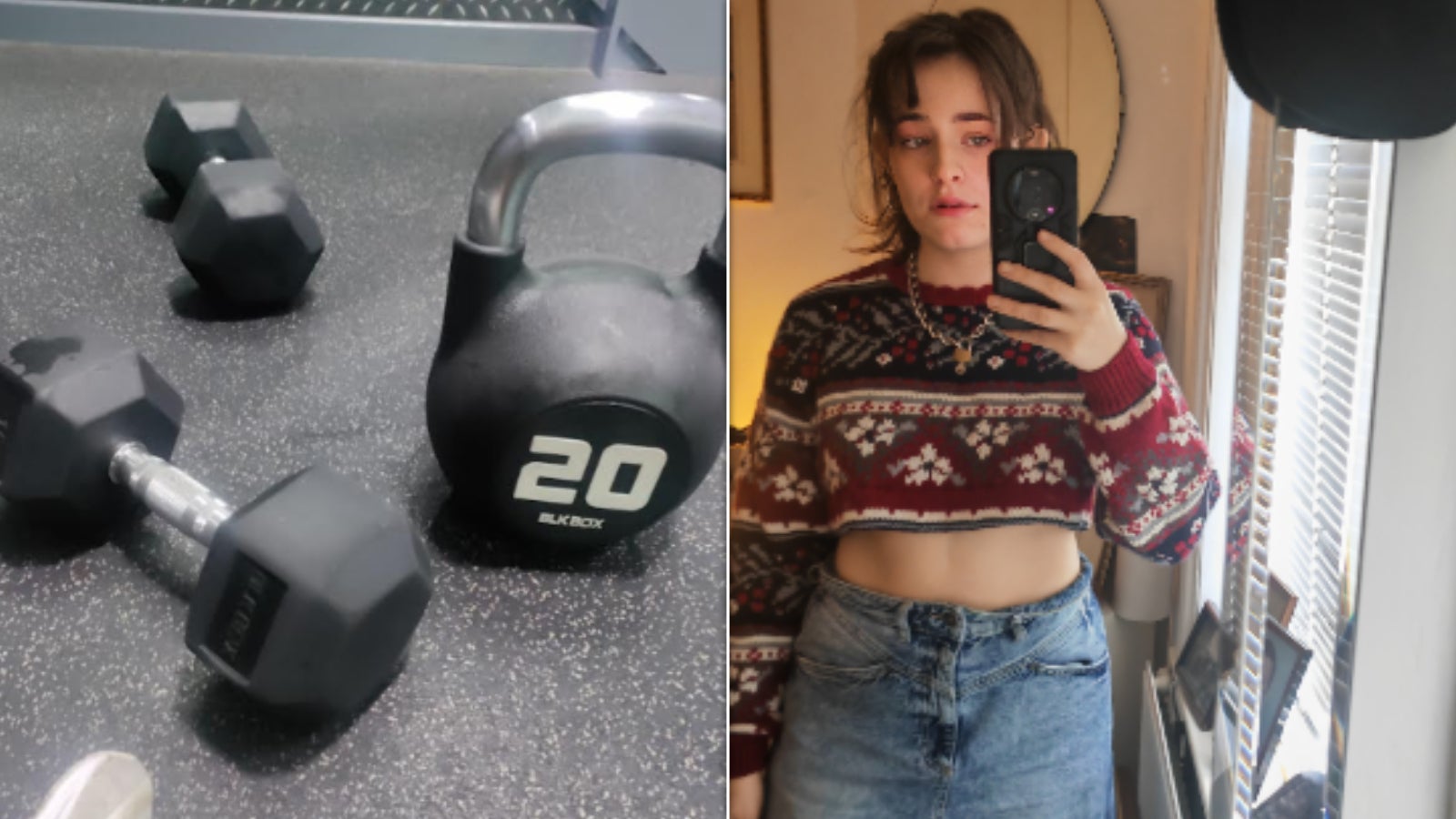
I recently found myself faced with quite the riddle: what’s the difference between an ab workout and a core workout?
If I’d been asked that by a bridge-dwelling troll a few months ago, I’d have resigned myself to a watery end. After all, I only recently learned that while abs are part of your core, your core is so much more than just abs.
Advertisement
I mostly go to the gym for health, rather than aesthetic, reasons. I’m way more worried about my bone density and brain health than I am about my muscle definition. So, I wouldn’t have minded if the difference was mostly cosmetic.
But it turns out that not only are core muscles key to a healthy back (and crucial for preventing falls in ageing), but a lot of the ab-led workouts I’d been doing previously actually did little to strengthen the crucial muscle group.
As a result, I changed my routine ― and I’ve noticed less back pain, better form in other moves (like squats), and even improved posture since.
Advertisement
Your core is a set of muscles that includes the transverse abdominis and rectus abdominis, oblique, erector spinae, multifidus, diaphragm, quadratus lumborum, hip flexors, and pelvic floor muscles.
It involves groups of muscles we don’t usually think much about when flicking through workout videos, including those that support your spine and hips.
Only one of those muscle groups ― the rectus abdominis ― forms the “six-pack” people might try to achieve through sit-ups and crunches.
Advertisement
But The Mayo Clinic said that while lots of us try to achieve visible abs, broader core exercises (which “train the muscles in your core to work in harmony”) are all too often neglected.
That’s a shame, they said, because true core workouts are key to every other exercise you want to try ― and the stability a strong core gives you makes day-to-day life easier, too.
Good news. The Mayo Clinic said any exercise that involves “the use of your stomach muscles and back muscles in a coordinated way” counts as a core exercise.
Advertisement
That’s why your class instructor is constantly asking you to “engage your core” when squatting, lifting, and even running.
Personally, I started doing what are known as compound exercises ― those which work multiple muscles at once, rather than isolating a couple ― to target both as many core muscles as I can in one go.
Hollow holds, planks, L-sits, pull- and push-ups, and bird dog exercises are all well-known core workouts that include far more muscles than we realise. I still love these.
Advertisement
But lifting weights with your core engaged, as is needed for overhead marches, renegade rows, and kettlebell swings (my personal favourite, and the move that I feel has strengthened me most) works too, and was a revelation to me.
Since incorporating more full-body core movements into my routine, I’ve not only spent more time on the area (a kettlebell swing can be part of a leg day routine, while sit-ups are usually core-specific moves), but added more weight, and therefore resistance, to the action too.
After all, it’s not like your stomach has a way of lifting a dumbbell; you have to recruit other parts of your body for that.
Advertisement
Speaking to Harvard’s site, physical therapist Carina O’Neill recommended planks and bridges for the best day-to-day core stability.
But it doesn’t need to be that intense. NHS Fife recommends moves like cat-cow yoga patterns and kneeling planks to keep your trunk steady.
Of course, ab-focused sit-ups and crunches have their place too ― but if you’re hoping to get the best benefits from a strong core, it might be time to expand your understanding of the area to more parts of your body.
Advertisement

I try a lot of celebrity chef recipes for my job (hard-hitting journalism, you know?).
And while I love Nigella Lawson’s iconic lasagne of love, swear by Hugh Fearnley-Whittingstall’s brown butter brownies, and have even allowed Gordon Ramsay’s tips to alter my treasured rocky road recipe, my heart still lies with Mary Berry.
Her Thai-inspired tomato soup was an instant hit in my home. I tried making her 15-minute lemon curd last weekend too ― it was so good, I skipped making the rest of the pie I’d planned and made six jars instead.
Advertisement
So, who else would I turn to for my next spag bol? Though the dish is described as “controversial” on the BBC’s site for its, er, un-Italian star ingredient, hey ― in Mary we trust.
The start of Mary’s bolognese is pretty simple. She finely chops onions, celery, and carrot, and fries them over a medium-high heat until soft.
I took Nigella’s lasagne advice here; it’s just faster to whizz them up in a blender rather than chopping them to tiny, even bits.
Advertisement
Once those have softened, she chucks in pork and beef mince (I’ll be honest; I only had beef, and it was fine) and garlic, cooking them until the mince is browned and its liquid has evaporated.
Mary adds tomato purée to the mix and follows it up with passata, chopped tomatoes, stock, wine, and thyme.
If you take nothing else from her advice, I’d recommend the half-passata, half-chopped tomato mix for almost all tomato-based dishes now I’ve tried it. Tinned tommies can be too watery, while the paste can be too thick – this is perfect.
Advertisement
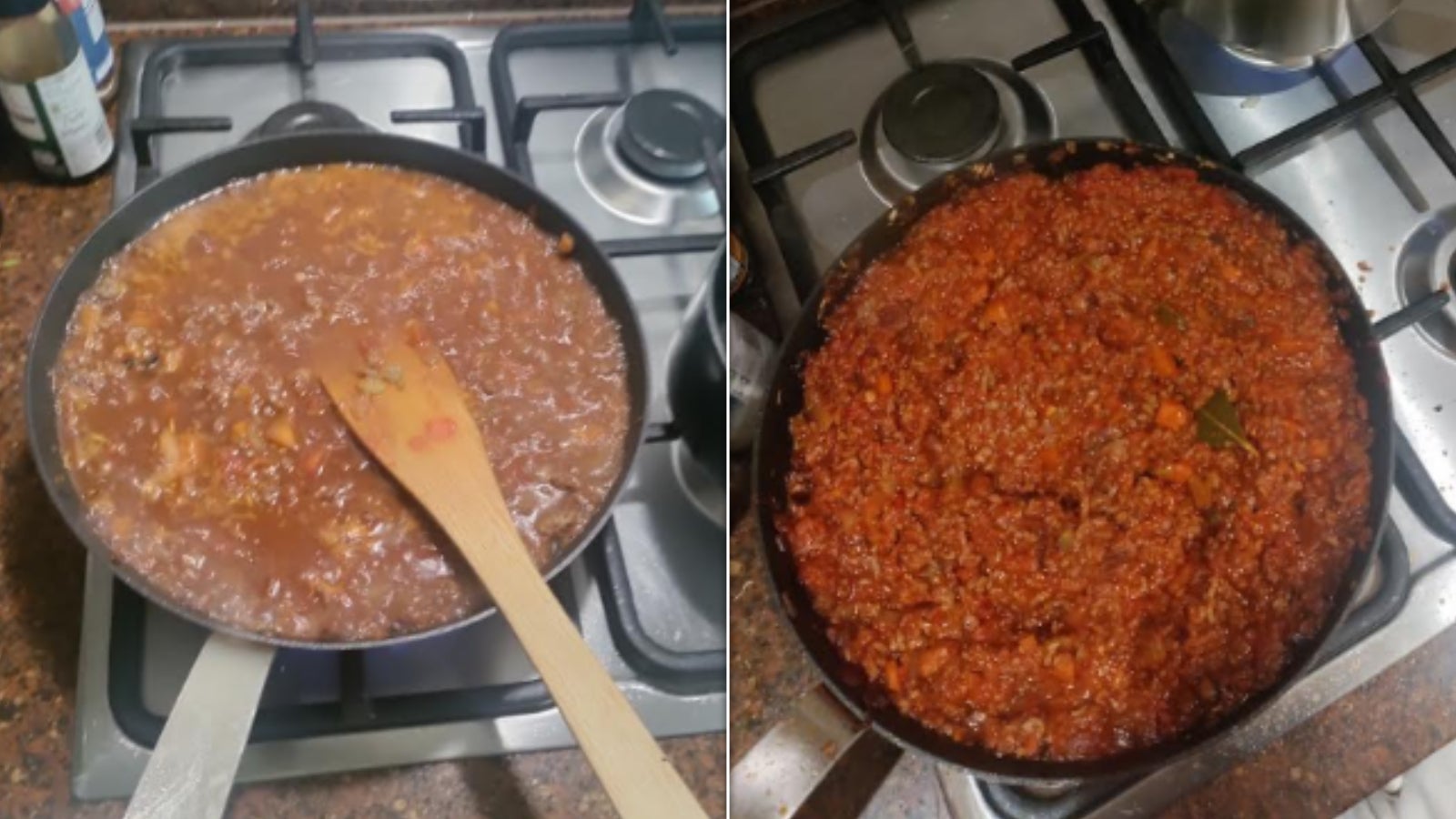
After seasoning it, you bake the bolognese for an hour. I placed tinfoil over my frying pan and whacked it in the oven, though I’m sure a proper Dutch oven is a better option.
Then, you stir in some cream (the controversial ingredient), put the bolognese back in for an hour, and serve it with whatever pasta you like.
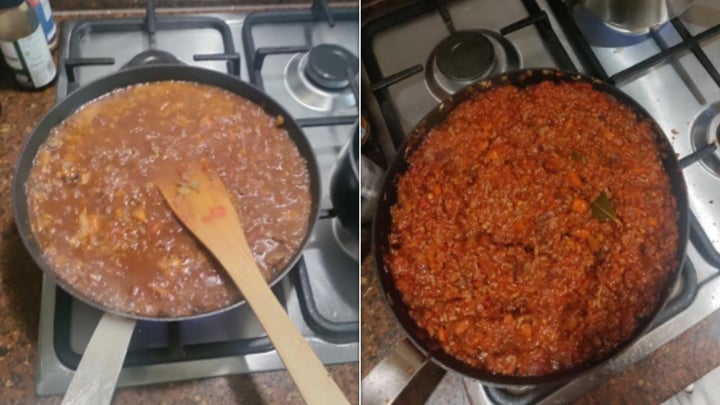
Amy Glover / HuffPost UK
Advertisement
I regret to inform you it’s delicious. I don’t know whether it’s the cream or the extended stay in the oven that did it, but this was the deepest, richest, most satisfying bolognese I’ve tried.
It kind of makes sense ― Nigella adds milk to her lasagne’s ragu for a subtly creamy finish, so this is sort of the same idea (only more decadent).
The two-hour bake time is annoying, but it didn’t require much actual active cooking. I work from home, so made the sauce on my lunch break and cooked it in the oven while I was working. As Mary points out, the sauce “can be made up to a day ahead and reheated.”
Advertisement
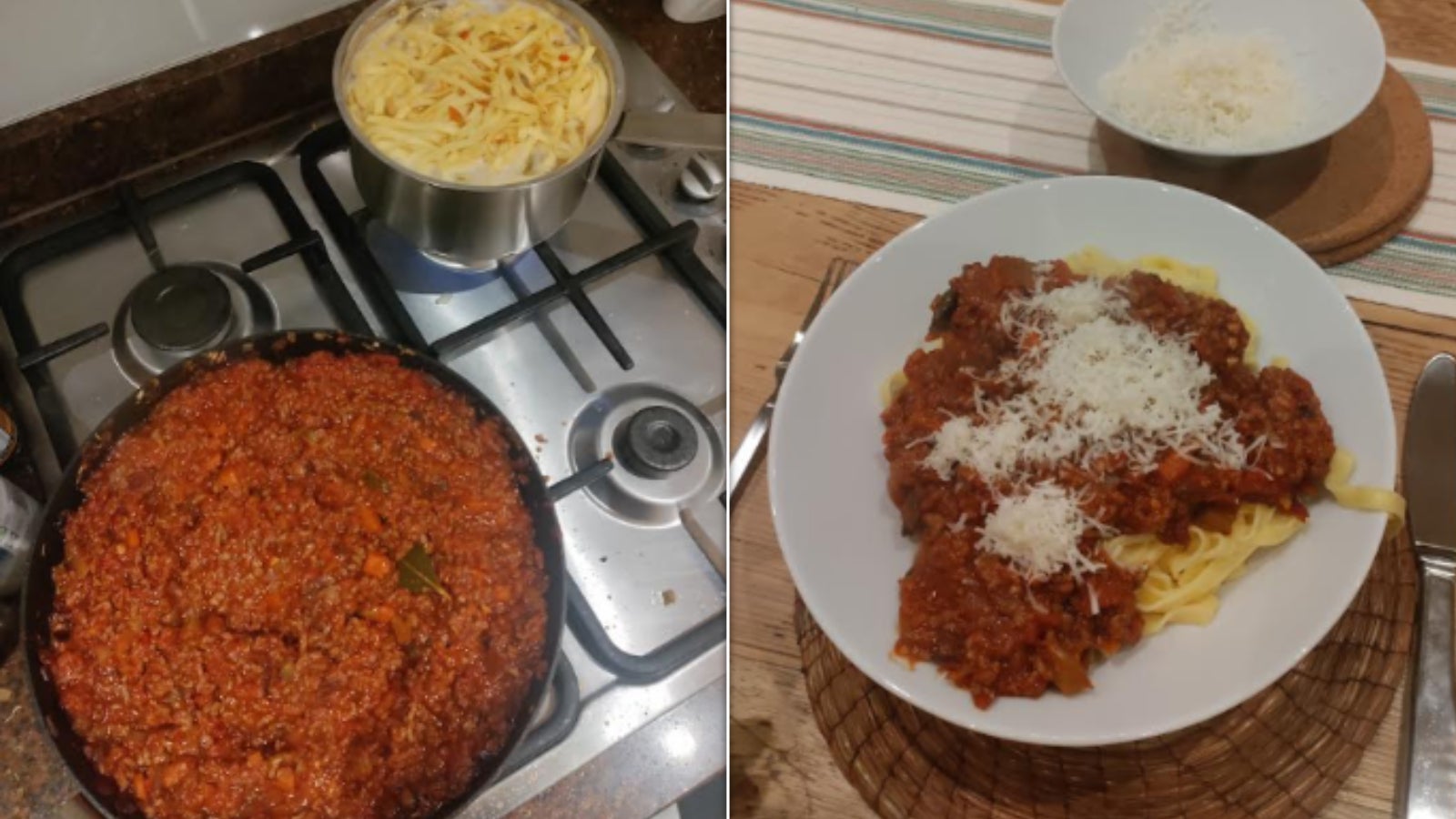
I ate mine with Parmesan, linguini, and a huge smile on my face ― OK, her star ingredient is “controversial”, but there’s no denying the results are delicious.

There comes a time in every parent’s life when their child starts to question everything.
You mention something and their reaction is: why? Then you explain why that is, and they ask again. They dig deeper and deeper, until you realise you actually have no idea why soil is brown, and you simply respond, a little exasperated: “I don’t know.”
If you’re stuck in the depths of the why?! phase then, first of all, solidarity.
Secondly, therapists have revealed a handy phrase you can respond with when you’re deep in the “why?!” cycle – and parents on social media are loving the tip.
Advertisement
Before we talk about how to respond, it might help to think about the reasons behind why (sorry) children ask their parents for more information.
In short: they’re trying to discover more about the world we live in.
Clinical psychologist Linda Blair told the BBC that around the age of two or three, connections are being formed in their brains about how certain things are categorised or how one thing can lead to another thing happening.
Once this clicks into place, they want to know more and they obviously realise that the best way to find out more is to ask you – their parent – about this.
Advertisement
Blair said this incessant questioning usually happens around the ages of three and four – and the reasons behind it are actually quite sweet.
“Firstly, they want you to clarify and explain things to them so that they can make predictions about the world and what will happen within it. Just like adults, children are most afraid when they’re not sure what is going to happen,” Blair said.
And secondly, they get excited to share things they’re interested in with you and “by sharing an interest with you, they feel valued, and that also grows their self-esteem”.
Advertisement
Deena Margolin, a family therapist who shares helpful parenting tips on the popular Instagram account Big Little Feelings, urged caregivers to respond to kids with the question: “Why do you think?”
“You’re empowering them to pause, build self-awareness by looking inside, and notice their own thoughts and opinions,” said Margolin in a reel.
“And you’re still staying connected in the relationship with them because you’re not totally shutting them down or ignoring them.”
Advertisement
The therapist added that parents would “be surprised how well this works” and caveated that this obviously isn’t the way to respond every time your child asks “why?” but it can help to give you a break from the cycle every now and then.
Linda Blair also suggested this phrase as a good way to get a better idea of what your child really wants to know. She offered the example of if it’s raining and they ask why it rains.
“Maybe what they really want to know isn’t the literal reason why it’s raining. Maybe it’s what they should wear when it’s raining? Or if they are allowed to run around in the rain?” she added.
Advertisement
While some parents swear by this technique (“yessss we do this and it’s so beautiful watching her process and come to whatever conclusion,” said one person in response to Margolin’s Instagram post), it’s worth noting that sometimes it doesn’t quite have the desired effect.
As one poor parent found out: “Mine replies ‘you tell me’ and we bat it back and forth until I give up.”

The decision to scrap the organisation could offer a new chance to examine how patients are dealt with.
