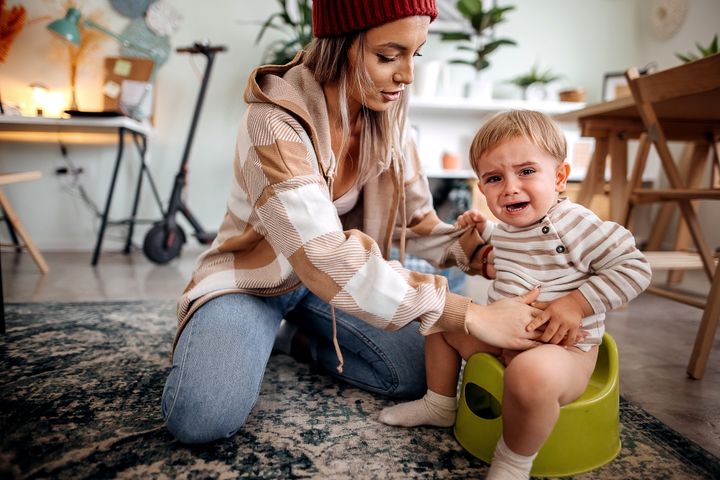
Potty training is not for the fainthearted. It requires oodles of patience, a lot of wipes and an ability to be increasingly chilled when a poo turns up on your nice cream carpet.
But once your child is out of nappies and proudly doing wees and poos in their potty (or on the toilet) it’s a very rewarding feeling for all involved.
Advertisement
One mum-of-two recently took to TikTok to share how she managed to potty train her two-year-old in 72 hours (aka three days) – and we have nothing but respect for this toileting champion.
Courtney Ryrie-Novack, who is known as @scottishcourt on the app, said she used something called the ‘3P method’.
Those Ps stand for: persistence, patience and praise. Sounds interesting. So what does it all involve?
Advertisement
For starters, Courtney shared that she and her toddler didn’t leave the house for three days while they embarked on the potty training mission. And for that entire time, her son was naked.
Discussing the ‘persistence’ part of the 3Ps, Courtney said this is “most important” in the first day or however long it takes for your child to grasp that the potty is where they need to do poos or wees.
“Personally for us it was one day to know where the pee or whatever goes. So every 10 minutes you’re going to put your child on the toilet and say: you need to go pee, or poo, or whatever word you want to use,” she explained.
“You’re going to fill them up with juice … and you fill [them] all day long, and every single 10 minutes: [put them on the] toilet, toilet, toilet. And you do that until it’s bedtime, and that’s when we put a nappy on.”
She added that when her son first started using the potty, they’d use a distraction like an iPad to keep him sitting there, because otherwise he would try and run away.
Advertisement
There were some downsides to this technique, however. “He kind of tried tricking us sometimes by sitting on it for like 20 minutes so he could watch 20 minutes of his iPad, but we kind of let it pass the first day because – like I said – it was his first day,” she said.
By the end of the first day, Courtney said her son knew where he needed to pee and would know to get his parents, so they could take him to the toilet. And by the end of day two, he was going to the toilet by himself.
The mum added that ‘patience’ is also crucial during this time – and especially on the first day – because there will be a lot of accidents.
On the second day, she said her son was no longer having any accidents in the wee department, but did a couple of rogue poos. But that’s to be expected.
Moving on to the third P – ‘praise’ – Courtney said this is definitely the most important part of the process.
Advertisement
“We’re never going to scold our kid for missing the toilet, not making [it to] the toilet, or just not doing it in the toilet,” she said. “Because it’s not their fault. All they’ve known their whole life is ‘do it wherever I am in my diaper’.”
So, when children end up weeing or pooing on the potty, she encouraged parents to check what’s in the potty and then cheer and celebrate with them. She suggested you could give them a sticker, sweet or a toy – “whatever you think will motivate them”.
In her case it was chocolate, and it worked like a dream.
Fellow parents were keen to try the process, while others shared their own success. “I was a toddler teacher and this is exactly how I ended up potty training my two boys and how I recommended my friends potty train theirs,” said one mum.
There is no set age to start potty training as every child is different, however the NHS does recommend that around the age of 18 months to two years old parents can introduce sitting on the potty as part of the normal daily routine.
When it comes to quintessential British family holidays, Center Parcs is up there – between the cute log cabins, wealth of things to do and picturesque settings, it’s got a lot going for it, especially as far as parents are concerned.
But one thing that can put some families off – especially given the current financial climate – is the price tag that comes with a week-long break.
Advertisement
Consumer champion Which? recently found that, on average, the cost of a UK Center Parcs stay is roughly £1,274. And that’s for a family of four to stay at a site for four nights during a peak period like half term.
But if you’re after a cheaper way to enjoy Center Parc’s outdoor adventure vibes, it might just be worth looking further afield.
A new report from Which? found families could more than halve the cost of a Center Parcs break by booking in Europe instead of the UK.
Oh, really?
Yup. The consumer group compared the cost of a four-night stay for a family of four at 16 Center Parcs sites across England, France and Belgium during four peak periods.
Advertisement
It found a UK stay came in at £1,274 on average, compared to £833 in France and £701 in Belgium.
Which? said the biggest price differences could be found for bookings over October half-term and Easter, partly due to differences between the school calendars here and in Europe.
On average, a family could save 55% opting for a Center Parcs resort in Belgium rather than the UK over October half term, with a four night break costing just £613, compared to £1,369 in the UK.
And the savings in France were almost as good, with the same stay costing £868 on average.
But don’t the travel costs make it more expensive?
Of course, with any trip abroad you need to factor in travel costs – and these can really rack up when the kids are off school, especially if you choose to fly.
That said, when Which? factored in travel costs – like taking a ferry and then driving – they still found families could save hundreds of pounds overall.
For example, Dunkirk is less than an hour’s drive from Center Parcs’ Park de Haan, in Belgium.
At the time of writing, a return ferry trip for a family of four from Dover to Dunkirk could be booked for approximately £170 during the October half-term.
Advertisement
Similarly, a return car ferry for a family of four from Dover to Calais could be booked for £125 return during October half term, and over Easter weekend a return journey via Le Shuttle can be booked for £179.
Venturing to European Center Parcs sites is something more and more parents are wising up to. One mum previously told The Sun how she took her family to Center Parcs in the Netherlands during the Easter holidays and saved hundreds of pounds.
For £680 she managed to bag a week in a three-bed cottage. She also suggested activities were cheaper in the Netherlands than in the UK.
And Which? also found this. Its analysis found archery costs between £19 and £26.50 at the UK’s Whinfell Forest park, while it costs £14 at Belgium’s Park de Haan. Similarly, Laser Battle games range in price from £24.50 to £34.50 at Whinfell Forest, and cost £15 at Park de Haan.
Jo Rhodes, deputy editor of Which? Travel, said: “Our research found that it’s well-worth casting your eye beyond the Channel to snap up some significant savings
It’s often the first question you’re asked about your baby, posed before they’re even born: “Boy or girl?”
But a growing number of parents, many of them – though not all – queer or transgender, are choosing to leave the answer up to their child.
Advertisement
This means waiting until the child is old enough to declare their own gender identity, and often (but not always) using they/them pronouns until the child voices their own preference.
The concept of gender self-determination isn’t complicated, but navigating a gender-obsessed society rife with stereotypes isn’t easy.
Still, parents who have chosen this path believe it’s worth weathering some discomfort to give their child access to the full spectrum of gender experience.
This practice, sometimes known as “gender-creative parenting,” isn’t about getting rid of pink and blue, or restricting kids’ options to shades of beige and grey that our culture hasn’t coded male or female.
Advertisement
It’s about giving kids access to every colour in the rainbow.
Gender-creative parenting goes beyond pronouns
When Arlo Dennis gave birth to their second child, Sparrow, six years ago, they and their partners (Dennis is in a polyamorous relationship) decided not to announce the baby’s sex and to use they/them pronouns for Sparrow. It was a choice they arrived at before Sparrow was even conceived.
Arlo Dennis
Arlo Dennis and their child Sparrow.
“Very early on, it just kind of was an obvious conclusion for us,” Dennis, a Florida resident, told HuffPost.
Dennis and their partners also have an older child, 12-year-old Hazel, who was identified as female at birth and addressed with she/her pronouns. But around age four, Hazel began to explore their own gender identity and decided to change their pronouns. This prompted their parents to pursue a different path when handling the question of Sparrow’s gender.
Critics say that gender-creative parents are imposing their own agenda onto children. But Dennis and members of other families told HuffPost that what they are actually doing is freeing their kids from people’s gendered expectations.
Advertisement
“It’s the rest of the world – kids on the playground, parents at school, teachers, a stranger at the grocery store,” Dennis said. “They all are going to have different interactions with the child based on an assumption of the gender.”
This assumption can lead to differences in the way that people talk to children, such as calling a baby with a bow on its head “pretty” instead of “handsome”. There is even research showing that mothers interact physically in different ways with boy and girl babies, being more active physically with boys.
If you use they/them pronouns for your child, or let them wear clothing and play with toys that don’t “match” their assigned sex, some adults may assume a gender for your child and then act accordingly.
Others may be flummoxed (or delighted) to encounter a child who isn’t adhering to all of the usual gender stereotypes.
As a result, Dennis said that Sparrow “is able to get a variety of experiences” with other people and their gendered assumptions. This allows them to identify which kinds of interactions feel right for them, so they can make decisions about their own gender identity.
Advertisement
“The goal is not to isolate them and have a gender-free experience. It’s to let them explore it all,” Dennis said, adding that using they/them pronouns “facilitates that” for Sparrow. Dennis coined the term “antegender” to talk about the period before a child understands the concept of gender and can claim an identity, which usually happens around age three.
Now six, Sparrow uses she/they pronouns, and their gendered experiences out in the world are a topic of conversation at home. For example, when Sparrow commented that a child on the playground identified them as a girl and Dennis asked how it felt, Sparrow responded that they went along with this gendering to get back to playing.
“They’re so astute, they’re so mature in their understanding of things,” Dennis observed.
Sparrow’s gender-expansive views, however, aren’t shared by others in their home state. To escape an increasingly hostile political environment and a slate of anti-trans bills signed by Florida Gov. Ron DeSantis (R), the family plans to relocate to Maryland, where Sparrow will have the option to talk at kindergarten about being non-binary or having trans parents.
Parenting outside the gender binary can provide options for kids and be freeing for parents, too
Iris and Tori Saunders are a couple raising their one-year-old child in a gender-creative way in Washington, DC.
One of their posts on Instagram, where they are documenting their story, lists several responses they give when people ask about their child’s gender. One they like to use with kids, they write, is: “We don’t know! They’ll tell us who they are one day.”
Advertisement
Raye of Sun Photography @rayeofsunphoto
Iris and Tori Saunders with their baby.
The Saunders told HuffPost in an email that they parent this way to give their child “the autonomy that we didn’t have as kids. Giving them the whole world instead of half of it. Encouraging them to express themselves in ways that are not limited by the traditional social construct of gender. It is not getting rid of gender – it’s giving them all of it.”
New York-based Rebecca and her partner, Alana, who run the Be Yourself Bookshop, are another couple who identify as gender-creative parents. To them, this means “educating young kids about gender diversity so they can grow up to be their most authentic self,” said Rebecca, who asked for her full name to be withheld for privacy reasons.
Their goal is “to create a welcoming and affirming home environment so they would know there is no one way to be, and who you are changes over time and that’s OK,” she added. Parenting in this way has helped her realise “how much gender expression is forced on kids at young ages.”
Dennis said this is a load that they personally don’t have to bear. “I see a lot of people who haven’t taken on this kind of philosophy carry a great burden of gender education,” Dennis said. In contrast, they added, “I’m able to just hand my kid any toy off the shelf that they think is cool.”
Advertisement
For parents who identify as trans, queer or gender-nonconforming, there can be a healing aspect to providing your own child something that you needed but didn’t have.
“In both of our childhoods we were told that we were, and had to be, ‘one thing,’” the Saunders wrote to HuffPost. “We did not want to make that decision for our child. We wanted to allow them the space to explore and tell us who they are instead of the other way around.”
Gender-creative parenting is in line with other child-centred parenting philosophies
Dennis sees gender-creative parenting as dovetailing with other “parenting philosophies that really honour the autonomy and the personhood of children,” which these days are often referred to as “gentle parenting”.
Like with giving children control over what and how much they are going to eat, gender-creative parenting teaches kids to respect their own instincts and what feels true for them.
With millennial parents and others, Dennis said, they see “a lot of unpacking of trauma,” and a movement toward “this idea that we all know ourselves best.”
Advertisement
“It’s so simple a principle, but I think it’s really a valuable one,” they continued.
Free from the baggage of others’ expectations, kids can pursue their own gender identity and a wide range of possible interests. Gender-creative parenting gives trans kids space to come out, and can allow a boy to pursue ballet or cry when he is sad, and a girl to excel in math, science or sports.
“Hand the reins over to your child and let them take the lead,” wrote the Saunders. “You will be so in awe of what you’ll discover about them when gendered boundaries are taken down.”
Parenting in this way doesn’t look the same in every household – it’s flexible
If the idea of explaining your baby’s pronouns to everyone you meet sounds exhausting or even unsafe, there are other ways to keep the spectrum of gender possibilities open for your child.
“It doesn’t have to be all or nothing,” Dennis said. If, for example, your mother-in-law insists on using a binary pronoun, or you decide to use they/them at home but not at day care, all is not lost.
“The goal is not militant perfection on pronouns,” Dennis said. “The goal is to let the kid be who they want to be.”
Advertisement
The Saunders concurred. “There are plenty of folks out there who follow a gender open concept while using gendered pronouns for their child(ren),” they wrote.
Maybe you use they/them pronouns in one safe space, or you work on not automatically gendering new people you meet so that they know you understand gender is not always a given.
New York resident Rebecca has chosen to parent in a gender-creative way.
“It’s never too late to start,” Rebecca said. “Allowing kids a multitude of choices for their own gender expression has a huge impact.”
She added, “Teach safety and boundaries first, especially if you live in an unsafe area, but always have a place for them to be themselves.”
Advertisement
Exposure to people who challenge stereotypes or exist outside the gender binary is another important way to embrace this philosophy, according to Caroline Carter, a psychologist who works with trans and gender-nonconforming kids and the author of the children’s book Every Body Is a Rainbow.
This can happen via “experiences within gender-diverse communities where children can see and experience the many embodiments possible for gender,” she said.
Carter referred to images as “a child’s first language” and underscored the importance of picture books for toddlers and preschoolers. She recommended the We Are Little Feminists series of board books about families and other topics as a good source of diverse images.
Another potential place to begin is allowing and encouraging your child to follow their preferences, even when they fall outside of the gender binary.
Advertisement
“Start allowing your kids to pick out their own clothes, hairstyle, toys, activities, and sports,” wrote the Saunders. “Introduce them to books and media with gender diverse representation. Model exploration and breaking gender roles in your own home and family.”
Dennis sees this last point as critical. In addition to providing all options for toys and clothes, they said, “parents should explore gender and they should model exploring gender. If you are cisgender, that’s great. Still, play with gender, play with identity, explore, ask questions.”
Queer parents aren’t off the hook, either. “You still have to do intentional work to deconstruct, and you still have to do the work to make community,” said Dennis.
Rebecca explained that she sees her own discomfort as a sign that she’s on the right track: “Dismantling my millennial foundations of gender shouldn’t feel comfortable. This is how we know we’re creating change.”
Advertisement
It’s important to find a community that can support you in this journey
Gender-creative parents will often be met with confusion and resistance — in addition to a volatile political climate.
Advertisement
“Gender-creative parenting is one of the most culturally counter manoeuvres a parent can make during one of the most ‘gendered’ times in a child’s life,” Carter said.
She suggested that parents seek out community that offers them the support they need to withstand these challenges. “You need spaces where you feel a part of a majority (even if a small space), where your values are the dominant ones,” she said.
If you choose to parent in this way, it’s not uncommon to have your own moments of doubt around whether you’re doing the right thing. In her experience, Carter said, families often experience this when they’re in a place of fear — which, she added, “completely makes sense … given that this feeling inevitably would come up when going against one of the strongest systems of cultural meaning-making in Western culture.”
This is where community plays a vital role, she explained. “Understanding and empathy are the antidote for fear. They literally help regulate our nervous systems,” she said. “We need to be with others who have been in our shoes.”
Whether you’re confronted at the playground by a parent who thinks you shouldn’t let your son wear a dress, or you’re trying to draw boundaries with extended family about who is allowed to change the baby’s diaper (to limit who knows what their genitals look like), families facing similar challenges are best equipped to offer the support you need.
Advertisement
Carter also recommended establishing a mindfulness practice to help you cope with these moments of stress. “When parents experience interpersonal judgment or self-doubt, I encourage them to simply be mindful or aware of the feeling they are experiencing and not judge it,” she said. “Pausing and noticing the feeling creates a little space and takes away some of its power.”
Cultivating compassion is another way to deal with both your own discomfort and criticism from others. It “reframes the other person’s judgment as coming from a place of fear and misunderstanding,” Carter said. “It can additionally be seen as their own inner judgment projected out — i.e., ‘hurt people hurt people.’”
While you are allowed to draw boundaries for your own family, and under no obligation to educate everyone who questions your parenting, “a compassion practice can prime us for the times where there may be opportunities to lovingly build awareness in others,” Carter said.
Britain’s childcare system is on the brink – and parents are feeling the strain more than ever.
Soaring nursery fees, staff retention issues and nursery closures are just some of the issues the sector is facing, with repercussions for childcare workers, parents and children.
Here’s a rundown of all the ways in which the system is on its knees right now – and if one thing’s abundantly clear, it’s that change must happen fast.
Advertisement
1. Childcare costs are horrendously expensive
A new report has confirmed what every parent already knows (and dreads) – that childcare costs are extortionate. According to charity Coram, the average annual cost of a full-time nursery place for a child under two in Britain is just shy of £15,000. To put that into context, annual university course fees are a maximum of £9,250.
Recently, parents were left reeling by news that these fees may rise by a further £1,000 this year because of the cost of living. This is on top of the fact the average costs of childcare have risen by 5.9% in the past year, according to Coram.
The TUC previously warned that the cost of early years care for a child under two could rise to £2,000 a month by 2026. But for some, this is already the case. One dad in London told HuffPost UK he’s shelling out £2,100 per month for his daughter to go to nursery four days a week.
It’s a postcode lottery for many parents. Coram’s report found there are significant differences in the cost and availability of childcare depending on where you live across England.
Advertisement
The average weekly cost of a part-time place for a child under two is 54% higher in inner London (£199.01) than in Yorkshire and Humberside (£129.32).
Parents in the UK face some of the most expensive childcare costs among leading economies, according to the Organisation for Economic Co-operation and Development (OECD).
There is some help available. From the age of two, children from low income families are eligible for ‘free hours’ at nursery in England, Wales and Scotland. When they turn three, all children – regardless of household income – are entitled to a certain amount of these ‘free hours’ per week.
Parents who earn less than £100,000 a year can also get tax-free childcare – up to £2,000 a year – to help with childcare costs. But when the total cost of putting a child in nursery can be up to £15,000 a year, it’s still a struggle for lots of families.
Advertisement
Unfortunately, many women are suffering as a result of such costs. A staggering three in four mums (76%) who pay for childcare say it no longer makes financial sense for them to work, a recent report by the charity Pregnant Then Screwed found. One in four parents (26%) say their nursery bill is now more than 75% of their take-home pay.
This time last year, a survey of almost 27,000 parents with young children found the cost of childcare had driven 43% of mums to consider leaving their jobs.
Joanna Corfield, head of communications and campaigns at NCT, previously told HuffPost UK they’d been hearing more and more about how working parents are having to think about childcare well in advance of when they need it.
Advertisement
“In some areas where demand is high and provision is low, some families are having to make decisions in the early stages of pregnancy,” she confirmed.
3. Childcare staff are (unsurprisingly) leaving for better paid jobs
With everything else that’s going on, the sector is facing staff retention issues. In October 2021, a Early Years Alliance survey on staff recruitment and retention in the early years sector in England revealed over a third of respondents were actively considering leaving the sector.
Meanwhile one in six believed that staffing shortages were likely to force their setting to close permanently within a year.
The survey also found more than eight in 10 settings were finding it difficult to recruit staff. Around half had to limit the number of, or stop taking on, new children at their setting in the six months prior to the survey.
The average salary of a UK nursery worker is £21,000 according to Totaljobs. But despite the low salary, the job is increasingly stressful – especially as staff shortages mean more pressure on those who are left behind. It’s also resulting in nurseries having to close rooms at short notice, leaving parents in the lurch.
Advertisement
In early years settings in England, one adult can look after three children under two years old; or four children aged two; or eight children aged three and over.
Under Liz Truss’s premiership, it was suggested these ratios could be stretched further, so staff could look after more children at one time – some parents were concerned it would pose a safety issue while members of the childcare sector suggested it would prompt even more staff to leave.
Neil Leitch of the Early Years Alliance previously told HuffPost UK that while childcare settings spend the majority of their income on staff wages, “years of government underfunding has meant that many educators are on little more than the national living or minimum wage”. Because of this, people are leaving the industry for better-paid positions in sectors such as retail and hospitality. And who can blame them?
4. Nurseries are closing at a rate of knots
Nurseries and childcare settings are also dropping like flies – and some organisations suggest it’s only going to get worse because of the cost of living.
The overall number of childcare providers in England dropped by around 4,000 between April 2021 and March 2022, according to figures from Ofsted.
Advertisement
In August 2022, the National Day Nurseries Association (NDNA) warned that between September 2022 and 2023, we could see record-breaking numbers of closures leading to a “catastrophic” reduction in places.
Purnima Tanuku, chief executive of NDNA, said at the time: “Most nurseries are small businesses and similar to the picture in other sectors, these are hugely impacted by rocketing fuel costs, inflation and chronic underfunding.” Tanuku added that nurseries have also had to pay “unfair business rates”.
The latest Coram survey revealed there’s been a sharp drop in childcare availability across England over the past year, with only half of local areas reporting sufficient childcare for children under two. This was a decrease of 7% on 2022.
5. Disabled children and those from low income households are impacted greatly
One of the alarming findings from Coram’s report is that less than one in five (18%) local authorities in England report sufficient childcare for children with disabilities – a 3% decrease on 2022.
The charity called for improved support for children with special educational needs and disabilities (SEND) by introducing responsive funding to improve staff skills and make more childcare places accessible.
All three to four-year-olds in England can get 15 hours free childcare a week (for 38 weeks of the year). And some eligible parents (for example, those on benefits) of three to four-year-olds may also be eligible for 30 hours free childcare a week. It’s a similar picture in Wales and Scotland.
But nurseries are struggling to offer these funded spots. Almost half (43%) of local authorities across Britain report that some or many of their local childcare providers have reduced the number of funded early education entitlement places they can provide.
It’s no surprise this is happening as these spots have historically been underfunded. A 2022 survey by the Early Years Alliance found that for 86% of settings, funding for the three- and four-year-old early entitlement scheme does not cover the cost of delivering places – and around a third (30%) of the providers surveyed said they’re operating at a loss.
Advertisement
6. There isn’t actually a plan (that we know of) for sorting all of this out
While there’s been a lot of talk about how to tackle the nation’s childcare problem from various prime ministers, not much has actually happened to sort the issue so far.
When a member of the press asked about the childcare sector, Sunak responded: “The government and I are completely committed to ensuring good availability and affordability and flexibility of childcare. There’s a consultation that is out at the moment, and we’re in the process of considering – about some reforms – and it wouldn’t be right for me to comment on that now.”
In December last year it was revealed that childcare will be treated as “national infrastructure” – this means local councils will be able to fund it alongside other crucial services like schools, GP surgeries and public transport.
It’s hoped the issue of childcare will be addressed at the spring budget on March 15. There have been murmurings that Sunak is considering extending the free 30 hours for childcare to all parents – not just those who are eligible because they’re on benefits. But nothing has been confirmed as of yet.
What we do know is that changes to Universal Credit will reportedly be announced at the budget, including paying parents on Universal Credit childcare support upfront and increasing the amount they can claim by several hundred pounds.
Advertisement
But for parents who aren’t on Universal Credit, the struggle may well continue if no additional support is provided.
Megan Jarvie, head of Coram Family and Childcare, said: “The need for reform of the childcare system is urgent. As well as eye watering bills, parents are facing widening gaps in availability of the childcare they need.
“As the Chancellor decides his budget, we urge him to recognise the value of investing in childcare – it is a wise investment, enabling parents to work and boosting the outcomes of young children.”
The charity wants to see a reformed system which “prioritises quality, guarantees a childcare place for every child, values the workforce and makes sure that parents only pay what they can afford”.
One thing’s abundantly clear: sorting out childcare should be a priority for the government, as charity Pregnant Then Screwed found 96% of families with a child under three years old are likely to vote for the political party with the best childcare pledge in the next election.
An actor on Tiktok has called for the creation of child-free suburbs after a trip to her local swimming pool ended in chaos. Because, well, kids.
Kitch, who is known as Tiktok user @soybabie__ and based in Melbourne, said she’d visited her pool to do laps, but her peaceful swim in the lap lane was disrupted by screaming kids who kept jumping in.
Advertisement
“I would like to know when somebody is planning on opening an adults only suburb where everything in it is only for adults, because I’m so sick of going places and kids are just everywhere screaming and I just have to put up with it,” she said in a Tiktok video, which has had a quarter of a million views.
“I just went for a swim. They have their own pool and they’re in the lap lane pool, not swimming laps just jumping in and screaming – and that’s just allowed because they’re allowed everywhere.”
“I just feel like for people like me that are evil and hate kids, we should have our own suburb where we can just be quiet and undisturbed,” she joked.
Most parents will tell you they love their child more than life itself. I’m the same. But I have to tell you, when I saw this, I thought: “Fair.”
Advertisement
Adults only holidays exist, so it doesn’t seem unreasonable to have more areas where children don’t venture.
Of course, there are some who would strongly disagree. One user commented on the video: “You used to be a kid mate.. ya know. So get over getting older.” The comment had 215 likes at the time of writing.
Another added: “Go live in Antartica.” Eek.
But plenty of parents, like myself, agreed that child-free people should have their own spaces to exist. In fact, we’d probably go to them too if we had a rare day to ourselves.
That’s not to say I don’t love my child fiercely. I do. But sometimes it’s nice to have some alone time where you can just… adult. The feelings aren’t mutually exclusive.
“As a parent of two small children, I completely understand what you’re saying and respect that childfree people need space too,” said one mum.
Advertisement
Another added: “As a mum, I agree. I hate going to dinner without my kids to listen to other people’s kids carry on. There should be more adult only places.”
“I would totally support a place without kids. Maybe I could go there too without my kids,” said another parent.
Some pointed out that adult only places like this do exist: retirement villages. But the original poster suggested they shouldn’t just be for older adults.
The video also prompted an interesting point that most adult only places are centred around alcohol – ie. bars and nightclubs. People suggested child-free parks, restaurants and even supermarkets should be a thing.
Advertisement
After the video was picked up by the media, @soybabie__ shared another video acknowledging that people were “pressed” that other people don’t want to be around children 24/7.
“I’m not saying kids shouldn’t be allowed at the pool, it’d just be nice if there were more places that were JUST for adults to enjoy and that includes parents wanting a break from their kids too,” she said.
We’ve all been there: you’re tired, overwhelmed, then one of your kids makes a move and it’s the final straw. Words you’d sworn you’d never use as a parent slip right out of your mouth.
Or maybe you’ve found yourself reevaluating your priorities. Restricting junk food or screen time might not be your number one goal every day.
Advertisement
It’s good to be thoughtful about your intentions as a parent, but you don’t want your expectations to be so rigid that they can’t bend to accommodate the moment you’re facing, or the child in front of you.
“Parenting is not static,” New York psychologist and parenting coach Sarah Bren told HuffPost.
“It requires a great deal of learning, adapting, iterating and tolerating messy growth (our kids’ and our own). It rarely looks in real life the way it all played out in our fantasy,” she explained.
Whether others are doing the judging, or we’re doing it ourselves, it’s important to remember that no one moment determines our worth as parents.
Cindy Graham, a psychologist in Maryland, told HuffPost: “Oftentimes we think the goal of parenting is to raise happy, healthy, well-adjusted kids.
Advertisement
“We sometimes forget that parenting is also about learning to show grace — to ourselves and our children — and teaching kids to show grace. You will say things you never thought you would, so learn to apologise effectively and make amends.”
If you’ve ever felt alone in not living up to your own parenting expectations, read on. We asked parents what things they promised themselves they would never do — and then did.
We’d bet that every parent can relate to at least one of these scenarios.
Feeding
“I swore my kids wouldn’t ever eat McDonald’s. Sometimes I just don’t have it in me to cook.” — Patty Van Laar
“That I wouldn’t cook separate meals for them, they would eat what we eat. Uhhhh, yeah. So what’s it gonna be tonight, kids? Chicken nuggets or mac ‘n’ cheese? Honestly, it’s because I have yet to figure out how to cook a meal worthy of adults that can also be on the table by 6pm. I work full time 9-5 and the kids deserve to eat at a time that matches their schedule and hunger. Just not enough hours in the day!” — Beth Carchia
“Breastfeed beyond a year. Had no idea that babies don’t just wean themselves. My boys nursed till two-and-a-half!” — Jean Wolfers-Lawrence
Advertisement
“Hot dogs.” — Sara Biehl Horsman
“I swore I would always have candy out, free for the eating. Needless to say, I didn’t do that!” — Gretchen Kuiper
“Eat dinner at 8pm, because of kid activities and practices. I never thought we would be that family so busy that dinner was at 8, on a school night. Yet it’s the norm for a lot of the year now and I’m just fine with it.” — Renee Colleen
“We were gonna eat dinner together every day at the table! With no electronics! Sigh.” — Katie Morris
JGI/Jamie Grill via Getty Images
Sleeping
“I swore that my children would never sleep in my bed, they would always sleep in their cribs. My son turns nine in April and only stopped sleeping in my bed regularly last year.” — Desiree Dalby
Advertisement
“Co-sleep. I thought you just let them cry and figure it out — till I was working two jobs while my husband worked night shifts and I needed to sleep. I started at two years old and don’t know why I didn’t start sooner. He slept and I slept. We did that till he was six/seven and we transitioned him back to his room.” — Amanda Krieger Royer
“My first was sleeping in her room by the age of seven months! I thought I had aced this parenting thing. And then my second came and he slept in our bedroom every night (and in our bed at least three times a week) till he was two-and-a-half years old!” —Michele Lempek Rosa
“Laying with them until they fall asleep.” — Jordanna Oswald
Screen Time
“I would look at people in public and think, ‘There’s no way my kid will ever bring a tablet out in public.’ Me, 10 years later: ‘A tablet is a must if we want to enjoy a dinner in public with our two year old.’ I completely understand and apologise to any parent I side-eyed 10 years ago.” — Amanda Manley
Toys & Clothes
“I swore we wouldn’t have a playroom full of toys. I was steadfast that the children’s bedrooms were where their toys would go. They can just play in their rooms! Fast forward to when I have three kids and we’ve turned our dining room into a playroom. Our kids are little so we need them close by for safety reasons. There’s no way they can just play unsupervised in their rooms on the second floor.” — Betsey Niebauer
“I said that I’d never dress my kids in clothing that had characters/TV shows on them, i.e. ‘Paw Patrol,’ Spidey, etc. I said my kid wasn’t going to be a walking advertisement. This lasted until I saw how excited and happy it made them to wear a shirt with Chase on it.” — Catherine C.R.
Advertisement
Discipline
“I swore I’d never say, ‘because I said so.’ Well, I have like 10 minutes a day of ‘me time’ and I’m not using it to repeat the same stuff I already told you in another conversation. I’m the parent, you’re the kid, sometimes you’re gonna have to live with that as an answer.” — Rachel Bowie Mace
“I swore I’d never have one of ‘those’ kids, the ones having a tantrum in the grocery store because you wouldn’t buy them Twizzlers or a toy. So naive!” — Jennifer Streng
“I never thought I’d tell my kid to not speak to me as if I were his friend (something my own mother would say to me) and the words have definitely come out of my mouth!” — Naomi Raquel
“I swore I would never yell at them. Well, let me tell you, I had no idea in my early 20s just how frustrating parenting is, and boy oh boy, have I screamed and yelled. I wish I didn’t, but it happens.” — Danielle Butler Shearin
The Leash
“I remember saying how ridiculous the kid leashes/harnesses/backpacks/ bracelets were. Oooh, I was so judgy. Anyway, life gave me a runner at 15 months old, so naturally we were using a backpack harness and I did get the dirty looks, but aw well, he’s alive and well.” — Cindy Montalvo
Advertisement
“My first son was chill, but my second son? Not so much. That kid would have run out into traffic without a second thought. The leash was a godsend. I honestly didn’t care what people thought. It helped keep him alive.” — Amy Kristine
“I was sitting there judging all of those people that put their kids on a leash, like OMG, get a dog if you want to use a leash. Until my 14-month-old no longer wanted to be in a stroller and she was also a runner. So I needed a leash and some running shoes and off we went!” — Courtney Entersz Wenhold
Motherhood is full of conflicting emotions. It can be beautiful and joyful and fun, but it can also be demanding and confusing and overwhelming at the same time.
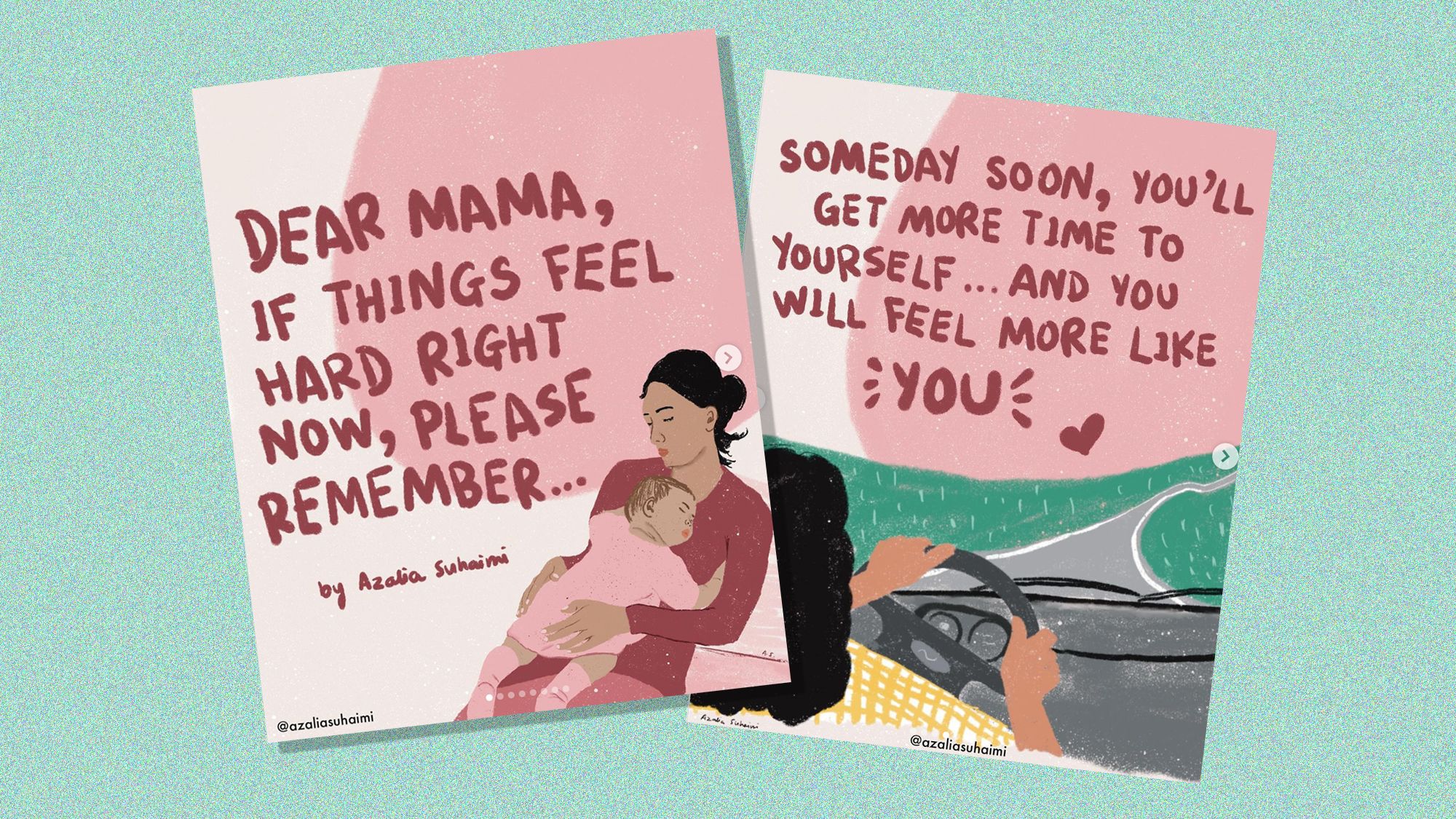
In artist and poet Azalia Suhaimi’s illustrations, the Malaysia-based mother of two offers comforting reminders to parents navigating these ups and downs.
Many of her illustrations, which she shares on her Instagram account, @azaliasuhaimi, begin with the words “Dear Mama.” But she said they apply to dads and other caregivers, too.
Advertisement
“My artworks are titled ‘Dear Mama’ as they mostly began as love letters to myself, like self-reminders on a bad day,” Suhaimi told HuffPost. “When I decided to share them with the world, I then began building a community of like-minded mothers, all of whom I have really loved connecting and exchanging stories with.”
Suhaimi started her Instagram account several years ago when she was “going through the postpartum blues.” At that time, she would share her own photography with poetic captions that talked honestly about motherhood.
“I scrolled through social media and saw all these picture-perfect Instagram photos of mothers enjoying their new babies,” she said. “I felt weird and alone and left out, like I was the only one struggling with these difficult feelings while every other mother out there seemed to be having the best time of their lives.”
Advertisement
Then, during the Covid lockdowns, she took a digital art course online and began creating illustrations for her posts.
In her work, she enjoys capturing the raw and real moments of parenthood, raising awareness of maternal mental health issues and offering solidarity to other parents in the thick of it.
Suhaimi’s kids are now ages eight and four. She said this is her favourite phase of motherhood so far.
“I can finally sit a bit and reflect on all the lessons I’ve learned from the struggles of early motherhood the past few years. And you can see these reflections on my artworks.”
Advertisement
As an artist, Suhaimi hopes to make parents feel less alone in their own journeys, whatever they’re going through.
“Parenthood is hard and messy as it is, so it’s nice to have solidarity, and a safe space where we can talk about the hard things without being judged and where our feelings are validated,” she says. “And I hope my artworks provide that safe space.”
Another important part of Suhaimi’s message is reminding parents to give themselves more grace.
“Some of my darkest moments of parenthood were really made darker simply because I wasn’t kind to myself,” she said. “I easily judged myself and concluded myself as a bad mom when what I faced was simply just a bad day.”
For Suhaimi, learning to practise self-compassion made “a whole lot of difference” in how she parents her kids and in her motherhood experience.
Advertisement
“So I hope that my artwork can help remind other parents and myself too – I still need the reminder – to practise self-compassion,” she says.
What do you think of when you hear the word family? More often than not, it may be a heterosexual couple – a mum and dad – and their two biological children. The classic nuclear family setup.
But the reality is that many families no longer look like this in the UK, despite the those old stereotypes holding fast. In 2021, there were 19.3 million families in the UK – of these, 3 million were solo parent families.
Advertisement
Around 1.1 million children in England and Wales are estimated to live in a stepfamily, while statistics on same-sex parent families are harder to come by. According to charity FFLAG, the most recent statistics for the number of same-sex couples raising children are from 2013, when 12,000 couples were doing so. It’s safe to say there’s probably a lot more now.
For children who come from single parent, LGBTQ+, adoptive, blended, foster and kinship families (where family members or friends raise children), being bombarded with the message there’s only one type of family can cut deep.
Journalist Freddy McConnell – a self-described solo seahorse father – issued a plea on Instagram recently after his tearful child came home from school and said everyone in his class had a mum and dad.
“I don’t know if this was someone else’s observation or his,” wrote McConnell, before urging parents to tell their children what families actually look like. “If your kid has a mum and a dad, please don’t let them out into the world under the misconception that *that* = family,” he said.
Advertisement
“Please take every single opportunity to point out that ‘family’ is a huge and never-ending idea,” he said. “That love makes a family, not who’s in it. That everyone’s family means the world to them, so be gentle.”
Sadly, the othering McConnell’s children’s faced is not unique. But while there are some amazingly diverse books and TV shows for kids out there, as well as references to different types of families when learning at school, the classic 2.4 family is still very much the norm in lots of the media kids consume from a young age. Bluey and Peppa Pig, for example (though a shout out to Hey Duggee for doing things a bit differently).
Lots of the classic children’s books we end up buying our kids (mainly for our own nostalgic pleasure) also centre around very ‘traditional’ family units, not necessarily reflective of 2023. Think: Mog, The Tiger That Came For Tea, Peepo.
Louisa Herridge, a solo mum who is 43 and from Warrington, says films and books can sometimes be triggering for her daughter Emilie if they’re just about dads.
“I would love to see a single mum narrative in books and kid’s films and one where they are thriving and not just trying to get back with dad,” says Herridge, a positive psychology and mindset coach, and founder of Mamas Ignited.
She praises the latest Disney films which “have much more powerful messages for young girls in particular – and we do see different family makeups.”
The mum actively teaches her daughter about how families are all different, and says her daughter’s school makes an effort in this area too. One example she gives is that they say “grown-ups at home” instead of mum and dad.
“But schools are still portraying stereotypical norms,” she adds. “In her school Nativity this year, they portrayed four family setups showing how they celebrate Christmas. In each scene, there was a mum, dad and two kids.”
Discussing the impact, the solo mum suggests children who do not come from nuclear families “have the potential to feel different – and very early on in life” which, she says, can impact their self-worth and self-esteem.
“Children that stand out as different are at risk of bullying – and as an ex-teacher this is something that I have experienced,” she adds.
Advertisement
““I remember the stigma attached to single mums and the societal message was that I should aspire to get married and have a baby.””
– Louisa Herridge
Herridge recalls feeling guilt when she separated from Emilie’s father because she didn’t want her daughter to “come from a broken home” – something that was shaped by her own perception of what a family should look like growing up.
“I grew up terrified that my parents would split up and that I would come from a ‘broken home’,” she says. “Looking back this stigma of a ‘broken home’ comes from how family life is portrayed in society.
“I remember the stigma attached to single mums and the societal message was that I should aspire to get married and have a baby.”
Her daughter has, on occasion, been impacted by the narrow view of family that is sometimes portrayed in society and culture. “The first time I can remember it having an impact on her was at her Reception Nativity,” she recalls. “After the Nativity she was very upset that she didn’t have her dad there and, in her head, everyone else did.”
Sometimes families have one parents, sometimes two, sometimes even three. And sometimes one – or all – aren’t necessarily the biological parent. Mok O’Keeffe, a LGBTQ+ historian at GayAristo, has been helping his sister-in-law raise three children after his brother died in 2010.
“I promised my brother I would keep his memory alive and be there for the girls. And I have done that. They have a wonderful mother and I am their father figure,” says O’Keeffe, who is married.
svetikd via Getty Images
“They were flower girls at my wedding and mean the world to me. My sister-in-law says we are the modern family,” he adds. “We certainly are unique at sports day!”
The children – who are now all teenagers – “think it is quite cool to have a gay uncle as a father figure,” says O’Keeffe, who is 53 and splits his time between Chelsea in London, and Abergavenny, Wales.
Advertisement
Their experience as a family unit, while tinged with tragedy, has been an overwhelmingly positive one – helped, O’Keeffe says, by their extended family who live in Spain.
“The aunts and uncles and grandma are loving and welcoming to the girls,” he says. “They spend summers in Spain and, in many ways, my girls may have lost a father, but as a result have more loving and invested adult role models than they might have had if he had lived.”
The historian says he’s had a positive experience with their schools, who have accepted him as the father figure in the girls’ lives – something that came about after he and his sister-in-law set up a meeting to explain their situation. “Both their junior and high schools were 100% supportive,” he adds.
“I have not experienced any negativity around what my sister-in-law and I call ‘our modern family’. I have found that the girls’ friends and parents have been totally accepting of me as a significant part of the girls’ lives.”
Advertisement
The UK is a more diverse place than it’s ever been – with so many families of all shapes and sizes. But it’s clear that some children are still being made to feel like outsiders because of the narrow view of family that still presents itself.
While schools and media are doing their best to move with the times, it’s clear more needs to be done. And caregivers – especially those in more ‘traditional’ family units – are the ones who can be doing some serious legwork here.
Freddy McConnell suggested parents must be the ones to “keep talking” to their kids about this stuff. “However you want to explain it, with however many picture books to help, please just make sure you *actively* do,” he said.
“So that kids with a solo dad or solo mum, two mums, two dads, more than two parents, adoptive families, donors, guardians, carers, blended families etc etc, don’t find themselves having to defend their loved ones at school or anywhere else.
“So that school is as safe a place for us as it is for your family. And, to put it bluntly, so that no one’s little one has to put on brave face in class, before letting it out through tears at bedtime.”
While parents are a great place to start, Herridge caveats that “unfortunately the same messages will not be given [by all parents] as there will be old prejudice and misrepresentation in some families”.
Given this is the case, schools have a huge opportunity to make a difference.
What are children taught in schools about family?
Guidance provided to primary schools states that children should be taught “families are important for children growing up because they can give love, security and stability”.
Children are told “that others’ families sometimes look different from their family, but that they should respect those differences and know that other children’s families are also characterised by love and care”.
The guidance says teachers must teach pupils that there are many types and sizes of families, for example:
some children live with a parent or parents
some children live with other family members such as grandparents or older siblings
some children live with a foster family or in another type of home
some people are the only child in their family while others have siblings.
Diversity is needed more widely is needed in the media, adds Herridge. “This is a much wider issue than just families as there needs to be more representation of colour, disability, gender and sexuality.
“Diverse resources in schools would be a great start, along with breaking down the patriarchal expectations of women that are still so often represented in books and films.”
So what is a family then? “Families come in many different varieties, changing and adapting over time,” says O’Keeffe. “They are no longer fixed entities, with traditional mother and fathers – and educational establishments are recognising this.”
Advertisement
“Family are the people who love you no matter what, who you want to be with and who add that extra spark to your life,” adds Herridge.
Her daughter Emilie, who is seven, says families “are happy, go on nice days out, are loved and [there’s] no falling out”.
“The people in families are mums, nannies, dads, children or maybe not a child, aunties, uncles and cousins. There doesn’t need to be a number of people,” she says.
“You are family because you were made a family. In any shape and sizes, you are still a good person.
“Just because you don’t have a dad, doesn’t mean you are different.”
A reading list for you and your kids to explore what different families look like
Do you have recommendations for more books or shows about the shape of families today. Email ukparents@huffingtonpost.co.uk to let us know about them.
Plenty of parents dread potty training – and for good reason. There will be rogue poos that find their way onto your favourite rug, there will be wee everywhere, and there will be tears (mainly from you).
But once the penny drops and things click into place, nothing can quite prepare you for that feeling of accomplishment. You will burst with pride – not just for your genius of a child, but for yourself. After all, if you can teach them how not to soil themselves, you can literally achieve anything.
Advertisement
For those yet to embark on the journey, or if you’ve recently started but aren’t having much success, there are some key things to know.
Potty training and toddler specialist Amanda Jenner – who is glamorously known by kids as “the wee and poo fairy” – has worked with hundreds of parents over the years, helping their children master the art of going to the toilet.
When asked what the perfect age is to start, she says there isn’t one as every child is different. “You know your child best,” she says, suggesting you might want to start the process “any time from around 2-4 years old”. When they’re showing signs of readiness (more on that later) and can communicate when they need to go, “then it’s the right time to give it a go,” she adds.
Here, the toddler expert talks us through the potty training mistakes that parents commonly make (we’re only human after all) – and how to rectify them.
Advertisement
1. Starting when your child isn’t ready
If you’ve started potty training, given it a good couple of weeks and your toddler is showing absolutely no interest and having lots of accidents, then they are simply not ready, says Jenner.
Children are able to control their bladder and bowels when they’re physically ready and when they want to be dry and clean. Every child is different, so some might be ready to start this sooner than others.
We know that by two years of age, some children will be dry during the day, but the NHS acknowledges this is still quite early. By three, however, most children are dry most days – although some will have the odd accident if excited or upset.
What to do instead: have a break for one or two months and then start fresh. Look out for them showing signs of readiness. These include:
stopping in their tracks when they are doing a wee or a poo,
becoming aware of their bodily functions,
insisting on a nappy change when it has been soiled,
hiding behind the sofa when they are doing a wee,
going longer periods with drier nappies,
understanding simple instructions and commands,
being able to communicate that they’ve done a wee or poo.
2. Getting started when there’s a change in circumstances
It’s not a good idea to start potty training if you’re experiencing some disruption to your lives right now. This could be because your toddler is feeling unwell, there’s a new baby in the family, you’ve moved house, your child has started or changed nursery, or there are any problems in the household, such as a separation or a death in the family, says Jenner.
What to do instead: wait until there’s less disruption in your lives and start the process again. Jenner recommends spending the week before you start potty training educating yourselves on the process and reading a potty training story book to your little one to help them understand what they have to do.
StefaNikolic via Getty Images
3. Getting frustrated with your child
Potty training can be unbelievably frustrating for both you and your toddler. Believe us, we know. But little ones don’t like to disappoint their parents, so try not to become cross with your child for accidents or not wanting to sit on the potty or toilet, says Jenner.
What to do instead: turn your frustration into lots of encouragement using upbeat and happy language. You could say: “mummy and daddy are so proud of you for trying” or “what a big boy/girl you are using the potty/toilet and wearing big girl/boy pants”.
Advertisement
4. Trying to nighttime potty train at the same time as daytime potty training
Trying to get your child to use a potty in the day and then go through the night without going to the toilet – and not wearing any nappies – is probably not going to work out like you’d hoped.
It usually takes a little longer for children to learn to stay dry throughout the night and although most learn this between the ages of three and five, around 20% of children aged five sometimes wet the bed.
Nighttime dryness involves different bladder control than the day and some children sleep deeper than others, which means they aren’t aware when they have a full bladder, says Jenner, which can then lead to bed wetting.
What to do instead: wait until they are dry in the day for a couple of months and then begin nighttime training. In the meantime, keep them in nappies overnight.
5. Forcing them to sit on the potty if they are refusing
If they won’t sit on the potty, don’t make them do it as this will only result in them associating the potty with a negative or fearful experience, says Jenner, meaning they probably won’t want to continue with potty training.
Advertisement
What to do instead: try using distractions and making it a more fun and positive experience – use bubbles, books and sensory toys. If they still refuse, then stop after a few days of trying and revisit again in a month or so. Continue to educate them in this break by using books, flash cards, watching videos and talking about it. Good luck!
I lay in bed realising I’d finally succumbed. I had flu. The self-diagnosis made sense: our then 15-month-old had picked up her billionth illness of the year from childcare and was suffering with a high temperature and the kind of chesty cough that rattled her ribcage. Meanwhile, flu cases were on the rise in the UK.
I’d spent a sleepless night shivering in bed one moment, my teeth chattering aggressively, and sweating buckets the next. By morning, my body ached and I was so tired I was unsure I’d be able to move out of bed. Spoiler alert: I had to because, as we all know, toddlers do not stop. Even when sick.
Advertisement
I did a Covid test, and it came back negative. I spent the rest of the day trying to look after my daughter while feeling like I’d been hit by a ton of bricks. It meant back-to-back Hey Duggee and lots of reading – she’d fetch books and sit on top of me while I lay on the sofa, so I didn’t really have much say on the matter.
One of my boobs started to feel a bit tender as the day went on but I brushed it off. In over a year of breastfeeding I’d never had mastitis, so I presumed I wouldn’t develop it now – the stories I’d heard about it were always from those experiencing it in the few months after having babies.
Plus, there had been multiple occasions where my breast had felt a little bit sore due to engorgement but I’d always managed to clear the issue at home.
The following day I still felt awful and noticed that my tender boob now had a red patch on one side and, oh my word, the pain. It had progressed to the point where it hurt to even put a bra on. I strongly suspected it might not be flu that was causing my body aches, fatigue and shivering after all, so I called the doctor’s surgery and managed to bag an appointment that afternoon.
Advertisement
After a quick examination, with my GP exclaiming how hot and red the area was, she confirmed I had mastitis – where the breast becomes inflamed, usually as a result of an infection. This issue mostly occurs in those who are breastfeeding when there’s a build-up of milk in one of the breasts or a blocked milk duct hasn’t cleared properly.
The diagnosis made sense. I’d been reducing my feeds for a few weeks to try and wean my daughter off milk during the day, so she was only really having the odd feed at night.
Still, I was surprised I hadn’t developed an issue sooner, and that the pain had been secondary to my flu symptoms – but maybe I’d just become used to that dull ache that comes from not having your boobs emptied properly.
Symptoms of mastitis include:
a swollen area on your breast that may feel hot and painful to touch The area may become red but this can be harder to see if you have darker skin
a wedge-shaped breast lump or a hard area on your breast.
a burning pain in your breast that might be constant or only when you breastfeed
nipple discharge, which may be white or contain streaks of blood
flu-like symptoms such as aches, a high temperature, chills and tiredness
Antibiotics were prescribed (the go-to treatment for mastitis) and within a few days I was feeling right as rain again – no shivers, no shakes, and a very happy breast. Since then, I’ve had a few issues with blocked ducts, but I’m no longer complacent. Whenever I’ve felt a twinge of tenderness, I’ve promptly dealt with the issue to avoid it developing into mastitis again.
This has often meant putting a warm wet cloth on the tender area, or having a warm shower or bath. But the NHS also recommends continuing to breastfeed, starting feeds with the sore breast first to empty any backed up milk; expressing milk between feeds; and massaging the area of the breast where it’s tender.
It’s important to note that mastitis can occur in anyone, even men. When it’s not caused by breast milk building up, it may be down to: smoking, damaging the nipple, breast implants, having a weak immune system, or shaving/plucking hairs from around the nipples.
If you’re experiencing flu-like symptoms and breast pain which doesn’t go away after 24 hours, speak to your GP. Don’t struggle on or brush it off, as the sooner you get it treated, the sooner you’ll feel better.
And if you experience recurrent mastitis, it’s definitely worth speaking to a midwife, health visitor or breastfeeding specialist who can help you get to the bottom of why.
Advertisement
Help and support:
You can call the National Breastfeeding Helpline on 0300 100 0212 (9.30am to 9.30pm, daily)