Mary Berry’s Unexpected Secret Ingredient For The Best Shortbread


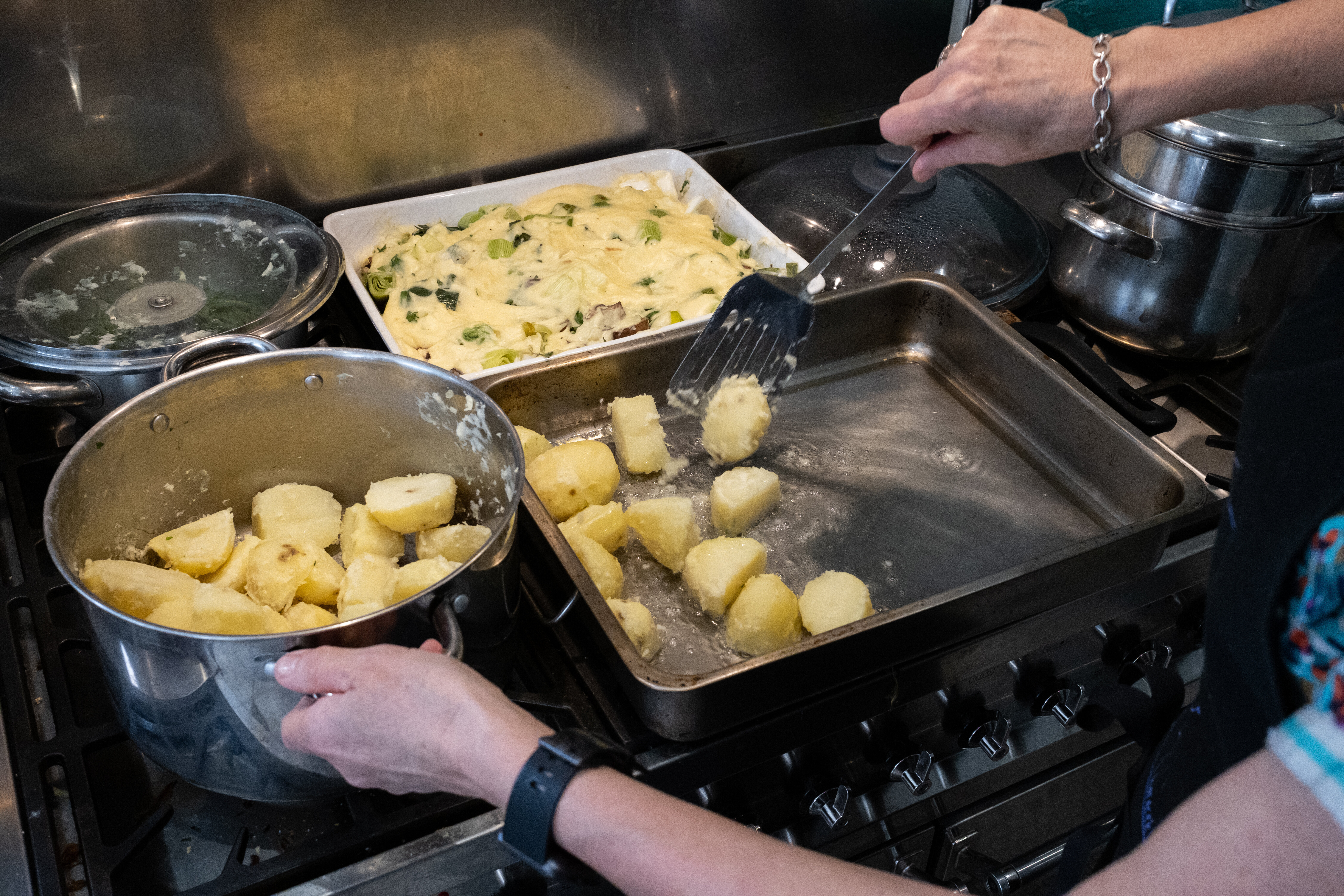
Marry Berry, unsurprisingly, has a lot of culinary tricks up her sleeve ― she adds muscovado sugar to her cottage pie, uses an extra yolk in her pancake, and even coats her roast spuds in semolina.

And now, it seems the Cordon Bleu-trained chef has a secret for shortbread, too.

In her recipe for the simple Scottish delicacy, Mary Berry goes beyond the typical sugar-flour-butter recipe we’d expect.

Instead, she adds another ingredient for extra crunch ― semolina (yup, like for her roast spuds).

Why semolina?

Semolina is a hard flour, the less finely-milled version of durum wheat (which is used for pasta).

It has more gluten and protein than all-purpose wheat four, as well as more flavour. And because it’s coarser, it doesn’t become soft and fluffy as easily as all-purpose flour ― meaning it’ll help to provide a structure and bite to your baked goods.

“I like to use semolina as well as flour to give the shortbread crunch, but you can use cornflour or ground rice instead,” Mary Berry says.

What’s Mary Berry’s shortbread recipe?

First, you should preheat your oven to 160°C/Fan 140°C/gas 3, and grease a 30cm x 23cm roasting or traybake tin.

You’ll need 225g (8oz) of plain flour, 100g (4oz) of semolina, 225g (8oz) of butter, 100g (4oz) of caster sugar, 50g (2oz) of flaked almonds (there aren’t mandatory), and 25g (1oz) of demerara sugar for dusting.

Combine the flour and semolina in a bowl or food processor. Incorporate the butter and sugar, then use your fingertips to rub them together until the mixture starts to come together. Gently knead the mixture until it forms a smooth dough.

Spread the dough into a baking tray and then press its top until even with a knife or spatula. Then, prick its surface with a fork, add your flaked almonds if you like, and store it in the fridge to chill until it’s firm.

After it’s chilled, bake it for 35 minutes or until lightly golden brown. Sprinkle it with demerara sugar after it leaves the oven. Then, after a few minutes, cut it into 30 fingers in the tin and leave those to cool further on a cooling rack.

Enjoy ― store any leftovers on a cooling rack (though I’d be amazed if you had any.)

Share Button

Where Should You Be Keeping Your Ketchup? You Might Be Surprised By What Experts Say.

Ketchup is reportedly found in 97% of American homes, but where in the home should it be kept?

Can it be stored in the pantry after it’s been opened? Or does it need to stay in the refrigerator in between trips to the dining room table? And if it should be in the fridge, why do restaurants leave it out?

Those are just a few of the questions that we — Raj Punjabi and Noah Michelson, the co-hosts of HuffPost’s “Am I Doing It Wrong?” podcast — posed to Kristen Aiken, HuffPost’s editorial director of Life and Commerce, when she recently stopped by to chat about keeping leftovers out of the danger zone.

“There was a huge debate over this a few years ago, and Heinz had to tweet out and explain themselves, but basically, in a restaurant, it’s different than at home, because the turnover is so fast,” Aiken said. “They’ll go through a bottle in a day, maybe, with so many people squirting it on their food.”

But even if you aren’t serving hundreds of guests a day, your ketchup would likely do just fine in the cupboard.

“Heinz, for example, is shelf-stable. You should be able to keep it not refrigerated for a long time. However, [because of specific factors that may vary from home to home like] the temperature of your room or certain storage conditions, they recommend that you refrigerate it after you open it [to maintain quality]. But it really is meant to be shelf-stable.”

That’s thanks to the product’s high level of acidity. However, other brands and homemade ketchup may not have the same acidity level and may need to be handled differently.

“There are all these new fancy ketchup brands that are organic, and they probably are not as shelf-stable, so you just have to read the label,” Aiken advised.

Heinz UK responded to this condiment storage dilemma in a 2023 tweet. After learning that more than a third of respondents to an X (formally Twitter) survey were keeping their ketchup in the cupboard, the company tweeted, “FYI: Ketchup. goes. in. the. fridge!!!”

A spokesperson for the company added, “Although we’re aware many Heinz Tomato Ketchup fans have been storing their ketchup in the cupboard, we do recommend refrigeration after opening. This is the best way to maintain the delicious tangy taste of our Heinz Tomato Ketchup that you know and love.”

So, while it’s probably safe to leave your bottle of Heinz out (and if you do, experts advise you should consume it within 30 days), if you want your ketchup to taste its very best (and who doesn’t?), keep it chilled.

Aiken also chatted with us about what you never want to do when you’re defrosting food, the foods you never want to keep in the door of your fridge and much more. Listen to the full show above or head here to check out every episode of “Am I Doing It Wrong?”

After you’ve had a listen above or wherever you get your podcasts, subscribe to “Am I Doing It Wrong?” so you don’t miss a single episode.

Need some help with something you’ve been doing wrong? Email us at AmIDoingItWrong@HuffPost.com, and we might investigate the topic in an upcoming episode.

Share Button

We’re Obsessed With This Strange Rule For Dog Names In France

If you’re a pet owner, you likely had a lot of fun (or frustration!) naming your pet. Do you go silly and call them something like pancake or do you go aggressively normal and name them something along the lines of Barry?

The choices are endless and while it obviously isn’t anything like naming a child, there is a certain weight to it as you are literally naming an animal that lives in your home.

It’s all very surreal if you think about it too much – which you shouldn’t.

Anyway, it turns out that in France, your choices are a little more limited as there are actually naming conventions around naming dogs over there. Sacre bleu!

The rules for naming dogs in France

In a recent video on her TikTok account, travel influencer Roya did a skit of two people discussing a dog and the year in which he was named. In the skit, the ‘French’ person assumed that her dog Peanut was born in 2019 because his name begins with the letter ‘P’.

It turns out that the dog was born in 2020 and, therefore, should have been named something beginning with the letter ‘R’.

Is this all making sense to you?

Yeah, same, I was a little lost. So I did some digging to find out what exactly was behind this convention.

According to Connexion France, this actually goes back to 1926. Since then, dog owners who hoped to register their pedigree dogs have had to name their dogs in accordance with the Société Centrale Canine in its Livre des Origines Français (LOF) which means naming them from the letter of the year they were born.

This is because the Société Centrale Canine has responsibility for keeping track of the genealogy of pedigree dogs and this rule was brought in to simplify the listings of these pups as sometimes owners would delay registering their dog at birth, making registers not-quite accurate, with older dogs appearing after younger dogs.

Since the introduction of this rule, the letters for each year have cycled through the alphabet with some exceptions. The letters K, Q, W, X and Y are left out due to the scarcity of names.

As for the French dog name letter for 2024? It’s V! As one commenter said on the original TikTok, “Can’t wait to name my dog Vulva this year ❤️”

Share Button

Straight Folk – You Seriously Need To Start Talking About HIV

While we may think that, at this point, we know all there is to know about HIV and what causes it after decades of research, recent data has revealed that there is still a long way to go, especially for heterosexual people.

Newfoundland Diagnostics have recently conducted a study using a sample of 2,504 people, into public awareness and perception of HIV ahead of HIV Testing Week this week. Alarmingly, their research found that many people aren’t aware that anybody can get HIV and have never been tested.

According to the researchers, over one million straight people in the UK believe that they are immune to HIV. This is exceptionally alarming, given that UK Government figures show that almost half of HIV cases are heterosexual people.

73% of straight Brits have never tested for HIV

The study also found that over a fifth (21%) of heterosexual Brits believe that they are unlikely to contract HIV, leading them to not get tested. Additionally, one million Brits believe that they are ‘immune’ to the condition.

Other reasons for heterosexual people not testing for HIV include never having unprotected sex (18%), not having access to an HIV test (4%) and not being bothered to test for HIV (3%).

Overall, this research exposes a sore lack of education within the UK around HIV and how it is contracted and manifests. Newfoundland Diagnostics notes that this ironically echoes the infamous tombstone ads of the 80s which said: “don’t die of ignorance.”

Frederick Manduca, co-founder of Newfoundland Diagnostics, said: “Whilst testing does seem to be increasing in the long-term, these findings reveal there remains a substantial amount of ignorance towards testing and its importance amongst heterosexual people.”

Who can get HIV and how is it transmitted?

Despite much of the focus surrounding HIV being on gay, bisexual, and men who have sex with men testing for HIV, far more people could contract the disease. Anybody who has unprotected sex, exchanges bodily fluids or shares needles should regularly test for HIV. Anybody can get infected with it, regardless of sexuality, race, gender, sex, or age.

HIV is found in the body fluids of someone living with HIV. This includes semen, vaginal, and anal fluids, blood, and breast milk. In the UK, according to Newfoundland Diagnostics, the most common way of getting it is through anal or vaginal sex without a condom. It cannot be transmitted through sweat, urine, or saliva.

How do I test for HIV?

All HIV tests will check your blood for any blood-borne diseases and are available as part of a regular STI check up. You can visit a GUM clinic or sexual health practice for a test, or you can test at home with a self-test such as Newfoundland Diagnostics’ HIV test.

Share Button

The One Thing You Should Be Doing After A Big Meal To Improve Your Health

Is there anything more satisfying than the feeling after a big meal? You’re full, you’re a little sleepy, and you’re satisfied. In fact, for some (me), it’s the ideal time to just nod right off and have a cheeky 20 minute nap.

In fact, the Christmas Day nap after the huge dinner is a highlight of the day for me.

However, apparently, what we should be doing is not napping but actually, walking. I know, I know, I’m disappointed too, but I think the health benefits may make it worthwhile.

According to @nikkithepa, an aesthetics, emergency and functional med physician assistant and TikTok creator, going for a walk after a big meal has a multitude of health benefits.

@nikkithepa

Taking a walk after eating can significantly improve digestion and enhance overall metabolism. 🍽️🔬 When you engage in gentle physical activity, like walking, it helps stimulate your digestive system, aiding in the breakdown of food and absorption of nutrients. It also encourages the movement of food through your gastrointestinal tract, reducing the likelihood of discomfort and bloating. 💪🌟 Moreover, walking after a meal has been found to positively impact blood sugar control. After you eat, your blood sugar levels rise, but walking can help your body utilize glucose more effectively. This means it helps prevent sharp spikes and dips in blood sugar, which is particularly beneficial for individuals with diabetes or those aiming to manage their weight. 📊🥦 Post-meal walks can also contribute to weight management. Engaging in light exercise, like walking, increases the number of calories burned, assisting in weight maintenance or even weight loss over time. It’s a fantastic way to stay active without putting excessive strain on your body. 🏃♀️🌈 So, why not make post-meal walks a regular part of your routine? Not only will you optimize digestion and metabolism, but you’ll also enjoy the added benefits of fresh air, stress reduction, and a chance to connect with nature. 🌳🌼 Remember, it doesn’t have to be a vigorous workout. A gentle stroll around the block or a nearby park is all it takes to reap these scientifically proven advantages. 💚✨ #PostMealWalks #ElevateYourWellBeing #HealthyHabits #weighloss #glucosecontol

♬ Don’t Let Me Go – Lane 8 & Arctic Lake

Why you should go for a walk after a big meal

In a recent video, Nikki says that this is the most simple but effective health habit you should be adding to your day for these x reasons:

Can help with digestion

Taking a short walk after a meal improves digestion. This is because walking helps to stimulate the muscles in your abdomen, promoting the movement of food through your digestive system.

Helps with blood sugar control

Nikki says: “By engaging in a post-meal walk, your muscles become more receptive to glucose uptake, allowing them to efficiently utilise and absorb the sugar from your blood stream.”

She adds that this helps regulate your blood sugar levels, preventing sharp spikes and crashes, promoting a metabolic balance.

It offers mental and emotional benefits

Nikki said that as you walk after a meal, your brain releases “feel good neurotransmitters” like serotonin and endorphins which improve the mood and reduce stress levels as well as enhancing overall mental wellbeing.

Nikki advises walking between 30 minutes to an hour after your meal and your walk only needs to be 10 to 15 minutes.

We’re off to get our steps in….

Share Button

I Went To A Brothel With My Boyfriend. It Was Nothing Like What I Expected.

My boyfriend, Rod, is passionately kissing another woman.

Little fingers of jealousy squeeze my insides, and I’m not sure where to look or what to do. The woman senses my discomfort and immediately stops, pulling me up beside her with a big, warm giggle and a squeeze. I relax and remember: This is why I chose her. I like her, I love that giggle, and I know she has absolutely zero interest in poaching my boyfriend.

How do I know this? Because I picked her out of the lineup at one of Nevada’s most storied legal brothels. We hired her to join us for a threesome for an hour, and when our time is up, she will go back out to the bar and charm someone else with that sexy laugh, and we will go home.

I’d never had a “real” threesome before, other than some fairly benign fooling around in college. It had been a lifelong fantasy, but the emotional politics of threesomes always seemed so forbiddingly complicated. Surely someone would get hurt, someone would feel left out, someone would get jealous ― surely, maybe, definitely me? Plus that third-wheel ― would she turn stalker? Would we get an STI? Would an angry boyfriend show up out of nowhere and make us the unfortunate stars of a true-crime show? Just too risky. So I had resigned myself to the fact that some things are best left to fantasy.

When I met a lover who knew his way around a paid hookup, however, a whole new possibility presented itself. Rod and I headed to the brothel outside Reno, Nevada, to celebrate my upcoming birthday. And it was not at all what I expected.

We took a cab from our hotel in downtown Reno to the brothel’s bar, all flashy neon outside but classic sticky floors and bare-bones Old West saloon inside. Escorts chatted among themselves on bar stools or lounged on velvet banquettes against the wall. It was early ― around 4 p.m. ― and we were some of the only patrons. A few old men sat at wooden bar tables, eating out of plastic foam TV trays and silently sipping beer. Women who obviously knew them would pop by periodically to pick them up, a scene much more akin to medical assistants ushering patients to the exam room than participants embarking on a sexy encounter.

Rod and I were the subject of great interest ― couples are a fairly rare event ― and we had many friendly women cruise by our table, asking if we had any questions and offering to show us around. Before we had a chance to chat with anyone in detail, the “lineup” bell rang, and every patron who had not already initiated an encounter with a woman went through a forbidding dungeon-like door into a cavernous hunting lodge space.

In front of a giant stone fireplace the women lined up. They were every kind of everything ― all different races and body types and styles of dress. I found myself in a rare moment of simply admiring the beautiful diversity of their bodies without that knee-jerk need to compete or compare myself. I winced a bit self-consciously, however, when I realised that none of them were as old as I was. Would they be turned off by our middle-aged bodies? Wait, was I actually expecting them to be turned on? I was momentarily stumped.

The author and her boyfriend, Rod, on the plane to Reno, Nevada.

Courtesy of Melissa Duge Spiers

The author and her boyfriend, Rod, on the plane to Reno, Nevada.

The house manager ― a business-suited woman who was my age ― introduced each woman, who then stepped forward for a moment, gave a little wave and a smile, just like at a beauty pageant. A handsome young guy in the chair beside us made his pick immediately. His woman grinned and sashayed over to sit on his lap and gave him an enthusiastic greeting ― this was clearly not their first time together. The manager then asked any women who wanted to entertain couples to step forward, and about half of the line did.

Rod and I had made an agreement before we arrived: I got to choose. I already knew that I wanted Carmen, the curvy, dark-haired woman in a fishnet dress and thong who had been the first to say hello to us in the bar. She was flirty and seemed happy. She was pretty and she had that giggle. So I pointed at her, while my nice-girl upbringing screamed at me silently: Pointing is so rude! The women without dates headed back to the bar and I felt another guilty stab as they filed past us. Had I made them feel rejected? Did they take it personally?

I didn’t have time to think about it because Carmen was shimmying on our lap, or, more specifically, on my lap as I sat on Rod’s lap. Pulling me up by the hand, and looping an arm around him, she led us to the negotiation room. It was a small room with dim lighting that resembled a hall closet and was just big enough for us all to sit knee to knee while we discussed what our hour might look like and what the price tag would be.

Depending on what services we wanted, our time with Carmen could easily total a thousand dollars or more. She laid out her ground rules (condoms were always required; kissing was OK) and asked if we had any specific requests. Not really, we just want to have fun, we told her. We negotiated a price ― I gulped and Rod agreed. Then we offered up our genitals for inspection, a quick once-over she conducted with a sly sense of humour while she detailed the rigorous STI testing she undergoes every week. Oddly, the whole thing was reassuring and funny rather than awkward. STIs are taken very seriously at the brothel, which is obviously a good thing.

The unusual formalities over, we headed to the pay window and forked over the cash. Once we were finished, we followed Carmen down a maze-like hallway — a literal red light glowed everywhere ― and she pranced along ahead of us with a Champagne bottle in an ice bucket.

When we finally got to her room, a tiny, semi-personalised space, I was thrilled to find it was toasty ― I’m always freezing when I’m nervous. Carmen pointed out condoms, towels, the fresh sheets on the bed, and the adjoining bathroom (which she shared with the woman in the room next door). The little tour was a strange combination of straight commerce and flirtation.

Carmen seemed to be a naturally touchy-feely person and she held my arm or tapped my back as she showed us around. I noticed that she focused her attention much more on me than Rod, which charmed me, but the cynical observer in me noted that it is an undoubtedly smart, practiced move — she is obviously well-versed in disarming the female competition and jealousy aspect of these encounters.

The author and her boyfriend hanging out at the bar in their hotel, where she says they, "enjoyed shocking people by telling them our destination."

Courtesy of Melissa Duge Spiers

The author and her boyfriend hanging out at the bar in their hotel, where she says they, “enjoyed shocking people by telling them our destination.”

Things flowed effortlessly between Carmen and me, from our intro chatter to getting into the horizontal action, and within minutes Rod enthusiastically joined in, the three of us rotating around in a surprisingly fluid give-and-take. While he nominally took charge ― after all, a threesome needs a little direction ― it was overwhelmingly female-centered sex. I smiled to myself. Threesomes are such trite male-fantasy territory, but Carmen and I were a girl party of teamwork, exploration and celebration. I even joked at one point that we hoped Rod didn’t feel excluded. (He decidedly did not.) The whole experience was fun and sexy ― all I had hoped it would be ― with none of the awkwardness I had feared.

Carmen was unfailingly charming and enthusiastic, but I never once mistook her warmth for actual sexual excitement. There was no pretence on anyone’s part that this encounter was expected to include satisfaction for her.

I asked her about this later, as we all lounged naked on the bed, sipping Champagne and chatting. She batted the question down with a polished little sidestep ― she explained that she has enough fun just making her clients happy, and it’s too much work to have orgasms all day long anyway. We asked her where she grew up (Venezuela) and how she got into this line of work. (She was initially a stripper but found brothel work safer, with less harassment and more money.) When I wondered aloud whether the post-coital chat was the best or worst part of the job, Carmen assured me she looks forward to connecting with customers and that the old saw is actually true: She often has clients who pay just to talk.

Way too soon, an intercom buzzer rang and a female voice let us know our time was up. I had wondered about security ― surely there was a network of bouncers and cameras and intercoms and emergency buttons to protect the women, but everything was so discreet, we didn’t notice any of it. We jumped up and bustled around, helping Carmen strip the bed and straighten up (even though she insisted we didn’t have to) and then the three of us spilt out into the hallway.

We returned to the bar where we began our adventure for some final chatter and a drink. We were sitting cozily together at a table and laughing at our own newly made inside jokes, when a young woman who looked fresh off a farm joined us. She clearly had a friendly relationship with Carmen and was eager to know, “What exactly do you do in a threesome?” As we happily shared our insights, she turned to me and said with a wink, “This is what happens to a girl when you raise her in a really strict, controlling religion!” I raised my glass and said, “That makes two of us, girlfriend! Amen!”

A drink suddenly arrived at our table for Carmen. It was sent from a gentleman at the bar, and she smiled and raised a toast to him. She got up immediately and, after squeezing my leg in a little goodbye, strutted over to him. I watched as they chatted for a few moments and then she linked her arm in his and led him over to the big lodge door. The last thing I heard as it swung shut behind them was that warm, bubbly giggle, and I found myself sad to see her go. I guess I was jealous after all.

Melissa Duge Spiers is an award-winning screenwriter and memoirist, whose memoir-in-progress, “The Glory Whole,” won the Book Pipeline 2021 Unpublished Manuscript Non-Fiction award. She is represented by Dani Segelbaum/The Carol Mann Agency. For more from her, visit her Instagram at @mdugespiers.

Share Button

Cosy Daytime Habit Can Be A Symptom Of Dementia

According to the Alzheimer’s Society, there are currently 900,000 people living with dementia in the UK and this is projected to rise to 1.6 million by 2040.

The NHS states that some of the early symptoms of dementia include memory loss, difficulty concentrating, confusion, and mood changes. However, one doctor speaking to The Express has highlighted that there is a hidden symptom that can be a sign of the syndrome.

While there is no cure for dementia, early detection can ensure that the condition is managed and you can get the help you need.

The ‘hidden’ sign of dementia

Dr Rayaz Malik, professor of medicine at Weill Cornell Medicine in Qatar warned that taking naps throughout the day could be a sign of dementia saying, “Taking frequent daytime naps is also a notable behaviour associated with certain conditions, including dementia, and losing interest in friends and family is a sign that may indicate dementia.”

This is backed by Alzheimer’s Research UK. Dr Susan Mitchell, Head of Policy from Alzheimer’s Research UK said, “Unusual sleep patterns are common for people with dementia, but research suggests that sleep changes could be apparent long before any symptoms like memory loss start to show.”

According to research, this appears to only apply to older people. In something of a paradox, scientists in the US have suggested that those who nap more frequently when they get older are more likely to get dementia, but those who have dementia are more likely to nap.

So, how long should we actually nap for?

A healthy nap is around 15-45 minutes, according to experts. However, the NHS urges that if you experience excessive daytime sleepiness, you should speak to your GP as it could be a sign of something more serious.

Share Button

Martin Lewis Issues Warning For Those Planning A Summer Holiday

If you’re planning on going on a summer break abroad this year, Martin Lewis’s team have issued a warning for you.

The team has warned that not only should you check that your passport doesn’t need to be renewed but also that it’s valid for the country you’re visiting. This is because many countries have laws for how long you can have left on the passport in order to visit and how old the passport is. Since Brexit, this includes some EU countries, too.

The expert added, “If you fall foul of these, you could be refused entry – we’ve heard one story of a family’s four-year-old girl being refused entry to Turkey because she had less than two months left on her passport.”

The EU encompasses Austria, Belgium, Bulgaria, Croatia, Republic of Cyprus, Czech Republic, Denmark, Estonia, Finland, France, Germany, Greece, Hungary, Ireland, Italy, Latvia, Lithuania, Luxembourg, Malta, Netherlands, Poland, Portugal, Romania, Slovakia, Slovenia, Spain and Sweden.

If you renewed your 10-year passport early, ensure that you’re still in the valid period as extra months may have been added at the beginning of the passport’s validity, meaning that your passport may be technically over 10 years old and excluded from some travel destinations.

However, if you’re travelling to Ireland, it’s not quite as strict. Ireland is part of the common travel area with the UK and a passport isn’t required from British nationals travelling from the UK. However, as immigration officers check the identification of people arriving by flight and may ask for proof of nationality. Money Saving Expert recommends taking your passport anyway and ensuring it’s valid for the entire stay.

For information on the specific country you’re visiting, the government has an online tool which tells you the latest information on travelling and entry requirements

The only website to use to apply for a passport is the Gov.uk website. On there, you can get your first passport, renew an old one or get one for your child. You can also apply by paper at the Post Office.

Renewing a passport can take three weeks and Money Saving Expert urges that travellers apply early to avoid disappointment.

Share Button

This January Movement Challenges Women To Rethink Their Body Hair

Many people use the month of January to try out lifestyle changes, like going alcohol-free for “Dry January” or abstaining from animal products for “Veganuary.” But one January movement you might be less familiar with is “Januhairy.”

A portmanteau of “January” and “hairy,” Januhairy is a movement that encourages people to put their razors down and let their body hair grow out for the month ― and then perhaps year-round if they enjoy the experience. While Movember and No Shave November aim to raise awareness around men’s health and cancer, Januhairy is about challenging societal beauty norms, especially for women and femme-presenting people.

“It’s a way for us to question body hair standards and why we follow these societal norms that make us feel like body hair isn’t beautiful or feminine or acceptable on a woman’s body — despite being acceptable on a man’s body — and it challenges the feeling that our body hair is innately gross when it’s just hair,” Esther Calixte-Bea, a body hair activist and visual artist, told HuffPost.

Indeed, Januhairy founder Laura Jackson launched the movement just before January 2019 to raise money for a body-image-focused organisation called Body Gossip, and to empower women to stop shaving, waxing and lasering ― or at least question why they might feel they have to.

“I think it’s an interesting way for women to try to grow out their hair in a collective way, as a form of resistance, as a form of self-experimentation, and as a playful and fun form of rebellion,” said Breanne Fahs, a professor of women and gender studies at Arizona State University and author of “Unshaved: Resistance and Revolution in Women’s Body Hair Politics.”

In many ways, Januhairy serves as a reminder that women removing their body hair is a relatively recent phenomenon.

“It came about in the early 1920s as a result of several different factors: the advent of fashion photography, the end of WWI and men coming home with their (mandatory) razor kits, the 1918 pandemic moved bathing from communal settings to individual household bathrooms for middle-class households, and the Gillette razor company making a conscious decision to market razors to women and sell them on the ‘grossness’ of body hair in order to make money,” Fahs explained. “Prior to the 1920s, women mostly did not remove their body hair voluntarily. This occurred only in the context of colonial conquest, etc.”

As fashion trends evolved toward sleeveless tops that showed women’s underarms and skirts that revealed a little more leg, Gillette released its “Milady Decoletté” razor for women in 1915 and marketed it as a product that “solves an embarrassing personal problem.” Although there is evidence of ancient Romans, Greeks and Egyptians removing body hair, women around the early 20th century were not so focused on hairlessness.

Women shaving their legs with mechanical razors in New York City in 1927.

Keystone-France via Getty Images

Women shaving their legs with mechanical razors in New York City in 1927.

“As a Black woman, I was interested to read an article that shared how it was mostly white women who propagated the idea of a woman being hairless as the ideal,” Calixte-Bea said. “I’ve also heard from women from African countries that they didn’t feel obligated to shave their legs until they arrived in America or Canada. My hairiness mostly comes from my Ivorian side, and I’ve learned that in my ancestors’ time, body hair was seen as something beautiful. So i think my body hair tells the story of my family and my ancestors.”

While marketers might have made women see body hair as “an embarrassing personal problem,” the practice of removing it generally has no basis in medical or hygiene concerns.

“In reality, hair is normal, and having hair or choosing not to shave your hair is actually embracing what is normal,” said Dr. Susan Massick, a board-certified dermatologist at The Ohio State University Wexner Medical Center. “Not shaving and leaving hair to grow in places like the armpits, bikini area and legs is not unhygienic. Believe it or not, pubic hair, for example, serves a protective purpose, particularly for women’s vaginal health. If people choose or prefer to shave, that is fine to do. Keep in mind that for some people, shaving can actually be irritating to the skin, causing bumpy, painful breakouts and rashes.”

In recent years, there have been some shifts toward body hair acceptance in Western culture, but for the most part, the changes haven’t been as significant as many would hope.

“We’re seeing some more body hair on-screen, and some companies have even figured out how to sell razors with body-hair-positive marketing,” Conger said. “But I don’t think that’s translated into full-blown norm shifting since the vast majority of cisgender women regularly shave our legs and pits.”

She pointed to the moment when Julia Roberts revealed her unshaved armpit hair at the 1999 premiere of “Notting Hill” and the subsequent media frenzy (though the actor later admitted that it was not intended as any sort of statement).

Julia Roberts at the premiere of "Notting Hill" in London in April 1999.

Fred Duval via Getty Images

Julia Roberts at the premiere of “Notting Hill” in London in April 1999.

“She forgot to shave once, and pop culture will never un-remember it,” Conger said. “Almost 25 years later, if say, Taylor Swift hit a red carpet with visible pit hair, the internet would probably cave in on itself. I think body hair removal is still so persistent partly because the hair-free pressure starts young, and it often comes from peers and parents alike. As long as we expect girls to start shaving, women won’t be ‘allowed’ to stop.”

Fahs agreed that notions of the norm shifting have been overstated, with some estimates saying that over 95-99% of women in the U.S., Australia and England still remove their body hair. She finds it encouraging, however, to see women use opportunities like Januhairy to try to grow out their body hair and see how it feels.

“It’s always better to see the power of a norm by breaking it, and it’s a great way to understand your body better!” Fahs said, sharing what she would say to someone considering taking part in Januhairy. “Go for it! It can teach you many things about who thinks they have a say in your body and how you present your body in the world. It can also teach you about your own biases about grooming and femininity related to body hair. Body hair is a powerful site of gender and power!”

Conger echoed this sentiment, applauding the movement’s impact in making folks reconsider this “this time-consuming, sometimes painful and expensive femininity maintenance.”

“Januhairy is an opportunity to opt out of a beauty norm, but more importantly, it’s a chance to check our own reactions to women’s body hair and understand how it’s different for people with polycystic ovarian syndrome, for instance, or Sikh women who keep kesh,” she added.

January is also a particularly good time of year for people to experiment with their body hair if they’re hesitant.

“If you live somewhere with a cold winter like I do in Canada, you get to grow out your body hair while covering it outside and not feeling like anyone is going to judge you,” Calixte-Bea said.

Conger believes that “Januhairy” is a catchier way to describe what many women and femme people already do during cold weather months.

“That’s the thing about body hair, right?” she said. “It’s only ‘taboo’ when other people can see it.”

Growing out your body hair for yourself in a cold season provides a type of safe space to push back against the norms and discourse that make us see ourselves in a negative light.

“Once you get home, you can see yourself as you are,” Calixte-Bea added. “It’s a very liberating experience to see your body as it naturally is and not once you’ve changed it. Working in retail, I’ve seen women of all ages talk about the things they hate about their bodies, but that’s not something I want for myself and other women.”

Of course, everyone is welcome to try growing out their body hair at any time of year. And if you don’t enjoy how it feels, you aren’t obligated to continue.

“I think it is important to normalise hair and having body hair in much the same way society should embrace all body types,” Massick said. “My philosophy is ‘you do you’ ― do what feels right.”

Share Button

Flight Attendant Shares The 1 Seat She Always Avoids On Planes

I feel like “I’ll sleep on the plane there” falls into the same category as “I’ll let it soak” ― they’re both little but destructive lies we tell ourselves when we’re too stressed or tired to think through the reality of a situation.

And like facing a clogged-up sink hours after you said you’d clean that grimy pot, taking an exhausted exit from a plane only to face a groggy 12 hours of activities in a new country can be completely overwhelming.

Luckily, it turns out there’s a trick that only the pros know to help ensure a great nap while you’re travelling ― recently, a former British Airways flight attendant, shared with The Express where to avoid sitting to get your best shot at sleep.

What’s that then?

“If you book the middle aisle front row on a long-haul flight, yes you might get some extra leg room, but you’re more than likely to be sat next to a baby,” she said.

“This is because this seat has a fold-down table for cots/bassinets for babies to sleep instead of on someone’s lap for the whole flight.”

So, if the infant you’re sat beside is particularly vocal or fussy, it might be hard to drown out their cries well enough to nod off.

The former flight attendant also told The Express that while a window seat is often comfiest for mid-flight naps (you need something to rest your head on that isn’t an irritated stranger’s shoulder, after all), there’s one job we should all do there if we want to catch some pre-holiday Zzzs.

“If you’re at a window seat and planning to get some sleep (particularly when flying through the night into daylight) close your blind after take-off,” she told the publication.

That’s because those who don’t remember to shut their blinds will have flight attendants “climbing” all over them to close it for them. After all, they need to be down during takeoff and landing ― and, of course, it’s better for blocking daylight.

It’s also a good idea to stay in the back of the plane, she added.

Anything else?

Yep! We’ve written before about how everything from a good neck pillow to meditation can help you fall asleep on a plane.

And Phil Dengler, co-founder of The Vacationer, previously told HuffPost that how you dress is key.

“The most common mistake people make on long-haul flights is not dressing properly,” he said. “Since you will be sitting in the same seat for six or more hours, it is essential to be as comfortable as possible.”

The middle aisle of the front row isn’t the only seat you should avoid on a flight, either ― “Sitting near the restroom may sound convenient, but it’s never fun to be in that row when a line forms outside the restroom,” said Paul Jacobs, general manager and vice president at Kayak North America, told HuffPost.

So, dress comfy, cushion up, avoid the middle front aisle seat, pull those blinds down, and skip the pre-loo view if you can, the pros say. Noted.

Share Button