A 2018 study found that about 10% of Millenials were hoping their in-laws would disinvite them from Christmas dinner at the last moment.
Regardless of which age group you’re in, you may know the feeling ― whether you outright hate your in-laws or just wish for the comfort of your own Crimbo traditions, it’s no secret some struggle to deal with spouses’ parents at Christmas.
Advertisement
If you’re among them, I can at least assure you you’re far from alone.
1) “Bought my toddler a gigantic John Deere ride-on tractor toy which is now taking up my entire lounge.”
2) “My MIL bought me a hair brush set. I have alopecia.”
“And I shave the rest so definitely do not need it. She also bought my male partner I floral bath bomb and a Christmas candle set. She does it on my purpose and it winds me up because my partner spends so much time looking for the perfect gifts for them!” Abz75
Advertisement
3) “Mother-in-law (who lives in a posh apartment and dresses in Gucci) arrived at my daughter’s for Christmas day. Her contribution was a bottle of lime cordial.”
8) “They turned up just in time to sit on their arses scrolling for an hour while we prepared both days’ Christmas meals, and returned to the couch immediately when it was time to clear up.”
“Then when we’d waited until after lunch and a walk to open the presents so that everyone would be there, they decided they needed a snack and made the rest of the family sit waiting for them to work out where the snacks were, then they returned with their snack without even considering asking if anyone else wanted anything.” u/bluntbangs
Advertisement
9) “Argued that all TV on Christmas day had to be live, and not recorded months before.”
10) “MIL saw the mountain of ingredients and other things I had bought for Christmas dinner and desserts. She was happy with our plan and didn’t want to change anything.”
“As I’m assembling a massive trifle (made from scratch), after cooking for hours, she waltzes in with a huge jelly dessert and a prepared ham under the other arm.
There’s obviously no room in the fridge and of course, absolutely no way the FOUR of us will be in any way able to eat all of it.
Advertisement
I didn’t say anything of course but I’m mightily pissed off.” u/daniel625
11) “We woke up early to FaceTime them when they were all together for Christmas and my MIL then spent 25 minutes going one by one through the Christmas cards one of them made with AI.”
“She’d already shared all of the images via text.” u/annedroiid
Do you have anything to add? Let us know in the comments!
When I exit the elevator into the hotel lobby, the urgency of my own voice startles me. “Are there any bodies of water nearby that I can access on foot?” The front desk receptionist gestures to the door and says I’ll meet Indian Creek within a few blocks.
I see sadness wash across my 73-year-old mother’s face. She’s holding the plastic bag containing her younger sister Carol’s cremains, and we’ve just learned we need permission from the U.S. Consulate to fly them back to my mother’s home in Spain for a proper memorial. Our flight leaves in a few hours, and a quick online search reveals that scattering ashes within 3 nautical miles of Florida’s shore is illegal. We have to be discreet.
“Carol loved Miami,” my mother whispers to soften the reality of what we are about to do: Leave Carol behind.
Advertisement
My aunt’s death at 69 had taken us by surprise. My mother’s weekly voice message, left on a Thursday, went unreturned. By Sunday, my aunt’s neighbour, who lives on the other side of the adjoining patio wall, smelled something off. He heard Chelsea, my aunt’s rescue dog, barking for days before he called 911.
The autopsy report attributes acute peritonitis caused by untreated (treatable) rectal carcinoma as the cause of my aunt’s death. The medical examiner surmised that she sat down in her rocking chair while preparing Chelsea’s food and never got back up to serve it.
The dog sat vigil by my aunt’s side for four days before they were discovered.
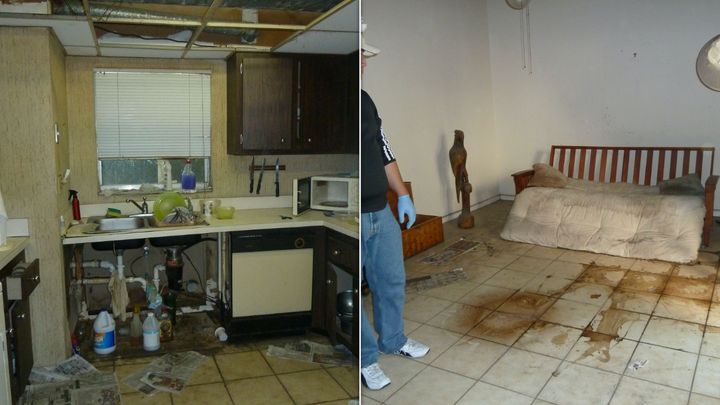
The Miami-Dade homicide detective explained that, because my aunt died alone in her home, the law required a forensic account of the scene. After they removed her body, I requested the property remain untouched. I wanted to piece together her final days to better understand her life, but I was not prepared for the chaotic state of her final months.
Perhaps my journalistic approach to her death is a way of coping with guilt and loss, but my investigation has revealed a heartbreaking reality.
Advertisement
My aunt, an educated, politically passionate, older gay woman, died isolated, financially destitute and alone. What could I have done to prevent it?
I had never asked Carol questions about her health or well-being. I was always caught up in my career and relationships, assuming deaths like this didn’t happen in a family like mine. I also believed my aunt was part of a system that took care of its aging population, and that I didn’t have to worry about her. I was terribly wrong, and I wanted to understand why.
Courtesy of Michelle Tamara Cutler
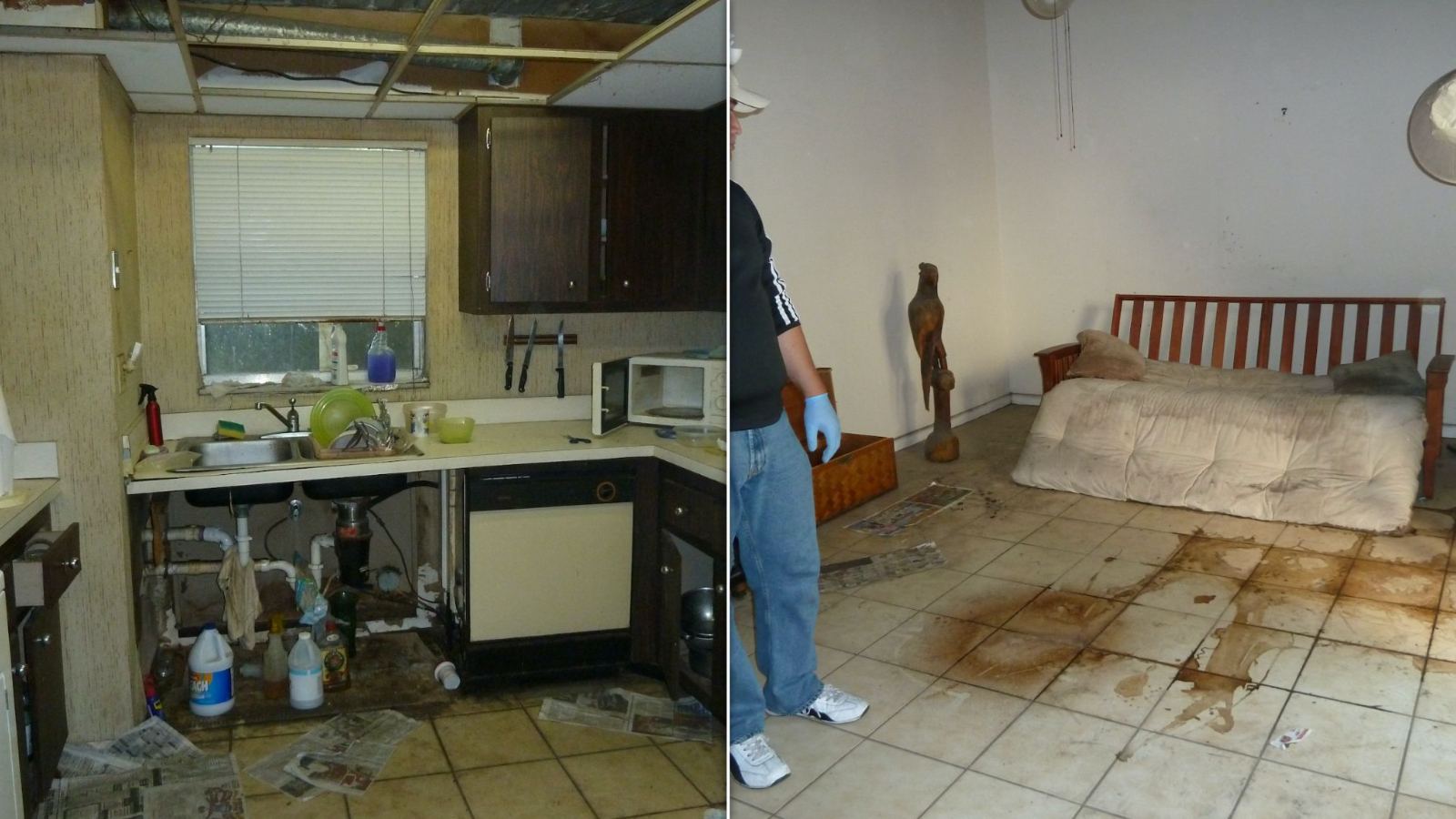
Aunt Carol’s home in Miami after her death (2012); Left: Aunt Carol’s kitchen Right: The room in Aunt Carol’s condo where she died.
My aunt knew she was gay at 13, in 1955, but coming out wasn’t the custom in 1950s America. Instead, Carol excelled in sports, was known as a class comedian and had a boyfriend, despite being in love with her best friend, according to my mother.
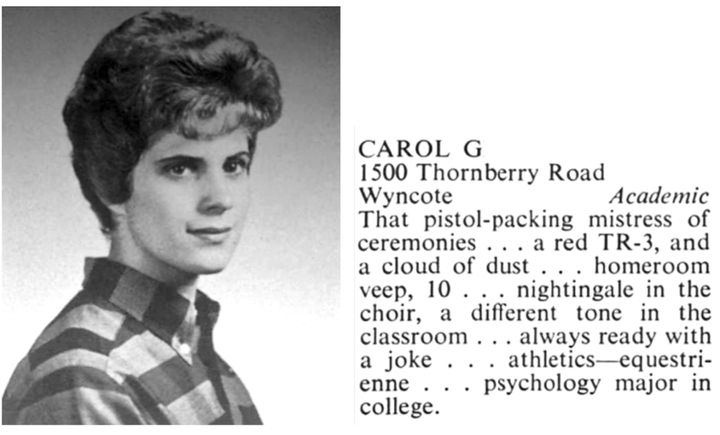
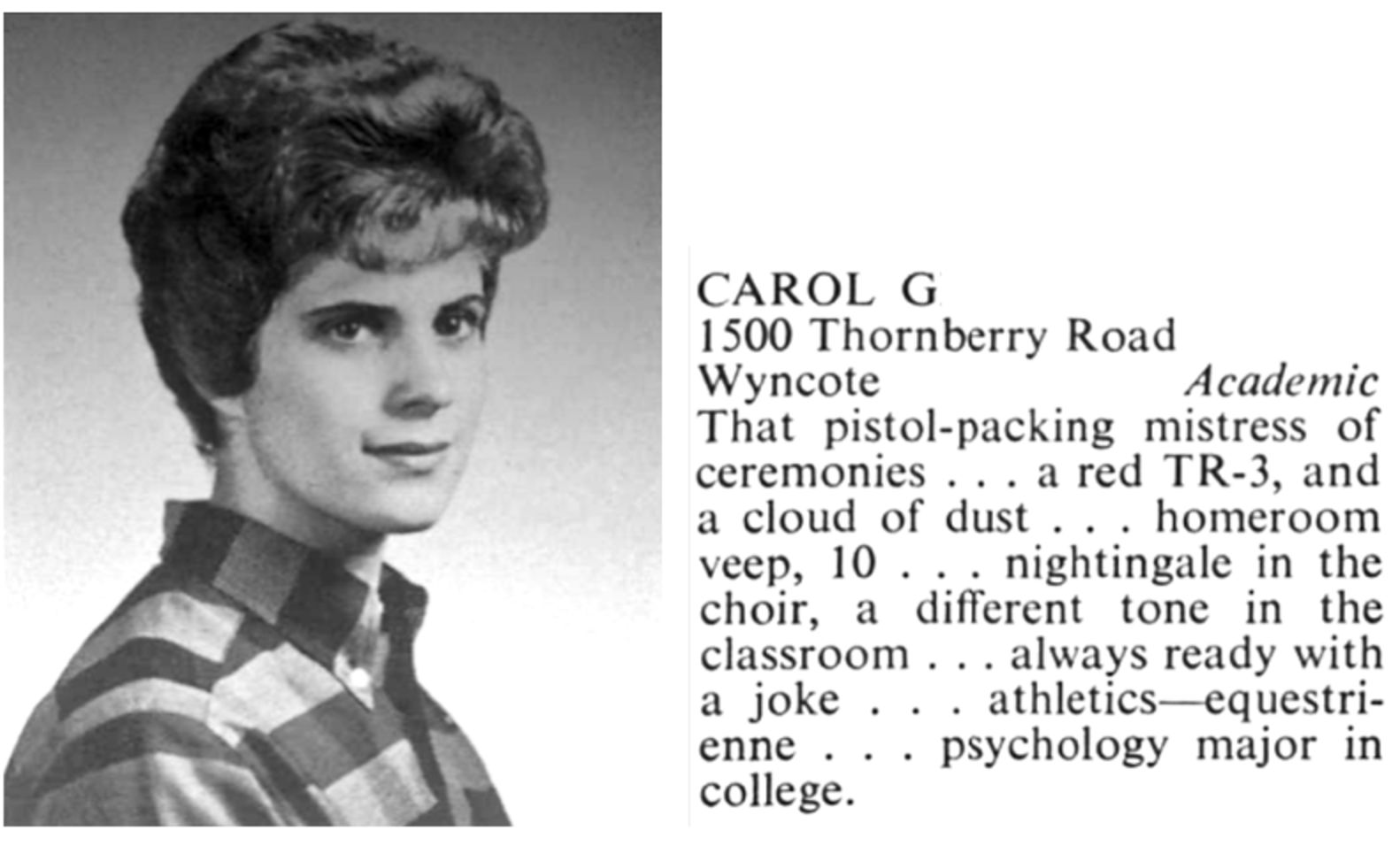
The comments under her yearbook photo describe her as a “pistol-packing mistress of ceremonies… always ready with a joke… athletic… psychology major in college.” Compared to the other femalestudents on the same page, with descriptions like “knee-length sweaters” and “future Miss Private Secretary,” it’s clear Carol was already defining herself by her choices.
Advertisement
Courtesy of Michelle Tamara Cutler
Aunt Carol’s high school yearbook photo (Philadelphia, 1958)
A man who introduced himself as Carol’s high school boyfriend contacted me after reading my aunt’s obituary. He said they were going steady until she suddenly cut off contact right before his senior prom. When he drove by her house to speak with her about what had happened, she ran inside. He was heartbroken and confused by her behaviour.
Years later, he bumped into my aunt when they were studying for their master’s degrees at Temple University. She pointed to his Eldridge Cleaver “If you’re not part of the solution, you are part of the problem” pin and let him know that she was now open about her sexuality and that he should accept it or else remain part of the problem.
Surprisingly, between the dreaded 1959 high school prom and the empowered run-in with her high school ex at Temple in 1970, my aunt married a young man from the neighbourhood. He was a friend, my mother told me, who agreed to a “sham” marriage to ward off scrutiny from her parents.
I can imagine how difficult it may have been for Carol to come out to them. My grandparents were first-generation Americans who owned a successful beauty salon known for styling young Grace Kelly’s hair before she left for Hollywood. They raised their family with the understanding that public appearance was social currency, and heteronormative relationships were the gold standard.
Advertisement
Still, Carol was 25 when she got married in 1967. Couldn’t she have escaped her parents’ middle-class aspirations without the charade of a marriage? And what happened during the three years between her wedding and 1970, when she was fully out of the closet? What had changed? Was there some specific catalyst for her coming out and accepting who she truly was, or had she simply grown tired of hiding? I wish I’d asked her.
Later, when I was growing up in the ’70s, I had two aunts: Aunt Carol and Aunt Patty. There was never talk of lesbians or girlfriends or homosexuality; there was simply Carol and Patty as a couple until something changed in their relationship in the ’80s.
According to my mother, Carol didn’t want Patty, who was younger, to see Carol’s body aging. Vanity is another byproduct of growing up in the beauty business, but I think their breakup had more to do with my aunt’s codependent relationship with my grandmother.
Courtesy of Michelle Tamara Cutler
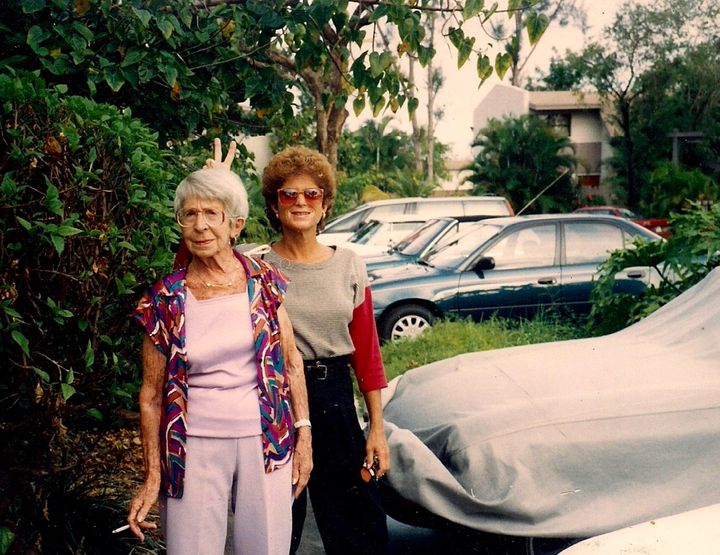
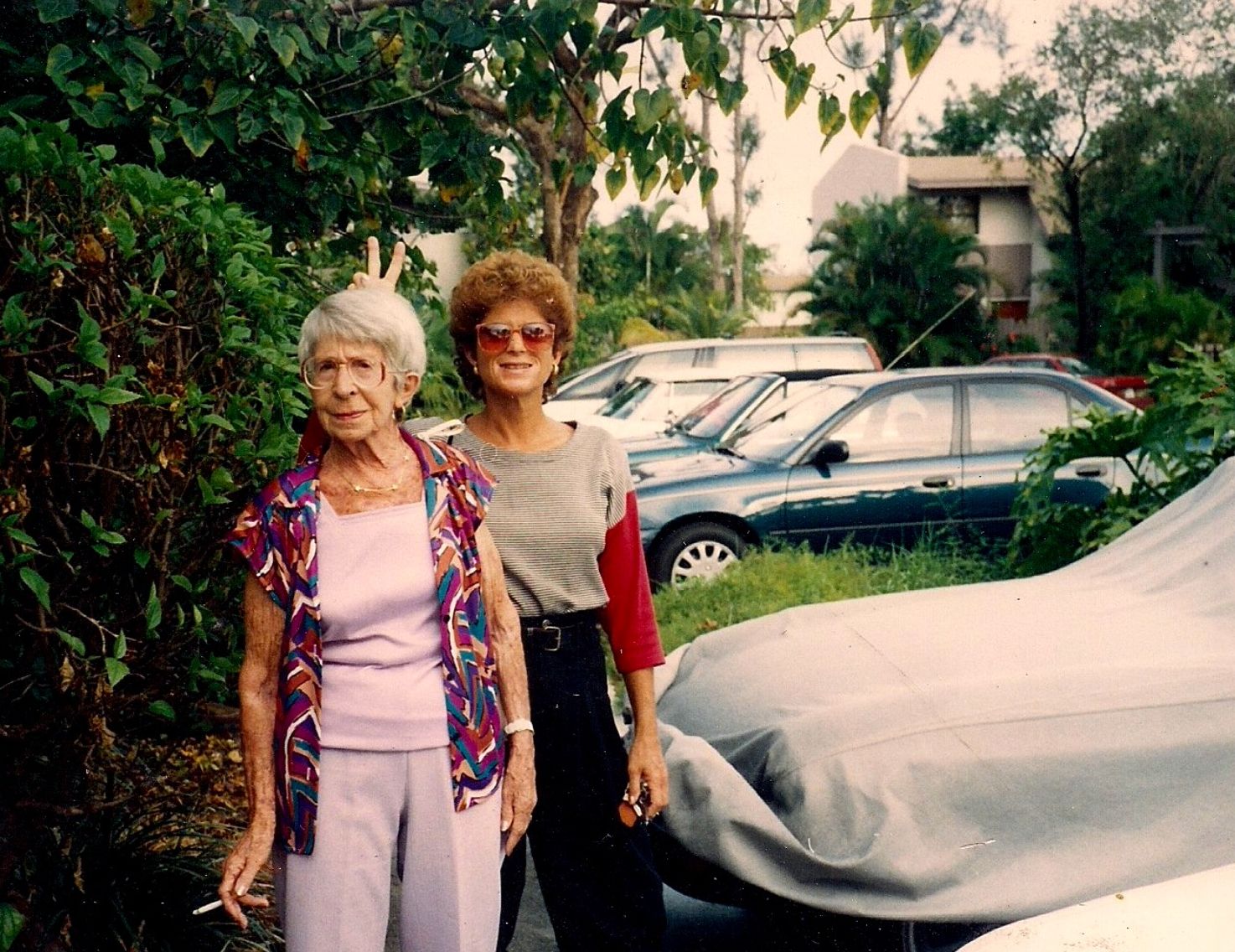
The author’s grandmother, left, with Aunt Carol in Miami sometime in the 1980s.
When my grandparents retired to Miami, my aunt followed and was single for another 40 years. She did have one longtime friend, also named Pat, but Pat swore in a conversation with me that she and my aunt were never romantically together. She said they went to the same “women’s parties” in Coral Gables in the ’80s and lived with or close to each other for decades.
Advertisement
Pat said she felt she had met a “veteran lesbian” in my aunt, someone who knew who she was and wasn’t struggling with her truth. Carol was liberating to young Pat. Pat was also the last person to see my aunt alive.
Pat agrees that Carol didn’t invite anyone into her life after the relationship with Patty ended. She had no long-term romantic relationships, just her rescue dogs and exotic birds, public television, and football.
She was a frequent caller on sports talk radio shows and taught English composition to the football players at the University of Miami to make sure they kept up their grades to play. I remember her saying The Rock was one of her favourite students.
My aunt was also known for her sharp humour and open critique of politics, according to reviews on RateMyProfessor.com. One of her Florida International University colleagues told me Carol was “always upbeat and eager to discuss books, teaching, and travel.”
The challenges of being an underpaid adjunct lecturer without benefits gradually wore her down, he explained, though her dedication to students remained clear. It was around this time that her contract at FIU wasn’t renewed, and she left her house less and less.
Advertisement
Courtesy of Michelle Tamara Cutler
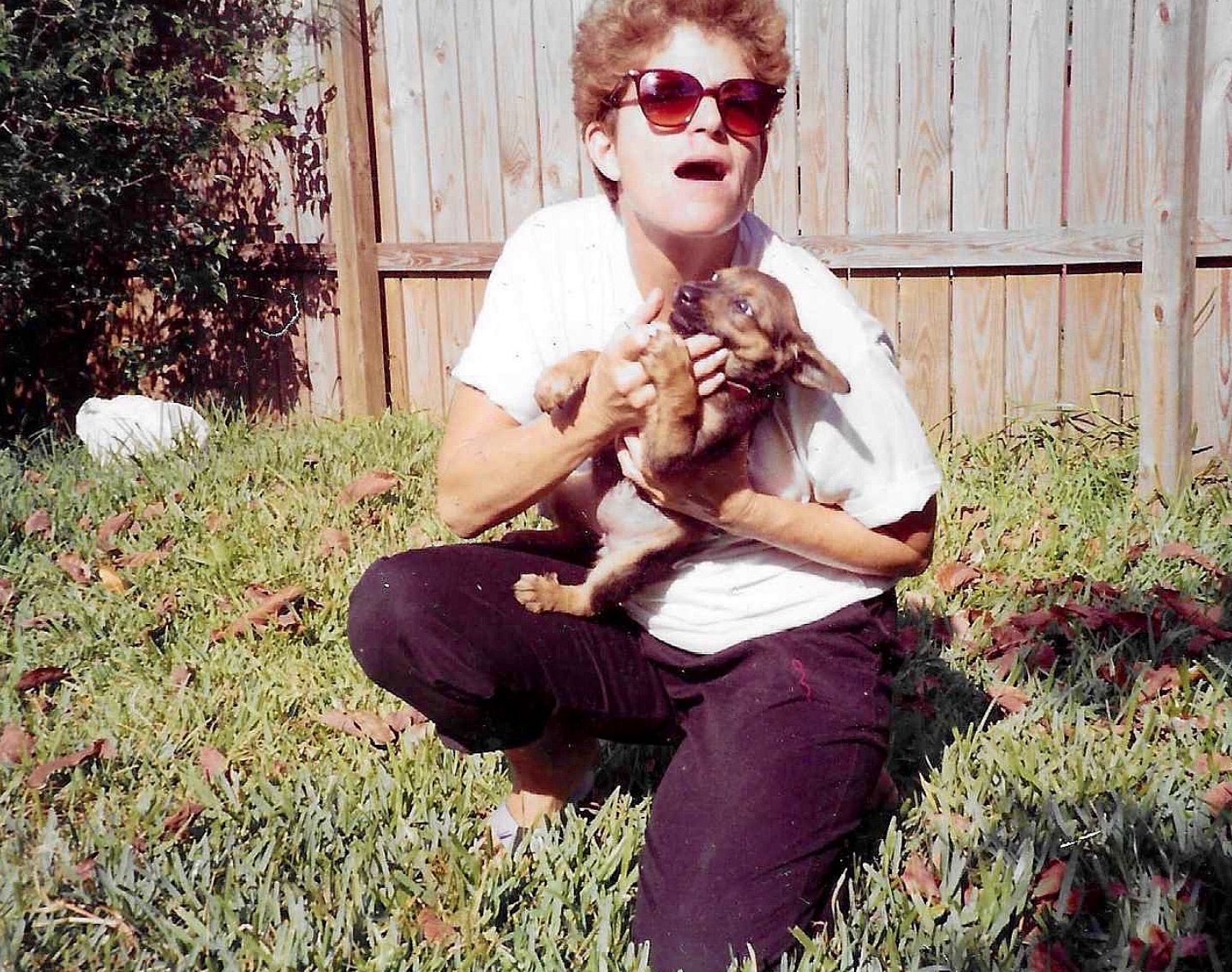
Aunt Carol with Chelsea as a puppy in Miami (date unknown).
The whole experience of going through Carol’s few remaining belongings in her foreclosed, gated-community condo shook me. I sobbed in the parking lot after seeing my mother break down for not successfully convincing Carol to move to Spain with her. It reminded me that I’d made no real effort to check in beyond email. Carol never extended an invitation to visit, and I never thought to just show up.
Suddenly flooded with memories, I quickly jotted them down before they disappeared — like one Christmas holiday in Miami Beach when Carol, dressed in black, made me laugh uncontrollably with an inspired version of Placido Domingo & John Denver’s 1981 song “Perhaps Love.”
Perhaps Love…
Is like a sweater
That fits into a box.
It shouldn’t smell like herring.
It shouldn’t taste like lox.
Carol had a way of poking fun at tradition even though she never felt at home with family gatherings or holidays, as she shared with me in an email the year before her death.
Courtesy of Michelle Tamara Cutler
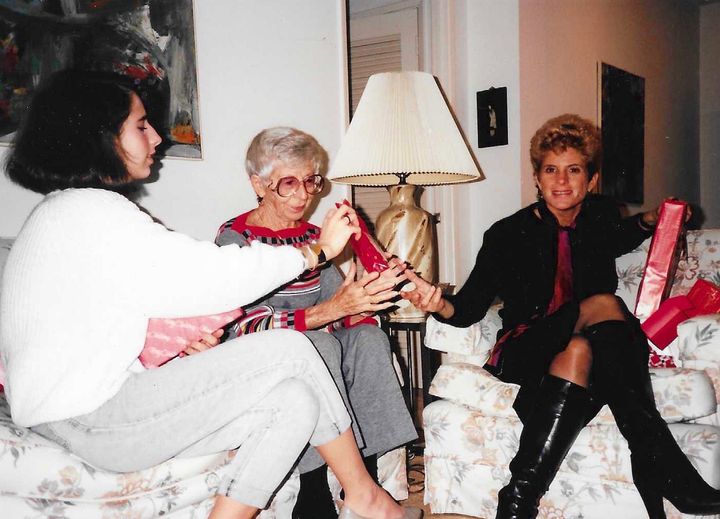
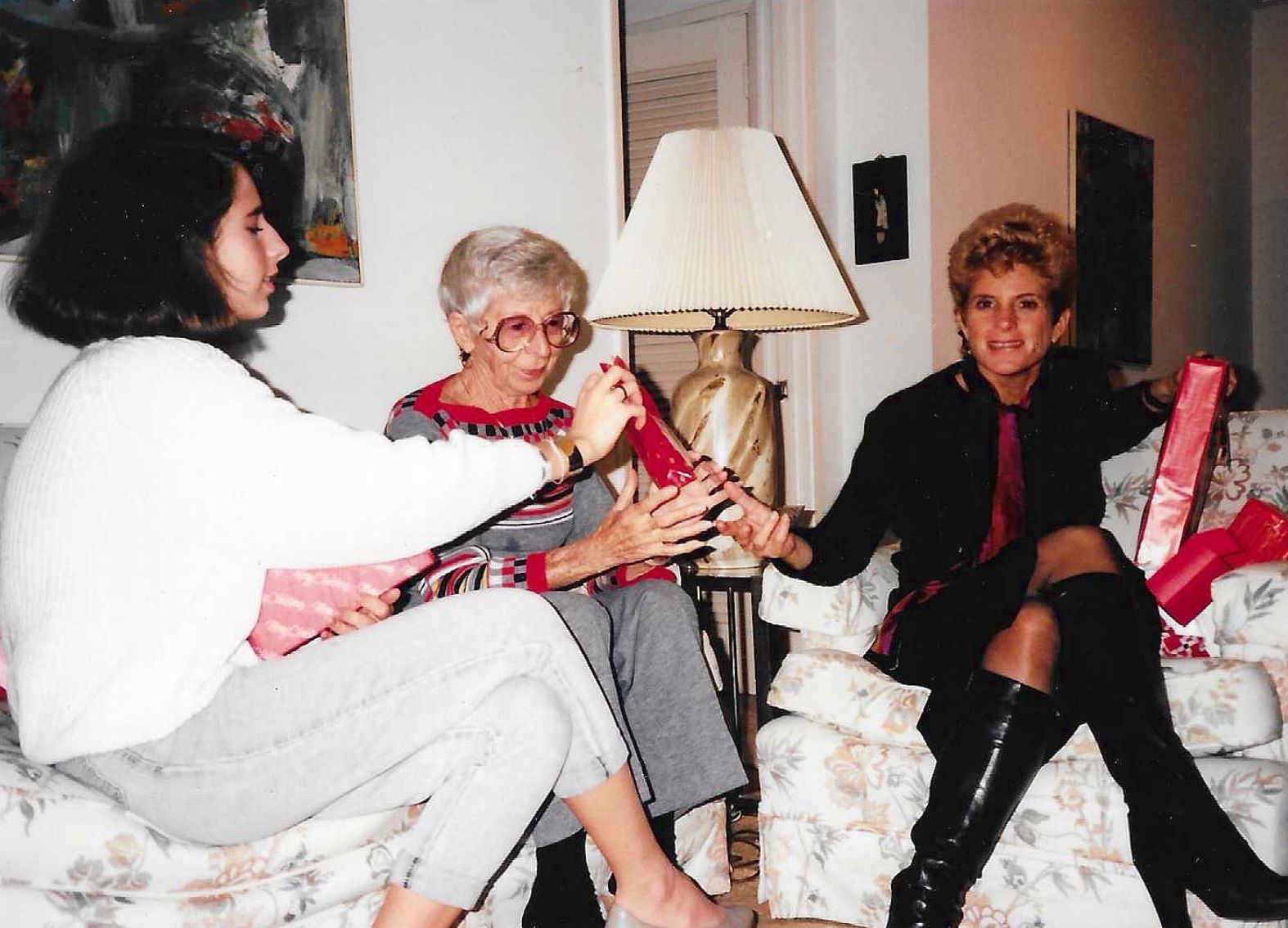
The author, left, with her grandmother, center, and Aunt Carol in Miami Beach (Christmas, 1981).
Advertisement
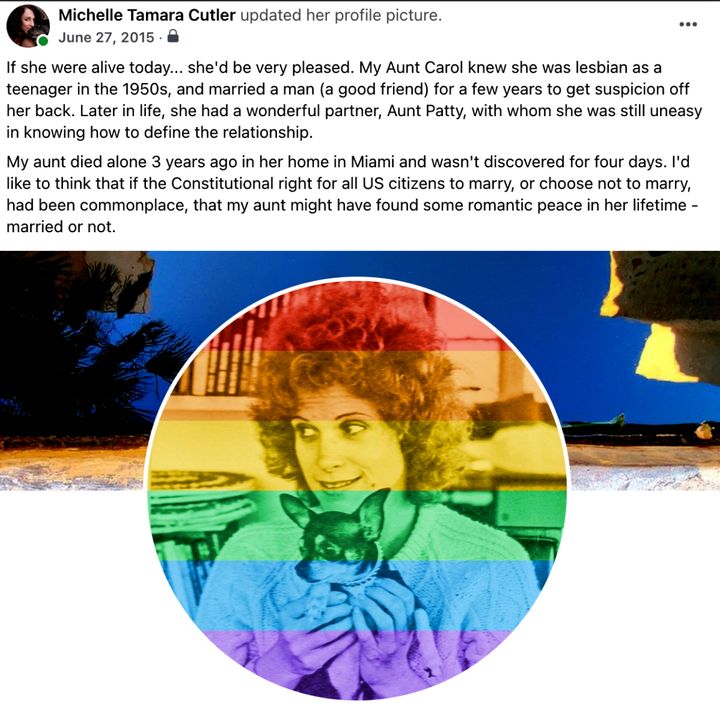
On June 26, 2015, 19 years after President Clinton signed the Defense of Marriage Actinto law, marriage equality became a right for millions of Americans. On that historic day, friends coloured my newsfeed with celebratory rainbow filters and messages.
Some had no intention of marrying, some were already traditionally or symbolically married, but they were all in agreement that discrimination has no place in our society.
I wondered if my aunt’s distrust of institutions, doctors and the public in general was an underlying contributor to her heightened level of self-preservation and loneliness.
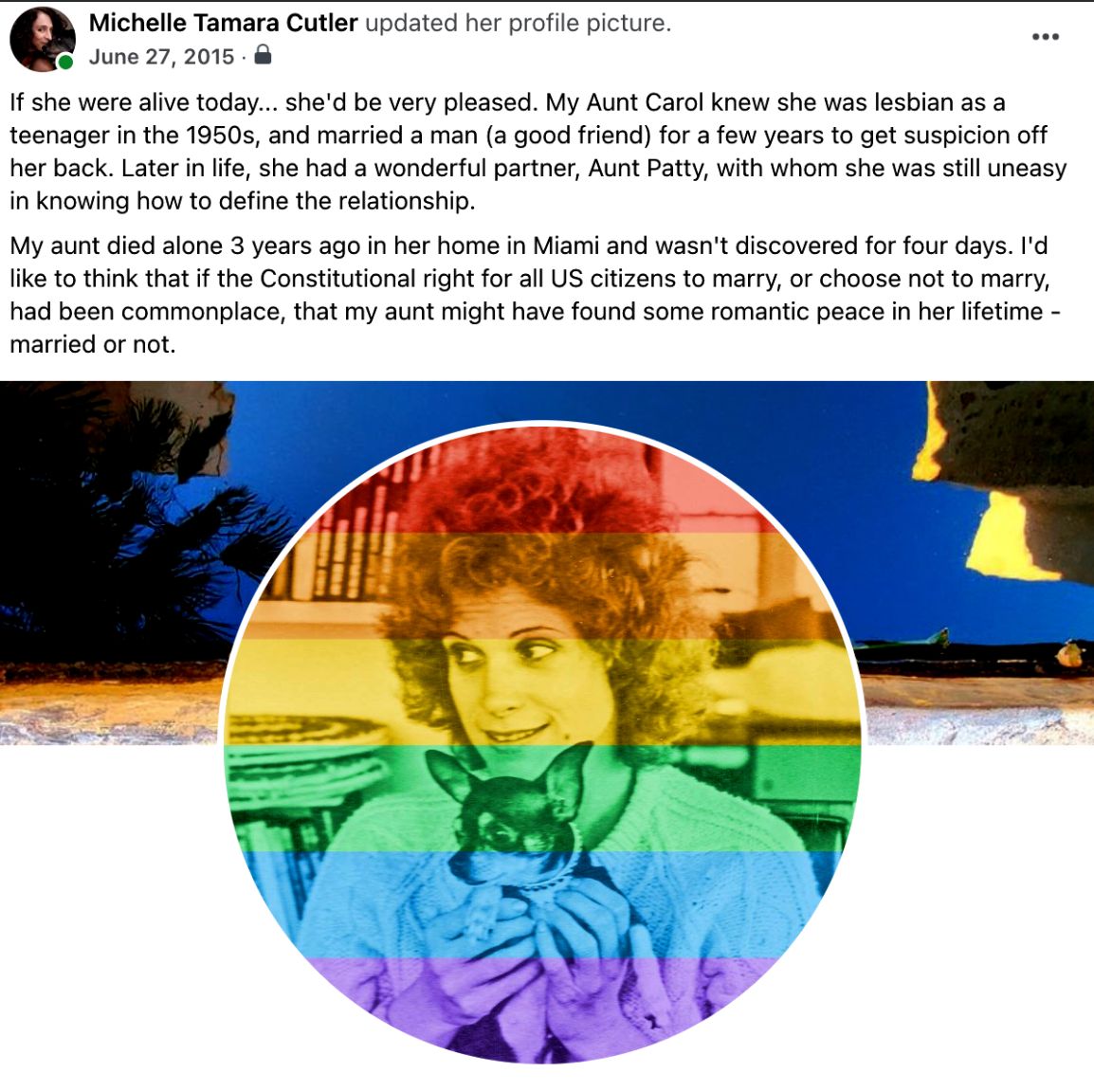
I dug out a black and white photograph of Aunt Carol in her late 30s.After studying her for a few moments, contemplating her life as an intelligent animal lover and activist with a wicked sense of humour — a real political firecracker — I decided to put a rainbow filter on the photo and share it on Facebook.
Advertisement
Courtesy of Michelle Tamara Cutler
The author’s 2015 Facebook post with a photo of Aunt Carol, circa 1980
If Carol were a 13-year-old today, however, there’s no guarantee she would feel any safer than she did in 1955. Basic civil rights, like marriage, family and financial planning, and hate crime prevention, have been argued and advanced in courtrooms, capitol buildings and the media, but these freedoms are perennially under attack.
I do believe Carol would still be fighting this fight if she were alive. I found her listed as a signatory in a 1993 pro-choice ad in the Miami Herald published in protest of the murder of Dr. David Gunn at a women’s medical clinic in Pensacola.
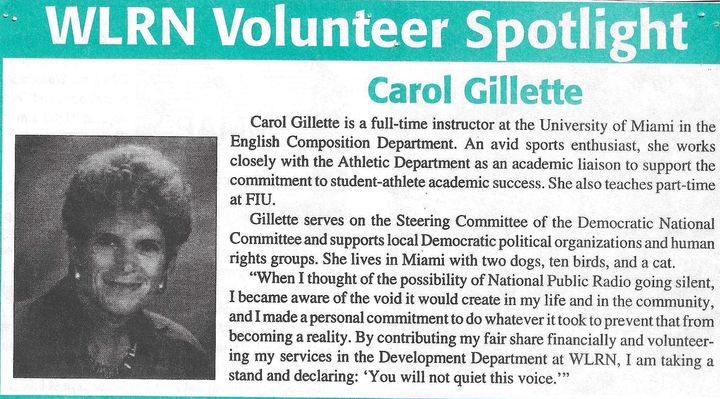
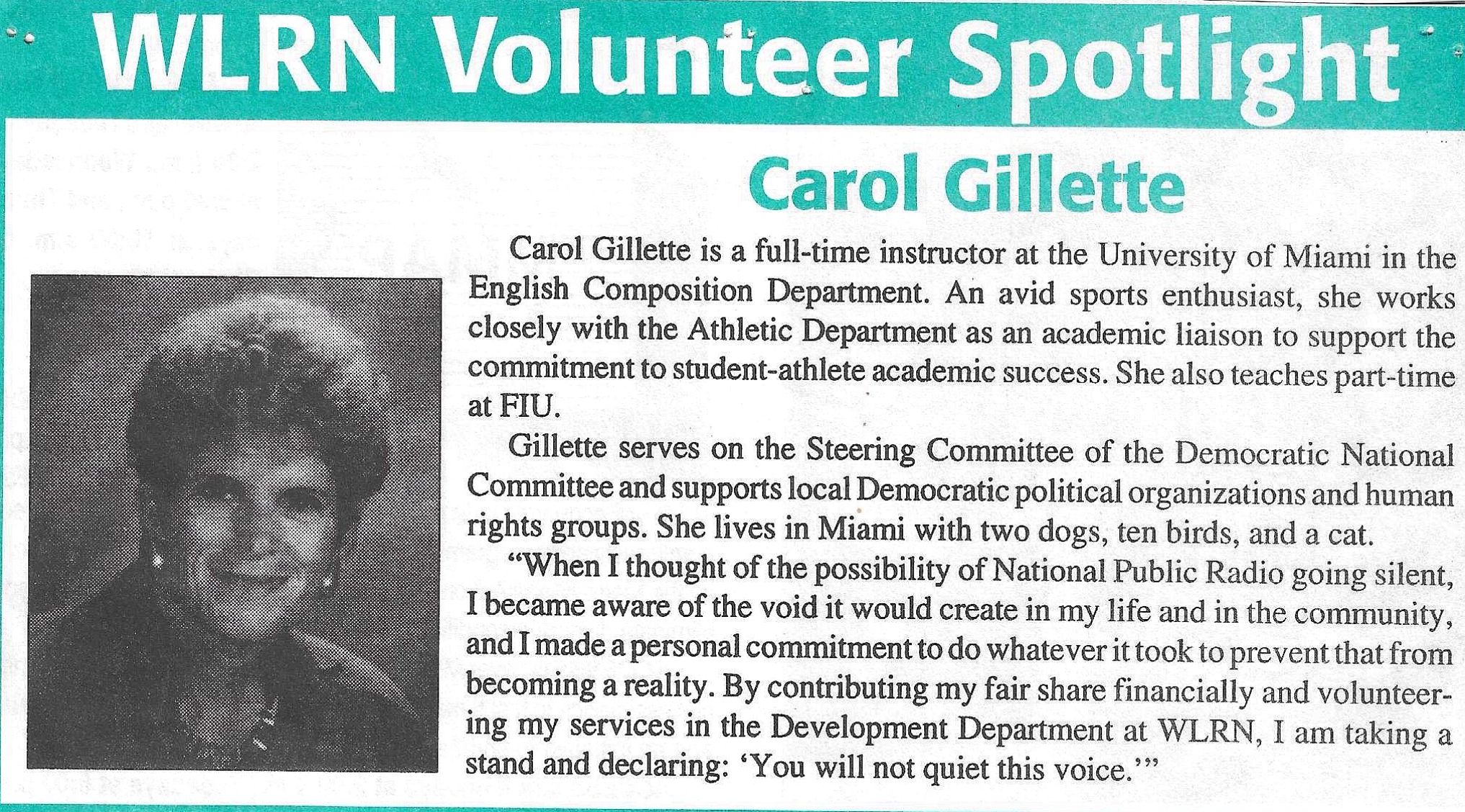
In another folder she kept of her achievements, I found letters from the head of her public television chapter, and in a 1997 volunteer profile, Carol is quoted as saying, “By contributing what I can… I am taking a stand and declaring, ‘You will not quiet this voice.’”
Advertisement
Still, her voice was ultimately quieted — and I know she’s not the only one.
Courtesy of Michelle Tamara Cutler
WLRN Volunteer Spotlight featuring Aunt Carol (1990s)
I wonder how many other Aunt Carols will die alone. There are an estimated 1.1 million LGBTQ+ identifying adults aged 65 and older.One study found 7 in 10 LGBTQ+ older adultslive by themselves compared to 3 in 10 non-queer adults, and many queer elders don’t have children to help them.
LGBTQ+ retirement communities and care facilities are on the rise, but not everyone — including Aunt Carol — wants to live their day-to-day life with other people or has the funds to support that level of care. Organisations like SAGE, founded in 1978 by queer activists, further advocacy, services and support to older members of the LGBTQ+ community, but these groups do not exist in many areas and, where they do, there is still much work to be done to prevent queer elders from facing an end like my aunt.
I cannot change what happened in my family, but I will continue to tell Aunt Carol’s story whenever and however I can. I miss her voice, her humor, and her chutzpah. She was navigating an era of deep adversity and left a lasting impact on the people and organisations she touched.
At the same time, I’m beginning to understand the tragic truth of her last days and why she closed herself off from a world in which she felt unvalued, invisible, and at risk.
Advertisement
I often think of the day Aunt Carol talked me into water skiing for the first time when she was working with the Miccosukee tribe in the Everglades. I was 12 and terrified to go out of my comfort zone, but as the engine revved, Aunt Carol sang out Elton John’s biggest hit at the time from the back of the boat: “I’m still standing better than I ever did… Looking like a true survivor, feeling like a little kid!”
And as the boat pulled away, my arms extended at the end of the rope. Thanks to her inspiring confidence in me, I found my footing, stood up tall, and overcame my fear.
Michelle Tamara Cutler is an award-winning screenwriter and storytelling coach who specialises in true story adaptations. Her reported and personal essays have appeared in HuffPost, Business Insider, Trail Runner Magazine, Under the Gum Tree, Longridge Review, Brevity Blog and elsewhere. She is writing a memoir that examines the circumstances of her Aunt Carol’s death to illuminate LGBTQ+ elder isolation, the rewards of family caregiving, and the influence of the beauty business on identity and mental health. Learn more at michellecutler.com and connect on Instagram.
Has anyone ever come up to you and said “you must be the youngest in your family, I can tell” or “you’re definitely the eldest daughter”?
Your birth order might actually have a part to play in the way your personality is shaped, but the question is, to what extent?
Advertisement
Dr Julia Rohrer, a personality psychologist at the University of Leipzig spoke to the Science Weekly Podcast to explain how siblings shape the personalities we have.
She explained her own situation saying that she has a younger half sibling which would biologically make her the first born, but she also grew up with an older cousin and they were raised together.
Talking about how birth order might impact someone, she said: “The most influential one more recently is Frank Sulloway’s niche theory.
“It’s an evolutionary inspired idea that within the family the siblings are competing for resources, but also they must get along as they share genes so they have shared interests and so on.
Advertisement
“So the idea is that it’s a bit like it’s in the animal kingdom that there are different ways to specialise. So the first borns specialise in being like a surrogate parent, they are the big and the bossy ones.
“The younger siblings must find their other niches so that’s why they are more creative as they have to explore to find out how they fit into the family context.”
Alongside this, it was recently found by the University of California, Los Angeles-led research team that, in certain instances, first-born daughters tend to mature earlier, enabling them to help their mother rear younger siblings.
A University of California, Los Angeles-led research team found that, in certain instances, first-born daughters tend to mature earlier, enabling them to help their mother rear younger siblings.
Other studies suggest that there is some later-in-life payoff for highly responsible eldest girls.
Brenda Seltzer was still in the hospital, having just delivered her son, when her family started asking when she was going to have another one.
“Everybody was like, ‘How long are you going to wait until you have the second one?’” Seltzer, 33, told HuffPost. “I was like, ‘He was just born. What do you mean a second one?’”
Advertisement
Before she got pregnant, Seltzer had assumed she and her husband would have two children, but almost immediately she began having doubts. Her birth was hard and Seltzer required a blood transfusion. Finances also came into play. Seltzer and her husband both work full time, and her son’s full-time preschool cost nearly $20,000 a year.
“We started questioning: Why would we have two? I had a bad birth experience … we were working full time, and we didn’t have much help with family nearby,” said Seltzer.
By having one child, they’ve been able to put money toward fun family activities, like a pre-COVID cruise and a family season pass to Disney World. They’re also able to pour themselves into playtime with their son when they’re not at work.
“We can have a great relationship with him,” she said. “We enjoy being with him.” Having “just” one child was the perfect choice for her family.
Advertisement
And they’re not alone. The number of American parents who have one child has been steadily increasing for years. According to data from the Pew Research Center, the proportion of moms at the later end of their childbearing years who have one child doubled from the mid-1970s to 2015 — from 11% to 22%.
For many parents, the choice to have one child really comes down to knowing — and honouring — themselves and their particular circumstances.
“I chose to give my child a healthy and happy parent instead of a sibling,” said Amanda Pacovsky, 36, who has a 7-year-old daughter with her husband. She grappled with undiagnosed postpartum depression and anxiety, which “really took a toll on my mental health,” she told HuffPost, and could not imagine going through that again.
“What one-and-done parents are sick of is having their choice looked down on, or having it dismissed as a passing phase. They resent the notion that they’re not just as joyful about their family arrangement as a family of two or three or more children might be.”
Her choice was also rooted in the desire to be able to afford extracurriculars for her daughter. Currently, she’s into cheerleading and running, but they’ve also signed her up for soccer and dance without fretting too much about whether they can afford it.
Advertisement
“We are definitely not wealthy,” Pacovsky said. Having just one child gives them some financial breathing room — because as any American parent can attest, having kids is wildly expensive. It costs more than $230,000 to raise a child from birth through age 17, and that is without factoring in college.
Pacovsky and her husband are really happy about the decision they made to have one child, but she is struck by how many people in her life are not — or assume that must not be the case.
Like Seltzer, she’s spent years having her decision dismissed, with family and friends telling her that she will eventually change her mind. Or noting the (debunked) stereotypes that only children are spoiled. Or even asking her what will happen to her daughter when she and her husband die. Pacovsky started a popular Instagram page dedicated solely to one-and-done parenting memes to, as she puts it, squash the stigma of being an only-child parent.
One-and-done families say that stigma is real. Despite the steady rise in only-child households, Americans still generally think of larger families as “ideal.” About 50% of Americans say two children is best, while 40% say three or more is ideal. This in spite of research suggesting that having a second child doesn’t make parents any happier — and may specifically cause women’s happiness to dip.
Ultimately, what one-and-done parents are sick of is having their choices looked down on, or having their desire to have one child dismissed as a passing phase. They resent the notion that they’re not just as joyful about their family arrangement as a family of two or three or more children might be. (Of course, some families have one child because of infertility or a death or other reasons out of their control.)
Advertisement
“Our son is amazing. I know everyone says that, but our son has changed our lives. He’s the perfect blend of both of us,” said Meredith Rufino, 39, who has a 6-year-old son. “He brings out the best in my husband. He brings out the best in me. He has truly been a blessing.”
Her friends and family have been puzzled by how it is possible for her to so obviously delight in parenting — to so enjoy the company of her son — but not want to grow her family to try to replicate the experience.
Rufino, however, wouldn’t dream of it.
“I know myself. I know my own strengths, and I know my own limitations,” she said, noting that she has dealt with depression and anxiety. “I would rather be a great parent to one rather than an OK parent to two.”
It was 5 days after my brother Toby’s death and, standing on a windswept Cornish headland in mid-January 2022, with some of his best friends, I decided to write the book “Moderate Becoming Good Later”.
It wasn’t my book to write but, as I reeled from the grief of losing my second brother and the last member of my close family, I realised that finishing it was the best thing I could still give him.
Advertisement
Like many of his friends and family, I knew all about the project. How he’d set off three and a half years earlier on a self-imposed challenge to sea kayak in all 31 sea areas of the Shipping Forecast (the marine weather forecast for the waters around the UK – reaching from Iceland in the north to Portugal in the south) and how in November 2021, he’d signed a publishing contact with Summersdale Publishers to tell his story.
I knew he hadn’t completed it (the agreement with the publishers was based on a proposal with 3 sample chapters). Before he died, he had taken to being somewhat elusive about how much he had drafted. Fair enough, I thought, because at this stage he was in the midst of terminal cancer. But admittedly, I was disappointed when I opened his external disk drive and clicked on the hopefully entitled “MBGL” folder, to find it empty.
A few days later, I came across the handwritten notebooks he had filled during his travels.
The detail in his observations lead me to one conclusion: he wanted his story to be told.
“Sitting in a chringhito beach bar overlooking the Ria Vigo,” he wrote in August 2019, “sailing boats low in water. Mist gradually lifting mountains re-emerging. Fading sunlight shining through the leaves of plants. A few people enjoying the loss of the sun on the beach. Low light picks up shadows on the bumpy sand making it look like waves.”
Now this I could work with.
For Toby, being in nature was one of the ways he dealt with Marcus’s death. It became a way for him to choose a full adventurous life, while no doubt, thinking in the back of his mind, “I’m next.”
Advertisement
So, I sat down for months with Toby’s notes, his blogs, his phone, his photos, his voice recordings and his videos and pieced together the book. When I look back, I feel like I was staring down a lion. Having lost my other brother Marcus in 2017, from cancer caused by Fanconi Anaemia (a rare illness they both shared), my dad from a heart attack in 2010, and my mum to mental illness in 1988, I knew that there is no running away from grief. Why not then turn to face it?
Cue a lot of crying at my desk and thinking to myself “who the hell does this?”. And yet, little by little, I got through it.
I spent an extra year with Toby at the best time in his life thanks to the book. On an adventure myself, I eventually turned something as ugly as cancer and death into something beautiful, despite acknowledging how hard they can be to deal with.
And something else happened, the more time I spent on the book, the more I wanted to get outside. For Toby, being in nature was one of the ways he dealt with Marcus’s death. It became a way for him to choose a full adventurous life, while no doubt, thinking in the back of his mind, “I’m next.”
On the 4 of January 2022, 6 days before he died, he wrote a note about the book and his journey on his laptop:
Advertisement
“It’s been a special experience that has shown me what can happen when you open the door to new adventures, perhaps asking what if? rather than why? …I hope that the journey can help others to find ways to connect with nature and imagine different realities.”
This comment stuck with me as I put the finishing touches to the manuscript in January this year. Who was I as the co-author to be encouraging others to get outside, when I struggle to get my kids dressed, fed and around the corner to the bus each school day?
Yes, I’d had some adventures, but since I became a mum they had been severely curtailed. Then I realised: Toby didn’t just leave me a book to write, he also left me an adventure to finish.
Katie Carr
The adventure is on.
Toby kayaked in 17 of the 31 sea areas of the Shipping Forecast, as part of the project. 4 of the ones left have no land, so are challenging to get to in a sea kayak, which leaves 10 areas for me. Rudimentary maths done; it was time to think feasibility.
Advertisement
When Toby started his journey, he’d been sea kayaking for over seven years, had the highest coaching and leading qualification that British Canoeing awards, was 10 years younger than me, had no kids and lived in the UK. I, on the other hand had never been in a sea kayak, was a mum of two and lived in Spain.
But this did not deter me. Toby’s challenge was to sea kayak in all areas of the Shipping Forecast. He was interested in the history of the places, the sense of connection across the seas and the solace you can find in the wild. I could see myself doing that bit.
I’d already made up my mind to finish Toby’s Shipping Forecast challenge when my aunt Nicky got me in a sea kayak for the first time in the clear turquoise waters of the Costa Brava (just up the coast from Barcelona). I was relieved to find out that kayaking is a rather lovely thing to do, just as well really! All I needed to do now was get better at it.
With Nicky’s help a plan came together: start in Bristol in early March, continue in May in Pembrokeshire and Anglesey, take the kayak to Ireland and tick of the Irish sea areas during a 3-week family holiday with my partner and 2 young boys in late June, then Hebrides in August – all of these with experienced sea kayakers. I’ll then complete the last 4 areas next year, ended up in the Shetland Islands.
So, the adventure is on. I know I wouldn’t have found the time to complete it if it was “just for me” but since it’s for Toby, I will.
Advertisement
And perhaps that’s the best thing that Toby could have given me.
I read my mother’s suicide note for the first time at 36 years old while making chocolate chip protein pancakes for my daughter.
It was difficult to read — literally. It had been written on a hotel notepad 31 years ago and photographed as evidence after it was found. The photos sat in a filing cabinet until the case was closed, when the note was converted to microfiche. But I recently submitted a Freedom of Information Act request to the police department for my mother’s death investigation case file. Then, the note was printed on white copy paper and handed over to me.
Advertisement
At the kitchen counter, I turned to flip the pancakes and then flip through the file, reading about the housekeeper who found my mother’s body, the interviews that police conducted with my family, the medical examiner’s report. My daughter played with Lego bricks at the kitchen table. I had planned to wait until she went to school to read the report, but the compulsion to learn about my mother’s death after all those years proved an overwhelming draw.
My mother died when I was 5 years old and my sister 2. I was told at the time that my mother had a “brain disease.” I suppose that was the way a professional had advised my dad to explain mental illness to a child as young as I was. I remember being in kindergarten with the school social worker and drawing a pink, blobby brain shape with a graphite gray spot on it.
My dad was not, is not, shy about his love for my mother. Every anniversary, he writes a column — poems, song lyrics, words — about how much he misses her and how proud of us she would be. When I was younger, these columns were published in the local newspaper. In recent years, they have transformed into moving Facebook posts with pictures of the grandchildren she will never get to meet.
As children, my dad took us to the cemetery often to “visit” my mom. My sister and I took turns choosing the flowers that we put in the upturned urn on her headstone and snuggling with a small, tan teddy bear he told us had belonged to her. My mother’s side of the closet stayed full of her clothes for decades, and mementos of her still remain in my dad’s home. We talked about the loss, but we never really talked about the woman, her life and her death beyond the superficial.
Advertisement
At some point in my childhood, I must have worked up the nerve to ask more questions about her, although I do not remember a specific conversation. That is when I learned that my mother had taken her own life at a hotel near our home. No additional details were forthcoming, and perhaps that is why, over the decades in between, I never asked any more questions. What more did I need to know, and what good would it do?
As a young child, I was often angry that I didn’t have my mother as a “room mom” or to celebrate Mother’s Day with. I was resentful when teachers assumed that it was a mother who packed my lunches and signed my permission slips. But as I grew, I got good grades and received scholarships to college, and I met and married an incredible partner. It did not seem to matter that I did not have a mother — until I became one myself.
My daughter was born healthy, beautiful and colicky. She cried nearly constantly for the better part of six months. Nothing I did seemed to help — breastfeeding, baby-wearing, multiple trips to the pediatrician. I spent the days and nights listening to her incessant, incriminating howls. The cries accumulated in my psyche as evidence that I didn’t deserve to be a mother, that I would never be good enough. I began to have fleeting thoughts of leaving like my mother had. I also wished she was there to help and reassure me.
I survived those early months, when I wasn’t fantasizing about starting a new life, by writing to my daughter. I wrote messages of love in the covers of books I ordered for each holiday and piled in her room. I wrote cards and letters, crying onto them while she cried in the background. I wrote over and over again to my daughter about how special she was, the joy she brought to our family, my hopes and dreams for her future.
I sealed the notes to my daughter in envelopes and stacked them into a pink safe I ordered for this purpose. If it turned out that I couldn’t stay, at least my daughter would have tangible evidence that her mother loved her.
Advertisement
Eventually, the crying subsided — and along with it, my thoughts of departure.
As my daughter has grown, I have been awed by her empathy, compassion and creativity while simultaneously feeling unworthy of the privilege of being her mother. I have tried to fix this through frenzy; I enrolled her in private school, fed her fruits and vegetables, minimized screen time. We moved to a bigger house, bought her a scooter with light-up wheels, adopted a guinea pig. Checking all of the boxes kept the feelings of inadequacy at bay for a while.
Then the Covid-19 pandemic hit, and we went through the same shock and upheaval as many families across the world. For my daughter, the stresses were perhaps compounded by my working as a nurse in the emergency department and my husband in law enforcement. Again, nothing I did or tried could fix how she felt.
Out of desperation, I resumed writing. I signed up for a writing workshop and penned a 78,717-word novel about a woman with a dead mother trying to parent her daughter through hard times. After months of revising the draft, trying to write the happy ending that I wanted for my characters — and for me and my daughter — I gave up. There were too many holes in the story, and the biggest was the protagonist’s relationship with her dead mother, i.e., my relationship with mine. I finally confronted the fact that to write the ending, I needed to look back to my beginnings, to my relationship with my mother. Perhaps there would be wisdom in unraveling our history.
I began my journey by obtaining my mother’s death investigation file and court records. In hindsight, it seems revealing that I would rather look through a police file than have an honest conversation with my family about who my mother was.
When I finally read my mother’s suicide note for the first time, five words jumped out at me.
“I was a horrible mother.”
I surprised myself by feeling not shocked or sad, but relieved by her words. “I am a horrible mother” had been the refrain in my mind for my daughter’s entire nine years of life. Thirty-one years after my mother’s death, here was physical evidence of the thread that connected us across the decades.
Advertisement
It wasn’t until months later that I noticed additional text at the bottom, nearly impossible to make out. I had to reference the typed rendering in the police report. It was transcribed as my initials, then my sister’s, and then “I love you and I did the best things for you.”
Her last words were to tell us that she loved us and was trying to do right by us. I find this somewhat comforting. But having now known my daughter twice as long as my mother knew me, those words on that scrap of paper, and the intention, don’t make up for my loss.
Although my heart hurts for my mother and how sick she must have been, her actions sent out shock waves of trauma with intergenerational consequences. Their impact on me may be part of the reason that my daughter feels the hurts of the world so deeply.
But the moral of my mother’s story seems to be simple: My presence means more than perfection to my child. I hope that the more I am brave enough to ask the hard questions, and to speak and write honestly, the more my daughter and I can undo the “horrible mother” legacy, break the cycle and create a better future.
Help and support:
Mind, open Monday to Friday, 9am-6pm on 0300 123 3393.
Samaritans offers a listening service which is open 24 hours a day, on 116 123 (UK and ROI – this number is FREE to call and will not appear on your phone bill).
CALM (the Campaign Against Living Miserably) offer a helpline open 5pm-midnight, 365 days a year, on 0800 58 58 58, and a webchat service.
The Mix is a free support service for people under 25. Call 0808 808 4994 or email help@themix.org.uk
Rethink Mental Illness offers practical help through its advice line which can be reached on 0808 801 0525 (Monday to Friday 10am-4pm). More info can be found on rethink.org.
What do you think of when you hear the word family? More often than not, it may be a heterosexual couple – a mum and dad – and their two biological children. The classic nuclear family setup.
But the reality is that many families no longer look like this in the UK, despite the those old stereotypes holding fast. In 2021, there were 19.3 million families in the UK – of these, 3 million were solo parent families.
Advertisement
Around 1.1 million children in England and Wales are estimated to live in a stepfamily, while statistics on same-sex parent families are harder to come by. According to charity FFLAG, the most recent statistics for the number of same-sex couples raising children are from 2013, when 12,000 couples were doing so. It’s safe to say there’s probably a lot more now.
For children who come from single parent, LGBTQ+, adoptive, blended, foster and kinship families (where family members or friends raise children), being bombarded with the message there’s only one type of family can cut deep.
Journalist Freddy McConnell – a self-described solo seahorse father – issued a plea on Instagram recently after his tearful child came home from school and said everyone in his class had a mum and dad.
“I don’t know if this was someone else’s observation or his,” wrote McConnell, before urging parents to tell their children what families actually look like. “If your kid has a mum and a dad, please don’t let them out into the world under the misconception that *that* = family,” he said.
Advertisement
“Please take every single opportunity to point out that ‘family’ is a huge and never-ending idea,” he said. “That love makes a family, not who’s in it. That everyone’s family means the world to them, so be gentle.”
Sadly, the othering McConnell’s children’s faced is not unique. But while there are some amazingly diverse books and TV shows for kids out there, as well as references to different types of families when learning at school, the classic 2.4 family is still very much the norm in lots of the media kids consume from a young age. Bluey and Peppa Pig, for example (though a shout out to Hey Duggee for doing things a bit differently).
Lots of the classic children’s books we end up buying our kids (mainly for our own nostalgic pleasure) also centre around very ‘traditional’ family units, not necessarily reflective of 2023. Think: Mog, The Tiger That Came For Tea, Peepo.
Louisa Herridge, a solo mum who is 43 and from Warrington, says films and books can sometimes be triggering for her daughter Emilie if they’re just about dads.
“I would love to see a single mum narrative in books and kid’s films and one where they are thriving and not just trying to get back with dad,” says Herridge, a positive psychology and mindset coach, and founder of Mamas Ignited.
She praises the latest Disney films which “have much more powerful messages for young girls in particular – and we do see different family makeups.”
The mum actively teaches her daughter about how families are all different, and says her daughter’s school makes an effort in this area too. One example she gives is that they say “grown-ups at home” instead of mum and dad.
“But schools are still portraying stereotypical norms,” she adds. “In her school Nativity this year, they portrayed four family setups showing how they celebrate Christmas. In each scene, there was a mum, dad and two kids.”
Discussing the impact, the solo mum suggests children who do not come from nuclear families “have the potential to feel different – and very early on in life” which, she says, can impact their self-worth and self-esteem.
“Children that stand out as different are at risk of bullying – and as an ex-teacher this is something that I have experienced,” she adds.
Advertisement
““I remember the stigma attached to single mums and the societal message was that I should aspire to get married and have a baby.””
– Louisa Herridge
Herridge recalls feeling guilt when she separated from Emilie’s father because she didn’t want her daughter to “come from a broken home” – something that was shaped by her own perception of what a family should look like growing up.
“I grew up terrified that my parents would split up and that I would come from a ‘broken home’,” she says. “Looking back this stigma of a ‘broken home’ comes from how family life is portrayed in society.
“I remember the stigma attached to single mums and the societal message was that I should aspire to get married and have a baby.”
Her daughter has, on occasion, been impacted by the narrow view of family that is sometimes portrayed in society and culture. “The first time I can remember it having an impact on her was at her Reception Nativity,” she recalls. “After the Nativity she was very upset that she didn’t have her dad there and, in her head, everyone else did.”
Sometimes families have one parents, sometimes two, sometimes even three. And sometimes one – or all – aren’t necessarily the biological parent. Mok O’Keeffe, a LGBTQ+ historian at GayAristo, has been helping his sister-in-law raise three children after his brother died in 2010.
“I promised my brother I would keep his memory alive and be there for the girls. And I have done that. They have a wonderful mother and I am their father figure,” says O’Keeffe, who is married.
svetikd via Getty Images
“They were flower girls at my wedding and mean the world to me. My sister-in-law says we are the modern family,” he adds. “We certainly are unique at sports day!”
The children – who are now all teenagers – “think it is quite cool to have a gay uncle as a father figure,” says O’Keeffe, who is 53 and splits his time between Chelsea in London, and Abergavenny, Wales.
Advertisement
Their experience as a family unit, while tinged with tragedy, has been an overwhelmingly positive one – helped, O’Keeffe says, by their extended family who live in Spain.
“The aunts and uncles and grandma are loving and welcoming to the girls,” he says. “They spend summers in Spain and, in many ways, my girls may have lost a father, but as a result have more loving and invested adult role models than they might have had if he had lived.”
The historian says he’s had a positive experience with their schools, who have accepted him as the father figure in the girls’ lives – something that came about after he and his sister-in-law set up a meeting to explain their situation. “Both their junior and high schools were 100% supportive,” he adds.
“I have not experienced any negativity around what my sister-in-law and I call ‘our modern family’. I have found that the girls’ friends and parents have been totally accepting of me as a significant part of the girls’ lives.”
Advertisement
The UK is a more diverse place than it’s ever been – with so many families of all shapes and sizes. But it’s clear that some children are still being made to feel like outsiders because of the narrow view of family that still presents itself.
While schools and media are doing their best to move with the times, it’s clear more needs to be done. And caregivers – especially those in more ‘traditional’ family units – are the ones who can be doing some serious legwork here.
Freddy McConnell suggested parents must be the ones to “keep talking” to their kids about this stuff. “However you want to explain it, with however many picture books to help, please just make sure you *actively* do,” he said.
“So that kids with a solo dad or solo mum, two mums, two dads, more than two parents, adoptive families, donors, guardians, carers, blended families etc etc, don’t find themselves having to defend their loved ones at school or anywhere else.
“So that school is as safe a place for us as it is for your family. And, to put it bluntly, so that no one’s little one has to put on brave face in class, before letting it out through tears at bedtime.”
While parents are a great place to start, Herridge caveats that “unfortunately the same messages will not be given [by all parents] as there will be old prejudice and misrepresentation in some families”.
Given this is the case, schools have a huge opportunity to make a difference.
What are children taught in schools about family?
Guidance provided to primary schools states that children should be taught “families are important for children growing up because they can give love, security and stability”.
Children are told “that others’ families sometimes look different from their family, but that they should respect those differences and know that other children’s families are also characterised by love and care”.
The guidance says teachers must teach pupils that there are many types and sizes of families, for example:
some children live with a parent or parents
some children live with other family members such as grandparents or older siblings
some children live with a foster family or in another type of home
some people are the only child in their family while others have siblings.
Diversity is needed more widely is needed in the media, adds Herridge. “This is a much wider issue than just families as there needs to be more representation of colour, disability, gender and sexuality.
“Diverse resources in schools would be a great start, along with breaking down the patriarchal expectations of women that are still so often represented in books and films.”
So what is a family then? “Families come in many different varieties, changing and adapting over time,” says O’Keeffe. “They are no longer fixed entities, with traditional mother and fathers – and educational establishments are recognising this.”
Advertisement
“Family are the people who love you no matter what, who you want to be with and who add that extra spark to your life,” adds Herridge.
Her daughter Emilie, who is seven, says families “are happy, go on nice days out, are loved and [there’s] no falling out”.
“The people in families are mums, nannies, dads, children or maybe not a child, aunties, uncles and cousins. There doesn’t need to be a number of people,” she says.
“You are family because you were made a family. In any shape and sizes, you are still a good person.
“Just because you don’t have a dad, doesn’t mean you are different.”
A reading list for you and your kids to explore what different families look like
Do you have recommendations for more books or shows about the shape of families today. Email ukparents@huffingtonpost.co.uk to let us know about them.
Having kids is all fun and games until your child decides they hate your relative – especially when you’re going to be spending Christmas with them.
One mum recently took to networking app Peanut to say her toddler had taken quite the dislike to her sister-in-law’s husband.
Advertisement
“She is a totally chill baby but when he comes over she will cry loads and cling to me,” she wrote. “I haven’t seen her like this with anyone else.”
What’s more, the mum said her sister-in-law’s husband is “the loveliest person”. What a pickle.
“I feel so bad that she doesn’t like him,” she wrote. “Any tips or advice? We’re having them over on Christmas Day and I’m worried. I also feel bad as she’s obsessed with my side of the family.”
There might be several reasons why little ones take a dislike to family members or friends, suggests Dr Kalanit Ben-Ari, a family therapist who founded the parenting platform Get The Village.
In some instances, a baby might sense a parent’s anxiety or stress around a particular person and react to it, she says. It might also be that once that person holds the baby, the child loses touch with the parents and becomes stressed, leading to fear of separation anxiety that is associated with that person.
Advertisement
“The problem is that when a parent anticipates the baby’s stressful reaction, the baby becomes more stressed, so it is a cycle or reaction that starts to be associated with that person,” says Dr Ben-Ari.
Everything a young child does – whether throwing themselves on the floor, or nuzzling their parents – is their way of demonstrating how they feel, because they often can’t verbalise it.
“In this instance, it sounds like the child is using lots of non-verbal messaging and non-verbal clues,” says Fiona Yassin, family psychotherapist and founder and clinical director of The Wave Clinic.
“Children often cry or cling to a parent in this way because they feel unsafe. It could be the person reminds them of someone else who looks quite scary,” she says.
The therapist offers the example that if the person has a beard, it could be that the child associates them with a bearded villain they’ve seen on TV and will remember the negative emotions they felt when they saw said villain – so “seeing this person may trigger a similar response”.
Advertisement
Sometimes children might have a sensory reaction to a family member that isn’t necessarily positive. They might take a dislike to a different voice, accent, smell or even appearance: for example, if they wear glasses or keep their shoes on in the house.
“Although these appear to be very small points, children look out for tiny differences, which is something we call the Little Professor,” says Yassin. “The Little Professor in the child has the job of trying to work out what’s going to happen next.”
What can parents do about it?
You’re probably dreading your child seeing the family member they’ve taken a dislike to, but you’re going to have to try really hard to think positively and anticipate a good connection. Otherwise your little one might pick up on your anxiety – fuelling the negative reaction further.
Ahead of seeing them, it might be helpful to create and share a positive persona of the person the child dislikes.
“If you have family photographs with the person in, show them to your child and talk about what that person does, who they are, who their family is and what activities they like to do,” says Yassin.
Advertisement
This helps the child to understand more about who they are and squash the idea of them as a villain-type character.
It can also be helpful to have your little one’s security blanket or toy on hand, suggests Dr Ben-Ari, to offer comfort and familiarity.
If the child’s reaction to the person is very strong, allow someone else to hold them while you greet and welcome the person, adds the therapist. “Seeing you at ease, relaxed and happy, interacting with that person will send the signal to the baby that it is safe.”
“Seeing you at ease, relaxed and happy, interacting with that person will send the signal to the baby that it is safe.”
– Dr Kalanit Ben-Ari
One thing you definitely shouldn’t do is force your child onto the person – whether that be letting them hug, kiss or hold them, which can ultimately just make things worse.
Advertisement
Instead, encourage the adult to give space to the baby to reach out to them, suggests Dr Ben-Ari. “The adult can start making fun noises, point to or hold a toy, offer the baby’s favourite toy, speak calmly to the baby, and once the baby shows signs of interest, they can slowly get closer.”
It’s also important not to leave your child alone with them – regardless of whether they’ve just arrived or have been there a while.
“When the person the child dislikes enters the room, it’s better they are not left on the floor or on their own,” says Yassin. “Hold the child or sit on the floor with them so you are physically at the same level.”
She continues: “Parents mustn’t force cuddles or plead the child to be nice to the person they have taken a dislike to. Railroading the situation and trying to force a relationship will create bigger barriers. Do not leave the child alone with the person for any length of time and be gentle with introductions.”
If the family – including the person the child dislikes – is coming for Christmas, keep things as normal as possible, says the therapist. And remember: it probably won’t last forever. “This type of situation tends to be a very big deal for a short period of time,” she adds, “but does blow over.”
With our quirks and personal traditions, no two Christmases are the same. And – at the risk of sounding like a cheesy Christmas ad – that’s what makes the holidays so special.
Ahead of this year’s festivities, we asked readers across the country to share what they’ll be doing come Christmas day.
Advertisement
Some of you are heading to church, others to the pool. Some are looking forward to family time, others will kick back with friends – or cats. And the food? If you’re uninspired by traditional turkey fare, how does cottage pie, chicken Kyiv, or a Zimbabwean feast sound?
However you’re spending the day, have a happy one.
‘I’m a working Santa, Christmas is my day off’
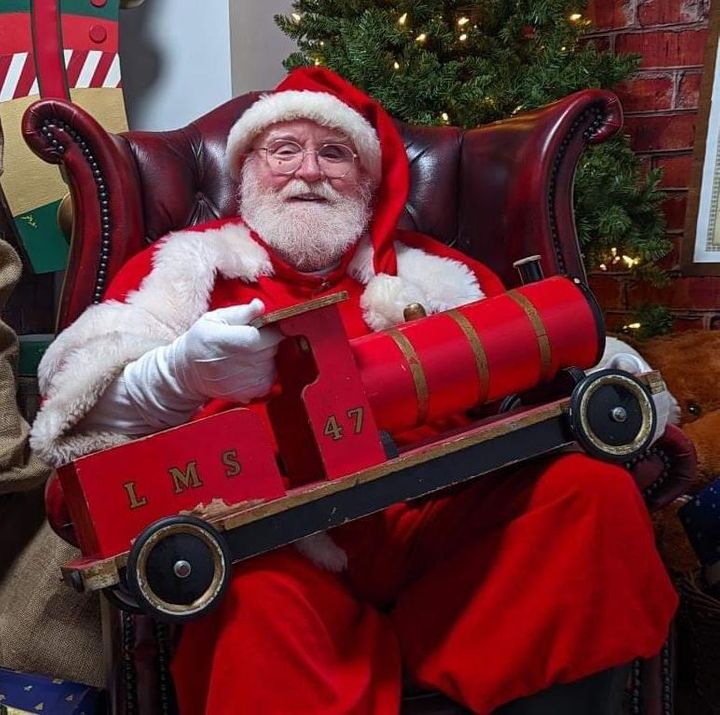
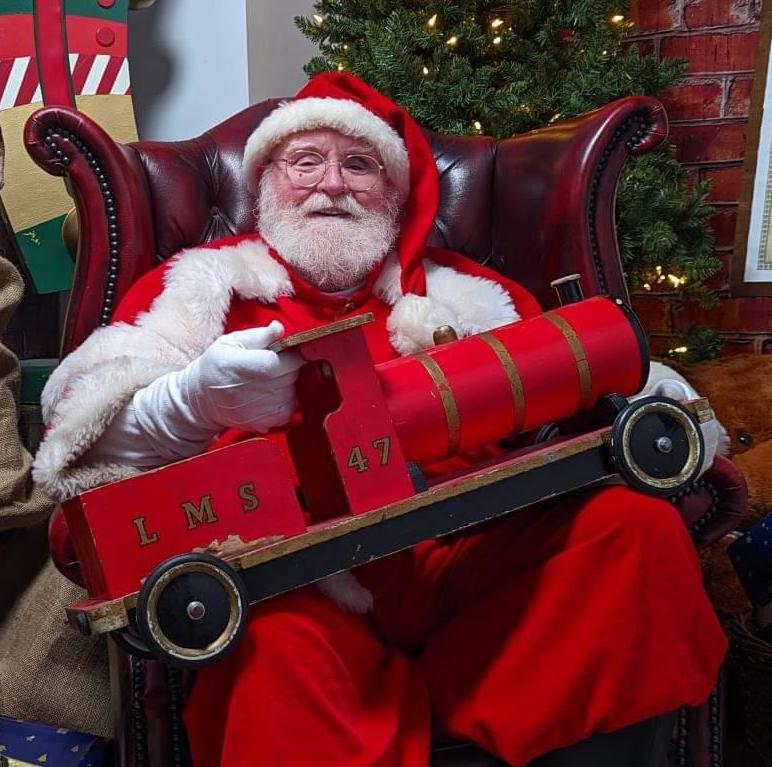
Michael Facherty, who’s 71 and based in Caversham, and has played the role of Father Christmas for nearly 40 years. On December 25th he’ll be having a well-deserved break.
Michael Facherty
“In the run up to Christmas a working Santa has many jobs. Among them is recording videos for clients, this year including a charity pop single, various corporate jobs including parties, and grottos. My favourite this year was being Santa on Hobbs of Henley Santa Cruises. Work with individual families includes Zoom calls and home visits.
Advertisement
“I often have a charity visit on Christmas Day but not this year, so I’ll have a lie in. The day starts with some presents and then I have my special Christmas lunch. My wife and son are vegans, but Matt makes me cottage pie with steak mince as a special treat. I’ll watch the Richard Attenborough version of Miracle on 34th Street at some point during the day. Boxing Day is my favourite day, because our grandchildren visit us.”
‘My British friends are now family.’
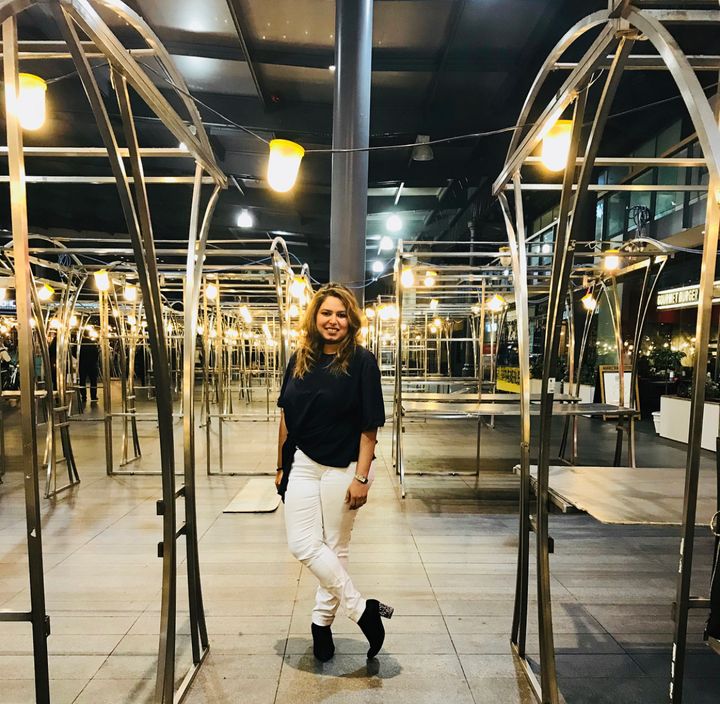
Nishtha Goel, the founder of sustainable brand Unnaaty, is 32 and based in London. She’ll be spending her fourth Christmas in the UK with friends, who she calls her “chosen family”.
Nishtha Goel
“I am from India and have been living in the UK since 2018. I don’t have any family here, but have found a friend who is my chosen family and since 2019 it is has become a tradition that I spend Christmas at her place, with a few other friends. What could have been a lonely day is not, because my British friends are now family.
“I am a vegetarian so, while my friends enjoy turkey, they are thoughtful enough to cook a separate vegetarian meal for me, which includes vegetarian stuffing, peas, carrots, Brussel sprouts, to name a few things. I enjoy every bit of the traditional Christmas dinner, it is such a beautiful way of bringing families together.
Advertisement
“My favourite part of the day is late evening, when we play silly board/card games and just have a relaxed time with each other, full of smiles and laughter.”
‘It is my favourite park run of the year.’
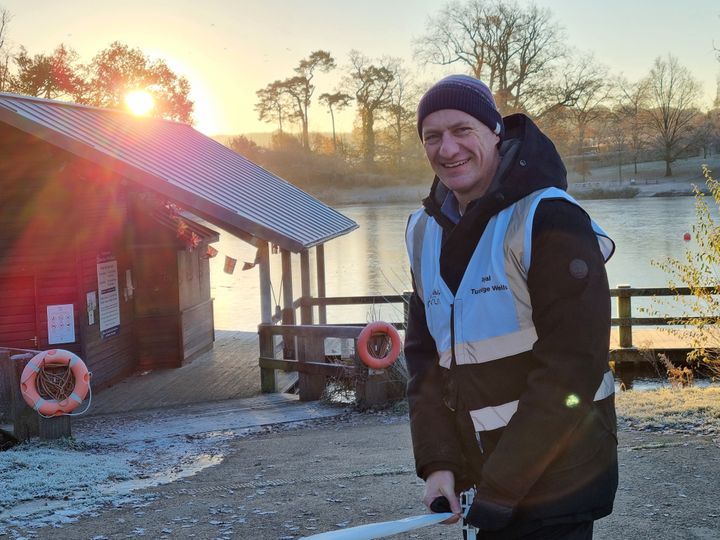
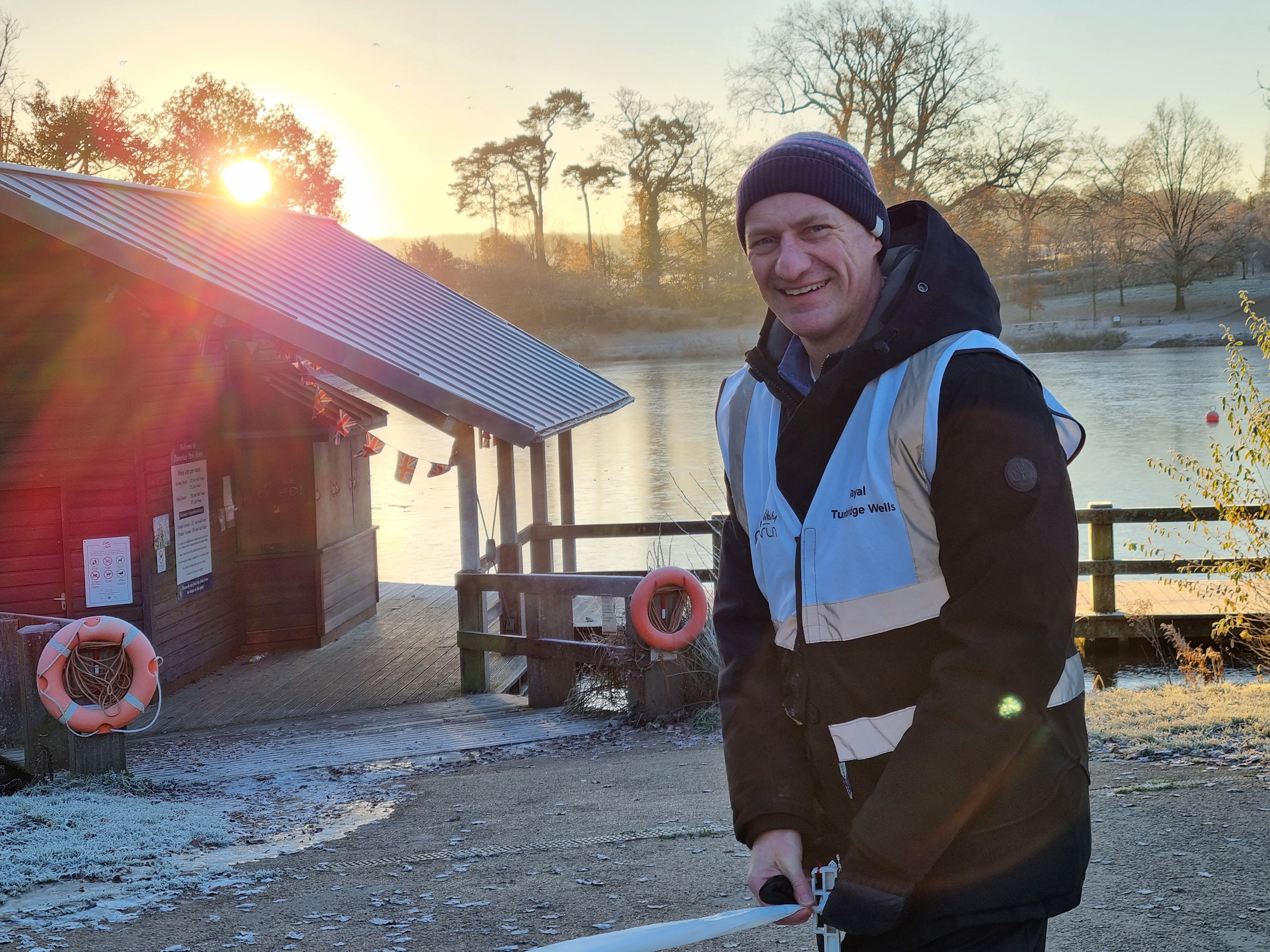
Robin Barwick, aged 50, is the event director Royal Tunbridge Wells parkrun. On Christmas day he’ll be helping 200-300 runners start the day in high spirits.
Robin Barwick
“I will be run director at RTW parkrun this Christmas morning, for what has become one of our best attended fixtures. It is my favourite parkrun of the year. Between 200 and 300 runners and walkers are likely to show up for our 9am start, along with around 35 volunteers.
“Christmas morning parkruns have a special atmosphere. Many come in festive fancy dress, with anything from reindeer headbands, elf costumes, the full Father Christmas outfit or maybe a Christmas tree disguise.
Advertisement
“Runners can take the 5k run competitively if they want to but on Christmas Day most people treat it as an opportunity to get some fresh air and exercise with friends and family without worrying about their finish time. It is a very social occasion and as our cafe in Dunorlan Park will be closed many will bring their own refreshments to enjoy after their run. They are not always alcohol-free.”
‘I’ll sleep the whole way through Christmas day’
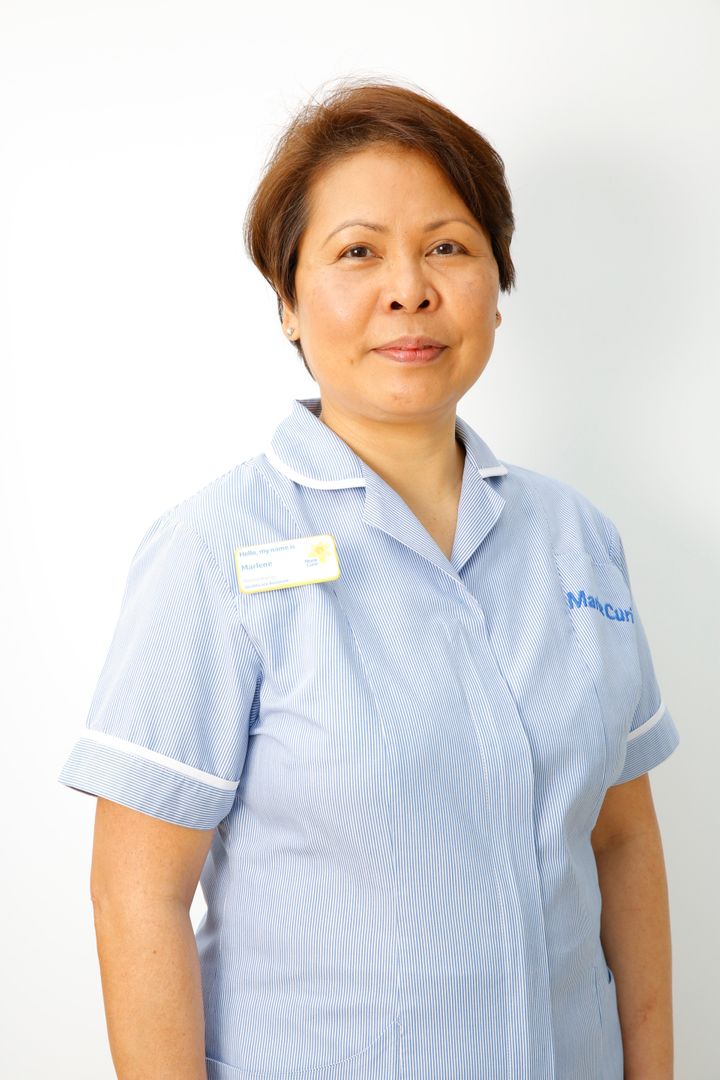
Marlene Bayuga, 59, lives in Morden, Surrey and works as a Marie Curie healthcare assistant in the community covering Southwest London and sometimes Kent.
Marie Curie
Healthcare assistant Marlene Bayuga.
“This Christmas I will be working throughout the night from 10pm until 7am. On Christmas day I will sleep during the daytime, and I will go for Christmas supper at my brother’s house, where we have roast turkey with all the trimmings. Then I will leave at 9pm to go to work and I will bring a mince pie and some Christmas pudding with me!
“When I arrive to my patients’ house I greet them with Christmas greetings and reassure their family that their loved one will be cared for, monitored, and supported during the night so that they can have a restful sleep. It can reassure them to know that someone is there with their loved one, so they won’t be alone overnight.
Advertisement
“I work during Christmas because someone in the community will always need my care at the end of their life, and because everyone deserves to have a good end of life experiences, both patients and their families. My family completely support and understand this. I know I’m there to give light during what can be a really difficult time for them.”
‘We go to church to celebrate Jesus’ birthday’
Nicole Bateman, 34 from Bournemouth, is a mum of two, author and owner of A Box Full of Joy. She’ll be celebrating Christmas by attending church and spending time with her family.
Nicole Bateman
“We start the day with the kids coming into our bed to open their stockings, then we have gammon and eggs with orange juice for breakfast and then open our presents under the Christmas tree.
“We then go to our church to celebrate Jesus’ birthday and then head over to grandparents for Christmas lunch, then a walk after that.
Advertisement
“I have a daughter who is three and a son who is six, and my son has epilepsy. He was diagnosed in July 2020 and has yet to find a medication to control his seizures. Last Christmas, he had five seizures over the four-day period, so by keeping to familiar things (like waking up at our house and going to our church like we do on a normal Sunday) it keeps some routine and stability to the day, which hopefully limits seizures.
“Christmas time can sometimes cause sensory overload and seizures for our boy, so we have to get the balance between too exciting (excitement is one of his seizure triggers) but then still making it a fun day.”
‘I’m solo cat-sitting – and I can’t wait’
Charlotte Lingard, who’s 34 and based in Kent, is looking forward to spending Christmas with some feline friends.
Charlotte Lingard
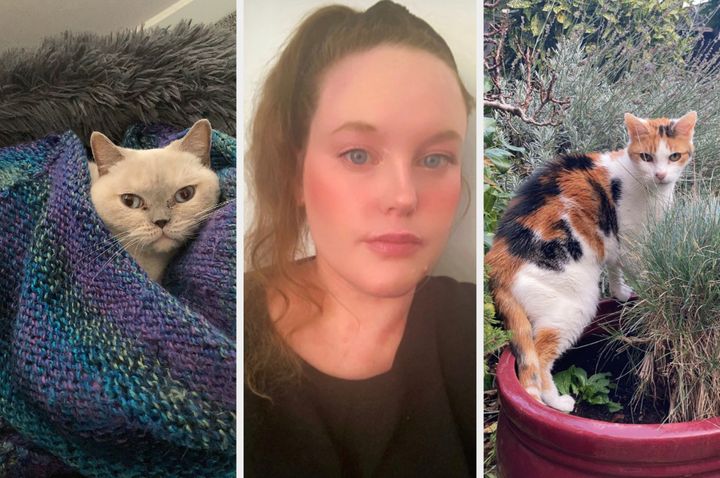
Charlotte Lingard and two of the cats she’s looked after this year.
“I will be cat-sitting a cat called Lola in Blackheath over Christmas for a couple who are abroad for the Christmas holidays.
Advertisement
“I plan to spend my day eating all the festive party foods I enjoy, cuddling Lola and making sure she is spoiled; also exploring Blackheath and Greenwich, as it is not an area of London I am familiar with, but I have heard a lot of nice things about it.
“I have been doing cat-sitting on and off for nearly a year now. It started when my flat did not allow pets, and I was missing feline company whilst working remotely. I use two websites to find and apply for cat sits, I have had five star reviews so far.
“I am completely happy in my own company, so I am looking forward to it!”
‘I swim then cook the kids’ favourite: Chicken Kyiv’
Sue Bordley, who’s 51 and from the Wirral, writes swimming-related books and will be heading the pool for her daily dip on Christmas morning.
Sue Bordley
“On Christmas Day, I’ll get up at about 7.15 am and have a quick coffee before heading to the pool, which opens at 8am that day. It’s always nice to have a chat to Julie, Paula and Harry, my fellow die-hard swimmers who are there every morning.
Advertisement
“I’ll swim for an hour. Swimming got me over a breakdown six years ago. It’s my release, my lifeline – why on earth would I not want to have that on the day that’s supposed to be the best of the year?
“After my hour’s swim and a lovely relaxation boost in the hot tubs, I go home to spend the day with my husband Mark (48) and sons, Jack and Olly (15 and 12).
“While the boys play their new computer games, I prepare a (reasonably) traditional Christmas meal: I make the usual roast potatoes and vegetables, but we don’t have turkey, choosing roast pork instead and the boys are allowed to have their favourite Chicken Kyiv. At Christmas, everyone should have what they like – and it’s only one more dish to wash.”
‘I’m setting my own solo Christmas traditions’
Patience M. Chigodora, a 30-year-old spiritual life coach from Nottingham, is using Christmas to have some me-time.
Advertisement
“This year I’m doing things differently. My Christmas isn’t about being with family and friends; it’s about me. I actually want to rest, recover and feel replenished in the New Year which honestly last year I didn’t after spending a lot of my time travelling around the UK to be with family and friends.
“I am planning a few days filled with candle-lit baths, PJs, feasting on all my favourite Zimbabwean and English infused dishes paired with my fave red wine of course. Binging on my favourite Christmas movies and series (like How to Ruin Christmas series on Netflix), I might pop to the cinema to watch the new Avatar movie, go on walks and I’m allowing freedom for spontaneity and going with the flow.
“It’s really important to me this year that I celebrate Christmas how I want to – not how I am expected to. I will be seeing family and friends here and there, focusing on quality time rather than quantity, but 80% of the period, including New Year, will be spent basking within my inner-verse.”
‘We Zoom our families and celebrate online’
Viva O’Flynn, who’s 40 and based in Gloucester, enjoys spending a cosy Christmas at home with her husband, John. They’ll spend the afternoon on Zoom, celebrating with family abroad.
Viva O’Flynn
Viva O’Flynn and her husband, John.
Advertisement
“Christmas Day starts with me waking up next to my husband, John. He cooks brunch for us, eggs florentine or eggs Benedict with salmon. Then, we head to our Christmas tree to open presents. I open each gift with a kiss, a ‘thank you’ and ‘I love you’. He does the same.
“It’s just the two of us celebrating Christmas in person, because his family are in Ireland, mine are in the Philippines. We log into Zoom and say our Christmas greetings to them, and we play some games with them online. Some of my cousins even sing Christmas tunes.
“There is nothing like being with family to celebrate in person: hugging them, kissing them on the cheek, holding their hands, eating meals with them. But it is the pandemic and flu season, and flights back home are doubly expensive. We’ll wait until after the holidays to reunite with them in person. The next best thing is seeing them, hearing their voices, and celebrating Christmas with them virtually.”
There’s no doubt that the festive season can be a stressful time, amid all the travel plans, family visits and present shopping.
These activities often involve an array of demands that take a toll on your mental health, such as cleaning, cooking and spending. So it’s totally OK to experience stress or anxiety among the festivities; even mental health professionals – who may seem like they have it all together – aren’t immune to these feelings.
Advertisement
HuffPost asked therapists for insight on how they feel joy and cheer amid the stress of the season. Here are their personal tips for decompressing and relaxing:
They set aside time for themselves
The festive season can be a busy time, especially if you are surrounded by friends and family. It’s normal to feel stressed and anxious about meeting up with people or hanging with relatives.
“I always make sure I set aside some time for myself to relax during the holidays and focus on my wellness needs,” says Michael Klinkner, a licensed clinical social worker in Arizona.
They scribble a few thoughts in a journal
Minerva Guerrero, a therapist who founded Mind Matters Mental Health Counseling in New York, says she often takes a journaling break to intentionally ground herself.
Advertisement
“I like to journal to get clear on what I’m hoping the holidays bring me and how I feel during this time,” she says. “This self-care activity really helps me destress and relax during the holiday season.”
They listen to music
Music therapy can evoke feelings of calmness and relaxation.
“I often create soothing and hype-me-up playlists, which help me move through my feelings,” says Naiylah Warren, a therapist and clinical content manager with mental health platform Real.
They focus on holiday events that give them joy
During one of the busiest times of the year, it’s important to set boundaries to take care of your mental health and wellbeing.
“I generally check in with myself in regards to what traditions or gatherings feel stressful to me and which ones bring me joy,” says Kama Hurley, a clinical counsellor and life coach in Idaho. “I prioritise what I love to do and say no to the things that make me feel anxious.”
LordHenriVoton via Getty Images
Even therapists need some coping strategies to get through the holidays.
Advertisement
They make a self-care list
Hurley says she writes a self-care list when she’s anxious or stressed, as it gives her agency and lifts her mood.
“I write down activities that help me relax and make me feel good about myself that I can accomplish when feeling the intense emotions,” she says.
Having a go-to list that you can reference and change will help you identify which activities are sources of joy.
Madeline Lucas, another therapist and clinical content manager at Real, shared some self-care activities that help her feel less isolated in her holiday stress: taking long showers with music, applying sheet face masks, going on walks and stretching.
They sit in stillness for a few minutes
The art of meditation can be powerful in achieving a sense of calm and balance.
“I practise meditation exercises for a few minutes whenever I feel stressed,” says Regine Muradian, a clinical psychologist in California. When you feel that stress starting to creep up on you, take a moment to inhale deeply and focus on your breathing.
Advertisement
They plan ahead
Israa Nasir, a therapist who founded the mental wellness brand Well.Guide, said she plans ahead for the festive season, which helps her destress. “I make sure to take care of any client and associated work-related obligations fully when I take time off during the holidays,” she says.
Planning a schedule before you get too busy may feel comforting as it offers a sense of routine, with many decisions already made in advance.
They talk to their therapist
Many mental health professionals get help from therapists of their own to manage stress. If you feel that stress is inhibiting your ability to get through the day, consider connecting with a mental health professional now.
“If I anticipate a lot of stress prior to the holiday season, I’ll schedule a few extra sessions with my own therapist before they go on their holiday break to help process the feelings I’m having,” Nasir says.