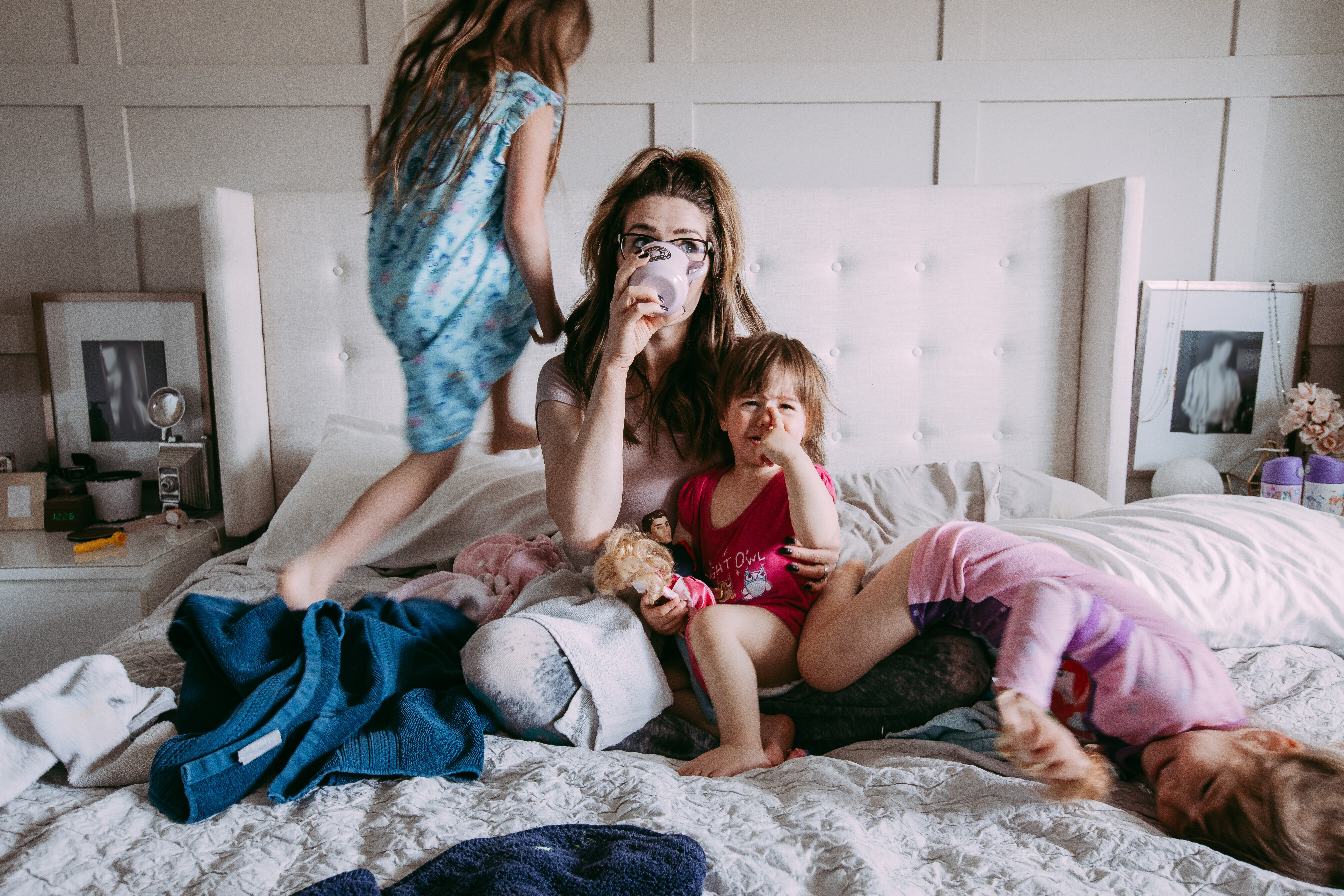
Life with toddlers is a real rollercoaster – one moment they’re telling you they love you, the next they’re mooing at you as you step out of the shower.
Fast forward two hours and they’re prostrate on the floor, screaming at you because you wouldn’t let them lick your shoe.
Advertisement
While they can be pretty harsh sometimes – and totally unreasonable – their brutal honesty and innocent outlook on life often brings plenty of laughs to the table, too.
These tweets sum up just how chaotic life can be with young children – and while we do love a moan as parents, we also know we wouldn’t have it any other way.
1. Where did you hide the poo?!
I know there’s the famous sad story in three words, but I just heard a horror story from my toddler in six: “I pooped in a SECRET way!!!”
3. Today in questions you never thought you’d ask yourself: Why is there a car under my back?
Our toddler, while extremely cute, is a trash sleeper. He’s just not great at it. So he started sleeping with race cars to help him feel better. And the current car of choice is a large one that ends up under my back when he climbs into our bed. So now I need a new spine 😩
5. This parent was probably quite relieved they didn’t get to see their toddler’s carol concert IRL.
Was sent a recording of my toddlers carol concert (no space in her nursery for parents to come and watch) and it’s literally the best thing ever- just a bunch of 3/4 year olds screaming FELIZ NAVIDAD like maniacs with no effort to make it sound like a song. 10/10
9. Twinkle Twinkle Little Star. But with the word penis.
Instead of sleeping, my toddler is singing “penis penis penis” to the tune of twinkle twinkle little star and I have no joke to add to this, it’s just happening
10. This two-year-old ran the dishwasher undetected and empty for an entire hour.
Was watching tv, realized the dishwasher was on even though Id emptied it. Asked my husband why he ran it. He didn’t. THE TWO YEAR OLD RAN THE DISHWASHER UNDETECTED AND EMPTY for an entire hour. He’d been asking if he could run it for weeks. Guess he just saw his opportunity?
Does anyone else’s toddler just randomly do the Naruto run even tho they’ve never seen Naruto?? The parenting books don’t mention how to handle this?? Is Naruto endemic to toddlers?? Do they show it in the womb? Is my son Naruto??
16. Who doesn’t love getting sick 17 times a month?
17. This toddler requested their pear is cut into rectangles and nobody has time for this.
My toddler recently learned all about shapes and has started requesting that I cut his pear into rectangle slices so I guess this is the beginning of the end for me
21. WFH and looking after toddlers is a real hoot (said no one ever).
Shoutout to all parents who are trying to reply to emails this morning while on a Zoom call, while holding infant/toddlers who are sick with non-COVID fevers. You are not alone. #parenting#WorkinProgress
If you enjoy catering to the whims of someone who is illogical, insistent, and mostly incomprehensible, parenting a toddler is the perfect gig.
— Jess Hernandez BUY 1ST DAY OF UNICORN SCHOOL (@jhernandezbooks) December 11, 2022
Advertisement
23. Two going on… 42?
These toddlers are built differently with this gentle parenting. Today mine asked me asked if I could hand him a toy he couldn’t reach from car seat. I told him “I can’t rn, I’m driving”. He stared straight at me & calmly said “but you are at a red light”…… pic.twitter.com/oFZy0ZLDnF
It’s hilarious what toddlers bring home from daycare (when it’s not the latest respiratory virus.) Our little one’s new catch phrase is, “para! no me guuuuusta” which he yells full voice while thrusting out his hand in a stop ✋ sign directly in your face.
25. But then in the next breath they can be stone cold.
My toddler ran across the room to me with her arms open, and at the last second stopped herself, shook her head and said “no” and walked back to her dad. Toddlers are cold. 😭😭
26. This toddler is going places. (Mainly the steakhouse next door.)
While leaving the grocery store, my toddler smelled food from the steakhouse next door and said, ‘that smells like it needs to be in my mouth.’ Who am I to argue with logic like that?
Name two words parents dread more than sleep regression… we’ll wait.
We often hear about them in Whatsapp groups (why is my baby suddenly not sleeping?! Send coffee!), or in books about child development, with most agreeing the first sleep regression happens around the age of four months. Then eight months. Then 18 months and finally, two years.
But for lots of parents, it can feel like every week you’re starting a new sleep regression with a baby. And even when they’re toddlers, you’ll get the odd night where they sleep through in their cot (and you’ll pop some Prosecco in the morning to celebrate), but you’ll also get lots of occasions where they’ll wake up, end up in your bed, pull your hair, grab your lips and shout “DADDY!” approximately 59 times at 3.30am.
Advertisement
So what are sleep regressions – and why oh why does it feel like you’re constantly in one?
It turns out most sleep specialists don’t really consider sleep regression a thing, per se – the concept is not really used in scientific or medical contexts when discussing child sleep. That said, sleep specialists do recognise that lots of parents are aware of them.
“The only ‘regression’ with any science behind it, that I recognise, is the one that happens around four months old when babies’ sleep cycles actually change and become more like adult sleep,” says Emily Houltram, founder of The Sleep Chief. “But even that one divides professionals!”
Explaining what a sleep regression is, Lauren Peacock, a sleep consultant at Little Sleep Stars, says that “it generally refers to a sudden perceived deterioration in a child’s sleep pattern, typically characterised by difficulty settling at sleep onset and/or night-waking that is happening more frequently and possibly for an increased duration”.
Sleep isn’t linear, she explains, and like all other aspects of development, it matures over time with a noticeable change occurring in the first six months. “Once this change occurs, periodic night-waking becomes a normal part of the sleep pattern,” she says.
Advertisement
Then, whenever children hit a significant stage of their development – so that could be crawling, walking, talking, starting childcare, becoming a sibling, getting sick or teething (the list goes on), there is potential for their sleep to be impacted. Again, and again, and again.
Peacock suggests the term ‘regression’ is actually very misleading because none of these events occur as a result of a child going backwards – “they are only ever moving forwards,” she adds.
But for parents who aren’t sleeping that well, it can definitely seem like a step backwards compared to those halcyon days of newborn sleep when you could ease them gently back into slumber with a mere cuddle and a bit of milk.
Most babies will be impacted by a disruption to sleep at some point in their first few years, but some will be less impacted than others.
“All babies experience changes to their sleep pattern and many will go through phases where sleep feels more challenging,” says Peacock. “Some little ones do have a trickier relationship with sleep than others and so whilst some children will experience more frequent and persistent sleep disruption, others will navigate through these inevitable ups and downs much more smoothly.”
Advertisement
If you’re very much in the camp of surviving the day on four hours’ sleep and feeling like you might never get a good night’s kip ever again, we have some good news – and some bad news.
The good news is that this won’t last forever. When they’re teenagers they’ll be sleeping for lengthy stretches to the point where you’ll probably worry they’re sleeping too much.
The bad news is that even as your baby becomes a toddler, and then a young child, there’ll probably be a few bumps in the road as far as their sleep is concerned. (Like we said: basically one big sleep regression.)
Signs your baby might be entering a so-called sleep regression include:
:: Becoming more difficult to settle at bed or nap time
:: Waking more frequently than was previously typical
:: Waking in the night and then staying awake for a long period – something sleep experts refer to as a “split-night”
:: Waking up a lot earlier.
Vera Livchak via Getty Images
Advertisement
There is a popular narrative around sleep regressions occurring at specific ages: so typically we hear four months, eight months, 18 months and two years as inevitable points that sleep will deteriorate, says Peacock.
“However, some families will feel that their child never experiences a ‘regression’, whereas others will feel that they are hit hard by every single one – with some extra ones thrown in for good measure,” she says.
“There are ages that it is more common to see sleep challenges crop up, and they do tend to coincide with children making big developmental shifts which are more common in the baby and toddler phases, but even older children can hit bumps with their sleep.”
If you are struggling right now, infant sleep expert Katie Palmer, from Infant Sleep Consultants, suggests maintaining good sleep hygiene to get your child into the best position possible to navigate the next few months (and years, if you’re really lucky) of sleep disruption.
“This involves a good routine in the day, well-timed naps, a good bedtime routine and allowing your child to self settle,” she says. “They will always find this easier at the onset of sleep but if you know they can do it at the start of the night, there is no reason why they can’t for the rest of the night.”
Advertisement
The sleep specialist adds that if a child is going through a developmental leap, they may be more unsettled when it comes to drifting off – and if you’re finding this, you can help them by keeping familiar routines and boundaries in place.
Of course, there are certain points where a parent might think: is there something drastically wrong with my child because they literally do not sleep? And if you’re feeling that, it’s definitely worth speaking to a sleep specialist about it – or at the very least your GP.
“There are ages that it is more common to see sleep challenges crop up, and they do tend to coincide with children making big developmental shifts which are more common in the baby and toddler phases, but even older children can hit bumps with their sleep.”
– Lauren Peacock
If a child’s sleep is good enough most of the time – both in terms of quality and quantity – then sometimes just knowing that more challenging periods are biologically normal, and will pass, is all the reassurance parents need, says Peacock.
“All children will, sooner or later, reach the stage of sleeping through the night,” she adds.
But if a child isn’t managing well with the sleep they are getting – for example, if they are regularly tired and irritable throughout the day, or it’s taking hours to settle them at bedtime every night – that’s indicative of a more pervasive challenge with sleep rather than a short-term ‘regression’, she explains.
Advertisement
“Sometimes these challenges are underpinned by physiological aspects such as digestive discomfort or daytime naps not being optimal,” she says. “Other times, the patterns of behaviour that have developed around sleep aren’t helping a child to sleep well.
“The question really is whether things are working well enough, most of the time. If the answer to that is no, there are lots of ways that children can be supported towards better sleep.”
An estimated 6.5 million people in the United States have endometriosis, a painful condition in which the uterine lining spreads and grows outside of the uterus. But that statistic likely vastly underestimates the prevalence of endometriosis because it’s notoriously difficult to diagnose.
Many of the symptoms ― which range from painful, heavy periods and painful sex to gastrointestinal issues and intense fatigue ― are associated with other reproductive health problems, including ovarian cysts and pelvic inflammatory disease. In addition, the pain associated with endometriosis is often dismissed by doctors as normal period cramps.
Advertisement
The only surefire way to diagnose endometriosis is to get a laparoscopy, a tiny surgical procedure that can identify the size and location of endometriosis. But that’s typically not the first test doctors recommend. Consequently, it can take years of inconclusive tests and misdiagnoses before the condition is properly diagnosed. In fact, endometriosis is so commonly misdiagnosed that the condition has picked up the nickname “the missed disease.”
Below, women diagnosed with endometriosis share what it physically feels like to live with the condition. They hope that their stories will encourage others experiencing symptoms to seek care and advocate for an accurate, timely diagnosis.
Extremely painful, heavy periods
Jaime Henson, a nurse practitioner who was diagnosed with endometriosis at age 32, says her symptoms started when she was 14 – 18 years before she got an official diagnosis.
As a teenager, she had extremely painful and irregular periods. At one point, her period lasted over a month. “I did not want to go out and do things because of the pain and nausea,” Henson says.
Advertisement
Blaine Mallory, a woman diagnosed with endometriosis, said she lost a ton of blood over the course of seven to eight days when she had her period. While menstruating, she experienced extreme cramping and dizziness.
“It was an iron deficiency brought on by my period,” Mallory said. Like Henson, Mallory’s period pain intensified over the years and became localised to her left ovary, which she later learned was covered in endometriosis.
People are often told that period pain is a normal part of menstruation, which causes many who experience intense or severe pelvic pain to believe that it’s just part of having a uterus. While it’s common to have some mild discomfort during menstruation, severe pain that impacts your quality of life or ability to function is not normal.
“I did not know any different and how it was ‘abnormal,’” Henson says.
martin-dm via Getty Images
Intense periods and cramping are hallmark symptoms of endometriosis.
Pelvic pain during ovulation
Eventually, Henson’s pain increased and remained a problem throughout the month, not only while she had her period.
Advertisement
“I had extreme pelvic pain to the point where I could not stand up straight and would have to walk hunched over,” Henson says.
Kylie Meyer, a 33-year-old who recently had a hysterectomy to treat her stage 4 endometriosis, said her pain also initially flared up during her period, but got worse and occurred when she was ovulating, too. The pain, which she describes as crampy, was typically localised to one side of her body, rotating between the left ovary and the right ovary each month.
“There’d be times I would be shopping and would have to put my hand, essentially, into my pelvis to try to put pressure on the pain just to get through the store,” Meyer says.
Urinary and gastrointestinal issues
Henson says she sporadically noticed there was blood in her urine and often felt like she had a urinary tract infection ― but when she got tested for a UTI, the test results were normal. Additionally, she developed deep rectal pain. Despite undergoing multiple tests, her gastrointestinal specialist couldn’t identify the root of the problem.
Meyer also developed gastrointestinal issues. “I started getting bloating to the point that my stomach was distended,” she says. The bloating became so severe that her skin ached from being so stretched out.
Advertisement
Natalia Gdovskaia via Getty Images
Difficulty getting pregnant or infertility can be a side effect of endometriosis.
Struggling with unexplained infertility
Sheila Petersen, a woman diagnosed with endometriosis at age 34, began trying to get pregnant at 30. After multiple unsuccessful attempts, she was diagnosed with “unexplained infertility.”
She underwent multiple rounds of intrauterine insemination and in vitro fertilization, but still did not get pregnant. When she was finally diagnosed with endometriosis, she understood what had been preventing her from conceiving. Estimates suggest that around 47% of women experiencing infertility have endometriosis.
“I can’t help but wonder if it was caught when I was younger if our fertility journey would have been easier,” Petersen says.
Chronic, intense fatigue
One of the more debilitating symptoms Meyer deals with is fatigue that limits her ability to go out and live her life. Because endometriosis is an inflammatory disease, the body is constantly working to fight off the inflammation. Meyer learned that she has to carve out a few days each month to rest, otherwise her body will get too run down.
Advertisement
“It is exhausting. I can’t do things that I used to be able to do,” she says.
Meyer hopes that by sharing her symptoms, she can prevent others from going down a similar path.
“If I had gotten diagnosed earlier, it probably wouldn’t have gotten to severe stage 4 with frozen pelvis – and who knows if my uterus could have been saved if had I been diagnosed earlier,” Meyer says.
If you’ve been making eyes at your co-worker all year, the office Christmas party can represent the perfect opportunity to shoot your shot. But you do, inevitably, need to proceed with caution. Nobody wants to be that person pulled in to see HR on Monday morning.
Still, a snog by the cloakroom can lead to far more than water cooler gossip. Below, we chat to two couples who hooked up at the Christmas party and found longterm love.
Advertisement
If these stories get turned into a Netflix romcom next year, you read them here first.
“He said ‘I have to get my anorak’ and I was like ‘Oh god.’”
Zoe Burke, 31, met her partner, Simon, 45, when they both worked for a media publishing company. Zoe worked in editorial while Simon worked in IT. They had their first snog six years ago at the Christmas party in London’s Cafe De Paris and now live together in Whitton, Twickenham, with their daughter. Zoe, who is editor at wedding website Hitched.co.uk, tells their story.
Zoe and Simon, whose chemistry became a running joke in their office.
“We had chemistry from the first moment we met – although I was seeing someone else so nothing happened. Also he was so comically the opposite of my usual type – I tended to go for creatives who were always skint but were free spirits. He was a single dad of two who oversaw IT operations for a huge company and was 14 years older than me.
“It was a running joke in our office because it was so ridiculous, but we got on SO well. By summer I was single and dating but nothing really happened until we got into the Christmas period and the Xmas party was looming and our flirting ramped up a bit.
Advertisement
“I have never put so much effort into getting ready for a party! And I didn’t see him all night! I was about to leave and my boss was like ‘he’s at the bar!’ So I went over and it was all very sweet and innocent – there was no kissing, nothing like that, he put an arm around me but that was it.
“I remember when we left we did it separately and he said ‘I have to get my anorak’ and I was like ‘oh god’. But then we met round the corner, kissed for the first time and have been together ever since!
“Me and ‘the IT guy’ is still a running joke at work, but I don’t mind so much as it’s now been six years, and we have a daughter together now too. While I might be all about weddings in my working life, we have no plans to get hitched ourselves any time soon ― even though it comes up in conversation a LOT!”
‘We did keep it a secret in the office for a month.’
Tom Bourlet, 35, and his financée Raquel, 33, recently got engaged surrounded by 32 dogs at the Golden Retriever Experience (yes, we’re jealous too). The couple, who are based in Burgess Hill, work for the party planning company Fizzbox, so they know a thing or two about hosting a good knees-up. Still, their Christmas party was more memorable than most. Tom tells their story.
Tom Bourlet
Tom Bourlet and his financée Raquel
Advertisement
“We worked together for around a year before the Fizzbox Christmas party; she worked in the finance department and I worked in marketing. I used to get Degustabox deliveries [a food subscription service] to the office, and would offer around the snacks to people in the office slowly making my way over to Raquel, before using it as an excuse to have a chat with her. We also went on a work trip to Bournemouth, where we instantly bonded, sitting next to each other on the coach over.
“We mentioned much later that we both secretly fancied each other, but tried ‘playing it cool’, but the Christmas party was the point in which we got to sit next to each other with some prosecco and the rest was history.
“I think there is always a worry the next day if alcohol has been involved. I worry if I said something stupid, whether I came across well and whether she was actually interested in me or whether that was the booze talking. It was also on a Friday, so we didn’t see each other until the Monday, so [there were] a few nervy days where we sent the occasional message to each other, but nothing in-depth.
“Fortunately, as soon as I saw her on Monday, we were joking around like normal, so all awkwardness was gone away, and we then arranged to go for some drinks that evening.
“We did keep it a secret in the office for a month, however one of our colleagues saw us in the bar down the road from the office after work. It quickly spread around the office soon after this. I then went up to the CEO to let him know I was dating someone in the office, I was in a managerial role so I wanted to make sure I wasn’t breaking any HR rules at all. He was very understanding and happy for me, pointing out that a number of office relationships had led to marriages.
Advertisement
“It seems funny to think how nervous I was going up to her, trying to think what to say and making silly conversations about our love for Babybels. The office Christmas party certainly helped to get us both out of the office and in a more relaxed environment, so I can thank the party for the amazing relationship I’m in.
“Five and a half years on, I love her more with every day and soon I’ll be able to call her my wife. We also bought our a house together in August, while we got a puppy a month ago, our fur baby!”
Few things are more Christmassy than the smell of pine and fir, which is often the happy result of buying a real Christmas tree. For many, the smell is a true sign of the season. For others, it can be irritating — which is why some people opt for artificial trees as an alternative.
Either way, putting up your festive Christmas tree may tinker with your home’s air quality, according to experts.
Advertisement
Dustin Poppendieck, an environmental engineer in the indoor air quality and ventilation group at the National Institute of Standards and Technology, said that both real and artificial trees can emit chemicals for weeks, a month or even beyond (for artificial trees that are stored in your home all year). And while it’s likely nothing to be overly alarmed about, it’s still worth knowing what’s going down when you’re putting your tree up.
While there isn’t too much research on exactly how much emission both kinds of trees actually create, Poppendieck said there is adjacent research that can inform just what might be happening to our home’s air when these trees are brought inside. Here’s how both real and artificial Christmas trees impact your home’s air:
Real Christmas trees emit a mix of volatile organic compounds.
The pleasant pine scent that your Christmas tree gives off is actually due to a release of a mix of different volatile organic compounds, or VOCs, according to Bryan Cummings, a research scientist in Drexel University’s College of Engineering. Specifically, most of these compounds are known as pinenes and they are what gives the Christmas tree its distinct odour; the same goes for products like pine-scented floor cleaners.
While these side effects may be seen in some people, Cummings does not think VOCs from a Christmas tree will have a large impact on the general public’s health either short-term or long-term when compared to all of the items that release VOCs all throughout the year. But, he added that people who are sensitive to irritants of this nature — like people with asthma or certain allergies — may feel extra irritation when they have a Christmas tree in their home.
With a real Christmas tree, you’re also bringing in potential mould and other outdoor contaminants.
Beyond the chemical reaction a real tree could have on the air in your home, “when you’re bringing a tree, you’re bringing in a microbial community in addition to the tree,” Poppendieck said.
In other words, that tree could be offcasting irritants that could potentially trigger asthma or allergies, he added. These irritants can include mould and pollen, according to IQ Air, an air quality group based in Switzerland.
Additionally, Poppendieck noted that any spills when watering a real tree could lead to mould growth, too. Or, if your tree has mud on it, the mud may have additional irritants that can permeate the air.
As for artificial trees, the plastics used to create them may also impact your home’s air.
While many people with severe allergies turn to fake Christmas trees for their holiday cheer, Cummings said these trees, too, may make a mark on your home’s air quality.
Advertisement
“These artificial trees, they contain plastics and PVCs [polyvinyl chloride], and one of the major plasticisers in these materials are phthalates,” Cummings said. Additionally, he said that artificial trees also contain flame retardants.
When it comes to flame retardants, “some of the compounds might be neurotoxins or carcinogens with long-term exposure,” he said.
And when it comes to phthalates, “those are thought to be mostly endocrine disruptors,” which are chemicals that could interfere with your body’s hormones. “There’s lots of research going on in the indoor air quality community especially around phthalates because they’re one of those forever chemicals,” he added. Forever chemicals are manmade chemicals that don’t break down, and as a result, stick around for hundreds and hundreds of years.
What’s more, while they can evaporate into a home’s air, which means you can breathe them in, they can also stick to your hands or other products, giving them the ability to be ingested further and can even go directly into your bloodstream after skin contact, Cummings noted.
“I say that’s a bigger health concern than potential exposure to pine-scented terpenes,” he said.
Crispin la valiente via Getty Images
The plastics used in artificial Christmas trees can migrate throughout a home and eventually end up in your home’s dust.
Advertisement
All of that said, your artificial tree isn’t the only contributing factor when it comes to plastic contamination.
“I also want to say: How many other plastic products do you bring into your home?” Cummings said. Between plastic water bottles, plastic appliances, plastic toys and plastic decor — the answer is probably a lot.
“Are the artificial trees the major source of this pollution? Probably not,” Cummings said.
Additionally, Poppendieck pointed out that “phthalates are commonly found in house dust” beyond the Christmas season. So, no matter what plastics you’re bringing in, the same pollution pattern is happening.
“We know it’s moving from the plastics in our home to the dust,” Poppendieck said.
If you are someone who is very concerned about phthalates and plastics in general, you should avoid artificial trees, Cummings noted. But, if you have many other plastic items in your home, one Christmas tree is not going to change anything.
This is not a cause for panic. Both experts still have Christmas trees.
While both experts said they limit (or do not use) scented home products like scented detergents, body soap and cleaning items, they both have Christmas trees in their homes.
Advertisement
“There’s an emotional attachment that I grew up with,” Poppendieck said, “I like the smell, I like the ambiance and the psychological value.”
He added that when it comes to any indoor air quality topic, you have to balance the physical health impacts with the psychological impact. If your Christmas tree brings you joy, you should not stop getting one to protect your home’s air quality (unless you are one of the few people who deal with severe respiratory reactions) if your home is full of other air quality risk factors, too.
Both experts added that there are many other things in our homes — other plastic items, scented cleaners, candles and gas stoves — that also impact the air we breathe.
There is not enough research to know exactly how much Christmas trees affect our home’s air quality, but Poppendieck said he would be surprised if Christmas trees were a huge risk and would also be surprised if there was zero risk.
If you want to better your indoor air quality, there are things you can do.
Cummings said you should always follow indoor air quality best practices, whether you are bringing a tree in or taking one out.
Advertisement
“So, things I always like to do — clean with soap and water instead of harsh chemicals whenever possible, limit the use of scented products [and] you can always open a window to clear out some of these indoor pollutants,” he said.
You can also use HEPA filters in your home, which “clear out indoor particles and dust,” Cummings noted.
Poppendieck added if you’re really concerned about emissions from either a real or artificial tree, you can set the tree up outside or in a garage before bringing it into your home. This will help lessen the initial indoor emission. But, this step is probably only necessary for those who’ve had historical reactions to trees, he said. It isn’t necessary for the average person.
Beyond air quality issues, remember real Christmas trees are a fire hazard.
“Whenever we talk about indoor air quality, we need to talk about relative risk and how dangerous is a Christmas tree compared to the other things that we do,” Poppendieck said.
He stressed that real Christmas trees have the potential to burn. It’s crucial that you keep your tree watered and remove it from your house when it dies.
Advertisement
This will help reduce the risk of fire when it comes to your real tree, which, Poppendieck said, far outweighs any indoor air quality issues.
If you’ve ever pulled an all-nighter or spent the night tossing and turning, you know how awful it can feel to be sleep-deprived.
Your body might ache, you may struggle to pay attention and your mood will most likely take a hit. This is because sleep is linked to nearly every important bodily function — it affects our immune system and our appetite, our stress hormones and our metabolism, our blood pressure and our cardiovascular system. Even a single night of poor sleep can trigger a wide range of health effects (which is why you may feel so crummy after that late night out).
Advertisement
Most of us need between seven and eight hours of sleep a night to feel alert and healthy the next day. But for whatever reason, that’s not always possible. In fact, a study recently published in JAMA Network Open found that nearly half of Americans are sleep-deprived on a regular basis.
The best way to combat sleep deprivation is ― well, to sleep. There’s really no quick fix, but there are a handful of tips and tricks that can make the day more bearable. We asked a few sleep specialists to share how they cope when they’re sleep-deprived. Here’s what they said.
Don’t stress about it
This is easier said than done, but it’s helpful not to get fixated on the fact that you’re sleep-deprived.
When Fiona Barwick, the director of the sleep and circadian health program at Stanford Health Care, is low on sleep, she reminds herself not to worry about it because she knows her body will do what it takes to get back on track.
Advertisement
Our sleep drive is a self-correcting system that naturally tries to keep the sleep-wake cycle in balance. “If we don’t sleep well one night, we’ll sleep better the next night. If we worry about it, however, our sleep will be worse,” Barwick said.
Expose yourself to light
Barwick also makes a point to expose herself to some bright light first thing in the morning. Our sleep-wake cycle is heavily dependent on light — daylight sends a signal to our brain that it’s time to get up and be active, while darkness sends the cue that it’s almost time to go to bed.
Exposing yourself to light when you first wake up “suppresses melatonin, which increases alertness and boosts mood,” Barwick said. It’ll also help keep your circadian rhythm in check, which should help you sleep more soundly at night.
Have some caffeine (but not too much)
It might seem obvious, but yes: Coffee helps. This is because caffeine blocks adenosine, a chemical in our body that increases the need for sleep. As a result, caffeine makes us feel less sleepy and improves learning and decision-making if you’re sleep-deprived, according to Dr. Andrey Zinchuk, a sleep medicine doctor with Yale Medicine.
But while it may be tempting to keep refilling your mug, it’s important to be mindful of how much caffeine you consume.
Advertisement
“I don’t have too much caffeine, as I want to avoid the crash that occurs when its alerting effects eventually subside,” Barwick said.
Dr. Wissam Chatila, a pulmonologist at Temple Lung Center and professor of thoracic medicine and surgery at the Lewis Katz School of Medicine at Temple University, advises against having that late-afternoon cup of coffee.
“If taken at the wrong time — e.g. late in evening — then they will interfere with sleep later on,” he said.
FG Trade via Getty Images
A little caffeine can go a long way after a night of poor sleep.
Take a catnap
If you’re able to squeeze in a 30- to 60-minute catnap, go for it. A short nap can improve alertness, sleepiness, memory and exercise capacity.
Advertisement
On the flip side, a lengthier midday snooze can actually impair cognitive function, Chatila said, and potentially make it even harder to complete tasks. Make sure to set an alarm so you don’t overdo it.
“I keep the nap relatively short so that I don’t use up too much sleep drive, as I want to save most of it for the coming night,” Barwick said.
If you’re not a napper, even getting some deep rest can be beneficial, Barwick said. Ten to 30 minutes of yoga nidra, a meditative yoga practice that involves deep relaxation, can help you feel refreshed and more attentive.
Go for a walk
When Barwick can’t nap, she tries to go for a walk outside. Even a 10-minute walk can significantly reduce stress, boost your mood and increase alertness, research shows.
Plus, it can build up your sleep drive, which should help you doze off at night.
“That helps to further ensure I will get better sleep the coming night,” Barwick said.
Know that your body is resilient
Lastly, don’t beat yourself up. Our bodies are incredibly resilient, which is why we’re still able to function even when we’re sleep-deprived. (Think about all you’ve been able to accomplish on those days when you didn’t get enough sleep.)
Advertisement
Don’t assume the day will be a wash just because you didn’t get the sleep you needed, Barwick said. Go easy on yourself, and listen to your body.
“I don’t cut back on what I planned to do, but I also don’t beat myself up if I get less done than I wanted,” she said.
Each new stage of parenthood comes with different joys and stressors. The problems that weigh heavily on a parent when raising a toddler or a teen are much different than the ones they face once their kids are grown up.
We asked therapists what issues parents of adult children most often bring up during their sessions. Below, they reveal the top concerns they hear again and again and offer advice on how to work through them.
Advertisement
1. “I’m concerned about what they’re posting on social media.”
A parent may know it’s unreasonable to expect an adult child to share all the details of their lives with mom or dad. Still, parents worry that their child may be secretly struggling with something while they’re kept in the dark, said Atlanta clinical psychologist Zainab Delawalla.These worries are often based on — or exacerbated by — what parents see on their kids’ social media profiles.
“Parents often try to ‘read between the lines’ and worry about if their kids are drinking too much, socializing too little or prioritizing the ‘wrong things’ all based on what they see their kids posting,” Delawalla said.
“I often advise these parents to think about what they see on social media as the ‘headline’ of a news article: It gives you some information about the content of the article but is rarely the full story.”
NickyLloyd via Getty Images
Here’s what parents say about their adult kids in therapy.
Advertisement
The next step is to have an actual conversation with your kid to gather more information about the potential problem.
“The harder part, of course, is trusting that their kids will give them all of the necessary information,” Delawalla said. “And if they choose not to share a specific aspect of their lives with their parents, that they feel equipped to handle it without the parents’ help.”
2. “What if my kid never finds a partner?”
Some parents of adult children worry when their kid is single passed a certain age. Perhaps their son or daughter wants to be in a relationship but has no serious prospects. Or maybe their kid is quite happily single. In either case, the lack of a long-term partner can be distressing to parents when it feels like everyone else is settling down.
Winifred M. Reilly, a marriage and family therapist in Berkeley, California, often hears comments like these from her clients with adult children: “She’s 33, and the clock is ticking,” “He keeps meeting people who are afraid of commitment,” and “Maybe we weren’t the best role models for marriage. What if it’s our fault?”
“At best, as parents of adult children, we’re in the audience watching a play in which our children have the leading role,” Reilly, author of “It Takes One to Tango,” told HuffPost. “None of us enjoys the helpless feeling of being unable to control things or make things better. Especially when our children are struggling. It’s harder still when we take their difficulties personally.”
Advertisement
“None of us enjoys the helpless feeling of being unable to control things or make things better.”
– Winifred M. Reilly, marriage and family therapist
Reilly’s advice? Take a breath and leave it alone. Repeated questions about the status of their love life will only bug them or make them feel worse than they already do.
3. “Is our relationship too close? Or too distant?”
Navigating the closeness (or lack thereof) of the parent/adult child relationship is a common theme among the clients of Pasadena, California, clinical psychologist Ryan Howes.
“If their child is taking their individuality very seriously and not calling or visiting as much as they would like, the parent is wondering how they can foster more contact,” Howes told HuffPost. “And they may be questioning what they did wrong to make their child want to avoid them.”
He continued: “If their child is failing to launch, is still living at home, or seems dependent on them to make rudimentary decisions, they wonder how they can inspire their children to become their own person and are perhaps questioning what they did wrong to make their child so dependent.”
Advertisement
In either situation, the parent is looking for answers on what the “right” amount of independence or contact is for this stage of life and how to persuade their child to get on board.
Howes explained that there is no universal right or wrong amount of contact — only what works best for a given family’s dynamic.
“Now that their child is an adult, their job is no longer to tell their children what to do, but to have a conversation about it, adult-to-adult,” he said. “They need to start by clarifying what they want and hope for regarding the frequency and depth of contact with their adult children, and then ask their children what they want and hope for, and try to come to an agreement.”
4. “My child is too strict — or too permissive — with their kids.”
For some grandparents, the urge to butt in and voice their opinions on their kid’s parenting style can be hard to tamp down.
“Yep, it is really hard not to say something!” Reilly said. “And that’s exactly what you need to do. This issue is both a parenting and an in-law issue, which makes it extra-high voltage. Parents of young children have to find their way. And they usually find that way by trial and error. Sometimes parents don’t even agree about what’s OK and what’s not for the kids. The last thing you want to do is be taking sides.”
Advertisement
“Supporting them financially, materially and in other ways while they flounder and drift aimlessly is not what love looks like.”
– Kurt Smith, therapist specializing in counseling men
Reilly’s rule of thumb: If your kid asks for parenting advice, offer your two cents. Otherwise, be loving and supportive and keep your opinions to yourself.
5. “I feel like my kid has no direction in life.”
Parents come to Northern California therapist Kurt Smith, who specializes in counseling men, for help when their 20- or 30-something-year-old child doesn’t have consistent employment (even though they’re physically and mentally capable of holding down a job). He walks them through how to set healthy boundaries and helps them acknowledge the role they may have played in the child not being more motivated or independent.
“Supporting them financially, materially, and in other ways, while they flounder and drift aimlessly is not what love looks like,” Smith said. “Instead, it looks like being uncomfortable, child and parents, for however long it takes for the adult child to find their identity and turn that into a direction for their life.”
Also, these adult kids may live with their parents long-term until they’ve found steady employment and some financial stability (or perhaps longer). While this may be a fine — or even preferred — arrangement for some families, it can be a common pain point for others.
Advertisement
“Some recent parents I helped had their 47-year-old son living with them for more than 10 years. He moved back home after his divorce, lost his job, never got another one, and never left,” Smith said. “The biggest issue in these situations is helping the parents redefine what loving an adult child looks like, since most mistake love as still caring for them like they did when the child was an actual child.”
Eventually, these clients could set — and firmly hold — new, healthy expectations for their son. He was able to secure a job and move out on his own.
“He’s been out for a while now and just bought a house,” Smith said. “His parents are thrilled and so proud. He was capable of this the whole time — his parents just needed to get out of the way.”
6. “I worry my kid is making the wrong life decisions.”
Parents often have doubts about their kids’ big life decisions: whether it’s about how they manage their money, what career they pursue, or who they choose to date, Delawalla said.
In these cases, the goal in therapy is to help parents understand that the person best-equipped to make these decisions is the person whose life they impact the most, she said.
Advertisement
“Parents are one step removed from such decisions, and while they may have a different perspective, it is healthier for them to allow their children to have freedom of choice,” Delawalla said. “We discuss how to offer their opinion without imposing their will and not withdrawing their support, whether intentionally or unintentionally if their children’s decisions don’t align with their own.”
7. “I think my kid needs help. When should I intervene?”
This one encompasses several of the abovementioned issues: financial, career, relationship or other stressors can all fall under this umbrella. A parent sees that their child is struggling. Their instinct is to swoop in immediately and bail them out of trouble. While it’s understandable that they want to fix things for their child, this behavior may not be in anyone’s best interest in the long run.
Parents may have the resources, knowledge or experience to remedy the situation. They want to intervene but don’t know when or how to go about it. (And those who don’t have the means to fix things for their kid may feel guilty about it, Howes said).
When dealing with this issue, Howes said he defers to a school philosophy from his kids’ kindergarten days: “We don’t do anything for the kids they can do for themselves.”
“If they can tie their shoes, then the teachers won’t tie them for them,” he said. “If they can clean up after lunch, the teachers won’t clean up after them. This is a solid philosophy. Doing those tasks for them teaches them that 1) the world will take care of the things they don’t want to do, and 2) they aren’t competent, so someone better at the task should take over.”
Advertisement
This applies to young adults, too, Howes said.
“If they are able to figure out a budget, recover from heartbreak, and learn to take care of themselves, then they should have the opportunity to do that, which builds self-confidence and a sense of independence,” he said.
“If they are able to figure out a budget, recover from heartbreak, and learn to take care of themselves, then they should have the opportunity to do that.”
– Ryan Howes, psychologist
Swiftly jumping in to save the day sends the message that the adult child cannot handle the situation on their own and needs Mom or Dad to come to their rescue.
“Of course, there are exceptions” to this, Howes said. “If the adult child truly lacks the ability or resources to manage their own life, then parents and other family members may need to step in. But that is not as frequent as some parents think.”
In therapy, Howes asks the parents to consider why they’re intervening: Is it because their child needs them to? Or is it because they don’t like the uncomfortable feeling of knowing their kid is in a tough spot?
Advertisement
“If it’s about their discomfort,” he said, “then we have some important work to do.”
Families across the UK have been urged to stay vigilant about Strep A symptoms this week, following a series of tragic deaths in children.
A total of 15 children have now died in the UK from Strep A since September, according to the latest figures. This includes 13 children under the age 15 in England and two others in Northern Ireland and Wales, according to data from the UK Health Security Agency (UKHSA).
Advertisement
Streptococcus A (Strep A – also known as Group A Strep or GAS) are a group of bacteria that can cause a wide variety of skin, soft tissue and respiratory tract infections. These include strep throat and impetigo, but the most common illness caused by Strep A is scarlet fever, which is highly infections and has been spreading across the country.
But why are infections so awful this year? And what – if anything – can parents do about it?
Why is Strep A spreading?
Less mixing due to Covid could be part of the reason why hundreds of children are being diagnosed with Strep A-related illnesses this year. When social measures were put in place, the spread of Strep A was contained. Now, children who did not catch Strep A in 2020 or 2021 are being infected.
“It strikes me that as we are seeing with flu at the moment, lack of mixing in kids may have caused a drop in population-wide immunity that could increase transmission, particularly in school age children,” microbiologist Dr Simon Clarke, from the University of Reading, told Sky news.
What are the symptoms?
The best way to protect your kids is to know the symptoms and seek treatment quickly. It’s important to remember that Strep A causes a mild illness in the majority of children that can be easily treated with antibiotics. Symptoms include:
Advertisement
red and white patches in the throat
trouble swallowing
a headache
lower stomach pain
general discomfort, uneasiness, or ill feeling
loss of appetite
nausea
rash
“On darker skin, the rash can be more difficult to detect visually but will have a sandpapery feel,” Duncan Reid, pharmacist at Pharmacy2U told HuffPost UK.
Additionally, the British Islamic Medical Association explained that “the rash is more obvious in the groin/armpit area. Sometimes the flushed cheeks appear as ‘sunburned’ on darker skin with whiteness near the mouth”.
“In children with darker skin tones, the rash could be harder to spot as it may not appear red, but will be darker than normal skin,“ Dr Mabs Chowdhury, president of the British Association of Dermatologists added.
“The rash in all pigment types can have a sandpapery feel. The tongue can appear redder than normal with prominent white spots (sometimes called ‘strawberry tongue’).”
Advertisement
Where are the infections in the country?
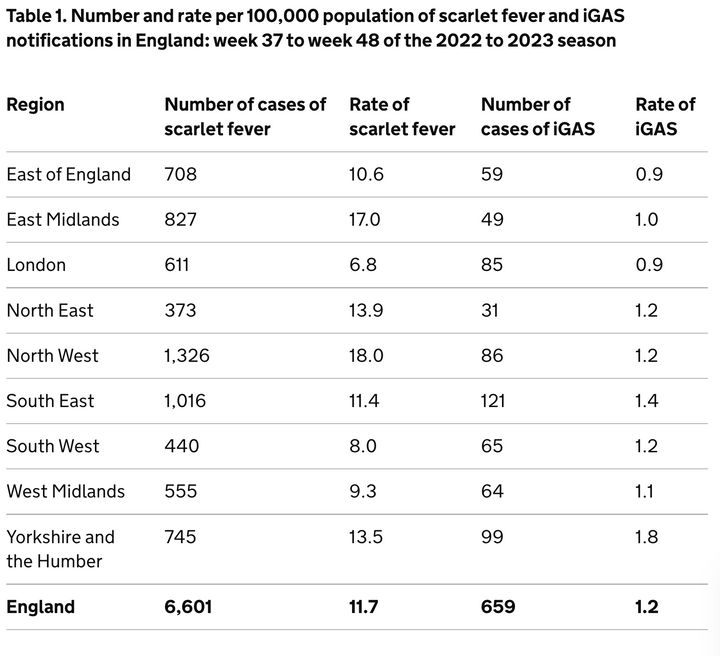
The latest available data shows that in England, there were 1,062 scarlet fever infection notifications received in week 48 (the week commencing November 28).
Currently, there are large concentrations of Strep A and associated scarlet fever cases in multiple parts of the UK, with the North West particularly impacted. The below data also shows incidences of invasive group A streptococcal infection (iGAS) – a rare but serious complication of Strep A, which can be life-threatening.
Number and rate per 100,000 population of scarlet fever and iGAS notifications in England: week 37 to week 48 of the 2022 to 2023 season.
How do parents feel?
Plenty of parents are beside themselves with worry right now as strep A continues to dominate the news. On social media and in private Whatsapp groups there’s been an outpouring of worry from parents, who are understandably on edge in case they miss the signs of illness that could progress to something far worse.
Advertisement
“I’m personally more worried about this than I was when Covid started,” said 35-year-old Emma Hawes from Wigan.
Hawes, who has a 13-year-old and eight-year-old, told HuffPost UK: “I am extremely anxious at the moment. I had no idea what the symptoms were so I’ve obviously been reading as much as I can.”
Diana Wilkinson, 45, has two children of primary school age. She told HuffPost UK: “I’m genuinely so worried about it. Every time I see the news it’s full of warnings of Strep A, and horrifically the number of fatalities is rising.
“Our school has been great at flagging concerns and sending out information about what to look out for, but with several cases already it feels very close to home.”
Is there an antibiotics shortage?
Some pharmacists are warning of a shortage of antibiotics – which hasn’t done much to quell concerns. However, the government has repeatedly denied it.
Advertisement
The National Pharmacy Association explained: “Pharmacies are having to work very hard to obtain stocks of these antibiotics and some lines are temporarily unavailable.
“We have been advised by wholesalers that most lines will be replenished soon, but we cannot say exactly when that will be.”
Leyla Hannabeck, CEO of the Association of Independent Multiple Pharmacies, claimed that authorities going on broadcast rounds saying there is supply is “misleading”.
“I want to reassure the public that pharmacies are doing everything we can to get hold of antibiotics and we are pushing the government to identify where the blockage is,” Hannabeck added.
Health secretary Steve Barclay said there was a “good supply” of penicillin, and that he had been reassured by medical suppliers. However, he said some GPs may experience shortages as stock is moved around to meet demand.
Advertisement
“Now, sometimes, GPs can have particular surges if they’ve got a lot of demand in an area, and that’s quite routine, we can move the stock around our depots,” he told Sky News.
Will schools close?
Currently, the Department for Education (DfE) has not updated its official advice to schools, but it is directing them to guidance from the UK Health Security Agency (UKHSA).
Parents were told to keep their children at home if they suspected that their children had Strep A, in a blog published by Dfe.
Education secretary Gillian Keegan said the department was “working closely” with the UKHSA and “monitoring the situation”, adding that the situation is “worrying”.
One school in Hull temporarily closed for a “deep clean” after several Strep A cases, but at the moment, schools on the whole are not being advised to close.
Advertisement
How do you catch Strep A?
Duncan Reid, pharmacist at Pharmacy2U explained: “Strep A is spread through contact with droplets from an infected person when they talk, cough or sneeze.”
“Some people can have the bacteria present in their body without feeling unwell or showing any symptoms of infections and while they can pass it on, the risk of spread is much greater when a person is unwell. It is still possible to infect others for up to three weeks.”
“Good hand and respiratory hygiene are important to top the spread of Strep A. By teaching your child how to wash their hands properly with soap for at least 20 seconds, using a tissue to catch coughs and sneezes, and keeping away from others when feeling unwell, they will be able to reduce the risk of picking up or spreading infections.”
When should parents contact their GP?
if you suspect your child has scarlet fever
your child is getting worse
your child is feeding or eating much less than normal
your child has had a dry nappy for 12 hours or more or shows other signs of dehydration
your baby is under 3 months and has a temperature of 38°C, or is older than 3 months and has a temperature of 39°C or higher
your baby feels hotter than usual when you touch their back or chest, or feels sweaty
your child is very tired or irritable
your child is having difficulty breathing – you may notice grunting noises or their tummy sucking under their ribs
there are pauses when your child breathes
your child’s skin, tongue or lips are blue
your child is floppy and will not wake up or stay awake.
ADHD is one of the most common neurodevelopmental disorders in children. According to the charity ADHD UK, it’s thought to impact around 3.62% of boys and 0.85% of girls between the ages of five and 15.
As a result, there’s a lot of helpful research and literature to guide parents who find themselves raising a child with ADHD. However, less is written about parents who themselves have ADHD.
Advertisement
The demographic certainly exists. In fact, while some children no longer display signs of ADHD as adults, it’s estimated that 3.5% of adults in the UK experience ADHD. A small study published in 2016 also found that, of 79 children with ADHD, 41% of their mothers and 51% of their fathers also had the disorder.
To shed some light on the experience of parenting with ADHD, HuffPost spoke to experts about the challenges that parents with ADHD face as they raise children while trying to manage their own symptoms.
ADHD is underdiagnosed in parents.
“Parents are absolutely under or misdiagnosed, as are many adults in general, because there’s still this misunderstanding that ADHD is a ‘kid’ disorder,” said Michigan-based psychotherapist and ADHD coach Terry Matlen, who herself is a parent with the disorder.
Although the perception has been shifting, we still have a long way to go in giving parents and other adults better access to evaluations and treatments. A number of factors contribute to this issue.
Advertisement
“Many ADHD symptoms overlap with the common experience of parenting,” said therapist Rachael Bloom, who practices in Los Angeles. “All parents talk about dealing with being distracted, overwhelmed, overstimulated, etc. Parents who in fact do meet the criteria for a clinical diagnosis of ADHD often talk themselves out of seeking a diagnosis by telling themselves that what they’re experiencing is normal.”
“The executive function challenges of ADHD and the tasks of parenting are like a double whammy, a setup for overwhelm.”
– Dr. Lidia Zylowska, author and psychiatrist
Someone who grew up in the ’80s, ’90s or earlier was less likely to get a proper diagnosis when they were a child than kids are today. So over time, parents with undiagnosed ADHD likely learned ways to compensate for their symptoms or make themselves seem more “normal” to others.
“A lot of adults have learned to ‘mask’ their ADHD symptoms and often function ‘well enough’ on the outside to have symptoms overlooked,” said Billy Roberts, a therapist at Focused Mind ADHD Counselling in Columbus, Ohio. “In addition, ADHD is challenging to diagnose in adulthood, especially if someone is seen by a provider who does not specialise in adult ADHD. Commonly occurring mental health conditions such as depression and anxiety can mimic symptoms of ADHD and often a thorough testing process is needed to confirm the diagnosis.”
As a result, it’s quite common for parents to receive an ADHD evaluation after their child is diagnosed, as they often recognise their own struggles in their kid’s experience.
Advertisement
Catherine Ledner via Getty Images
Parents with ADHD often don’t receive a diagnosis until their children are evaluated.
Parents with ADHD may feel like they have to work harder to hold it all together.
“Adults with ADHD can struggle with planning, organisation, prioritising, and focusing in the moment,” Roberts said. “However, for most parents, they find that there isn’t a day that goes by in which they do not need to plan, organise, or problem-solve at a moment’s notice. Consequently, adults with ADHD often feel like they have to work ten times harder to ‘hold it all together,’ as they must compensate for the frustrating parts of ADHD.”
People with ADHD generally have problems with executive function ― the skills related to planning, organisation, time management, decision-making and all the other things it takes to get stuff done.
“As all parents know, having children means managing not just yourself but also your children, often with increased stress or sleep deprivation,” said Dr. Lidia Zylowska, a psychiatrist with the University of Minnesota Medical School and author of “Mindfulness Prescription for Adult ADHD.” “The executive function challenges of ADHD and the tasks of parenting are like a double whammy, a setup for overwhelm.”
Advertisement
In addition to feeling generally underwater, parents with ADHD may feel like they’re unable to pass on organisational skills to their children or teach other lessons.
“Parents tell me, ‘How in the world do I help my child if I can’t help myself?’” Matlen said. “That could include difficulties with their child getting homework done, paying attention in class, etc. The parents suffer the same problems but in a different setting. For example, a mom with ADHD may forget to sign her child’s permission slip for a field trip, while her child may forget to hand in homework.”
They may struggle with emotional regulation.
“The biggest challenge parents with ADHD face are challenges regulating their emotions,” said Cristina Louk, a clinical psychologist based in Washington state who also has ADHD.
She compared the experience to a snow globe. When your emotions run high, things are a bit like a snow globe that has been shaken.
“The image is hidden,” Louk explained. “You can’t see clearly. Things are cloudy. This is what it’s like for ADHDers to experience ‘overwhelm.’ When emotions are high, our brains get cloudy, we can’t see things clearly. This can be really challenging as a parent when we need to tend to our child who may be acting out or experiencing their own emotion dysregulation.”
Reaching this point of overwhelm means you struggle to be fully present and at full capacity. The situation is especially tough if you have a child with ADHD and you both experience this dysregulation at the same time.
Advertisement
“If the child is having a meltdown, the ADHD parent may lose patience quickly or join in the meltdown,” Matlen said. “Patience runs thin.”
FG Trade via Getty Images
“Many ADHD symptoms overlap with the common experience of parenting,” according to therapist Rachael Bloom, including feeling “distracted, overwhelmed, overstimulated, etc.”
Sensory overload can be an issue.
“Another area where parents often struggle is sensory overload ― feeling overstimulated, ‘touched out’ ― experiences that are common for all parents, but the severity and impact on a parent with ADHD is much more significant,” Bloom said.
Researchers have started looking into the connection between sensory processing disorder and adults with ADHD. The conditions of living with children can present extra challenges to these adults.
“Many with ADHD are hypersensitive to noise and chaos,” Matlen said. “How does a parent with ADHD manage with a chaotic disorganised house with hyperactive, loud children?”
Advertisement
These struggles bring up feelings of guilt and shame.
“Parents often have a lot of guilt about how their ADHD impacts their children,” Bloom noted.
Being late to school drop-off or pick-up, forgetting to sign a field trip permission slip or otherwise not being organised can affect kids and make parents feel terrible.
“Parents with ADHD may find many aspects of parenting difficult and may not always meet the expectations of what ‘good parent’ is,” Zylowska said. “Such moments can bring up feelings of self-criticism, shame or blame for parents with ADHD and overall increase stress and negative emotions in the family.”
Parents with ADHD may have additional sleep challenges.
Parenthood isn’t typically associated with healthy sleep patterns, but ADHD can make it worse.
“Since I am a parent with ADHD of a now young adult child with ADHD, I can attest to the problems experienced in such families,” Matlen said. “I could write quite a bit about that, and my heart goes out to these families. It is exhausting, which brings me to another topic: sleep issues. We tend to see exhausted parents and children.”
Indeed, studies have suggested that adults with ADHD might be predisposed to sleep issues. They may have problems with the nerve pathways that regulate wakefulness and sleep-wake transitions or biological disruptions to their circadian rhythm. These issues can lead to trouble falling asleep, frequent waking in the night, difficulty waking up and other struggles.
Davin G Photography via Getty Images
Sleep issues are also common for parents with ADHD.
Advertisement
Conflicts with partners might arise more frequently.
Parenthood presents a whole new set of obstacles for couples to navigate together. When one parent has ADHD, however, this new chapter can feel particularly complicated.
“Conflict over household responsibilities or different parenting styles can arise between the ADHD and the non-ADHD partner,” Zylowska said.
You may take different approaches that feel imbalanced or have trouble understanding your partner’s mindset at times. That’s why it’s extra important to have big conversations about parenting, your shared goals and values, and logistical approaches to raising children together.
Parents with ADHD aren’t always able to take their medication.
Many adults with ADHD have found that medication is an effective way to manage their symptoms and live a more well-balanced life. But this treatment generally isn’t an option for expectant parents.
“Most of that drugs that help people manage their ADHD are contraindicated for pregnancy and breastfeeding,” Bloom said. “So from the minute someone finds out that they’re pregnant, they have to stop taking the medication that they might’ve been on for years and figure out how to manage without any type of pharmacological intervention.”
Advertisement
If you suspect you have ADHD, here’s what to do.
“ADHD is a heritable condition. There is a 50% chance that one of the parents of a child with ADHD also has ADHD,” Louk said. “So, if your child was diagnosed, I would also consider getting an evaluation. I would also advise getting siblings evaluated.”
Even if your child doesn’t have ADHD, talk to your primary care physician if you suspect you might. Look at the signs of ADHD in adults and see how many feel familiar to you.
A full evaluation of your symptoms, family history and other relevant data, as well as psychological testing, can help lead to a diagnosis. And when it comes to ADHD, the diagnosis is a major step toward taking back control of your life.
“As makeup artists, and people who want to be creative and push boundaries and go to the next level, what other show on TV at the moment is there a chance to do that on?” Lisa Armstrong says of her role as Strictly Come Dancing’s makeup designer. “That’s why we feel so lucky.”
Lisa is now in her 14th year heading up the makeup department on the hit BBC ballroom show, and when HuffPost UK catches up with her, it’s clear she loves working on it as much now as when she first joined.
Advertisement
Her glittering career in TV makeup artistry started after a chance meeting with Ozzy Osbourne during her days working on photo-shoots as a jobbing MUA, which eventually led to Lisa being recruited by his wife Sharon to be her personal makeup artist for the first series of The X Factor in 2004.
Having climbed the ranks of the ITV talent show during its early years, Lisa – who originally found fame as part of 90s girlgroup Deuce – was called into a secret meeting with BBC bosses about joining the show’s Saturday night rival and heading up its hair and makeup team.
“It was beyond my wildest dreams,” she says. “It was just incredible from a makeup artist’s point of view to be going from the biggest show on ITV to the biggest show on the BBC, and to be heading up the team and be in charge, it was literally, OMG!”
Having built her team of professional MUAs, the makeup department on Strictly has gone from strength to strength with their incredible looks, even being recognised by the industry when Lisa won both a Bafta Craft and Royal Television Society awards.
Advertisement
Lisa Armstrong attends the British Academy Television Craft Awards in 2019
Eamonn M. McCormack via Getty Images
As our behind-the-scenes look at Strictly continues in our Backstage At The Ballroom series, Lisa reveals the astonishing pace at which her team works, the inventive ways she brings the show’s famous themed weeks to life, and names her favourite looks of all time…
I wanted makeup and hair to push boundaries when I joined Strictly..
I wanted it to look and feel very much like modern day, bringing all those aspects of Latin and ballroom up to date, and making them relatable to the public.
I wanted us to be the leaders, not the followers, so I wanted people to watch our show and go, ‘OMG, did you see her hair? I want that hair for my wedding or my prom’. I wanted us to be up there and pushing boundaries.
The technique of doing makeup on a show like Strictly is completely different to other shows…
You have to take into consideration that these dancers will be pinging around the dance floor at 100mph, turning themselves upside down and inside out, sweating and being out of breath. Makeup smudging and hair falling out is just something I could not have. So attention to detail is an absolute must, and to be the best of the best.
Advertisement
Lisa in the Strictly makeup room with Aljaz Skorjanec and Giovanni Pernice
Instagram/Aljaz Skorjanec
At the start of a series, it’s me, seven makeup artists and two assistants…
When [the cast gets] smaller, there are six, and it goes down as the series goes on. It’s the same for hair. We have Lisa Davey who is the designer of the hair now, who has seven artists and two assistants.
There’s quite a team of us, but we’re working with so many people, including all the dancers, and we now have 20 pros. With all the extra numbers it’s a very busy show, with lots of looks in one night.
Makeup can come on and off the dancers as many as four times on filming days…
For example, in Blackpool this year, we put that orange graphic eye makeup and blue liner on Nancy four times during the day. We had to dress-run her concept look with Will, then we had to take that off to do the celeb reveal in the opening number, then we had to put that back on to go into the live show for her and Will’s dance, then take that off again to go into the opening number of the results show, and then put it back on to do the rest of the results show – and that’s just one person!
Will Mellor and Nancy Xu performing at Blackpool
Advertisement
It’s a lot of skill and a lot of technique to be able to do that whilst the pressure is mounting the minutes are ticking down, and the floor manager is saying, “Five minutes ’til live!”
A typical week on Strictly for me looks like…
On the Saturday evening, we get a confirmed concept document about midnight on how the next week’s show is going to look. It gives us a style of dance and staging, how the lighting is, if there are any props, the era it’s in and potentially what colours are on the screens or what colour the costume is.
Through the week, it’s a process where it builds and builds with every department pulling together to make decisions. On Friday, it’s confirmed with the execs the exact hair and makeup looks you’re going to do, so that’s then handed out to the team members who are actually executing them.
And then it’s fingers crossed for Saturday morning and that it runs like clockwork – and sometimes it doesn’t!
We don’t actually know what the makeup is going to look like on everyone’s face until each Saturday morning…
What I don’t think people really understand is how complicated, stressful and creative it is, because those looks are all there down on paper, but it’s completely different seeing it on paper to on someone’s face. The only chance we get to do that is on the show day.
We come in early in the morning and then the couples will be coming into hair and makeup when the schedule allows. We have them all pretty much tip-top perfect for the dress run, then we have two hours to fix any things that didn’t quite work.
It’s meticulously planned, but you can’t execute it until the day. All my ducks are in a row and ready to go, but where they waddle off to is anybody’s guess, because we are live!
We really have to think outside of the box for some looks, especially on theme weeks…
People don’t realise that we have to get really creative. They think it’s all professional makeup – and predominantly it is – but stuck around Tyler West’s face when he was Beetlejuice on Halloween Week was porridge oats, which were glued with eyelash glue and painted green to give him that grubbiness of the character.
It’s about thinking out of the box when we don’t have a million pound film budget or 100 hours to do something.
Advertisement
Tyler West dressed as Beetlejuice in Halloween Week this year
Every makeup artist will bring their own kit to work, and then I have the main Strictly kit there with all the extra bits…
Everyone is different because everyone likes and uses different things and everyone uses different things in our main kits.
You go to different places for different things – so, at the moment, I am sourcing a Santa beard for one of the couples on the Christmas show, but I can’t go and get that from Boots, so I have to get that from a specialist makeup shop. There are quite a few of them around, like ScreenFace or PAM, the professional makeup artistry shop. We go to them and then we can get all the adhesives, glues and if you needed things like bald caps.
It’s like a mass shopping list – preplanning and going over and over it to make sure that we’ve got that wig or those devil horns, or if we’ve remembered the paint for that.
Advertisement
After we film the results show straight after the live show, we have to bring everyone back into makeup and do a ‘de-rig’…
It’s taking off all the wigs, cutting out hair pieces, removing glue, taking eyelashes off, washing paint off faces if they’ve been characters, and then placing bits and bobs back in their boxes, clean down all the sides, pack all the make up away, clean the brushes, clear the room, and then go again the next week!
It’s gone midnight, sometimes 1am, by the time we get out. It’s a long day.
My favourite looks I’ve created on Strictly are…
I did think [Stacey Dooley and Kevin Clifton’s] Minions were genius – who knew that a metal coat hanger would come in so handy?
","type":"video","meta":{"author":"BBC Strictly Come Dancing","author_url":"https://www.youtube.com/channel/UC0-p7mK8hRVvV86yREq342A","cache_age":86400,"description":"Stream Strictly LIVE on BBC iPlayer 💃🕺 https://bbc.in/2MyAdzw\nSubscribe and 🔔 to BBC Strictly ✨ https://bit.ly/2kzjjAT\nSubscribe and 🔔 to BBC 👉 https://bit.ly/2IXqEIn\n\nSUBSCRIBE to BBC Strictly Come Dancing: https://bit.ly/2kzjjAT\n\nStacey Dooley & Kevin Clifton Jive to ‘Happy’ from Despicable Me 2\n\nWatch Strictly Come Dancing on the BBC: https://bbc.in/2xMhHKg\n\nStrictly Come Dancing | Series 16 | BBC\n\nSUBSCRIBE to BBC for more entertainment highlights: https://bit.ly/2IXqEIn\n\n#strictly #bbcstrictly #strictlycomedancing","options":{"_cc_load_policy":{"label":"Closed captions","value":false},"_end":{"label":"End on","placeholder":"ex.: 11, 1m10s","value":""},"_start":{"label":"Start from","placeholder":"ex.: 11, 1m10s","value":""},"click_to_play":{"label":"Hold load & play until clicked","value":false}},"provider_name":"YouTube","thumbnail_height":720,"thumbnail_url":"https://i.ytimg.com/vi/KABjoVp8JMw/maxresdefault.jpg","thumbnail_width":1280,"title":"Stacey Dooley & Kevin Clifton Jive to ‘Happy’ – BBC Strictly 2018","type":"video","url":"https://www.youtube.com/watch?v=KABjoVp8JMw","version":"1.0"},"flags":[],"enhancements":{},"fullBleed":false,"options":{"theme":"featured","device":"desktop","editionInfo":{"id":"uk","name":"U.K.","link":"https://www.huffingtonpost.co.uk","locale":"en_GB"},"slideshowAd":{"scriptTags":[],"otherHtml":""},"slideshowEndCard":{"scriptTags":[],"otherHtml":""},"isMapi":false,"isAmp":false,"isVideoEntry":false,"isMt":false,"entryId":"638f38b6e4b0214ec9831166","entryTagsList":"uktv,strictly-come-dancing,we-love-tv,lisa-armstrong,backstage-at-the-ballroom","sectionSlug":"entertainment","deptSlug":null,"sectionRedirectUrl":null,"subcategories":"","isWide":true,"headerOverride":null,"noVideoAds":false,"disableFloat":false,"isNative":false,"commercialVideo":{"provider":"custom","site_and_category":"uk.entertainment","package":null},"isHighline":false,"vidibleConfigValues":{"cid":"60afc140cf94592c45d7390c","disabledWithMapiEntries":false,"overrides":{"all":"60b8e525cdd90620331baaf4"},"whitelisted":["56c5f12ee4b03a39c93c9439","56c6056ee4b01f2b7e1b5f35","59bfee7f9e451049f87f550b","5acccbaac269d609ef44c529","570278d2e4b070ff77b98217","57027b4be4b070ff77b98d5c","56fe95c4e4b0041c4242016b","570279cfe4b06d08e3629954","5ba9e8821c2e65639162ccf1","5bcd9904821576674bc55ced","5d076ca127f25f504327c72e","5b35266b158f855373e28256","5ebac2e8abddfb04f877dff2","60b8e525cdd90620331baaf4","60b64354b171b7444beaff4d","60d0d8e09340d7032ad0fb1a","60d0d90f9340d7032ad0fbeb","60d0d9949340d7032ad0fed3","60d0d9f99340d7032ad10113","60d0daa69340d7032ad104cf","60d0de02b627221e9d819408"],"playlists":{"default":"57bc306888d2ff1a7f6b5579","news":"56c6dbcee4b04edee8beb49c","politics":"56c6dbcee4b04edee8beb49c","entertainment":"56c6e7f2e4b0983aa64c60fc","tech":"56c6f70ae4b043c5bdcaebf9","parents":"56cc65c2e4b0239099455b42","lifestyle":"56cc66a9e4b01f81ef94e98c"},"playerUpdates":{"56c6056ee4b01f2b7e1b5f35":"60b8e525cdd90620331baaf4","56c5f12ee4b03a39c93c9439":"60d0d8e09340d7032ad0fb1a","59bfee7f9e451049f87f550b":"60d0d90f9340d7032ad0fbeb","5acccbaac269d609ef44c529":"60d0d9949340d7032ad0fed3","5bcd9904821576674bc55ced":"60d0d9f99340d7032ad10113","5d076ca127f25f504327c72e":"60d0daa69340d7032ad104cf","5ebac2e8abddfb04f877dff2":"60d0de02b627221e9d819408"}},"connatixConfigValues":{"defaultPlayer":"8b034f64-513c-4987-b16f-42d6008f7feb","clickToPlayPlayer":"5a777b9b-81fe-41a6-8302-59e9953ee8a2","videoPagePlayer":"19654b65-409c-4b38-90db-80cbdea02cf4"},"customAmpComponents":[],"ampAssetsUrl":"https://amp.assets.huffpost.com","videoTraits":null,"positionInUnitCounts":{"buzz_head":{"count":0},"buzz_body":{"count":0},"buzz_bottom":{"count":0}},"positionInSubUnitCounts":{"article_body":{"count":6},"before_you_go_slideshow":{"count":0}},"connatixCountsHelper":{"count":0},"buzzfeedTracking":{"context_page_id":"638f38b6e4b0214ec9831166","context_page_type":"buzz","destination":"huffpost","mode":"desktop","page_edition":"en-uk"},"tags":[{"name":"uktv","slug":"uktv","links":{"relativeLink":"news/uktv","permalink":"https://www.huffingtonpost.co.uk/news/uktv","mobileWebLink":"https://www.huffingtonpost.co.uk/news/uktv"},"relegenceId":4255579,"section":{"title":"Entertainment","slug":"entertainment"},"topic":{"title":"UK TV","slug":"uktv","overridesSectionLabel":false},"url":"https://www.huffingtonpost.co.uk/news/uktv/"},{"name":"Strictly Come Dancing","slug":"strictly-come-dancing","links":{"relativeLink":"news/strictly-come-dancing","permalink":"https://www.huffingtonpost.co.uk/news/strictly-come-dancing","mobileWebLink":"https://www.huffingtonpost.co.uk/news/strictly-come-dancing"},"relegenceId":3457896,"section":{"title":"Entertainment","slug":"entertainment"},"topic":{"title":"Strictly Come Dancing","slug":"strictly-come-dancing","overridesSectionLabel":false},"url":"https://www.huffingtonpost.co.uk/news/strictly-come-dancing/"},{"name":"we love tv","slug":"we-love-tv","links":{"relativeLink":"news/we-love-tv","permalink":"https://www.huffingtonpost.co.uk/news/we-love-tv","mobileWebLink":"https://www.huffingtonpost.co.uk/news/we-love-tv"},"section":{"title":"Life","slug":"lifestyle"},"topic":{"title":"We Love TV","slug":"we-love-tv","overridesSectionLabel":false},"url":"https://www.huffingtonpost.co.uk/news/we-love-tv/"},{"name":"lisa armstrong","slug":"lisa-armstrong","links":{"relativeLink":"news/lisa-armstrong","permalink":"https://www.huffingtonpost.co.uk/news/lisa-armstrong","mobileWebLink":"https://www.huffingtonpost.co.uk/news/lisa-armstrong"},"url":"https://www.huffingtonpost.co.uk/news/lisa-armstrong/"},{"name":"backstage at the ballroom","slug":"backstage-at-the-ballroom","links":{"relativeLink":"news/backstage-at-the-ballroom","permalink":"https://www.huffingtonpost.co.uk/news/backstage-at-the-ballroom","mobileWebLink":"https://www.huffingtonpost.co.uk/news/backstage-at-the-ballroom"},"url":"https://www.huffingtonpost.co.uk/news/backstage-at-the-ballroom/"}],"cetUnit":"buzz_body","bodyAds":["
Then I loved Halloween Week with Faye and Giovanni. That hair never stayed put until the live show – every time we did it, it dropped and collapsed. Her hair was quite short, so to have it scraped up and that big, thick plait stitched on there and then using in the choreography swinging it, we were like, ‘How is this going to stay up?!’
Advertisement
One of the girls just pinned it, gaffer taped it, sewed it, and then we all watched it on the screen through an open hand, and thankfully it worked on the night. It does get a bit hairy sometimes!
","type":"video","meta":{"author":"BBC Strictly Come Dancing","author_url":"https://www.youtube.com/channel/UC0-p7mK8hRVvV86yREq342A","cache_age":86400,"description":"Stream Strictly LIVE on BBC iPlayer 💃🕺 https://bbc.in/2MyAdzw\nSubscribe and 🔔 to BBC Strictly ✨ https://bit.ly/2kzjjAT\nSubscribe and 🔔 to BBC 👉 https://bit.ly/2IXqEIn\n\nSUBSCRIBE to BBC Strictly Come Dancing: https://bit.ly/2kzjjAT\n\nFaye and Giovanni take to the floor in a bid to impress the judges with a Theatre and Jazz to ‘Fever’ by Peggy Lee\n\nWatch Strictly Come Dancing on the BBC: https://bbc.in/2xMhHKg\n\nStrictly Come Dancing | Series 16 | BBC\n\nSUBSCRIBE to BBC for more entertainment highlights: https://bit.ly/2IXqEIn\n\n#strictly #bbcstrictly #strictlycomedancing","options":{"_cc_load_policy":{"label":"Closed captions","value":false},"_end":{"label":"End on","placeholder":"ex.: 11, 1m10s","value":""},"_start":{"label":"Start from","placeholder":"ex.: 11, 1m10s","value":""},"click_to_play":{"label":"Hold load & play until clicked","value":false}},"provider_name":"YouTube","thumbnail_height":720,"thumbnail_url":"https://i.ytimg.com/vi/pklFxYRI4i4/maxresdefault.jpg","thumbnail_width":1280,"title":"Faye Tozer and Giovanni Pernice Theatre and Jazz to ‘Fever’ by Peggy Lee – BBC Strictly 2018","type":"video","url":"https://www.youtube.com/watch?v=pklFxYRI4i4","version":"1.0"},"flags":[],"enhancements":{},"fullBleed":false,"options":{"theme":"featured","device":"desktop","editionInfo":{"id":"uk","name":"U.K.","link":"https://www.huffingtonpost.co.uk","locale":"en_GB"},"slideshowAd":{"scriptTags":[],"otherHtml":""},"slideshowEndCard":{"scriptTags":[],"otherHtml":""},"isMapi":false,"isAmp":false,"isVideoEntry":false,"isMt":false,"entryId":"638f38b6e4b0214ec9831166","entryTagsList":"uktv,strictly-come-dancing,we-love-tv,lisa-armstrong,backstage-at-the-ballroom","sectionSlug":"entertainment","deptSlug":null,"sectionRedirectUrl":null,"subcategories":"","isWide":true,"headerOverride":null,"noVideoAds":false,"disableFloat":false,"isNative":false,"commercialVideo":{"provider":"custom","site_and_category":"uk.entertainment","package":null},"isHighline":false,"vidibleConfigValues":{"cid":"60afc140cf94592c45d7390c","disabledWithMapiEntries":false,"overrides":{"all":"60b8e525cdd90620331baaf4"},"whitelisted":["56c5f12ee4b03a39c93c9439","56c6056ee4b01f2b7e1b5f35","59bfee7f9e451049f87f550b","5acccbaac269d609ef44c529","570278d2e4b070ff77b98217","57027b4be4b070ff77b98d5c","56fe95c4e4b0041c4242016b","570279cfe4b06d08e3629954","5ba9e8821c2e65639162ccf1","5bcd9904821576674bc55ced","5d076ca127f25f504327c72e","5b35266b158f855373e28256","5ebac2e8abddfb04f877dff2","60b8e525cdd90620331baaf4","60b64354b171b7444beaff4d","60d0d8e09340d7032ad0fb1a","60d0d90f9340d7032ad0fbeb","60d0d9949340d7032ad0fed3","60d0d9f99340d7032ad10113","60d0daa69340d7032ad104cf","60d0de02b627221e9d819408"],"playlists":{"default":"57bc306888d2ff1a7f6b5579","news":"56c6dbcee4b04edee8beb49c","politics":"56c6dbcee4b04edee8beb49c","entertainment":"56c6e7f2e4b0983aa64c60fc","tech":"56c6f70ae4b043c5bdcaebf9","parents":"56cc65c2e4b0239099455b42","lifestyle":"56cc66a9e4b01f81ef94e98c"},"playerUpdates":{"56c6056ee4b01f2b7e1b5f35":"60b8e525cdd90620331baaf4","56c5f12ee4b03a39c93c9439":"60d0d8e09340d7032ad0fb1a","59bfee7f9e451049f87f550b":"60d0d90f9340d7032ad0fbeb","5acccbaac269d609ef44c529":"60d0d9949340d7032ad0fed3","5bcd9904821576674bc55ced":"60d0d9f99340d7032ad10113","5d076ca127f25f504327c72e":"60d0daa69340d7032ad104cf","5ebac2e8abddfb04f877dff2":"60d0de02b627221e9d819408"}},"connatixConfigValues":{"defaultPlayer":"8b034f64-513c-4987-b16f-42d6008f7feb","clickToPlayPlayer":"5a777b9b-81fe-41a6-8302-59e9953ee8a2","videoPagePlayer":"19654b65-409c-4b38-90db-80cbdea02cf4"},"customAmpComponents":[],"ampAssetsUrl":"https://amp.assets.huffpost.com","videoTraits":null,"positionInUnitCounts":{"buzz_head":{"count":0},"buzz_body":{"count":0},"buzz_bottom":{"count":0}},"positionInSubUnitCounts":{"article_body":{"count":6},"before_you_go_slideshow":{"count":0}},"connatixCountsHelper":{"count":0},"buzzfeedTracking":{"context_page_id":"638f38b6e4b0214ec9831166","context_page_type":"buzz","destination":"huffpost","mode":"desktop","page_edition":"en-uk"},"tags":[{"name":"uktv","slug":"uktv","links":{"relativeLink":"news/uktv","permalink":"https://www.huffingtonpost.co.uk/news/uktv","mobileWebLink":"https://www.huffingtonpost.co.uk/news/uktv"},"relegenceId":4255579,"section":{"title":"Entertainment","slug":"entertainment"},"topic":{"title":"UK TV","slug":"uktv","overridesSectionLabel":false},"url":"https://www.huffingtonpost.co.uk/news/uktv/"},{"name":"Strictly Come Dancing","slug":"strictly-come-dancing","links":{"relativeLink":"news/strictly-come-dancing","permalink":"https://www.huffingtonpost.co.uk/news/strictly-come-dancing","mobileWebLink":"https://www.huffingtonpost.co.uk/news/strictly-come-dancing"},"relegenceId":3457896,"section":{"title":"Entertainment","slug":"entertainment"},"topic":{"title":"Strictly Come Dancing","slug":"strictly-come-dancing","overridesSectionLabel":false},"url":"https://www.huffingtonpost.co.uk/news/strictly-come-dancing/"},{"name":"we love tv","slug":"we-love-tv","links":{"relativeLink":"news/we-love-tv","permalink":"https://www.huffingtonpost.co.uk/news/we-love-tv","mobileWebLink":"https://www.huffingtonpost.co.uk/news/we-love-tv"},"section":{"title":"Life","slug":"lifestyle"},"topic":{"title":"We Love TV","slug":"we-love-tv","overridesSectionLabel":false},"url":"https://www.huffingtonpost.co.uk/news/we-love-tv/"},{"name":"lisa armstrong","slug":"lisa-armstrong","links":{"relativeLink":"news/lisa-armstrong","permalink":"https://www.huffingtonpost.co.uk/news/lisa-armstrong","mobileWebLink":"https://www.huffingtonpost.co.uk/news/lisa-armstrong"},"url":"https://www.huffingtonpost.co.uk/news/lisa-armstrong/"},{"name":"backstage at the ballroom","slug":"backstage-at-the-ballroom","links":{"relativeLink":"news/backstage-at-the-ballroom","permalink":"https://www.huffingtonpost.co.uk/news/backstage-at-the-ballroom","mobileWebLink":"https://www.huffingtonpost.co.uk/news/backstage-at-the-ballroom"},"url":"https://www.huffingtonpost.co.uk/news/backstage-at-the-ballroom/"}],"cetUnit":"buzz_body","bodyAds":["
I also loved the creative journey I had with Sophie Ellis Bextor…
Her face is just insane and so beautiful, and she is so up for anything. I’d do big blue eye makeup and then stick orange crystals over the top, and she’d be like, ‘OK!’. It’s very on trend now, like when I did Ola Jordan for a spooky Alice In Wonderland group number and I couldn’t decide whether to do a pink or orange lip, so I did both – orange on the outer corner and then pink in the middle.
Then what happened a couple of months later on the pages of Vogue? The ombre lip! I’m claiming that!
Sophie Ellis Bextor with partner Brendan Cole on the show in 2013
Advertisement
It feels overwhelming to have won a Bafta and RTS award for my work…
It’s amazing and incredible and really overwhelming. You think, ‘Wow, my work is being looked at and is being noticed and being recognised by the industry.’
I’m not blowing up own trumpet, but Strictly is one of the biggest and best and most-watched shows on telly, so I feel it does deserve [awards for the show]. But when it comes to personal ones, I find it very emotional.
My top tips for getting the Strictly look this party season are…
You need a good eye shadow base, some loose glitter you can pop all over the lid and then a fabulous big lash.
On the market at the moment, there are so many things that don’t have to be for professional use – those glitter pen sticks from Collection 2000 in Superdrug or Boots. Just whack on a glittery eye, whack on a lash and off you go – party!
This interview has been edited for length and clarity.
Strictly Come Dancing continues on Sunday at 7.15pm on BBC One.