Remember being 21, drinking whatever you could get your hands on (i.e the cheapest booze) with nary but a piece of toast to line your stomach? And somehow the next morning, you were still fine to make it to uni, or work, or just a day of youthful hedonism?
Well yeah, at some point that changes and out comes the hangover from hell to humble you.
There’s something about getting older that makes you more likely to experience the dreaded hangover sickness – headaches, a raging stomach, nausea, and other fun things.
Advertisement
And now, researchers have put a number on when you’re most likely to feel rough. And sorry 34-year-olds, it’s not looking good.
Greeting cards company Thortful carried out a survey of 2,000 people and found that post 34, you’re likely to start getting raging hangovers. And after 35, the dreaded after effects of drinking seem to last two days.
The survey found that we only start realising our boozy limits at age 37, while a year later is when people feel ‘too old’ to go out-out.
Advertisement
You’d think that as we get older, and thus more acclimatised to drinking, our bodies would be used to it. But actually it’s kind of the opposite.
“This means there are more toxins in our bodies for longer as they’re broken down more slowly into carbon dioxide and water,” Booker previously told HuffPost UK.
But before it can get to the CO2 and water stage, alcohol is broken down by the liver into a number of different substances, including the compound acetaldehyde. Dr Niall Campbell, consultant psychiatrist at Priory’s Roehampton Hospital, explained that as we age, our ability to metabolise acetaldehyde is reduced.
“That’s what you can smell on a heavy drinker’s breath the morning after the night before,” he said. “High acetaldehyde levels in heavy, steady drinkers is increasingly implicated in causing cancer.”
To add insult to injury, we’re just not fit as we once were. “More body fat and less muscle make the alcohol we consume more concentrated in the body, leading to dehydration and worsening the dreaded hangover,” Booker said.
After your mid-twenties it takes the body longer to recover from anything due to increasing levels of inflammation and chronic diseases, which your immune system and liver are busy fighting, said Dr Campbell.
You’re also more likely to be taking prescription medication as you get older. “These medicines can alter the way your body breaks down alcohol, leaving you with a worse hangover,” he said
Booker recommends drinking more water before, during and after boozing to limit the effects of alcohol as we age. But of course, the only way to truly avoid a hangover (and the long term damaging impacts of alcohol) is to cut your intake altogether.
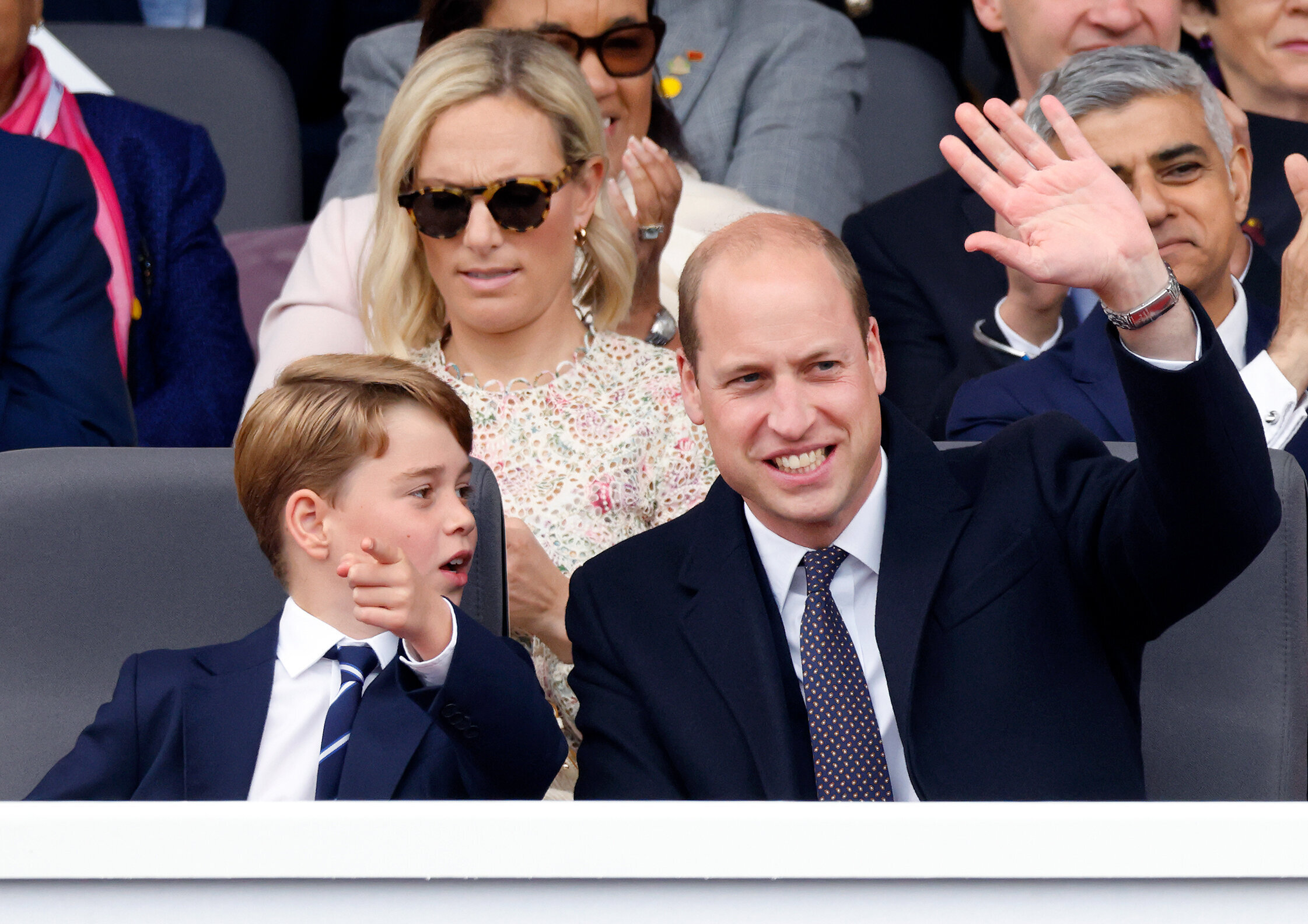
This is probably not a question Prince William is asking himself as enters his fifth decade. But the Duke of Cambridge’s birthday has got us thinking about milestone ages, and why some of us place so much significance on certain numbers.
For women, approaching ‘The Big Four O’ often means discussions of fertility and the biological clock intensify (whether or not you want children and even though a woman doesn’t suddenly wake up on her birthday unable to conceive).
Advertisement
But what’s at the forefront of men’s minds as they approach this age? We asked a bunch of guys aged 39 and over to find out.
‘I get a lot of stick for being single still’
“I’m almost 40, single, with no permanent long-term job. I still love travelling and exploring and totally lack any sort of plan. But I’m kind of okay with that.
“At 40, you’re expected to have job security, a demonstration of some sort of career progression, where you’ve ended up with a bigger salary, a nicer suit and a nicer house.
Advertisement
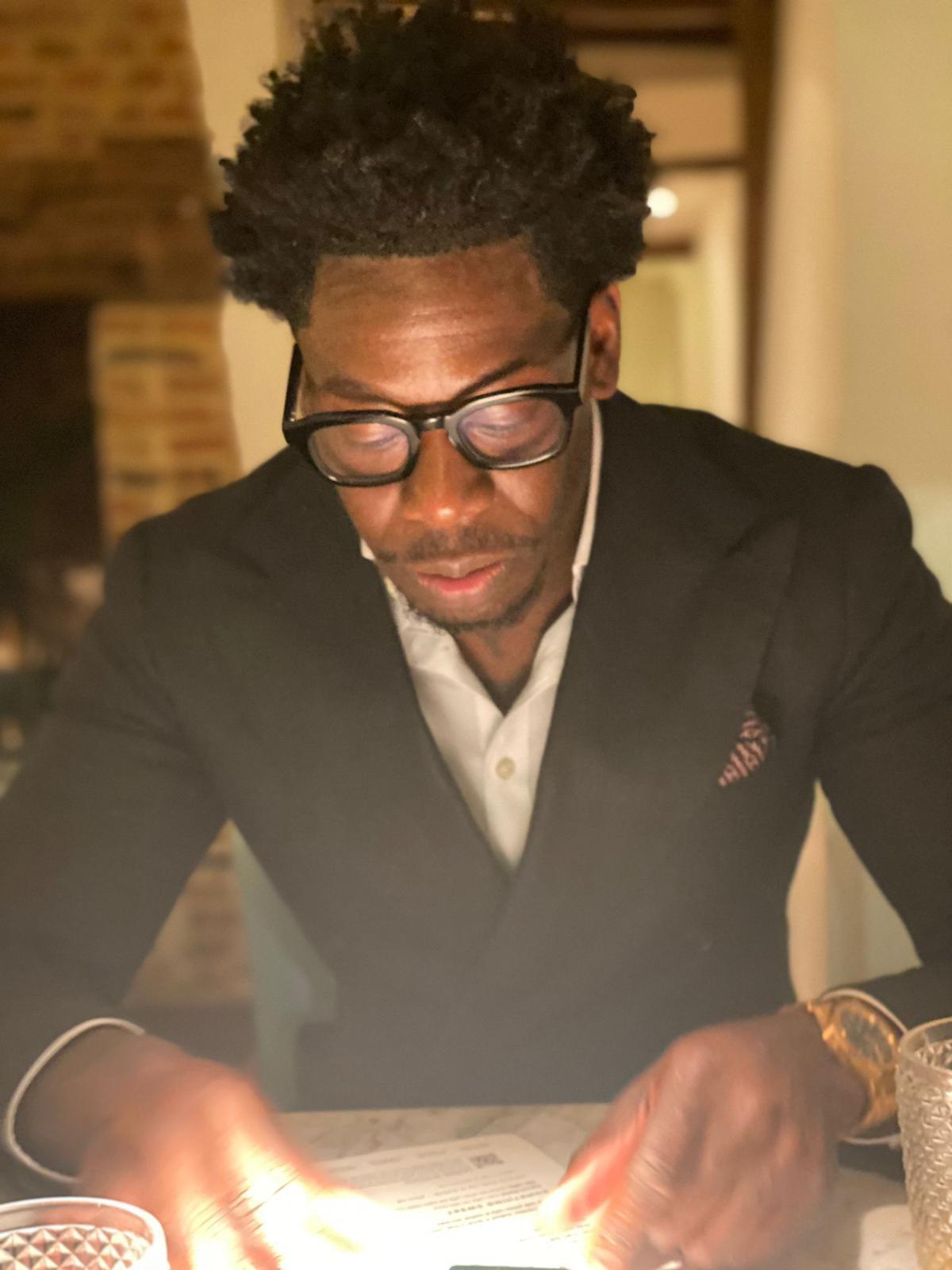
“I get a lot of stick for being single still. All my friends are in marriages or second marriages in some cases, people say: ‘you’re not going to get sorted are you?’ Every now and then, you do question your life choices. There are always going to be periods in a 12 month calendar where you’re going to have a couple of phases of self-doubt, where you might question the way you’ve done things. You might feel a bit sorry for yourself and have a bit of a pity party. But on the whole I’m quite content with where things are – I’ve seen a lot of the world, I’ve met a lot of great people. I’ve been very, very fortunate in that sense.” – Stephen Boyd, 39, Lincolnshire
‘I was fine with turning 40, but turning 41 hit me hard’
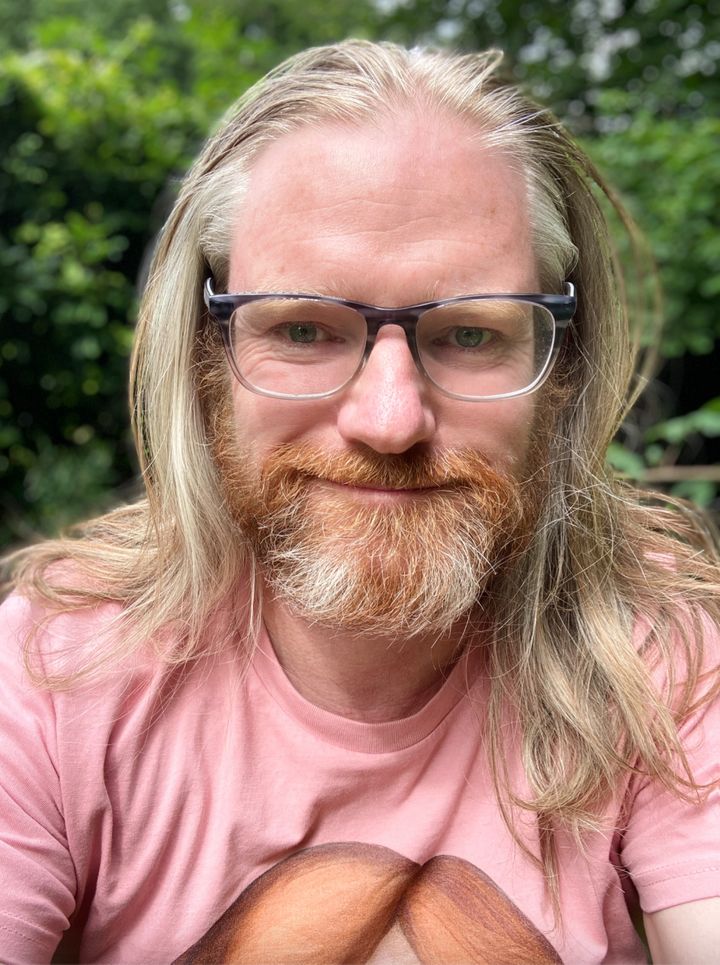
Peter McKerry
“Turning 40 didn’t phase me, but when I turned 41 I began to obsess over the fact that my life was in a type of descent towards the inevitable end, and that my best experiences were behind me. I was also worried that if I had a child I’d have a limited amount of time to be in their life. My dad was 53 when I was born and I was teased about it at school, so I didn’t want to be an ‘old dad’.
“As it turned out I was 43 when my daughter was born so I beat him by 10 years! Now my life is all about watching her grow and develop (she’ll be three in August) and it has given me joy but also anxiety. I’m trying to live in the moment now because I don’t want to have more regrets than I already do, and I want my daughter to have the happiest and most secure childhood I can give her. So now I don’t obsess as much over my age or my past as I have a real focus on ensuring Flora is happy and loved.” – Peter McKerry, 45, Westcliff-on-Sea
‘Men get more of a free pass’
Andy Dewar
Advertisement
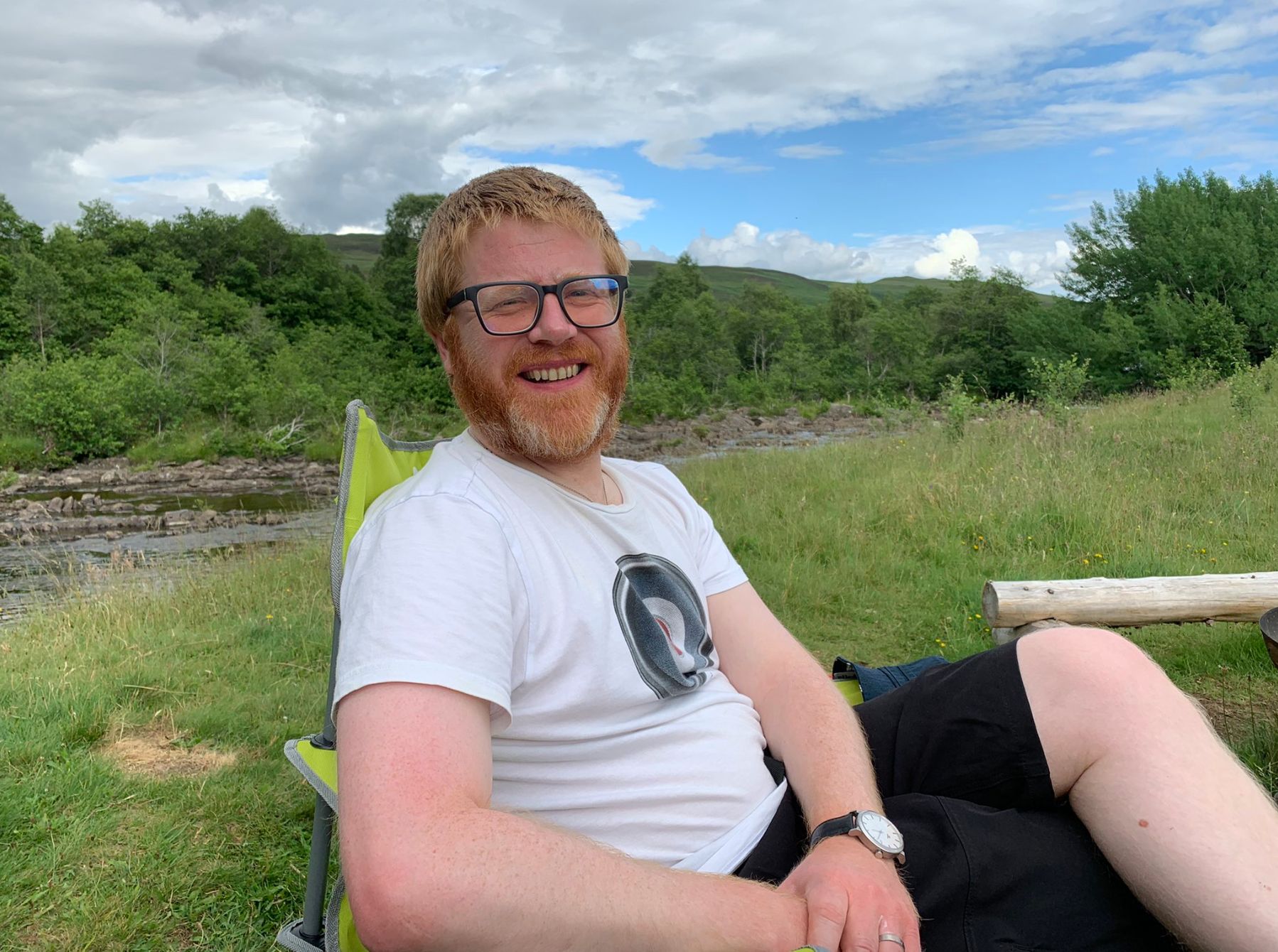
“I turn 44 this week and love it. I think 30 was more of hurdle for me psychologically, as it was the age where I felt you needed to knuckle down to some responsibilities and achievements personally and professionally, as well as resenting the fact I was no longer young and carefree. So by your 40s, you can enjoy all the new challenges and opportunities that come your way.
“There’s far more pressure on women at all ages but particularly 40s to have a great career and be a mum, I think. As far as media and peer pressure goes, men get more of a free pass. I’m lucky in the sense family and friends have never had any great competition between us to do well, some days are a grind, some days are easy. If you set yourself targets you lose sight of what’s important, which in my case is just trying to enjoy whatever it is I’m doing.” –Andy Dewar, 44, Hamilton, Scotland
‘I haven’t altered anything’
Michael Charles Grant
“I felt perfectly fine [approaching 40], with no pre-conceived thoughts of 40 being an issue and prohibiting me from what I can do physically and mentally. I look younger than my age so perhaps that played a fact in my mindset.
Has anything about being 40 surprised me? No not at all, why should it? I haven’t altered anything about my lifestyle to encompass my age or felt as if I had needed to.” – Michael Charles Grant, 40, Hertfordshire
Advertisement
‘Turning 40 made me re-evaluate my health and fitness’
″40… oh, that sounds old. Well, that was the thinking I had when I was in my mid 30s and heading towards 40. Society slots you into a category when your age starts with a four. I had just had my twin boys Alex and Lewis a few months before and dealing with them was really taxing on the mind and body. It was then also that I decided that ‘Dad Bod’ wasn’t something I liked and that I needed to do something about it. General fitness levels were poor and I found myself struggling with day to day tasks in dealing with two newborns. So I said to myself ‘Paul, you’re now 40, you’ve got the twins to think about, you don’t want two young boisterous boys growing up with a dad that can’t keep up… time to get into shape.’ It was a ‘If I don’t do this now, I never will’, moment.
“I’m in better shape now that I was in my 20s and 30s. Confident in how I look, with loads of energy for playing with the twins. My change in physique also motivated my wife to get back to the gym too, plus it has brought us closer with shared interest in fitness and just being better for our sons. Also, more body confident = more intimacy too.” – Paul McCaw, 46, Belfast Northern Ireland
‘Every decade has got better for me.’
Stu McKinlay
“Every decade has got better for me so – despite the birthday itself not feeling like a big deal – I was really excited that my 40s would continue that trend.
Advertisement
“My 30s were where I started to put into action the stuff that I had discovered in my 20s. I left my really great job in the public service (which I totally loved) to start my own business in brewing. My wife and I started the business, had three kids, and then moved our business and family from New Zealand to UK. It was busy beyond belief, but we were both doing things we loved. Coming up for seven years into my 40s and despite the clusterfucks of Brexit and Covid, I’m having the time of my life!
“While there’s immense privilege in being a man – and that’s something far too few men understand – I think there’s a lot of pressure on men to achieve certain things by certain ages. I’m constantly aware of how, at certain stage in my life, I feel like I’ve still not grown up. And I wonder if my parents felt the same. I do remember my dad telling me that he didn’t actually feel safe and comfortable in his life until he was in his 50s. I totally get that. I guess a part of it is kids growing up and releasing that weight of expectation around looking after them.” – Stu McKinlay, 46, London
A single copy of these materials may be reprinted for noncommercial personal use only. “Mayo,” “Mayo Clinic,” “MayoClinic.org,” “Mayo Clinic Healthy Living,” and the triple-shield Mayo Clinic logo are trademarks of Mayo Foundation for Medical Education and Research.
Employees undergoing fertility treatment could soon be entitled to statutory time off work, under a proposed law being brought before parliament.
The law suggests that fertility appointments should be treated in the same way as antenatal appointments during pregnancy.
Advertisement
NHS England and NHS Improvement have already recently given roughly 8,000 of their staff the right to three days off a year specifically for fertility treatment, The Mail on Sunday reports. (Though it’s worth noting that free IVF treatment under the NHS has faced huge cut backs in recent years.)
Under the latest bill, proposed by Tory MP Nickie Aiken, all companies would have to give both women and their partners time off for fertility treatment. It’s hoped the change will help those who may currently be going through multiple rounds of tough IVF treatments in secret.
“Undergoing treatment while juggling a career is very tough,” Aiken said. “Many people feel they cannot tell their employer for fear of being overlooked for a promotion or being made redundant.”
Why is this new proposed law so important for hopeful parents?
Becky Kearns, Co-Founder of Fertility Matters At Work, tells HuffPost UK this law is potentially game-changing, because it gives people “permission to talk to their employer about going through treatment (if they choose to) rather than feeling like they have to hide it”.
Advertisement
“We know from our research that 61.1% did not feel confident talking to their employer about trying for a baby,” she explains.
“Many fear that there will be an impact to their career in asking for time off to attend appointments and so a law in place to give a statutory right and protection against unfair treatment will help them to know that this is recognised by their employer.”
She adds that IVF is often seen as a ‘lifestyle choice’ rather than a treatment for a medical condition – though the World Health Organisation describes infertility as a “disease of the reproductive system”. The proposed law would help to right this wrong.
How will this benefit people who are having IVF?
Kearns believe this will benefit hopeful parents as IVF is a gruelling process over the course of a number of weeks involving numerous, frequent and unpredictable appointments. “From my own personal experience, taking time off for fertility appointments felt very different to when I finally became pregnant and was ‘allowed’ by law the right to attend antenatal appointments,” she says.
“It not being recognised or even allowed within many organisations creates additional stress and burden on top of an already emotionally draining process. This law would mean that over time fertility appointments would also be expected, accepted and acknowledged as a statutory right.”
Advertisement
What are some of the work challenges women face when undergoing fertility treatment?
When going through IVF or other fertility treatments, women face “a very real fear of not being seen as committed to their jobs, of being overlooked for promotion or even selected for redundancy if their employer knows,” Kearns says.
“It’s also a hugely personal experience, one that still often has stigma and shame attached to it,” she adds.
“Planning is hugely difficult as it often depends on how your body responds to treatment and when your period starts as to when treatment can begin, the appointments can be every other day and sometimes at late notice depending on blood test and scan results.”
In a 2020 survey by the community interest company, 83% of respondents said Covid (and working from home) had made it easier to plan and squeeze in fertility treatments. But now most of us have returned to the workplace – at least some of the week – things will get harder again.
“There’s the physical challenges of the hormones that are injected, also the challenge of finding an appropriate place to administer injections and pessaries whilst at work, one woman told us she had to hide her in a sandwich box in a fridge,” Kearns explains.
Advertisement
“Financial worries are huge too with the cost of treatment often running into the thousands, another stress when you need to take time off work – some are told to use annual leave or unpaid leave, we found that 69.5% took sick leave during treatment.
“Most predominantly is the mental health challenge, we found that 68% felt their treatment had a significant impact on their mental and emotional wellbeing, having to hide appointments and the huge grief that this process brings about can make it even more of a challenge, to the extent that 36% considered leaving their employment due to treatment.”
Let’s hope the bill marks the start of the change that’s needed.
An STI which is virtually unknown to the public is likely to be found in Black, Asian and other minority women more frequently, according to new research.
While more common than other sexually transmitted infections such as gonorrhoea, the virus Trichomonas vaginalis (TV) is largely not known about to large swathes of people.
Advertisement
But new research shows that it is more common among ethnic minority women and can appear with common symptoms or asymptomatically.
Without treatment, the condition can have serious consequences, increasing the likelihood of HIV and pregnancy complications, which is why it’s important we get clued up on it.
The research, presented by Preventx at the British Association for Sexual Health and HIV annual conference, found that TV is also more common among heterosexual people. They studied 8,676 women from six English local authority areas who had completed remote STI tests.
While women of colour were most likely to be affected, Black women were particularly found to be at risk.
Advertisement
In the study, they found that 5.2% of women from Black, Caribbean and African heritage who had vaginal discharge – a common symptom of the infection – ended up testing positive for TV.
For all other women, the risk of having and displaying signs of the condition were 3.5%, with white women facing lower chances, at 3.4%.
Even in Black women who did not show any symptoms, the chances of TV remained higher among them, with a positivity rate more than twice as high as for white women. For Black women, this figure was eight times more likely, whereas for white women it was twice.
But it might not be genetic differences that predispose more women of colour to the condition than white women – it could be to do with levels of social deprivation.
For the first time, scientists also considered the relationship with poverty and rates of TV.
They found that the highest levels of TV were found in disadvantaged areas, with 5.9% of women in the most deprived neighbourhoods (in which women of colour are more likely to reside) testing positive for TV. In affluent areas, this number is at 1.4%.
Advertisement
Dr John White, medical director at Preventx and consultant physician in sexual health commented on the study, saying: “Trichomoniasis is a relatively unknown STI among the general population, but it can cause significant pain and discomfort. I know from the patients in my care that it can also cause a lot of emotional distress for the person infected too.
“Women, in particular, can remain infected for years – and their distressing symptoms are often misdiagnosed or dismissed. If untreated, TV can also increase the chance of acquiring HIV in at-risk communities, as well as cause complications in pregnancy.”
Scientists hope more research and testing is done to understand and treat the condition.
Dr White added: “Our new data shows worryingly high positivity rates, with certain communities more affected than others. As TV can easily be diagnosed with remote NAAT tests, it is vital that more high-quality TV testing is carried out across the UK, helping us to understand more about the distribution of this infection.
“This will allow us to address the consequences of undiagnosed TV and reduce transmission.”
What is TV and what are the symptoms?
TV can affect both men and women. According to the NHS, symptoms of trichomoniasis usually develop within a month of infection. However, up to half of all people will not develop any symptoms (though they can still pass the infection on to others).
The symptoms of trichomoniasis are similar to those of many other STIs so it can sometimes be difficult to diagnose.
Laura Whitmore has defended her interview with eliminated Love Island contestant Remi Lambert after facing criticism on social media.
During Sunday night’s instalment of the ITV2 reality show, Remi became the latest Islander to leave the villa, and later spoke to the presenter via video-link on companion show Aftersun.
At the end of the interview, Laura told the panel: “Everything in me just wanted to cuddle him.”
Remi leaving the villa on Sunday night
ITV/Shutterstock
The following morning, one Love Island fan commented that Remi looked “broken” during the interview, accusing producers of asking him to rap “in bad faith” to “humiliate” him.
Laura then insisted: “Remi is a rapper and [was] asked in good faith in advance if he’d rap and prepare something which he did.
Advertisement
“Live telly is nerve-wrecking, believe me, so maybe he was a bit nervous but he deserved to have his time.”
Remi is a rapper and asked in good faith in advance if he’d rap and prepare something which he did. Live Telly is nerve wrecking, believe me, so maybe he was a bit nervous but he deserved to have his time. Also I want to make Remi & Afia happen! ❤️ https://t.co/Rw3KWdp9b7
Prior to this year’s Love Island launch show, Laura decided to get ahead of her usual detractors with a TikTok video addressing some of the criticism she claims to have faced every year since she took over as host.
This included comments about her salary, her decision to fly between Mallorca and the UK over the course of the series, her interview technique when she speaks to the Islanders and claims she’s “never in” the villa.
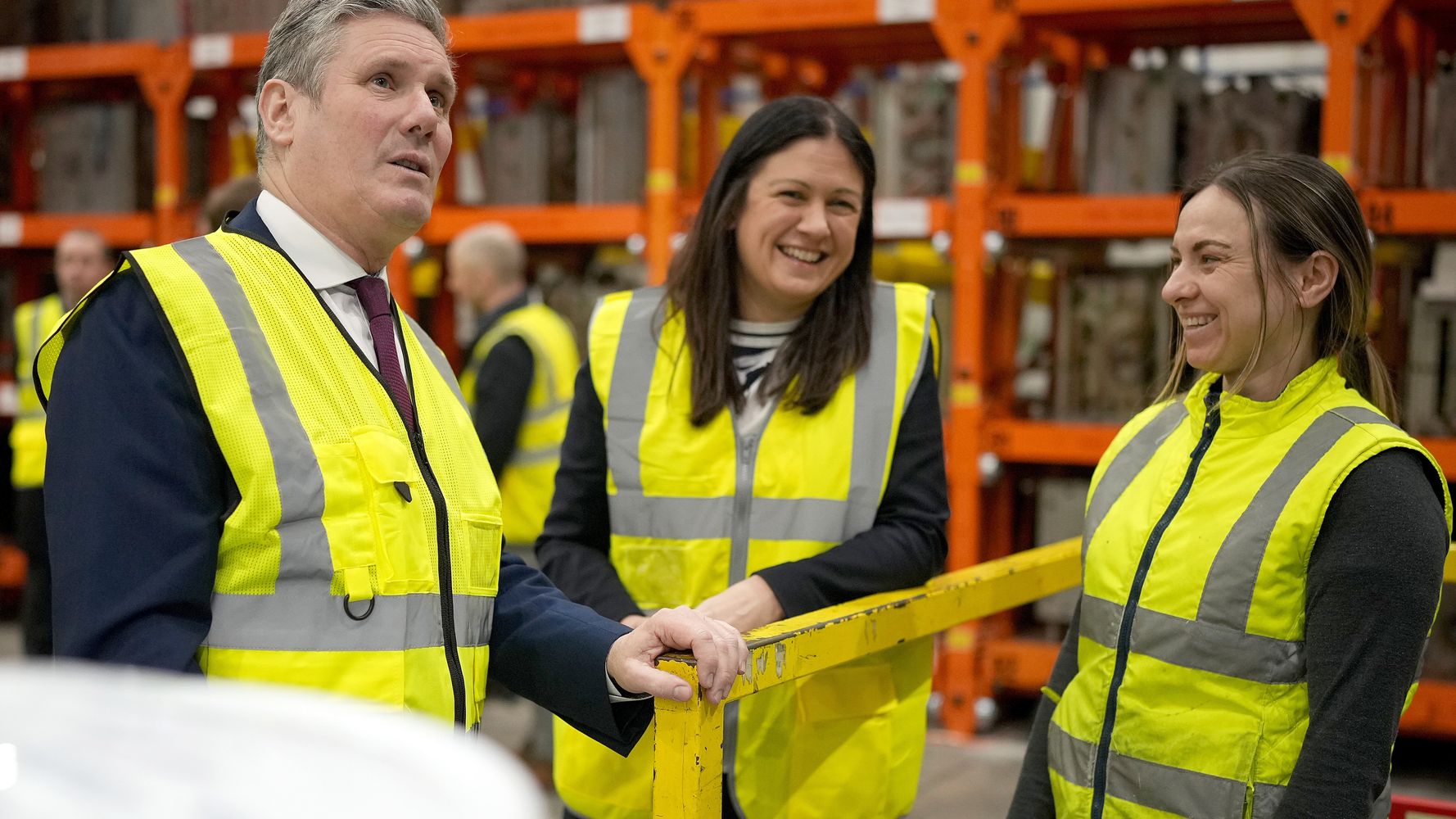
Lisa Nandy has dismissed speculation that Keir Starmer is lining up a successor to lead the party if he is forced to quit as “absolute nonsense”.
Nandy, the shadow levelling up secretary who is often touted as a future Labour leader, said she had not spoken to Starmer about plans to secure a replacement if Durham Constabulary fine him for breaching Covid rules.
Advertisement
Although he has insisted he did not break any rules, the Labour leader has promised to step down if he is issued with a fixed penalty notice over a takeaway beer and curry he ordered with campaigners in the city last year.
Nandy was responding to reports in the Sunday Times that Starmer — who has been battling days of negative headlines and briefing — has told potential rivals to put campaign teams in place to continue to ensure his work in rebuilding the party does not go to waste.
According to the newspaper, Starmer told allies: “I will not let this party become a basket case again. I will not let our hard-won gains be squandered so we will need to be ready in the unlikely event that the worst comes to the worst.”
But asked about the report on Sky News, Nandy said she had only spoken to Starmer twice in the last couple of days about “how we persuade this government to lift a finger to avert a crisis on the railways”.
Advertisement
Presenter Sophy Ridge joked: “Are you a bit worried he’s been talking to Wes Streeting and not you?”
Nandy replied: “No, I’m not worried that he’s been talking to anybody about succession planning, because I know that he’s been talking to all of us about how we rid this country have a government that has held us back for the last 12 years and finally start to deliver for working people — that is the conversation that we’re having in the Labour Party at the moment.”
And asked separately on Times Radio whether she was plotting her own leadership bid behind the scenes, Nandy said: “Not true. Not true at all. I’ve not been having fundraising dinners, I haven’t been launching some kind of leadership bid.
“The only job that I am going after right now is Michael Gove’s and I am determined that I’m going to get it. Not because of my wishes for myself, but because I’m ambitious for this country. And I know that we could do better than this.”
The Labour Party confirmed on Friday that both Starmer and deputy leader Angela Rayner have now returned their questionnaires to Durham Constabulary.
The prospect of a looming fine is just the latest headache for Starmer.
The Labour leader has endured days of negative headlines and briefings from members of his own shadow cabinet who have accused him of “boring voters to death”.
Advertisement
One told the Times: “Is he exciting? No, of course not — that isn’t why we ended up with him.
“But there is a big difference between not being Mr Razzmatazz and boring everyone to death . . . to loads of my constituents he just doesn’t exist in their minds at all.”
In return Starmer was forced to tell his shadow cabinet not to brief the press that he was boring, in an exchange one colleague described as “ironically very boring”.
However, Starmer has been defended by former prime minister Gordon Brown, who told him to “ignore” the negative briefings against him.
Asked by the BBC’s Sunday Morning programme what his advice would be to the Labour leader, Brown replied: “To ignore this because what’s exciting about the possibility of Keir Starmer’s leadership is he will have a plan for Britain.
“He will show how we can get back growth, he will show how we can get living standards rising again and he will show how we can have a fairer society that deals with climate change.
Advertisement
“Keir Starmer was the director of public prosecutions. He’s been a great public servant over many years and I think he will make a great prime minister.”
Next week Starmer will be put to the test in a key by-election in Wakefield, West Yorkshire, where the former Tory MP was forced to stand down following his conviction for sexually assaulting a 15-year-old boy.
Recent polls have put Labour 20 points ahead of the Tories for the contest on June 23.
However, internal polling cited in the Sunday Times suggests that lead could in fact only be around eight points.
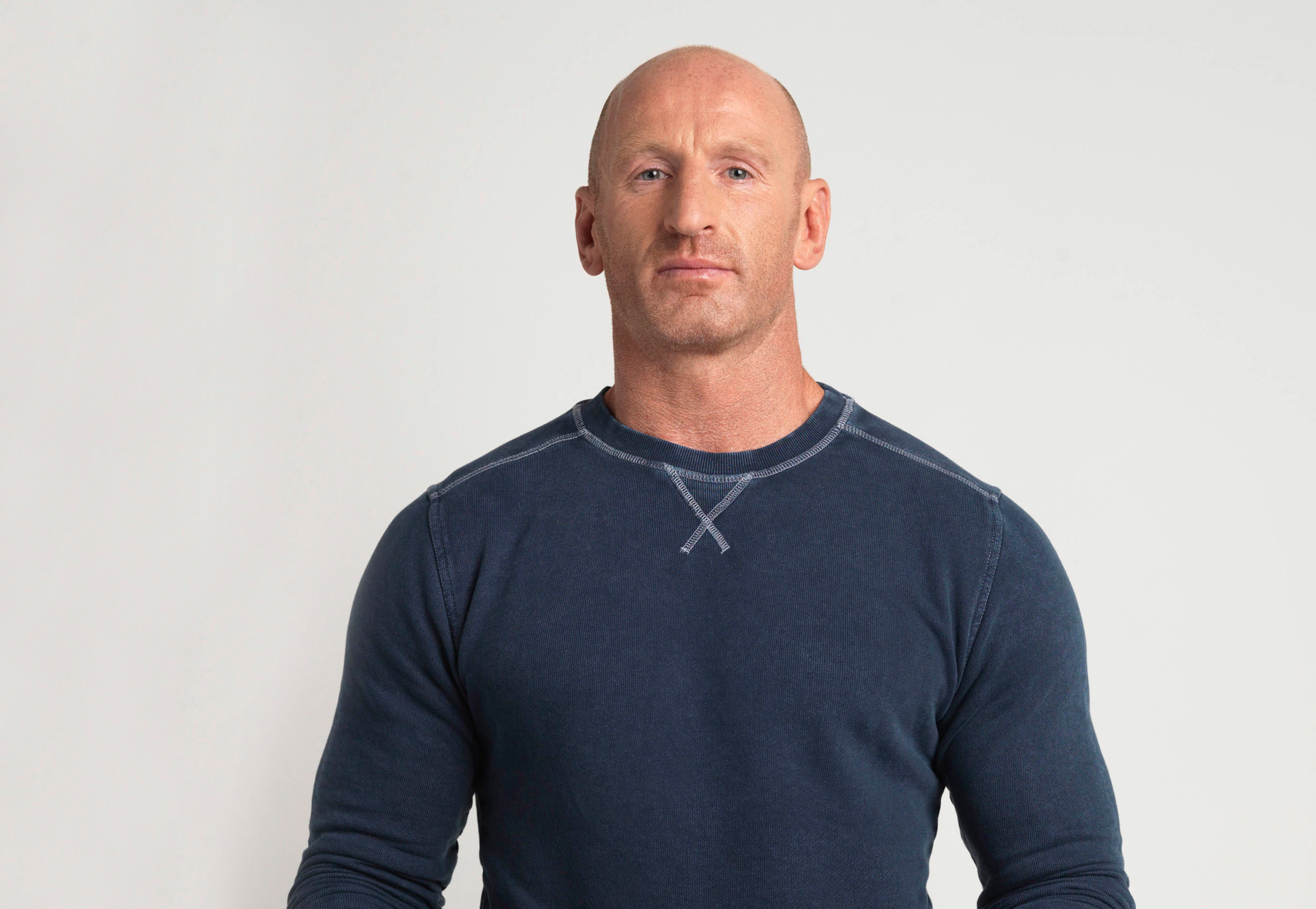
Gareth Thomas is undeniably one of the most prolific and celebrated LGBTQ+ figures in the world of British sport.
In addition to his impressive, record-breaking career on the rugby pitch – which included serving as captain of the Welsh national team – Gareth has also received praise for having raised awareness of issues around queer identity, mental health and destigmatising HIV.
Advertisement
For his latest venture, the rugby pro has teamed up with Ford for a new video series which aims to fight discrimination in industries that are stereotypically male-dominated.
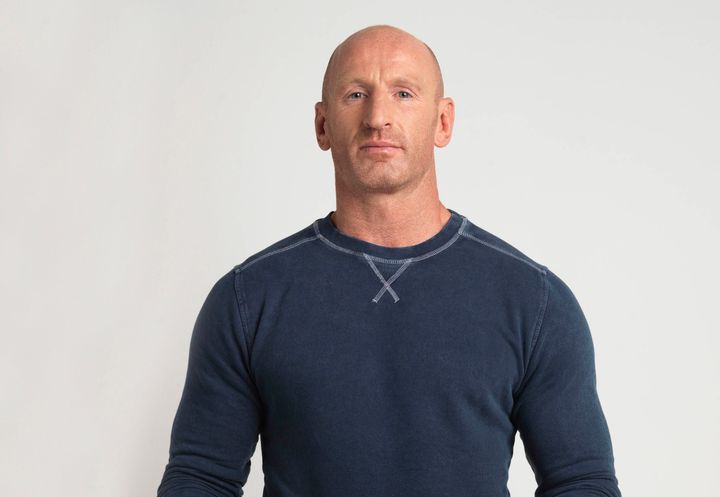
Gareth Thomas pictured in 2020
ITV/Shutterstock
“Tough Talks is all about sitting down with people and giving them a safe place where they feel they can air the problems that are around what is a very very macho and sometimes toxic masculinity kind of environment,” he explains.
“What we’re trying to do is get the culture of this industry up to speed with 21st century thinking and 21st century living. And try to create change, because culture can break people down and stop people being authentic. And to be successful, you need a diverse work environment, you need people to be able to be authentic, you need people to be able to be the best version of themselves.”
Advertisement
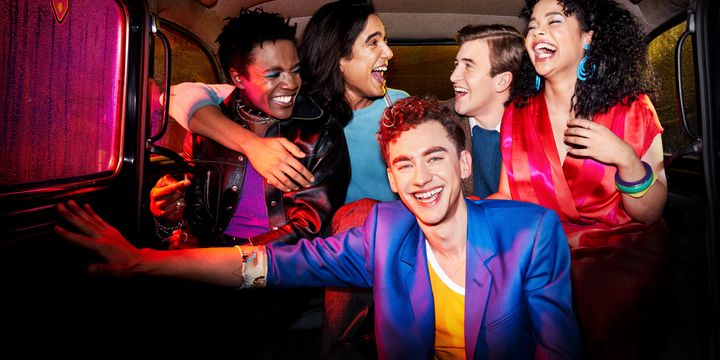
To mark Pride month, HuffPost UK spoke to Gareth about how Queer As Folk provided an insight into a world he’d “only ever dreamt of” before coming out, why It’s A Sin proved to be both an “addictive” and “disturbing” watch and his admiration for Blackpool’s Jake Daniels…
Who was the first queer person you can remember looking up to?
I kind of feel like I used to shelter myself away from many iconic LGBT figures when I was growing up, because I was afraid of being “guilty by association”. So I kind of hid myself away.
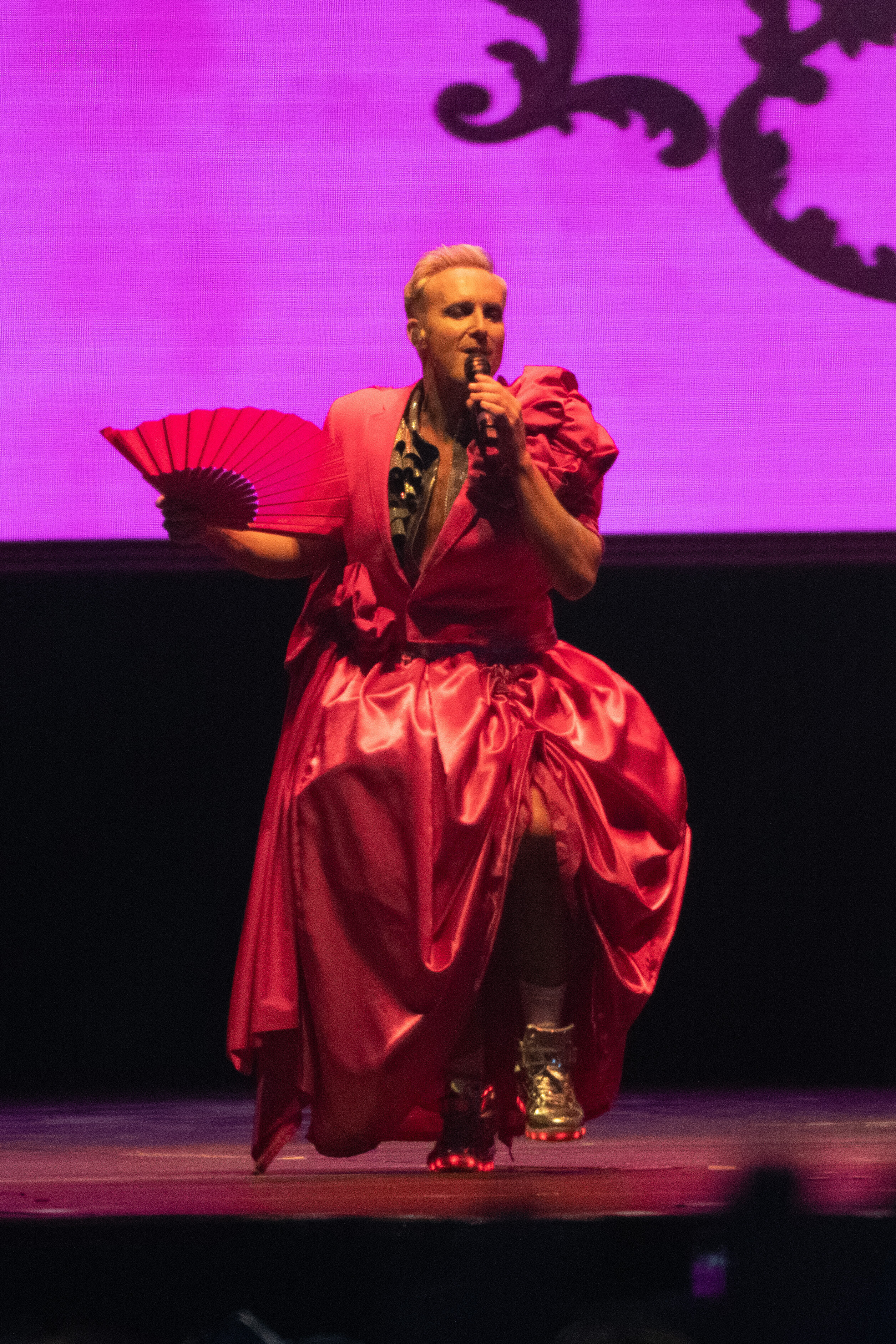
But someone I would say now is H Watkins from Steps, who’s a really good friend of mine. He’s probably not somebody that people would think [I would say], because he’s not someone I grew up watching. He’s even younger than me! It sounds like a really bizarre one, because I’m sure people would think, you know, Peter Tatchell or Ian McKellen or somebody like that.
But for me, he has the same lived experience as me, he’s from the same area, he’s always celebrated who he is and he’s very active in fighting for the rights of LGBT people in the community and the area that I know.
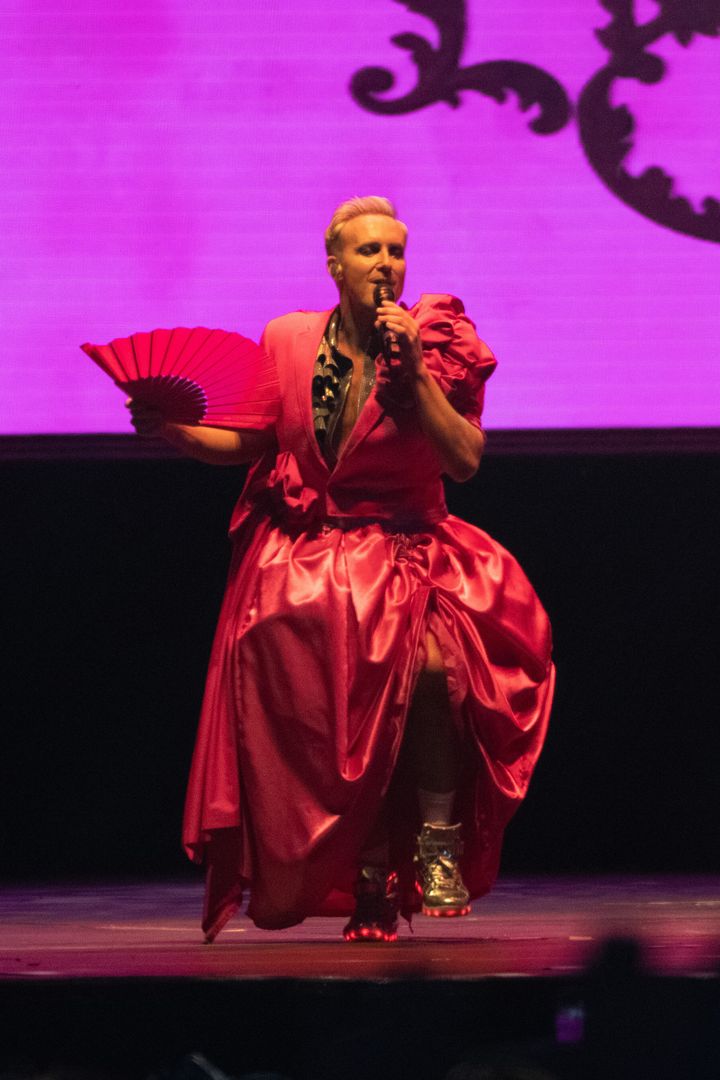
H on stage earlier this year
Joseph Okpako via Getty Images
Advertisement
What was the first LGBTQ+ TV show or film that you remember resonating with you?
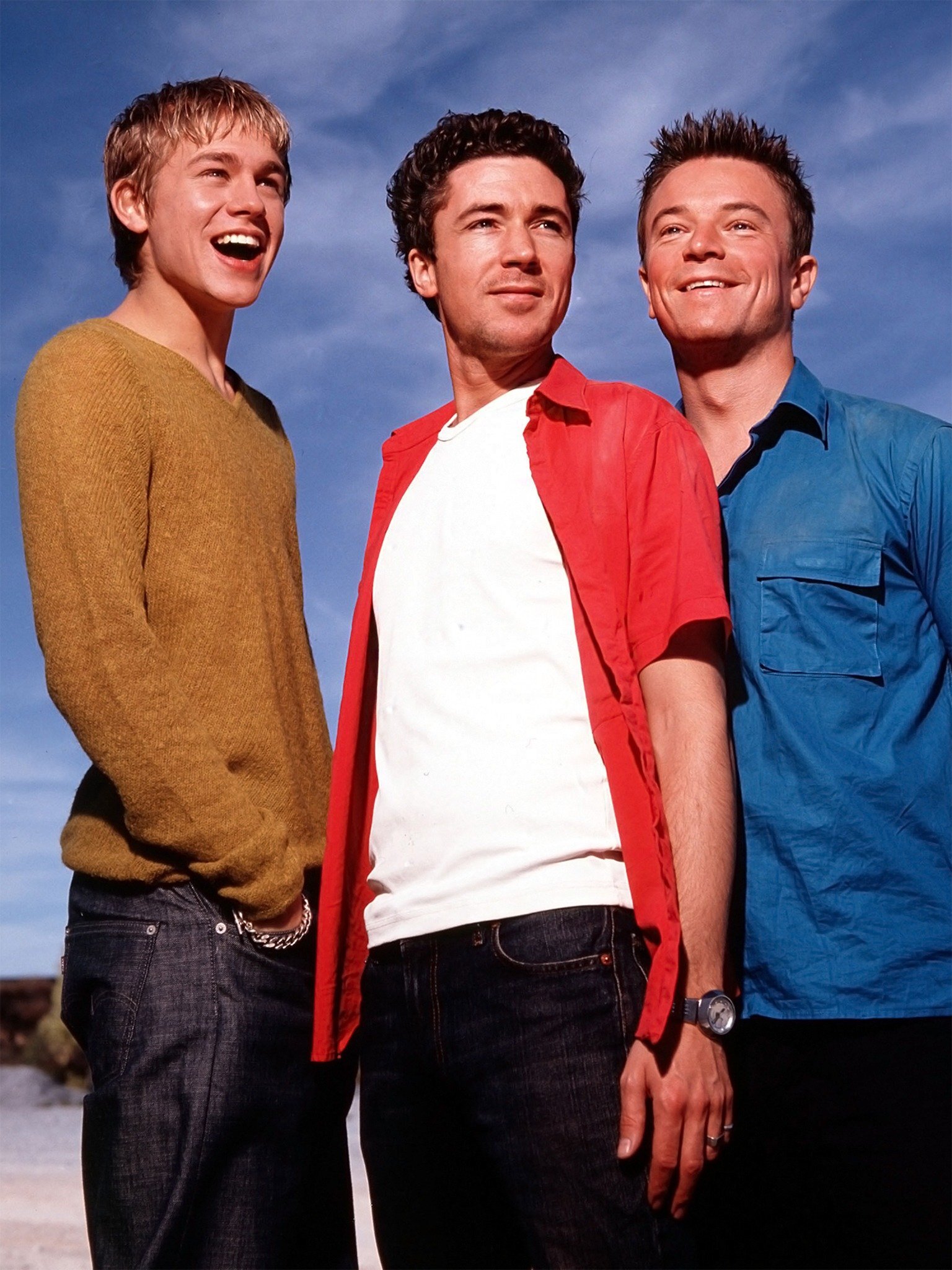
Oh my word, well, I wasn’t out at the time, but I remember watching Queer As Folk when it first came out about 20 years ago. And it was like an insight into a world that I’d only kind of ever dreamt of exploring or being in. It was a very interesting watch for me.
It pushed the boundaries and got people’s attention and got people talking about what it’s like to live in that community. I’m not sure if it scared me, or whether it excited me about the potential of, “OK, that’s what’s on the other side of the door if I dare ever unlock it”.
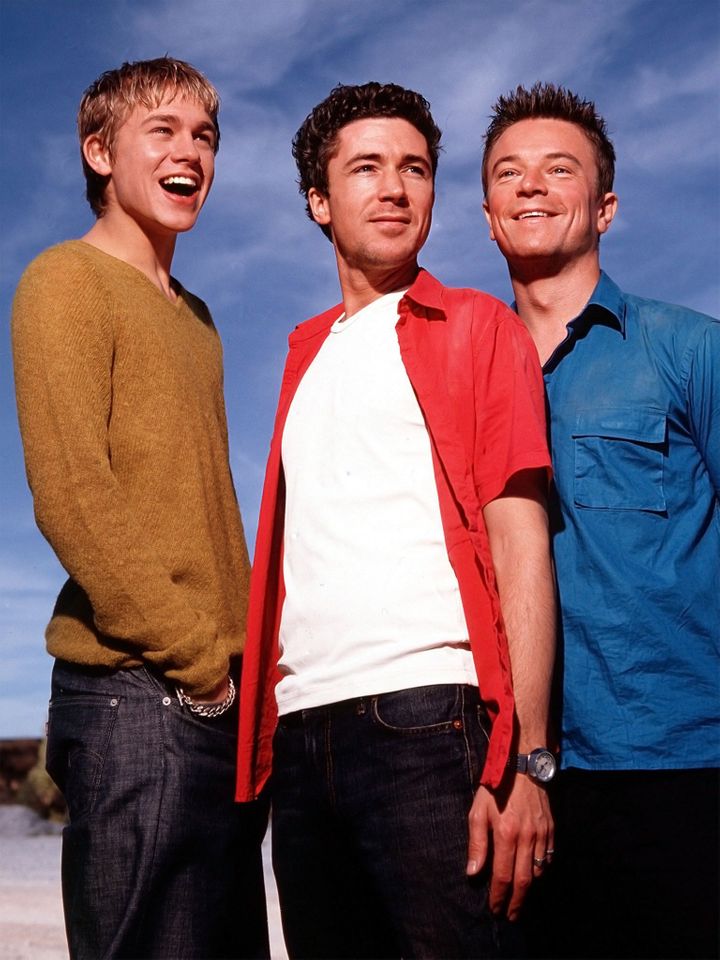
Queer As Folk
What’s a song you associate with your own coming out?
The Freemasons’ remix of Here Comes The Rain Again by The Eurythmics, and I’ll always remember it because it was playing the first time I ever walked into my first gay club experience.
The reason it resonated with me was because that was the first moment where I really saw people not worrying about what other people were thinking about them. It felt like, for the first time in my life, I was standing there, looking around, and feeling really liberated. Whenever I hear that song, I have that memory of seeing people smiling, seeing people holding hands, seeing people not afraid to be themselves.
What was the most recent LGBTQ+ show or film that made an impact on you?
It has to be It’s A Sin, without a shadow of a doubt. For me, watching It’s A Sin, as much as I found it addictive and wanted to binge-watch it, I also found it quite disturbing. I live with HIV myself, and through the work I do now, I know a lot of people who are from that generation. They’ve told me stories, but to see it played out and the reality of what it was brought it to life a lot more.
I became very appreciative of the times I live in now, the fact that I can live on medication now. But also, I felt so connected to, and helpless for, the people who lost their lives in horrific, horrific ways. They spent the rest of their lives, after diagnosis, being locked in a room or being discriminated against or with people not wanting to touch them.
[Seeing] the reality of what happened, and with my connection to it, I wished I could have done something then, but also it made me more determined to realise, “at least I can do something now”. That gave me a sense of motivation, but also a sense of sadness that people had to live through that.
And I made sure that everybody that I spoke to watched it, because I wanted to make sure that we never go back to times like that. There is always a chance in society that if we relax or if we stop talking about things, it’s easy to fall back to the way things were.
Advertisement
The cast of Channel 4’s It’s A Sin
via PA Features Archive/Press Association Images
Who is your ultimate queer icon?
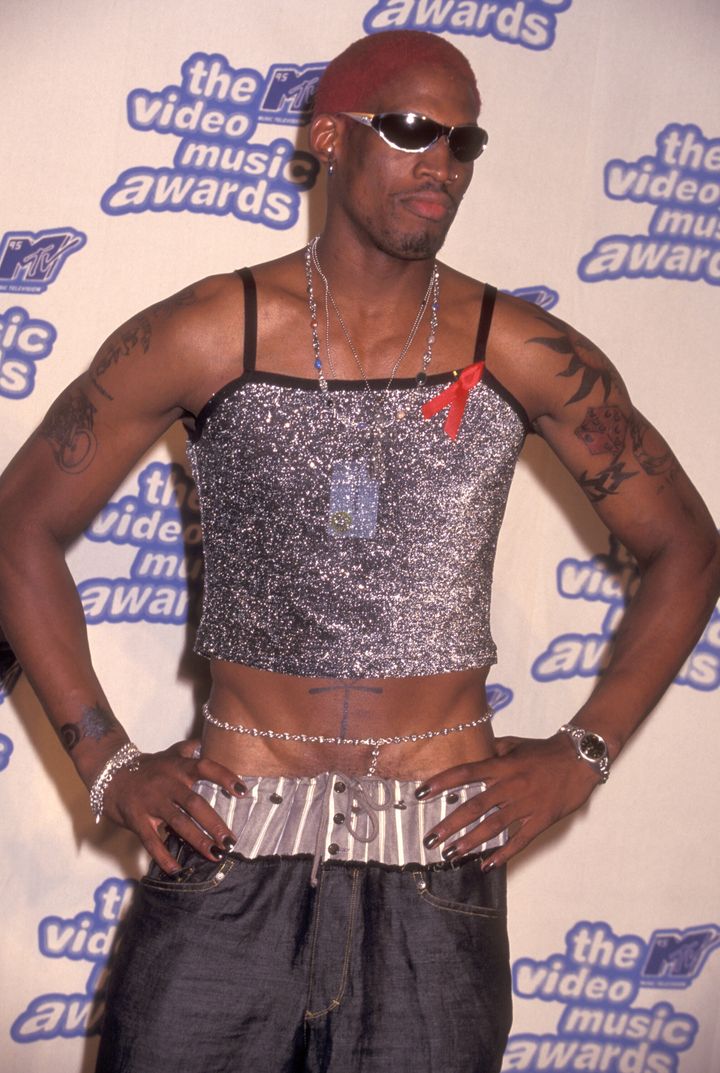
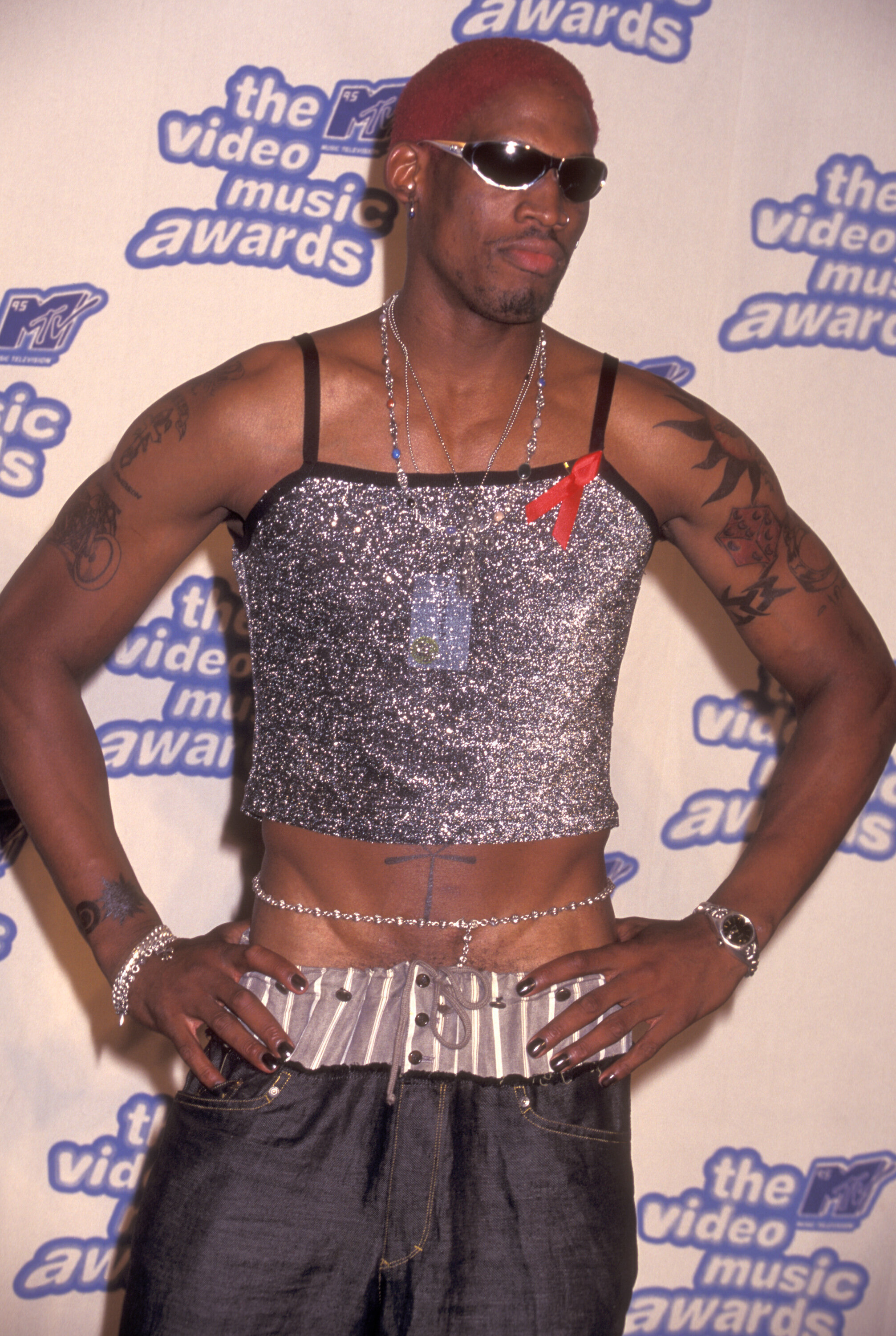
Growing up, I loved Dennis Rodman so much. He was a great athlete, he was a great basketball player, but he also always pushed the limits. He would wear a dress if he woke up and felt like he wanted to – it didn’t define him, he just felt like he wanted to wear one. He had tattoos and piercings and it felt, to me, he was someone who had no shame around his identity. And if his identity didn’t match what someone else thought it should be, that was somebody else’s problem to deal with, not his.
I was such a sports fan, and I think to have a sporting icon – which he was at that time – pushing the boundaries and the limits of what people assumed every sports person should be, or look like, or wear, or say, it was very iconic to me. He didn’t follow the rules, and he didn’t break the rules, he just made his own rules.
Dennis Rodman at the VMAs in 1995
Ron Galella, Ltd. via Getty Images
Who is a queer person in the public eye right now that makes you excited about the future?
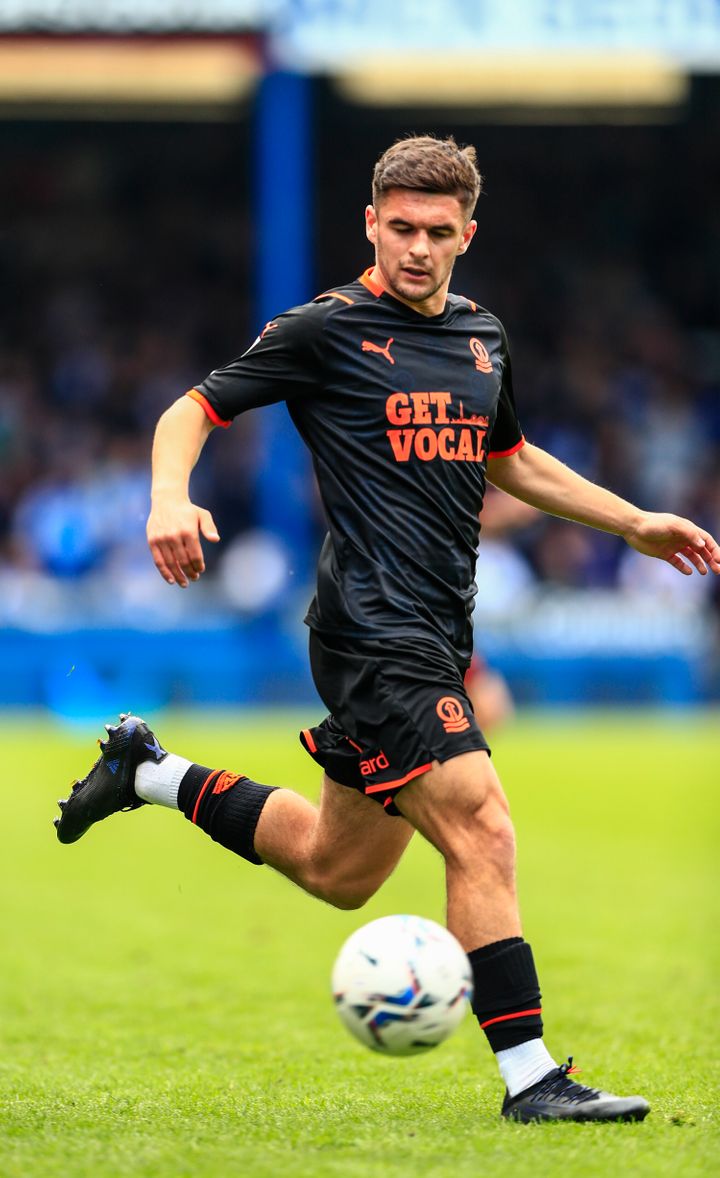
It has to be Jake Daniels, the footballer. It kind of blew me away, reading about him coming out. It was such a brave decision – he’s 17 and he’s only just signed a professional contract. At 17 I was so immature, so to show that maturity and bravery at such a young age, makes him such a positive role model for that generation – and everyone else.
Advertisement
And now, whether he’s successful or not, he’ll be able to look himself in the mirror and say, “I gave myself every opportunity”. Because if he failed, and he hadn’t spoken about his sexuality, he could have been left wondering, “would I have been successful if I had been authentic?”. The fact that he’s willing to put himself under that spotlight and that pressure, he’s willing to take the failures or successes and through all of it being himself, I think that is such a positive message for the future.
Jake Daniels
Lee Parker – CameraSport via Getty Images
Why do you think Pride is still so important today?
There are so, so many reasons. For me, Pride was not created or born out of a need to celebrate but being gay, it was born out of a need to fight for the right to exist without persecution. And we still live in a world where there is discrimination, nobody in this world can sit down and say there is zero discrimination against the LGBT community. There are still 69 countries where it is still illegal to be gay.
There are far-reaching messages from these Pride festivals and marches, that transcends borders and transcend communities. And it gives people hope. If I go to a Pride, I don’t go there to celebrate me being gay, I go [to celebrate] my right to exist without being persecuted for it.
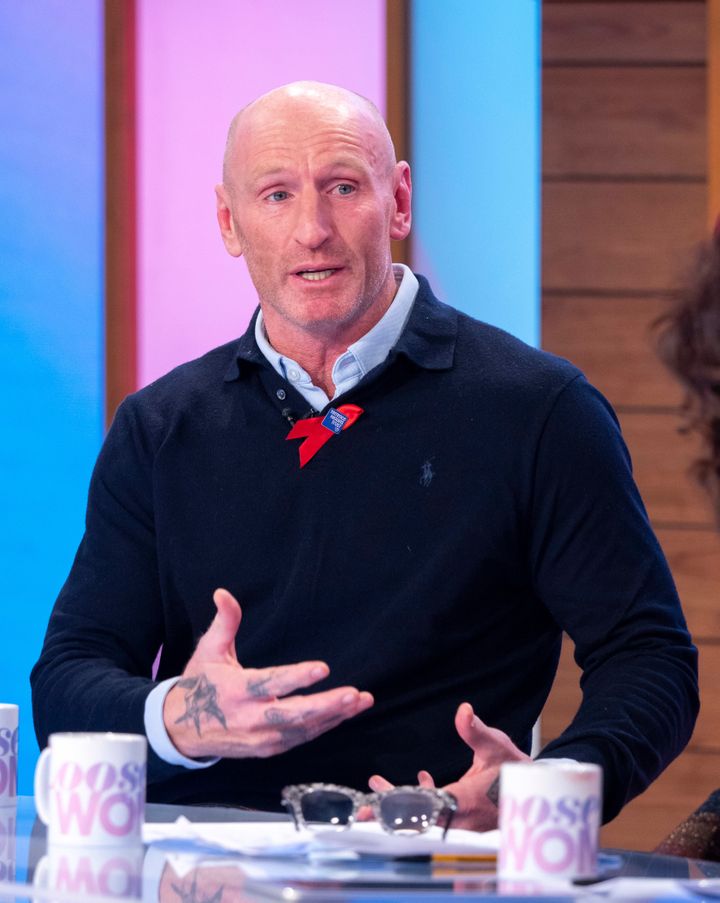
Gareth Thomas
Ken McKay/ITV/Shutterstock
Advertisement
What’s your message for the next generation of LGBTQ+ people?
Everyone goes through life wanting to be liked by everyone. And that’s not necessarily a bad thing. But I’d like the next generation of people to realise that it’s OK to be disliked for being authentic, but it’s not OK to be liked for being a version of you that’s a version that other people think you should be.
I feel that if people didn’t feel the need to lie about who they are, life would be a lot easier for everybody.
Watch Gareth Thomas and Ford’s Tough Talks video below:
","type":"video","meta":{"url":"https://www.youtube.com/watch?v=1_UmIurTCYc","type":"video","version":"1.0","title":"Ford Presents: Tough Talks with Gareth Thomas","author":"Ford News Europe","author_url":"https://www.youtube.com/channel/UC-uGdDHxmwi_eH5t_ph9uuw","provider_name":"YouTube","description":"Ford presents, #ToughTalks, a new series exploring how the automotive industry and ‘car culture’ needs to become more inclusive of the LGBTQ+ community and drive out discrimination.\n\nFormer Welsh Rugby Player, Gareth Thomas speaks to Racing Driver, @GoCharlie and Ed Rogers, Founder of Driving Pride to define ‘tough’ and discuss their experiences within the automotive world.\n\nWatch Episode 1 now and share your experiences with us below. 🏳️🌈\n\nDiscover more about Ford Presents Tough Talks: https://ford.to/FordPresentsToughTalksEp1\n___\nFollow us on social media: \n▶ YouTube 👉 https://www.youtube.com/c/fordnewseurope\n▶ Twitter 👉 https://twitter.com/FordNewsEurope\n▶ Instagram 👉 https://www.instagram.com/fordnewseurope \n▶ Blog 👉 https://ford.to/FordNewsEuropeBlog","thumbnail_url":"https://i.ytimg.com/vi/1_UmIurTCYc/maxresdefault.jpg","thumbnail_width":1280,"thumbnail_height":720,"cache_age":86400,"options":{"_start":{"label":"Start from","value":"","placeholder":"ex.: 11, 1m10s"},"_end":{"label":"End on","value":"","placeholder":"ex.: 11, 1m10s"},"_cc_load_policy":{"label":"Closed captions","value":false},"click_to_play":{"label":"Hold load & play until clicked","value":false}}},"fullBleed":false,"flags":[],"enhancements":{},"options":{"theme":"news","device":"desktop","editionInfo":{"id":"uk","name":"U.K.","link":"https://www.huffingtonpost.co.uk","locale":"en_GB"},"slideshowAd":{"scriptTags":[],"otherHtml":""},"slideshowEndCard":{"scriptTags":[{"attribs":{},"scriptBody":"\r\n (function(){\r\n var c = document.getElementById(‘taboola-endslate-thumbnails’);\r\n c.id += ‘-‘ + Math.round(Math.random()*1e16);\r\n \r\n var taboolaParams = {\r\n loader: \"//cdn.taboola.com/libtrc/aol-huffingtonpost/loader.js\",\r\n mode: \"thumbnails-b\",\r\n container: c.id,\r\n placement: \"Endslate Thumbnails\",\r\n target_type: \"mix\"\r\n };\r\n \r\n if (typeof window.modulousQueue === \"function\") {\r\n \twindow.modulousQueue.add(function(){ doTaboola(taboolaParams); });\r\n } else {\r\n \tdoTaboola(taboolaParams);\r\n }\r\n }());\r\n"}],"otherHtml":"
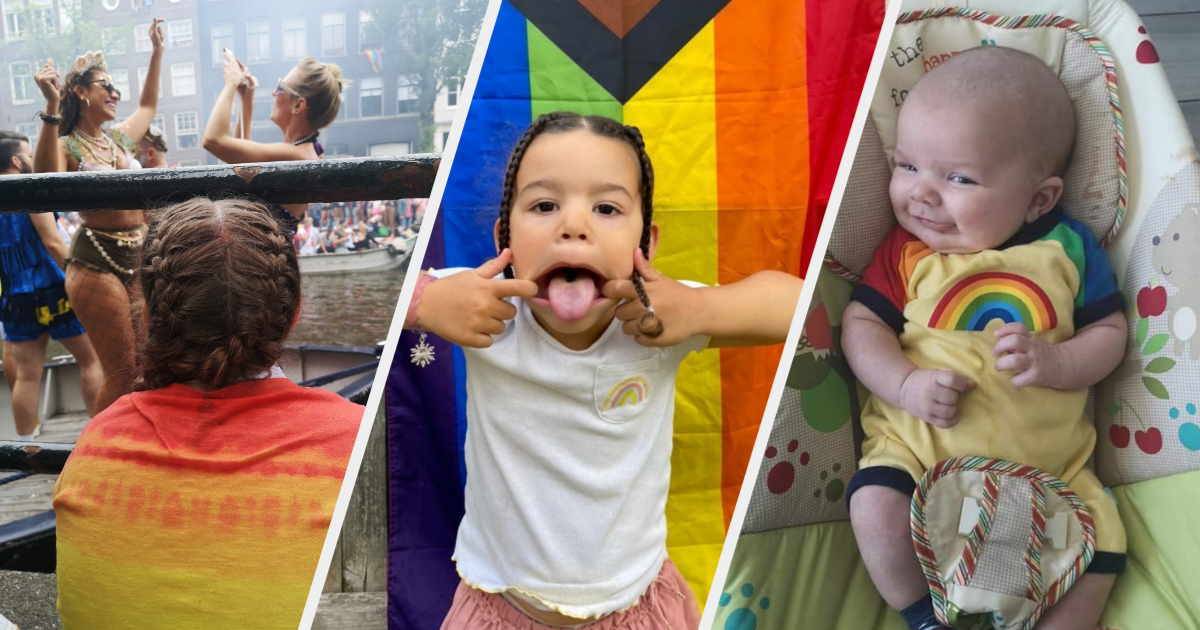
Don’t believe us? Ask mum-of-one Kate Everall, who’s taken her son since he was born, or mum-of-three Amie Jones, whose made wearing the family’s Pride-themed babygrow a rite of passage among her horde.
The fastest way to teach kids #LoveIsLove is by celebrating it in all forms from day one. Add in some rainbow flags, glitter and fun and they won’t question it one jot.
Advertisement
As writer Victoria Richards put it, explaining LGBTQ+ relationships to kids is actually very simple: “Try it: ‘Some men love men, some women love women and some people love both (or neither).’ Ta da.”
Pride is the perfect time to normalise queer love, to show kids that they don’t have to play “mums and dads” in the playground, and that they’ll be loved at home always, whoever they turn out to be. For LGBTQ+ parents, it’s also an opportunity for kids to see more families like their own.
We spoke to five families who enjoy Pride about what it means to them and their little ones.
‘Pride is a time to celebrate our queer family’
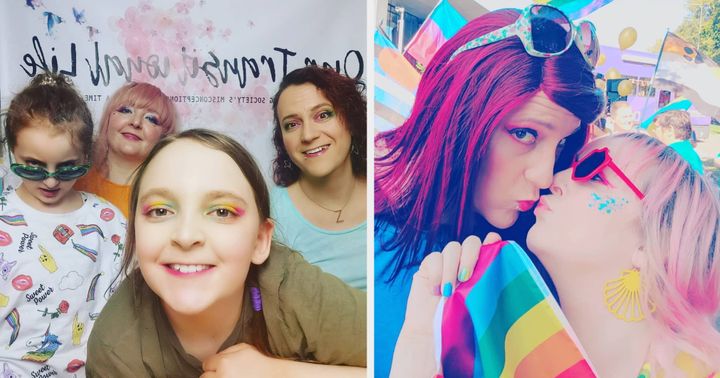
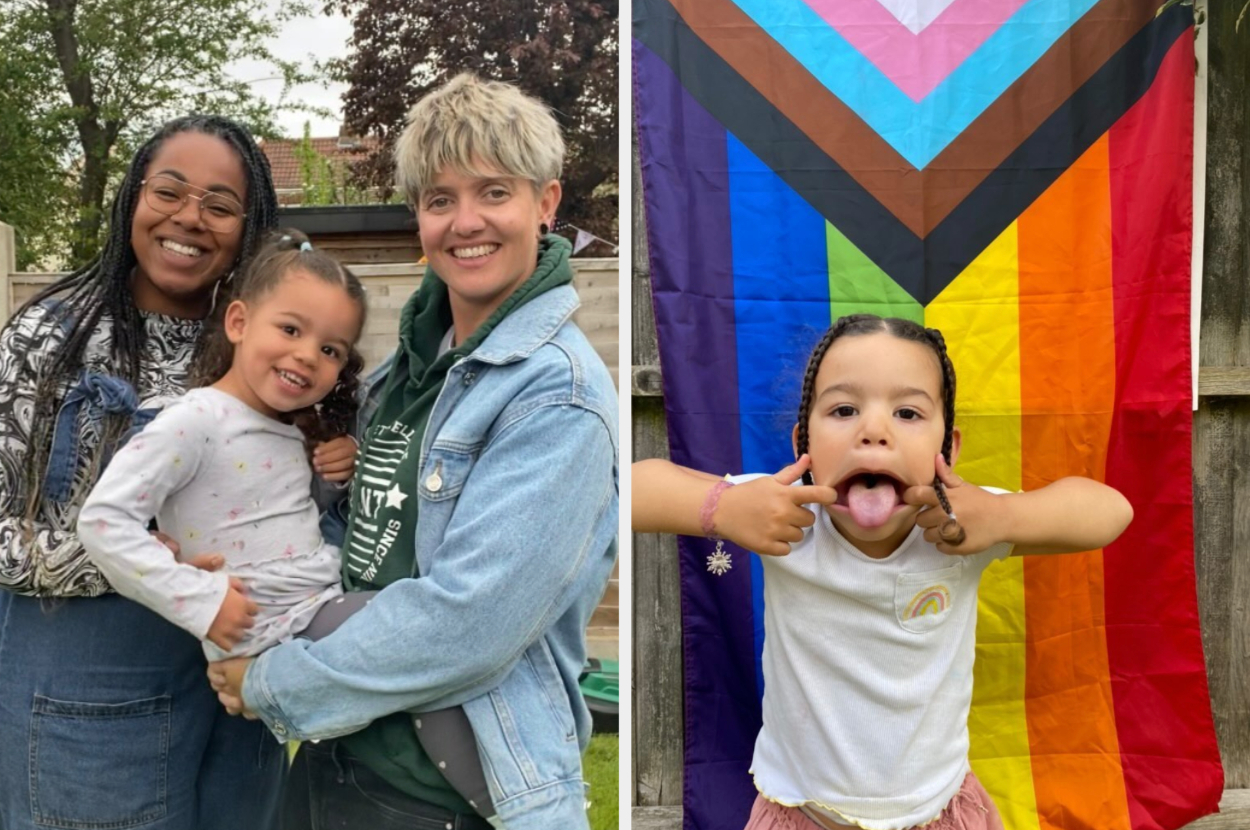
Kelly Allen with her wife, Zoey, and children George (12) and Molly (11).
“We take our children to Pride because we feel it’s integral to their future, and the future of other human beings, to be surrounded by a diverse community. We also feel Pride is a time to celebrate our queer family in a safe and fun way. It’s essential they are able to grow knowing they can be their true selves, and Pride is a time for us to really celebrate our diversity, amongst a community that accepts us for who we are.
Advertisement
“It’s become even more essential since Zoey came out as transgender, as the world can feel very bleak at times for the trans community. However, Pride gives us a chance to feel fully accepted and loved as the LGBTQ+ family we are.” – Kelly Allen, 40, who runs ourtransitionallife.com with her wife, Zoey
‘A great way to teach our boys what it means to be an ally.’
Amie Jones
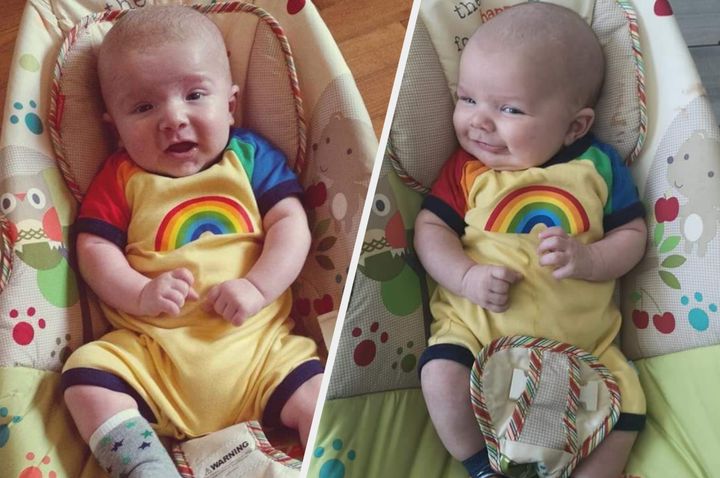
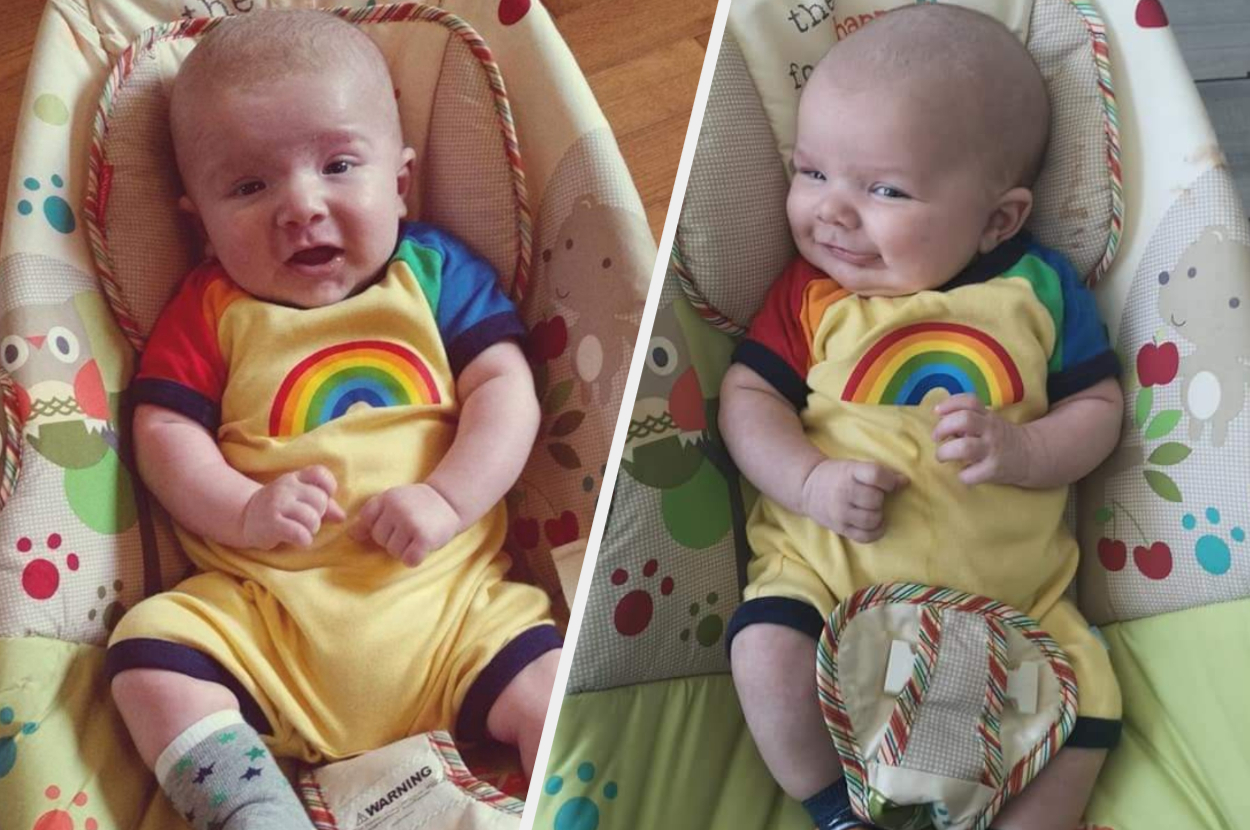
Amie Jones’ two sons Dylan and Huw in the family Pride romper.
“We have taken our three boys to our local Pride event in Chester since they were very young – and we even have a Pride inspired outfit for them to wear. The photos show my oldest son Dylan (now seven years) and my youngest son Huw (now two years) in the same Pride romper! Unfortunately, I don’t have any photos of us actually at Pride, as we are always having too much fun!
“As founder of Kind Kids Book Club – the UK’s first children’s book club with a focus on nurturing social conscience and sharing inclusive stories – Pride is an important celebration for our family and a great way to teach our boys what it means to be an ally. They always love the day – the atmosphere is brilliant, everyone is so friendly and there’s so much to see and do!” – Amie Jones, 37, Bagillt, North Wales
‘There’s no one way to be a family.’
Caprice Fox
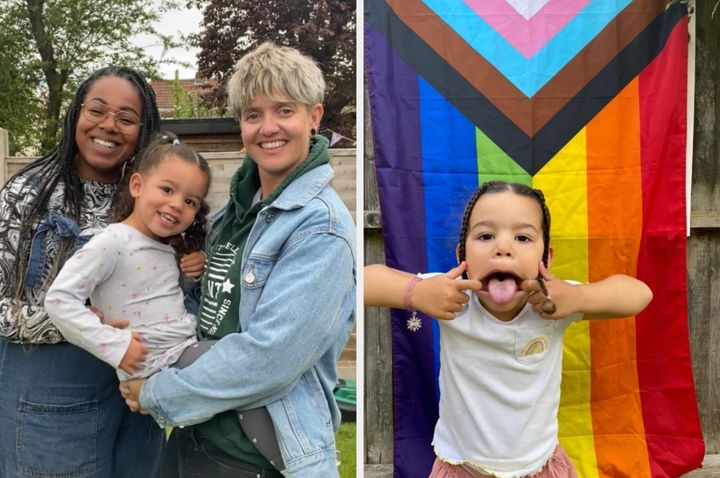
Caprice Fox with her wife, Holly and three-year-old daughter, Honey
Advertisement
“We celebrate Pride month by attending our local Pride event and decorating at home. Pre-Covid we attended Pride as a family and they had Drag Queen Story Time, a children’s dance stage and a soft play area. We have diverse books out all year round, not just for one month, however we make a conscious effort to read these and encourage preschool to do the same!
“It is so importance for Honey to celebrate Pride and our family so that she realises just how diverse every family can be! There’s no one way to be a family and each one can look different, but it’s about showing that each one has something in common: love!” – Caprice Fox, 32 from Bristol
‘I want him to grow up enriched.’
“Pride is incredibly important to us as a family, which is why when our son came along we would continue our tradition of attending Brighton Pride.
“For us, Pride means ‘community’. It’s a time we feel less isolated and othered;. It also gives us an opportunity to meet up with other LGBTQ families – and making friends along the way, so that our son doesn’t feel as isolated as we were when growing up.
Advertisement
“Our son is currently seven, and we’ve been attending Pride events and celebrations since he was born. For us, it’s important that he sees himself seen and represented in society, not to mention witnesses what other families look like. I want him to grow up enriched; knowing that there’s no one way to be a family and that your family is often more than just blood.” – Kate Everall, Brighton, founder of Lesbemums
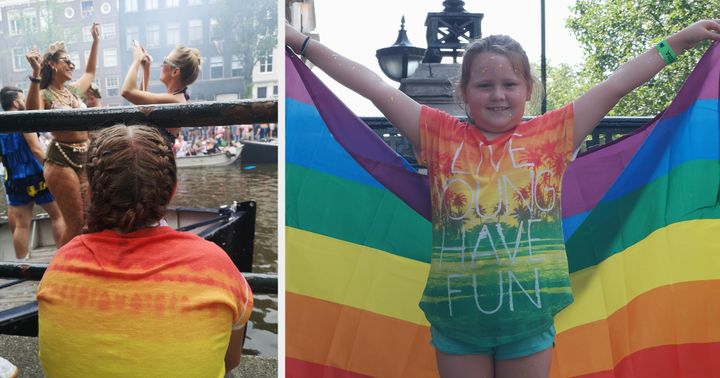
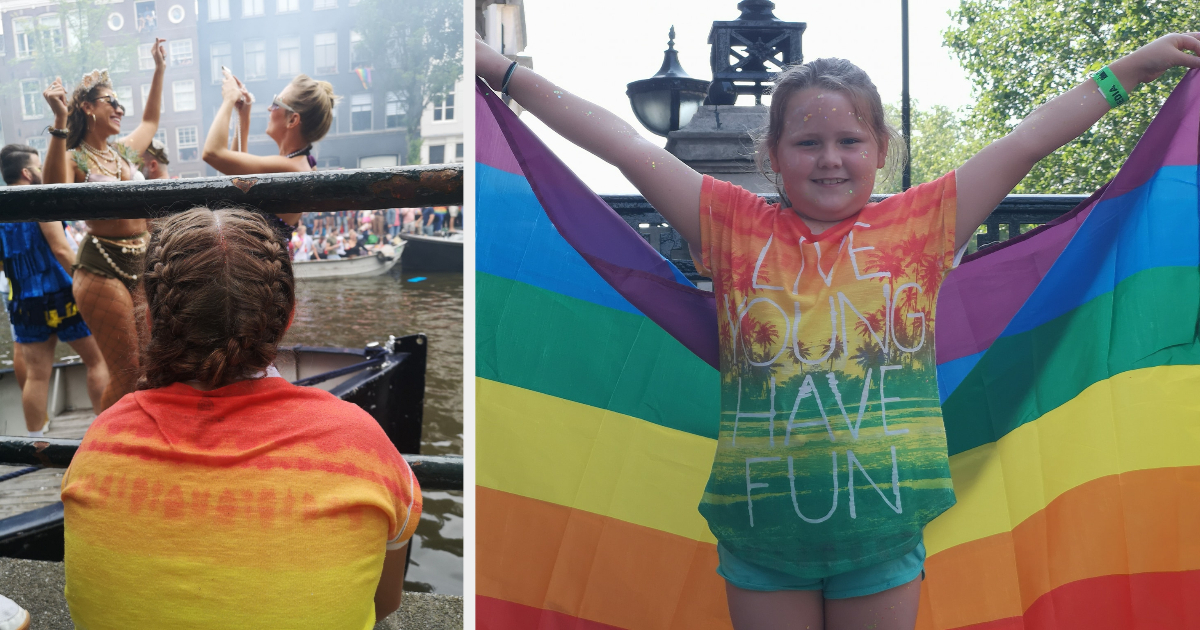
“I have taken my daughter to Pride In London, Canterbury Pride and Amsterdam Pride. All of these events are different and I wanted to show her how different people celebrate Pride.
“To me, Pride means supporting people with their life choices, I grew up in a time when it was taboo (I am 49). It was frowned upon and I remember that it was always a scandal when an actor or singer announced they were gay. People that were transitioning into the opposite sex were laughed at and ridiculed. I did not want any of my kids to grow up without understanding and supporting people’s choices.
“Matilda was about six years old when I first went to Pride in London. We went by accident, but then she would ask me when Pride was happening again. Then in 2019 we decided to fly out to Amsterdam early one morning and attend Amsterdam Pride. Instead of the parade going through the streets, it was all on the canals in the city. It was awesome, a complete game-changer for Pride.
Advertisement
“When she was little she loved the vibrance of pride, she loved meeting different people who dressed up for Pride. As she got older, she learned the history of Pride, she wanted to support everyone more. She has held a sign up before offering hugs to members of the LGBTQ community and I am so proud of her.” – Vicky Warren, 49, Kent, who runs the blog Miss Tilly And Me
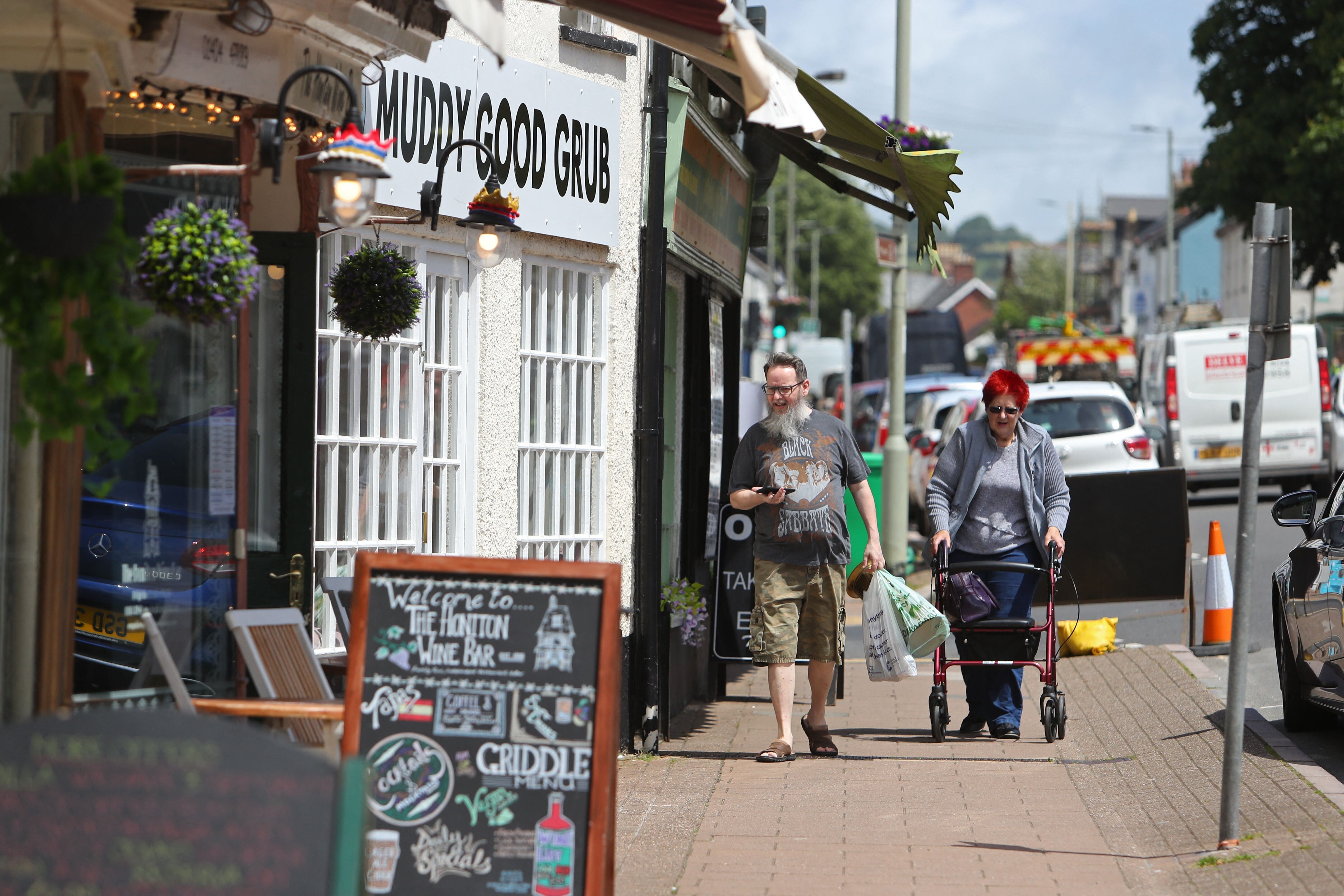
“I know he’s a madman in some ways,” says Loll Christie on Honiton high street. “But my argument again is — I think he kind of deserved a little party?”
The Lib Dems are expected to win the Tiverton and Honiton by-election on June 23, overturning the current hefty 24,000 Tory majority.
Advertisement
But there are still quite a lot of Conservatives in Devon. And the expectations game can kill you.
It has not been a good few weeks for Boris Johnson. And there are a lot of things going in the Lib Dems favour.
Tiverton is in their former south west stronghold – although the party has never held this seat itself.
At the local elections in May, the Lib Dems seized control of neighbouring Somerset council. The party has climbed to 15 per cent in the national polls.
The prime minister was recently almost ousted by his own MPs, but his survival has allowed opposition parties to argue it is the entire Tory party that needs to be given a kicking.
Advertisement
And the by-election itself was triggered when the incumbent Tory MP, Neil Parish, resigned after being caught watching porn in the Commons.
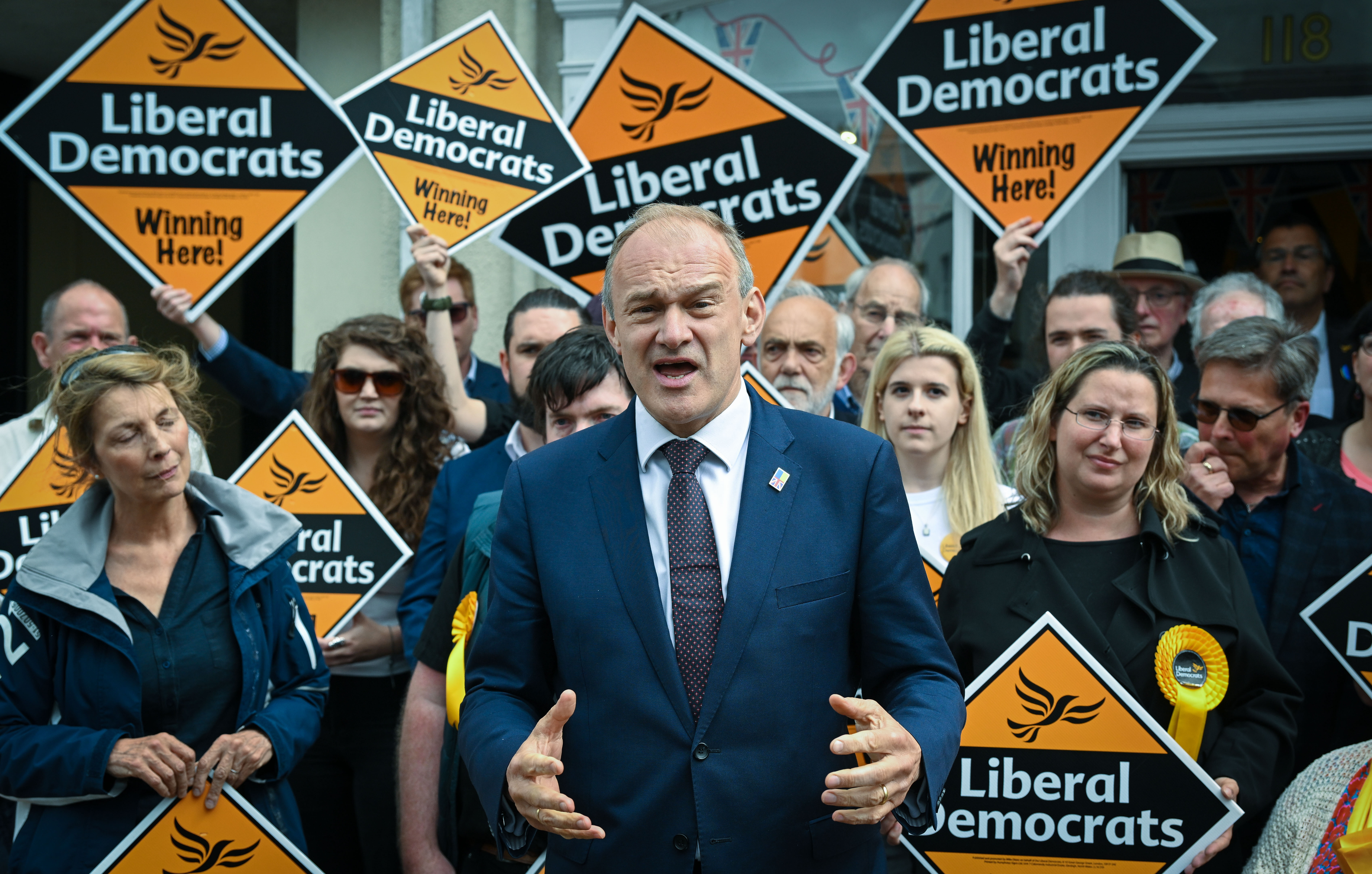
“The tide,” Ed Davey says, “Is going out for the Tories.” But the Lib Dem leader, campaigning in the seat, is trying to stop everyone getting carried away.
“The Tories are fighting far harder than they did in North Shropshire,” he says. “There is a battle on our hands. I think it could be really close.”
It is a delicate balancing act, of making a Lib Dem victory highly possible, to make it worthwhile voters turning out, but not so inevitable potential supporters do not think they need to.
In December the Lib Dems overturned a 23,000 Tory majority in North Shropshire. This time last year they did similar in Chesham and Amersham.
Both of these seats were snatched before the partygate saga had played out and the cost of living crisis had yet to bite.
Repeating it in Tiverton and Honiton would arguably be their biggest scalp yet.
All three are part of what the Lib Dems have successfully, and somewhat cheekily, branded the “blue wall” – southern Tory seats the party hopes are vulnerable to a yellow wave.
A few days out of the Chesham vote, Lib Dems on the ground were bullishly confident of victory. Westminster was somewhat taken by surprise by that result.
In Tiverton and Honiton the mood is more cautious optimism, despite a Tory loss already having been priced in by many Conservative MPs.
Advertisement
“People do think that. The bookies think that. They are just wrong. I mean, they don’t see the data we see, they don’t knock on doors,” Davey tells HuffPost UK when asked if the Lib Dem candidate, Richard Foord, is all but certain to be elected on Thursday.
“What’s different from North Shropshire is that some Labour supporters are already backing us. It took time to switch them in North Shropshire,” he says.
“The difficulty is you only win these seats if you persuade Conservatives to move over. Some Conservatives in Tiverton and Honiton are angry. But not all of them.”
On the same day as people vote in Tiverton and Honiton, there is a by-election in the red wall Tory held seat of Wakefield.
Labour are expected to easily win the seat back. Although, again, party sources are talking down expectations of a landslide. One poll gave Labour a 20-point lead in the seat.
Advertisement
Davey rejects the suggestion he struck an agreement with Keir Starmer to divvy up the two seats between them. “There’s no deal,” he says. “It’s just rational behaviour.
“My job as Lib Dem leader is to get as many Lib Dem MPs we can with the resources we’ve got.
“We have had a really strong legacy in the West Country. This was a natural seat for us to come and put our scarce resources into.”
He says the party has a “great candidate” in Wakefield. But concedes he is unlikely to mount a serious challenge.
“It was a Labour seat for a long long time. We don’t have the tradition that we have down here. We’ve got a candidate and are proudly flying the flag. But, you know, you face political reality under first-past-the-post.”
GEOFF CADDICK via Getty Images
Advertisement
Honiton high street is lined with bunting. Union Jacks jut out from every shop, still up in celebration of the Queen’s Jubilee.
If the Conservatives do hold on to the seat, it will be hard to argue it was a result of a door-knocking charm offensive.
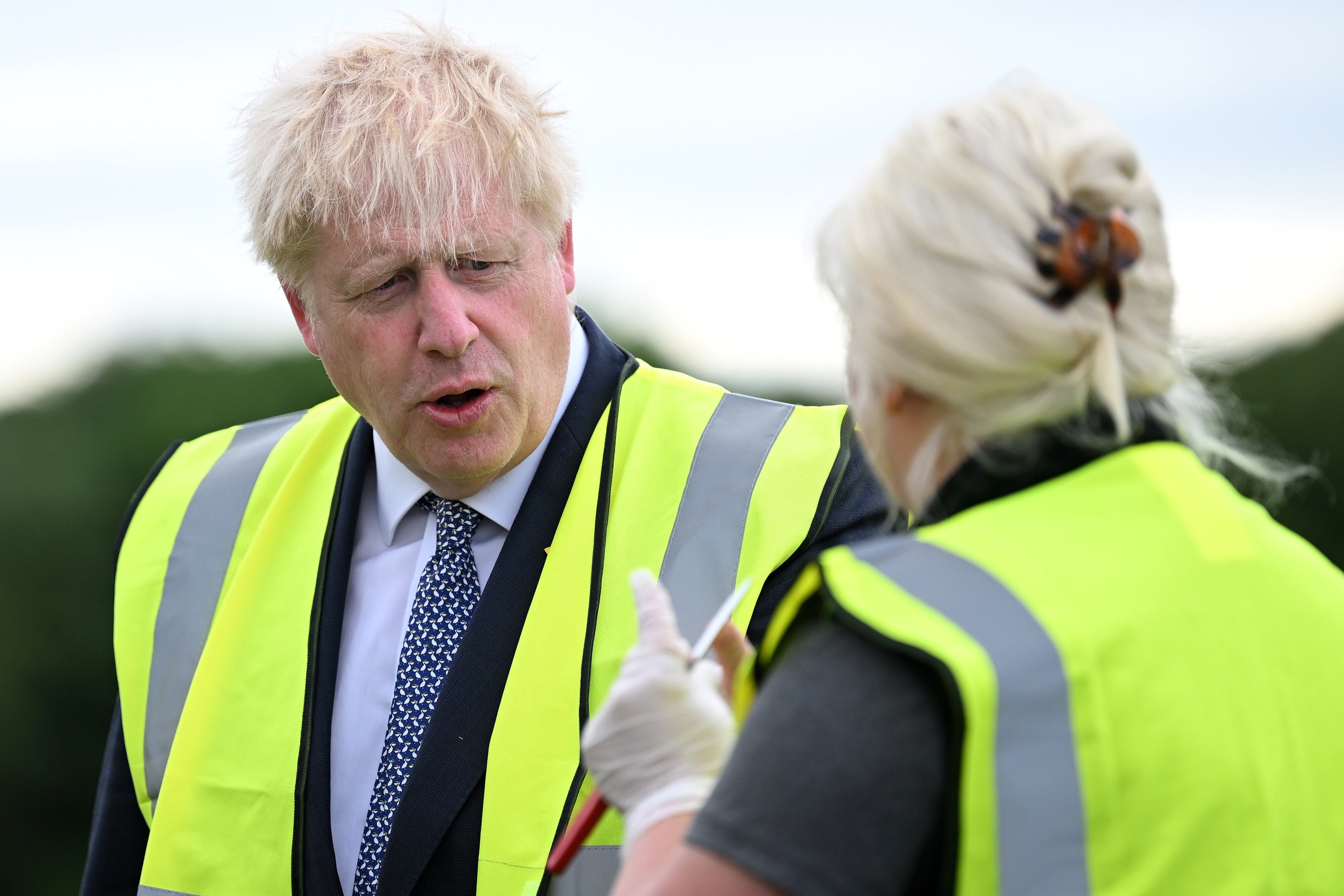
Opposite The Crusty Cob bakery a film crew is hunting for the prime minister, who, somewhat covertly, is in the constituency. “Boris Johnson rumoured to be in Devon,” runs the headline on the local Devon Live website.
Rishi Sunak was spotted earlier in Complete Meats, but the butcher is not terribly excited or showing signs of having been aggressively canvassed. “He’s quite short. Think he just came in for some lunch.”
Helen Hurford, the Conservative candidate, has also not exactly been a constant presence.
A former headteacher who runs a beauty academy, Hurford has not been hugging Johnson close and has been somewhat evasive about whether she would have backed the PM in the confidence vote.
Advertisement
Perhaps surprisingly Neil Parish, given the circumstances of his resignation, is not a pariah.
Foord, a former soldier, says many locals respect how Parish “went quickly”.
“They contrast the very dignified way in which Parish resigned straight away with Johnson,” he says.
“Neil wasn’t a wholly unpopular MP around here. At least he did the decent thing. It’s just a pity the PM doesn’t do the same.”
The Tory campaign is alive to the Lib Dem threat. “Thinking of voting Liberal Democrat?” one bright Lib Dem yellow leaflet delivered by the Conservatives to voters asks, before accusing the party of wanting to “rejoin the EU” and “actively plotting to put Labour into power”.
And as Davey observes, there are plenty of people who remain charmed by the PM.
Christie, 30, supports the PM. “I’m not a rich person. I know that a lot of people look at Tories as rich people. I live day-by-day, penny-by-penny. I think he has done quite well.
“In the way that he’s actually had Covid, had a baby and the whole process and just having to go through so much stuff.”
Advertisement
Wayne, 45, shares that view. “I still think that none of the others would have done what Boris has done. He’s the man who’s taken it on the chin. And he’s accepted taking it on the chin.”
The safe bet next week is that the Lib Dems will have pulled off another stunning by-election victory.
But even just as Johnson’s allies claimed seeing off a no confidence vote by one MP would count as a win, holding on in Tiverton and Honiton, despite everything, will be hailed as proof the PM retains his magic electoral touch.