7 Reasons Greta Thunberg Is Spot On With Her Takedown Of UK Climate Promises

Greta Thunberg denounced the claim that the UK is a climate leading nation on Friday and said that is a “lie”.

The Swedish activist has a reputation for calling out world leaders when they don’t act on their climate promises – and it now seems the UK is in her sights. 

She attacked the claim that the UK has reduced its climate emissions by 44 percent since 1990, a comment prime minister Boris Johnson made at this year’s Leaders’ Climate Summit, and said that Downing Street is good at “creative carbon accounting” instead.

Thunberg added: “I am hoping that we stop referring to the UK as a climate leader. If you look at the reality, that is simply not true.”

Her words are particularly significant given the Intergovernmental Panel on Climate Change has just declared the environmental crisis a “code red”.

Here’s a breakdown of the top concerns about Britain’s battle against the climate crisis.

CARL-JOHAN UTSI via Getty Images

Swedish climate activist Greta Thunberg poses for a photo 

1. UK Emission targets aren’t as ambitious as they seem

The UK has technically promised to cut emissions faster than other developed nations by vowing to make 68% cuts by 2030 when compared to UK emissions released in 1990.

The UK does have the 2035 target to cut 78% too, according to the 2008 Climate Change Act, and it did cut more greenhouse gas emissions between 1990 and 2016 than any other G7 country.

However, the UK’s emission figures are misleading. Britain contributes to approximately 2% of the global emissions, meaning its target cuts are unlikely to have a major impact.

The US contributes 15% to global emissions, and has promised to cut around 50% when compared to 2005 levels – meaning by 2030, the States will have had more of an impact than the UK.

Emissions for UK transport have not shifted much at all over the past decade either, and home heating emissions are still very high.

Rachel Kyte, former top World Bank official at the Paris climate talks, told The Guardian: “What the UK is doing is like dad dancing – it is not that they’re evil, just that they are very uncoordinated. They have not yet perfected a whole government approach to getting to net zero.”
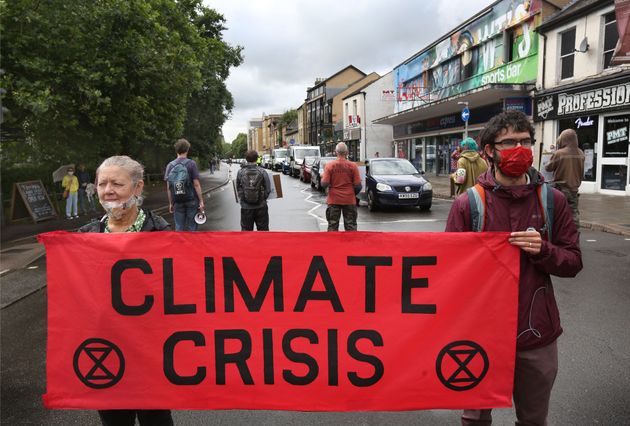
SOPA Images via Getty Images

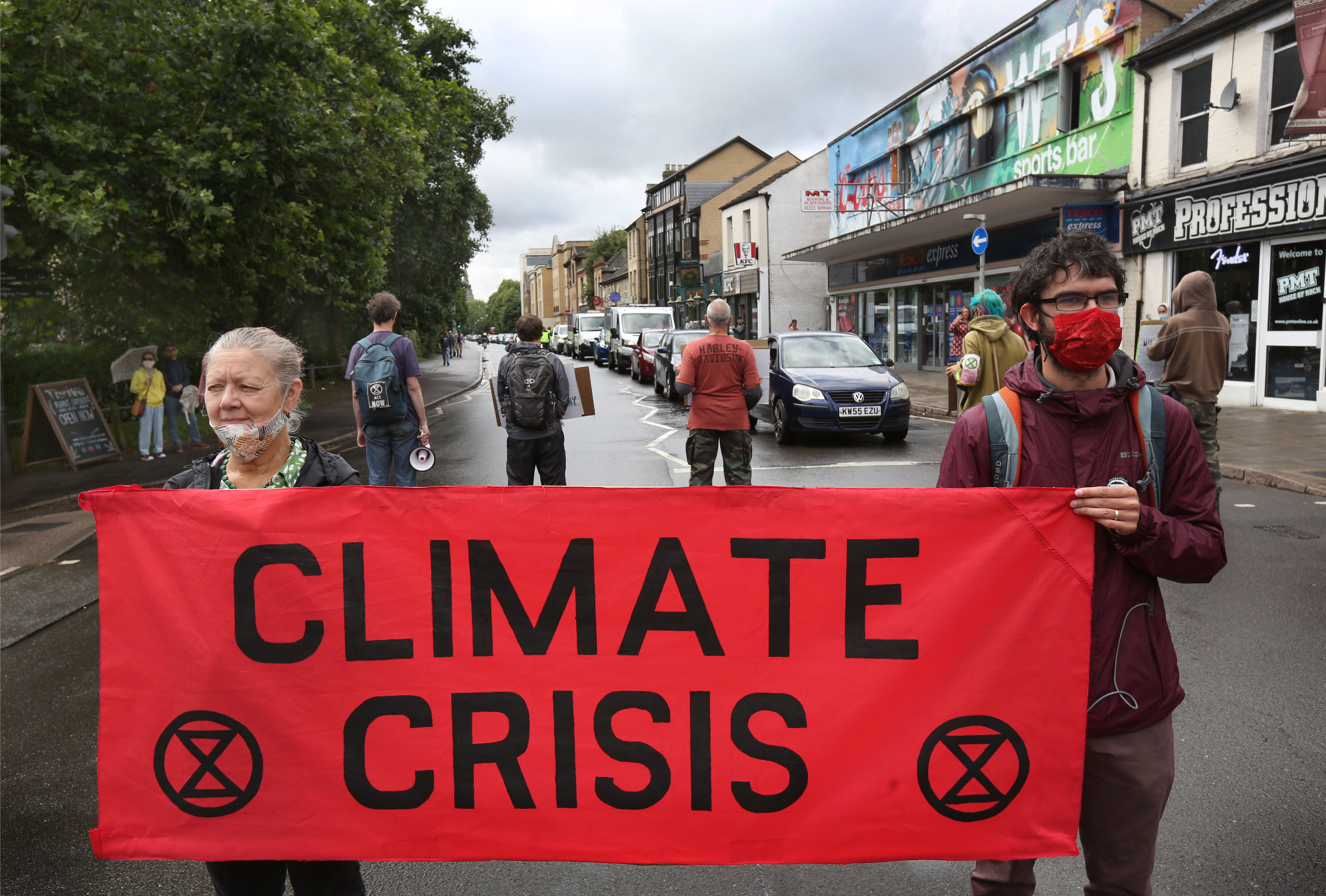
Protesters hold a banner saying climate crisis during the demonstration in Cambridge

2. Official climate advisers worry there’s no plan

The UN did actually urge more countries to follow the UK’s lead ahead of COP26, back in February.

The UK and the EU were the only two out of the world’s top 18 greenhouse gas emitters to submit plans for reducing emissions in the winter.

But, despite having a plan, there are concerns it was not thorough enough.

Chief executive of the Climate Change Committee, Chris Stark, shared his worries with Sky News in June about how the UK would reach net zero by 2050.

The government adviser said: “It is true the ambition of the country has changed in the last 12 months and this useful.

If we don’t take action now we risk falling to the back of the pack on tackling climate changeThe Energy and Climate Intelligence Unit’s Jess Ralston

“But unless it is being physically delivered, so the things that will drive us towards net zero, the changes we will see in homes, industry and transport, we can’t say we are credibly on track. The government has to change course.”

The committee advisers made 200 recommendations to Downing Street, including a Planning Bill to ensure new houses are low carbon and adapted for rising temperatures.

The committee also claimed the UK would only have to spend less than 1% of GDP a year to meet the net-zero target, and it could deliver a return boost of 2% by 2035.

The climate advisers also said the country was less prepared to tackle global warming than it was five years ago.

Stark said: “We’ve been raising our concerns consistently for some time now. [The government has] found it far too easy to dismiss those.”
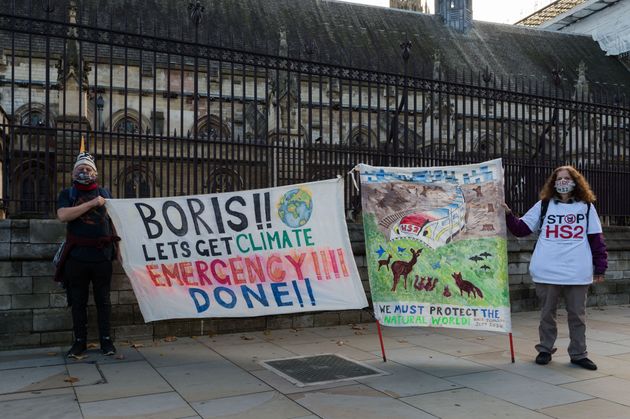
Barcroft Media via Getty Images

Environmental activists protest in Parliament Square against the UK’s High Speed 2 railway project as well as the Government’s failure to act on the climate and ecological crisis in October 

3. The UK is not adapting to a warmer future

The climate goals mean the world will have to adapt to an increase in temperature of between 1.5 degrees Celsius and 2 degrees Celsius in the next 80 years.

If not enough is done to reduce global warming, the average climate could rocket up to 4 degrees Celsius.

Professor Dame Julia King, chair of the Climate Change Committee, warned in June: “We cannot deliver net zero without adaptation.

“It’s absolutely illogical that we are not doing it.”

She also claimed it was a “failing” that the Treasury’s assessment did not consider the cost of adapting the nation to climate change.

Downing Street responded by acknowledging the report and saying it would examine its recommendations “closely”.

SOPA Images via Getty Images

A taxi drives through a flooded Farringdon Lane in central London after a day of heavy rain in the capital in 2021

4. Time is ‘getting a bit thin’ to make a change

The Energy and Climate Intelligence Unit’s Jess Ralston said the UK needs to make an action plan ahead of the year it hosts the climate summit.

She told Sky News: “This year is the government’s chance to prove to the world that they are not just talking about this, they are delivering on it as well.

“Time is getting a bit thin.

“If we don’t take action now we risk falling to the back of the pack on tackling climate change. We also risk missing out on new life-long jobs in green industries, which are the future of the UK.”

However, the government did respond to Ralston’s complaints.

A spokesperson said: “Our forthcoming strategies on heat and buildings, hydrogen, transport and comprehensive net zero strategy this year will set out more of the very policies the Climate Change Committee is calling for as we redouble our efforts to end the UK’s contribution to climate change.”
John Keeble via Getty Images

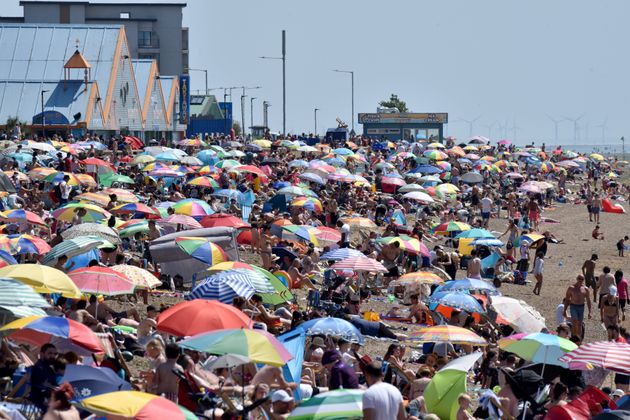
Heatwaves are becoming more frequent in the UK

5. Many changes are already ‘locked in’

According to the Climate Change Committee, the UK has already seen the average land temperature rise by around 12 degrees Celsius from pre-industrial levels.

Sea levels from around the country have risen by 16cm since 1900 as well, and extreme heat is becoming more common.

In the last five years, more than 57,000 new homes have been built which the committee believes are not resilient enough to sustain higher temperatures.

In the last three years, there have been 4,000 deaths related to heat in England alone.

Nearly 60 percent of the total risks noted by the committee were also given the highest urgency score.

Peter Summers via Getty Images

Oil rigs in Scotland

6. The UK gives a lot of subsidies to fossil fuel companies

Britain gives more subsidies to fossil fuel firms than any other country in Europe.

The government is also attempting to open a new coal mine in Cumbria, near Whitehaven, while continuing to grant new oil and gas exploration licenses.

There is an ongoing debate about the proposal to mine Cambo – an oil field in the North Sea – as well, even though it could undermine the UK’s credibility at COP26 in Glasgow come November.

This site could produce up to 880 million barrels of oil.

However, shouting down calls from activists not to open the oil field, Downing Street has said the initial exploration license was granted two decades ago.

It also claimed that if anything is extracted, the Oil and Gas Authority will only grant a license for 170 million barrels.

7. The UK relies on ‘false solutions’

The UK has been criticised for relying on “offsetting schemes” which promisees to reduce carbon emissions in the future.

However, delayed action could contribute to an additional 1.4 degrees Celcius of warming.

Friends Of The Earth claimed carbon offsetting does not work most of the time in practice, after a study for the European Commission found only 2% of offsetting projects were likely to resulted in additional emissions reductions.

The campaigners claimed carbon-offsetting was not the best way to tackle the climate crisis, and that it was best to prioritise the reduction of carbon emissions. This is a view also shared by renowned environmental organisation, Greenpeace.

Share Button

How To Deal With A Boss Who Sucks At Listening To You

Bad bosses come in all kinds of flavours –- from incompetent to just plain jerk -– but one of the most frustrating kinds of managers is the one who never seems to listen to you. Your ideas, requests and complaints are ignored or rejected. Everything you say seems to go in one ear and out the other.

At a certain point, not feeling heard can take a toll on your psyche. In a survey by the Society for Human Resource Management, 84% of U.S. workers say poorly trained people managers create a lot of unnecessary stress. The workers’ biggest recommendation on what their bosses could improve? Their communication skills.

Ideally, good bosses take the time to proactively ask what’s working and what’s not in your one-on-one meetings with them.

But when your boss is not listening to you, you have two options: either do nothing and hope your boss realises you are unhappy, or you can take actions to make yourself heard.

Jennifer Tardy, a career coach and diversity and inclusion consultant, said too often she sees employees who avoid dealing with their boss and are not comfortable talking in a direct way or in a timely manner to them.

“Employees wait too long to have the courageous conversation and now the situation has compounded,” Tardy said. “At this point, rather than have a rational, logical conversation with their manager, they explode ― often with emotion leaving the core message to get lost in.”

There are helpful steps you can take about feeling unheard long before it gets to that point.

Here’s what you can do to salvage a relationship with a boss who is not listening to you –- and when to decide enough is enough.

1. Diagnose whether they don’t listen to anyone, or just you.

Gorick Ng, a career adviser at Harvard University and the author of “The Unspoken Rules: Secrets to Starting Your Career Off Right,” said that when employees deal with bosses who are not understanding them, they may want to jump straight to quitting as the “path of fastest relief.” But one way to figure out if you can save the relationship is to take the time to understand where your boss is coming from.

“Whatever you’re dealing with, someone else has dealt with before.”

– Gorick Ng

To do that, first try talking to people who work with or used to work with your boss. “Whatever you’re dealing with, someone else has dealt with before,” Ng said.

He suggested asking questions about how your boss prefers to communicate, such as “What’s worked with this person before? Are they someone who needs to see it on paper? Are they someone who needs a nice long pro/con list? Are they someone who needs a mockup or draft? Are they someone who needs to hear it from a certain person?”

“What you’re really trying to figure out is if this is a problem that you can solve,” Ng said.

After you do this bit of research, you should have an idea what will get your boss’ attention, be it project deadlines or influential colleagues. If your manager listens to what a certain colleague says, for example, you could focus on asking that colleague to be the whisper in your boss’ ear about your ideas, Ng said.

2. When you bring it up to your boss, make sure that you have a solution in mind.

Once you diagnose your boss’ deal, you can have a conversation. But don’t simply complain. Get specific about what actions made you feel unheard, and bring solutions that could address the problem.

Tardy said you should ask yourself what specific actions your boss took that led to this. What specific actions would my boss need to take for us to remedy the challenge? That way, when you bring it up with your boss, you can be clear on their role in the problem and in the solution.

And then after you acknowledge how you felt unheard, have a solution on what could make your joint communication style better.

“Many times when we have courageous conversations, we leave it to the other party to figure out what action to take to reach the solution,” Tardy said. “The more specific you are on the action you want from your boss, the more clearly you can articulate it to them so they can take the action.”

You can bring up solutions with language such as, “Hey I know we’re trying to achieve this. I was thinking of this option or this option or this option. These are the pros and cons. My suggestion is that we might want to consider option B. What is your reaction?” Ng said.

Or, the solution can be brought up as simply as something like, ”‘Would it be helpful if I did ‘blank’?’” Ng added.

3. If talking and suggesting solutions fails, it’s time for change ― either your boss or your job.

If you’ve exhausted these options, and nothing has changed, then it’s time to consider switching it up ― perhaps out of the job altogether.

First, you can try leaving your particular manager if you still want the role.

“Change doesn’t mean leaving the company. Maybe it means leaving the manager, but staying in the department or company,” Tardy said. “Escalation means talking to your manager’s manager. Oftentimes, messages that go unheard from an employee become clearly understood by a leader.”

But if leaving your inattentive manager is not a possibility, then it really may be time to start looking for a new job where you and your ideas will be heard. And then, at this new job, you can hash out communication styles with your boss up front.

“If you make it very clear that you need to feel like your ideas are heard, and define what that looks like when it doesn’t happen, it will be easier for you to bring up three, six or 12 months into the role with the manager,” said career coach Kaitlyn Buckheit, who specializes in career transitions. “You won’t be bringing up the topic for the first time.”

Share Button

What Is Single-Origin Coffee, And How Is It Different From A Blend?

As more people have been working from home over the past year, coffee drinkers have had a chance to explore coffees apart from their usual Starbucks or Costa. Home baristas are digging into specialty coffee, grinding their own beans and making cold brew, Japanese iced coffee, espresso and pour-overs in their own kitchens. As a result, they’re realising there’s a whole unfamiliar world of coffee beans out there – one of which is single-origin coffee.

Most third-wave specialty coffee companies offer both single-origins and blends, but what’s the difference between them and what should you be buying and drinking?

What is single-origin coffee, anyway?

Essentially, single-origin coffee comes from a single producer, crop or region in one country.

“Single-origins are small lots and typically, depending on how granular you get, single-origin can be from a single country or region, and you can go all the way down to as granular as a specific lot size, which would be a small section of a [coffee] farm where they’re growing one specific type of coffee,” explains Jeremy Brooks, Verve Coffee Roasters’ head of sourcing and green coffee buying.

“Single-origins really do highlight the terroir of a specific place – so how the coffee tastes in that place,” Brooks adds. “Single-origins are typically very expressive of the country where they’re purchased from. Ethiopian single-origin coffee is like eating a peach. Whereas with blends, we can play around and position them in a way that actually gives you a little bit more of a dynamic range: Instead of having a peach, you have a peach cobbler.”

Most blends contain single-origins, but the difference comes from how a coffee roaster will build a flavour profile. “We’re taking coffees that maybe have one attribute of chocolate or plum and then you’re building something in order to bring a coffee to a customer that would allow them to experience it in a certain way,” Brooks explains.

Which tastes better: single-origins or blends?

“I think there is a time and place for everything,” Brooks says. “Early on in my coffee career, I was a die-hard single-origin maker. I would only drink single-origins. As I developed my coffee career and I’ve also become closer to the sourcing and roasting side, I now understand the value in both. They both play an important role in sourcing and the supply-chain side of how we support farmers and kind of what you want to taste. Like anything in your life, it depends on your mood.”

“Blends are a way that roasters communicate a vibe or something about themselves, something signature,” Talitha Clemons, owner of the Oklahoma City-based mobile coffee company Bright Vibe Coffee and a coffee taster competitor, tells HuffPost. “Maybe they want to create something that will remind folks of time around a fire or of holidays. When you taste a blend called Fireside, Sweater Weather or Tropical Weather, you are in a frame of mind to let that coffee take you to a place or a moment or memory, rather than focusing so much on given tasting notes. What is difficult for me is that a blend can contain multiple coffees and you may get some information about the regions the coffee comes from, but the level of transparency changes.”

Single-origin coffee can come from a single producer, crop or region in one country.

Single-origin coffee can come from a single producer, crop or region in one country.

Veronica P. Grimm is the founder of Glitter Cat Barista, an inclusive organisation focused on helping minority groups become baristas and providing them resources to compete in coffee competitions. Grimm prefers to work with blends in these competitions because it balances the coffee with more depth. “Basically, [it’s] like having a soprano and a bass in a choir,” she says.

“When they are in harmony it is beautiful.” Despite preferring blends over single-origins in the field, Grimm likes to drink single-origins. “Blends bring together something magical in a cup of coffee,” she says. “But blending coffee takes work and on a daily basis I like to just enjoy what I’m drinking without too much thought.”

While both single-origins and blends will appeal to different types of coffee drinkers, Brooks said some people complain about how acidic or sour single-origins can taste. “It is a little bit more of a unique flavour profile that you have to grow to love,” he says. “Sometimes people can take that as a negative. On the reverse, some people can say that blended coffees are boring, they don’t have any flavour at all, that you have to put milk and sugar in them just to make them taste good.”

Clemons points out that just because a blend might not taste like a single-origin, the blend’s quality isn’t necessarily inferior. “Blends can be really tasty,” she says. “I am all for adding sugar and milk if and when you want it, but feeling the need to add something to coffees like milk or sugar because something it is lacking can have more to do with that coffee not hitting the notes you hoped it would.”

Brooks recommends that single-origins are best made with paper filter pour-overs, or a Chemex. As for blends, “If you’re looking for something with more body and you’re wanting the coffee to showcase a little bit more of that blend traditional flavor profile, using a drip pot or doing a French press is really good with blends,” he advises.

Single-origin costs a bit more than blends

During the pandemic, Verve saw an increase in online sales, with single-origins outpacing blends – Brooks thinks more at-home brewers are curious about specialty coffees. Single-origins tend to cost more than blends, but customers are willing to pay the higher price points.

“I think that people should drink the coffee that they can afford. Things are rough and there are folks who love to drink several cups of coffee throughout the day. I say just buy the best coffee that you can buy,” says Clemons.

For novice single-origin drinkers, Brooks recommends they start with mild Latin America coffees from Costa Rica and Colombia. “They tend to be inherently sweet and really approachable,” he says. “As you progress, you can get into some of the more exotic profiles, getting into Africa, especially East Africa.”

Whether you buy single-origin or a blend, here’s why you should always look into where your coffee is sourced

As both Brooks and Clemons stated, the most important part of buying any coffee is the ethical practices of the company. “I would love it if people drank more coffee that is sourced ethically from roasters who practice direct trade, safe and equitable work environments for employees, and who bring us tasty coffees,” Clemons said. “There is a need for wage transparency, racial equity, access and so much more in the industry as a whole.”

Brooks echoes similar thoughts. “Whenever you’re really looking to buy coffee, you’re really looking at the underlying missions and values of the people who are buying the coffee and the coffee that you’re drinking,” he says.

“If there’s a coffee company that’s buying really amazing blends and they’re paying their farmers really well, and they’re making a blend and that’s your approach, I think as long as you’re buying the coffee you know is supporting the long-term sustainability of the coffee industry as a whole, then you’re doing your part. If some coffee companies are really doing that just through their single-origins, then I think you should buy single-origins. But if they’re doing it through their entire buying philosophy, with their blends through their single-origins, I think it’s perfectly fine to buy from either side.”

The bottom line: Give new coffees a chance

Changing one’s coffee palate takes time, and a big part of that is education. “I think a lot of people are like, ‘This is weird. I’m out. I’ll just go back to whatever I was doing before,’” Brooks says. “I think once you start understanding it, you start to appreciate it because you realise this is intentional. This doesn’t just taste this way by accident – they’ve actually done something to make it taste this way, and that’s really cool. I think that once people start taking the time to learn about the coffee – the processes and the growing – and they learn about how complex it can be, they start to appreciate it.”

Share Button

We Tried 8 TikTok Beauty Trends To See If They Really Work

TikTok is littered with hair and makeup tutorials, ranging from the wacky to the “oh, this might actually be doable.” While some of them aim to solve common everyday problems (like a flat ponytail, for example), others are a little more out there (for instance, it’s a mystery why anyone would feel the need to draw fake freckles on their face, but that’s a viral tutorial nonetheless).

While no one should feel pressured to sport faux freckles or contour their face to look like a Kardashian, I wanted to see if these TikTok beauty hacks at least deliver on their claims. In that spirit, I tried eight viral TokTok beauty trends to see how they actually work.

1. DIY skin tint (or BB cream)

The concept behind this trend is mixing creams you already own to create a custom shade of skin tint. See an original TikTok video highlighting the trend here:

BB, which stands for “beauty balm,” is meant to be a lightweight base, so mixing your foundation with other products (primers, SPF and more) makes sense. You’ll note that in the original video above, the creator added sunscreen – but be warned that mixing sunscreen with other products diminishes the SPF factor and offers less protection. For this DIY product to work, you have to ensure your foundation and primer have the same base ingredients – for example, if one has a silicone base, the other should too; otherwise the product will roll right off your face.

Did it work?

It did! It feels like the perfect base for summer. I found it was a little tricky applying with a brush, but it was smooth and easy when using fingers. It’s like “your skin but better.” Plus, it’s great that you can customise how much glow or moisturizer you want to add.

Here’s a video of my experiment:

2. High ponytail for long hair

This popular tutorial creates a ponytail that sits up super high and is extra voluminous. It’s done by twisting the hair tie around the bottom part of the ponytail twice. It sounds like it won’t make much difference to the height of a ponytail, but as someone with long and heavy hair, I’m willing to try anything. See an original TikTok tutorial here:

Did it work?

Not only did it work, but it was also extremely easy! And it doesn’t feel like a ponytail that’ll give you a headache. Here’s a video of my experience:

3. A makeup routine that claims to be sweat-proof

If you prep your skin and apply your base makeup products the way this tutorial suggests, it claims to be absolutely sweat-proof. This was inspired by the way drag queens do their makeup, as are many great discoveries in the beauty world. It goes like this: moisturiser, translucent powder, setting spray, makeup primer and foundation. Here’s an original TikTok tutorial:

I originally tried this trick in March 2020 and found it to be a little cake-y for my dry skin, but I was willing to give it another go.

Did it work?

Initially, yes. The base looked very good upon application. But after a while it started pilling (balling up) around my neck. I think it’s one too many layers for me, but I’d still try it again being more careful around my neck area.

Here’s a video of my experiment:

4. The scrunched-up tissue eye look

When I first saw this look, I thought there’d be no way it could actually look good. You take a tissue, wad it up, dip it in random colours of eyeshadow, and dab it on your eyelids to create an artistic, almost tie-dyed look. Here’s an original tutorial from TikTok:

Did it work?

I loved this! Who says you need expensive brushes to create something fun? All you need is a colourful makeup palette and some tissue. Sure, it looks a little messy, but it’s a fun and colourful look I’d gladly wear again. I think brighter colours work best for this beauty trend.

What I used: The NikkieTutorials x Beauty Bay palette. Here’s my take:

5. A quick way to fuller lips

Overlining lips isn’t new, though it grew in popularity thanks to Kylie Jenner. Not everyone loves the overlined look – it can look like too much (it can also look like you have a thin moustache), but this tutorial promises it’s not only easy but very quick, too. Huda Kattan of Huda Beauty recreated it, and she’s also a fan.

Essentially, you purse your lips together very tightly and apply the lipliner around and inside the lips. In essence, because the lips are stretched out, you get a more even overline more quickly. Check it out:

All you need is your lip pencil and a liquid lipstick or lipstick of choice. I tried it with red, as I was feeling adventurous.

Did it work?

I suppose so, but it’s a lot more overlined than I’m used to so it looked weird at first! It was quick and easy, though. I prefer not drawing over my cupid’s bow, and once I cleaned up that part, I liked it a lot more. I used the MAC lip pencil in Cherry and Colourpop Ultra Matte Lip in Creeper. Here’s my video:

6. 10-second contour

All you need is a stick bronzer, your foundation and 10 seconds to the perfect contour. Sound too easy? That’s what I thought, too. You simply contour over the lips, under the cheekbones and chin, and on the forehead, add your foundation on the rest of the face and blend in, like this:

Did it work?

Surprisingly, yes. It was easy and quick and blended in really nicely ― I will certainly use that hack again.

Here’s my take:

7. Using a burnt almond as eyeliner

I couldn’t believe that burning an almond could actually be used as a smoky eye liner/shadow, but apparently it works. I obviously had to try it out, as it seems like an easy and affordable way to do your eye makeup. You just take an almond, burn the tip a little bit, wait for it to cool down (this step is important!) and apply it like you would your shadow when doing a cat-eye. Watch this:

Did it work?

Somewhat so! It was a lot harder to get color out of the almond. Also, let me advise you again to wait until the almond isn’t burning hot! It’s more of a soft smoked outline and though it was a fun challenge, I think I’ll stick to my black eyeshadow and liner for future looks. Here’s my take:

8. Easy and natural-looking freckles

TikTok is full of faux freckle videos, most including fake tanning mousse, which are intimidating and can easily go wrong. However, this tutorial uses Maybelline Brow Tattoo, which is meant for your face ― so I was hoping the colour whould be more natural-looking. Here’s what it claims to do:

To be on the safe side, I picked a color lighter than my hair —colour Medium Brown — and applied it across my nose and cheeks.

Did it work?

It worked so well! It created a very natural-looking result ― I went over my natural nose freckles and did some more over my cheeks. I think leaving it on for two hours wasn’t necessary, but the product’s instructions recommend that for the colour to last three days. I will try it again, for sure. Here’s my attempt:

Share Button

Little Mix: 20 Incredible Old Photos That Show Just How Far They’ve Come

Beretta/Sims/Shutterstock

Little Mix pictured in December 2011

In the 10 years they’ve been in the public eye, Little Mix have topped the charts, dominated the headlines and become style icons in their own right.

But it wasn’t always that way.

You see, they’ve come so far in the past decade it’s easy to forget that the hit girl group started life as four girls who auditioned for The X Factor as soloists, only to be put together as a four-piece group by the judges at the eleventh hour.

And as these old photos show, they were still a long way off establishing themselves as the group we know and love today in that first year.

On the 10th anniversary of Little Mix’s formation, let’s take a stroll down memory lane and remember the girls as they were – clashing prints, patterned braces, questionable dye jobs and all…

Like One Direction before them, Little Mix were formed at Bootcamp, after originally auditioning as solo artists. It was Destiny’s Child singer Kelly Rowland who first saw the potential in the four-piece as a group.

ITV

A month later, the newly-formed Rhythmix (as they were then known) were off to Greece, where they performed for the first time in front of the very 2011 crowd of Tulisa and Jessie J.

ITV

Little Mix

In those days, X Factor was synonymous with its makeovers. After making it through to the live shows, here’s what X Factor’s team of stylists did to Jade, Jesy, Leigh-Anne and Perrie…

Ken McKay/Shutterstock

4 October

As live shows got underway, the newly-formed band became known for their wardrobe, which included lots of bright colours, bold prints and shiny materials.

Ken McKayKen McKay/Talkback Thames/Shutterstock

8 October

Seriously, they loved a print.

Ken McKayKen McKay/Talkback Thames/Shutterstock

16 October 2011

It was this eerie Halloween week performance that cemented the girls’ place as contenders in what became a stiff competition…

Ken McKayKen McKay/Talkback Thames/Shutterstock

We’re giving you fair warning, do not look directly at these skirts…

Ken McKayKen McKay/Talkback Thames/Shutterstock

Or, frankly, these skirts (though that has less to do with their luminous properties)…

Ken McKayKen McKay/Talkback Thames/Shutterstock

As the renamed Little Mix’s popularity grew, they began being papped on their way to X Factor rehearsals.

BerettaBeretta/Sims/Shutterstock

Is this photo making anyone else want to buy some Dove soap? Just us?

Ken McKay/Talkback Thames/Shutterstock

Eventually, Little Mix made it all the way to the X Factor final where they went up against Marcus Collins.

Ken McKay/Talkback Thames/Shutterstock

11 December

And we all know how that turned out by now…

Ken McKay/Talkback Thames/Shutterstock

The morning after their win, Little Mix made an appearance on Daybreak.

Ken McKay/Shutterstock

12 December

Here they are posing with the oft-forgotten fifth member of Little Mix: Kate Garraway…

Ken McKay/Shutterstock

Fresh from their X Factor victory, Little Mix opened the show at the NTAs in January 2012.

Mike Marsland via Getty Images

And, a month later, made their Brits debut. Later in their career, Little Mix would eventually go on to deliver a string of iconic Brits performances and – almost a decade after forming – became the first girl band in history to scoop Best British Group.

Dave Hogan via Getty Images

With superstardom within reach, the band made a string of public appearances in early 2012 in the lead-up to their debut album’s release.

Chris Lobina/Shutterstock

There is a lot going on here…

Alex Moss via Getty Images

On the band’s first birthday, they performed their debut single Wings at G-A-Y, and Jade was over the moon that the group got some balloons.

Jo Hale via Getty Images

And a year after that first performance in Greece, they topped the charts with their debut single Wings (like the band themselves, we’re just pretending that Cannonball doesn’t exist).

Officialcharts.Com/Shutterstock

Share Button

The Most Meaningless, Unhelpful Feedback People Get At Work

Getting good feedback is necessary for anyone to grow their career. But too many of us end up receiving unhelpful advice that doesn’t mean anything useful.

Phoebe Gavin, a career coach who specialises in supporting early and mid-career professionals, said she often sees bad feedback fall into two categories: empty praise and vague criticism.

These types of feedback are unhelpful, she said, because what people really want is “to be able identify something specific that they can do that they should either keep doing because it’s working, or something they should adjust because it’s not working.”

Unfortunately, bad feedback is common, and it can even start to infect your own language at work. Here are types of feedback you should rethink.

1. “Great job.”

Popular but vague words of encouragement like this are not actually helpful, because they aren’t tied to a specific outcome related to the role or the organisation. The person hearing it doesn’t “know why they did a great job, what exactly they did a great job at. They don’t know how their great job has an impact. It’s just not very useful,” Gavin said.

It doesn’t encourage anyone to keep up the good work, either.

“The problem with this type of feedback ― although it feels great to receive it ― is that it is not reinforcing any behaviours. In order to turn meaningless feedback into something that will encourage employees to continue to perform, the feedback must be very specific,” said Angela Karachristos, a career coach who has worked in human resources.

“Instead of saying, ‘good job,’ the manager should say give a specific example of what the person did well so that those positive behaviours can be repeated,” she said.

Often, giving too much unhelpful praise is a people-pleasing mistake that first-time managers make as a way to make up for negative experiences they personally had on a team. “A lot of managers over-correct and really lay on the praise, and not give the kind of support through constructive criticism that actually helps people grow,” Gavin said.

2. “I don’t like that.”

Bad criticism stops with what someone did wrong, while good criticism gives them a clear path of what needs to happen differently and how they can do it better next time.

“If you just tell someone, ‘Hey, you missed that deadline, that caused problems,’ sure, that might be valid, but it doesn’t give space to improve with whatever context that person is working in,” Gavin said. “It doesn’t create a conversation where the problem can be solved.”

Gavin said subjective, vague feedback such as, “I don’t like that,” “That doesn’t work for me,” or “I’ve never heard that before” stems from someone reaching into “their own subjective experience and not bringing any other external factors in.”

A better method is to be specific about what’s going wrong, or to have the humility to note that the feedback is just an opinion. It’s the difference between “‘Those colours seem very jarring to me, that’s just how they look to my eye,’ versus ‘I don’t like that, I don’t like that design,’” Gavin said.

3. “You need to work on your attitude.”

In her book Radical Candor: Be a Kick-Ass Boss Without Losing Your Humanity, management expert Kim Scott writes that a lot of bad work criticism falls into the trap of highlighting personal traits rather than having external causes of a problem acknowledged.

“It’s easier to say, ‘You’re sloppy’ than to say ‘You’ve been working nights and weekends, and it’s starting to take a toll on your ability to catch mistakes in your logic.’ But it’s also far less helpful,” Scott writes, noting that better criticism makes it clear that a work problem is not “due to some unfixable personality flaw,” and can be used as a tool for improvement.

Karachristos said that a common example of this kind of personal criticism is “You need to work on your attitude.” “Any type of feedback that is focused on the person or that person’s personality, and not the work, can be very problematic,” she said.

At worst, when job performance feedback is tied to a person’s identity, it can be used to hold their career back. Women of colour, in particular, are given subjective labels like “difficult,” “angry” or “challenging” in performance reviews – words that signal they are not a “fit” in a workplace or don’t “fit” a manager’s homogenous idea of success.

Nadia De Ala, founder of Real You Leadership, a group coaching program for women of color, said her clients deal with feedback – often unsolicited – about their natural tone of voice and how they dress, rather than about actual points of improvement on their work.

One client asked a co-worker for help with compiling marketing research for a promotion and was told, “You’re not going to get promoted if your voice goes up at the end of sentences. You don’t sound confident.”

“This type of feedback was unhelpful because it was unsolicited advice and had nothing to do with market research,” De Ala said.

It speaks to how feedback is not just words: It can make or break an employee’s experience and even push them to leave. Gallup research found that when a boss’ feedback makes employees feel demotivated, disappointed or depressed, four out of five of those employees start to job-hunt.

Sometimes, the feedback can be right, but still be wrong because of how the message is delivered.

If you’re in a position to give feedback, recognise that not everyone likes to hear it the same way.

“You have to be sensitive to where you do it. You might feel like it’s great to publicly recognise the person, but some people hate that. It makes them feel embarrassed,” Karachristos said.

Karachristos said it’s also a mistake for peers and managers to publicly criticise a group when they really intend that message for one person.

“That person will never get the message, and then my whole team is going to get annoyed that I’m down on the whole group, or not necessarily respect me as a team leader or colleague because I’m not brave enough to address the problem,” Karachristos said.

Share Button

How To Survive Your First Holiday Together As A Couple

You are reading Anywhere But Here, our summer-long series on travel at home and abroad, serving up the information and inspiration you need.

After the 18 months we’ve had, many of us are aching for a holiday, but you might be a little hesitant about enjoying a staycation or jetting abroad with a new partner.

There are so many things to consider when you’re going on holiday with a partner for the first time. Will you argue? Will you want to do the same activities? Will their snoring be unbearable? It’s perhaps no wonder that almost a quarter (23%) of couples feel more nervous than excited about their first trip together.

A third (33%) of Brits are most nervous about using the toilet in close confines with their partner, not having any time to themselves (27%) and having their partner see how they look first thing in the morning (28%).

In the new survey by Hotels.com, 62% of Brits also said going on holiday with their significant other is a “make or break” situation. Talk about pressure.

Many see holidays as a time for indulgence, which is why 34% of Brits said the most annoying thing their partner can do on holiday is being tight with their money. Meanwhile 31% of Brits said making the hotel messy would be their biggest pet peeve and 25% said they wouldn’t want their partner to wake up late and miss the hotel buffet.

So, how do you have a successful first break? Keeping the room tidy and being open to new activities and ideas will help, as will pushing your toilet worries to one side (remember: everyone poops!) Dating coach and relationship expert Hayley Quinn also shares these tips:

Great Expectations

“Big expectations can often lead to disappointment. After a year of being cooped up, for a lot of couples, summer 2021 represents their first opportunity to go on holiday: this can create a lot of pressure for everything to go perfectly. Remember things invariably never go exactly to plan, so don’t sweat if you don’t bag the best hotel sun loungers on the first morning! Enjoy being in the moment instead.”

There’s no time like the present

“Get off the grid! And yes, that means the Instagram grid too. A holiday is a great excuse to switch off, and you may find you connect better with your partner if you factor in a few phone-free days. Get off the gram, switch on your out of the office and get yourself to the hotel bar. Doing novel activities will also help you to be more present with your partner.”

Try a mini break first

“Before committing to that two-week summer vacation, road test how your relationship works abroad by going on a mini-break. A low-pressure shorter hotel staycation will help you to iron out any potential differences before you commit to a longer haul destination.”

Money, money, money

“It may not sound sexy, but budgeting is an important part of any long-term relationship. As your lives and finances become more intertwined, it’s important that you’re on the same page with your attitude to money. As a general rule of thumb, the budget for your holiday should be affordable to the lower-income partner.”

Communication is key

“A first holiday together signals a gear shift in your relationship where perhaps things are becoming a little more serious. It may also throw up some points of incompatibility. If you’re seeing this person as a long-term partner these are actually all good conversations to have. Remember it’s not about having everything in common, to begin with; it’s about your ability to communicate and resolve any conflicts that really make the difference.”

Travel is the story of our summer. The rules (and traffic lights) are always changing, but one thing’s clear, we dream of being Anywhere But Here. This seasonal series offers you clear-headed travel advice, ideas-packed staycation guides, clever swaps and hacks, and a healthy dose of wanderlust.

Share Button

What Is The J-Lo Effect And How Can You Channel It?

You’re defying age and almost every other human standard? Congrats, you’ve unlocked the J-Lo effect. You’ve set the bar higher for everyone else? J-Lo effect once again. You’re dating a man whose hotness has now multiplied because of you? Ding-ding-ding, J-Lo effect.

Jennifer Lopez has done it all. Whether it’s frolicking under the Capri sun with her former flame Ben Affleck, showing off what the new 52 looks like, or just being a total badass at work, J-Lo is killing it.

The New York Times recently published an article marvelling at J-Lo’s professional and personal achievements, dubbing it the J-Lo Effect. The multi-hyphenate’s accomplishments include managing to secure $12 million (£8.6 million) to replace Simon Cowell on American Idol, plus booking a Las Vegas residency and the Super Bowl halftime show at 50.

Though she’s had her fair share of flops too, J-Lo has been able to do something other celebrities with a 30-year career have not: stayed relevant.

And her allure has been long recognised. The term J-Lo effect was first popularised in 2012 after Lopez’s American Idol success, setting off a string of other talent show judges asking for more pay.

A new context has also been added to the phrase – the desirability of Ben Affleck as a result of their pairing. By virtue of being with with her, Affleck is considered more desirable, or so the theory goes.

On Urban Dictionary, the J-Lo effect has a different meaning altogether – describing it as wearing tight trousers to make one’s butt look bigger.

To get more of an idea of this diverse concept, we spoke to Dr Hannah Hamad, a media and communication lecturer at Cardiff University, to ask what she understands the phrase to mean.

Jennifer Lopez performing in May 2021. 

Jennifer Lopez performing in May 2021. 

“The J-Lo effect is a phrase that has entered pop culture parlance and the celebrity gossip lexicon to refer to a phenomenon whereby the perceived sexual desirability of a man increases when he successfully couples with a woman who commentators and observers understand to exist in celebrity culture with higher levels of social, cultural and industry capital than him,” Dr Hamad explains. “In other words, she is ‘hotter’ than him, and she is ‘out of his league’.

“However, his levels of capital increase as a result of his association with her via their romantic or sexual relationship.”

Another connotation of the phrase is how Lopez bucks the trend for female celebrities being lambasted for ageing.

“In experiencing the levels of cultural cachet and industry power that she is at this time of her life (her 50s), she is bucking cultural and industry trends that have seen female stars criticised in the media for ageing appropriately – see for example the scorn that was heaped upon Renee Zellweger and the scrutiny to which she was subjected as a result of a noticeable change to her facial appearance in 2014,” Dr Hamad says. “Equally, we saw this in the ‘tragic spinster’ discourse that has attached itself to celebrity gossip media’s coverage of Jennifer Aniston in the post-Friends decades.”

She adds: “Lopez is not only escaping what previously appeared to be the inevitability of these cultural scripts of ‘bad ageing’ that attach themselves to female stars as they enter the mid-life decades, but is rather successfully channelling renewed confidence, energy and vitality into her celebrity career both on screen [her central figure in Hustlers is a glorious example of this] and beyond, as we see in the noteworthy levels of positive interest being taken in her reunion with Affleck.”

The rest of us might not have her fame and fortune, but we can certainly channel J-Lo’s big, baddie energy.

Life coach Kiran Singh says it’s more a state of mind. “Confidence is a daily practice. You need to connect with yourself and call out the limiting thoughts every single day,” she tells HuffPost UK. “You need to get yourself to a point where you become your own best friend, your own coach and your own cheerleader. Where you know how to talk yourself through moments of doubt and pump yourself up to take action.”

Singh believes confidence is a “by-product of action”, so you need to develop your own hype routine to pump yourself up to take action.

“Learn to love and validate yourself so that the opinions of others are irrelevant,” she says. “You do this by getting to know yourself and what you like about yourself and living in alignment with that and by overcoming the limiting stories that you are not enough through reprogramming your mindset.”

And lastly, remember “confidence is an ever-evolving journey, and the development of it is one that you will be on forever”. So if you’re not Jenny from the yacht just yet, there’s still time.

Share Button

Only Time Will Tell: Did Boris Johnson Really Mark 11am Silence At 11.14?

Twitter @10DowningStreet

Boris Johnson marking the 11am silence for victims of the Plymouth shooting. 

Twitter users were unimpressed when the prime minister posted a photograph of himself marking Monday’s 11am silence when his watch clearly said it was 11.14am – but just how accurate were these criticisms?

Boris Johnson released the images as a tribute to the five victims of last week’s devastating Plymouth shooting on Monday.

One Twitter user commented: “They cared enough to turn back the clock on the mantelpiece but forgot his wrist watch.”

Another account criticised the claim that the prime minister was honouring the 11am silence, and compared the two different times on the mantlepiece clock and on Johnson’s watch. They asked in their caption: “You sure about that?” 

Others questioned why it took so long for the photograph to be uploaded to social media as it appeared online at 12.37pm.

One account noted: “Took one hour and 36 minutes to write this tweet and upload this photo? Or maybe, given the different times on the clock and watch, it was a belated, hastily assembled piece of gesture politics?”

Another account dubbed the photograph as “embarrassing”.

Journalist Chris Stokel-Walker also weighed in on the debate, and tweeted: “Absolutely incredible scenes as Boris Johnson’s watch gives away that this wasn’t actually taken at 11am, despite the clock in the background.”

However, he later tweeted in defence of the photograph after reportedly hearing more about the photograph’s origins.

He deleted his original tweet, and added: “For transparency: deleting the screenshotted tweet below before it gets picked up by conspiracists after being told the EXIF data shows the watch is wrong, the clock is right.”

The EXIF data means the Exchangeable Image File Format and refers to the accurate data about the image’s origins stored in the camera when a photograph is taken.

A Downing Street official also claimed that it was actually the watch which was running 14 minutes fast, and that the image was taken at 11am.

Johnson also acknowledged the horrendous incident last week, tweeting: “My thoughts are with the friends and family of those who lost their lives and with all those affected by the tragic incident in Plymouth last night. I thank the emergency services for their response.”

The prime minister was not the only one to honour the horrifying shooting in Plymouth, which was the worst seen in the UK for a decade.

Approximately 200 people gathered outside Plymouth city centre at 11am on Monday to mourn the lives lost.

William Dax via Getty Images

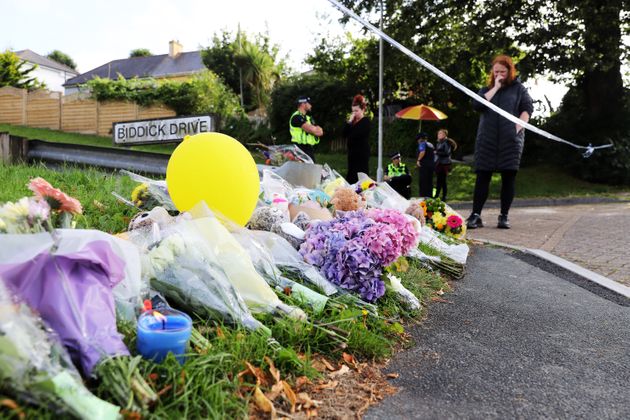
Members of the public place flowers at the entrance of Biddick Drive, where Davison began his killing spree last week

Jake Davison, a 22-year-old, shot his mother Maxine Davison, 51, dead in Biddick Drive, before shooting 3-year-old Sophie Martyn, and her father 43-year-old Lee Martyn on the street.

Davison went on to kill Stephen Washington, 59, and 66-year-old Kate Shepherd.

Davison was a licensed firearms holder, raising serious questions about the government’s current gun laws and prompting widespread calls for change.

The government has confirmed that it is preparing statutory guidance to help promote high standards of decision-making within gun licensing applications.

The Home Office wants future gun applications to cover the social media of individuals too.

Davison’s YouTube channel and Facebook account showed he referred to himself as the “terminator” and held misogynistic views.

All police forces in England and Wales have been advised to review their current processes and assess existing licences.

Share Button

The Mistakes Many People Make When Doing A Downward Dog

You’re reading Move, the nudge we need to get active, however makes us happiest and healthiest.

When you think of yoga, you probably immediately picture the downward facing dog pose – or Adho Mukha Svanasanaas, as it’s called in Sanskrit. It’s widely considered as the mother of all yoga poses. Even non-yogis tend to know it.

The downward dog is great for strengthening your body, as well as providing balance for mind and body. And it can easily be snuck in-between tea breaks if you’re still working from home (guilty).

“The pose enhances flexibility in the shoulders, hips and thoracic spine,” says Naomi Annand, author of Yoga: a Manual for Life and founder of east London yoga studio Yoga on the Lane. “It lengthens the hamstrings and calves and strengthens the long spinal muscles, quadriceps, rotator cuff, and triceps to name just the main muscle groups used.”

Think of it as a mind and body MOT. Bodies respond well to doing things little and often, so even if you don’t have 90-minutes, you can squeeze in a stretch here and there. “Every time you do yoga, you’re building resilience and creating new little imprints in your nervous system,” adds Annand.

However famous the pose may be, it’s quite an intense posture and there’s a lot to pay attention to. So, here’s how to make sure you’re doing it properly.

1. Align your body correctly

As one of the more well-known yoga poses, the downward facing dog gives off the impression that it’s a straightforward pose, says Triyoga teacher, Christian Di Giorgio. But many people slip into misalignments.

The focus should be on lengthening the trunk and visualising an inverted “V” shape with your body, he says, with the coccyx at the apex. “Beginners should keep the arms locked and use them to press the spine and hips up and back whilst straightening the legs to lift the tail bone higher.”

2. Keep enough space between your hands and feet

Di Giorgio says not keeping enough space between the hands and feet is a common mistake he sees in yoga classes. “This forces the spine to curve and compress instead of lengthening healthily as it should,” he says.

So, how much space should you keep? “You should aim to use much more of the mat when doing downward facing dog,” he tells HuffPost UK.

“Lie on your front with the toes tucked under and the finger tips level with the collar bones and lift up from there. An overly short stance can require too much stretch on the back and leg muscles, causing the spine to bulge outwards as it would when slumping in a chair. We are trying to correct the problems of long sitting not exacerbate them!”

3. Don’t fixate on putting your heels down

Many people have a fixation on getting their heels down, flat to the floor, when doing the pose, adds Di Giorgio. “Forget putting your heels on the floor,” he says, “this is advanced work!”

While placing the heels down firmly gives a good grounding in the pose, Di Giorgio says this is more like a “cherry on the cake”.

“Over months and years, as hamstrings and calves lengthen then students should strive to get the heels down but not at the expense of compromising the spine.”

Yoga class at Triyoga

Yoga class at Triyoga

4. Look after your wrists

It’s important to look after hands and wrists which, over time, can cause injury. “Some tend to lean heavily on the wrist bones which are not designed to bear weight, leading to potential repetitive strain injuries,” says Di Giorgio.

“They should try to spread the palms and fingers and press them strongly into the mat. This forces the forearm muscles to be more active and offloads the wrist bones.”

5. Adjust the pose to your level if needed

If you’re finding the pose difficult, keep in mind you can tailor it to your abilities. “You might not be as able-bodied or want to throw yourself into such a dramatic stretch, but there are alternatives like the puppy pose, which is the downward dog, but on the knees,” says Annand. “It’s a little more gentle.”

There are also options to make it more advanced. “Try more broadening of the shoulders and opening of the armpits and chest, so that the lungs can remain open and free whilst keeping the neck passive,” suggests Di Giorgio.

“The abdomen and pubic area should be more lifted and toned as the waist lengthens much more. Work the calves and ankles harder to ground the heels without compromising the extension of the spine.”

Move celebrates exercise in all its forms, with accessible features encouraging you to add movement into your day – because it’s not just good for the body, but the mind, too. We get it: workouts can be a bit of a slog, but there are ways you can move more without dreading it. Whether you love hikes, bike rides, YouTube workouts or hula hoop routines, exercise should be something to enjoy.

Share Button