I Stopped Trying To Make Picture-Perfect Bread And Fell Back In Love With Sourdough

For some people, it’s filtered, airbrushed social media pictures. For others, it’s unrealistic romantic expectations set by movies and TV.

For me, though, my greatest source of insecurity was the r/sourdough forum.

It’s nobody’s fault: if I had created a tall, fluffy masterpiece with a perfect golden crust, I, too, would want to share a shot. If my first-ever loaf looked like it belonged in an ad for artisanal butter, I would indeed want the world to know.

And people share their less successful loaves – a gummy rise, a burnt base – as well.

Still, I couldn’t help it. After a while, I began judging my slightly gummy, slightly deflated loaves a little too harshly. Then, the inevitable turn towards The Product That Solves It All: if I just owned one of these twisty little starter whisks, or a proper starter jar, or a bigger banneton, I’d be (grid) worthy!! I thought.

It sounds silly, because it is. But according to a post shared by u/good-things_ in the group, I’m not alone.

“I don’t use any of the equipment everyone talks about for sourdough. I mix my dough in any bowl available that’s big enough, and I eyeball the rise. Sometimes my bowls are solid and plastic, so I can’t see if there are bubbles,” the poster confessed (mine is metal).

Still, they pointed out, loads of the recommended gear and science-backed rules are relatively new (especially compared to sourdough’s thousands of years of history). Which means my great-great-great-grandma probably didn’t give a hoot about whether the ear of her every loaf curled up like a cowlick.

“I love that people get obsessed and get into the nitty-gritty of how to make a beautiful, perfect loaf. But I also want everyone to know ugly, imperfect loaves are still delicious,” the post continued.

Underneath was a swarm of agreement. “I also admit that my loaves are a bit substandard, but that’s okay with me in the long run. By not stressing about it, I can manage to keep making bread regularly for sandwiches, etc., and not lose enthusiasm,” u/bajajoaquin replied.

“I gave up chasing the perfect loaf with huge holes and a perfect ear, etc. I decided I just wanted to make bread for my own enjoyment… It works for me, and that’s what really matters,” u/dearmax added.

I’ve been through a similar process recently.
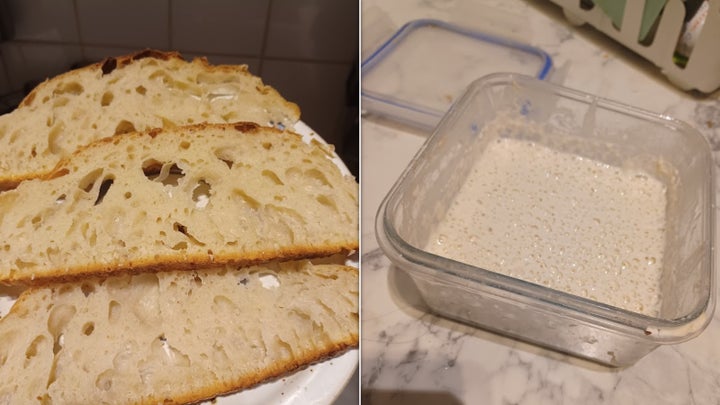
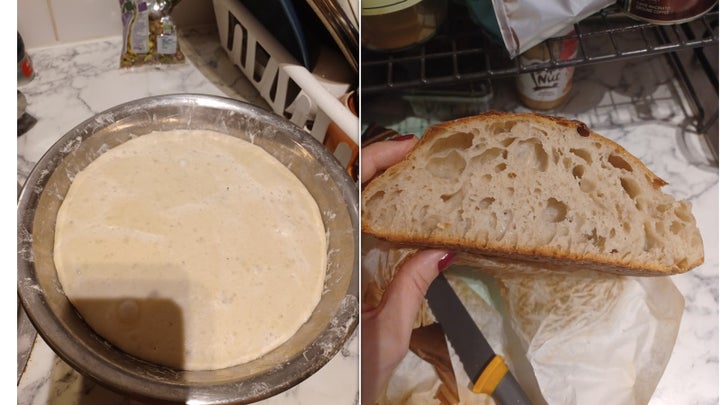
some just-fine bread on the left: a starter that would probably be bubblier if I fed it more on the right

Amy Glover / HuffPost UK

some just-fine bread on the left: a starter that would probably be bubblier if I fed it more on the right

For a couple of months, I stopped making bread entirely. It wasn’t just because I felt mine was subpar, but that was part of it: I felt I was spending so long on something so far from perfect that I got frustrated.

But recently, I’ve fallen back in love with the craft. My new starter (Gluton Airport, if you want her government name) doesn’t have a super-strict feeding schedule, and probably would bubble more enthusiastically if she did.

I’m 99% sure I’m leaving my overnight sourdough out to prove for about two hours too long (I don’t go to sleep immediately after mixing it, and I sleep too late to bake it on time).

A way overproofed, lightly drying dough on the left: some perfectly fine!! resulting bread on the right

Amy Glover / HuffPost UK

A way overproofed, lightly drying dough on the left: some perfectly fine!! resulting bread on the right

Probably as a result, my loaves are somewhat limp, a little gummy, and nowhere near as photogenic as I’d like.

Nonetheless, they’re still delicious. I haven’t splashed out on a pricier shop-bought loaf – a lot of which isn’t technically sourdough – since.

It’s a bit like half-assing my workouts. I don’t give 100% every single time, and it’s made me enjoy the hobby so much more.

Now, I’m more in love with making sourdough – meh as it may be – than ever. Most of all, I’m having fun again (and isn’t that the point of a hobby?).

Share Button

Scientists Think They’ve Found A Way To Stop Ageing ‘Zombie Cells’

As we age, our bodies lose some resilience, which can lead to less movement throughout the day and an increased risk of facing multiple chronic diseases at once (multimorbidity).

This happens partly because senescent cells, sometimes called “zombie” cells, stop dividing and build up. They secrete “proinflammatory molecules that contribute to chronic inflammation and ageing-related diseases”.

A process called senolysis usually clears these away, but as we get older, that cleaning system becomes less efficient.

But scientists from the University of Kyoto think they’ve found a way to slow or stop the production of these “zombie cells”.

How did the researchers stop “zombie cells” from building up?

Though we knew that “zombie cells” seemed to create inflammation that affected nearby cells, scientists weren’t sure about how this went on to affect someone’s body.

These researchers looked closer at the senescent cells themselves and found they heavily relied on glycolysis (using sugar for energy), a process which is also involved in the spreading of cancer cells.

Using bioluminescence to help see what was going on in the cell better, scientists found that two enzymes were crucial to glycolysis in “zombie cells”. Their binding was increased in sensecent cells.

So, when they were able to interrupt that key interaction, researchers could selectively “delete” zombie cells.

In mice, the change was linked to reduced lung fibrosis.

They also found that when this activity was diminished, a protein that triggers cell death was suppressed too.

What might this mean?

The study authors hope this might help to maintain resilience in older age.

That way, it’s hoped, the risk of multimorbidity might go down.

This study’s corresponding author, Hiroshi Kondoh, said: “Our findings in glycolytic regulation suggest that impaired metabolic resilience in ageing is one of the targets for senotherapy, to aid in preservation of resilience in ageing.”

Share Button

Emmanuel Macron Hits Back At Donald Trump Over Comments About His Wife

Emmanuel Macron has hit back at Donald Trump after he mocked the French president over an altercation he appeared to have with his wife.

The US president said Macron was “still recovering from the right to the jaw” after the incident last year.

Bridgette Macron was filmed apparently pushing her husband in the face shortly before they disembarked from his presidential plane.

In a speech in Washington on Wednesday, Trump referred to the incident as he criticised the French for not getting involved in the Iran war.

He said: “Macron, whose wife treats him extremely badly. He’s still recovering the right to the jaw.”

Speaking during a state visit to South Korea, Macron said: “The remarks I have heard are neither elegant nor up to standard.

“So I am not going to respond to them. They do not merit a response.”

The French president said Trump’s previous suggestion that the international community use force to re-open the Strait of Hormuz was “unrealistic”.

He also condemned Trump’s criticism of Nato and hints that America could leave the military alliance.

Macron said: “I believe that organisations and alliances like Nato are defined by what is left unsaid – that is, the trust that underpins them, and that has often been the case, incidentally, with military and strategic matters.

“If you cast doubt on your commitment every day, you erode its very substance.”

He added: “We need to be serious, and if you want to be serious, you don’t go around saying the opposite of what you said the day before.

“I think there is too much talk.”

Subscribe to Commons People, the podcast that makes politics easy. Every week, Kevin Schofield and Kate Nicholson unpack the week’s biggest stories to keep you informed. Join us for straightforward analysis of what’s going on at Westminster.

Share Button

All The Health Benefits Linked To A Cup Of Rooibos Tea

Mint tea may have benefits for our digestive system, while passionflower tea can help us sleep.

And there’s some evidence to suggest that rooibos tea, a South African variety made from the fermented leaves of the Aspalathus linearis shrub, can help with everything from reducing inflammation to controlling blood sugar and boosting our gut health.

Green rooibos is made from the same leaves, but they’re unfermented.

Here are some of the potential health benefits of the caffeine-free tea:

1) It’s brimming with antioxidants

Green rooibos tea is the only source of aspalathin (which helps to maintain cell health), and it’s high in other antioxidants, like quercetin (potentially anti-inflammatory, anti-histamine, and immune-boosting), too.

Antioxidants help to protect our DNA from harmful free radicals. They may also assist in protecting against chronic illness, heart disease, and cancer.

A 2023 review found that drinking rooibos tea seemed to be linked to higher antioxidant levels in our bodies.

2) It could be good for our gut health

According to a 2024 paper, green rooibos tea appears to help to keep our guts moving.

It could also help the integrity of a single-cell gut layer, which helps us to absorb nutrients and keeps toxins and disease out.

3) It could help to manage inflammation

Inflammation isn’t always a bad thing. We need it to build muscle and recover from some illnesses.

But when inflammation becomes chronic and happens when the body doesn’t need it, it can lead to “inflammaging”. That can “contribute to conditions such as heart disease, type 2 diabetes, dementia, and frailty,” GP Dr Suzanne Wylie previously told HuffPost UK.

A 2021 paper said that rooibos tea might help to limit the growth of angiotensin converting enzymes (ACEs), linked to inflammation and high blood pressure.

4) It may help to manage blood sugar

Remember the rooibos tea-specific aspalathin we mentioned earlier? A 2023 paper suggested that it could help to explain why rooibos tea seemed to help control blood sugar levels in both healthy and at-risk individuals.

Still, more research is needed to work out how, why, and to what extent that’s true.

Share Button

Rachel Reeves Admits She Is ‘Angry’ With Trump For Starting War In Iran

Chancellor Rachel Reeves has admitted she is “angry” at Donald Trump for starting the war in Iran.

Iranian troops have effectively closed the Strait of Hormuz ever since the US president decided to bomb Iran in late February.

Closing the major oil shipping lane has sent oil prices rising and rocked the global economy.

The president has attacked allies, particularly the UK, for not supporting his efforts.

He has called the Royal Navy “too old” and threatened to pull out of Nato after claiming the defence organisation has not given him “automatic” backing.

But Keir Starmer has held his own, reiterating on Wednesday that Britain would not be “dragged” into the conflict – while also warning that economic strains lie ahead.

Speaking to Radio 2′s Jeremy Vine, Reeves went further and said she was “angry” over Trump’s decision to bomb Iran.

She said: “I’m angry that Donald Trump has chosen to go to war in the Middle East – a war that there’s not a clear plan of how to get out of it.

“It’s why we didn’t want to enter this.

“Yes it will have implications for our economy, I get that.

“We are monitoring very closely what’s happening – trying to bring the oil and gas into the UK so that those supplies are there and get the prices down. We are monitoring the situation very carefully.”

“We are preparing – as you would expect me to be – for every single eventuality to make sure there alongside people, standing beside them, keeping costs down for everyone.”

The White House is trying to find an off-ramp to end the conflict and Trump claims Iran has asked for a ceasefire.

The president also told Reuters that the US will be “out of Iran pretty quickly” now Iran are supposedly “incapable” of using a nuclear weapon.

Iran has denied the claim and say the strait is “fully” under the control of the Islamic Revolutionary Guard Corps (IRGC).

Subscribe to Commons People, the podcast that makes politics easy. Every week, Kevin Schofield and Kate Nicholson unpack the week’s biggest stories to keep you informed. Join us for straightforward analysis of what’s going on at Westminster.

Share Button

Starmer Unveils New Measures To Help Ease Cost Of Living. Will They Be Enough?

Four government measures meant to ease the cost of living are set to start on April 1 – but will they be enough to help Brits?

Iranian forces continue to effectively block the major shipping lane, the Strait of Hormuz, in response to US–Israeli strikes.

The closure of the waterway, which transports a fifth of the world’s oil supply, is rocking international markets and sending fuel costs skyrocketing.

Brits were already facing a financial squeeze before the conflict began at the end of February.

The latest Which? consumer insight tracker – recording from the month leading up to March 13 – found half of UK households are now making at least one adjustment, like selling their possessions or getting loans, to cover the cost of essentials on a daily basis.

The watchdog also found 67% of UK adults are now expecting the national economy to worsen over the next year.

However, the government has urged the public to carry on as usual while it puts “contingency plans” in place.

Keir Starmer also launched Labour’s local elections campaign on Monday by insisting his party understands “most people are concerned most of all about the cost of living”.

In a separate statement, the prime minister promised the public that they “have a government on their side, working with allies on de-escalation and bearing down on the cost of living.”

But, he admitted: “We must go further to bear down on costs, and that means pushing for de-escalation in the Middle East and a re-opening of the Strait of Hormuz.

“That is the best way we can bring down the cost of living for families and that is my focus.”

Here’s a quick look at the measures the government is introducing on Wednesday – and their effectiveness…

1. Increasing The National Living Wage and National Minimum Wage

The government will be increasing the National Living wage to £12.71.

That works out to a £900 increase for 2.4 million workers aged 21 and over.

More than 200,000 young workers – those aged between 18 to 20 – will also enjoy a hike of £1,500 per year as the National Minimum wage goes up to £10.85.

The director of the Living Wage Foundation, Katherine Chapman, said last November – when the change was announced – that this was “a really positive move’.

However, she claimed: “It will still fall short of the voluntary real Living Wage which is the only wage rate based solely on the cost of living.

“The real Living Wage is currently £13.45 in the UK with a higher rate of £14.80 in London.”

Chair of the Low Pay Commission, Philippa Stroud, also warned about the impact rising wages would have an businesses.

She said in November: “In our discussions this year with workers and employers alike, it has been clear that no one is having an easy time.”

2. Cutting Energy Bills

The energy regulator Ofgem has decided the energy price cap will be set at £1,641 per year between April 1 and June 30.

That’s a decrease of 6.6% compared to between January 1 and March 31, when the annual price cap was at £1,758.

However, the April-June cap was decided prior to the breakout of the Iran war.

The next cap, from July to September, will likely go up as a result of the conflict.

Chancellor Rachel Reeves is looking at plans to help with energy bills expected to get closer to nearly £2,000 a year from July.

The government has suggested it may implement some targeted households for those most in need, rather than the universal support offered by Liz Truss’s government in 2022.

Jess Ralston, the head of energy at the Energy and Climate Intelligence Unit, said: “Bills going up again because of war thousands of miles away will be a tough pill to swallow for households still saddled with debt from last time.”

3. Freeze On Prescription Prices Extended

NHS prescription charges in England have been frozen at £9.90 per item for the 2026/27 financial year to help with financial pressures.

Prescriptions will still be free in Scotland, Wales and Northern Ireland.

However, the Prescription Charges Coalition’s Laura Cockram pointed out that people living with long-term conditions who are not exempt still feel the cost is too high.

She said: “No one should have to worry about affording the medication they need to stay well, so although a freeze on prescription charges is more welcome than an increase it’s not enough.

“Unlike in Scotland, Wales, and Northern Ireland, people in England with Parkinson’s and other long-term conditions still have to pay for the prescriptions they need to manage their health. The UK government must rethink.

“At the least, the government should review the prescription charge exemption list so people with long-term conditions like Parkinson’s, MS, asthma, HIV don’t have to pay an ill health tax.”

4. Crisis and Resilience Fund

This £1 billion a year council-run scheme in England will start running from April 1 2026 until March 31, 2029.

It’s money from the government which can be used for people struggling with a financial shock or unexpected finances. The fund will be focused on those who are in or close to poverty, disabled or in older households.

Anyone can apply for the fund for money towards their energy bills, food, clothing and furniture.

It will replace the Household Support Fund which has now ended.

It’s thought the government may pump extra cash into the fund if fuel and energy costs do rise in the summer.

Anti-hunger charity, the Trussell Trust, welcomed the news, calling it a “major milestone”.

“Effective crisis support is crucial to prevent people from falling into severe hardship, so they can still afford the essentials we all need,” the charity said.

However, it warned there is still work to do and “is not a substitute for the deeper reforms needed to the inadequate rates of social security which fail to protect people from going without the essential day to day”.

Share Button

This Aphrodisiac Easter Egg From Lovehoney Will Get You Humping Like Bunnies

We hope you love the products we recommend! All of them were independently selected by our editors. Just so you know, HuffPost UK may collect a share of sales or other compensation from the links on this page if you decide to shop from them. Oh, and FYI — prices are accurate and items in stock as of time of publication.

Forget everything you think you know about chocolate. We’re not mad at it as it is, but Lovehoney has a new release that proves we should all be expecting a lot more from our choccy treats.

While the most pleasure you’ve got from a chocolate egg thus far might have been giving in to that moreish flavour, this Easter Lovehoney has a new love egg out, and it’s not (exactly) what you think.

Not just a delicious treat to snack on (in fact, Lovehoney advises only eating half per day), this egg is packed with the natural aphrodisiac Liboost to please your downstairs, too.

Made from Damiana extract, Liboost supposedly improves blood flow to your pleasure spots, whose effects you’ll be grateful for by the time you get to the ‘surprise’ portion.

Spoiler alert: it’s a bullet vibrator, loaded with three vibration speeds and seven patterns. Thanks to its hard plastic exterior, the tiny toy packs quite a punch and is the exact size you’d want from a toy to slip between you and a partner during sex. (Warning: you’ll need to remember to buy a AAA battery as it’s not included, boo.)

Considering the weather is not yet aware of the fact it’s spring (rude), we expect you’ll be spending more time than expected indoors over the next few weeks. But if the weather isn’t heating up outside, at least you can generate some in bed because, let us tell you: the combination of the chocolate and vibrator is spicy AF.

So much so that one reviewer said this “is most definitely THE egg to buy this Easter”.

But, if there’s one thing we’ve learned from the cinema we’ve seen lately (Wuthering Heights and Pillion, looking at you), it’s that things can always get spicier.

So of course, Lovehoney has also created an Easter sex toy collection, too. Packed inside an egg-shaped container, this includes a rabbit (for obvious reasons), penis stroker, vibrating cock ring, fluffy butt plug, and tickler.

Finally, a way to celebrate Easter if you’re not into chocolate!

All we’ll say is: this is the sign you’ve been looking for to plan a date night for the long weekend – get cracking.

Share Button

As A Psychologist, I See Where Parents Of Neurodivergent Toddlers Are Let Down

As a psychologist working with children and families, I often meet parents at a moment of both clarity and uncertainty.

They may have started to notice that their toddler experiences the world a little differently. Perhaps their child becomes overwhelmed in busy environments, struggles with communication or finds social interaction more difficult than other children their age.

For many families, recognising neurodivergence brings a sense of relief. But it is usually followed by a daunting question: how do we get the right support for our child?

In the UK, that journey can be particularly complex during the early years.

According to the Department for Education, around 1.6 million pupils in England are identified as having special educational needs, representing roughly 18% of the school population. Yet families with preschool children often face long waiting lists for assessments and limited access to early support.

This delay matters. Early childhood is a critical period for brain development. Evidence shows that early support programmes for neurodivergent children, particularly those on the autism spectrum, can significantly improve communication, social skills and everyday functioning.

When support arrives early, it does not change who a child is, nor should it. What it can do is help children develop strategies that make learning and taking part in daily life much more manageable.

The early years can be very difficult for families

The period after recognising that a child may be neurodivergent can be one of the most stressful times for parents.

Families are often required to navigate complex systems across health, education and social care, while also supporting their child’s day-to-day needs.

Research has shown that parents of neurodivergent children report significantly higher levels of stress during the early stages of seeking support, particularly when services are delayed or fragmented.

In practice, many parents become the main coordinator of their child’s support: they research therapies, push for assessments and adapt their home routines to help their child manage emotions and sensory challenges.

Yet this expertise is not always recognised by the professionals they encounter.

Challenging outdated advice

In my clinical work, I still hear well-intentioned but outdated advice offered to parents of neurodivergent toddlers. Comments such as “they will grow out of it” or “they simply need firmer discipline” reflect a misunderstanding of how neurodivergent children develop.

Research increasingly shows that behaviours often described as disruptive are more accurately understood as a child trying to express sensory, emotional or communication needs.

When a child struggles to join in with group activities or becomes overwhelmed in a busy environment, it is rarely deliberate defiance. It is often a sign that the environment does not yet suit the way their brain works.

A more helpful approach shifts the focus away from controlling the behaviour and towards understanding what is behind it.

What early years settings could do differently

Nurseries and early years settings are well placed to support neurodivergent children before formal schooling begins.

However, according to the Department for Education, many staff feel underprepared to recognise and respond to the different ways children develop and learn.

Inclusion means more than simply allowing neurodivergent children into mainstream settings. It means adapting those environments with calmer spaces, flexible routines, visual aids and genuine collaboration with families.

When these changes are made, the benefits extend to all children. Every young learner does better in an environment that feels predictable and safe.

One young child I worked with struggled to join in at nursery and was frequently described as disruptive. Staff were unsure how best to respond.

After introducing a simple visual timetable and a quiet space where the child could go when feeling overwhelmed, the difference in their participation was remarkable.

What changed was not the child but the environment. This reflects a broader principle: when we adjust our surroundings to meet a child’s needs, their ability to engage often grows considerably.

Dr Marguerita Magennis is a psychologist, educational consultant, counsellor and psychology tutor at FindTutors.

Share Button

If You Need Running Motivation, Here Are Eight Of Its Greatest Benefits

About six and a half million adults in the UK were regular runners from 2023-24, or just over 9% of the population.

Still, not everyone sticks to it. In one paper, 11% of people who said they wanted to run a marathon quit the sport entirely before they got close to the start line.

But you don’t need to break records to see the health benefits of running. Here, we thought we’d share some of the (many) advantages of the sport – just in case you needed a little extra motivation.

1) It may be beneficial for your joints

You might have grown up hearing that running wrecks your knees (I did). But a systematic review of 17 studies found that “In the short term, running is not associated with worsening [patient-reported outcomes] or radiological signs of knee [osteoarthritis] and may be protective against generalised knee pain.”

2) It can boost your mood

A review of over 100 studies concluded that running appeared to have “important positive implications for mental health, particularly depression and anxiety disorders”.

And another paper found that a single 10-minute run can help to boost participants’ mood and even executive function.

3) It could help you live longer

More proof that small efforts are far better than nothing in a 2015 paper, researchers noted that five to 10 minutes of running a day and/or running slower than 9.6km/hour was linked to a lower risk of all-cause and cardiovascular mortality.

4) It’s really, really good for your heart

Running is a cardio workout, so perhaps it’s no wonder it’s so good for our hearts. It’s linked to lower cholesterol, better blood pressure, and a decreased risk of adverse cardiovascular events, like heart attacks or strokes.

5) It can strengthen your bones

Scientists found that marathon runners’ bones may be denser than those of their non-running counterparts.

6) It’s a great way to get a good night’s sleep

Exercise, especially exercise with outdoor light exposure (e.g. running in your local park) is linked to better sleep quality and improved sleep habits.

7) It can make your legs stronger

Like walking, running can help to build your leg strength. But it can plateau after a while, which is why it’s important to mix in some strength training.

8) Your endurance will improve

Running trains the heart and lungs, meaning you’ll be able to exercise harder, for longer, once you get into the habit.

What about the downsides?

While running is good for us, there are some downsides.

A 2020 paper found that injury rates were about 20% among runners, especially those with weaker hips. The risk is higher for new runners.

Strength training, including that which targets the hamstrings, knee-stabilising methods, hips, and glutes, can reduce your likelihood of getting injured.

Like HIIT, overdoing running can lead to insomnia. About a third of all runners are believed to suffer some form of overtraining syndrome.

If you notice mood changes, fatigue, poor sleep, and getting sick more often, get more rest and let your running shoes breathe for a while.

Remember that running three days a week is enough to lower your risk of early death by 40%, and that five to 10 minutes of running does a lot of good.

Share Button

Tomb Raider Series Pauses Production After Sophie Turner Sustains Injury

Production on the upcoming TV adaptation of Tomb Raider is currently on hold after its leading star Sophie Turner suffered an injury.

A spokesperson for the production company Amazon MGM Studio confirmed on Monday that the former Game Of Thrones actor had “recently experienced a minor injury” leading to production being “briefly paused to allow her time to recover” on a precautionary basis.

“We look forward to resuming production as soon as possible,” they added.

Sophie previously enthused: “I am thrilled beyond measure to be playing Lara Croft. She’s such an iconic character, who means so much to so many – and I am giving everything I’ve got.”

Tomb Raider’s heroine Lara Croft has previously been played on the big screen by Oscar winners Angelina Jolie and Alicia Vikander, with Hayley Atwell also lending her voice to the character in a Netflix animated series.

Of her predecessors, Sophie added last year: “They’re massive shoes to fill, following in the steps of Angelina and Alicia with their powerhouse performances, but with Phoebe at the helm, we (and Lara) are all in very safe hands. I can’t wait for you all to see what we have cooking.”

Phoebe also beamed: “It’s not very often you get to make a show of this scale with a character you grew up loving.

“Everyone on board is wildly passionate about Lara and are all as outrageous, brave, and hilarious as she is. Get your artifacts out… Croft is coming…”

Share Button