With this endless dreary winter dragging on, you could be forgiven for looking forward to brighter, warmer days in the garden as spring and summer are just around the corner (no, really).
Plus, if you’ve been meaning to get into gardening, there’s no better time than the present to plan ahead and look forwarding to planting seeds under a bright, warm sun.
Advertisement
It’s coming, we promise.
However,if you are feeling a little intimidated by the idea of gardening, it can be hard to know where to start. With this in mind, we’ve chosen 5 starter plants for those taking the green-fingered leap this year.
Three beginner-friendly plants
Lavender
According to the Royal Horticultural Society (RHS): “Lavender is best planted in April or May as the soil naturally warms up and when many fresh plants become available in garden centres.
“Lavender should never be planted in winter when young plants are vulnerable to rotting in cold, wet soils.”
Advertisement
They give the following planting advice:
Lavender is easy to plant and takes just a few minutes. If your soil is heavy, plant on a 20-30cm (8in-1ft) mound, ridge or in a raised bed where the roots will not sit in wet soil.
Plant the lavender as soon as possible after buying
Space plants about 90cm (3ft) apart if growing in groups
If planting a hedge, space plants 30cm (1ft) apart or 45cm (18in) for larger cultivars
After planting, water regularly, especially in dry weather, for the first season
Then, let it flourish in your garden. You can prune it if you’d like to or just leave it for birds to feed on. It should grow back every year.
Advertisement
Pheasant’s tail grass
This stunning ornamental grass can add a visually-striking touch to your garden with very little upkeep required.
BBC Gardener’s World says: “This evergreen perennial grass provides year-round colour and structure with bold, low clumps of light-reflecting leaves. Its slender foliage emerges green, but matures to yellow, orange and red over time, reaching a peak in intensity in winter.”
Choose a sunny but lightly shaded spot to plant your tall grass and put the grasses around 45-60cm apart.
Advertisement
Catmint
If you are a big fan of seeing cats roam around your garden, you may want to keep inviting them back with a Catmint plant for them to chew on and rub their heads against.
Plant this in spring, in a shaded spot and ensure that if you’re potting the plant, that the soil a high-quality mix and there is plenty of drainage in the spot.
As for ongoing care, The Old Farmer’s Alamanac says: “Watering is only needed during the first growing season or in prolonged dry spells. Catmints are drought-tolerant once established.”
“What’s your name?” Catherine O’Hara asked me, leaning forward in the booth. “What’s your story?”
I was standing in a swanky restaurant in New York City wearing a black dress short enough to satisfy management, my hands clasped behind my back in case a manager appeared. I had just broken the most important rule of the job: Never acknowledge a celebrity.
Three months earlier, I had dropped off my resume anywhere I could in hopes of securing a job that would supplement what my $35-a-week publishing intern stipend wouldn’t get me, which was, of course, everything but my subway fare.
Advertisement
I was hungry in every sense of the word. By the end of the day, I was offered three serving jobs and took them all. One was at this legendary restaurant continuously full of rock stars, Oscar-winning actors and models.
During my interview, the manager had ignored my flimsy (both in substance and content) resume and assessed my body instead. My waist. My chest. My legs. He said they had a place for me as a cocktail server in the private lounge where the windows were tinted, the tables were low and loungy, and the only clientele allowed in were ultra-wealthy patrons and celebrities.
The manager told me to show up later that night for my first training shift and emphasised that the dress code was all black, dresses only, hemlines not to exceed the end of my fingertips when my arms were hanging by my sides.
Advertisement
“We prefer the skirt to graze your first knuckles,” he said, making a fist and pointing to the ridged top of his hand to make his point.
I was 22, fresh out of college, and ready to do whatever it took to become a writer. If I can make it here… I thought.
When I walked in for my first shift, I was surprised to see a friend from college working at the host stand. Back in Colorado, he’d been a boisterous theater kid — lanky with bright blue eyes and flamboyant energy. Now he looked hollowed out — dark under the eyes, less “youthfully thin” and more underfed. He seemed tired and nervous, and his eyes flicked around as if we might get in trouble for hugging.
Advertisement
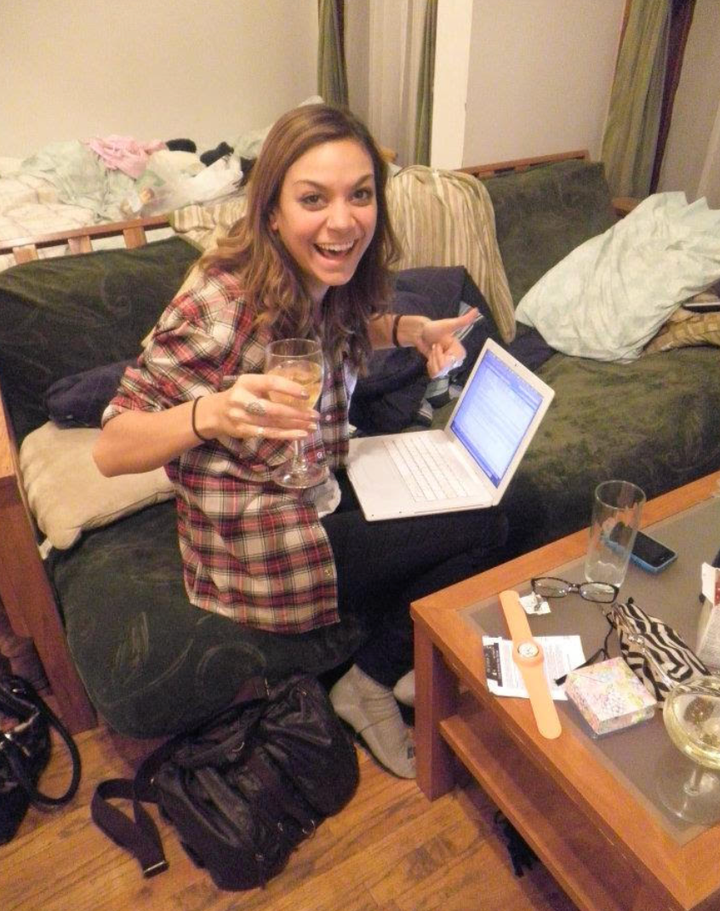
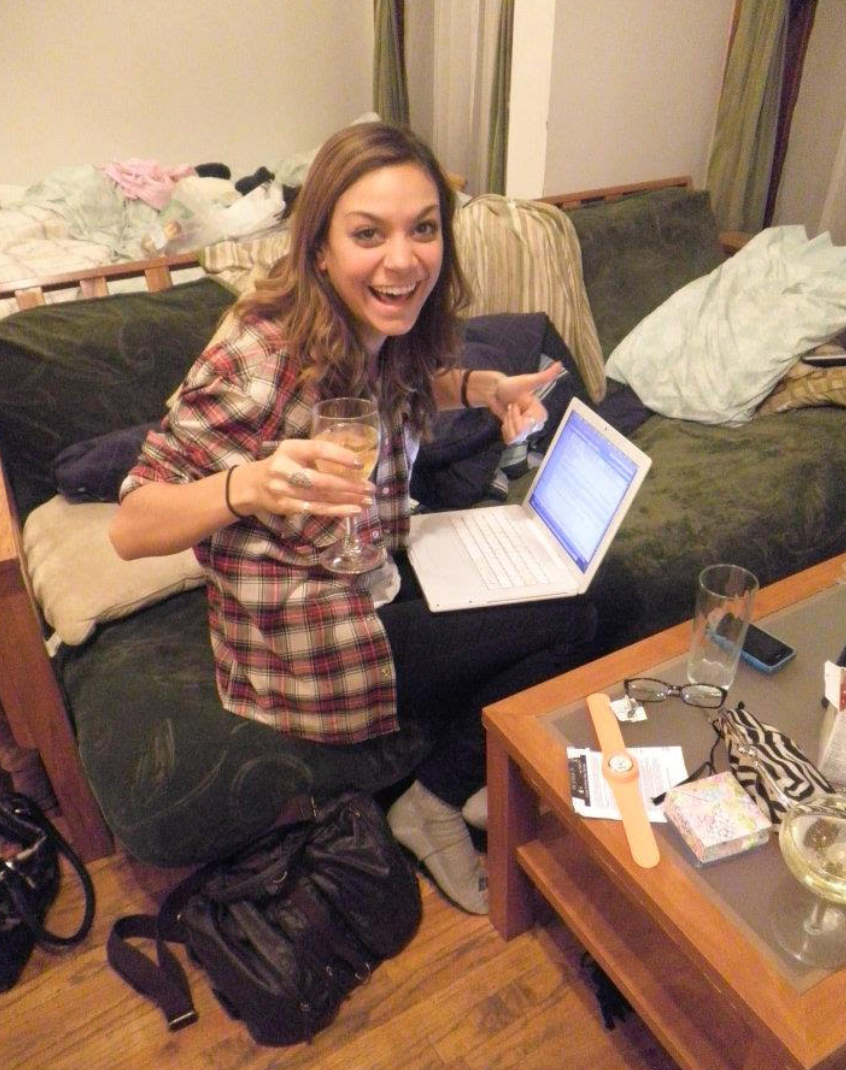
Courtesy of Sammi LaBue
The author celebrating her first story being accepted for publication in 2011 — a year before she decided to move to New York City.
The server I was assigned to shadow approached the host stand to retrieve me. She was gorgeous, waifish, and in place of the air of sadness my college acquaintance had, she’d built a bitter bubble of sarcasm around herself.
She walked me quickly through the labyrinthine back-of-house, dodging catcalls from her co-workers and managers deftly. She listed off rules as I struggled to keep up. Three of them stuck out.
Advertisement
1. We were required to try everything on the menu, which perked me up as a hungry, broke person used to only eating family meal slop before a shift.
2. We were a “pooled house,” which meant the managers gathered and then divvied up our tips (after shaving a cut).
3. We were not allowed — under any circumstances — to reveal that we recognised a celebrity. We were to treat everyone as an anonymous guest. Asking for an autograph, a photo, or even announcing that you were a fan of anyone famous would result in immediate termination.
Advertisement
Perhaps this last rule sounds easy enough to follow, but during my first training shift, Jay-Z, Adam Sandler and Mariah Carey were among our guests.
I lasted one month at this restaurant. Long enough to eat my way through the menu and gather enough celebrity run-in anecdotes to last a lifetime. My cocktail party stories suddenly involved run-ins with Bill Belichick, Jon Bon Jovi, Jonah Hill and Josh Hartnett, among many, many others. But not even these exciting encounters could make up for the depleting atmosphere of working in a place where every staff member was a hopeful singer, model, actor or artist.
After my first shift, I witnessed the server who was training me earn over $1,000 in tips — then walk out the door with only $220 after management’s cut. When I asked about the tip breakdown, my manager was finishing a line of cocaine in his windowless basement office. His explanation made little sense, but he laughed at my confusion, and I left his office feeling dejected and violated.
Advertisement
However, what really convinced me that I couldn’t survive there long was when I realised that my co-workers all seemed to be struggling with disordered eating. Years earlier, after my dad had died suddenly of a heart attack, I’d developed my own eating disorder — a coping mechanism that came with consequences. I’d slowly healed in college, partly thanks to a tight circle of wonderful friends. Now, without them and being surrounded by behaviours that I instantly recognised as potentially damaging, I felt my anxiety rising in a new — though disturbingly familiar — way.
During my work shifts, my trainer-server and I worked through the restaurant’s menu, each night picking something new for me to try, and we’d sit on the back staircase (there was no break room) while she explained the dish to me. No matter what it was — tuna on crispy rice, a black truffle pizza, half a roast chicken on a mountain of garlic mashed potatoes — she refused to have a bite.
“No way. I’m trying to be an actress,” she told me. “I wouldn’t even eat a cucumber here. They put sesame oil on everything.”
Advertisement
She joked about it — “I don’t eat, really. None of us do.”
Though I wasn’t attempting to make it as an actress, I still began to leave food on the plate, uneasy about doing so, but also worried she might have a point. She was putting her goals first. Hunger as discipline. Emptiness as a badge of ambition. Maybe fed girls didn’t make it in NYC.
Courtesy of Sammi LaBue
The author right after she moved to New York City in 2012.
By the time I walked in for my last training shift on a Sunday night, I was thinner, my spirit was beaten down, and I was worried about the road I seemed to be headed back down.
Advertisement
I was also still broke. I’d trained for seven shifts at $10 an hour, and I was relieved when my trainer asked me to take this shift alone. The managers were nowhere to be found, as usual, and she wanted to meet up with her boyfriend — a musician who was always cheating on her. The restaurant was slow, she told me I now knew what I was doing, and, best of all, she would let me take all of the tips I made home.
At nearly 9 o’clock, three women walked in: two women I’d never seen before and the one and only Catherine O’Hara. I froze. My mind flashed to O’Hara’s squiggly sideburns in “Beetlejuice.” Her iconic “Kevin!” in “Home Alone.” The dozens and dozens of times my sister and I had watched “Best in Show.” All of the characters she’d played that shaped my sense of humour. My sense of joy. How could I possibly serve her without telling her I loved her?
They sat in a window booth with Catherine in the centre. When I went to greet her party, her friends enthusiastically interrupted to tell me they were taking her out for her birthday. She shook her head sheepishly, embarrassed and amused.
Advertisement
“We’ve been friends forever,” she told me. “They don’t let me get away with anything.”
As a writer, I try to avoid cliches, but reader, her eyes truly sparkled with life and kindness.
Soon, they were my only table. I folded napkins a short distance away from them and watched the three friends enjoy each other’s company — and one of everything from the starter section, plus a burger, the tuna and the chicken. They shared a bottle of wine and giggled like girls.
Over the course of their meal, I realised that in just a few weeks, the restaurant I stood in had distorted what success should look like, but no one could extinguish the aura of true success that radiated off Catherine. She had “it” — that thing I’d come to NYC to prove I had, too, and “it” wasn’t thinness or ambition at all costs, or even talent, though of course she had that, too. It was her sense of self — how she held herself and confidently, yet humbly, moved through the world — that no one could rival… or take away from her.
By the time I dropped the chocolate soufflé off, their table held the last lit candle in the restaurant.
Advertisement
I placed the dessert in front of Catherine, and then I took a breath.
“I’m not supposed to bother our famous diners,” I said, “but I just have to tell you how much your acting means to me and my sister. ‘Best in Show’ is our favourite movie, and your character is my favourite.”
“Me?” she said, genuinely incredulous. “Your favourite!”
“I’m sorry to bother you. I just had to say something. Happy birthday.” I quickly turned away, mortified.
“It was her sense of self — how she held herself and confidently, yet humbly, moved through the world — that no one could rival… or take away from her.”
Advertisement
“Wait,” she called after me, “What’s your name? What’s your story?”
She insisted that I join them in their booth and asked what kind of artist I was.
“Every server in this city has an interesting story,” she said, gesturing her spoon toward me, her mouth full of birthday soufflé, and the trio’s attention now fully, yet comfortably, on me.
I told her all about my dream to be an author and about the short story I was working on.
“What if one of the characters dies?” she riffed, delighted.
Were we collaborating? I could hardly breathe.
I was glad to have refused their offer of a bite of soufflé because the manager suddenly appeared from his basement lair, and I immediately popped out of the booth.
“I’ll just grab you the check,” I said, with my arms behind my back again, in an attempt to look professional. She winked at me as I walked away.
Advertisement
She paid the bill herself, though her friends tried, and though my tip out didn’t reflect it, she left me 100% on their $400 bill and a note that read, “I know your day will come. Keep writing.”
The manager wouldn’t let me keep the receipt, but I didn’t need it.
Catherine had given me something invaluable that night. Her kindness has always stayed with me. She showed me a different way to be an artist — to be a person. She chose passion, curiosity, individuality and humility in an industry that often made that feel impossible.
I never went back to the restaurant again after that night. I left before the thinness of the place convinced me I had to disappear to deserve a future. There were plenty of other workplace cultures ahead of me that would also try to normalise self-erasure as ambition, but years later, when I sat down to write this essay just days after Catherine O’Hara’s death, I could still clearly conjure that moment with her. Thanks to her, I still try to follow my appetite, to seek fullness and to believe, even on my hungriest days, that my day will come.
Advertisement
Sammi LaBue is the founder of Fledgling Writing Workshops (“Best Writing Workshops,” Timeout NY) and basically obsessed with the feeling of having an idea and writing it down. Her latest project is a recently finished memoir written in collaboration with her mom titled “Bad Apples.” Some of her other essays can be found in BuzzFeed, Slate, Literary Hub, The Sun, Glamour and more. To follow her writing journey and find opportunities to write with her flow, visit fledgling.substack.com.
As I settled in for the 17-hour flight from Australia to the United States, I turned to the vacant seat between my wife and me and smiled. While other passengers might have thought it was a stroke of luck, they didn’t know this was deliberate. It was the result of my seat selection obsession.
The ritual starts the moment I book a flight: I check legroom measurements and read seat reviews, then study the airline’s seat map to predict which seats will stay open. There are rules: I go for an aisle seat on the right side of the aircraft, and on wide-body planes with a 3-3-3 configuration, I pick one in the middle section.
Advertisement
Even after I’ve locked in my seat, I can’t stop. In the days leading up to departure, I’m refreshing the “Manage My Booking” page, monitoring which seats fill up, debating whether to switch to 12D or stick with 11D.
Turns out, plenty of travelers have their own versions of this routine. Some travelers insist on the same side of the plane every time. Others will only sit in odd-numbered rows. A few refresh seat maps obsessively, fixated on bathroom proximity or meal service order.
Performance psychology specialist Sam Wones said this quirk runs deeper than seat preference. “It reflects a need for control in environments where individuals feel they lack it,” he explained. “Ritualistic actions like seat-map checking can reduce anxiety about the unknown.”
Advertisement
When everything about air travel feels chaotic, securing a specific seat sends a signal to your nervous system that something is manageable.
These rituals can be remarkably specific. Georgia Hopkins, a freelance travel writer, only sits in odd-numbered rows: 11A ideally, or 13A/15A if that’s taken. Rows 12 or 14 simply don’t exist in her world. “I can’t do even numbers. If not 11, I have to sit in an odd-numbered row,” she said. She also insists on a window seat as far forward as possible, so she boards earlier, exits faster and is served first.
Row 25. Always row 25. Amanda Kendle is so committed to this specific row that she will not change it, even if a better option opens up. Not because it has extra legroom or is closer to the exit, but because it is her lucky number.
Advertisement
“Some part of my anxious flyer mentality tells me if I change my seat, the plane will crash and my original seat would have been safer,” she explained. When traveling with her teenage daughter, who insists on a window seat, Kendle still claims row 25; she just takes the middle instead of the aisle. Her flexibility still operates within strict boundaries.
wera Rodsawang via Getty Images
Your plane seat preference might reveal a lot about you, according to travelers and experts.
These rituals feel personal, even irrational. Chris Lipp, a social psychologist at Tulane University who studies power dynamics, said they expose how confident we feel in public spaces.
Advertisement
“People who feel more powerful are less sensitive to sitting next to someone,” Lipp explained. “They’re comfortable with less interpersonal space, less worried about others encroaching on their space, and less vigilant because they don’t feel threatened by others.”
The dreaded middle seat, which most people avoid, illustrates this power dynamic. Lipp notes that powerful people can tolerate it. They will claim both armrests without hesitation, exuding a confidence that likely extends beyond the cabin. Anxious travellers either guard the armrest like a border wall or avoid it completely to prevent any contact.
Seat location also reflects travellers’ approach to control and efficiency, Wones says. Front-of-plane passengers want to disembark quickly and avoid feeling trapped, valuing efficiency and a faster process. Back-of-plane flyers operate differently. They’re more relaxed about waiting, less concerned with being first off the aircraft and often actively avoid the chaos of the front rows. Neither preference is inherently better, but they reflect different tolerances for waiting.
Advertisement
Beyond front vs. back, another choice reveals personality: window or aisle. Wones said introverts gravitate toward window seats for privacy and control, while extroverts prefer aisle seats for mobility and easier interaction.
Lisa Burns, founder of The Travel Photography Club, understands this completely. On a flight from Tokyo to Helsinki over the Arctic Circle, she ended up in an aisle seat with the window passenger asleep, shutter closed. “All I could imagine were icebergs and glaciers below,” she said. “I had to practice deep breathing because it took so much self-control not to lean across and look out the window.” For a travel photographer, being trapped on the aisle meant missing exactly what she needed to see.
I’m firmly in the aisle camp, though my reasons are less about interaction and more about autonomy. I can move whenever I want without performing a gymnastics routine to climb over a sleeping passenger or getting the side-eye when I’m up and down for the third time in an hour. On a long flight, this freedom matters. Maybe it makes me someone who needs to feel in charge of something, even if it’s just bathroom breaks. Or perhaps I just drink too much water.
Advertisement
My right-side preference has a practical foundation. Analysis of Air Canada and American Airlines seat data shows passengers disproportionately choose the left side, which means the right side offers better odds of an empty seat beside me.
Wones said that once you unconsciously favour one side, your brain locks onto it. “Some people unconsciously favour one side due to how their brain processes spatial awareness or comfort,” he explained. Maybe it felt slightly better once, or you had a good flight on that side. The reason doesn’t matter. Once the pattern exists, you stick with it, even when both sides are identical. It becomes less about logic and more about what feels right.
If you’re reading this thinking, who obsesses over seats?, that reaction itself reveals something, according to Wones. Strategic planners are highly conscientious and prefer control. Acceptors are more adaptable, with lower anxiety and a higher tolerance for uncertainty.
Advertisement
When my wife catches me refreshing the seat map days before a flight, she thinks I’m ridiculous. She’s probably right. But 17 hours squeezed into economy with an empty seat next to us? That’s when ridiculous becomes genius.
There’s a seemingly endless array of quippy terms to describe rising travel trends and preferences.
One particularly interesting term is “inheritourism”, which really gets to the heart of why different individuals travel the way that they do and how family plays a role.
Below, travel experts break down the meaning of “inheritourism”, as well as the benefits and drawbacks of this holiday phenomenon.
Advertisement
What is ‘inheritourism’?
“Inheritourism reflects how travel preferences are passed down across generations,” said Jess Petitt, senior vice president or strategy, insights and full service brands at Hilton.
“Many people inherit travel preferences from their parents, with family experiences often shaping how people travel well into adulthood.”
A 2026 travel report from Hilton identified “inheritourism” as a notable trend for the new year – with 66% of travellers surveyed by the hotel brand saying that their parents have influenced their choice of accommodations, 60% saying they guided their choice of loyalty programs and 73% saying they shaped their general travel style.
Advertisement
“I think inheritourism shows up most clearly in how people define what ‘comfortable’ travel looks like,” said travel blogger Esther Susag. “Many travellers inherit not just destinations, but entire travel styles from their parents. For example, I often notice that people who grew up only doing cruises or all-inclusive resorts tend to gravitate back to those formats as adults.”
Travellers accustomed to the ease of having everything in one place might be more hesitant to go off the beaten path with independent accommodations, hidden gem destinations or locations that require more planning or cultural navigation.
“That same pattern extends into how people pay for travel,” Susag said. “I’ve noticed that travellers whose parents used travel credit cards and understood points and miles tend to feel much more comfortable navigating loyalty programs and booking elevated experiences. On the other hand, people who grew up saving for years for one big trip and paying mostly in cash or with a single credit card often carry that same cautious mindset forward and are hesitant to open multiple cards or experiment with points strategies.”
Advertisement
She added that many parents remain deeply involved in their adult children’s travel decisions, often financing trips with their own loyalty points or preferred brands. Multigenerational travel is increasingly popular, thus exposing new generations to the same kinds of choices.
“Over time, that becomes their baseline for what travel ‘should’ look like,” Susag said. “As travel has become more expensive and more intentional, people are less willing to experiment and more likely to stick with what they know works. That often means repeating the travel patterns they grew up with, whether that’s specific destinations, hotel brands or trip formats.”
Flashpop via Getty Images
It’s only natural that people who grew up vacationing in a certain way as children would adopt similar travel behaviors as adults.
Advertisement
It’s only natural that people who grew up travelling in a certain way as children would adopt similar preferences. Katy Nastro, a spokesperson and travel expert for the flight alert service Going, pointed to the cliché “the apple doesn’t fall far from the tree”.
“I personally grew up going to warm beach destinations to escape the New York winter every February,” Nastro said. “I wholeheartedly believe that the desire for a warmer weather destination during the month of February versus a cold weather trip is not just a preference but is now a personality trait inherited from my family travels as a child.”
She believes the same pattern is evident in the families attracted to “the magic of Disney” with Disney theme parks vacations over multiple generations. Our early memories can inform what we find meaningful and rewarding as we grow up.
Advertisement
“My family chooses the mountains over the beach always, because it’s where I grew up vacationing – and if you ask me, it’s just better,” Petitt said. “Those experiences are also what I’m excited to share with my kids, building on those memories. If we never visit a beach as a family, that would be OK by me.”
Family travel habits strongly influence people’s choices – but is that a good thing?
“Any travel is beneficial in my opinion,” Nastro said. “And in theory, inheritourism can create generational travel because people are inclined to continue the tradition of travel to a certain place, hotel, etc. The only downside may be that this perpetuates a blinder affect where people don’t tend to branch away from what they know, and thus never really explore beyond their comfort zone.”
She added that inheritourism might lead people to miss out on good deals if they can’t look beyond the specific brands or locations they’ve “inherited”.
Advertisement
“Travellers may avoid less popular destinations or more immersive experiences because they feel less predictable or convenient,” Susag said. “That said, awareness is growing, and many people are starting to challenge those habits once they realise there are other ways to travel that still feel safe and rewarding.”
Overall, she sees a mix of downsides and benefits to the influence of inheritourism today.
“On the positive side, inheritourism makes travel more accessible and lowers the barrier to entry for a lot of people,” Susag said. “It also encourages multigenerational travel and shared experiences, which can be incredibly meaningful.”
Inheritourism can serve as “a foundation, rather than a fixed path,” she emphasised. Travellers can carry forward meaningful traditions but also cultivate their own.
Advertisement
“People tend to start by recreating the trips and habits they grew up with, then adapt them as their confidence grows and their priorities shift,” Susag said. “Whether that means exploring less traditional destinations, traveling more independently or becoming more intentional about how they spend on travel, many travellers eventually build on what they inherited rather than abandoning it altogether.”
As in other areas of life, parents tend to set the norms and serve as trusted sources for young adults as they make decisions.
“In a world of digital overwhelm and an abundance of choice, travellers are looking to their inner circle to inform their travel decisions,” Petitt said.
Advertisement
“When seeking an experience beyond what is familiar, inherited preferences and trusted travel habits serve as a starting point for discovering something new. The key is balance – while inheritourism offers comfort and confidence, the greatest benefit comes when those familiar influences open the door to exploration, rather than limit it.”
Whether it happens on your postprandial fart walk, right in the middle of yoga class or while you’re sleeping, everyone — even the poshest among us — farts.
According to Dr. Satish Rao,professor of Medicine at Augusta University’s Medical College of Georgia, the average person farts seven to 24 times a day.
Advertisement
“It’s a normal physiological phenomenon,” he said, explaining flatulence as the byproduct of fermentation in the colon.
That fermentation creates gas, which is a mixture of nitrogen, oxygen, carbon dioxide, methane, hydrogen and more. One surprisingly smelly fact is that more than 99% of farts are odourless, but a foul smell comes from trace sulphur compounds. Unfortunately, our noses are extremely good at detecting sulphur, even in microscopic amounts.
Once that gas is formed, Rao said there are only two options for it to escape. “Some gas will move from the lining of the colon to the bloodstream, then get exhaled by the breath,” he said. “But the other pathway out is the fart. The gas will find its way out eventually, and if you produce a lot of gas too quickly, it won’t be absorbed, but will automatically push its way out through the anus.”
Advertisement
In general, a few farts a day are nothing to worry about, said Dr. Cait Welsh, postdoctoral researcher from Monash University and the Hudson Institute of Medical Research. “Most of the time, the release of gas is a healthy sign that digestion and gut microbiota are happy and functioning well.”
While you produce gas all day long, you’re more likely to let ’em rip during sleep, when your anal sphincter relaxes and gas escapes more easily.
Which People Are The Gassiest?
It might be hard to think of King Charles or the Pope as real toot machines, but Rao is positive that anyone who eats food, especially carbohydrates, is going to fart at least some time during each day. And some of us are certainly more, um, productive than others, said Dr. Folasade P. May, associate professor of Medicine at University of California Los Angeles.
Advertisement
“People who chew a lot of gum, drink carbonated drinks or eat too quickly may swallow more air, for example, which can cause flatulence,” she said. “Other people have gut bacteria that produce more gas. Diet, how fast you digest, and medications can also change how much gas you make and pass.”
If you’re thinking that President Donald Trump is making you fart more, you might be right. (Fun fact: An old Australian slang word for a fart is a “trump.”) Stress or anxiety, about the current political climate or matters closer to home, can have an impact on how much someone farts, May said.
“Especially in people with irritable bowel syndrome or other functional gut disorders, stress can change how fast we eat and digest, making flatulence seem worse,” May explained.
Advertisement
krisanapong detraphiphat via Getty Images
Stress can increase your flatulence, according to gastro doctors.
Foods That Can Up Your Fart Count
Dr. Ed Giles, a pediatric gastroenterologist and associate professor of pediatrics at Monash University, noted that the most well-known foods to cause gas are the so-called FODMAP foods, an acronym for Fermentable Oligosaccharides, Disaccharides, Monosaccharides and Polyols.
The key term for these carbohydrates, Giles said, is “fermentable.” That means the foods have an ability to produce gas. “They feed the bacteria in the gut and the bacteria produce the gas, including methane, which smells,” he said.
Advertisement
May outlined some of the worst FODMAP culprits: beans, lentils, onions, garlic, crucifers like broccoli and cabbage, and some whole grains and fruits. “If you’re lactose intolerant, consuming dairy can also increase gas production,” she said.
When To Be Concerned
Gas is concerning when it’s painful, disruptive or different from your normal pattern. If you’re regularly releasing gas more than 23 or 24 times a day and it’s causing problems, it’s worth investigating. However, some people may experience more flatulence than that and it’s still considered normal; it all depends on your diet and your personal health factors.
“The most important thing is that if excessive flatulence is persistent or accompanied by pain, weight loss, diarrhea or blood in the stool, it’s worth consulting a clinician for evaluation,” May said. “If gas is persistent or accompanied by these other warning signs, a clinician can help sort out causes.”
Advertisement
Some of the conditions a health care professional will want to rule out include celiac disease, inflammatory bowel disease, irritable bowel syndrome, lactose or other food intolerances, pancreatic enzyme insufficiency and small intestinal bacterial overgrowth. Connective tissue disorders like Ehlers-Danlos syndrome and other diseases like multiple sclerosis also come with increased flatulence.
You might be asked to keep a food journal and, yes, even count the number of farts you produce each day. Luckily, there are now several apps to help you do this, including Gaslog, FlareCare, Gutly and Vitalis. These apps aren’t medical diagnostic tools, but might help you spot patterns in how your diet and lifestyle contribute to gas symptoms.
And just keep in mind that everyone — every single one of us — has experienced an ill-timed fart, and lived to tell the tale. So unless your gas comes with pain or surprises, you’re probably just doing what everyone else is doing, too.
Susannah turned to her husband, Ron, mouth agape. He looked down, his cheeks reddening.
“It was right after college. I was experimenting,” he mumbled, twisting in his seat. “No big deal.”
As a couples therapist, I am always looking for how to mend the frayed edges of a relationship, but Susannah and Ron were different: they had come to my office to end their marriage.
I practice what I call breakup therapy — a short-term treatment I developed for couples who want to end their relationships without bitterness.
The premise is counterintuitive: instead of looking forward toward separate futures, we look backward at the relationship itself. It’s structured to look at the beginning, middle and end of their time together with exercises that focus on both their gratitude as well as their resentment.
Advertisement
The work culminates with the couple crafting a shared narrative about their union and literally writing it down – a story of what worked and ultimately what did not. Then, I ask them to sign it. In this way, they resolve the many unanswered, and often unasked, questions that can trap couples in recriminations and keep them from moving on.
The idea was born from my own bitter divorce. After my split, I was plagued by questions that repeated on an endless loop in my brain: “What was I thinking?”; “Why didn’t I see that red flag?”; “What is wrong with me – I’m a therapist and I should have seen what was happening.”
Then, one day, my therapist asked me a different question: who was I when I decided to marry? Suddenly, my internal feedback loop stopped.
Advertisement
“You’re asking me who I was, not why I married him?” I said, skeptically.
“Yes, I am,” she answered. “Marriages can be as much about identity as they are about a union. What were you trying to solve — or avoid — by marrying him?”
The question unlocked something for me. I’d been full of anger at myself, but I hadn’t really taken responsibility for my own actions. With her help, I crafted a story that I could hold onto about what function the marriage had served for me. Truly owning my choices helped me have more compassion for myself and less anger. The most startling realisation? When I had created a story that hung together, the nagging questions ended for good.
I have seen this same process unfold for many couples. But often, in the course of these sessions, new things surface.
Advertisement
“Susannah?” I said, surprised to hear the hurt in her voice. “This feels like a big deal for you. Why is that?”
Ron and Susannah had not been the most willing subjects for breakup therapy. During our first session, Ron blurted out: “You’re like a medical examiner doing autopsies on dead relationships! Your scalpel hurts. I don’t think you know what it feels like to be humiliated.”
“I wouldn’t be so sure,” I answered softly. “I have a teenager.”
Ron was not mollified.
“This feels stupid,” he said on another occasion. “She’s done, I accept that. What is there to say? This feels like horseshit.”
Advertisement
“See what I’m working with here?” Susannah said, throwing up her hands and shifting away from Ron on the couch. “I knew he wouldn’t take this seriously.”
“No, he’s right,” I said. “If it’s really true that you fully accept and understand her decision, Ron, then this is horseshit. But is that true?”
His silence was all the answer I needed.
Over the next few sessions, we went over how they’d fallen in love (“It just made sense, we fit”); the birth of their three children (“The unit held us together”); the unraveling of their connection (“We were ships in the night for as long as I can remember, but then one day I woke up and just wanted more from life”).
Advertisement
We mapped the patterns their marriage had fallen into over the course of three houses, two cross-country moves and their children’s exodus from home. It was a saga spanning decades.
Then, in our fourth session, Ron mentioned the sex tape.
“Something about this is landing hard on you,” I said to Susannah, her mouth still ajar. “Why?”
“Yeah, why?” Ron echoed.
Susannah paused and looked out the window.
“It’s that you … you tried something that – I don’t know – was out there … bold and different.”
A tear welled in a corner of her eye.
“It’s not you. You’re not brave! Or, at least you haven’t been with me, not in all these years together.”
Then she began to cry. Ron and I looked at one another.
“Susannah?” Instantly, I regretted breaking the silence.
“All this time, I decided you just couldn’t try new things,” she managed after a while. “I gave up.”
Ron put up his palms. “What is happening?” he said, exasperated.
“But if you can do that …” she continued. “What was it? Did I just not ask? Did I build my life around a lie?” She looked lost. “Was it that you never really loved me enough?”
Advertisement
She turned back to Ron and banged her fist on the couch.
“I did ask! I asked you to look at porn together when we stopped having sex, to take classes with me, to go on that whale-watching tour. … You just ignored me!”
This time, I held my tongue.
“Is that a thing?” she went on, turning to me. “That you can reach the end of a relationship and not even have known what was possible?”
“I made that tape 30 years ago,” Ron blurted out. “She’s upset over something I did when I was a totally different person!”
Advertisement
This was the impasse that I had expected, that arrives in most of my breakup therapy work – the moment when two people realise that as well as they think they know each other, there are things they don’t know or have lost track of. It’s my job to help them hold that bitter realisation. Then it’s my job to help them arrive at forgiveness or some kind of reconciliation – if not with each other, then with what happened to them.
“It was 30 years ago, Ron,” I said. “But you aren’t a different person. You’re the same person, and she’s wondering why you couldn’t have been that with her.”
I turned to Susannah and said, “You have a right to be hurt, but were you truly honest with him? Did you give him the space and the safety and the encouragement to be that person? Do you think you both can forgive each other for what you weren’t?”
Advertisement
It was three weeks before they appeared again in my office, having canceled two sessions in between appointments.
“I was stirred and moved by what happened here last time,” Susannah began. “When we left, I thought: Maybe there’s enough left between us?”
Ron’s eyes were downcast.
“But I realised I can’t,” she said. “I just can’t open up that part of me with him anymore. I want … I need this divorce.”
Advertisement
I nodded. “Ron? How do you feel?”
“I can see where we are … I’m not fighting it.” His voice broke. “I’m just really sad.”
Often it requires some kind of shock to break through the built-up layers of anger, resentment and disappointment in a couple in order to illuminate the cracks in their relationship – something true that has been avoided or left unsaid. In this case, it was the surprise of an ancient transgressive act that lay bare how little they knew each other and how misaligned they’d become.
Susannah moved closer to Ron on the couch and laced her fingers with his.
“You guys seem calmer – closer. Tell me what you are feeling,” I said.
I knew something about that calm after the storm. After my own divorce, we had maintained an uneasy truce for years, until one long car ride after dropping our daughter at camp. As we rode in silence, I suddenly remembered my therapist’s question: Who was I when I decided to get married? For the next two hours, we talked over that question and everything else, and together realised how lonely we had been — two Israelis who, instead of understanding why we had both chosen to leave, had clung to each other and to a shared language. Before long, we were laughing as we had not laughed since the early days of our marriage.
“So, where do we go from here?” Ron asked me in their last session.
“Well, in my experience, when a marriage ends, a different relationship can sometimes be created,” I said. “That’s up to you guys. All endings are sad, but not all endings have to leave you broken. There’s an opportunity here to get to know each other in a different way. And …” I leaned forward to make eye contact with each of them “… to know yourselves better.”
Advertisement
After they left, I sat quietly in my chair for a while. I allowed myself to remember that moment in my therapist’s office when I realised that I had been using my marriage to escape a question I had been avoiding and what a relief it had been to finally face it.
When a sex tape from decades ago unlocks two people’s grief, it’s not so much about the end of the road as it is about the roads never taken – the versions of a marriage they never tried. It is a sad moment, but also a generative one.
They’d come to me to bury their marriage. What they found instead was a way to know each other – maybe for the first time in years – even as they said goodbye.
Advertisement
Note: Names and some details have been changed to protect the identities of the individuals appearing in this essay.
Sarah Gundle, Psy.D., is a psychologist in private practice and an assistant professor at the Icahn School of Medicine, Mount Sinai Medical Center. She is currently writing a book about breakups. You can find her on Instagram @dear_dr_sarah.
I’m going to be honest: I find travelling with other people pretty draining.
There’s the compromise. There’s constantly being “on”. There’s the horrifying prospect of someone you love seeing you at your post-airport worst, and the nightmarish possibility of being expected to talk on a plane.
So I’ll admit I’m sympathetic with TikTok’s “solo honeymoon” trend, which cuts arguments, different itineraries, and “active vs resting” holiday discrepancies completely out of the question.
Advertisement
Instead, “solo honeymooners” – often single people who are sick of waiting ’til they find a spouse to enjoy their dream honeymoon – are taking matters into their own hands.
Here, experts from TrustedHousesitters shared how to achieve the perfect one.
What is a “solo honeymoon”?
It’s basically booking a holiday by yourself, but the term seems to have helped some TikTokers to navigate the feelings and motives behind solo travel.
In one video, an app user said she’s calling her trip to Bali a solo honeymoon because “while I’m not married to a human being, I am kind of married to my work”.
Advertisement
She decided to give herself a break after closing an important business project.
Yet another person said they were “travelling to a honeymoon destination as a very single person” because “you don’t have to wait until you’re in a relationship to go somewhere”.
He added, “I never thought I’d be here single, but here I am”.
Commenters often said they wish they’d felt OK doing something like that sooner. “I should’ve done this after I finished my master’s degree,” an app user wrote: “You have no idea how you have encouraged me to do let go of the fear and do this,” another stated.
And in response to a TikToker’s video about taking a safari trip for her “solo honeymoon,” a commenter wrote, “This was my honeymoon idea, and now I’m like F it I need to go.”
Advertisement
How can I plan a “solo honeymoon”?
Trusted Housesitter advised people seeking a “solo honeymoon” to consider the following:
Checking flight times: “For those who love sitting back for a long time with a book, make the most of the solo flying time and travel long haul, but if you’re a little more on the nervous side, choose a shorter, familiar route to start your me-moon stress-free.”
Checking the area’s safety: “Make sure to research ahead and make sure where you head to has good contact points.”
Planning activities in advance: “Many activities are designed for couples or groups. So make sure you won’t face extra costs, and don’t be deterred if something is marketed primarily to pairs or groups; you can still participate and enjoy the experience.”
Not worrying about others’ expectations: “Plan activities that support your own well-being. Whether it’s spa treatments, meditation sessions, hiking, or simply time to read and reflect, tailor your itinerary around what makes you feel recharged and happy.”
Choosing accommodation carefully: “Think about the type of place you want to stay and whether it will enhance your self-care.”
We hope you love the products we recommend! All of them were independently selected by our editors. Just so you know, HuffPost UK may collect a share of sales or other compensation from the links on this page if you decide to shop from them. Oh, and FYI – prices are accurate and items in stock as of time of publication.
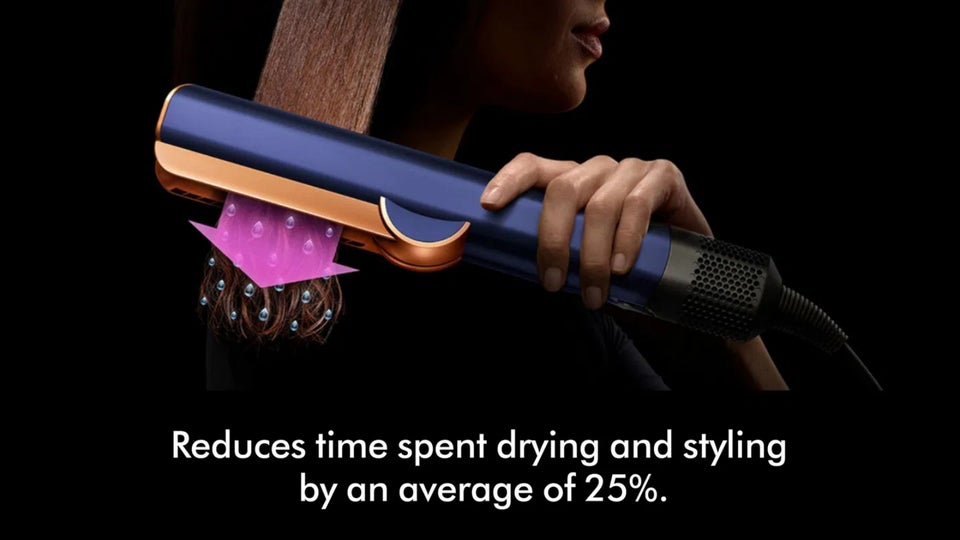
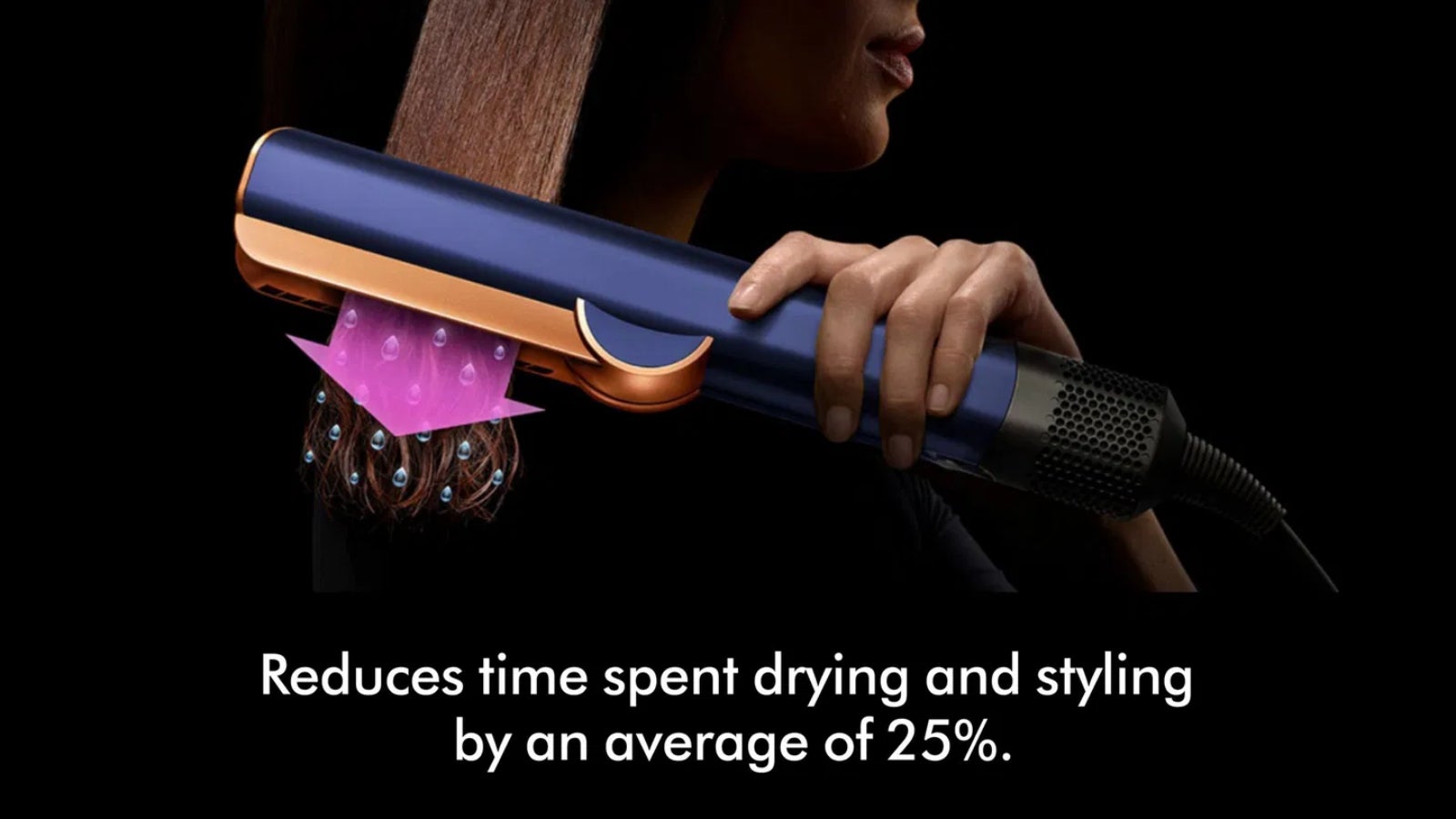
Look, I am human, and I have a lot of hair. That can only mean one thing: like millions of style-conscious people before me, I covet every Dyson styler on the market.
Mind I say “covet,” and not “own”. That’s because the brand’s offerings are notoriously on the pricier side, and while my colleagues assure me it’s worth it, I’d rather not pony up that much cash upfront if I can help it.
Personally, I’ve got my beady eye on the Corrale straightener, which is the only kind that has flexible copper plates which gather your hair together for better control.
But that’s not the only styler on the site. You can also nab a refurbished Dyson Supersonic hair dryer, which people who usually find drying their hair a plan-cancel-worthy ordeal have probably craved for years, from £6.66 a month.
You might have heard that autism diagnoses are on the rise in the UK. Some even argue it’s being “overdiagnosed”.
But the National Autistic Society says that about 750,000 autistic adults in the UK remain undiagnosed. And a 2025 review estimated that 89% of autistic adults over 40 remain undiagnosed, with that figure rising to 96% for over-60s.
Advertisement
Here, HuffPost UK spoke to the review’s author, research fellow and co-leader of the ReSpect Lab, Dr Gavin Stewart, about why those numbers might be so high, and how autism might show up among older adults.
Why are these numbers so high?
Dr Stewart said that in his research, an overwhelming majority of autistic people aged 40 and older remained undiagnosed.
He explained that there are “many reasons” for that.
“First, the diagnostic criteria for autism have greatly evolved over the past several decades. It was originally conceptualised with very narrow diagnostic criteria,” he said.
Advertisement
“This meant that it was a rare condition, affecting around 1 in 3,000 people in the 1960s.”
But as our understanding of autism expanded, he said, so too did the diagnostic criteria; autism is now recognised as a “spectrum affecting around 1 in 100 to 1 in 33 people.
“This means that many middle-aged and older people were likely overlooked when they were young as they did not fit the narrow diagnostic criteria being used at the time.”
Some members of this group, however, can go on to get a diagnosis under the new criteria, he added.
Why does it matter if people stay undiagnosed into older age?
Having autism without realising it can affect people’s lives in many ways, the study author told us.
Advertisement
“For some, it might mean that they are not able to access help and support that would be available to them if they did have a diagnosis. For example, autistic people often benefit from additional support while as a child in school, or as an adult when in higher education or in employment.”
Their physical health might be affected, too.
“Autistic people often have more complex health support needs, including age-related health conditions as they get older. While accommodations can be made to make healthcare more accessible for autistic people, if the person has not been recognised,” Dr Stewart said.
And a lack of tailored support can take its toll on autistic people’s mental health, too.
“They are more likely to become socially isolated and have poorer well-being, which in turn can lead them to be more susceptible to periods of crisis like suicide.”
Advertisement
What are some signs of undiagnosed autism in over-40s?
Some signs of autism are “common” among both diagnosed and undiagnosed autistic people, said Dr Stewart.
These can include:
1) Social difficulties
“In social situations, an autistic person might find it hard to read what other people are thinking or feeling, and they might struggle to tell when someone is joking or being sarcastic.
“Making and maintaining friendships can feel effortful, and people might perceive them as being quite blunt or uninterested without meaning to. This might make them feel quite anxious and uncertain in social situations, meaning they prefer to be on their own.”
Advertisement
2) Very consistent and rigid routines
“In daily routines, an autistic person might have a strong preference for sameness, so doing things the same way every time, and when things change, it can be quite distressing,” said Dr Stewart.
3) Special interests
“They may also have very focused interests, which can be beneficial for some but not always.”
4) Becoming overwhelmed and/or overstimulated often
“They may also find certain sensory environments quite overwhelming, and notice details that many other people do not, like the way a room smells or the buzzing of overhead lights.”
Dr Stewart noted that some autistic people, especially women, will have learned to “mask”, meaning they “have learned to hide parts of themselves to fit in better, but this is an effortful process and can have an impact on their wellbeing.”
Advertisement
What if I think I have autism?
Dr Stewart advised speaking to a healthcare professional, like a GP, if you think you might have autism and want to explore an assessment.
“There are also charities and organisations, like the National Autistic Society in the UK, who can provide information about accessing autism assessments as an adult,” he added.
You can reach out to the National Autistic Society through this link.
Between the ’90s and late 2010s, early-onset cancer diagnoses – those given to people aged between 25 and 49 – rose by 22%.
About 90% of cancers still affect those over 50. But, Dr Jiri Kubes, radiation oncologist and medical director at the Proton Therapy Centre in Prague, said: “We are seeing far more younger patients than we would have expected a decade ago.
Advertisement
“The issue isn’t just that cancers are appearing earlier – it’s that symptoms are often subtle, and many people don’t think cancer is something that could affect them at this age.”
Here, he shared the signs people under 50 should look out for.
What symptoms should people under 50 check for?
Dr Kubes said “persistent changes are what matter”.
“Ongoing digestive issues, unexplained weight loss, unusual lumps, changes in bowel habits or fatigue that doesn’t improve should never be ignored – even in your 20s or 30s.”
He added that often, persistence can matter more than severity: “If something lasts weeks rather than days, it deserves attention.”
Advertisement
He warned to keep an eye out for:
Persistent changes in bowel habits
Unexplained weight loss
Ongoing fatigue that doesn’t improve with rest
Lumps or swelling that doesn’t go away
Frequent headaches or neurological changes
Unusual bleeding or pain that persists.
Dr Kubes added: “Many early cancers are painless. Waiting for pain before acting is one of the biggest mistakes people make.”
Advertisement
Why might some cancers be developing sooner?
We don’t know for sure. But Dr Kubes said modern life has changed “dramatically”.
“Sedentary behaviour, poor sleep, ultra-processed foods, obesity and chronic inflammation are all being studied as possible contributors,” he explained.
But, he added, the point isn’t to create panic. “The goal is awareness, not fear,” he stated.
“When cancers are detected early, treatment is usually simpler, more effective and far less disruptive to quality of life… that’s especially important for younger patients who have decades of life ahead of them.”
What should I do if I think I have one of these symptoms?
Dr Kubes said it’s a good idea to trust your instincts if you feel something is off.
“If something feels wrong and it doesn’t go away, get it checked… being proactive is not overreacting. Early action saves lives.”
Advertisement
After all, he added, early detection is key: “Cancer is no longer just an older person’s disease – but early detection means outcomes have never been better.”