Small talk is something many of us avoided even before the pandemic, and neither months of social distancing or the awkward return of socialising has made it easier – but it’s something that can still save lives.
That is the message from Samaritans, as the mental health charity and helpline relaunches its campaign to raise awareness about the role small talk can play in preventing suicide on the railways and in other public settings.
Advertisement
The ‘Small Talk Saves Lives’ campaign has run in partnership with Network Rail, British Transport Police and the rail industry since 2017. But as the UK steps out of lockdown, it is focusing on rebuilding public confidence to trust our gut and start conversations with anyone who looks as though they may need help.
Brits are known for being quite reserved, especially in public. We rarely go out of our way to speak to strangers and keep ourselves to ourselves. But engaging in the smallest of conversations – it could be as simple as asking “hello, what’s the time?” – may help interrupt someone’s suicidal thoughts, Samaritans says.
Advertisement
luza studios via Getty Images
Handsome confident businessman on his way home from work. He is standing on the train station platform at sunset, waiting for his train.
The pandemic has had a huge impact on mental health – and while it may have made the idea of small talk more daunting, it has also made us value a sense of community.
Dom, who prefers not to give his surname, knows how important small talk can be. As a teenager, he was experiencing suicidal thoughts but was interrupted at a crucial moment by someone who used small talk to ask if he was ok.
Advertisement
“When I was 19 years old, I was struggling to cope and didn’t know where to turn,” he tells HuffPost UK. “I was on my way to university one day and found myself thinking about ending my life. A lady came over and started a conversation with me and when I heard her ask, “are you ok?” it instantly snapped me out of thinking about harming myself.”
Dom, who now works for Network Rail himself, says he’s supporting the ‘Small Talk Saves Lives’ campaign because it saved his.
“From my own experience, I know suicidal thoughts can be interrupted and it was the kindness behind the small talk that also made a difference to me,” he says. “That human connection made me feel seen.
Working in the railway sector for almost a decade, Dom has used small talk on several occasions when someone’s behaviour has concerned him.
Advertisement
There aren’t “typical” signs someone might need help, Dom says. “When I’ve approached people, sometimes it’s because they’ve looked withdrawn, distant, or upset. Other times, they seem completely calm, but I’ll notice that they’re in an unusual location in relation to the environment. I would say, if you get a sense that something might be wrong, trust your instincts and start a conversation – as I’ve experienced, you could save a life.”
The public is better prepared for these interventions that you might expect.
A YouGov survey for Samaritans found over three quarters (78%) of UK adults have engaged in small talk during the pandemic – 37% of those surveyed said they had chatted with neighbours they hadn’t spoken to before and 37% with strangers at the supermarket.
Almost one in five said they are also more likely to want to make small talk with a stranger face-to-face not that restrictions are lifted. Given that small talk makes 57% of respondents feel less lonely and boosts the mental health and wellbeing of a further 45%, there’s potential to make a real difference here.
Of course, starting a conversation with a stranger can be difficult and it’s natural to feel nervous.
“If you spot someone you’re worried about and aren’t comfortable approaching them, then that’s completely fine as well,” Dom says. “You can still act by trying to find someone else who might be able to help, for example, a member of staff or police officer, or you can call 999 in an emergency.”
But with everything that’s happened in the past 18 months, Dom is optimistic that people can make a difference. “One thing I’ve noticed is the pandemic seems to have brought out a greater sense of community,” he says.
“I think we all recognise how important human connection is and that checking in on each other – whether it’s a friend or family member, a neighbour or key worker you’ve never spoken to before – can make a huge, positive difference to someone else’s day, as well as your own.”
Useful websites and helplines
Samaritans offers a listening service which is open 24 hours a day, on 116 123 (UK and ROI – this number is FREE to call and will not appear on your phone bill).
Advertisement
Mind, open Monday to Friday, 9am-6pm on 0300 123 3393.
CALM (the Campaign Against Living Miserably) offer a helpline open 5pm-midnight, 365 days a year, on 0800 58 58 58, and a webchat service.
The Mix is a free support service for people under 25. Call 0808 808 4994 or email help@themix.org.uk
Rethink Mental Illness offers practical help through its advice line which can be reached on 0808 801 0525 (Monday to Friday 10am-4pm). More info can be found on rethink.org.
If you’re watching a film or TV show and see a young woman dressed all in black with a grungy hairstyle and a resting bitch face, be warned – she’s probably a feminist character written by a man.
Such is the single dimension of some women characters on screen and in fiction, often written by men. And TikTokkers are exposing the lazy writing.
Female creators on the video-sharing app are acting out all the unrealistic ways women are often characterised: sexy, seductive, clumsy, and whimsical, their looks and tics a cue to their inner soul.
Advertisement
Actor and content creator Caitlin Reilly was among the first to the trend, satirising how a woman in sci-fi films is often depicted: you know, the geeky scientist who probably wears glasses and keeps her hair in a tight ponytail, and is so dedicated to her work, she has no time for love or a social life.
Reilly’s breakout video, which includes such lines as “I’m a woman and a scientist, I can’t be both good at my job and nice”, has been watched more than a million times.
Advertisement
She has also mocked action movies for the way they paint women; helpless, emotional, forgetful. “I forgot the box of things that are very special to me, I have to go back”, and the hysterical mum shouting “please find my daughter,” are lines that have seriously tickled her Instagram followers, too.
Over on TikTok, the trend has blown up in recent days, soundtracked by Portishead, as young women ridicule the way they’re written into fiction in the most mundane scenarios, from having breakfast to going to sleep, from putting on their makeup to taking it off, from reading to dating to chewing gum.
In one clip, a woman experiencing a break-up sits wistfully, wearing just a top – many of these portrayals are trouser-less – as she licks ice cream seductively off a spoon. Ice cream is a big thing in the land of the male gaze, it seems.
Advertisement
In fact, many of these #writtenbymen clips are tagged #malegaze, spreading feminist theory about the problems with women being depicted from a masculine and heterosexual (indeed sexual) perspective to a new generation.
You’ll see what we mean when you check out others videos tagged into the trend. And while you’re watching them, please remember no woman in history has ever taken off her glasses to realise that she was beautiful all along.
She was “all that” already – without the nerd-to-hottie makeover by a man.
The words of co-workers and clients can stay with you long after you leave a job and certain phrases can detonate a professional relationship, making people question whether they ever truly belonged at a company or if they can ever work with or trust a colleague again.
That’s why it’s so important to learn to identify and avoid such phrases, whether they’re obviously rude or seemingly innocuous. Here are psychologically damaging but commonly used phrases to watch out for in your work communications.
Advertisement
1. “No offence but …” or “No disrespect but …”
Mary Abbajay, president of the leadership development consultancy Careerstone Group, was once hired by a company to conduct team building. When she met the manager of the team she would work with, he told her, “With all due respect, I’ve forgotten more about team building than you’ll ever know.”
Advertisement
Abbajay ended up turning down the job as a result. “This was 15 years ago, and it stills sticks with me,” she said. “If he hadn’t said ‘with all due respect,’ I might’ve taken it differently. That’s just the icing on the cake that shows ‘I do not respect you, I think you’re wrong.’”
Along with the similar phrase “No offence …,” she said, these condescending words signal that the speaker does not respect the other person’s point of view.
Advertisement
2. “I don’t have time for this.”
Psychological safety is key to keeping teams together. Researchers describe it as the mental space in which employees are free to speak up, share bad news, and ask for help when they are in over their heads.
If your pattern in responding to colleagues’ requests is telling them that you are too busy or don’t have enough time, it sends a signal that the other person is not a priority and that they shouldn’t go to you when they need help.
“That person is going to be reluctant to come back to you again if there’s a problem or situation, and it may throw them off so much that they’re worried too much about taking your time and annoying you than getting what they need,” Abbajay said.
Advertisement
When managers say this, it can silence their team and make members less likely to own up to mistakes, she added.
3. “What X is trying to say is …”
If you’ve been in a meeting with a colleague who feels the need to reframe what you just said in their own words, then you understand the frustration of hearing this phrase. Abbajay said this is the one she dislikes the most, because it doesn’t move the conversation productively forward even if that’s the speaker’s intent.
When someone does this to you, you may jump to a conclusion like “I’m inarticulate, I’m stupid, people aren’t understanding me, people aren’t respecting it out of my mouth, so you feel like you have to say it out of your mouth,” she said. “It’s very diminishing. It lowers the other person’s status.”
Rather than rephrasing colleagues’ words, Abbajay said colleagues could simply request when they need more of an explanation in a conversation.
4. “You seem young for …” or “You’re so articulate for a …”
Lawrese Brown, the founder of C-Track Training, a workplace education company, cited the type of undermining comments that you can sometimes be the recipient of when you go against a colleague’s assumptions and expectations of how you should present yourself at work. These comments can range from microaggressions about your identity to questions about your leadership potential.
Brown said she has heard from clients who have been told they were being a “weak” leader or “seemed young.” One client was advised to change her hairstyle.
“Her manager told her people would take her more seriously if she straightened her hair,” she said. “These all fall under the umbrella of, ‘You’re being perceived as not appropriate; something about your self-presentation or the way you’re being perceived causes people to question your ability to do the job.’”
These kind of comments can get under employees’ skin and make them feel inadequate at work. “We start to feel the way we’re operating is not appropriate or effective, or we’re just conscious that it could be a knock against us,” Brown said.
Advertisement
5. “I didn’t mean it like that.”
Brown said it’s OK to note that words can be interpreted differently, but that you should be careful not to be dismissive when others disagree. “I didn’t mean it like that” is a common defensive comment that does not acknowledge how your words can be received, she said.
The goal is to recognise that your words carry weight, and can do harm. Remind yourself someone is on the receiving end of your comment, and first ask yourself, “Is it productive?” before you say it, she said.
6. “Nobody else has brought this up to me” or “You’re taking this personally.”
Brown said managers commonly make the mistake of using invalidating comments such as, “Nobody else has brought this up to me” when a team or employee raises a concern. According to Brown, that can send the message: “If this is only important to you, is this worth taking seriously?”
When colleagues invalidate your feelings like this, or you do it to others, it can stop much-needed conversations from happening.
″‘You’re too emotional about this, you’re taking this personally. Other people haven’t said this.’ What you’re missing by saying this is you’re undermining the other person,” Brown said. “These are phrases, that once said, very few people have the tools to have the difficult conversation to unpack that. People just don’t say anything.“
And ultimately, when co-workers stop talking to each other, communication breaks down, mistakes are more likely to happen, tensions run higher and everyone is more on edge.
Your colleagues will “tend to be more people-pleasing, because they no longer trust their own voice, or perception of an experience, or it inhibits their ability to trust their colleagues,” Brown said. “When we don’t trust, we put more rigid processes in place, and it’s because we don’t believe that our word will be acknowledged or that our needs in environments will be met.”
You’re reading First Thing, a weekly series on HuffPost UK helping to make your mornings happier and healthier.
Does your morning exercise routine consist of working your arms by smacking the snooze button for the third time? (No shame ― sometimes you gotta do what you gotta do!)
Advertisement
It may feel like exercising at the start of the day is an impossible feat when you’re so exhausted. However, you don’t have to spring out of bed and start running a 5K to feel energised. Even a little bit of movement will go a long way when it comes to revving you up for the day.
“Moving your body when you first wake up helps your circulation and stimulates your lymphatic system,” said Jennifer Jacobs, a certified personal trainer and founder of The J Method, adding that exercise helps fluid move through your body and reduce inflammation. “As a result, you feel more energised.”
Advertisement
We asked experts to share the best energy-boosting moves that’ll help you kickstart your morning feeling loose and alert. Here are their favourites:
1. Downward dog
Advertisement
Mavocado via Getty Images
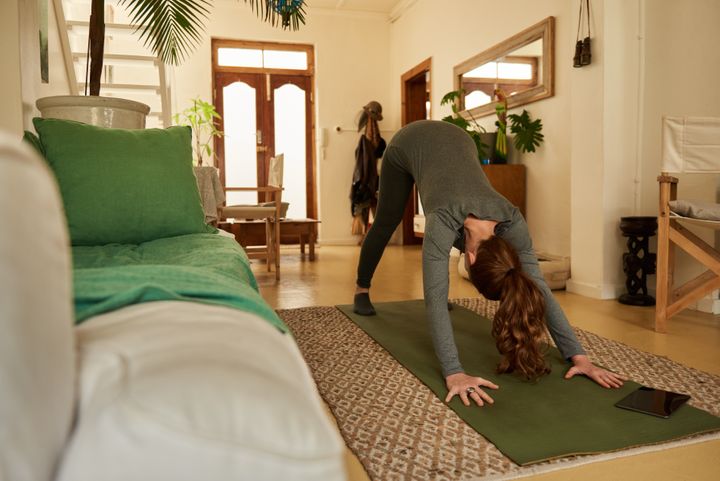
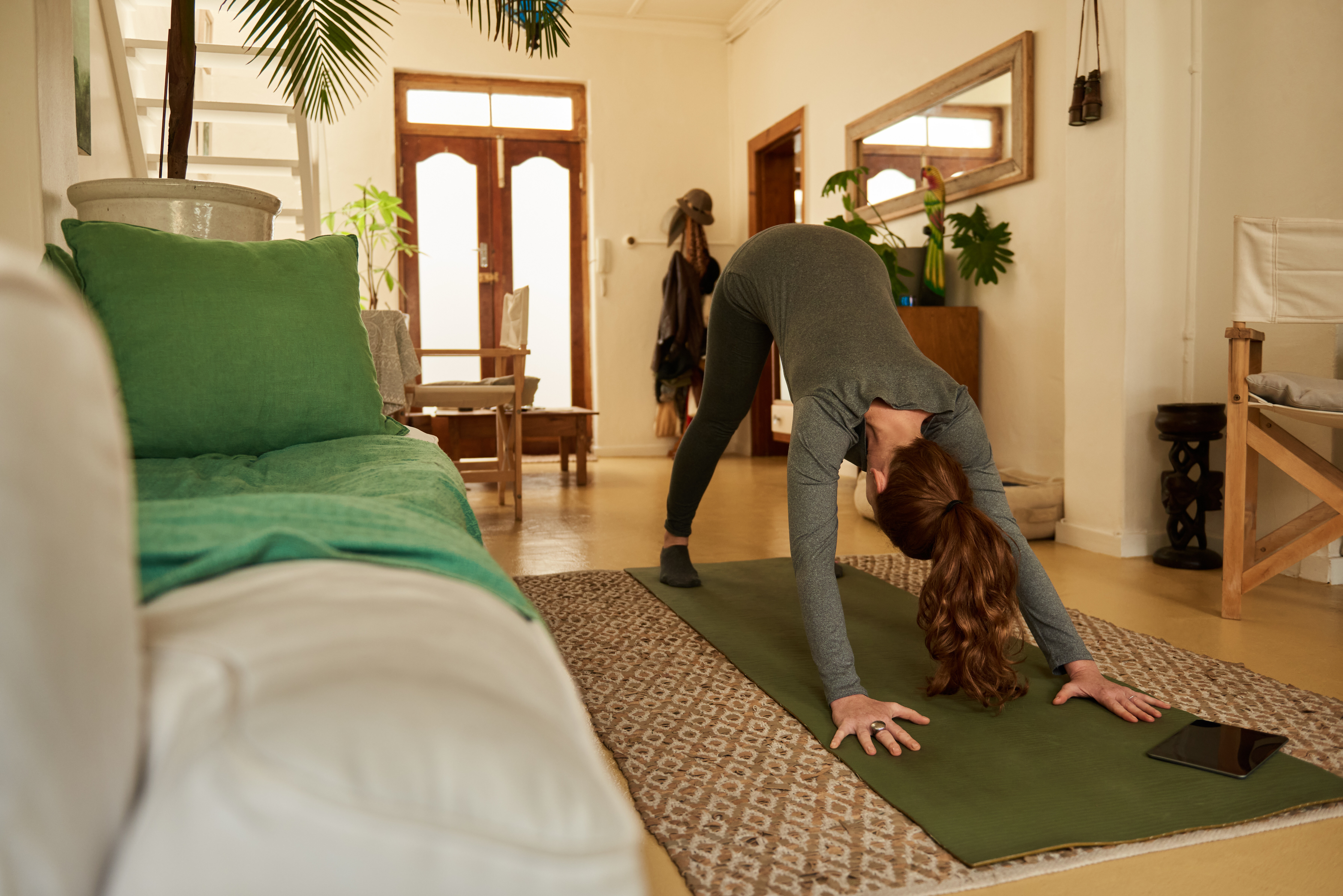
Start your a.m. with a downward dog to get your blood flowing and increase alertness.
One of the reasons you may not want to drag yourself out of bed is because your body is stiff from sleeping all night. This yoga pose is a great way to kickstart blood flow and wake up, said Megan Roup, founder of The Sculpt Society.
Starting on your hands and knees, stack your shoulders over your wrists and spread your palms out wide. Pressing through your palms, tuck your toes and lift your knees, pointing your hips toward the ceiling as you press down through the heels.
“To make this stretch more active, you can pedal out the feet while you actively press into the floor or bend and straighten both legs,” Roup said. Hold the pose for 15 seconds and repeat for three to four rounds.
2. Hamstring flossing
Advertisement
“This dynamic stretch helps to loosen up your hamstrings and your lower back more effectively than doing a static stretch, which may cause muscle spasms if your body isn’t properly warmed up,” said Theresa Marko, a board-certified orthopaedic clinical specialist in physical therapy and owner of Marko Physical Therapy.
To do this move, start by lying on the floor with knees bent and feet flat. Gently grab behind one of your thighs and straighten and bend the knee repeatedly (just make sure not to overextend your knee). This back-and-forth flossing motion will give your hamstring a stretch-and-release sensation. Do 10 repetitions on each side for two to three rounds.
3. Wake-up bounce
svetikd via Getty Images
Don’t underestimate the cardio and energy power of a little dancing.
“This is my go-to morning move that really wakes me up,” Jacobs said. “Choose a song that’s roughly three to five minutes and spend the duration of the song bouncing through the balls of your feet. You’ll start to increase blood flow – not to mention sneak in a quick calf workout – and may find that after the song ends your mood has improved, too.”
4. Child’s pose to side bend
It may seem counterproductive that one of the stretches to wake you up resembles a move that looks like you’re sleeping, but Khalil Jones, a certified personal trainer who also trains at Rumble Boxing in Philadelphia, said this move is great for stomach sleepers. This is because it can reset the spine after having the lower back rounded forward all night. (And reducing stiffness in your back allows you to move more freely and feel more energised.)
Kneeling on the floor, spread your knees hip-width apart and bend forward to place your torso between your thighs. Lengthen your tailbone and place your hands out to the side. Hold for 15 seconds for three to four rounds. As you come out of child’s pose, do a side bend: Grab one elbow with the opposite hand over your head and lean away from the elbow. This will stretch your back and triceps and improve mobility in your upper body.
5. Hip flexor stretch
Eugenio Marongiu via Getty Images
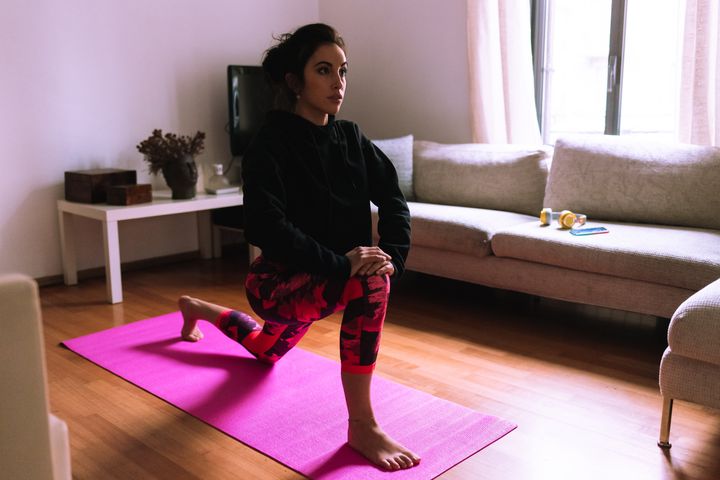
A hip flexor stretch can alleviate tightness in multiple parts of your body.
“Hip flexors are such an important muscle,” Marko said. “Tight hamstrings can tug on your lumbar spine, and this can cause pain.”
Dropping down into a half kneeling position, do a slight pelvic tilt, lunging yourself forward to stretch your hip flexors. Hold for 15 seconds, repeating for three to four rounds.
Advertisement
If you feel too tight to try this, start by lying on the floor first, knees bent and feet flat. Keep your knees together and rock your legs side to side. Next, let your knees fall all the way down to one side to get a more intense stretch on your lower back. Switch sides, holding for 15 seconds each time, and then try the hip flexor stretch again.
6. Lateral breathing
If you just can’t get yourself out of bed to stretch and move before you need to be productive, don’t sweat it. NikkiChrysostomou, a licensed movement therapist and founder of Movement Integration, said you can practice this stimulating stretch anywhere ― in the car, at your desk or even on your bed.
All you need to do is inhale and exhale deeply and focus your mind on getting the breath into your sides. If it’s helpful, you can place your hands on your ribcage to help you monitor where your breath is going.
“Lateral breathing helps to stimulate the mind,” Chrysostomou said. “To do this, work on taking breath away from the stomach. Think of breathing into the back of your ribcage, into the sides of the ribs and into your armpits. This creates a bucket-handle effect, with the ribs expanding out, and can perk you up.”
First Thing is a weekly series on HuffPost UK Life giving you tips and advice on how to enjoy your mornings. Whether you’re an early bird or night owl, starting your day off right will make for a happier and healthier day. We’ll be sharing exercise advice, nutrition guidance, as well as ideas on forming new habits. (And no, the answer to a productive morning isn’t just setting an alarm for 5am!)
Ministers have tightened up the law to raise standards for Covid tests sold privately in England – but have exempted Chinese-made tests which have cost the taxpayer billions, HuffPost UK can reveal.
New regulations from the department of health and social care (DHSC) aim to stamp out “poor quality tests” that could give the public a false sense of security and allow people to spread the virus unwittingly.
But the higher performance standards, quietly introduced this week, include a loophole that explicitly excludes lateral flow tests previously bought by the government such as those bought from Innova Medical Group at a cost of more than £3bn.
British manufacturers privately welcome the new regime as they believe their home-grown tests are cheaper and more reliable than the Innova tests.
But many in the UK bio industry question why ministers are exempting the Chinese-made devices from the same high standards.
The rules, which will kick in from September 1, have also prompted fresh suspicions that the government is moving away from giving the public and businesses free rapid tests and will instead expect them to pay for the devices commercially.
Firms will have to pay the government £14,000 for any application and any tests not deemed up to the grade will be removed from sale by law.
Retailers, distributors and manufacturers of tests that attempt to sell unvalidated tests would face sanction.
Currently, PCR or lateral flow tests can go on commercial sale in England as long as they carry a CE mark, which means they meet EU and UK requirements, but each manufacturer designs their own data collection and analysis methods to validate them.
Under the new proposals, the government will require that “all COVID-19 tests placed on the UK market undergo a mandatory validation process”, with the same standards applied equally to allow consumers to make a fair comparison.
A new DHSC document states: “It would undermine current public health goals if people used poor quality tests that give them a false sense of security.
“In the case of a false negative, this could see an infected individual unknowingly spread the virus. Conversely false positives could require business to close and people to isolate unnecessarily.”
But an explanatory memorandum to the new legislation states that “tests supplied by government will be exempt” from the new validation process.
The memo adds that contracts agreed by the government to supply NHS hospitals “can continue to be honoured by the manufacturer even if the test has failed validation”.
This has prompted anger among UK bioscience insiders, who believe that the Innova tests would compare badly with British-made rivals and who complain that ministers have done everything to favour the Chinese-manufactured products since last year.
Innova, which is based in California and funded by a private capital group by a Chinese-born businessman, uses tests produced by Chinese Biotime Biotechnology, in Xiamen city, Fujian province.
Publicly available contracts on the government’s website shows that £3.3bn has been spent to date on the company, as part of the £37bn allocated to the controversial Test and Trace service.
Innova’s 30-minute tests have been used for regular weekly testing of NHS and care home staff and in schools. Since April, any member of the public has also been able to order twice-a-week tests for free.
Yet concerns about cost and reliability have been raised repeatedly by critics, underscored when the US Food and Drug Administration (FDA) issued an alert about the test in June.
The FDA told Americans to “destroy the tests by placing them in the trash”, saying it had “significant concerns that the performance of the test has not been adequately established, presenting a risk to health”.
The UK’s Medicines and Healthcare products Regulatory Agency (MHRA) – which critics claim is an arm of the DHSC and not fully independent – then did its own risk assessment and found no similar action was needed here.
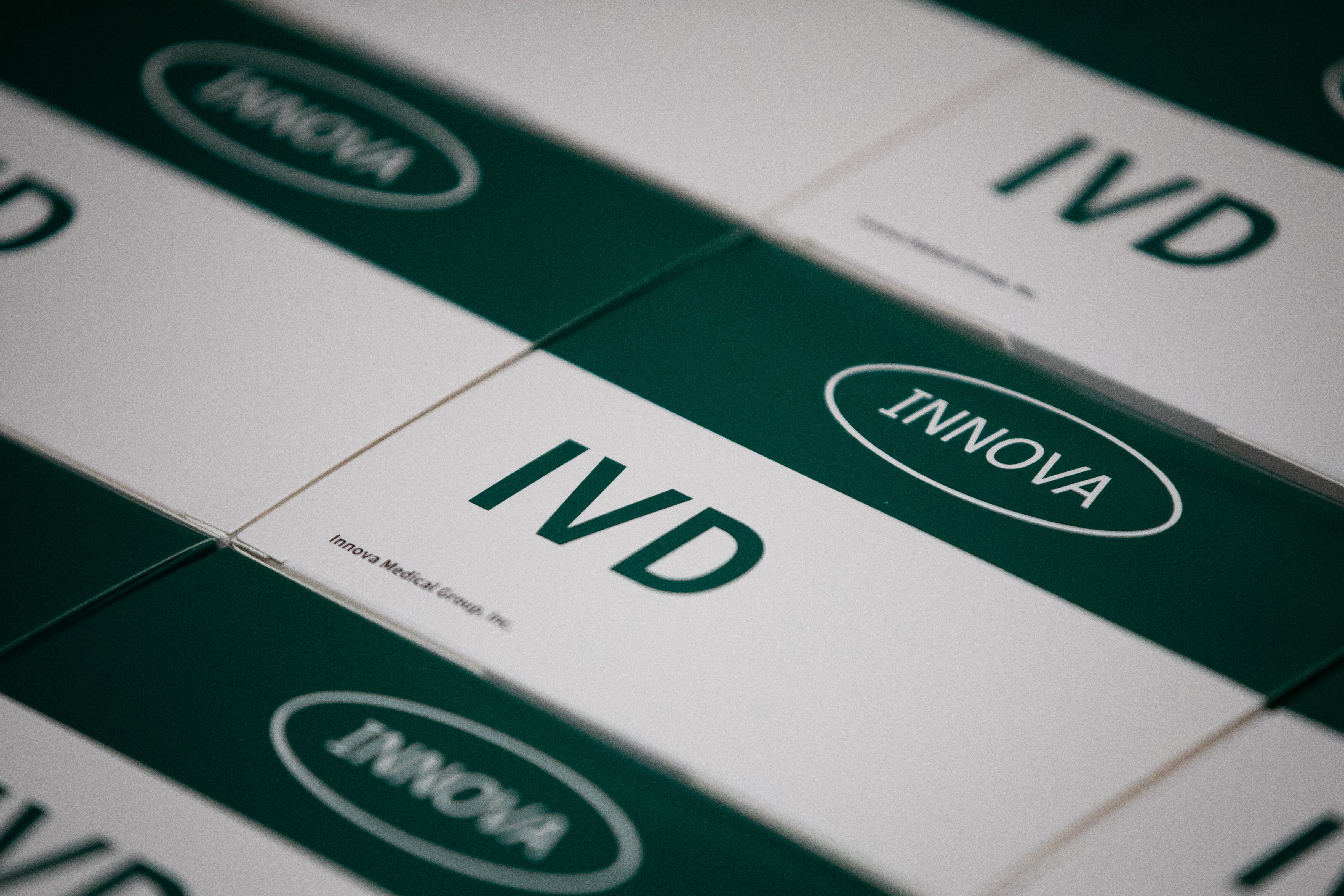
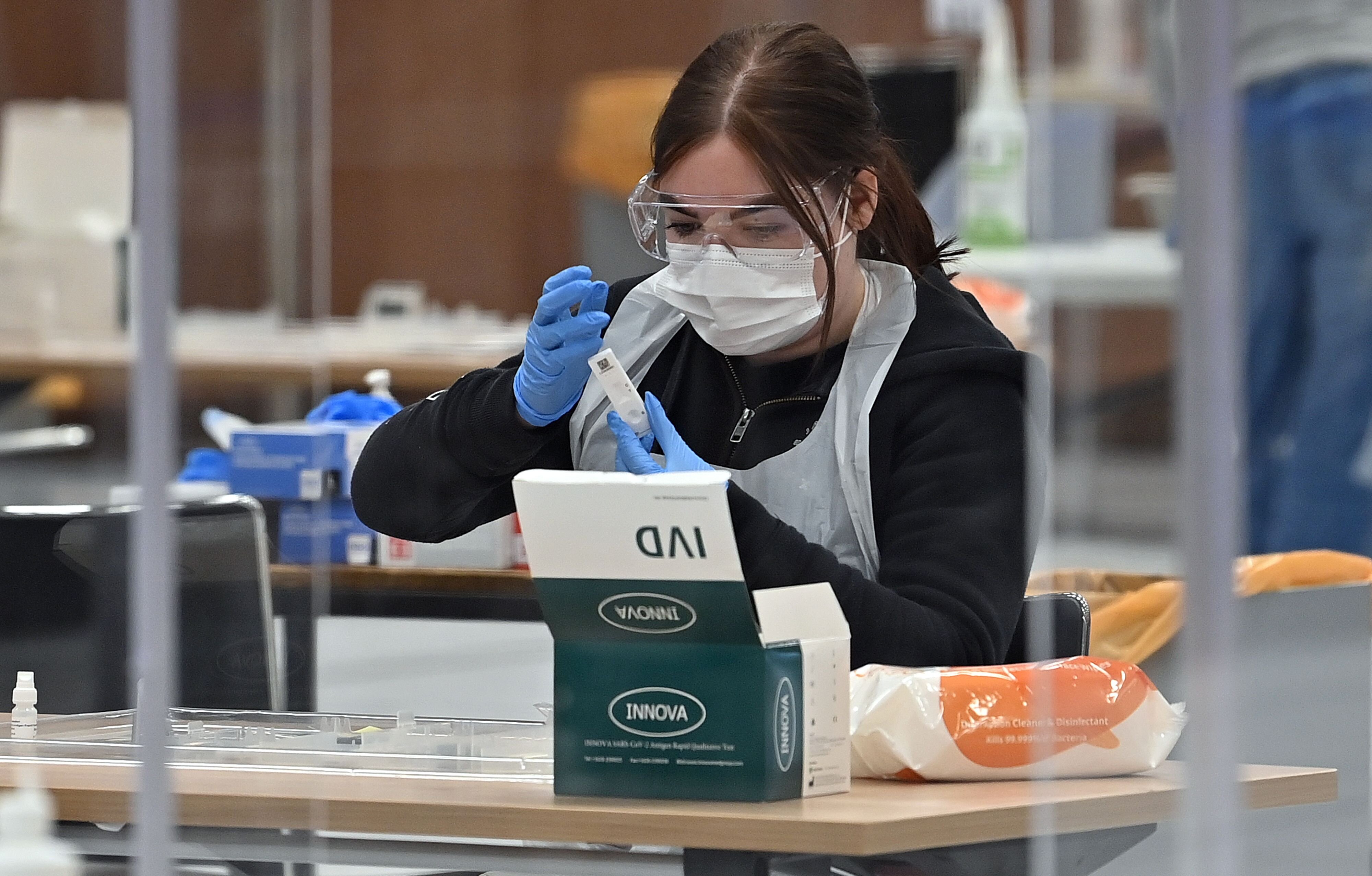
Aaron Chown – PA Images via Getty ImagesInnova Covid-19 testing kit
Critics further point out that Innova’s own manufacturer’s instructions make clear the tests were designed for use only in symptomatic Covid cases, but the UK government allowed them to be used in asymptomatic cases as part of its “Operation Moonshot” plan to mass test the population.
Authorisation for the Innova test to be used by asymptomatic people at home was due to expire on June 22 but has been extended until August 28, but the new regulations have sparked hope that they can gradually be replaced by British alternatives.
But controversy dogs the Innova tests and the way the UK government has effectively taken ownership of its products. Innova branding has been dropped from the boxes used to deliver tests, replacing it with NHS branding. Eyebrows were further raised when the DHSC decided to tweak the way in which the Innova test could be used.
Although the manufacturer’s “instructions for use” insist on the invasive and uncomfortable practice of taking a swab from the back of the throat, the government has quietly changed the rules to allow it to take swabs from the nose only.
Similarly, the original instructions for use made clear the tests were never intended for home use and were designed to be administered by a clinical professional.
The exemption for Innova from the new validation rules is seen by some British manufacturers as a way of avoiding the potential huge embarrassment of seeing their tests fail to match the standards of others, not least given large sums spent on them to date.
The legislation mandates a “desktop review” be undertaken of all Covid tests placed on the UK market and defines a set of minimum standards that these tests should meet.
One industry insider said the guidance document states that tests should achieve a minimum sensitivity rating of 95%, whereas the Innova test sensitivity rating achieved at Public Health England’s Porton Down lab was 57.5%.
One industry source said: “This means that the tests already selected won’t need to go through this exercise. It’s a disgrace. One rule for them…”
Another bioscience source said: “The UK industry was not totally confident with the way tests were evaluated for the NHS in the first place.”
Yet another said: “By appointing themselves ‘judge and jury’ of the Innova test, the DHSC has allowed itself to make fundamental changes to the Innova test’s characteristics, implementing them without any follow up Porton Down assessment.
“[These are] changes that would inevitably have had a significant detrimental impact on the test’s already underwhelming performance. Notably, to date, the government have not seen fit to publicly assess the impact of these wholesale changes.”
Shadow health minister Justin Madders told HuffPost UK: ”Given the concerns in the USA over the Innova tests and the fact they are only on a temporary approval here it does seem extraordinary that this legislation could allow Sajid Javid to let them carry on being used without being subject to the same approval processes as everyone else. Far more transparency is needed.
“This also seems to suggest that the government intends to move away from having Covid tests being provided free of charge. This has massive implications for public health and could seriously undermine efforts to reduce transmission of the virus. The government needs to come clean on whether they intend to introduce a charging regime for Covid test.”
The DHSC and the department for education raised suspicions that the distribution of free lateral flow tests could cease at the end of September, when a “review” will take place of their twice-weekly use in schools and to the wider public.
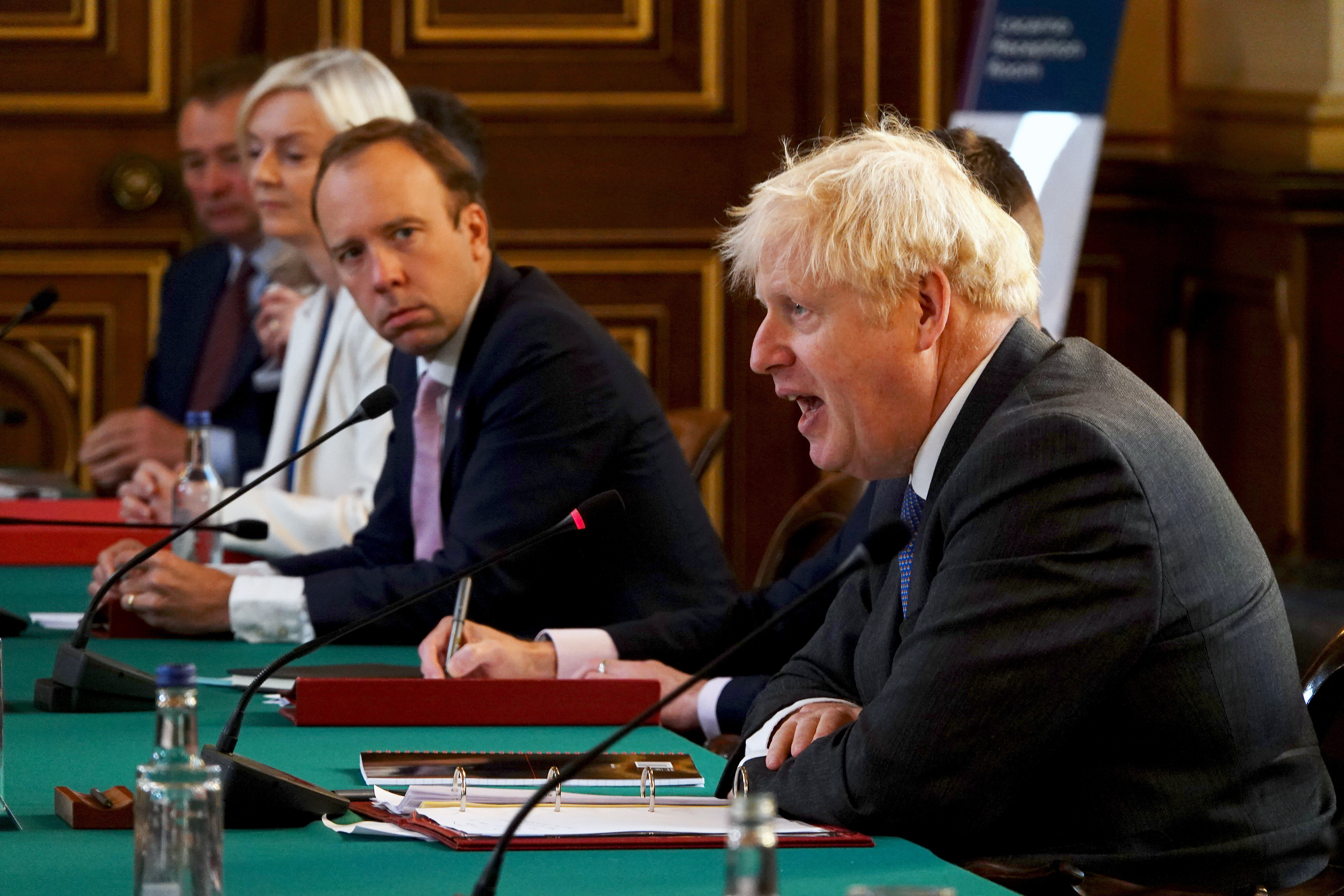
WPA Pool via Getty ImagesFormer health secretary Matt Hancock and Boris Johnson pushed ‘moonshot’ mass testing
Allyson Pollock, professor in public health at the University of Newcastle, said the bigger issue was that there was little evidence that testing of asymptomatic people – at home or in the workplace – was effective at all.
“This is about creating a market in tests which have questionable performance but above all, it’s still unknown despite the billions spent whether tests as part of a screening intervention actually help to prevent transmission,” she said.
“This isn’t a public health strategy, this is a commercial strategy. They want the public to get hooked on tests and employers to believe that testing is the way out. This is increasingly ridiculous given that the prevalence is low and falling now that immunity is being established.
“Secondary attack rates are low in the immunised population and infection likely to be mild and risks of transmission commensurately lower. Mass testing with lateral flow tests is an enormous waste of resources and it’s the antithesis of good public health.”
One key criticism of lateral flow tests is that their negative readings are being used as a “green light” to allow people to go about their daily lives, when in fact they were only ever designed as a “red light” test – when a positive reading tells people when they may have Covid and to get a gold-standard PCR test to check.
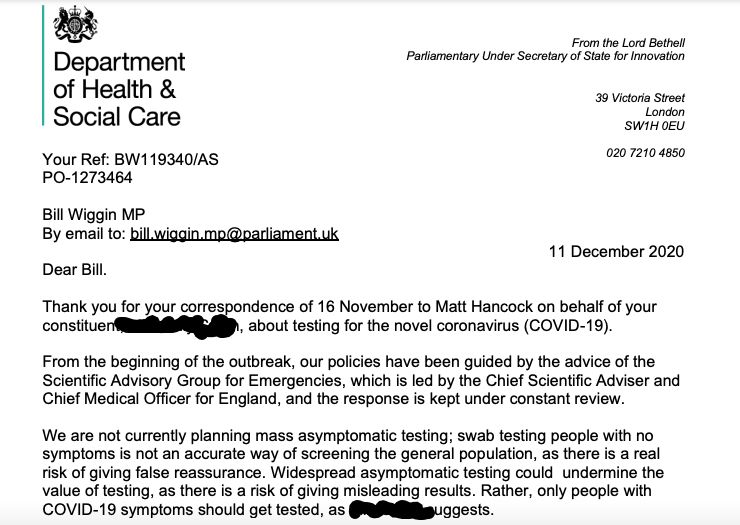
HuffPost UK has seen a letter from health minister Lord Bethell, sent last December to Tory backbencher Bill Wiggin, in which he makes clear the real risks to public health from asymptomatic mass screening.
In the letter, Bethell said: “We are not currently planning mass asymptomatic testing; swab testing people with no symptoms is not an accurate way of screening the general population, as there is a real risk of giving false reassurance.
“Widespread asymptomatic testing could undermine the value of testing, as there is a risk of giving misleading results. Rather, only people with COVID-19 symptoms should get tested.”
HuffPost UKLord Bethell letter on asymptomatic testing risks
Alba MP Neale Hanvey, who has raised the issue of Innova’s big government contracts and the failure to use rival tests made by Scottish-based firms such as Omega Diagnostics, said the letter was telling.
“This letter supports everything that I have said to [former health secretary] Matt Hancock and to other members of the department of health, that this is a grand folly. It’s giving people false reassurance and a huge cost to the public purse for no perceivable benefit.”
Hanvey added that the new mandatory guidance for commercial tests was “a fig-leaf for the government’s misdeeds”.
“What the government needs to do now is to cease supporting tests that we know are not designed for their current use, not picking up enough infectious cases and move swiftly to open the doors for the domestic market, to get access not just to private purchase, but to NHS supplied tests. Where is the global Britain and all of this mess?”
Boris Johnson has repeatedly declared that he wants home-grown rapid tests to be developed, but the UK bioscience industry has been increasingly frustrated that their tests were not approved by Porton Down labs despite other independent validation.
The UK government raised hopes earlier this year when it loaned manufacturing equipment to British companies and earmarked £1.15bn for a programme that would see rapid production. But virtually none of the money has been spent because British tests have not been approved.
One firm, Mologic, was so frustrated with the lack of validation of its tests that it threatened to sue the government. It has since been bought by the Bill & Melinda Gates Foundation and turned into a not-for-profit to help develop rapid tests to combat tropical diseases such as dengue, bilharzia, and river blindness, as well as Covid.
One UK bio industry source said: “They completely screwed the UK diagnostic industry. They invested in LFD [lateral flow device] machinery and are refusing to allow the factories to use them. Our firms are having to export world leading tests, two are in the top ten globally, while we import inferior ones.”
One bio industry source said: “I’m really unhappy that the government was signaling particularly to the UK manufacturers that we will provide you with a lot of support, and we’d like you to help us be self-sufficient in lateral flow tests by spring 2020.
“The companies all took them at their word. Then the government basically says well we didn’t actually promise we’d buy anything from you. That is a little two faced.”
A diagnostics expert said that the new commercial validation process was at least a signal that there would be a shift to getting the public to buy their own tests and that the cheaper price and better performance of British tests would mean that from the autumn “everyone will get a market share”.
“The lateral flow tests being provided to the population free of charge at the moment, at some point, people will either have to start buying themselves or employers will have to start buying them for their employees and there will be only be a certain amount that are provided free of charge.”
Dan Kitwood via Getty ImagesHealth secretary Sajid Javid now has sweeping powers over commercial tests
Industry insiders believe that firms like Mologic and Omega will submit their tests under the new system and expect to get approval. “This is all in readiness for when DHSC stop giving away free tests for a lot of use cases and reopens the private market,” one said.
Some insiders believe that the Innova test was adopted by the government early in the pandemic simply because it could be provided in mass numbers and that even though its performance is “not perfect” it was “good enough for what it does”.
Defenders of the Innova test believe it can be effective at detecting high viral loads quickly, claiming there is evidence to back this up.
The DHSC has in recent months pivoted to using another Chinese-made test produced by OrientGene, which some in Whitehall believe produces more reliable results than Innova.
Doris-Ann Williams, chief executive of the British In-Vitro Diagnostics Association (BIVDA) said one problem with the new mandatory system was that it would add needless regulation when existing systems could have been updated.
“While we appreciate the government is acting with the best of intentions by introducing this legislation, we still feel a better solution would have been to amend the existing regulation so that the MHRA, who are a world leading regulator for medicines and medical devices, could have ensured the right products are available to the British population.
“However, industry is committed to working under the legislation and alongside UKAS [UK Accreditation Service] to ensure COVID antigen tests are reliable and safe.”
The government insists that its own tests should be exempt from the new mandatory testing standards in an effort to avoid duplication of previous validations.
“This is because the market validation is based on the validation DHSC has been doing for public procurement of tests as such these two validation process are judged to be equal,” according to the explanatory memorandum accompanying the new regulations.
“As such DHSC will place tests onto to the market without undergoing the regulatory validation process conducted by DHSC to control access to the UK market.”
A spokesperson for the DHSC said: “Private testing continues to play an important role in managing COVID-19 by supplementing and supporting NHS Test & Trace as we learn to live with this virus.
““As we ease restrictions, including for travel, the role of private testing is increasing and our regulations are ensuring consumers can be confident tests they buy give accurate results and are of sufficient quality.”
They added that private testing will continue to play a role as part of the overarching strategy for managing COVID-19.
The department believes that it is important to introduce a regulatory regime to ensure those tests available on the market are validated for performance, regardless of whether the government is also providing free tests.
A spokesperson for Innova Medical Group said: “Our tests have proven by independent studies to be very effective in detecting individuals who are considered infectious regardless of symptoms.”
They said that the latest UK test had shown it “detects nearly 100% of infected asymptomatic individuals who are considered infectious to others, and there was very little difference in the specificity between self-testing (99.1%) and testing performed or observed by a professional (99.8%)”.
“We understand FDA’s health risk concern for the US market as they have not evaluated or authorised the Innova test in the US.
“In simple terms, the regulator won’t confirm a product is safe to use until it has evaluated and authorized a product itself. None of the FDA inspectional observations concern the performance of the test.”
The company said that its test had been widely used, studied, tested, scrutinised and analysed. Its point of care test had been approved in Germany, France, Netherlands, Finland, Sweden, UK, Austria, Estonia, Finland, Israel, Malaysia, and Sultanate of Oman. Its self-test kit had been approved in Austria and the UK.
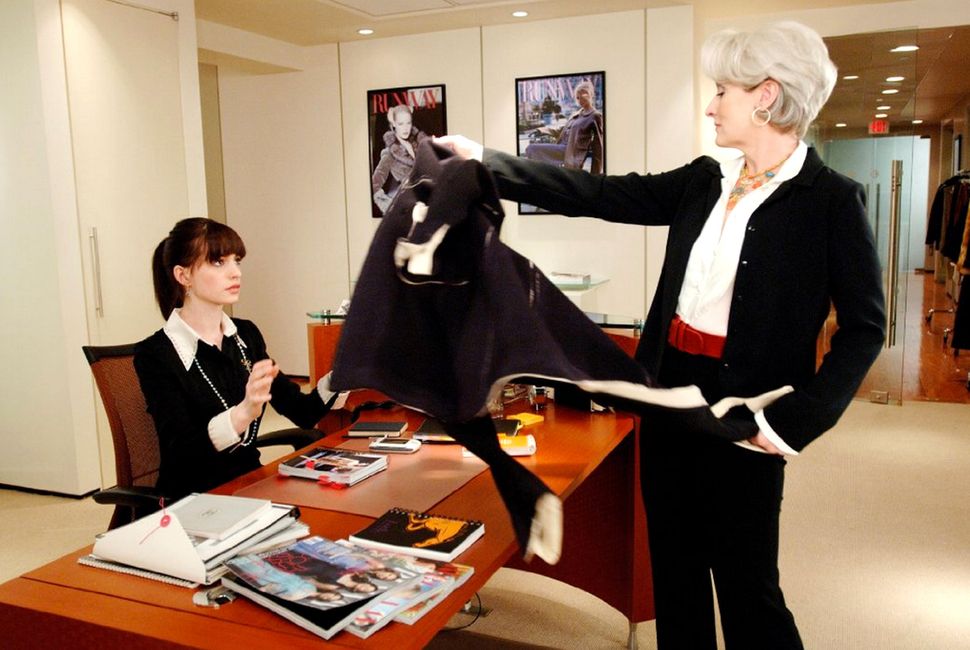
Celebrating its 15th anniversary, The Devil Wears Prada remains a cultural phenomenon that has shaped the way we view the fashion industry. Meryl Streep’s renowned portrayal of Miranda Priestly, the steely editor-in-chief of Runway magazine, is one the world won’t soon forget.
Priestly’s effortless delivery of her infamous catchphrase, “that’s all,” held a gravity that clearly depicted fashion as a high-stress, high-stakes industry with no tolerance for any hint of incompetence.
Advertisement
The Devil Wears Prada is not the only media depiction of the fashion industry as a glamorous, impenetrable space where dreams are both dashed and realised. In 101 Dalmatians, Cruella De Vil is a designer whose love of fashion drives her to criminal extremes to obtain the coat of the season.
Ryan Murphy’s Halston miniseries on Netflix recently provided insight into the designer, who was prone to grand gestures of affection and verbal abuse of colleagues, providing another trope of the misunderstood genius who’ll dispose of anyone not aligned with his vision.
Advertisement
But how accurate are these film portrayals in reality? Four fashion industry professionals shared their perspectives on what it’s really like to work in fashion.
Alamy Stock Photo
Miranda Priestly was the queen of microaggressions, like throwing her coat on her assistant’s desk.
“I don’t feel like those interpretations reflect what hard work is and how you’re rewarded,” said Heather David, who has worked as in-house public relations for Balenciaga and Alexander Wang. “When I was young, my boss seemed like Miranda Priestly, criticising my work. I realised she pushed me because she saw more in me. Her pushing helped mebecome a better worker and leader.”
Advertisement
David described the environment at Balenciaga as “structured” and “traditional,” and said there’s a disconnect between media portrayals and the reality of fashion.
“Films show interns on a trip to Paris or using the fashion closet. I don’t think that’s realistic at all,” David said.
The fashion closet scene in The Devil Wears Prada set in motion millions of dreams that an intern could simply take a Fendi poncho and turn it into a personal wardrobe transformation. But that’s not real life. “I think people come into fashion naive and they only see these stories,” David said.
Cymone Williamson, a former publicist who worked for the brands DE Marketing and All the Rage, shared a similar sentiment. “People aren’t getting makeovers,” she told HuffPost. “I never came across anyone who had no experience and was moulded into a fashion prodigy.”
Williamson said The Devil Wears Prada thickened her skin, though. “I was prepared to be treated poorly. My experience was a mild version of what you see in movies. I was surprised I wasn’t fired when someone was having a bad day or I made a mistake.”
The Halston miniseries features tantrums and tongue-lashings galore ― there is a scene in which Halston’s career is on the decline and he storms into his atelier screaming at a designer for submitting a sketch without his approval.
Williamson said temper tantrums are not unheard of in reality. She recalled an instance with an employer in a PR showroom: “I had a male boss who was upset about losing an account. My desk was the first desk [near him], and he walked in and pushed everything off my desk. Everyone felt the wrath.”
Laurie Sparham/Disney
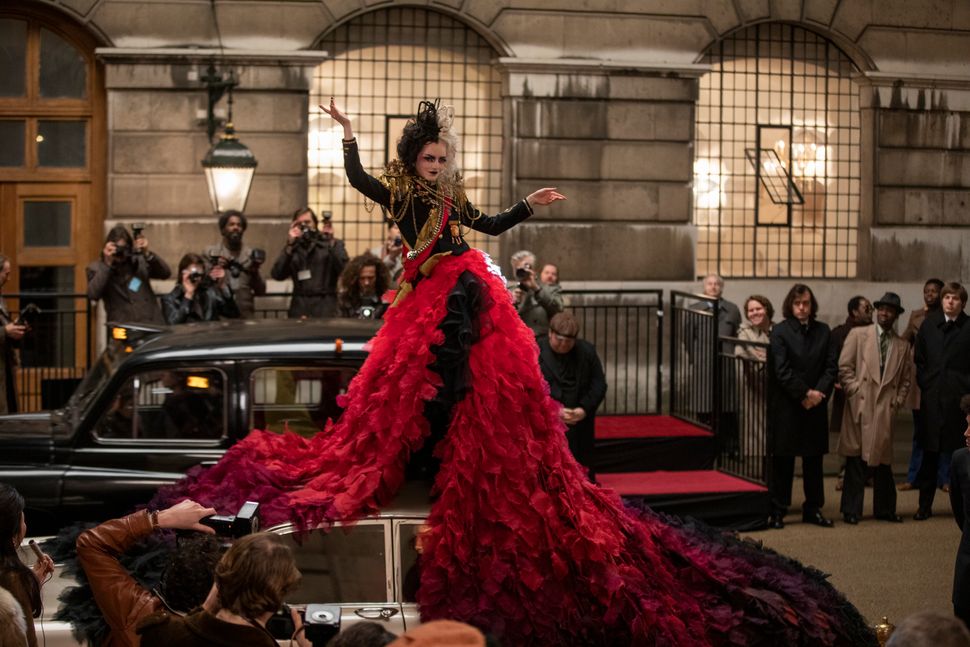
Emma Stone in Disney’s live-action “Cruella.”
The 2021 film Cruella touches on power dynamics between management and employees – Emma Stone’s titular character finds herself in a tense environment early on in her career, where she works with a designer who rules with an iron fist.
Recent headlines show that mistreatment of staff, by both designers and organisations, is still an issue in the fashion industry. Brands such as Refinery 29 and Manrepeller, for example, have been called out over the past few years.
Advertisement
513 designer Jerome Lamaar, also known asThe Style Monk, is familiar with industry antics. Starting with Baby Phat (run by Kimora Lee Simmons) at age 15, Lamaar said his trajectory has been similar to what he’s seen on film.
“Most of it is on point. I feel my life is very Funny Face he said. In that 1957 film, Jo Stockton, played by Audrey Hepburn, is a young librarian who’s plucked from obscurity and becomes a model at the pinnacle of fashion. While this is purely movie magic, Lamaar’s 20-year career is a one-in-a-million that’s not the norm.
He recalled an instance when “a PR person who was very well known didn’t recognise me and I was visiting a friend’s show. She kicked me out from backstage, and these are the old guards that the movies depict.” He added: “It’s because they are stressed out and it happens during Fashion Week.”
Julian J. Callis, who has worked at the Nicki Minaj Collection and Ralph Lauren, explained that while many films depict young women being groomed to become the future of fashion, they mostly focus on the character getting a glamorous life makeover, and ignore the actual hard work that goes into a career in fashion. “These films don’t show the gray area of starting from the bottom and working to the top,” he explained.
So, before you submit that application to become the next intern at your favourite fashion magazine, remember that it’s not all twirling around in fashion closets and trips to Paris.
In 1994, one of Rwanda’s darkest moments in history took place – a genocide that saw the death of 1,100,000 people – of which 800,000 people were Tutsi, an ethnic group that were minorities in comparison to the majority Hutus.
At the time, Alice Musabende was 13-years-old. Her parent, grandparents, and siblings all died during the war. The now mum-of-two had only a few surviving members of her family; her aunt, uncle, and their kids. In 2005, as part of her studies, Musabende left Rwanda for Canada, building a life for herself; she married (but has since separated), and had two precious boys.
Advertisement
She began working as a journalist and academic, later moving to the UK to work at the University of Cambridge. But despite her writing and hours of research into what happened, Musabende found it almost impossible to articulate the reality of the violence which was unleashed on her people.
“I have spent so many hours, countless of times, writing and reading and trying really to capture the magnitude of the horror. And I still haven’t,” she tells HuffPost UK.
Advertisement
Now, her two children, aged five and eight, have questions about their grandparents, their home in Rwanda, and how their mother feels about it all.
So, in an attempt not to “run away from her demons”, Musabende had to find a way to voice the unspeakable horror she endured at such a young age. Which is how she began making a radio show with the BBC to start the story.
Advertisement
In Unspeakable, Musabende asks for help and guidance from other genocide survivors, second-generation holocaust survivors, a therapist who works with AIDS orphans in South Africa, and a publisher of stories in Rwanda.
She explores identity, generational trauma, and the place of storytelling and with the help of these other voices, she tries to piece together the answer to one fundamental question: how do I tell my kids about my trauma?
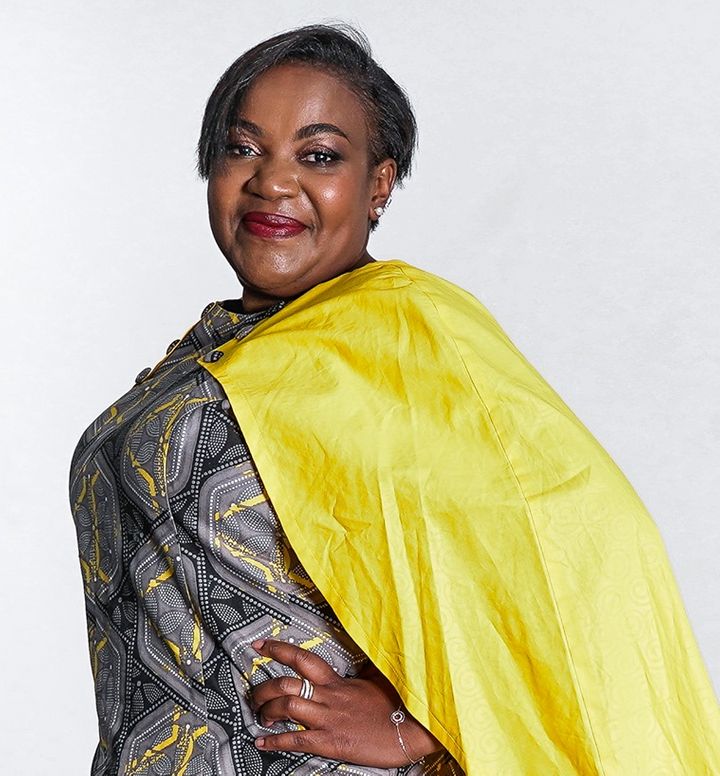
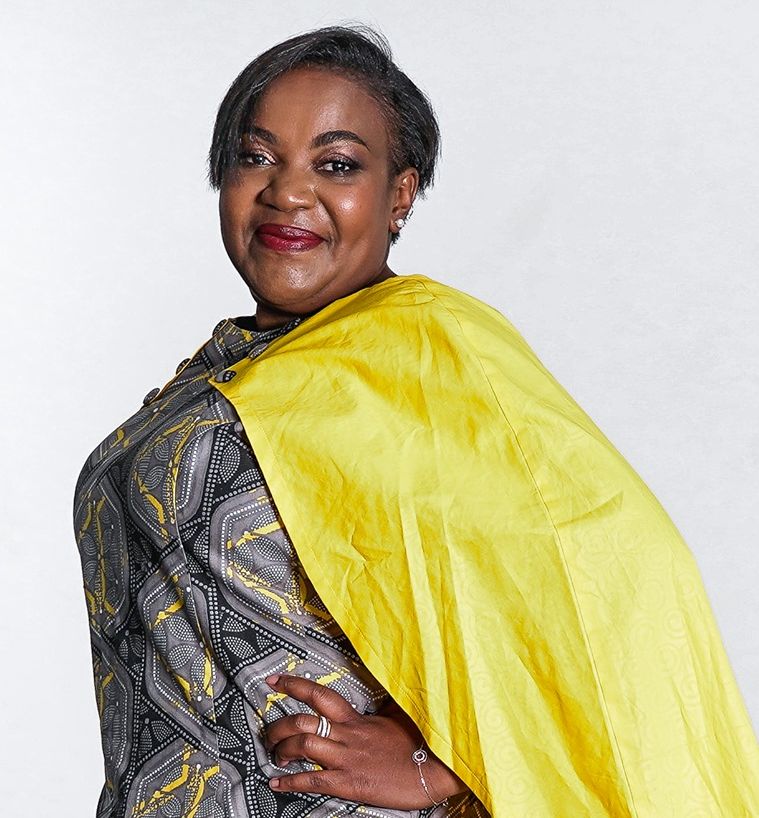
Alice Musabende
Mum-of-two Alice Musabende is figuring out the words to explain what happened in Rwanda 27 years ago
Firstly, says Musabende, she has had to come to terms with her own past.
“For the last 20 years, I’ve focused so much on me,” she explains. “I’ve done therapy, I tried to figure out how to live with PTSD, to understand how I will actually live a life without family, without anyone. I thought I was really getting a good handle on it. Then I moved here and in the middle of trying to reconfigure being a single parent and my work, I remember just one day thinking, ‘Oh no, I’m going to have to tell the boys about the genocide.’
Advertisement
“That bit was way more complicated than anything else I have done, mainly because the story of the genocide, for me, is extremely painful, but I think it’s painful for all the other survivors as well. Because I’ve spent so many years trying to run away from it, it was so hard.”
Growing up, Musabende was aware of the ethnic persecution of her Tutsi people – her family members had been arrested on suspicion of being part of rebel forces, and her granddad’s land had been seized.
After travelling to Ottawa for her graduate studies, Musabende recognised signs of PTSD in herself. She explains: “In school I couldn’t really function. I had a really difficult transition, I did so many things that we now associate with post traumatic stress disorder but at the time no one told me what it was.
“It wasn’t until I started different forms of therapy to make sense of what I was going through. Through those sessions, I wanted to find the essence of who I was, I wanted to be okay. I wanted to have joy, and I wanted to be able to use my brain to serve, to study and perhaps maybe even teach.”
In 2017, Musabende went back to Rwanda for the first time. Two years later, she took her two sons to show them where their family came from – so they could understand the great beauty, as much as the trauma, of her birthplace.
“I remember arriving in Rwanda and looking at these tiny humans and thinking, ‘This is their home, but I don’t know if they know that this is their home as well.’ That’s when things just started percolating in my head, I was like: ‘How do I do this, what do I say?’ She took her eldest boy, six at the time, to where her house used to be – now just a plot of land since it was destroyed in the genocide.
“I told him that’s where my home used to be and that’s where my brother and sister used to live. We were walking on this plot, he looked down, saw a piece of cloth, picked it up and said, ‘Do you think this was your sister’s dress?’ And I hadn’t seen that one coming. It was a bit of a struggle but I couldn’t cry.
“My words just left me. That’s when I realised he has questions. He has real questions where he’s trying to figure out where he fits into a story that’s so obscure and mysterious to him.”
Alice Musabende
Alice has since taken her children to Rwanda to show them the country
And Musabende had questions of her own, which is how the documentary came about. “I couldn’t write about it,” she says. “I don’t know how to write about it, so I thought to just ask people what they think.”
She was terrified. “I thought, ‘Oh, am I traumatising my children by telling them these horrible things?’ Previously I’d thought it’s best not to say anything as you don’t upset them. But I know that they want to know. They’re not asking tough questions. Their questions are like ‘Do you miss your mum?’ or ’Do you think your mum would have loved me?’Those things are so difficult because they send you right back to that place where you wish you didn’t have to go.
Advertisement
Unspeakable is Musabende’s attempt to bridge the gap between that place she has avoided for the past 27 years “and the place I am in now, as a parent hoping to raise healthy, well-grounded, empathetic children.”
Alice Musabende
Alice’s radio show Unspeakable comes out today
It’s not just genocide she has to talk to her children about. By virtue of being a mother to two young Black boys, Musabende knows that she will become accustomed to difficult conversations.
“Raising Black boys in a western culture that’s always telling them so many things about them that are false, it’s an even bigger responsibility to tell them about where they come from, what happened to them and tell them exactly who they are, so that when they get out there, they know in their hearts that they’re valued, that they are loved, that they are cared for.
“It is my job to tell my kids who they are. I haven’t quite figured out how to tell them the full story of my history so you’ll see in the documentary, I’m still learning, it’s a long journey.”
Unspeakable airs on BBC Radio 4 on Fridays and is available on BBC Sounds.
Approaching conversations about trauma
Alice Musabende wants to share the following advice for fellow parents.
First of all, accept you don’t know how to say it all
“That realisation that I don’t know how to talk to my children was the beginning of my quest because for a very long time, I just pretended that it wasn’t there. Once I sat down and I thought, ‘I know I have to, and I don’t know how,’ that was the beginning.”
Find a safe space to make sense of the trauma yourself
Advertisement
“I wouldn’t have been able to have this conversation five years ago. I had to do so much of my own work in self-healing, therapy, in figuring out how to listen. It took me so much time to get here.”
Seek guidance, talk to others who might understand
“You’ll be surprised about how many people are struggling to address these serious issues with their children. There are parents everywhere trying to figure out how to say things.”
Know that the conversation is hard but important
“You can’t just focus on the fact that you are transmitting trauma. You also have to know that by processing things, by seeking to figure out what the appropriate language is, you’re also ensuring that your kids will be more resilient, because you are being more resilient.”
Celebrate yourself for all that you’ve overcome
“We often forget to celebrate our resilience but ultimately, we should really look at ourselves and think, ‘We are here. We made it. We have children and they seem somewhat okay.’ That’s a win for me.”
Useful websites and helplines
Mind, open Monday to Friday, 9am-6pm on 0300 123 3393.
Samaritans offers a listening service which is open 24 hours a day, on 116 123 (UK and ROI – this number is FREE to call and will not appear on your phone bill).
Advertisement
CALM (the Campaign Against Living Miserably) offer a helpline open 5pm-midnight, 365 days a year, on 0800 58 58 58, and a webchat service.
The Mix is a free support service for people under 25. Call 0808 808 4994 or email help@themix.org.uk
Rethink Mental Illness offers practical help through its advice line which can be reached on 0808 801 0525 (Monday to Friday 10am-4pm). More info can be found on rethink.org.
The prime minister and his wife are expecting a second child after Carrie Johnson revealed the heartbreak of a miscarriage at the start of the year.
In a statement on social media, Ms Johnson said the brother or sister to their first child Wilfred was due to arrive “this Christmas”.
The 33-year-old environmental campaigner added: “At the beginning of the year, I had a miscarriage which left me heartbroken.
“I feel incredibly blessed to be pregnant again but I’ve also felt like a bag of nerves.”
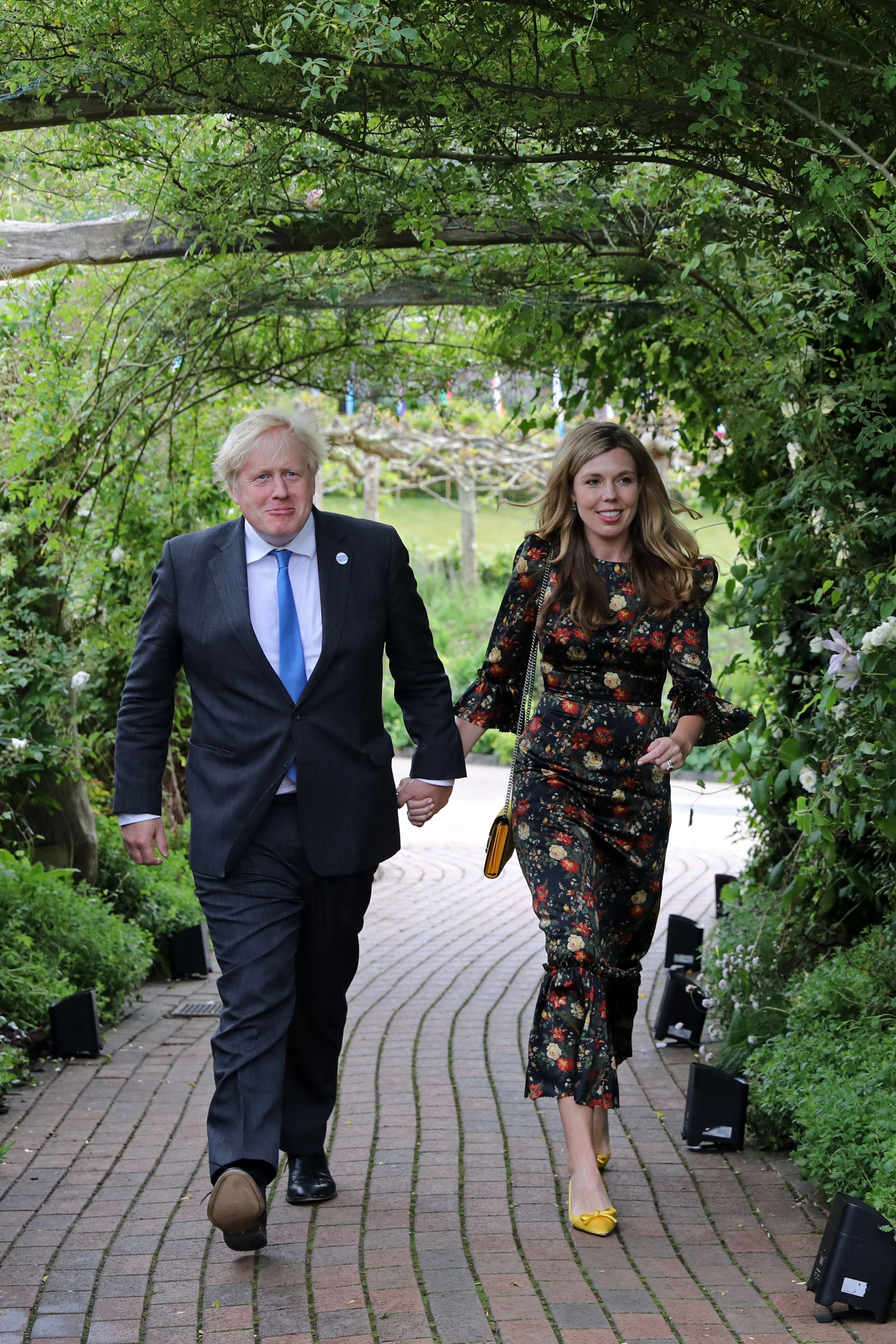
JACK HILL via Getty ImagesPrime Minister Boris Johnson and Carrie Johnson
The couple made the announcement only two months after they tied the knot during a low-key wedding at Westminster Cathedral.
Ms Johnson, a former Conservative Party communications director, said she wanted to share the personal news about her miscarriage to “help others”.
She added: “Fertility issues can be really hard for many people, particularly when on platforms like Instagram it can look like everything is only ever going well.
“I found it a real comfort to hear from people who had also experienced loss so I hope that in some very small way sharing this might help others too.”
Labour leader Sir Keir Starmer put politics aside to send congratulations to the couple and said he was “very sorry” to hear about the earlier miscarriage.
“I’m sure that Carrie speaking out will be of comfort to others and make them feel less alone,” the Opposition leader added.
Downing Street said the Prime Minister had been due to work this weekend from his official country residence Chequers in Buckinghamshire, although it is not known if the couple are there together.
Handout via Getty ImagesThe pair married earlier this year
The new arrival is set to be Mr Johnson’s seventh child at least, having had four children with second wife Marina Wheeler, who he divorced last year following their separation in September 2018.
In 2013 it emerged during another court hearing that Mr Johnson fathered a daughter during an adulterous liaison while Mayor of London in 2009.
The 57-year-old’s son Wilfred Lawrie Nicholas Johnson – named partly after a doctor who helped save the Tory leader’s life when he contracted coronavirus in spring 2020 – was born in April of the same year.
Mr Johnson has looked to brush off questions about whether he has any more children.
The former journalist met his first wife, Allegra Mostyn-Owen, while they were students at Oxford. They married in 1987 but the marriage was annulled in 1993.
In 2004, he was sacked from the Tory frontbench over a reported affair with journalist Petronella Wyatt.
The divorce from lawyer Ms Wheeler, who he married in 1993, and subsequent marriage to his now third wife is understood to make Mr Johnson the first prime minister to get divorced and marry in office in modern times.
Mr Johnson and his then girlfriend also made history as the first unmarried couple to officially live together in Downing Street when they moved into the flat in Number 11 in 2019.
Formerly known by her maiden name of Symonds, the PR expert first found herself making headlines when she was romantically linked to Mr Johnson in early 2019.
But her association with Mr Johnson dates back to when she worked on his successful re-election bid at City Hall in 2012.
After her husband’s arrival in Downing Street, she was involved in a power struggle with the former de facto chief of staff in No 10, Dominic Cummings, which led to his ousting in the autumn.
Mr Cummings has accused Ms Symonds of looking to interfere in the running of the Government and recommending to her husband who to hire and fire, allegations that Downing Street deny.
The Crown has offered fans their first look at Imelda Staunton as the Queen in the upcoming fifth series.
The actor is taking over the royal role from Olivia Colman in the hit Netflix drama, which is set to return in 2022.
The Crown’s official Twitter account shared the image on Friday afternoon, writing: “An early glimpse of our new Queen Elizabeth II, Imelda Staunton.”
Imelda is leading a brand new cast for in the new series, which sees the action jump ahead in time.
Speaking about taking over the role in an interview in a Woman’s Hour earlier this year, Imelda explained: “I think my sort of extra challenge, as if I needed it, is that I’m now doing the Queen that we’re a little more familiar with.
“With Claire Foy, [her version of Queen Elizabeth II] was almost history and now I’m playing one that people could say ‘she doesn’t do that,’ ‘she’s not like that’. And that’s my personal bête noire for me to deal with.”
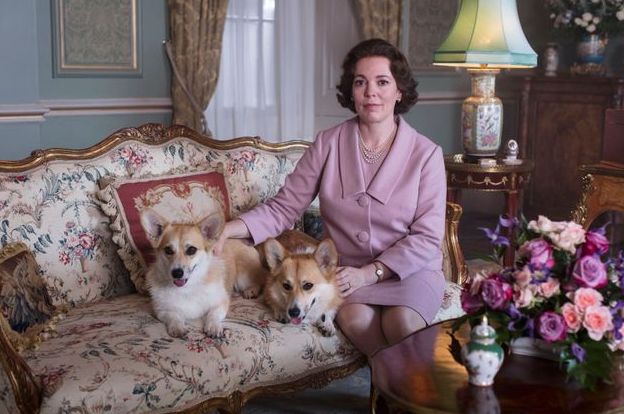
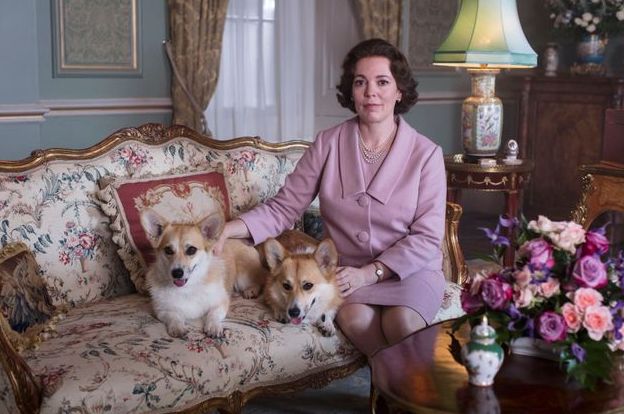
Sophie Mutevelian Olivia Colman as Queen Elizabeth II